




Let’s be honest, click-through rate (CTR) sounds like another piece of marketing jargon. But in reality, it’s one of the most straightforward and telling metrics you’ll ever use.
Put simply, it’s the percentage of people who see your ad or search result (an impression) and are actually interested enough to click on it. Think of it as a direct measure of how compelling your message is. A high CTR is a strong signal that your content is hitting the mark with your target audience.
What Is Click Through Rate and Why Does It Matter?
Imagine you own a shop on a busy high street. The total number of people who walk past your window display each day are your impressions. Now, the people who see that display, feel an instant pull to stop, and decide to walk right into your shop are your clicks.
Your click-through rate is just the percentage of those window shoppers who became actual visitors. Simple as that.
This metric gives you crucial, real-time feedback straight from your audience. A low CTR is a red flag, signalling a disconnect. It means your ad, headline, or listing isn’t grabbing attention or matching what people are looking for. On the flip side, a high CTR tells platforms like Google that you’re delivering relevant results, which they’ll often reward with better rankings and even lower advertising costs.
The Simple Formula Behind CTR
Working out your click-through rate is incredibly easy. All you need to do is take the total number of clicks your ad or link gets and divide it by the total number of times it was shown (impressions).
Formula: (Total Clicks ÷ Total Impressions) x 100 = Click-Through Rate (%)
For instance, if your Google Ad was shown 1,000 times and received 50 clicks, your CTR would be 5%. This basic calculation is the cornerstone for analysing the performance of almost any digital campaign you run.
Before we dive deeper, here’s a quick reference table to summarise what we’ve covered.
Quick Guide to Understanding CTR (What Is a Good Click Through Rate)
This table breaks down the core ideas behind CTR and why it should be on every marketer’s radar.
| Concept | Simple Explanation | Why It Matters to You |
|---|---|---|
| Impression | One person seeing your ad or link. | This is your total potential audience reach. |
| Click | Someone actively clicks on your ad or link. | This shows genuine interest and engagement. |
| CTR (%) | The percentage of impressions that result in a click. | It’s a key indicator of your ad’s relevance and appeal. |
| High CTR | Your message is resonating well with your audience. | Can lead to better ad positions and lower costs. |
| Low CTR | Your ad isn’t compelling or relevant enough. | Signals a need to test and improve your creative or targeting. |
Think of this table as your cheat sheet for CTR. It’s a simple but powerful metric that tells a big story about your campaign’s initial impact.
Why CTR Is a Vital Metric
Click-through rate is so much more than a vanity metric; it’s a core health indicator for your entire campaign. It’s a direct reflection of how well you’re connecting with potential customers at that very first touchpoint.
Here’s why you need to pay attention to it:
- Measures Audience Engagement: It’s the clearest sign you can get that your headline, ad copy, and visuals are working together to pique interest.
- Influences Ad Quality Score: On platforms like Google Ads, a higher CTR contributes to a better Quality Score. A good score can lead to a higher ad rank and, crucially, a lower cost-per-click (CPC).
- Indicates Targeting Accuracy: Is your CTR poor? It could be a sign you’re showing your ads to the wrong people. This metric helps you fine-tune exactly who you’re trying to reach.
- Provides Actionable Feedback: It lets you test what works and what doesn’t. By comparing the CTR of different headlines or images, you can continuously improve your approach and get better results.
Getting to grips with CTR is the first major step in optimising your digital presence. It’s also helpful to see how it fits into the broader picture of measuring social media success, where engagement is everything. For a deeper look, check out our guide on mastering key metrics, which explores how CTR works alongside other crucial figures.
What Is a Good Click Through Rate? Decoding UK Click Through Rate Benchmarks for Paid Search
When you ask, “What is a good click through rate?” for paid search in the UK, the only honest answer is: “it depends.” Chasing a single, universal number is a bit of a myth. A ‘good’ CTR for a local plumber in Bristol will look completely different from a national fashion retailer’s campaign.
Think of it like comparing the success of a niche independent bookshop to a massive supermarket. They serve different needs, face different competition, and attract customers with entirely different mindsets. The same logic applies to your Google Ads campaigns.
Your industry, the competitiveness of your keywords, and the user’s intent all combine to create a unique performance benchmark. Someone searching for “buy size 10 red running trainers” has high intent, so you’d expect a strong CTR. In contrast, a user searching for “running tips” is just browsing, making a lower CTR perfectly normal for that keyword.
Why Industry Averages Are Just a Starting Point
Looking at industry-wide data gives you a useful, but very general, sense of direction. It provides context, but it shouldn’t be the final word on your campaign’s success. Things like brand recognition, your ad budget, and even seasonality can cause massive swings within the same sector.
This chart shows just how much average click-through rates can vary across different industries.
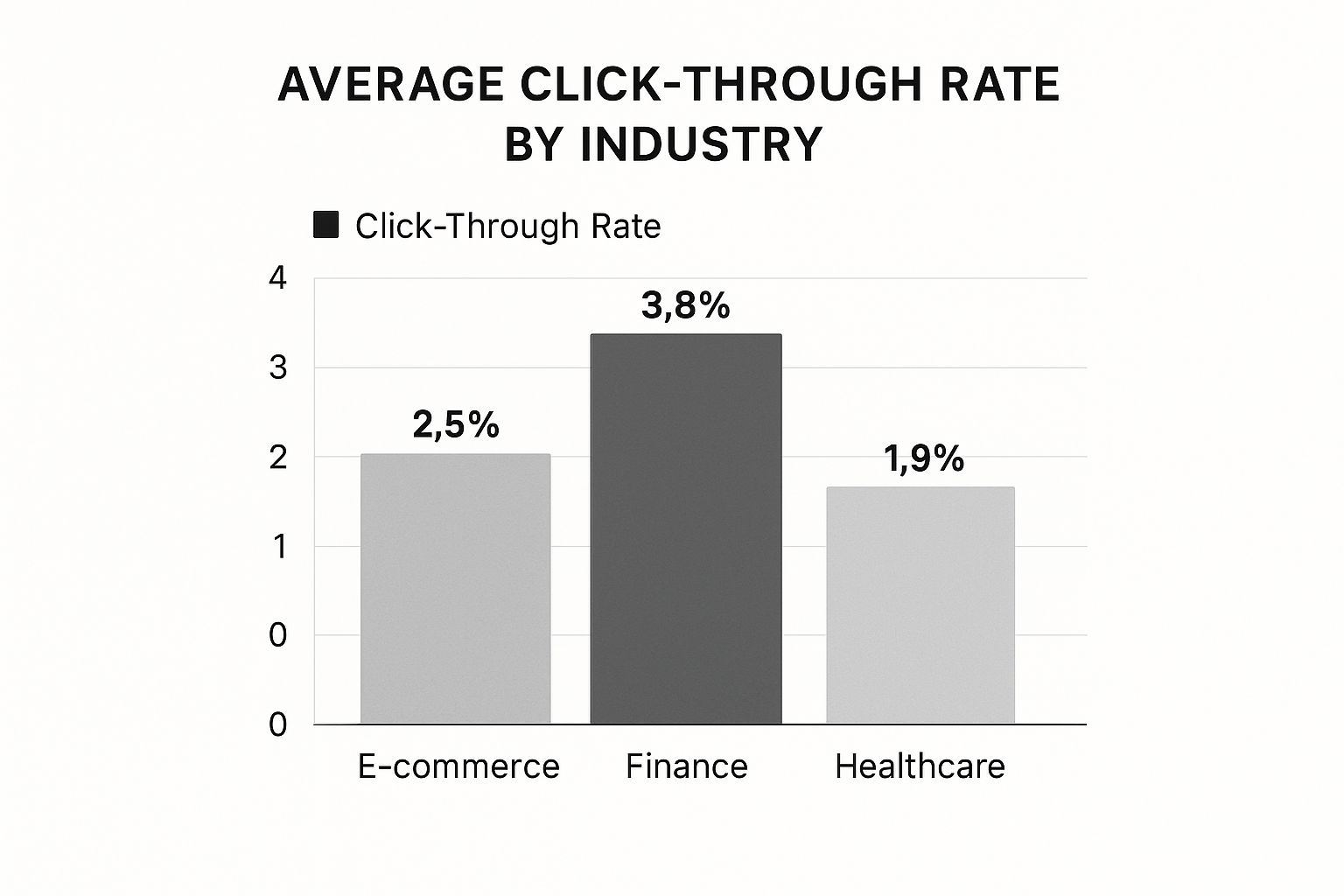
As the data shows, there is no single ‘good’ CTR. High-urgency or high-value sectors like Finance often see different engagement patterns compared to broader markets like E-commerce, where competition is fierce.
Honestly, setting your own internal benchmarks is far more effective. Aim for continuous improvement month-on-month rather than getting fixated on a generic figure.
A truly ‘good’ CTR is one that is consistently improving. If your rate is climbing, it means you’re successfully refining your ad copy, targeting, and offers to better match what your audience is looking for.
Setting Realistic Goals in the UK Market
The UK paid search market is a seriously competitive space. Paid search advertising here shows a huge diversity in click-through rates, all depending on the industry and the type of campaign you’re running. Research from thousands of UK campaigns shows that average CTRs vary significantly, reflecting different user intents and competition levels. While specific national averages aren’t widely publicised, typical click-through rates for well-performing UK sectors often range from 3-5%. Campaigns with higher CTRs are almost always linked to well-optimised strategies targeting keywords rich with intent.
This really highlights the importance of strategic campaign management. Understanding what influences these numbers is key to setting achievable goals and, crucially, knowing how much budget to allocate. To get a clearer picture of campaign costs, you can explore our guide on understanding how much PPC campaigns charge in 2025.
For those who want to get the absolute most out of their paid search performance, exploring dedicated PPC services can provide the expertise needed to navigate this competitive environment and drive meaningful results. The goal is to move beyond generic benchmarks and focus on what actually drives conversions for your specific business.
What Is a Good Click Through Rate: Navigating CTR Benchmarks for UK Social Media Ads
When you move from the world of paid search into social media advertising, you’re playing a completely different game. The rules for what makes a good click-through rate are thrown out the window. On platforms like Facebook, Instagram, and LinkedIn, you’re not capturing people who are already looking for you; you’re trying to create that demand from scratch. This is where visual appeal, a deep understanding of your audience, and creative flair really come into their own.
Think about it: search ads answer a direct question. Social media ads, on the other hand, have to interrupt someone’s scrolling. A good CTR here isn’t about matching a keyword; it’s about being compelling enough to make someone stop, look, and click. It’s an experience built on discovery and visual stimulation, so you have to judge your benchmarks through that lens.
Platform-Specific CTR Expectations (What Is a Good Click Through Rate)
You simply can’t compare apples and oranges here. A great CTR for a B2B campaign targeting finance directors on LinkedIn will look nothing like the CTR for a new clothing line on Instagram. Every platform has its own unique user mindset and behaviour, and that directly shapes engagement.
Here’s a quick rundown of what to keep in mind for the major players:
- Facebook & Instagram: These are visual-first platforms. Stunning images, slick carousels, and engaging videos are your bread and butter. A solid CTR here comes down to how well your creative connects with the specific interests of your target audience.
- LinkedIn: The home of B2B marketing. Users are in a professional headspace, making ads for industry reports, webinar sign-ups, or specialised services a natural fit. While CTRs might be lower than on Facebook, those clicks are often far more valuable.
- TikTok: It’s all about authentic, short-form video content that feels like it belongs on the “For You” page. A good CTR is driven by pure entertainment value and jumping on the right trends.
Picking the right platform is a massive first step. If you need a more detailed breakdown, you can read our guide on whether Google Ads or social media advertising is right for your UK business.
The Huge Impact of Mobile and Ad Formats
It’s impossible to talk about social media CTR without focusing on mobile. The overwhelming majority of social media use in the UK happens on a smartphone. This means your ad creative absolutely must be optimised for a vertical screen and grab attention within seconds.
Your ad is competing with photos from friends, viral videos, and breaking news. To earn a click, it needs to be immediately compelling and easy to interact with on a small screen.
The format you choose also plays a massive role. A simple static image might do okay, but a dynamic video or an interactive carousel ad will almost always perform better because they’re inherently more engaging. For instance, recent data shows that mobile users in the UK are responsible for over 92% of social media ad clicks. For e-commerce, Facebook still pulls its weight with a median CTR around the 1-2% mark, while LinkedIn’s impressive 6.1% average conversion rate highlights its B2B power. Interactive formats, like shoppable posts on Instagram and Facebook, have even boosted cart conversions by 22% among UK users, proving just how much integrated features can drive action.
What Is a Good Click Through Rate? Understanding Email Marketing CTRs in the UK
When it comes to email marketing, we’re playing a completely different game. Unlike search or social ads where you’re often shouting into a crowd of strangers, your email list is full of people who already know you. They’ve invited you into their inbox, which makes them a pre-qualified, warm audience.

This completely changes what a “good” click-through rate looks like. In email, your CTR is a direct reflection of your content’s quality, your subject line’s punch, and how well you know your audience. It’s not just about getting opens; it’s about whether your message was compelling enough to make someone act.
Standard Campaigns vs. Automated Flows
It’s a common mistake to lump all emails together, but their performance can’t be judged by the same yardstick. The most significant split in email marketing is between your general broadcast campaigns and hyper-targeted automated flows.
A general newsletter sent to your entire list is a bit like a town crier making a broad announcement. It’s great for getting the word out, but it won’t feel personally relevant to every single person at that exact moment.
On the other hand, automated emails are like a personal concierge, delivering the perfect message at just the right time.
Think of a welcome email that lands moments after someone signs up, or a gentle nudge about an abandoned cart a few hours after they’ve left your site. These messages are incredibly timely and relevant, which is why their engagement rates are consistently through the roof.
Understanding this difference is absolutely vital if you want to set realistic goals for your email CTR.
Setting Realistic UK Benchmarks (What Is a Good Click Through Rate)
So, what numbers should you actually be aiming for? Looking at the UK email marketing scene for 2025, the average click-through rate for a standard campaign sits at around 1.29%. That means for every 100 people who open a regular promotional email, maybe one or two will click a link.
But the top-tier performers can push that figure up to 4.74%. Some industries do even better – Sporting Goods, for example, boasts an average of 5.39%.
The real magic, though, is in automation. The average CTR for automated, triggered emails is a massive 4.67%, and the top performers in this category are hitting an incredible 12.21%. These figures truly show the power of personalisation and timing. You can discover more insights about these UK email benchmarks to see how your own industry stacks up.
This table really drives home the performance gap.
UK Email CTR Comparison Standard vs Automated
This table illustrates the significant performance difference between standard email campaigns and personalised automated flows in the UK market.
| Email Type | Average CTR | Top 10% Performer CTR | Key Driver |
|---|---|---|---|
| Standard Campaign | 1.29% | 4.74% | Broad Appeal |
| Automated Flow | 4.67% | 12.21% | Personalisation & Timing |
The gulf between a standard send and a triggered, personal message is clear.
Ultimately, a good email CTR isn’t just about hitting a number. It’s a sign of a healthy, engaged list. If you focus on segmenting your audience and sending them genuinely valuable content, your click-through rates will naturally climb, and you’ll build much stronger relationships with your customers along the way.
What Is a Good Click Through Rate: Proven Strategies to Improve Your Click Through Rate
Knowing what a good click-through rate looks like is one thing, but actually getting there is a whole different ball game. This is where we stop talking theory and start putting proven tactics into practice. Boosting your CTR isn’t about guesswork; it’s about making your ads and listings genuinely compelling to your ideal customer.

Think of yourself as a storyteller. To captivate an audience, you need to know who they are, grab their attention right from the start, and give them a clear reason to stick around. Let’s break down how you can become a better storyteller for your brand and earn those crucial clicks.
Craft Compelling and Relevant Copy
Your ad copy is your frontline soldier. It’s just a few words, but they have to do all the heavy lifting to convince someone to choose you over a sea of competitors. Generic, uninspired copy gets scrolled past. Compelling copy gets clicks.
To make your writing really hit home, focus on two key things: relevance and emotion.
- Mirror User Intent: Your headlines and descriptions must directly reflect what people are searching for. If someone types “emergency plumber in Leeds,” your ad needs to shout, “Emergency Plumber in Leeds.” This immediate confirmation builds trust and signals you’re the solution they need.
- Use Power Words: Words like “Exclusive,” “Guaranteed,” “Free,” and “Instantly” create a sense of urgency and value. They spark an emotional response that nudges people towards taking action.
- Focus on Benefits, Not Features: Don’t just say your software has “AI-powered scheduling.” Instead, say “Save 10 Hours a Week on Admin.” Speak directly to the user’s problem and show them exactly how you solve it.
The goal is to make the user feel completely understood. Your copy should be the direct answer to the question rattling around in their head. When you nail that connection, a click is the most natural next step.
Master the Art of A/B Testing (What Is a Good Click Through Rate)
You should never just assume you know what will work best. A/B testing, also known as split testing, is your secret weapon. It’s the process of creating two versions of an ad to see which one performs better, and it’s a non-negotiable for any serious marketer.
By changing just one element at a time—like the headline or the image—you can gather crystal-clear data on what your audience truly responds to. Start by testing the most impactful parts of your ad:
- The Headline: This is arguably the most critical piece of the puzzle. Test a benefit-driven headline against one that asks a question.
- The Ad Copy: Pit a short, punchy description against a more detailed one.
- The Call to Action (CTA): Does “Shop Now” outperform “Explore the Collection”? Or does “Get Your Free Quote” beat “Learn More”?
- The Visuals: For social media or display ads, test different images or videos. A photo of your product in use might crush a standard studio shot.
This process removes ego and gut feelings from the equation, letting hard data guide your decisions. To get a better handle on these principles, learning about maximising ROI with Google Pay-Per-Click advertising strategies can give you some powerful insights for building high-performing campaigns.
Fine-Tune Your Audience Targeting
You could write the most persuasive, beautifully crafted ad in history, but if you show it to the wrong people, your CTR will be dismal. This is especially true for social media and display advertising, where precision targeting is everything.
Don’t just stick to basic demographics like age and location. Go deeper. Look into your audience’s interests, their online behaviours, and their habits. Are they fans of certain competitor pages? Have they visited your website before (hello, retargeting)?
Effective audience segmentation ensures your message isn’t just well-crafted, but that it’s also delivered to the people most likely to find it relevant. This hyper-relevance is a massive driver of high click-through rates. For more granular advice on boosting organic engagement, you might want to check out these expert tips to increase your blog’s click-through rate, which pull together advice from dozens of seasoned professionals.
Your Common Click Through Rate Questions Answered
Once you get a handle on what click-through rate is, it’s only natural for more detailed questions to pop up. It’s one thing to know the definition, but it’s another to know what to do with it.
Let’s break down some of the most common queries we hear. This will help you see the full picture and use CTR to make genuinely smart, data-backed decisions for your campaigns.
Is a High CTR Always a Good Thing?
Surprisingly, no. It’s easy to assume a high CTR means you’ve hit the jackpot, but that’s not always the case. Sometimes, a high CTR can be a vanity metric that masks a deeper problem.
For example, your ad copy might be a bit too broad or even click-baity. You’ll get loads of clicks, sure, but they’ll be from people who aren’t a good fit for what you’re actually selling. This leads to a high CTR but a dismal conversion rate, meaning you’re just burning cash on clicks that go nowhere. Bot traffic and click fraud can also artificially pump up your numbers without adding any real value.
A high CTR is only valuable when it’s paired with a healthy conversion rate. The ultimate goal is not just clicks, but profitable actions.
How Long Should I Wait Before Judging My CTR?
Patience is a virtue in PPC. One of the biggest mistakes we see is people making snap judgements on a campaign that’s barely had time to get going. You need to let your ads gather enough data to give you a statistically sound idea of what’s happening.
Judging an ad’s CTR after just a few hundred impressions is like trying to call an election winner after polling a single street. You just don’t have enough information.
As a rule of thumb, wait until your ad has hit at least 1,000 impressions before you start drawing any real conclusions. For campaigns with lower traffic, this could take a week or even longer. The goal is to make sure the rate you’re seeing isn’t just a random blip.
What Is the Relationship Between CTR and Conversions?
Think of CTR and conversion rate as two sides of the same coin; they measure two critical, connected stages of the customer’s journey.
Your CTR tells you how good you are at grabbing someone’s attention and convincing them to visit your site (the click). Your conversion rate tells you what happens after the click – did they follow through and complete the goal, like making a purchase or filling out a form?
A high CTR with a low conversion rate is a classic red flag. It often signals a mismatch between your ad and your landing page. Your ad wrote a cheque that your website couldn’t cash. On the flip side, a low CTR with a high conversion rate suggests you have a fantastic offer, but your ad isn’t doing its job of getting the right people to see it. Looking at both metrics together is the only way to get a complete view of your funnel’s health.
At PPC Geeks, we look past the surface-level metrics to build campaigns that deliver genuine growth. If you want a strategy that connects clicks to conversions and drives real ROI, check out our expert PPC management services at https://ppcgeeks.co.uk/.