
What is a good cost per click? Practical guide to lowering CPC and boosting ROI

Here’s the thing about “good” cost-per-click: it’s not about a number on a spreadsheet. The real answer is that a good CPC is any cost that actually drives profitable growth for your business. It’s that simple. A good CPC is one that lets you bring in new customers at a cost that makes sense for your bottom line.
This shifts the focus from price to profitability.
What is a good cost per click? Defining a Good Cost Per Click for Your Business
So many advertisers get caught in the trap of chasing the lowest possible CPC. They think cheaper is always better. Honestly, it’s one of the most common and costly mistakes you can make in PPC.
Think of it like this: your CPC is an ingredient for a product you sell. A dirt-cheap ingredient is completely useless if the final product doesn’t sell or, worse, loses you money. In the same way, a cheap click is just wasted cash if it never turns into a paying customer.
The goal isn’t to find the cheapest click; it’s to find the most valuable one. A click that costs £5 but leads to a £200 sale is infinitely better than ten clicks at £0.50 each that lead nowhere. This completely changes the conversation from a penny-pinching mindset to a value-driven strategy.
From Cost to Value
To get your head around what a good CPC really is, you have to connect it directly to your business’s finances. The core idea is that a ‘good’ CPC has to fit comfortably within your target Cost Per Acquisition (CPA). That’s the total amount you can afford to spend to get one new customer and still turn a profit.
A “good” CPC isn’t defined by industry averages, but by your own business metrics. It’s the maximum price you can pay per click and still achieve a profitable customer acquisition.
When you look at it this way, you start building campaigns based on solid business maths, not just chasing vague industry benchmarks. Sure, benchmarks give you a bit of context, but it’s your own numbers that will ultimately decide if you succeed or fail.
To help you start thinking in terms of value over cost, here’s a quick summary.
Quick Guide to Understanding CPC Value (What is a good cost per click?)
| Metric Focus | Why It Matters More Than a Low CPC |
|---|---|
| Return on Ad Spend (ROAS) | Measures the total revenue generated for every pound spent on advertising. Profitability is the real goal. |
| Cost Per Acquisition (CPA) | Defines the maximum you can afford to pay for a new customer, anchoring your CPC in financial reality. |
| Customer Lifetime Value (LTV) | A higher CPC is easily justified if the customer you acquire ends up spending much more over time. |
| Conversion Rate | Shows the quality of the traffic. A higher CPC that converts well is better than cheap traffic that doesn’t. |
Ultimately, this framework helps you stop asking “Is my CPC low enough?” and start asking, “Is my CPC delivering profitable results?”
UK Benchmarks as a Starting Point
Even with a focus on your own numbers, it helps to know what the competitive landscape looks like to set some realistic expectations.
Across the UK, the average Google Ads CPC hovers around £3.50–£3.65 across all industries. For many small and medium-sized businesses, a practical working range for non-brand search campaigns is often £2–£5 per click, especially in sectors like retail or home services. But be warned, some competitive niches can see clicks costing anywhere from £10 to £50 or even more.
At the end of the day, your ideal CPC is a unique number tied directly to your:
- Product or service price
- Profit margins
- Customer conversion rate
By focusing on these internal metrics, you stop being a price-taker in the ad auction and become a strategic investor in your company’s growth. If you want more practical advice on managing your ad spend, you might find our expert tips for maximising your Google Ads budget helpful. Making this mindset shift is the first, and most important, step toward building a PPC strategy that’s both sustainable and profitable.
What is a good cost per click? UK Cost Per Click Benchmarks by Industry and Platform
Knowing your own numbers is one thing, but it’s always smart to have a peek at what everyone else is paying. Think of industry benchmarks as a compass, not a rigid map. They give you a realistic starting point for your budget and help you manage expectations, especially when you’re just getting started.
What you’ll end up paying for a click can swing wildly depending on your industry and, crucially, which platform you’re on.
In the UK, the digital ad space is a bustling marketplace. Costs are driven by demand, how ready your audience is to buy (their intent), and the type of ad you’re running. Google Search, for example, usually has higher CPCs. That makes sense, right? You’re getting in front of people who are actively typing in a problem they need solving right now. On the flip side, a platform like Facebook often has lower CPCs because you’re interrupting someone’s social scroll rather than answering a direct question.
This flowchart nails the strategic shift every smart advertiser needs to make: moving away from a fixation on cheap clicks towards achieving a killer Return on Ad Spend (ROAS).
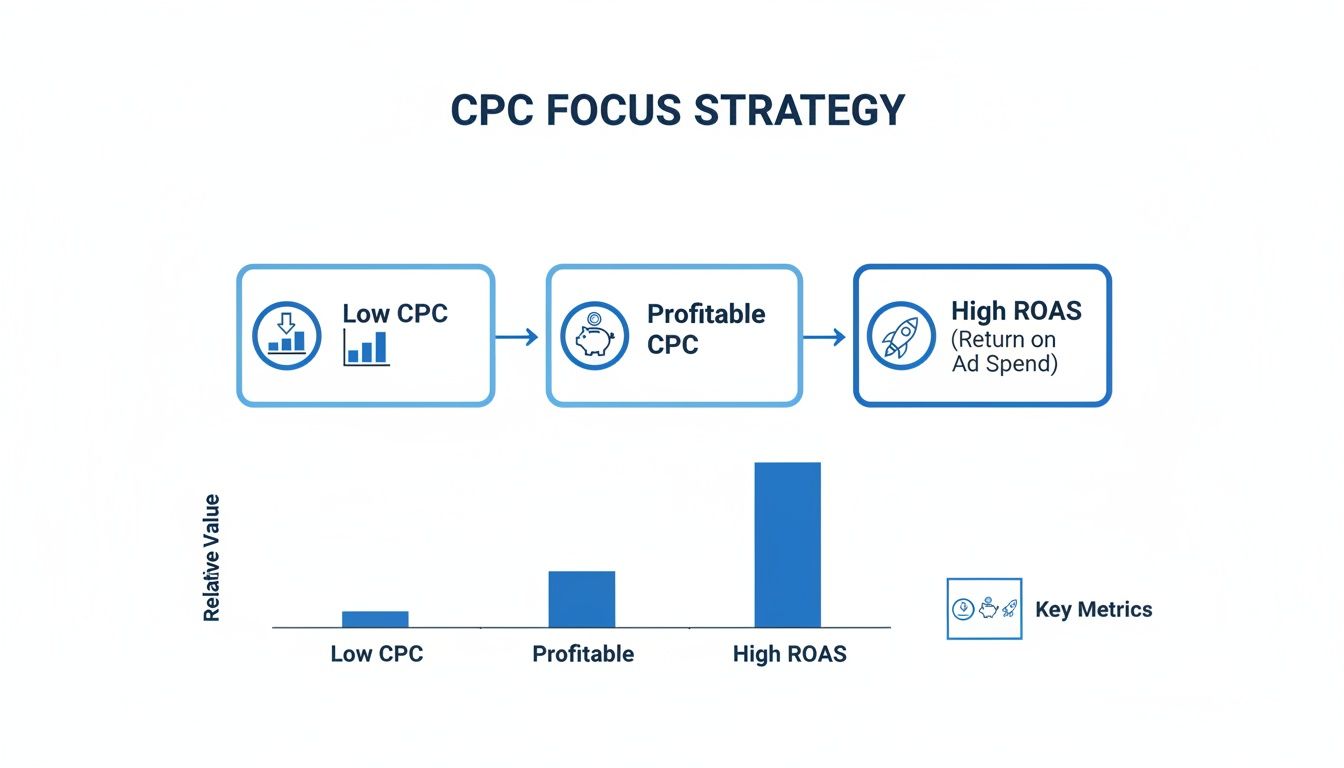
The real takeaway here is that the cheapest click is rarely the goal. The ultimate prize is the most profitable click.
Google Ads CPC Benchmarks in the UK
Google Ads is still the king of search advertising, and the costs reflect its dominance. For many UK small businesses, a typical, non-brand search click will land somewhere in the £2–£5 range. But honestly, that’s just a starting point.
In sectors where a single customer is worth a fortune—think finance or legal services—costs can get eye-watering. A click for a keyword like “personal injury solicitor” could easily top £40. At the other end of the scale, an ecommerce shop selling niche t-shirts might pay as little as £0.45 per click. Understanding how much Google PPC costs is all about figuring out where your business sits on that massive spectrum.
Facebook Ads CPC Benchmarks in the UK (What is a good cost per click?)
Facebook Ads plays a different game. Its superpower is targeting people based on who they are and what they’re into. This approach often leads to much lower click costs compared to search ads.
Here in the UK, it’s pretty standard to see Facebook CPCs stay comfortably below £2. For instance:
- Retail & Apparel: This is often where you find the best bargains, with clicks averaging around £0.70 – £1.50.
- B2B Services: Costs creep up here, sometimes getting close to £2.50, as you’re trying to pin down a very specific professional audience.
- Finance & Insurance: This is a premium category on Facebook too, and you can see CPCs push past £3.50.
The trade-off for these lower costs is often a lower conversion rate straight from the click. After all, the user’s intent isn’t as urgent as it is on Google Search.
Microsoft Ads (Bing) CPC Benchmarks in the UK
So many advertisers overlook Microsoft Ads (formerly Bing Ads), and that’s exactly why it can be a goldmine. Its user base is generally smaller than Google’s, but it’s often older and has more disposable income. Crucially, less competition means lower costs.
For a lot of industries, you can expect to pay anywhere from 30% to 50% less per click on Microsoft Ads compared to Google for the exact same keywords. This makes it a fantastic platform for testing new campaigns and grabbing valuable traffic without breaking the bank.
Average UK CPC by Platform and Industry (What is a good cost per click?)
To pull this all together, here’s a rough guide to estimated average CPCs across some key UK sectors. Use these as a starting point to shape your strategy, but don’t treat them as gospel.
| Industry | Google Search Ads CPC (Est. UK) | Facebook Ads CPC (Est. UK) | Microsoft Ads CPC (Est. UK) |
|---|---|---|---|
| Retail & Ecommerce | £1.50 – £3.50 | £0.70 – £1.50 | £0.90 – £2.00 |
| Home Services | £5.00 – £15.00 | £2.00 – £3.50 | £3.00 – £8.00 |
| B2B Services | £4.00 – £9.00 | £2.50 – £4.00 | £2.50 – £6.00 |
| Finance & Insurance | £10.00 – £40.00+ | £3.50 – £5.00 | £6.00 – £25.00 |
These benchmarks are here to help you set a realistic first budget. Your actual cost per click will always come down to the many factors we’ll dig into next. The key is to use this data as a guide while you zero in on a CPC that is profitable for your business model.
What is a good cost per click? The Key Factors That Influence Your CPC
Ever wondered why some of your clicks cost mere pennies while others set you back several pounds? It’s not random. The price you pay is decided in a lightning-fast auction that happens every single time someone searches on Google.
Getting a grip on what happens in this auction is the first step to taking control of your costs. You can move from just accepting the price to actively influencing it.
It’s a common myth that it’s all about who has the deepest pockets. While your bid amount certainly matters, Google’s top priority is giving its users a brilliant experience. This means they actually reward advertisers who create relevant, genuinely helpful ads. The mechanism they use for this is called Quality Score.
Think of Quality Score as your “relevance discount.” The higher your score, the less you might have to pay for a top ad position. A high Quality Score is a signal to Google that your ad is a fantastic match for what the user is looking for. In return, Google gives you a serious competitive edge, often letting you outrank competitors who are bidding more but have sloppy, low-quality ads.
The Three Pillars of Quality Score
Your Quality Score, rated from 1 to 10, boils down to three core components. If you want to lower your CPC, you need to get these right.
- Expected Click-Through Rate (CTR): This is Google’s prediction of how likely people are to click your ad when it shows up. It’s based on your past performance, so a history of compelling, relevant ads that grab attention will naturally earn you a higher CTR.
- Ad Relevance: This is all about how closely your ad copy matches the intent behind someone’s search. If they search for “women’s waterproof running jackets,” your ad needs to talk directly about that, not just generic “outdoor clothing.” Be specific.
- Landing Page Experience: What happens after the click is just as crucial. Your landing page has to follow through on the ad’s promise. It must be relevant, easy to navigate, and provide a clear, user-friendly experience. A slow, confusing page will sink your Quality Score in no time.
In essence, a high Quality Score is your reward for creating a seamless journey for the user—from their initial search, to your ad, and finally to your landing page. Nail this, and you’ll directly lower your advertising costs.
How Ad Rank Determines Your Final CPC (What is a good cost per click?)
While Quality Score is your secret weapon for efficiency, it’s Ad Rank that ultimately decides your ad’s position on the page. The formula is simple but incredibly powerful:
Ad Rank = Your Maximum Bid x Your Quality Score
Google runs this calculation for every advertiser in the auction. The advertiser with the highest Ad Rank wins the top spot. This is exactly why you can have a lower bid but still win a better position if your Quality Score is miles better than a competitor’s.
Your actual CPC is then worked out based on the Ad Rank of the advertiser directly below you. This means you only ever pay the minimum amount required to hold your position over them.
Other Critical Factors Driving Your Costs
Beyond Quality Score and Ad Rank, a few other elements have a direct impact on your cost per click. Being aware of these lets you make smarter, more strategic adjustments to your campaigns.
- Keyword Competition: This is the big one. Keywords with high commercial intent, like “emergency plumber London,” attract a crowd of advertisers. It’s a classic case of supply and demand, and it pushes bid prices up.
- Audience Targeting: The more specific you get with your audience, the higher the potential cost. Layering demographic, geographic, and behavioural targeting means you’re competing for a smaller, more valuable pool of people.
- Seasonality: Demand is rarely flat all year round. An online gift shop will see CPCs for “personalised Christmas gifts” soar in November and December. Likewise, a travel agency’s costs for “beach holidays” will spike in the months leading up to summer.
- Device Type: People behave differently on different devices. Clicks from mobile users might be cheaper or more expensive depending on your industry and how likely someone is to convert on a smaller screen.
By understanding how all these factors connect, you can start to strategically pull the right levers. You can work on improving your ad relevance, refining your landing page, and maybe targeting less competitive long-tail keywords. This proactive approach is how you stop being a passenger and start actively managing what you pay for every single click.
What is a good cost per click? How to Calculate Your Ideal Cost Per Click
Right, let’s get past the industry benchmarks and theory. It’s time to stop thinking about a “good” CPC as some vague, abstract idea and turn it into a hard number you can actually use to build profitable campaigns. This isn’t about plucking a figure out of thin air; it’s about doing some solid business maths to figure out exactly what your business can afford to pay.
By working backwards from your profit margins and conversion data, you can calculate the absolute maximum you should ever pay for a single click. This number, your Max CPC, becomes your financial North Star. It’s the guardrail that ensures every pound you spend on ads has a clear and direct path to making you money.
The Foundational Formula for Max CPC
At its heart, the calculation is refreshingly simple. It creates a direct link between what you’re willing to spend to land a new customer and how good your website is at turning clicks into customers.
Here’s the formula:
Max CPC = Target Cost Per Acquisition (CPA) x Conversion Rate
Let’s quickly break that down:
- Target Cost Per Acquisition (CPA): Think of this as your acquisition budget per customer. It’s the maximum you can afford to spend to get one new customer while still turning a decent profit.
- Conversion Rate: This is simply the percentage of visitors who do what you want them to do (buy something, fill in a form, etc.). If 2 out of every 100 visitors make a purchase, your conversion rate is 2% (or 0.02 as a decimal).
This straightforward calculation anchors your bidding strategy in pure financial reality. No more guesswork.
A Practical Example for a UK Retailer (What is a good cost per click?)
Let’s make this real. Imagine you run a UK-based ecommerce shop that sells high-quality leather bags. We’ll walk through the numbers step-by-step.
- Work Out Your Profit: Your most popular bag sells for £150. After you’ve paid for the materials, shipping, and other costs, you’re left with £60 in profit for each sale.
- Set Your Target CPA: To keep the business healthy, you decide you’re willing to spend up to half of that profit to win a new customer. That sets your Target CPA at £30. Spend any more, and the sale starts to lose you money.
- Find Your Conversion Rate: You pop into your analytics and discover that your website’s conversion rate for this bag is 2.5% (which is 0.025 in decimal form).
Now you’ve got all the pieces of the puzzle.
Calculation:
Max CPC = £30 (Target CPA) x 0.025 (Conversion Rate)
Max CPC = £0.75
What does this mean? It means you can bid up to £0.75 for a click, and on average, you’ll hit your target of acquiring customers for £30 a pop. If you consistently bid higher than this, you’re almost certainly heading into unprofitable territory.
Layering in Advanced Metrics for More Accuracy
The basic formula is a brilliant place to start, but for a truly robust strategy, we can get a bit more sophisticated by pulling in more detailed business metrics. This is especially vital for businesses with a wide range of products or those that build long-term relationships with customers.
Using Average Order Value (AOV)
Most ecommerce store owners know that people rarely buy just one thing. Using your Average Order Value (AOV) instead of a single product’s price gives you a much more realistic picture of how much revenue you make per transaction.
Let’s go back to our bag retailer. Sure, the main bag is £150, but a lot of customers also add a matching purse for £50. This pushes the AOV up to £200. If the profit margin holds steady at 40%, the average profit per transaction is now £80.
Let’s set our Target CPA at 50% of this new, higher profit figure, which gives us £40.
- New Max CPC = £40 (Target CPA) x 0.025 (Conversion Rate) = £1.00
Just by using AOV, our retailer has realised they can afford to bid 33% higher per click. That small change could be the difference between getting outbid and dominating the ad auction.
Accounting for Customer Lifetime Value (LTV)
Now for the most forward-thinking approach: Customer Lifetime Value (LTV). This metric isn’t just about today’s sale; it estimates the total profit you’ll make from a customer over their entire relationship with your brand.
A customer might buy that £150 bag today, but what if they come back over the next three years to buy a wallet, a belt, and another bag as a gift? Suddenly, their total LTV might be closer to £500, generating a total profit of £200.
Factoring this in completely changes the game for your Target CPA. You might now be willing to spend £80 or even £100 to acquire that customer, knowing the long-term payoff is huge. This justifies a much more aggressive bidding strategy, shifting the focus from just winning a single sale to acquiring genuinely high-value customers. Understanding this helps you see the bigger picture of your marketing spend; for a deeper dive, our guide on how to calculate marketing ROI offers some brilliant insights.
What is a good cost per click? Actionable Strategies to Reduce Your CPC
Figuring out your ideal cost per click is a massive step forward, but the real work starts now. It’s time to roll up your sleeves and actively manage your campaigns to hit that target.
Lowering your CPC isn’t about finding a magic button. It’s about making a series of smart, deliberate improvements that show Google your ads are high-quality and hyper-relevant. This approach doesn’t just cut what you pay per click; it almost always improves the quality of the traffic you get, too.
Here’s a breakdown of proven tactics you can implement right away to make every pound of your ad spend work harder and drive down your CPC without sacrificing performance.
Boost Your Quality Score Relentlessly
Like we covered, your Quality Score is the “relevance discount” Google gives you for great ads. A higher score means a lower CPC. It’s that simple. Focusing on its three pillars is the most direct route to cutting your costs.
- Create Tightly Themed Ad Groups: Stop lumping hundreds of keywords into one ad group. Instead, create small, focused groups where every single keyword is closely related. For a shoe shop, instead of a generic “trainers” ad group, you’d have separate ones for “men’s black running trainers,” “women’s white lifestyle trainers,” and “kids’ school trainers.”
- Write Magnetic Ad Copy: Your ad copy must mirror the keywords in the ad group. If the keyword is “emergency plumber in Bristol,” your headline should shout exactly that. This immediate relevance tells the user they’re in the right place, boosting your expected click-through rate (CTR).
- Optimise Your Landing Page Experience: The user journey can’t fall apart after the click. Your landing page has to deliver on the promise your ad made. It must be fast, mobile-friendly, and make it dead simple for the user to do what you want them to do next.
Master Your Keyword Targeting (What is a good cost per click?)
Your keyword strategy is a huge lever for controlling costs. So many advertisers fall into the trap of only targeting broad, expensive keywords, getting stuck in costly bidding wars. The real opportunity for finding a good cost per click often lies in getting more specific.
A common mistake is targeting broad, highly competitive keywords. The key to a lower CPC is often found in specificity. Focusing on longer, more detailed search terms helps you attract users with clearer intent, resulting in more valuable clicks at a lower price.
A smarter approach means digging deeper to find keywords that signal strong buying intent but face less competition.
- Uncover Long-Tail Keywords: Instead of bidding on a term like “solicitors” (high cost, vague intent), go after a long-tail keyword like “family law solicitor for child custody” (lower cost, high intent). These longer phrases attract much more qualified traffic from people who know exactly what they need.
- Build a Robust Negative Keyword List: This is completely non-negotiable for budget efficiency. Negative keywords stop your ads from showing for irrelevant searches, which prevents wasted clicks. A company selling premium software, for example, would add “free,” “cheap,” and “trial” as negative keywords to filter out users who aren’t looking to buy. To get to grips with this crucial technique, check out our in-depth guide to using negative keywords in Google Ads.
Refine Your Bidding and Scheduling
How and when you bid can have a massive impact on your CPC. Just letting your campaigns run 24/7 without any adjustments is a recipe for wasted spend.
- Use Ad Scheduling: Dive into your campaign data to find the days and hours when you get the most conversions. If you find your sales peak between 9 am and 5 pm on weekdays, you can increase your bids during these times and reduce them—or even pause ads—overnight and on weekends.
- Leverage Smart Bidding: Don’t be afraid to test automated bidding strategies like Target CPA (Cost Per Acquisition) or Maximise Conversions. These use Google’s machine learning to adjust bids in real-time for every single auction, aiming to get you the most conversions possible within your budget. This can be far more efficient than manual bidding alone.
- Implement Location and Device Bid Adjustments: If you find that customers in Manchester convert at a higher rate than those in London, apply a positive bid adjustment for Manchester. Similarly, if mobile users are converting better than desktop users, increase your mobile bids to capture more of that high-value traffic.
By systematically working through these strategies—improving your ad relevance, refining your keyword targeting, and being smarter with your bidding—you can actively bring your CPC down. Each small optimisation adds up, turning your PPC campaigns into a more efficient, profitable, and sustainable engine for growth.
Right, you’ve landed on a profitable cost per click. Fantastic. But don’t pop the champagne just yet. Managing your CPC is a marathon, not a sprint, and the digital marketplace never, ever stands still.
Getting a good CPC is one thing; keeping it is another. A “set it and forget it” approach is a surefire way to burn through your budget. You need a proactive rhythm for reviewing performance, a routine that keeps your campaigns sharp, profitable, and perfectly aligned with your business goals. This is how you turn a simple ad expense into a reliable growth engine.
Key Metrics to Track Beyond CPC (What is a good cost per click?)
Obsessing over CPC alone is like judging a car purely on its price tag without ever checking the miles per gallon. To get the full picture of your campaign’s health, you need to look at the metrics that actually measure profitability and efficiency.
Here are the big ones to watch:
- Conversion Rate: This number tells you everything about the quality of traffic your clicks are generating. A rising CPC is much less of a worry if your conversion rate is climbing right alongside it.
- Cost per Conversion (CPA): This is your true cost of winning a new customer or lead. It cuts through the noise and connects your ad spend directly to results, giving you a crystal-clear view of financial effectiveness.
- Return On Ad Spend (ROAS): The ultimate measure of success. ROAS shows you exactly how much revenue you’re making for every single pound you put into advertising.
Establishing a Performance Review Cadence
A structured review schedule is your best defence against wasted ad spend. It helps you spot trends, fix problems before they get out of hand, and jump on new opportunities. A scattered, inconsistent approach? That just leads to missed insights and money down the drain.
A successful CPC strategy isn’t a static document; it’s a living, breathing system that needs constant attention. Regular check-ins mean you can react to new competitors, seasonal spikes in demand, and shifts in customer behaviour, ensuring you never get left behind.
Try organising your reviews around this simple schedule:
- Weekly Check-ins: Think of this as a quick, high-level health check. Glance over core metrics like clicks, spend, and conversions. It’s the perfect way to spot any sudden red flags, like a broken landing page or a tracking code that’s gone haywire.
- Monthly Deep Dives: Now it’s time to get your hands dirty. Dig into the data to see which ad groups, keywords, and creative are bringing home the best ROAS. This is your chance to double down on what’s working and ruthlessly pause what isn’t.
- Quarterly Strategic Reviews: Zoom out and look at the bigger picture. Are your campaigns still supporting your main business objectives? Have new market trends or competitor moves changed the game? This is when you make the bigger, more strategic shifts.
Frequently Asked Questions About Cost Per Click
When you’re getting to grips with PPC, a few questions always pop up. Business owners and marketing managers across the UK often ask us the same things, especially when trying to figure out what a “good” cost per click actually is. Let’s clear up some of the most common ones.
Is a Lower CPC Always Better?
Not at all. It’s a common trap to think a super-low CPC is a massive win, but it often means you’re bidding on vague, irrelevant keywords that have very little buying intent. You end up with a flood of cheap traffic that never turns into paying customers.
Honestly, it’s much better to have a slightly higher CPC that’s actually profitable because it drives quality clicks and, most importantly, sales. Your number one goal should always be maximising your Return On Ad Spend (ROAS), not just chasing the lowest possible cost per click.
How Long Does It Take to Reduce My CPC?
Improving your CPC isn’t a one-and-done job; it’s an ongoing process of refinement. You might see some quick wins within a few weeks after making tactical tweaks to your ad copy or keywords. This happens as your Quality Score adjusts and the ad platform starts to crunch the new performance data.
But for real, lasting reductions in CPC, you need to play the long game. Meaningful progress usually shows up after one to three months of consistent, active optimisation. This includes things like improving your landing pages and smart, strategic account management.
Why Is My CPC Higher Than the Industry Benchmark?
If your costs are looking a bit steep compared to the average, a few things could be going on. You might be targeting a fiercely competitive area like London, or you could be bidding on broad, expensive keywords that everyone and their dog is trying to rank for.
Another classic reason is a low Quality Score. This is often a sign of a disconnect between your ads and what users are searching for, or it could be down to a clunky, slow landing page. A professional PPC audit can get to the root of the problem fast, giving you a clear strategy to get your costs down to a profitable level for your business.
Ready to stop guessing and start building a profitable PPC strategy? The expert team at PPC Geeks can perform a free, in-depth audit of your ad accounts to uncover opportunities for reducing your CPC and maximising your ROI. Find out more at PPC Geeks.
Author

Search Blog
Free PPC Audit
Subscribe to our Newsletter

The Voices of Our Success: Your Words, Our Pride
Don't just take our word for it. With over 100+ five-star reviews, we let our work-and our satisfied clients-speak for us.

"We have been working with PPC Geeks for around 6 months and have found Mark and the team to be very impressive. Having worked with a few companies in this and similar sectors, I rate PPC Geeks as the strongest I have come across. They have taken time to understand our business, our market and competitors and supported us to devise a strategy to generate business. I value the expertise Mark and his team provide and trust them to make the best recommendations for the long-term."
~ Just Go, Alasdair Anderson