
What Is Pay Per Click Marketing: Your Ultimate Guide

Let’s cut through the jargon. At its core, pay per click (PPC) marketing is a straightforward deal: businesses pay a small fee every time someone clicks on one of their ads. It’s essentially a way of buying visits to your site, rather than trying to “earn” them organically through search engine optimisation (SEO).
What Is Pay Per Click Marketing Exactly?
Think of it like renting a prime spot on a bustling high street. Instead of paying a flat monthly rent for your shop no matter how many people walk past, you only pay the landlord when a potential customer actually steps through your door. It’s a direct, measurable way to connect with people who are actively looking for what you sell.
In the digital world, that “high street” could be a Google results page, a social media feed, or a huge e-commerce marketplace. When someone types in a search, your ad can pop up right at the top, offering a perfect solution at the very moment they need it. That immediacy is what makes PPC so effective.
Core Concepts of PPC at a Glance
PPC can seem complex with all its terminology, but the fundamental ideas are quite simple. I’ve put together a quick table to break down the key concepts you’ll encounter.
| Concept | Simple Explanation | Why It Matters |
|---|---|---|
| Ad Auction | An automated process where search engines decide which ads to show and in what order. | It’s not just about the highest bid; ad quality plays a huge role, levelling the playing field. |
| Keywords | The specific words or phrases people type into a search engine that trigger your ad to appear. | Choosing the right keywords ensures you’re reaching people who are genuinely interested in your offer. |
| Ad Copy | The text of your ad. It’s your short, snappy sales pitch to get someone to click. | Compelling ad copy can dramatically increase your click-through rate and attract qualified leads. |
| Landing Page | The specific webpage a user is sent to after clicking your ad. | A great landing page provides a seamless experience and persuades the visitor to take the next step. |
| Quality Score | A rating Google gives your ads, keywords, and landing pages to measure their relevance and quality. | A higher Quality Score can lead to lower ad costs and better ad positions. It’s Google’s way of rewarding good ads. |
This table should give you a solid starting point. As you get more familiar with these terms, you’ll see how they all fit together to create a successful campaign.
Understanding the Bigger Picture (What Is Pay Per Click Marketing)
Most people think of the sponsored links at the top of Google when they hear “PPC,” but the strategy is much broader than that. To really see its potential, you need to understand its various forms.
For instance, PPC operates a bit differently within a massive e-commerce platform. Looking into specifics like What Is PPC on Amazon and How Does It Work? can offer some great context. The core idea is the same: you bid for visibility and only pay when someone engages.
Why PPC Is Such a Powerful Tool
The real magic of PPC lies in its precision and control. Unlike old-school advertising that casts a wide, often wasteful net, PPC lets you target specific demographics, locations, interests, and even people who have visited your website before. This level of focus means your budget goes directly toward reaching the most relevant audience possible.
PPC is a cornerstone of modern digital advertising because it bridges the gap between a business’s offering and a customer’s intent. You’re not interrupting their day; you’re providing an answer when they’re actively asking a question.
This strategic approach has made it absolutely vital in the UK. In fact, digital marketing spending in the UK recently hit £35.54 billion, which is 44.5% of all advertising spend. With revenue from digital ads expected to fly past £40 billion, it’s clear that performance-based models like PPC are what’s driving this growth. It gives businesses a scalable, data-driven way to generate leads and sales, plain and simple.
What Is Pay Per Click Marketing: How the PPC Ad Auction Really Works
Ever wondered why some ads shoot straight to the top of Google while others are nowhere to be seen? It’s not just about who has the deepest pockets. Every single time you search for something, a lightning-fast, automated process called the ad auction kicks off behind the scenes to decide the pecking order.
Think of it like a high-stakes art auction, but with a clever twist. In a normal auction, the highest cash bid wins. Simple. But in the world of pay-per-click, the auctioneer (the search engine) cares just as much about the bidder’s reputation as their bid. Your bid is vital, of course, but so is your Quality Score.
The Key Players: Ad Rank and Quality Score
The winner of this digital face-off isn’t decided by the bid alone. Search engines like Google use a calculation called Ad Rank to figure out the final ad positions. The formula itself is surprisingly simple but incredibly powerful.
Ad Rank = Maximum Bid x Quality Score
This little equation changes everything. It means an advertiser with a smaller bid but a brilliant Quality Score can actually leapfrog a competitor with a massive budget. The whole system is designed to reward advertisers who give users a great experience, not just those willing to splash the most cash. It keeps the ads you see relevant and genuinely useful.
Deconstructing Your Quality Score (What Is Pay Per Click Marketing)
So, what is this all-important Quality Score? Think of it as your reputation as an advertiser, rated on a scale of 1 to 10. It’s Google’s way of checking the quality of your ads, keywords, and landing pages. A high score tells the platform you’re providing something valuable and relevant.
Several things feed into this score, but it boils down to three main components:
- Expected Click-Through Rate (CTR): Based on past performance, how likely is someone to click your ad when it shows up for a keyword?
- Ad Relevance: Does your ad copy actually match what the user searched for? A tight match between keyword and ad copy means higher relevance.
- Landing Page Experience: Once someone clicks, does your landing page follow through on the ad’s promise? Is it relevant, easy to use, and trustworthy?
A high Quality Score is a massive strategic advantage. It leads directly to lower ad costs and better ad positions. For a deeper dive into the mechanics, our guide on how Google Ads work breaks down the platform’s core processes in more detail.
This diagram shows how a business uses its bids and Quality Score to aim for the best ad placement, with the pay-per-click model as the foundation.
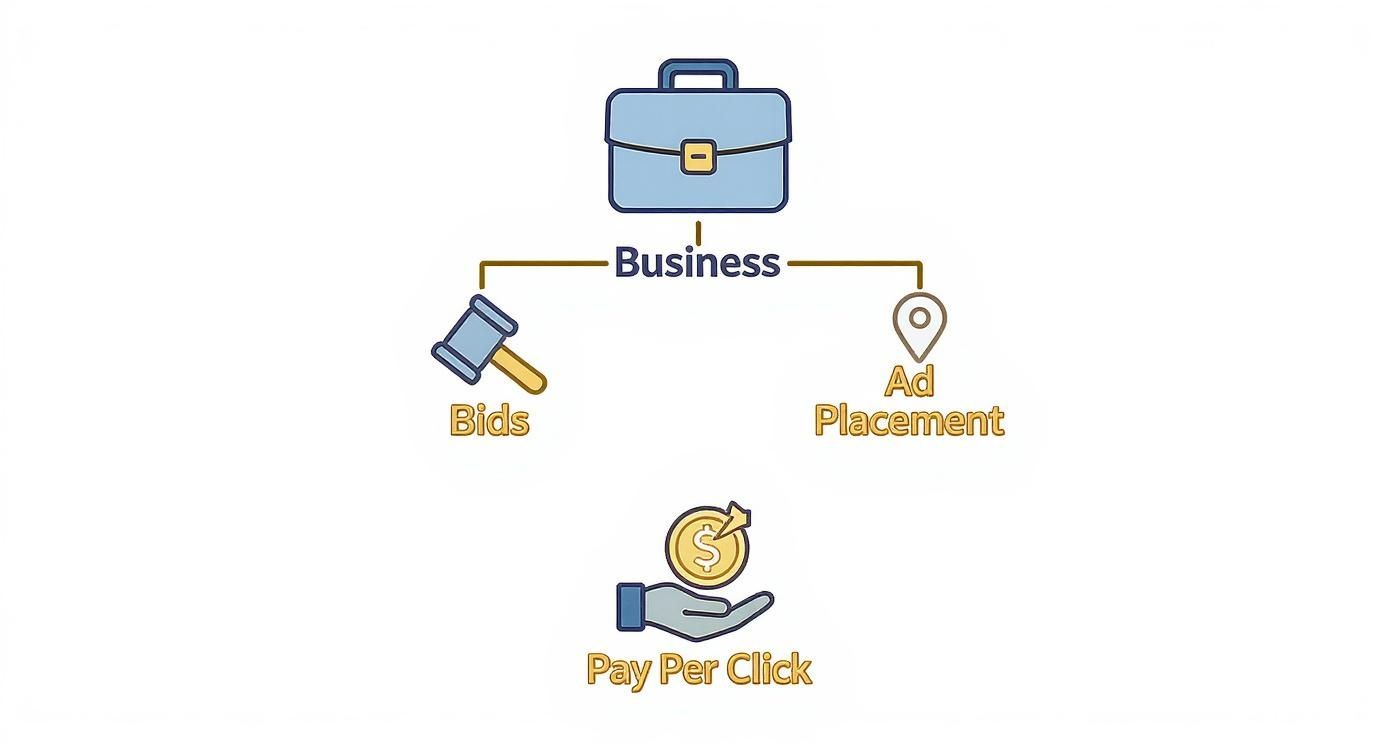
The image makes it clear that your bid is just one piece of a much larger puzzle. The real goal is securing those valuable ad spots, and the whole system is driven by the pay-per-click mechanism.
Ultimately, the ad auction is a clever system that balances an advertiser’s budget with the user’s experience. By focusing on creating high-quality, relevant ads and landing pages, you not only serve your audience better but also give yourself the best shot at winning the auction for less money. This is the engine that powers every effective PPC campaign.
What Is Pay Per Click Marketing: Exploring the Different Types of PPC Campaigns
Pay-per-click advertising is so much more than just those blue sponsored links you see huddled at the top of a search results page. Think of PPC as a marketing toolkit, kitted out with different tools designed for very specific jobs. Getting your head around the various campaign types is the first step in picking the right one to connect with your audience and hit your business goals.
And these campaigns really do work, as the UK market data shows. The average click-through rate (CTR) on Google Ads is now a solid 6.42% for search ads, which gives us a decent benchmark for performance. Even better, for B2B businesses, conversion rates for Google Ads search campaigns have climbed to 6.69%, proving just how well this channel can drive real business results.
Search Ads: The Foundation of PPC
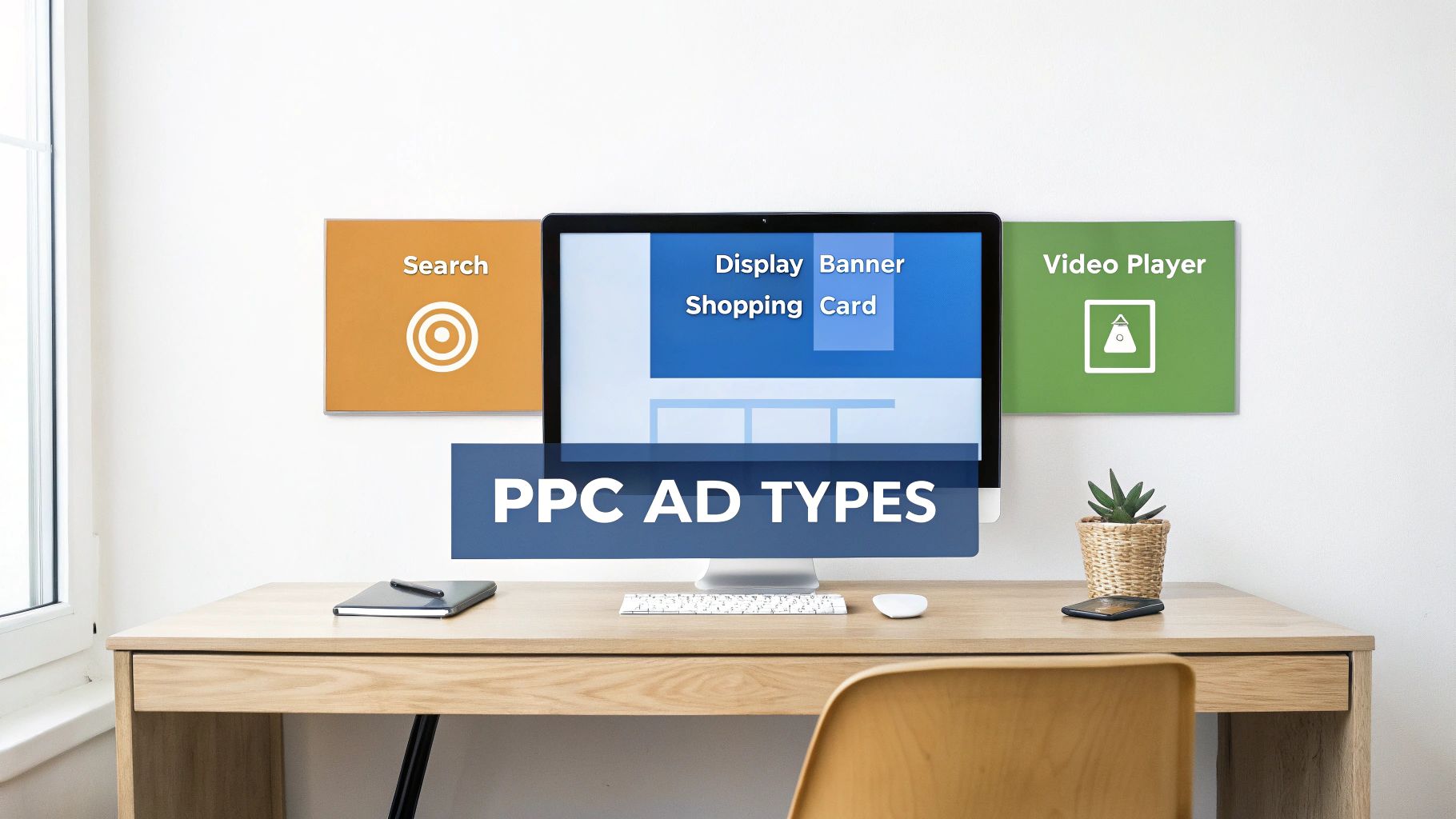
Search ads are the classic form of PPC and usually the first stop for most businesses. These are the simple text-based ads that pop up on search engine results pages (SERPs) when someone types in a specific keyword. Their real power is in their ability to capture intent – you’re reaching people at the exact moment they’re actively looking for a solution you can provide.
For instance, a local plumber in Manchester could run a search ad targeting the keyword “emergency plumber Manchester.” When a pipe bursts and a frantic homeowner searches for help, that plumber’s ad is right there at the top, offering an immediate fix. It’s this direct line between a user’s problem and a business’s service that makes search ads incredibly effective for generating leads and sales.
Display Ads: Building Brand Awareness (What Is Pay Per Click Marketing)
Unlike search ads that tap into existing demand, display ads are all about creating it. These are the visual, banner-style ads you see dotted across websites, blogs, and apps all over the internet. Instead of targeting keywords, they target people based on their interests, demographics, or what they’ve been browsing online.
Imagine a new, eco-friendly coffee brand based in the UK. They could use display ads to show off colourful banners on popular food blogs or sustainability websites. The person reading that blog post might not be actively shopping for coffee, but that repeated exposure to the brand’s message and imagery builds recognition. So, the next time they need to buy coffee, that brand is much more likely to spring to mind. If you fancy a deeper dive into this, our guide on the Google Display Network provides more detail.
Social Media Ads: Precision Targeting
Social media platforms like Facebook, Instagram, and LinkedIn have become absolute powerhouses for PPC. Their strength lies in the incredible depth of user data they hold, which allows for hyper-specific audience targeting. You can zero in on users based on their job title, interests, recent life events, and so much more.
A brilliant example would be a boutique wedding venue in the Cotswolds. They could run a stunning video ad campaign on Instagram, targeting users who are recently engaged, have shown an interest in “wedding planning,” and live within a 50-mile radius. This level of precision ensures their advertising budget is spent reaching only the most relevant potential customers.
Social media PPC campaigns let you slide your brand directly into the daily digital lives of your ideal customers, engaging them in a space where they’re already relaxed and open to new ideas.
Shopping Ads: The E-commerce Engine (What Is Pay Per Click Marketing)
For any online retailer, Shopping ads are a must. These are the product-focused listings that appear at the top of Google search results, complete with an image, price, and the shop’s name. They’re visually engaging and give shoppers all the key purchasing info upfront.
Think about an independent online bookshop in the UK. When someone searches for a specific book title, their Shopping ad can appear right alongside those from the big retailers, showing the book cover and their competitive price. This format completely shortcuts the buying journey, taking an interested shopper straight to the product page with a single click. It’s no wonder it’s one of the highest-converting PPC campaign types for e-commerce.
Each of these campaign types offers a unique way to connect with your audience, making pay-per-click marketing a truly adaptable and powerful strategy.
What Is Pay Per Click Marketing: Mastering Your PPC Budget and Costs
It’s the first question on every business owner’s mind when they dip their toes into pay-per-click marketing: How much is this actually going to cost me?
Unlike traditional advertising with its fixed price tags, PPC runs on a flexible budget that you set. But what you end up paying is shaped by a handful of ever-changing factors.
Think of it like bidding at an auction. The final price for that coveted item depends on how many other people want it (competition), what it’s actually worth (keyword intent), and even where the auction is held (your target market). In the world of PPC, these variables are what dictate your costs, so there’s no one-size-fits-all price for a click.
Understanding Key Cost Variables
Your total ad spend is a mix of strategic choices and what the market is doing. A few key elements will always have a big say in what comes out of your budget.
- Keyword Competition: High-value keywords, like “personal injury lawyer,” are incredibly competitive and, as a result, much more expensive than niche, long-tail keywords such as “eco-friendly dog toy supplier in Bristol.”
- Industry: Some sectors are just pricier. Legal, finance, and insurance, for example, have notoriously high average costs per click simply because a single new customer is worth so much to them over their lifetime.
- Geographic Targeting: It stands to reason that targeting an entire country will demand a much bigger budget than focusing your efforts on a single city or region.
- Ad Quality Score: As we’ve mentioned, a higher Quality Score is your secret weapon. It can dramatically lower your costs, essentially rewarding you for creating top-notch, relevant ads.
Getting your head around these factors is the first step to setting a budget that’s both realistic and effective. For a more precise estimate, using a specialised tool can be a massive help. You can get a much clearer picture with an AdWords budget calculator to model potential costs based on your specific industry and goals.
Setting a Realistic Starting Budget (What Is Pay Per Click Marketing)
So, where do you start? In the UK, small and medium-sized businesses (SMEs) have jumped on the PPC bandwagon in a big way, with over 68% now running active campaigns. For these businesses, the average monthly spend usually sits somewhere between £1,500 and £3,500.
If you’re just getting your feet wet, most UK agencies would suggest a minimum of £500 per month. This gives you enough runway to gather the data you need to see what’s actually working.
Platforms like Google Ads run on a daily budget. You simply tell the system how much you’re willing to part with each day, and it works to stay within that limit over the course of a month. This puts you in complete control and means no nasty surprise bills at the end.
The beauty of PPC is its scalability. You can start with a modest budget to test the waters, prove the concept, and then reinvest your profits to scale up your campaigns as they become profitable.
Measuring Your Return on Investment
Of course, just spending money is pointless; you’re here to make a positive return. The most critical metric for any PPC campaign is your Return On Ad Spend (ROAS). This simple calculation tells you exactly how much revenue you’re generating for every pound you put into advertising.
A massive part of mastering your budget and proving its worth is knowing how to accurately calculate marketing ROI. By keeping a close eye on conversions—whether that’s a sale, a contact form submission, or a phone call—you can directly link revenue back to your ad spend. This data-driven approach lets you make smart decisions, cutting what isn’t working and doubling down on the campaigns that are bringing in the money.
What Is Pay Per Click Marketing: The Strategic Benefits of PPC Advertising
Okay, so you know how PPC works, but the big question is why bother? While other digital marketing strategies like SEO are a long game, slowly building momentum over time, PPC gives you a set of powerful, immediate advantages that can be a game-changer for businesses of any size. It’s all about speed, precision, and control.
At its heart, PPC is your direct line to potential customers. You get to jump the queue and get in front of the right people at the exact moment they’re searching for a solution you offer. You’re making your case when their interest is at its absolute peak.
Get Rapid and Measurable Results
Perhaps the most irresistible benefit of PPC is the sheer speed. Unlike search engine optimisation, which can take months to show any real traffic gains, a PPC campaign can start sending visitors to your website the very same day it goes live. This makes it a priceless tool for businesses that need to make an impact, fast.
This instant traction is perfect for all sorts of situations:
- Product Launches: Instantly find out if there’s a market for your new product or service.
- Seasonal Promotions: Drive a surge of traffic and sales during crunch times like Black Friday or Christmas.
- Event Registrations: Quickly fill the seats for your next webinar or workshop.
And the best part? Every single click and conversion is tracked. You get crystal-clear, immediate feedback on what’s working and what isn’t. You can see precisely which ads and keywords are bringing in the sales, allowing you to make decisions based on cold, hard data instead of guesswork.
The instant feedback loop from PPC is its superpower. You’re not just spending money on ads; you’re buying data that can inform your entire marketing strategy, from product positioning to website messaging.
Achieve Pinpoint Audience Targeting (What Is Pay Per Click Marketing)
PPC advertising gives you an incredible level of control over who sees your ads. Forget casting a wide net and hoping for the best. You can move beyond broad demographics and laser-focus on the specific audience most likely to become a customer. This precision means your marketing budget gets spent where it counts, reaching people who are genuinely interested in what you’re selling.
The targeting capabilities are seriously granular. For instance, a local bakery in Brighton could target users within a five-mile radius who’ve recently searched for “vegan cakes” or “artisan bread.” This ability to layer geography, demographics, and interests means far less wasted ad spend and a much higher chance of attracting genuinely qualified customers.
Maintain Complete Budgetary Control
One of the biggest fears with any kind of advertising is the thought of costs spiralling out of control. PPC tackles this head-on by putting you firmly in the driver’s seat of your budget. You decide exactly how much you’re willing to spend each day or per month, and the platforms will never, ever go over that limit.
This flexibility makes pay per click marketing accessible to everyone. A startup can dip its toes in the water with a modest budget of a few hundred pounds, while a larger company can confidently scale up and invest thousands. You can pause your campaigns, tweak your bids, and move funds around in real-time based on how things are going, giving you complete financial agility.
What Is Pay Per Click Marketing: Your Action Plan for PPC Success
Knowing the theory behind pay-per-click marketing is one thing, but turning that knowledge into a winning campaign takes a clear, actionable strategy. This isn’t about just throwing money at keywords and crossing your fingers; it’s about a series of smart, data-driven decisions.
This roadmap will walk you through the essential best practices that separate the high-flyers from the campaigns that just burn through cash. Think of it as your pre-flight checklist before launching your ads into the digital world.
Conduct Deep Keyword Research
The foundation of any solid search campaign is built on keywords. Your job is to climb inside your customers’ heads and figure out the exact phrases they’re typing into search bars when they need what you’re selling. This process goes way beyond the obvious, high-competition terms.
- Brainstorm Core Topics: First up, list the main categories of your products or services. Simple.
- Use Keyword Tools: Get to grips with platforms like Google Keyword Planner or Semrush to find related terms, check their search volume, and see the estimated cost-per-click.
- Find Long-Tail Keywords: These are your secret weapon. Longer, more specific phrases (like “handmade leather dog collars for spaniels“) have less competition and tend to convert better because the user’s intent is crystal clear.
- Analyse Competitors: Have a nosey at what keywords your rivals are bidding on. You’ll often find gaps and golden opportunities in their strategies.
Craft Compelling Ad Copy (What Is Pay Per Click Marketing)
Your ad copy is your frontline sales pitch. In just a few lines of text, you have to grab attention, show your value, and convince someone to click. It’s a tall order, so every single word has to pull its weight.
A powerful call-to-action (CTA) is non-negotiable. Tell the user exactly what to do next, whether it’s “Shop Now,” “Get a Free Quote,” or “Download Our Guide.” This simple instruction removes any guesswork and can seriously boost your click-through rates.
A great ad mirrors the user’s search query, confirms you have the solution they need, and offers a compelling reason to choose you over the other options on the page.
Build High-Converting Landing Pages
Getting the click is only half the battle. If your ad promises one thing and your landing page delivers something else entirely, you’re just paying for wasted traffic. An effective landing page is a direct continuation of your ad’s conversation, designed for one thing and one thing only: conversion.
The page needs to be laser-focused, with a clear headline, persuasive copy, and a single, unmissable call-to-action. Get rid of any distracting navigation or links that could tempt visitors to wander off. For a deeper dive, exploring PPC landing page best practices will give you the detailed guidance needed to turn those clicks into actual customers.
Embrace Continuous Improvement (What Is Pay Per Click Marketing)
A successful PPC campaign is never “finished.” It’s a living, breathing thing that needs constant monitoring and tweaking. The real key to long-term success is getting into a mindset of continuous improvement through testing and analysis.
- Utilise Negative Keywords: Actively add terms to your negative keyword list to stop your ads from showing up for irrelevant searches. For example, if you sell premium software, adding “free” as a negative keyword will save you a fortune.
- Leverage Ad Extensions: Use extensions like sitelinks, callouts, and location information to make your ad bigger and more useful. They make you stand out on the results page and can improve your click-through rate at no extra cost.
- A/B Test Everything: Never assume you know what works best. Constantly test different headlines, descriptions, CTAs, and even landing page designs to find the winning combinations that deliver the highest return.
By following this action plan, you’ll move beyond just understanding what pay-per-click marketing is and start using the strategies that drive real, measurable growth.
Still Have Questions About Pay Per Click?
As we wrap things up, it’s totally normal to have a few questions rattling around. This last section covers some of the most common queries we hear from businesses just dipping their toes into the PPC waters. Think of it as a final chat to clear up any doubts before you dive in.
We’ll give you some straight, no-nonsense answers to make sure you feel ready to get your first campaign off the ground.
How Fast Can I Expect to See Results?
This is one of the best things about PPC: it’s fast. Really fast. Unlike SEO, which is a long game that can take months to show any real traction, a well-built PPC campaign can start funnelling traffic to your website on the very day you switch it on.
That speed makes it a powerhouse for hitting immediate targets. Got a new product launch, a flash sale, or just need to get the phone ringing now? PPC delivers that almost instant visibility. Of course, getting to the point where those clicks are profitable and your campaigns are fully optimised takes a bit more time—usually a few weeks or months of tweaking and learning.
Is PPC Better Than SEO?
Ah, the classic question. But honestly, it’s not about one being “better” than the other. They’re different tools for different jobs, and they work brilliantly together.
- PPC is your sprinter. It’s all about speed and precision, delivering immediate traffic and letting you target with laser focus. It’s perfect for short-term goals and testing the waters with new ideas.
- SEO is your marathon runner. It’s about building long-term, sustainable growth. It establishes your organic authority over time, creating a source of “free” traffic that keeps coming even when you’re not paying for ads.
A truly smart marketing plan doesn’t pit PPC against SEO; it uses both. You can use PPC for quick wins and to gather priceless data, then feed those insights back into your long-term SEO strategy. It’s a powerful one-two punch.
What’s a Good Click-Through Rate?
Everyone wants to know this, but the truth is, a “good” click-through rate (CTR) varies massively. It all depends on your industry, the keywords you’re bidding on, and which platform you’re using. For Google Search ads here in the UK, you’ll often hear an average figure of around 4-6%, but treat that as a loose benchmark, nothing more.
A niche B2B service, for example, is naturally going to have a lower CTR than a trendy pair of trainers. The key isn’t to get hung up on some universal number. Instead, focus on your own progress. Aim to consistently improve your CTR by split-testing your ad copy, sharpening up your keyword list, and making sure your targeting perfectly matches what people are searching for.
Ready to stop guessing and start getting real results from your advertising spend? The team at PPC Geeks creates data-driven strategies that increase traffic, generate high-quality leads, and maximise your return on investment. Reclaim your time and budget efficiency by partnering with our UK-based experts. Find out how we can help your business grow at https://ppcgeeks.co.uk.
Author

Search Blog
Free PPC Audit
Subscribe to our Newsletter

The Voices of Our Success: Your Words, Our Pride
Don't just take our word for it. With over 100+ five-star reviews, we let our work-and our satisfied clients-speak for us.

"We have been working with PPC Geeks for around 6 months and have found Mark and the team to be very impressive. Having worked with a few companies in this and similar sectors, I rate PPC Geeks as the strongest I have come across. They have taken time to understand our business, our market and competitors and supported us to devise a strategy to generate business. I value the expertise Mark and his team provide and trust them to make the best recommendations for the long-term."
~ Just Go, Alasdair Anderson