




Retargeting advertising is a clever bit of digital marketing that lets you reconnect with people who’ve already popped by your website but left without taking action. By showing them specific ads as they browse other sites, you keep your brand fresh in their minds and gently nudge them back to finish what they started. Think of it as your second chance to make a lasting impression.
Retargeting Advertising: Turning Window Shoppers Into Loyal Customers

Imagine a customer walks into your high-street shop. They pick up a coat, try it on, maybe even admire it in the mirror, but then walk out without buying. A savvy sales assistant might remember them and point out the coat on their next visit. Retargeting advertising is the digital version of that helpful assistant, only it’s far more precise and works at a massive scale.
It’s such a powerful method because you’re not just shouting into the void. You’re focusing your ad spend on a ‘warm’ audience—people who have already shown a clear interest in what you’re selling. This is a world away from casting a wide, expensive net and just hoping for the best. Instead, you’re nurturing that initial spark of interest.
Let’s break down the basics of how it works.
Retargeting at a Glance
This table gives you a quick, high-level overview of the moving parts involved in a retargeting campaign.
| Component | What It Does |
|---|---|
| Tracking Pixel/Cookie | A tiny bit of code on your site that anonymously ‘tags’ visitors. |
| Audience Segment | A list of those tagged visitors, often grouped by behaviour (e.g., viewed a product). |
| Ad Platform | The network (like Google or Facebook) that displays your ads to your audience segments. |
| Targeted Ad | The specific creative (image or video) shown to the user to remind them of your brand. |
Essentially, these components work together to follow up with interested prospects automatically.
Why Retargeting Advertising Matters for UK Businesses
In a crowded market, every single website visitor is a hard-won opportunity. But the tough reality is that 98% of visitors won’t convert on their first visit. That’s a staggering number. Retargeting helps you bring a good chunk of that traffic back, turning what looked like lost causes into real, measurable revenue.
This strategy is a vital piece of any successful Pay-Per-Click (PPC) puzzle. Your initial campaigns do the heavy lifting of getting people to your site, but retargeting ensures that investment doesn’t go to waste. It re-engages those who hesitated, making every penny work harder. If you’re new to the concept, our guide on what is PPC for small business is a great place to start.
Retargeting is the safety net for your marketing budget. It catches the value from all your other efforts—like SEO and social media—and turns that initial curiosity into actual sales and leads.
By keeping your brand visible, you’re doing more than just chasing one sale. You’re building familiarity and trust over time. For any UK business serious about getting the most out of its marketing spend, retargeting isn’t just an option; it’s essential.
How Retargeting Advertising Actually Works
So, how does this all happen? To really get what retargeting advertising is all about, you need to peek behind the curtain at the tech making it possible. But don’t worry, it’s surprisingly straightforward. The whole system hinges on a simple piece of code, usually called a retargeting pixel or tag.
Think of this pixel as a digital breadcrumb. When someone lands on your website, this tiny, invisible bit of code fires up. It doesn’t grab any personal details like their name or email address. Instead, it just anonymously drops a small text file, known as a cookie, into their web browser. This cookie simply acts as an identifier, essentially saying, “Hey, this browser was on our website.”
This first step is the bedrock of your entire retargeting strategy. It’s a quiet, automated process humming along in the background, building a list of people who’ve already shown some interest in what you offer.
The Journey of an Ad
Now, once that person leaves your site and carries on with their day online, the real magic starts. They could be catching up on the news, checking the weather, or just scrolling through social media. Most of these websites and apps are part of huge advertising networks, like the Google Display Network or Meta’s network.
When their browser loads a page with an ad space from one of these networks, the network reads that anonymous cookie your site left behind. It immediately recognises the user as part of your retargeting audience. This is the signal for your retargeting platform to jump into action and serve up one of your ads.
The core idea is simple: the cookie acts like a flare, telling ad platforms, “Show my ad to this person!” It’s a privacy-friendly approach that focuses purely on anonymous browsing behaviour, not who the person actually is.
The process below breaks down this simple, three-step journey from their first visit to the final conversion.
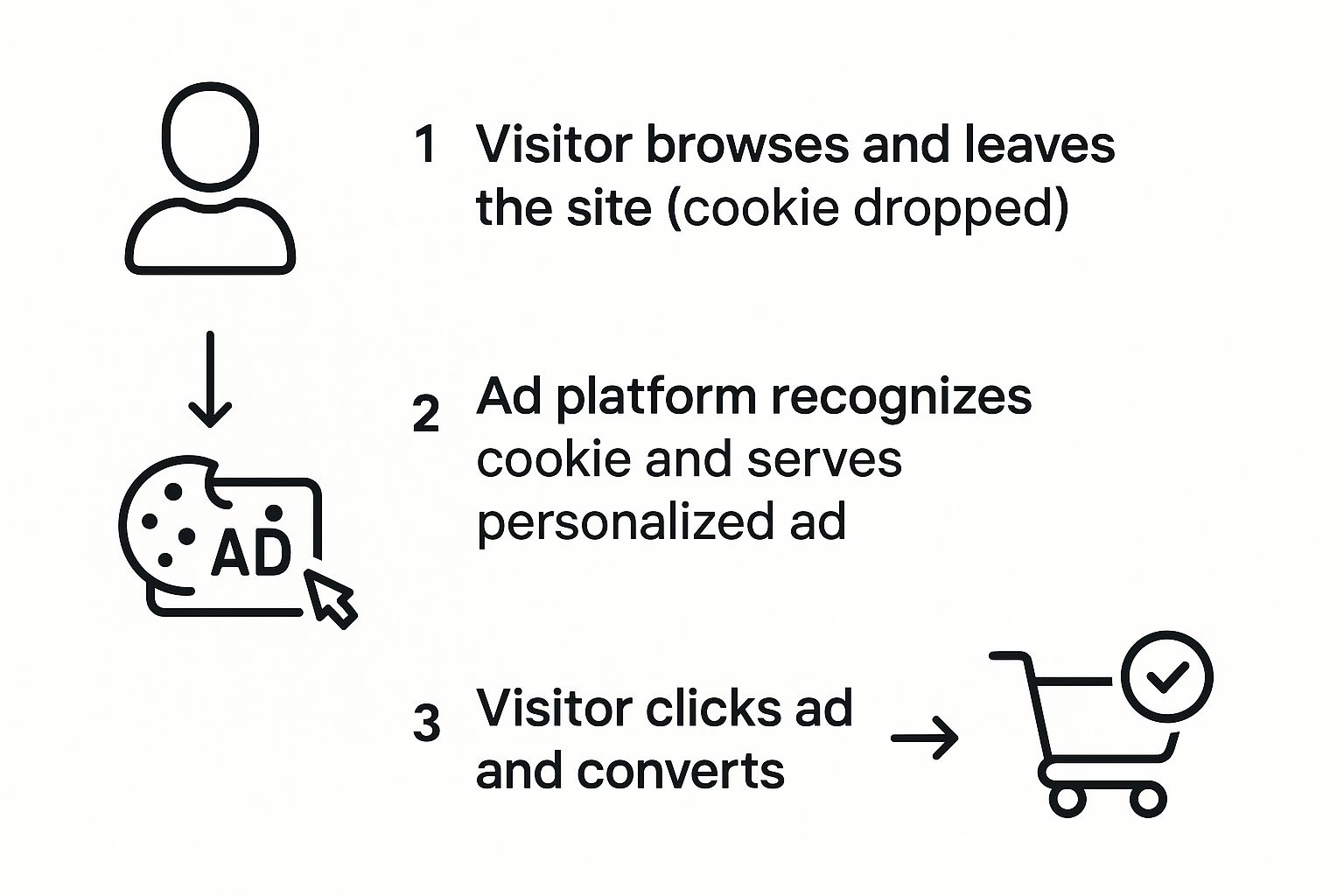
This flow shows how retargeting automates the job of reconnecting with people after they’ve left, gently guiding them back to finish what they started.
From Impression to Conversion (Retargeting Advertising)
The final piece of the puzzle is all about bringing that user back into the fold. The ad they see is designed to be a helpful reminder of your brand or the specific products they were looking at. When they click it, they’re taken straight back to a relevant page on your website, giving them a second chance to convert.
This whole sequence is so effective because it’s both targeted and timely. You’re not just shouting into the void; you’re having a conversation with an audience that has already put their hand up. The key stages look like this:
- Tagging: A user visits your site, and the retargeting pixel places an anonymous cookie in their browser.
- Tracking: As they browse other sites within an ad network, that cookie alerts the retargeting platform to show them your ad.
- Serving: A specific, relevant ad is displayed, reminding the user about your brand or products.
- Converting: The user clicks the ad, returns to your site, and completes the goal, whether that’s buying something or filling out a form.
Once you understand these mechanics, you can start making much smarter decisions about how to structure your campaigns to reach the right people at exactly the right moment.
Why Retargeting Is a Powerful Marketing Tool

Let’s get straight to it: retargeting works because you’re focusing your marketing budget on people who already know who you are. Instead of shouting into the void at a cold audience, you’re having a conversation with people who’ve already shown genuine interest in your brand. It’s that simple.
This single shift in focus has a massive impact on your results. These users are much further along in their buying journey, which means they need fewer nudges to make a decision. The end result? Dramatically higher conversion rates and a much better return on your ad spend.
Maximising Your Entire Marketing Funnel (Retargeting Advertising)
Think of retargeting as a crucial support system for all your other marketing efforts. You pour time and money into SEO, content marketing, and social media to bring people to your site. But when most of them leave without converting, that initial investment is at risk of going to waste.
Retargeting is the safety net that catches this valuable traffic. It makes sure the visitors you worked so hard to attract don’t just vanish forever. By keeping your brand front and centre, you pull them back in and squeeze every last drop of value out of every single click, from every channel.
This is exactly why understanding the impact of each touchpoint is so important. When you learn more about what attribution modelling is, you can see precisely how retargeting contributes to your final sales and leads.
Retargeting turns missed opportunities into measurable revenue. It transforms the 98% of users who don’t convert on their first visit from a lost cause into a pipeline of high-potential leads.
At the end of the day, this strategy makes your entire marketing mix more effective, making every pound you spend work that much harder.
Driving Conversions and Boosting ROI
The data doesn’t lie. Retargeting consistently delivers exceptional performance compared to other types of advertising. Because you’re reaching an audience that’s already engaged, the benefits are crystal clear:
- Increased Conversion Rates: Website visitors who are retargeted with display ads are a whopping 70% more likely to convert.
- Higher Click-Through Rates (CTR): The CTR of a retargeted ad is often 10 times higher than a standard display ad.
- Enhanced Brand Recall: A few gentle, repeated reminders keep your brand top-of-mind for when your prospect is finally ready to pull the trigger.
The UK’s advertising landscape is shifting to embrace these targeted strategies. Recent data on UK ad expenditure shows an 8% growth rate, with 54% of UK companies listing increased sales revenue as a top priority—a goal retargeting is perfectly built to support. You can read more on these UK advertising trends and business priorities on creativebrief.com.
Ultimately, retargeting isn’t just another ad tactic; it’s a strategic asset for sustainable growth. It builds brand familiarity, recovers sales you would have otherwise lost, and makes sure your marketing budget is spent as efficiently as possible.
Retargeting Advertising: Exploring Different Types of Retargeting Campaigns
Think of retargeting not as a single tactic, but as a complete toolkit. Just like you wouldn’t use a hammer for every job around the house, you shouldn’t use just one type of retargeting for every potential customer. Getting to grips with the main campaign types is the first real step towards building a strategy that actually works.
The most common approach, and really the foundation of it all, is Site Retargeting. This is the classic model you’ve probably experienced yourself: you visit a website, leave without buying, and then suddenly start seeing their ads pop up on other sites you browse. It’s a powerful, broad-strokes method for keeping your brand top-of-mind for anyone who has shown even a flicker of interest.
But you can get a lot smarter and more specific than that.
Advanced and Niche Retargeting Strategies
Going beyond just targeting everyone who visited your site, modern platforms let you run much more focused and intelligent campaigns. These advanced methods allow you to tailor your message based on exactly what a user did, creating a far more relevant and compelling ad experience.
Here are a few of the most powerful types you can put to work:
- Search Retargeting: This lets you target people based on the keywords they’ve searched for on engines like Google. For example, if someone searches for “best running shoes for marathon,” you can show them ads for your high-performance trainers—even if they’ve never been to your site before.
- Social Media Retargeting: Platforms like Meta (for Facebook and Instagram) and LinkedIn are absolute goldmines for retargeting. You can reconnect with users who have engaged with your page, watched your videos, or clicked a link, reaching them in a more relaxed, social setting where they spend their time.
- Dynamic Retargeting: This is a complete game-changer for ecommerce. It automatically creates personalised ads showing the exact products a user looked at, added to their basket, or even previously bought. If someone was eyeing up a pair of blue boots and left, this is how you show them an ad for those exact blue boots a day later.
Each type of retargeting campaign gives you a unique way to re-engage your audience. The real key is to match the strategy to the user’s specific behaviour and where they are in their buying journey.
To help you decide which approach fits best, here’s a quick breakdown of how these strategies stack up against each other.
Choosing Your Retargeting Strategy
| Retargeting Type | Primary Goal | Best For |
|---|---|---|
| Site Retargeting | Brand Awareness & Recall | Reaching a broad audience of anyone who has visited your website. |
| Search Retargeting | New Customer Acquisition | Capturing high-intent users actively searching for your products or services. |
| Social Media Retargeting | Nurturing & Engagement | Building community and staying visible in users’ daily social feeds. |
| Dynamic Retargeting | Driving Conversions | Closing the deal with shoppers who showed specific product interest (e.g., cart abandoners). |
| Email Retargeting | Cross-Channel Marketing | Creating a unified experience for your most engaged audience—your subscribers. |
This table should give you a clearer picture of how each type serves a different purpose. A well-rounded strategy often uses a mix of these to cover all the bases.
Re-Engaging Through Email and Other Channels (Retargeting Advertising)
Don’t think your retargeting efforts have to stop with display or social media ads. Email is another incredibly potent channel for reconnecting with your audience.
Email Retargeting is all about showing ads to users who are on your mailing list, or on the flip side, sending targeted emails to site visitors who haven’t yet subscribed.
This approach helps bridge the gap between your marketing channels, creating a more seamless customer experience. Beyond display ads, retargeting can use channels like targeted emails with huge success; check out these email marketing strategies for high ROI to see just how powerful this can be. By choosing the right combination of these campaign types, you can build a comprehensive strategy that guides users back to your business, no matter how they first found you.
Best Practices for Successful Retargeting Advertising Campaigns

Knowing the theory behind retargeting is one thing; making it actually work for your business is another game entirely. To move from ideas to action, you need a solid playbook. These are the tried-and-tested best practices that will help you create high-performing campaigns that feel like a helpful nudge, not a creepy stalker.
The absolute foundation of any good strategy is smart audience segmentation. Think about it: you wouldn’t say the same thing to someone who briefly browsed your blog as you would to a user who abandoned a shopping cart full of items. Segmenting your audiences based on their behaviour lets you tailor your message with incredible precision.
This targeted approach is crucial. You have to treat a first-time visitor differently from a loyal, returning customer. Getting this level of detail right is what makes your ads relevant, impactful, and ultimately, successful.
Fine-Tune Your Campaign Settings
Once you’ve sorted your audiences, the next step is controlling how and when they see your ads. The goal is to stay top-of-mind without becoming overwhelming, and this is where the technical settings become your best friend.
- Set a Frequency Cap: This is a simple but powerful tool that limits how many times one person sees your ad in a set period. Bombarding someone with the same ad leads to ad fatigue, where they start to ignore or even resent your brand. A cap of 3-5 impressions per day is a sensible place to start.
- Use Burn Pixels: A burn pixel is your secret weapon for a great customer experience. It removes users from your retargeting list as soon as they convert. There’s nothing more annoying than being chased by ads for a product you’ve already bought. This simple step keeps your campaigns efficient and your new customers happy.
These controls are essential for running respectful and effective campaigns. They also stop you from wasting your budget on people who’ve already done what you wanted them to do. If you’re looking for more ways to get the most out of your ad spend, you can explore our guide to improve online sales with effective strategies.
Create Compelling and Relevant Ads (Retargeting Advertising)
Your ad creative is your final handshake—it needs to be good enough to bring that person back.
The most powerful tactic here is Dynamic Retargeting. This clever tech automatically shows ads featuring the exact products a user was looking at on your site. For any e-commerce business, this level of hyper-relevance is incredibly effective.
Beyond that, always make sure your ad copy and offer match what the user was doing. If they were looking at a specific service page, your ad should talk about that service. This creates a smooth, logical journey from their initial interest right through to the final conversion.
The goal of retargeting isn’t just to follow users around the internet. It’s to continue a conversation they started, offering a relevant solution at the right moment to guide them back.
Advertising is a massive driver of the UK economy, and digital channels soak up the lion’s share of that investment. Retargeting is a key part of this spend simply because it’s so efficient. You can dig into more insights on global advertising trends on datareportal.com. By putting these best practices into action, you can make sure your retargeting budget delivers a real, measurable return.
Choosing the Right Retargeting Platform for Your Business
Picking the right retargeting platform isn’t about finding a single ‘best’ option. It’s about finding the best fit for your business and your goals. The platform you choose determines where your ads show up, who sees them, and, ultimately, how much bang you get for your buck.
The big players here are Google, Meta (that’s Facebook and Instagram), and LinkedIn. Each one offers something different, and knowing what makes them tick is the key to spending your money wisely.
Aligning Platform with Audience
Your first question should always be: where do my customers hang out online? Their online behaviour is your compass. Are they actively searching for answers on Google, killing time scrolling through their social feeds, or are they networking with other professionals?
- Google Ads: This is the king of reach. Through the Google Display Network, you can get in front of people across millions of websites, apps, and even on YouTube. It’s perfect for catching users as they browse all over the web.
- Meta (Facebook & Instagram): With its treasure trove of demographic and interest data, Meta is a goldmine for consumer brands. It lets you pop up in a much more relaxed, visual, and social setting. Think fashion, hobbies, and lifestyle products.
- LinkedIn Ads: If you’re in the B2B world, look no further. LinkedIn is the undisputed champ for business-to-business marketing. You can target people based on their job title, industry, or the company they work for, which is incredibly precise when you need to reach decision-makers.
The right platform is simply the one that puts your message in front of the right people, in the right context. A B2B software company will find more success on LinkedIn, while an online fashion retailer will likely thrive on Instagram and Facebook.
Retargeting has become a cornerstone of digital marketing here in the UK, where 89% of businesses now use social media for their advertising. For retailers, 51% see the AI that powers these automated strategies as absolutely critical for growth. It just goes to show how baked-in these platforms are for driving real conversions. You can dig into more UK digital marketing facts on searchhog.co.uk.
In the end, the best strategy might be to use a mix of platforms. Of course, for many small businesses, juggling multiple campaigns can get complicated fast. Getting a handle on PPC management for small business can give you the clarity you need to start off on the right foot and make every penny of your budget count.
Still Have Questions About Retargeting?
Even after getting the hang of the basics, a few practical questions tend to pop up. Let’s clear the air and tackle some of the most common queries we hear before you dive in.
For UK businesses, the first question is almost always about data privacy. Is retargeting actually compliant with GDPR? Yes, it absolutely can be, but you have to do it by the book. It all comes down to getting clear consent from your users to drop a cookie and being upfront about how you plan to use their data.
Another big one is cost. How much is this actually going to set me back? Most retargeting campaigns run on standard pay-per-click models, like Cost Per Click (CPC) or Cost Per Mille (CPM), which is your cost for every thousand ad impressions. The good news is that retargeting is usually incredibly cost-effective. You’re talking to a warm audience that already knows you, which almost always means a better return on your ad spend.
Clearing Up Some Jargon
You’ll often hear “retargeting” and “remarketing” used as if they’re the same thing. While they’re similar, there’s a subtle but important difference.
Retargeting is typically about showing display ads to anonymous visitors as they browse other websites around the internet. Remarketing, on the other hand, usually means re-engaging people you already have contact info for, most often through email campaigns.
Finally, let’s address the elephant in the room: can retargeting come across as a bit creepy? It definitely can if it’s overdone. The key to running a campaign that helps rather than harasses is to be smart about it. We use tools like frequency caps to limit how often someone sees your ad and burn pixels to stop showing ads to people who have already bought from you. It’s all about being helpful, not annoying.
At PPC Geeks, we build intelligent, respectful retargeting campaigns that drive real results without overwhelming your audience. Get your free PPC audit today and let’s turn those missed opportunities into loyal customers.