




For any UK building product distributor or merchant, a sharp Pay-Per-Click (PPC) strategy is the most direct route you’ll find to connect with trade and DIY customers who are ready to buy. It cuts through the noise of traditional marketing, putting your products—whether it’s bulk plasterboard or specialist heritage bricks—right in front of people searching for them at that very moment. PPC gives you measurable ROI, drives real footfall to your trade counters, and builds that all-important brand visibility.
Why PPC Is a Must-Have for UK Building Merchants
In the fiercely competitive building supplies market, being visible when a customer needs you is everything. PPC advertising, especially on platforms like Google Ads, isn’t just another box to tick in your marketing plan; it’s your direct line to immediate demand.
Think about it. When a local builder searches for “bulk sand delivery Bristol” or a contractor is desperately trying to find a “C24 graded timber supplier,” your ads can be the very first thing they see. This instant connection with highly motivated buyers is something other marketing channels can only dream of.
The goal here isn’t just about racking up clicks. It’s about driving real-world business outcomes, whether that’s an online order, a call to the trade desk, or a visit to a branch to pick up materials. For building product merchants, this direct link to both trade professionals and savvy DIYers is absolutely invaluable.
The Financial Case for PPC (PPC for UK Building Product Distributors and Merchants)
Jumping into PPC isn’t a gamble; it’s a solid, data-backed decision. In the UK construction sector, it’s common for businesses to see around £2 in revenue for every £1 spent on PPC—a tidy 2:1 return on investment.
Couple that with an average Google Ads conversion rate of 5.13%, which is one of the highest across all major industries, and you have a powerful tool for driving sales. This kind of performance means you can allocate your budget with confidence, knowing there’s a proven model for generating leads and boosting your bottom line.
Key PPC Metrics for UK Building Merchants at a Glance
To give you a clearer picture, here are some typical benchmarks you should aim for with a well-run PPC campaign in the UK building and construction sector. These aren’t just numbers; they tell a story about your campaign’s health and effectiveness.
| Metric | Industry Average (UK Construction) | Why It Matters |
|---|---|---|
| Return on Ad Spend (ROAS) | 2:1 (or £2 for every £1 spent) | The ultimate measure of profitability. Shows if your ad spend is generating real revenue. |
| Conversion Rate | 5.13% | Tells you how many clicks are turning into valuable actions (sales, calls, form fills). |
| Click-Through Rate (CTR) | 4-6% | A good indicator of how relevant and compelling your ads are to your target audience. |
| Cost Per Click (CPC) | £1.50 – £3.00 | Varies by product, but this is the baseline cost for attracting a potential customer. |
Tracking these metrics is non-negotiable. They are your compass, guiding your strategy and helping you make smarter, data-driven decisions to stay ahead of the competition.
Strategic Advantages for Distributors
Beyond just making the phone ring, a focused PPC strategy offers some huge advantages specifically for distributors and merchants like you:
- Pinpoint Local Targeting: You can use geo-targeting to show ads only to customers within your delivery radius or near a specific branch. No more wasting money on clicks from people you can’t serve.
- Capture Red-Hot Leads: PPC targets people based on exactly what they’re typing into Google. This means you’re connecting with prospects who have already decided they need what you sell.
- Dominate Your Local Area: Appearing at the top of search results for your key product terms builds massive brand authority. You quickly become the go-to supplier in your region.
- Make Data-Driven Decisions: Every click, every call, and every conversion is tracked. This gives you crystal-clear data on which products are flying off the shelves and which marketing messages are actually working.
By focusing on the right keywords and campaign structures, you ensure your ad spend is directly fuelling business growth. So many campaigns fall flat, not because PPC doesn’t work, but because they’re generic. They lack the specific industry focus needed to succeed. If you want to sidestep the common mistakes, it’s worth understanding why most Google Ads fail for building product suppliers and how to fix them.
PPC for UK Building Product Distributors and Merchants: Building Your Campaign Blueprint for Maximum Impact
A winning PPC strategy lives and dies by its structure. For building product distributors, this means throwing out generic, one-size-fits-all campaigns. Your blueprint has to mirror how your customers actually think and buy, not just how your product catalogue is organised. Get this right, and you’ll capture high-intent buyers without burning through your budget.
Forget lumping all your timber products into a single campaign. That’s a recipe for wasted spend. The key is smart segmentation. A local builder searching for “C24 graded timber delivery in Manchester” is a completely different prospect from a DIYer looking for “cheap decking boards online“. Your campaigns absolutely must reflect that reality.
Think of your account structure in layers:
- Customer Type: The first and most important split. Create separate campaigns for ‘Trade’ and ‘DIY/Retail’. This simple move lets you tailor everything—ad copy, landing pages, and offers. Trade ads can shout about account benefits and bulk pricing, while DIY ads focus on project ideas and click-and-collect.
- Product Category: Within your Trade and DIY segments, build campaigns around your core product categories. Think ‘Timber & Sheet Materials’, ‘Plumbing & Heating’, or ‘Bricks & Blocks’. This keeps things tidy and manageable.
- Geographic Focus: If you’ve got multiple branches, location targeting is your best friend. Set up campaigns specific to each branch’s delivery radius. It’s the only way you’ll reliably show up for crucial searches like “sand and gravel supplier near me“.
Drilling Down into Ad Groups
Once the campaigns are mapped out, the real precision work starts with your ad groups. Each ad group needs to be a tight, focused collection of keywords covering a specific product sub-category. Why? Because it makes your ads hyper-relevant, and Google Ads rewards relevance with better Quality Scores and, crucially, lower costs.
Let’s take that ‘Sheet Materials’ campaign. Don’t just chuck everything in one ad group. Break it down like this:
- Ad Group 1: MDF Sheets
- Keywords: ‘buy MDF sheets online’, ‘8×4 MDF board price’, ‘moisture resistant MDF UK’
- Ad Group 2: Plywood
- Keywords: ‘shuttering plywood for sale’, ‘marine plywood suppliers’, ‘birch plywood sheets’
- Ad Group 3: Plasterboard
- Keywords: ‘bulk plasterboard delivery’, ‘fire resistant plasterboard cost’, ‘soundproof plasterboard’
See the difference? This granular approach means someone searching for MDF gets an ad about MDF, not a vague “building supplies” message. It’s common sense, but so many merchants get it wrong.
This diagram shows the powerful, straightforward flow of how a strategic ad spend translates directly into growth for your business.
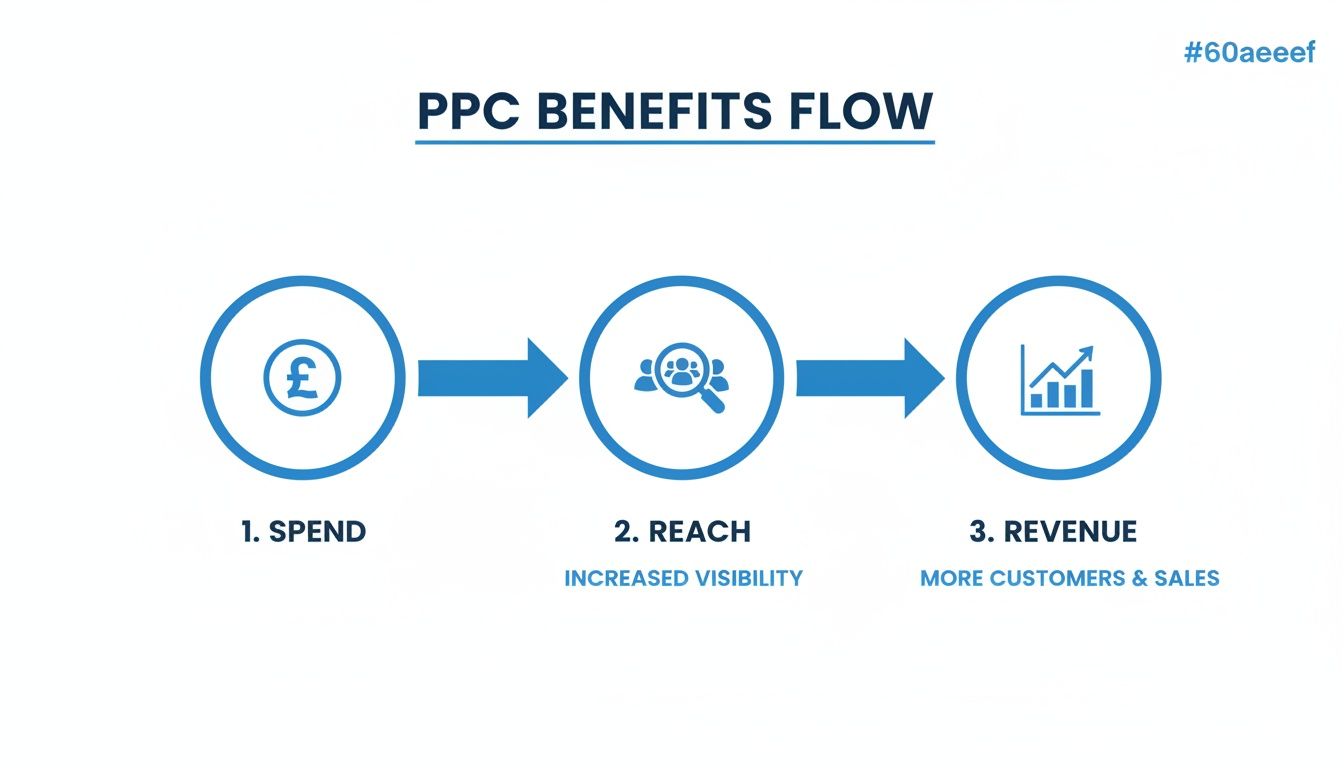
The logic is simple: targeted investment (Spend) expands your visibility (Reach), which in turn drives real, measurable financial returns (Revenue).
Choosing the Right Campaign Type (PPC for UK Building Product Distributors and Merchants)
Google offers a whole menu of campaign types, but for a UK building merchant, you’ll want to focus on a powerful combination of Search and Performance Max.
- Search Campaigns: These are your bread and butter. They’re perfect for targeting users with very specific, high-intent searches. When a chippy types “Velux window supplier Reading,” a Search ad is the best tool in your box to grab that lead. Pure demand capture.
- Performance Max (PMax): This is Google’s all-in-one, automated campaign type. It uses machine learning to find customers across all of Google’s channels (YouTube, Display, Gmail, you name it). PMax works best when you have solid conversion tracking and a good product feed, helping you reach a wider audience who might not have thought to search for you directly.
A classic mistake is to rely only on one campaign type. Use Search campaigns for precision, capturing the demand that’s already there. Then, layer in Performance Max to drive discovery and find new customers you would have otherwise missed.
The Power of Negative Keywords
What you don’t target is just as important as what you do. A well-maintained negative keyword list is your first line of defence against throwing money down the drain. It stops your ads from showing up for irrelevant searches that have zero chance of converting.
For any builders’ merchant, this list needs to be a living document. Start with the obvious stuff to filter out job hunters, students, and people looking for a freebie.
Essential Negative Keywords to Add Immediately:
freejobscareerstrainingcoursesalaryhow toDIY plansreviewsimages
By putting this structured, multi-layered blueprint in place, you’ll stop just advertising products and start strategically connecting with the right customers, right when they need you. This thoughtful approach is the absolute core of a profitable PPC strategy for any UK building product distributor.
PPC for UK Building Product Distributors and Merchants: Mastering Your Product Feed and Shopping Campaigns
For any building products merchant with an e-commerce site, Google Shopping isn’t just a ‘nice to have’—it’s an absolute must. While your search ads are great for catching specific, text-based queries, it’s the Shopping campaigns that put your products front and centre, complete with pictures and prices. This visual approach is a game-changer for both trade and DIY customers who are scrolling for materials.
But here’s the thing: a powerful Shopping campaign is only as good as its product feed. This is the data file you send over to Google Merchant Center, and if it’s weak or poorly optimised, you’re just throwing money away on irrelevant traffic and poor visibility. Getting this right is what separates the market leaders from everyone else.
Crafting Product Titles That Actually Sell
Your product title is, without a doubt, the most critical part of your feed. Google’s algorithm leans on it heavily to match your products with what people are searching for. That means it needs to be packed with the kind of details your customers actually use. A generic title like “Loft Insulation” is practically useless; you’ll get lost in the noise.
You need to think like your customer and build your titles with a clear, attribute-first formula. What information does a buyer need instantly? A tradesperson needs the brand, dimensions, and model number without having to click through.
A solid title structure for building materials should look something like this:
Brand + Product Type + Key Attributes (Material, Size, Spec) + Model/SKU
Let’s put that into practice.
-
Bad: Loft Roll
-
Good: Knauf Earthwool Loft Roll 44 Combi-Cut 100mm
-
Bad: Paving Slabs
-
Good: Bradstone Natural Sandstone Paving Slabs Grey Multi 600x600mm
That level of detail does the hard work for you. It qualifies your traffic on the spot. A builder looking for that exact Knauf roll knows they’ve landed on the right product, making a click—and a conversion—far more likely.
Leveraging Custom Labels for Smarter Bidding (PPC for UK Building Product Distributors and Merchants)
One of the most powerful yet underused tools in Google Merchant Center is custom labels. Think of them as tags you can attach to your products. They let you slice and dice your inventory within your Shopping campaigns, giving you much smarter, more strategic control over your bidding. This is where you really start pushing the products that boost your bottom line.
You have five custom label slots (0-4), so you need to be strategic. Here are a few practical ideas for a building merchant:
custom_label_0: Margin Level (e.g.,High-Margin,Mid-Margin,Low-Margin)custom_label_1: Sales Velocity (e.g.,Best-Seller,Slow-Mover)custom_label_2: Customer Type (e.g.,Trade-Only,DIY-Friendly)custom_label_3: Seasonality (e.g.,Decking-Season,Winter-Grit)custom_label_4: Stock Status (e.g.,In-Stock,Special-Order)
Once you’ve got these labels set up, you can structure campaigns to bid much more aggressively on your high-margin bestsellers while pulling back spend on low-margin items. Your Shopping campaign goes from being a blunt object to a precision-guided tool. Dodging low-margin traffic is a crucial skill, and you can learn more about how to optimise Google Shopping for building products in our detailed guide.
Your Product Feed Health Checklist
Keeping your product feed in good shape is an ongoing job, not a one-off task. Running regular health checks using this list will help you avoid frustrating product disapprovals and ensure your campaigns are always running at their best.
We see a lot of merchants treat their product feed like a static file they upload once. That’s a huge mistake. Your feed should be a living, breathing thing that reflects real-time stock, pricing, and product data. Automating daily feed updates is essential for performance.
Use this as your go-to checklist:
- Accurate GTINs are Non-Negotiable: Make sure every product has the right Global Trade Item Number (GTIN), like an EAN. Google uses these unique identifiers to understand exactly what you’re selling. Missing or incorrect GTINs will seriously limit your visibility.
- High-Quality Images Win Clicks: Your main image should be crisp, high-resolution, and ideally on a plain white background. It’s also a great idea to add supplementary lifestyle or in-situ shots showing the product being used on a job.
- Stock Availability Must Match Your Site: The
availabilitystatus in your feed (in stockorout of stock) has to be a perfect mirror of your website. If it doesn’t match, you’ll get products disapproved and annoy potential customers. - Complete All Relevant Fields: Don’t get lazy and skip the ‘optional’ fields if they apply to your product. Attributes like
colour,material, andsizegive Google’s algorithm more data to work with, helping you show up for more specific, long-tail searches. - Optimise Product Descriptions: The description isn’t as critical as the title, but it’s your chance to pack in secondary keywords and technical specs that a trade professional might search for. Don’t waste the space
PPC for UK Building Product Distributors and Merchants: Choosing the Right Keywords and Bidding Strategies
If your campaign structure is the skeleton, then your keywords and bidding strategy are the muscles that make everything move. Get this part right, and you’ll put your products squarely in front of high-intent trade and DIY customers. Get it wrong, and you’re just throwing money away.
It all starts with getting your head around keyword match types and how they apply specifically to the building supplies game. Each one has a job to do, from casting a wide net for initial research to hooking a customer right at the moment they’re ready to buy.
- Broad Match: Use this one very, very carefully. It’s for top-of-funnel discovery, think general terms like
roofing supplies. It can be useful for finding new search terms, but only if you pair it with a rock-solid negative keyword list and smart bidding. Otherwise, you’ll burn through your budget on irrelevant clicks. - Phrase Match: This is your bread and butter. It’s the workhorse for catching targeted searches like
"buy lead flashing roll". The searcher knows exactly what they want, and you can serve up an ad that’s a perfect match. - Exact Match: Save this for your absolute money-makers—the super-specific, highest-intent searches. A keyword like
[velux window ggl mk04]is about as targeted as it gets. Anyone typing that in is pretty much standing there with their wallet out.
A classic mistake I see all the time is merchants leaning too heavily on broad match and just hoping Google’s AI sorts it out. In the building supplies world, precision is everything. Build your campaigns on a solid foundation of phrase and exact match keywords for the products you know sell, and only then should you cautiously dip your toes into broad match.
Finding High-Intent Long-Tail Keywords
Sure, short, popular keywords like “timber” get a lot of searches, but the real gold is in the long-tail keywords. These are longer, more specific phrases that tell you someone is much further along in the buying process. A search for “timber” is vague. A search for “next day delivery c24 graded timber 4.8m” is a red-hot lead.
Use tools like the Google Keyword Planner to dig these out. Pop in a core product like “cement bags” and see what it spits out. You’ll find all sorts of valuable variations that signal real buying intent, such as:
- Urgency:
next day delivery,emergency - Location:
near me,in Manchester - Quantity:
bulk,pallet,trade price - Specificity:
waterproof,fast-setting
When you build ad groups around these long-tail themes, you can write incredibly specific ads that speak directly to a customer’s problem. That means higher click-through rates and, more importantly, higher conversion rates.
Demystifying Automated Bidding Strategies (PPC for UK Building Product Distributors and Merchants)
Look, manual bidding has its place, but for a busy building merchant, Google’s automated bidding strategies are a game-changer. They use machine learning to adjust your bids in real-time based on dozens of signals—something no human could ever keep up with. The trick is simply picking the right strategy for your business goals.
For most merchants, it boils down to two main options:
-
Maximise Conversions: This strategy does exactly what it says on the tin. You tell Google to get you the most conversions it can within your daily budget. It’s a great starting point, especially for lead generation campaigns where you just want to get the phone ringing or fill up your quote request form.
-
Target ROAS (Return on Ad Spend): This is the holy grail for e-commerce. You set a specific target for the return you want from your ad spend (e.g., £5 in sales for every £1 you spend on ads). It’s incredibly powerful but needs a decent amount of data to work its magic. As a rule of thumb, you want at least 30-50 conversions in the last 30 days before you switch this on.
For a proper deep dive into how these strategies work under the bonnet, our guide on how to use smart bidding like a pro in Google Ads is a great read.
Remember, your choice isn’t set in stone. It’s common to start with Maximise Conversions to gather data and then, once the account matures, switch to Target ROAS to really hone in on profitability. Your strategy should evolve as your business does.
PPC for UK Building Product Distributors and Merchants: Turning Clicks into Customers with Landing Pages & Remarketing

Getting the click is only half the battle. Once a potential customer is on your website, the real work begins. The journey from that initial ad click to a genuine lead or a sale rests squarely on the shoulders of your landing page and your strategy for re-engaging anyone who leaves. For builders merchants, this means crafting an online experience that speaks the language of trade professionals and serious DIYers.
Simply dumping PPC traffic onto your generic homepage is a recipe for wasted ad spend. You need to send them to a dedicated landing page that delivers exactly what your ad promised. If someone clicks an ad for ‘bulk plasterboard delivery’, they better land on a page all about plasterboard – not your general building supplies category. It’s this kind of seamless experience that keeps people on your site and guides them towards that all-important next step.
The Anatomy of a High-Converting Landing Page
To turn visitors into business, your product pages need to be more than just online catalogue entries; they need to be hardworking sales tools. They must give a trade customer all the critical info they need to make a quick, confident decision.
Here are the absolute must-haves:
- Crystal-Clear Calls-to-Action (CTAs): Your buttons need to be unmissable and use language that resonates with your audience. Think “Request a Trade Quote,” “Check Local Stock,” or “Add to Bulk Order.” These are miles more effective than a vague “Buy Now.”
- High-Quality Imagery and Video: Show the product from every conceivable angle. Include photos of it being used on a real job site. A short video showing how to install or apply it can be incredibly persuasive.
- Downloadable Technical Specs: Tradespeople live and die by the details. Give them easy access to data sheets, installation guides, and safety information as downloadable PDFs. It’s an instant way to build trust and position yourself as an authority.
- Visible Trust Signals: Don’t be shy. Display logos of any trade associations you’re part of (like the Builders Merchants Federation), the credit providers you accept, and any industry certifications you hold. These are shortcuts to credibility.
Your landing page must answer a visitor’s questions before they even think to ask them. Make it effortless for them to find dimensions, stock levels, and delivery options. Friction is the enemy of conversion.
Why Strategic Remarketing is Your Secret Weapon (PPC for UK Building Product Distributors and Merchants)
Let’s be realistic: most visitors won’t convert on their first visit. They’re probably comparing prices, double-checking specs, or just got interrupted by a phone call. This is precisely where remarketing comes in, acting as your most valuable tool to bring those interested people back to finish what they started.
The trick is to go deeper than just generic “come back!” ads. You need to build segmented audience lists based on what people actually did on your site. This lets you serve up hyper-relevant ads that feel less like a random interruption and more like a genuinely helpful nudge.
Building Your Remarketing Audience Lists
Inside your Google Ads account, you can create specific audiences to target. For a builders merchant, these are some of the most powerful lists you can put together:
- Specific Category Viewers: Group together everyone who browsed a particular product category. For instance, anyone who looked at your ‘Roofing & Felting’ section can be shown display ads featuring your best-selling tiles and membranes.
- Cart Abandoners: This is your golden goose. Someone who took the time to add products to their basket but didn’t check out is just a small step away from converting. A simple ad reminding them of what they left behind is often all it takes.
- Technical Spec Downloaders: If a user downloads a PDF for a specific boiler, you know they’re in serious consideration mode. You can retarget them with ads highlighting a special offer on that exact model or perhaps some related plumbing supplies.
By setting up these targeted remarketing campaigns, you make your marketing budget work so much harder. You’re no longer just shouting into the void; you’re continuing a conversation with an already-warm audience, which dramatically increases your chances of securing that final conversion and getting the best possible return on your initial PPC investment.
PPC for UK Building Product Distributors and Merchants: Measuring Success with KPIs That Actually Matter
Let’s cut through the noise. A successful PPC campaign isn’t about how many clicks or impressions you get; it’s about the direct, measurable impact it has on your bottom line. For any busy manager in the building supply trade, vanity metrics are a distraction. The real story is always told by the Key Performance Indicators (KPIs) that connect your ad spend to actual business results.
When you focus on the right numbers, you can have confident, data-driven conversations about marketing performance. The discussion shifts from “how many people clicked?” to “how much revenue did that generate?”. And that’s the conversation everyone around the boardroom table wants to have.
Core KPIs for Building Merchants
Forget wading through complex spreadsheets filled with data points that don’t mean much. In this sector, you only need to obsess over a handful of powerful metrics that truly define success. These are the numbers that matter when you’re reporting back to the business.
-
Return on Ad Spend (ROAS): This is the big one, your ultimate measure of profitability. It answers a simple, crucial question: “For every £1 we put into ads, how many pounds do we get back in sales?” A ROAS of 4:1 means you’re bringing in £4 in revenue for every £1 of ad spend. It doesn’t get much clearer than that.
-
Cost per Lead (CPL): Absolutely essential if you’re focused on lead generation. This KPI tells you precisely what it costs to get a phone call, a quote form submission, or a trade account application. Keeping a close eye on your CPL is how you gauge the efficiency of your lead-focused campaigns and stop costs from spiralling.
-
Conversion Rate: This is simply the percentage of people who click your ad and then take a valuable action. A healthy conversion rate is a great sign that your ad copy, your offer, and your landing pages are all perfectly aligned with what your target customer is looking for.
Tracking the right KPIs is the foundation, but the real magic happens when you understand the full journey—from that initial click all the way to a loyal, long-term trade account. Properly attributing this value is a critical step that many merchants overlook, leaving money on the table. To truly connect your ad spend to real-world business growth, you can learn more about how trade suppliers should track PPC ROI.
Common Questions We Hear About PPC for UK Building Product Distributors and Merchants
When you’re getting started with PPC, it’s natural to have a few questions. Let’s tackle some of the most common queries we get from UK building product distributors and merchants to help you get off on the right foot.
How Much Should a Building Product Merchant Budget for PPC?
Realistically, a good starting point for a UK building product distributor is somewhere between £1,500 and £5,000 a month. Where you land in that range really boils down to your patch, how competitive your products are, and how quickly you want to grow.
A local merchant covering just one town could see great results at the lower end. But if you’re a national distributor going after big-ticket terms like ‘timber supplies’, you’ll need to invest more to get seen. The smartest move is always to kick off with a test budget, keep a close eye on your Return on Ad Spend (ROAS), and then double down on what’s actually working.
Should I Target Trade Customers or the General Public?
Why not both? The trick is to do it with separate, cleverly tailored campaigns.
For your trade audience, you’ll want to get specific. Think technical keywords like ‘C24 graded timber lengths’ and send them straight to landing pages with options for trade accounts or bulk quote requests.
When it comes to the general public, keep the language broader – something like ‘decking boards’ works well. These clicks should go to your standard e-commerce pages. You can get even smarter by using Google’s audience settings to show different ads to people based on what they’re actively looking for online.
Be prepared to give it 2-3 months to see properly optimised results from a new PPC campaign. Yes, you’ll get traffic within hours, but that first period is all about gathering data. You’ll be tweaking keywords, testing ad copy, adjusting bids, and building out your negative keyword lists. PPC isn’t a ‘set it and forget it’ channel – consistent management is what gets results.
At PPC Geeks, we live and breathe data-driven PPC strategies that deliver real growth for UK businesses. If you’re ready to get a better return on your ad spend and win back some time, see how our team of experts can make it happen. Find out more at https://ppcgeeks.co.uk/.