




For many UK building product suppliers, Google Ads feels like pouring money straight down the drain. You pour a hefty budget in at the top, expecting a steady stream of quote requests from contractors and architects, only to get a trickle of low-value enquiries from DIYers.
It’s a frustratingly common story. But the problem isn’t that Google Ads is broken. It’s that the typical, off-the-shelf approach is completely wrong for the building trade.
Why Most Google Ads Fail for Building Product Suppliers: Why Your Google Ads Campaigns Are Underperforming
Let’s be blunt: most Google Ads campaigns fail for building product suppliers because they’re set up to attract the wrong people. They target broad, expensive keywords that pull in weekend warriors instead of qualified trade buyers.
This classic mistake is then made worse by sending that expensive traffic to a generic homepage that doesn’t speak to professionals, causing them to click away instantly. The result? A sky-high ad spend and a handful of poor-quality leads.
The platform is powerful, no doubt. But its power is useless without the right strategy behind it, and that’s where so many suppliers go wrong.
The Core Problem: A Complete Targeting Mismatch
The single biggest reason for failure is a fundamental disconnect between who you want to reach (trade professionals) and who your ads actually attract (the general public).
This misalignment almost always comes down to a few classic blunders:
- Bidding on Broad Keywords: Throwing money at generic terms like ‘building supplies’ or ‘timber merchants’ pits you against the big national retailers and attracts countless DIYers with no trade value.
- Using Vague Ad Copy: If your ads don’t speak the language of the trade—mentioning things like certifications, bulk pricing, or specific product codes—they do nothing to filter out unqualified clicks.
- A Rubbish Landing Page Experience: Directing highly specific ad traffic to your generic homepage is a death sentence. It forces professionals to hunt for information, and they’ll simply leave.
To get straight to the point, here are the three mistakes we see time and time again.
Top 3 Reasons For Google Ads Failure In Building Supplies
| Mistake | Symptom | Impact |
|---|---|---|
| Broad Keyword Targeting | High click volume, but low-quality enquiries from the public and DIYers. | Wasted budget on irrelevant traffic, high cost-per-lead, and a sales team bogged down with tyre-kickers. |
| Generic, Consumer-Focused Ads | Low click-through rates from trade professionals who don’t see your ads as relevant. | Your ideal customers scroll right past your ads, and you miss out on valuable leads from architects and contractors. |
| Sending Traffic to the Homepage | High bounce rates and almost zero conversions from your ad clicks. | Professionals can’t find what they need quickly and leave, meaning you paid for a click that had no chance of converting. |
These aren’t just minor slip-ups; they are fundamental strategic errors that guarantee a poor return on your investment.
The core issue isn’t that Google Ads doesn’t work for the building sector. It’s that a generic, consumer-focused approach is destined to fail. Success demands a specialised strategy that understands the unique search habits and needs of a trade audience.
This is especially true in the competitive UK market. Chasing broad, high-competition keywords just drives your costs through the roof without delivering qualified leads. According to UK Google Ads benchmarks, average CPCs in sectors like construction can hit anywhere from £5.00 to £15.00 per click—a huge jump from the £0.50–£3.50 seen in other industries. You can learn more about managing your Google Ads budget to get a better handle on this.
Think of this guide as your diagnostic tool. We’re going to pinpoint these weak links before rebuilding your entire strategy for profitability.
Building A Keyword Strategy That Attracts Trade Buyers
Let’s be blunt: a Google Ads campaign lives or dies by its keyword strategy. For building product suppliers, this is the single most critical factor that separates profitable campaigns from those that just burn cash. The aim isn’t to get the most traffic; it’s to get the right traffic – trade buyers with serious purchase intent.
This means you have to stop chasing broad, generic terms that act like black holes for your budget. Keywords like ‘timber’ or ‘roofing supplies’ will attract a flood of DIY enthusiasts and homeowners who will click your ad, browse around, and never place a bulk order.
Instead, you need to get specific. The key is targeting long-tail keywords that mirror how a professional actually searches for products. Put yourself in their shoes: an architect isn’t just looking for ‘cladding’; they’re searching for ‘FSC-certified oak cladding for external use’. That level of precision is your secret weapon.
Moving From Broad To High-Intent Keywords (Why Most Google Ads Fail for Building Product Suppliers)
High-intent keywords are those longer, more descriptive search phrases that tell you someone is much closer to making a purchase. They often include specific details that a weekend DIYer wouldn’t even know to look for.
Here’s where to start digging for them:
- Product Specifications: Think model numbers, material types, compliance codes (like ‘BS EN 13163 insulation’), and precise dimensions.
- Application-Based Terms: Target phrases that describe a specific job, such as ‘commercial grade non-slip vinyl flooring’ or ‘fire-rated plasterboard for partition walls’.
- Trade-Specific Language: Use the jargon professionals use. We’re talking about terms like ‘structural timber joists’ or ‘cavity wall ties’.
By homing in on these specific terms, you instantly filter out the vast majority of irrelevant searchers. Your click-through rates will climb, but more importantly, the quality of your leads will go through the roof. For a proper deep dive, our guide on keyword research for PPC covers some more advanced techniques.
The Crucial Role Of Negative Keywords
Just as important as what you target is what you don’t target. Negative keywords are the bouncers for your campaign, stopping your ads from showing up for completely irrelevant searches. For building product suppliers, this isn’t optional; it’s essential.
A well-tended negative keyword list is one of the quickest ways to slash wasted ad spend. It acts as a permanent filter, making sure your budget is only spent reaching genuine trade buyers.
You should be adding to this list constantly, but you can build a strong foundation from day one with terms that scream non-commercial or DIY intent.
Essential Negative Keywords For Building Suppliers:
- DIY & Hobbyist Terms:
DIY,how to,guide,tutorial,ideas,project,home - Job-Seeking Terms:
jobs,careers,hiring,salary,recruitment - Low-Value Intent:
free,cheap,discount,review,alternative - Unrelated Brands: Exclude competitor brand names if you don’t stock their products or want to sidestep brand-loyal searchers.
Make it a habit to regularly check your “Search Terms” report in Google Ads. See an irrelevant search that triggered your ad? Add it to your negative list immediately. This simple discipline can save you hundreds, if not thousands, of pounds every single month.
Combine precise, long-tail keywords with a robust negative keyword list, and you’ll transform your campaign from a wide, leaky net into a highly effective spear, targeting only your most valuable customers.
Why Most Google Ads Fail for Building Product Suppliers: Designing Landing Pages That Convert Clicks Into Customers
Getting a trade buyer to click on your ad is a promising start, but it’s only half the battle. The real test is what happens after the click. A staggering number of Google Ads campaigns for building product suppliers fall flat at this exact moment, sending valuable, expensive traffic to a page that simply isn’t built to convert.
This is the digital equivalent of inviting a potential client to a meeting and then making them wander through a messy warehouse to find you. Professionals are busy; if they can’t find what they need in seconds, they’re gone. This is where a dedicated, optimised landing page becomes your most important sales tool.
Why Your Homepage Is Not a Landing Page
The single biggest mistake we see is sending paid traffic straight to a homepage. Your homepage is designed for general exploration. It has to serve multiple audiences and has dozens of links pulling visitors in different directions. Think of it as a general company brochure, not a focused sales pitch.
A landing page, on the other hand, has one job and one job only: to turn a visitor from a specific ad into a lead. It’s focused, stripped-back, and continues the conversation your ad started, guiding the user towards a single, clear action.
Think of it this way: Your ad makes a specific promise, like “Get a Quick Quote on FSC-Certified Oak Cladding.” Your landing page is where you deliver on that exact promise, and nothing else.
Sending that click to your homepage breaks this promise, forcing the specifier to hunt for the information they were just offered. They won’t bother. This ad-to-page disconnect is a classic reason why so many campaigns burn through cash without generating a positive return.
Core Elements of a High-Converting Landing Page
To turn clicks into customers, your landing page must be a seamless extension of your ad. It needs to be clear, trustworthy, and incredibly easy for a busy professional to use.
Here are the absolute essentials:
- A Matching Headline: The headline on your page should mirror the message in your ad. If your ad talks about “fire-rated plasterboard,” those exact words should be front and centre on the landing page.
- High-Quality Product Imagery: Professionals need to see exactly what they’re specifying. Use high-resolution photos, technical drawings, and even short videos showing the product in application.
- Trust Signals: You need to build instant credibility. Display your certifications (BBA, FSC, CE marking), logos of trade associations you belong to, and glowing customer testimonials. These reassure buyers they’re dealing with a reputable supplier.
- A Frictionless Form: Keep your contact form short and sweet. Only ask for what you absolutely need to get a quote started—name, company, email, and phone number is usually enough. Every extra field you add will lower your conversion rate.
Nailing these fundamentals is a huge step forward. For a deeper dive, check out our dedicated guide on building a powerful lead generation landing page.
You Can’t Fix What You Don’t Measure
Even the most perfectly designed landing page is useless if you can’t measure its performance. This is where conversion tracking comes in. Without it, you’re flying blind, unable to tell which ads or keywords are actually driving quote requests and which are just burning through your budget.
Accurate tracking gives you the hard data you need to prove ROI and make intelligent decisions. It’s not a ‘nice-to-have’; it is the engine of any successful campaign.
You must track these two critical conversions:
- Form Submissions: When a user fills out your “Request a Quote” form.
- Phone Calls: When a user clicks a phone number on your site, which is crucial on mobile.
Setting up proper tracking tells Google which clicks are valuable, allowing its algorithm to get smarter and find more people like your best customers. This data-driven approach is what separates the campaigns that struggle from the ones that turn a real profit. Shockingly, research shows that 65% of UK building product suppliers’ Google Ads fail due to poor conversion rates from mismatched landing pages and a lack of mobile optimisation. Considering the average conversion rate for Google Search ads is just 3.75%, every single lead counts.
Managing Your Budget With Smarter Bidding Strategies
Wasted ad spend is the silent killer of an otherwise promising Google Ads account. For building product suppliers, where a single click can be eye-wateringly expensive, letting your budget run wild without a clear strategy is a recipe for disaster. The default settings in Google Ads are almost never the best fit, and taking back control of your bidding is the first step toward making every single pound work harder for you.
Think of your ad budget like an investment portfolio. You wouldn’t just chuck all your money into one unpredictable stock, so why let Google spend your entire budget on one generic bidding strategy? A much smarter approach is to allocate funds with purpose, set firm daily limits, and pick the right bid strategy for the right job.
This isn’t just about spending less; it’s about spending smarter. The goal here is to steer your budget toward the clicks that are most likely to turn into valuable trade enquiries, ensuring you see a healthy return on your investment.
Choosing The Right Bidding Strategy
Google offers a whole menu of bidding strategies, each suited to different goals. A common mistake many suppliers make is sticking with the default “Maximise Clicks,” which often just brings in a high volume of low-quality, tyre-kicking traffic. A more thoughtful approach involves matching the strategy to where your campaign is at in its journey.
For instance, a brand-new campaign with zero conversion data can really benefit from Manual CPC (Cost-Per-Click). This puts you firmly in the driver’s seat, letting you set specific bids for keywords you already know are valuable. It’s a bit more hands-on, but it stops the algorithm from burning through your budget on unproven searches.
Once your campaign has gathered enough conversion data (we usually look for 30-50 conversions in a month), you can confidently switch over to automated or Smart Bidding strategies. These use Google’s machine learning to bid more effectively based on your specific goals. You can get a full rundown of these options in our guide to Google Ads Smart Bidding.
To help you decide, here’s a quick look at the most common strategies for building product suppliers.
Choosing The Right Bidding Strategy (Why Most Google Ads Fail for Building Product Suppliers)
A comparison of common Google Ads bidding strategies and when they are most suitable for building product suppliers.
| Bidding Strategy | Best For | Key Consideration |
|---|---|---|
| Manual CPC | New campaigns or when you need granular control over specific, high-value keywords. | Requires active management and a good understanding of what a lead is worth to your business. |
| Maximise Conversions | Driving the highest number of leads possible within your set daily budget. | Can be very effective but you must have accurate conversion tracking set up to guide the algorithm. |
| Target CPA (Cost Per Acquisition) | Controlling the exact amount you’re willing to pay for each new lead (e.g., quote request). | Ideal for businesses with a clear cost-per-lead target, providing budget predictability. |
The key takeaway is to start with control, gather solid data, and then strategically hand the reins over to Google’s automation once it has enough information to make smart decisions on your behalf.
The Overlooked Power of Quality Score
Beyond bidding, there’s another crucial factor that dictates how much you pay for clicks: your Quality Score. This is Google’s rating, from 1 to 10, of the quality and relevance of your keywords, ads, and landing pages. A higher Quality Score means Google sees your ads as a great match for users, rewarding you with lower costs and better ad positions.
Ignoring this metric is an expensive mistake. A high Quality Score can slash your CPC, allowing your budget to stretch further and deliver more leads for the exact same spend. On the flip side, a low score forces you to pay a premium for every single click just to show up.
Think of Quality Score as your reputation with Google. A good reputation gets you preferential treatment in the ad auction, while a bad one means you have to pay more just to be seen.
Improving your score is all about creating tight alignment between your keywords, ad copy, and landing page content. If someone searches for ‘fire-rated door sets,’ your ad must mention that exact term, and the landing page they click through to should be exclusively about fire-rated door sets. This seamless relevance is what Google rewards.
Failing to optimise for this is where budgets truly evaporate. For example, UK building suppliers often see up to 70% of their Google Ads budgets wasted by ignoring Quality Score and using poor bid strategies. With average monthly spends of £770 for Shopping campaigns, this inefficiency is devastating. For competitive keywords like ‘bricks suppliers near me,’ costs can even soar to over £15 per click, making a high Quality Score essential for survival. You can discover more insights about these UK advertising costs on Quimby Digital.
Why Most Google Ads Fail for Building Product Suppliers: Writing Ad Copy That Speaks The Language of The Trade
On a crowded Google results page, your ad copy is your digital shopfront. For building product suppliers, this isn’t just about listing a few features; it’s about making an instant connection with a professional who knows exactly what they’re looking for. Use generic, fluffy language, and you’ll be scrolled past without a second thought. But speak their language? You’ll stop them dead in their tracks.
The biggest mistake we see suppliers make is describing what their product is, instead of what it does for the contractor or architect on the other end. “Durable roofing tiles” is a feature. “Guaranteed weatherproof roofing that slashes installation time by 20%” – now that’s a benefit. It solves a real-world headache for a busy professional, and that’s the secret to ad copy that actually works.
From Vague Promises To Specific Solutions
Trade buyers are short on time and big on detail. They’re scanning for specifics that prove you understand their world – things like technical specs, compliance standards, and trade-only perks. Your ad copy needs to reflect this by being razor-sharp and value-driven.
Think about the daily grind on a job site: delays, tricky installations, and the constant battle to source reliable materials. Your ad needs to be the immediate answer to one of those problems.
- Weak Copy: “High-Quality Timber Supplies”
- Strong Copy: “FSC-Certified C24 Graded Timber. Next-Day Site Delivery.”
- Weak Copy: “Buy Paving Slabs Online”
- Strong Copy: “Commercial Grade Non-Slip Paving. Free Kerbside Delivery On Pallet Orders.”
See the difference? The strong examples are packed with keywords a professional would actually search for, and they offer a clear, tangible benefit right there in the ad.
The most effective ad copy acts as a filter. It should actively attract qualified trade buyers while putting off the general public and DIYers, saving you money and dramatically improving your lead quality.
This approach instantly positions you as a serious supplier, not just another general retailer.
Maximise Your Ad Real Estate With Extensions
Ad extensions are a free, powerful way to make your ad bigger, more informative, and far more compelling. They let you take up more prime real estate on the search results page, pushing your competitors further down. For building suppliers, they are an absolute must.
Using extensions builds instant trust and hands over critical information upfront, helping a specifier or contractor decide to click your ad over someone else’s.
Must-Use Ad Extensions for Suppliers:
- Sitelink Extensions: Don’t just link to your homepage. Add direct links to high-value pages like “Trade Account Applications,” “Technical Data Sheets,” or “Project Case Studies.”
- Call Extensions: Put your phone number right in the ad. This is a game-changer for contractors on-site who need a quick answer and can call you straight from their mobile.
- Location Extensions: Show your business address. This is vital for pulling in local trade professionals who are looking for a supplier they can trust and visit.
- Image Extensions: Give your text ads some visual punch with high-quality images of your products in action. This is incredibly effective for visual products like cladding, flooring, or architectural ironmongery.
By bolting these on, your ad goes from a simple block of text to a rich, informative snippet that answers key questions before the user even has to click.
Continuously Improve With A/B Testing
Finally, writing great ad copy isn’t a “set it and forget it” task. What works today might not work tomorrow. This is where A/B testing, or split testing, comes in. The idea is simple: you run two slightly different versions of an ad to see which one performs better.
You can test anything from the headline to the call-to-action (CTA). For example, does “Request a Quote” get more clicks than “Get Trade Pricing”? A/B testing gives you the hard data to answer that question. It allows you to make small, steady improvements that can lead to massive gains in click-through and conversion rates over time.
Your Practical Checklist For Auditing And Fixing Your Campaign
Right, theory is one thing, but turning it into action is where you’ll see the real progress. Instead of feeling swamped, use this checklist to give your Google Ads account a proper once-over. We’ll pinpoint the weak spots and roll out fixes that actually get results.
Think of this as a health check for your campaign. The goal is to make sure every component is working hard to attract trade buyers, not just burning through your budget. Let’s transform your campaign from a cost centre into a reliable lead machine.
Here’s where to start.
Account Structure and Keyword Targeting
The foundation of any campaign that works is a logical structure and laser-focused targeting. Get this right, and everything else falls into place much more easily.
- Ad Group Organisation: Are your ad groups tight? Each one should focus on a single product category. For example, ‘C24 Graded Timber’ gets its own group, and ‘Fire-Rated Plasterboard’ gets another. This keeps your ads and keywords hyper-relevant.
- Keyword Intent: Have a good look at your keywords. Are you using specific, long-tail trade terms like ‘commercial grade non-slip flooring’? Or are they broad and generic like ‘flooring supplies’? Hit pause on anything too vague that’s just pulling in DIY traffic.
- Negative Keyword List: Is this list looking a bit empty? You need to be constantly feeding it. Dive into your Search Terms report and look for irrelevant queries like ‘jobs’, ‘how to’, or ‘DIY’. Add them as negatives straight away.
Ad Copy and Landing Page Alignment (Why Most Google Ads Fail for Building Product Suppliers)
Your ad makes a promise; your landing page has to deliver on it. Simple as that. A disconnect between the two is one of the fastest ways to lose a potential lead who just cost you money.
The image below shows a simple but powerful flow your ad copy should follow. It’s all about moving from a generic feature to a real-world benefit and finishing with a clear instruction.
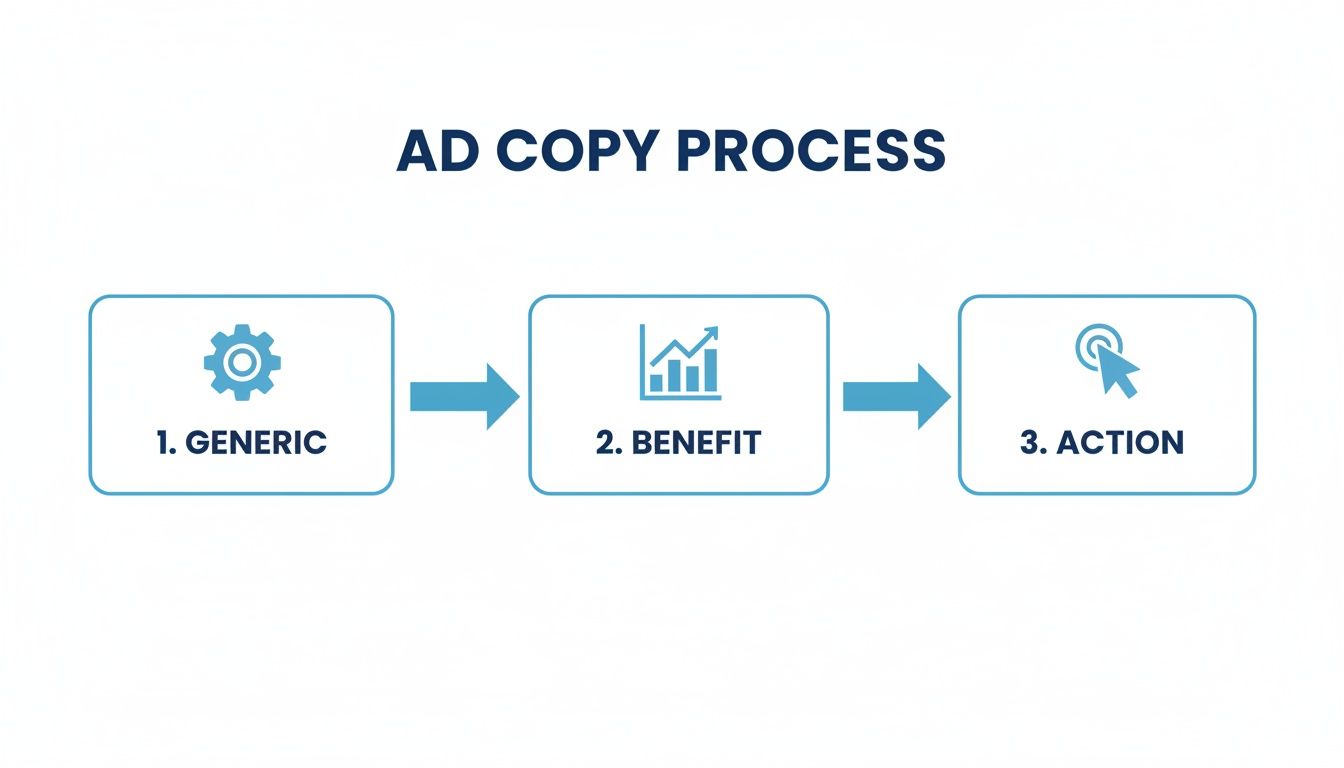
This process guides the user from a basic product feature to a clear benefit, leading them to a direct action. It’s the key to hooking qualified trade buyers.
One of the most common reasons Google Ads fail for building product suppliers is a mismatch between the ad’s message and the landing page’s content. Make sure your page headline mirrors your ad copy perfectly to create a smooth, reassuring journey for the user.
Conversion Tracking and Optimisation
Finally, you can’t fix what you don’t measure. Accurate tracking isn’t a ‘nice-to-have’; it’s completely non-negotiable if you want to prove ROI and make smart decisions.
- Conversion Actions: Have you set up tracking for both ‘Request a Quote’ form submissions and phone calls from your ads? If you’re not tracking both, you’re missing a huge piece of the puzzle.
- Landing Page Performance: Is your landing page actually turning clicks into leads? If the conversion rate is dipping below 2%, that’s a massive red flag. The page needs urgent attention—that could mean simplifying the form, adding trust signals like certifications, or improving the mobile experience.
Working through these points methodically will shine a light on the exact issues holding your campaigns back. For a much deeper dive, you might find the ultimate guide to conducting a comprehensive Google Ads audit useful, as it provides an even more detailed framework for analysis.
Why Most Google Ads Fail for Building Product Suppliers: Frequently Asked Questions
Getting to grips with Google Ads can throw up a lot of questions, especially for building product suppliers trying to cut through the noise in the UK market. Here are some of the most common queries we tackle, designed to give you some clarity and help you steer clear of the usual pitfalls.
How Much Should A Building Product Supplier Budget For Google Ads In The UK?
There’s no magic number, but if you’re serious about a regional campaign, a realistic starting point is between £1,500 and £5,000 per month. This gives you enough firepower to run meaningful tests and gather the data you need in those crucial early stages.
Your final budget really depends on things like how wide a net you’re casting geographically, how fierce the competition is for your keywords, and what your ultimate business goals are. The key isn’t just how much you spend, but how smartly you spend it. With sharp targeting and solid tracking, even a modest budget can pull in a fantastic Return on Ad Spend (ROAS).
Is Google Shopping Or Search Better For Building Supplies? (Why Most Google Ads Fail for Building Product Suppliers)
Honestly, you need both. They work best together, letting you catch buyers at different points in their journey. Think of it as a one-two punch.
- Google Search: This is your go-to for capturing high-intent professionals. They’re the ones actively hunting for specific solutions, technical data sheets, or a local supplier they can trust.
- Google Shopping: This is essential for any product where looks and price are big decision-makers. Think fixtures, flooring, or architectural ironmongery. The visual element is king here.
A really solid strategy these days often includes Performance Max campaigns. These let Google’s AI place your product ads across all its channels, effectively blending the strengths of both Search and Shopping for you.
How Long Does It Take To See Results From A New Google Ads Campaign?
You’ll see traffic almost immediately, but don’t expect miracles overnight. It typically takes a good 60 to 90 days to get to a point where the results are meaningful and consistent. The first month is all about data gathering and initial tweaks—you’ll be trimming keywords and testing out different ad messages.
By month three, assuming the campaign has been actively managed, you should have a clear idea of your cost per lead and your overall ROI. That’s when you can start making strategic calls on where and how to scale your budget for the biggest impact.
What Is A Good Conversion Rate For A Building Supplier’s Website? (Why Most Google Ads Fail for Building Product Suppliers)
General benchmarks float around the 2-4% mark, but for a well-dialled-in campaign targeting trade professionals, you should be aiming higher. For high-value actions like specifiers filling out forms or contractors requesting a quote, you should be targeting a conversion rate of 5% or more.
If your conversion rate is languishing below 2%, that’s a red flag. It points to a serious disconnect somewhere. Often, it’s a mismatch between what the person searched for and what they found on your landing page, or the page itself is just a pain to use.
At PPC Geeks, we specialise in digging into these problems and building high-performance Google Ads campaigns that deliver qualified trade leads, not just clicks. Stop pouring money down the drain. Let us show you how a data-first approach can completely change your ROI. Get your free, in-depth PPC audit today.