




AI native ads are a smarter, more dynamic version of the advertising you’re already used to. They use artificial intelligence to automatically build, place, and tweak ads so they fit perfectly with the content around them. But it goes deeper than that. These ads don’t just copy the look and feel of an article or social media post; they intelligently change their headlines, images, and messaging in real-time, based on who’s looking and what they’re interested in. The result is a far more relevant and less annoying experience for your audience.
What Are AI Native Ads and Why They Matter Now
Think of a chameleon. A traditional native ad is like a chameleon that changes its colour to match a single branch. It blends in, sure, but it stays put. An AI native ad, on the other hand, is a chameleon that not only matches the branch but also shifts its pattern and shade based on who is looking, the time of day, and even the weather. It’s a leap from simple camouflage to truly intelligent, dynamic adaptation.
This built-in intelligence is what really makes them different. While old-school native advertising was all about making an ad look like it belongs, AI adds a powerful layer of automation and prediction. We’re moving beyond basic cosmetic integration to deliver genuine personalisation on a huge scale.
The Shift from Cookies to Context
The need for this kind of tech has exploded with the looming death of third-party cookies. For years, marketers have leaned on cookies to follow users around the web, piecing together profiles to serve targeted ads. In a world that’s becoming more privacy-focused, that whole model is on its last legs.
This is where AI native ads come in as a brilliant solution. Instead of tracking the individual, they get to work understanding the context of what that person is looking at right now. AI algorithms can scan an article or webpage in a split second and serve an ad that’s directly related to the topic at hand.
An ad for sustainable running shoes showing up inside an article about marathon training is a perfect example. The placement is driven by pure contextual relevance, not the user’s past browsing history. It feels helpful, not creepy.
To give you a better idea of how this evolution works, here’s a quick comparison of the old way versus the new.
Traditional Native Ads vs AI-Powered Native Ads
| Feature | Traditional Native Ads | AI Native Ads |
|---|---|---|
| Personalisation | Basic segmentation based on demographics or site-level targeting. | Hyper-personalised creative and messaging for each user. |
| Optimisation | Manual A/B testing, slow and limited in scope. | Continuous, real-time optimisation of thousands of ad variations. |
| Targeting Method | Relies on third-party cookies and user browsing history. | Focuses on contextual relevance and first-party data. |
| Scalability | Difficult to scale personalised campaigns manually. | Delivers personalisation at massive scale automatically. |
| Efficiency | Labour-intensive, requiring constant human oversight. | Highly automated, freeing up marketers for strategic tasks. |
| Adaptability | Static creative that doesn’t change once live. | Dynamic creative that adapts based on performance and user context. |
As you can see, the jump is significant. AI doesn’t just improve native ads; it completely redefines what they’re capable of.
The Power of Automated Optimisation
Another massive win is automated optimisation. Manually A/B testing every single combination of a headline, image, and call-to-action is a thankless, impossible job for any marketing team. AI, however, can run thousands of these tests at once. It quickly learns which combinations get the best results for different audience segments and automatically puts the budget behind the winners.
This constant learning loop means your campaigns get smarter and more efficient over time, driving much better results. These intelligent, self-improving ad formats offer a whole host of benefits:
- Enhanced User Experience: Ads feel less like jarring interruptions and more like genuinely useful content.
- Improved Campaign Performance: Deeper personalisation leads directly to higher engagement and conversion rates.
- Future-Proof Strategy: This approach is perfectly aligned with the industry’s move towards privacy and contextual advertising.
- Increased Efficiency: Automation frees up your team to focus on the big picture—strategy and creativity.
The move towards contextual relevance is already well underway. In the UK, 52% of marketers are planning to increase their use of contextual data in 2025, often using AI to power their native placements. This strategic shift has been shown to slash acquisition costs and can even double conversion rates, making it a must-have tactic for businesses of all sizes. If you want to dig deeper into how artificial intelligence is changing the game, you might find our guide on OpenAI ad services useful.
The Core Technologies Driving AI Native Ads
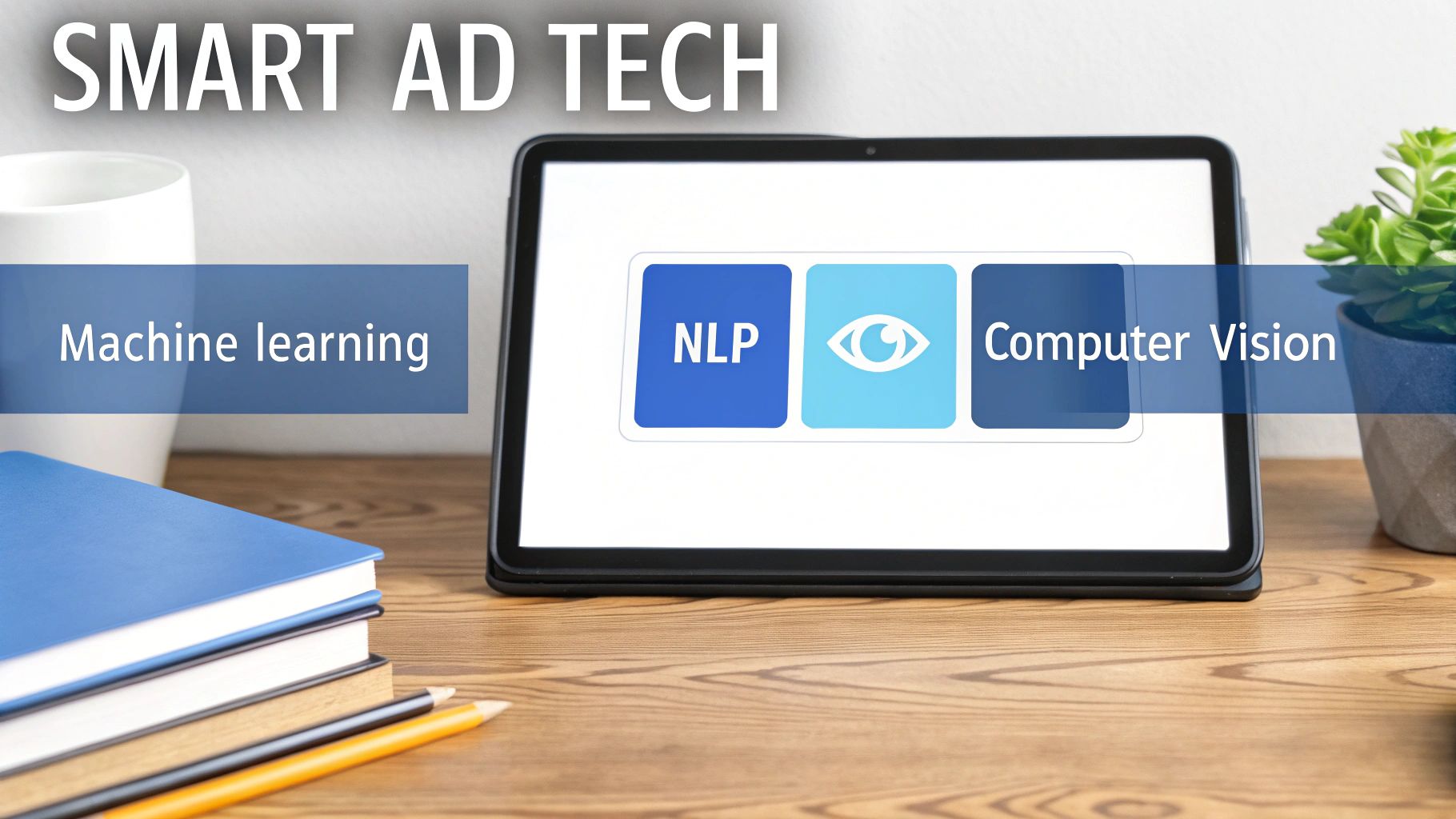
To really get what makes AI native ads tick, you need to lift the bonnet and look at the engine. It’s not just one bit of tech doing all the work; it’s a trio of intelligent systems all pulling in the same direction. These tools work together to turn a simple, static ad into something dynamic and responsive that adapts to its surroundings in real-time.
Think of it like a top-tier Formula 1 pit crew. Every person has their own specialised job, but they all move in perfect harmony to get the car back on the track in record time. In the world of AI native ads, our star players are Machine Learning, Natural Language Processing, and Computer Vision.
Machine Learning: The Predictive Brain
Right at the heart of any AI native ad platform is Machine Learning (ML). This is the predictive brain behind the whole operation. ML algorithms are built to chew through colossal datasets—far more than any person could ever hope to analyse—to spot patterns and predict what’s going to happen next.
For your ad campaign, that means sifting through thousands of data points like user behaviour, the time of day, device type, and the page content itself. The ML model learns which combination of these signals is most likely to result in a click or a purchase.
It’s a bit like a seasoned stock trader who’s spent decades watching the markets. They can glance at the current conditions and make a scarily accurate prediction about whether a stock will climb or fall. In the same way, ML predicts which user is most likely to convert and instantly adjusts ad bids to seize that opportunity at the best possible price. The role of machine learning in PPC is always evolving, giving a massive edge to advertisers who get it.
Natural Language Processing: The Master Wordsmith
Next up in the toolkit is Natural Language Processing (NLP). If Machine Learning is the brain, then NLP is the voice. This is the tech that gives computers the ability to understand, interpret, and even generate human language. When it comes to AI native ads, its main job is to nail the ad copy.
An NLP model can take your core messages and spin them into hundreds of different headlines and descriptions. It then tests these variations across different audiences and placements to figure out which exact wording hits the mark.
For example, it might discover that a headline phrased as a question performs best on a news site, while a more direct, benefit-driven headline smashes it on a lifestyle blog. It automates this entire discovery process at a scale you could never manage by hand.
This tech allows your campaigns to go way beyond one-size-fits-all messaging. It makes sure the text of your ad always feels relevant and persuasive, no matter who’s reading it or where they see it.
Computer Vision: The Creative Eye
The final piece of this puzzle is Computer Vision. This is the AI’s ability to “see” and make sense of images and videos. Just as NLP gets to grips with text, Computer Vision masters the visuals. It analyses the creative assets you upload for a campaign and matches them to the perfect context and user.
This technology can identify objects, settings, and even the mood of an image. It then uses this understanding to make smart choices about which visual to serve up.
Here’s how that works in practice:
- Contextual Matching: It can scan a publisher’s webpage and pick an ad image with a similar look and feel, helping the ad blend in without being jarring.
- Performance Prediction: The AI learns which types of images—say, shots with people versus product-only shots—get the most engagement from specific audience segments.
- Automated Cropping: It can automatically crop an image to fit perfectly into different native ad placements, making sure it always looks sharp without you having to resize everything manually.
Together, these three technologies form a seriously powerful alliance. Machine Learning finds the right person at the right moment, NLP crafts the perfect message, and Computer Vision picks the most compelling image. This incredible synergy is what makes AI native ads so effective, transforming advertising from a game of guesswork into a data-driven science.
Real-World Examples of AI Native Ad Success
Theory is one thing, but seeing how AI native ads actually perform in the wild is where their power really clicks into place. It’s all well and good talking about algorithms and optimisation, but success stories show us what’s possible, turning abstract ideas into tangible business results. By looking at real campaigns, we can see exactly how this tech drives engagement and delivers a proper return on investment.
And these aren’t just stories about massive brands with bottomless budgets. These examples show how AI-powered tools are making top-tier advertising accessible to businesses of all sizes, delivering results that used to be incredibly difficult (and expensive) to achieve by hand. Let’s break down a couple of standout case studies.
Empowering Small Businesses with Newsquest
One of the most powerful examples of AI native ads in action comes from Newsquest Media Group. They were tackling a classic marketing problem: helping small and medium-sized businesses (SMEs) get their stories seen by a wider, yet highly relevant, local audience. Using AI-driven tools, they launched campaigns that delivered phenomenal results for these smaller players.
The campaign pulled in over 75,000 article views—a whopping 66% above their initial target. That figure alone is impressive, but the engagement metrics tell an even better story.
The average time on page for these AI-promoted articles was 1 minute and 31 seconds. This is a huge sign that the ads weren’t just grabbing clicks; they were connecting with a genuinely interested audience who actually stuck around to read the content.
This level of engagement is a direct result of AI’s knack for matching the right content with the right person in the right context. It proves that AI native ads can level the playing field, giving smaller brands a powerful voice in a very crowded market.
Samsung’s Storytelling at Scale
It’s not just small businesses, either. Global giants like Samsung have also jumped on board, using AI-powered native storytelling to connect with audiences in a more authentic way. Instead of just hammering home product features, they use native formats to tell engaging stories that fit naturally with consumer lifestyles and interests—all optimised and scaled by AI.
By feeding their core creative assets into an AI platform, Samsung can generate and test thousands of variations of their native campaigns almost instantly. The AI continuously learns which mix of headline, image, and story angle drives the most shares, comments, and clicks across different platforms and audience segments.
This intelligent approach has allowed them to generate huge social reach and brand lift, far beyond what traditional display ads could ever manage. It really highlights a key benefit of AI native ads for larger companies: keeping the brand message consistent while achieving personalisation on a massive scale.
The success of these campaigns is backed up by wider industry trends. In the UK, marketers are relying more and more on AI to boost their native advertising performance. As we head into the post-cookie era, 52% are planning to increase their use of contextual data in 2025. Native ads already grab 53% more visual attention than banners and can deliver click-through rates up to 8x higher, making them the perfect channel for AI-driven optimisation. You can dig into more of these stats by exploring the latest AI in marketing statistics.
These real-world examples, from local SMEs to global brands, all point to the same conclusion. AI native advertising isn’t some far-off concept; it’s a proven strategy that’s delivering measurable success today, driving deeper engagement and better campaign outcomes across the board.
How to Launch Your First AI Native Ad Campaign
Dipping your toes into AI native ads might seem daunting, but it’s really just a matter of breaking it down into a clear, step-by-step process. A winning campaign isn’t about having the deepest pockets or the biggest team; it’s about being smart, setting clear goals, and then letting the technology do the heavy lifting for you. This guide will walk you through everything from the initial plan to a successful launch.
Your first move, always, is to define what success actually looks like. Are you trying to build brand awareness, get more eyes on a new blog post, or are you hunting for qualified leads to pass to your sales team? Vague goals like “get more clicks” just won’t cut it. You need something specific and measurable.
For instance, a solid objective would be: “Achieve a cost per acquisition (CPA) of £15 for new sign-ups within the first 30 days.” This kind of clarity gives the AI a concrete target to aim for right from the get-go.
Choosing Your Platform and Preparing Assets
Once you know your destination, it’s time to pick the right vehicle. Your choice of platform will hinge almost entirely on where your target audience hangs out online.
- Content Discovery Platforms: Think of services like Taboola and Outbrain. These are the specialists in native advertising, placing your content across a massive network of publisher sites. They’re perfect for top-of-funnel campaigns where your goal is to educate and attract new people.
- Social Media Platforms: Networks like Facebook, Instagram, and LinkedIn have incredibly powerful native ad formats that slide right into user feeds. These are brilliant for targeting precise demographics and interests with high-quality, eye-catching content.
- Search Engines: Even search platforms like Microsoft Advertising are getting deeper into AI native ads. They let you add logos, videos, and stronger calls-to-action to your audience ads, making them blend naturally into the user’s experience.
After you’ve settled on a platform, it’s time to get your creative assets in order. Unlike old-school ads where you’d slave over one “perfect” version, AI native ads are all about variety. You need to give the AI a whole library of components to play with.
Think of it like giving a chef a pantry stocked with top-notch ingredients. The chef (the AI) can then whip up endless combinations to create the perfect dish for every single diner (your audience).
Your creative “pantry” should have plenty of options for each ad element:
- Headlines: Write at least 5-10 different headlines. Play with the tone – some can be questions, others can focus on benefits, and a few can create a bit of urgency.
- Images: Provide a mix of high-quality images. Use product shots, lifestyle photos, and even custom graphics to see what sticks.
- Descriptions: Draft several short descriptions that each highlight a different feature or value proposition.
This approach gives the AI all the raw materials it needs to discover the winning combinations that truly connect with your audience.
This flowchart shows how a great AI ad campaign moves from just getting views to building a genuine connection with your audience.
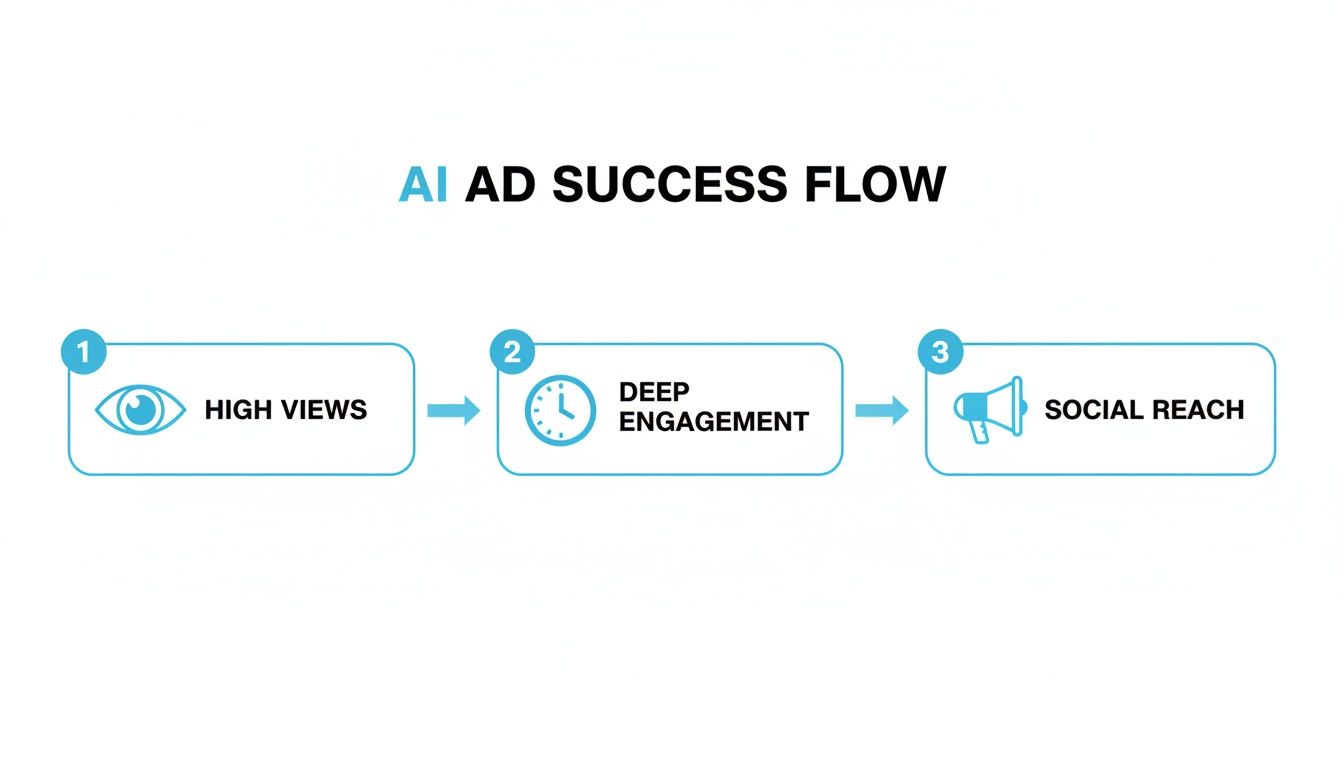
What this shows is that real success isn’t just about the initial eyeballs; it’s about fostering engagement that grows your social reach organically.
Targeting and AI-Powered Optimisation
With your assets ready to go, you can shift your focus to audience targeting and setting up the campaign. This is where AI really starts to flex its muscles. You’ll begin by defining a broad target audience based on demographics or interests, but the AI will quickly start refining it. It chews through real-time performance data to find predictive signals, pinpointing the users most likely to convert in ways that go far beyond simple segmentation.
Many AI native ad campaigns work on principles similar to automated systems in other channels. If you’re curious about the mechanics under the hood, our explainer on what is programmatic advertising offers some great context on how automated ad buying works.
Finally, you’ll switch on the AI-powered optimisation features. This means handing over control of key decisions to the AI, all based on the goal you set earlier.
- Automated A/B Testing: The platform will automatically pit all your creative components against each other to find the combinations that perform best. No more manual testing.
- Smart Bidding: The AI takes over bid management, adjusting bids in real-time. It will bid higher for users it thinks are likely to convert and pull back for those who aren’t, making every penny of your budget work harder.
- Dynamic Creative Optimisation (DCO): The system assembles personalised ads on the fly, matching the perfect headline, image, and description for each individual user and the context they’re in.
Following these steps provides a solid launchpad for your first AI native ad campaign. This approach lets you start smart, learn quickly, and let intelligent automation steer your campaign towards its goals with precision.
To help you stay organised, here’s a quick checklist to run through before you hit the launch button.
AI Native Ad Campaign Launch Checklist
This table breaks down the key actions and success metrics for each phase, ensuring you’ve covered all your bases for a strong start.
| Phase | Key Action | Success Metric |
|---|---|---|
| 1. Strategy | Define a specific, measurable campaign goal (e.g., CPA, ROAS). | A clear primary KPI is established. |
| 2. Platform | Select the ad platform that best aligns with your target audience’s behaviour. | Platform choice is justified by audience data. |
| 3. Creative | Develop a diverse asset library (5-10 headlines, various images, descriptions). | A full range of creative components is uploaded. |
| 4. Targeting | Define initial audience segments based on demographics, interests, or data. | Audience profiles are created in the ad platform. |
| 5. Setup | Configure campaign settings and enable AI optimisation features (bidding, DCO). | Automated bidding and creative optimisation are activated. |
| 6. Launch | Activate the campaign and begin the initial learning phase. | Campaign status is “Active” and impressions are being served. |
| 7. Monitoring | Check initial performance data within the first 24-48 hours. | Ad spend, clicks, and impressions are tracking as expected. |
Sticking to a checklist like this helps demystify the process and makes sure you’re building your campaign on a solid foundation from day one.
Measuring Success and Navigating the Risks
Getting an AI native ad campaign live is a great start, but the real work begins after you launch. A campaign is only as good as the results it delivers, and you need to look beyond surface-level numbers like clicks and impressions to see the full picture.
The true value lies in the key performance indicators (KPIs) that directly impact your bottom line. Vanity metrics might look impressive in a report, but they don’t pay the bills. It’s all about focusing on the hard numbers that prove your ad spend is a smart investment.
Key Performance Indicators That Really Matter
To get a proper handle on how your campaign is doing, you need to prioritise the KPIs that show genuine business growth. These are the metrics that tell you if your AI native ads are actually making a difference.
- Cost Per Acquisition (CPA): This is your efficiency benchmark. It tells you exactly how much you’re spending to get a new customer, whether that’s a sale, a lead, or a new subscriber. A low CPA shows your AI is doing its job, finding and converting the right people without breaking the bank.
- Return On Ad Spend (ROAS): For every quid you put in, how much are you getting back? A strong ROAS is the clearest sign that your advertising is a profitable part of your business, not just another expense on the balance sheet.
- Brand Lift: This one is a bit more subtle but incredibly important. It measures how your ads are changing people’s awareness and perception of your brand. Using surveys and analytics, you can find out if your ads are actually sticking in people’s minds for the right reasons.
Shifting your focus to these metrics changes the conversation from “how many people saw our ad?” to “how did our ads help the business grow?”. If you want to go deeper on this, check out our detailed guide on how to measure advertising effectiveness.
Navigating the Ethical and Regulatory Waters
The power of AI native advertising comes with a big responsibility. Because these ads are designed to blend in so well with the content around them, you have to be completely upfront with your audience. People need to know when they’re looking at an ad.
If you fail here, you don’t just lose trust – you also risk getting into hot water with UK advertising standards. Clear labelling, using simple tags like “Sponsored” or “Ad,” isn’t just a box-ticking exercise. It’s about building an honest, long-term relationship with your audience.
Maintaining user trust is paramount. An ad that feels deceptive, even if it performs well in the short term, can cause long-term damage to your brand’s reputation.
Regulatory bodies are also getting smarter, using AI themselves to keep an eye on things. The UK’s Advertising Standards Authority (ASA) is actively scanning social media to make sure ads are properly disclosed. In a recent sweep of over 50,000 posts, 57% of likely ads were clearly labelled—a big jump from 35% in 2021. But sectors like fashion and travel are still lagging, which shows there’s still work to be done. It’s a clear example of AI’s dual role: creating smarter ads while also helping to enforce the rules, as you can read more about in these IAB UK insights.
The Irreplaceable Role of Human Oversight
As clever as AI is at optimising campaigns, you can’t just set it and forget it. Human oversight is absolutely critical for keeping your strategy on track and your brand safe. An algorithm doesn’t get brand nuance, cultural context, or those tricky ethical grey areas.
Think of yourself as the strategic director. You set the goals, define the brand’s voice, and map out the creative vision. The AI is your tactical officer, executing that strategy with incredible speed and precision.
This partnership is what ensures your campaigns don’t just hit their performance targets but also stay true to your brand’s values. You need to check in regularly to make sure the AI’s automated decisions are still aligned with your big-picture goals. This stops any missteps, like your ads showing up next to dodgy content or sending out the wrong message entirely.
Frequently Asked Questions About AI Native Ads
As marketers start digging into AI native ads, a lot of practical questions pop up. It’s one thing to talk theory, but moving to real-world campaigns means getting clear on budgets, team roles, and where this tech fits in the bigger picture. We’ve answered the most common queries to help you get started with confidence.
How Much Budget Do I Need to Start?
One of the best things about AI native ads is you don’t need a massive budget to get going, which is a big win for small and medium-sized businesses. Many of the big platforms like Taboola or Outbrain let you start with daily budgets as low as £10-£20.
But here’s the catch: for the AI to really work its magic, it needs data. To get enough information for proper optimisation, we recommend setting aside a pilot campaign budget of at least £500-£1,000. This gives the system enough runway to test different creatives, headlines, and audience segments to figure out what actually works.
The key is to start with a test budget you’re comfortable losing. Focus on one clear KPI, like cost-per-click or cost-per-lead, and be ready to scale up once you see good early results and the AI starts delivering a predictable return.
Can AI Completely Replace Humans in Native Advertising?
Nope, not a chance. Think of AI as a powerful assistant that amplifies human creativity and strategy, not something that makes the marketer obsolete. While AI is brilliant at crunching data, optimising bids, and creating ad variations at scale, it completely lacks a nuanced understanding of brand voice, strategic thinking, and the ethical judgement that a human brings to the table.
The most successful AI native campaigns are always a partnership. The marketer is the architect—setting the strategy, defining the audience’s emotional triggers, coming up with the core creative ideas, and ensuring brand safety.
The AI then acts as a super-efficient construction crew, executing that vision with incredible precision and speed. It handles the heavy lifting of testing thousands of ad combinations and personalising delivery in real-time.
This teamwork ensures campaigns are not just data-driven and efficient but also strategically sound and genuinely on-brand.
What Is the Difference Between AI Native and Programmatic Display Ads?
While they both use automation to buy ads, their purpose and format are completely different. Programmatic display ads are what most people think of as online advertising—those visual banners like skyscrapers or leaderboards that sit in designated ad slots. They are very obviously ads.
AI native ads, on the other hand, are designed to blend in. They match the look, feel, and function of the content on the site where they appear, looking more like recommended articles or in-feed posts. This makes for a much less jarring experience for the user.
The ‘AI’ part is what makes them so clever. It personalises the content of these native ads in real-time. So, while programmatic display uses AI to target and bid on ad space, AI native ads use it to target the user and dynamically assemble the ad’s content—the headline, image, and description—to fit seamlessly into the user’s flow. The result is much higher engagement and way less ad fatigue.
How Do AI Native Ads Work in a Cookieless Future?
This is where AI native ads really shine and are becoming a must-have for modern marketers. With third-party cookies on the way out, the old method of tracking individual users across the web is dying. AI native advertising cleverly sidesteps this by focusing on contextual relevance and first-party data instead.
AI algorithms are incredibly good at analysing a webpage’s content in the blink of an eye—the text, images, and overall topic—to understand its context and sentiment. The AI then serves a native ad that’s highly relevant to that specific context, reaching an interested user without needing to know their personal browsing history.
For example, on an article reviewing the best hiking boots for the Peak District, the AI could serve a native ad for a new lightweight waterproof jacket. The placement is driven purely by contextual relevance, not personal data, making it a future-proof strategy that works perfectly in a privacy-first world. It also aligns with the predicted 25% decline in traditional search engine volume by 2026, as advertisers scramble to find effective new formats.
Ready to see what a data-driven, expert-led approach can do for your campaigns? PPC Geeks builds tailored strategies to boost your traffic, leads, and sales while cutting down on wasted spend. Get your free, in-depth PPC audit today and discover your true advertising potential.