
A UK Guide to B2C PPC Campaigns

B2C PPC isn’t just about buying clicks; it’s about making a genuine connection with real people, right at the moment they’re ready to pull out their wallets. Think of it as setting up the perfect shop window on the busiest high street in town, but one that’s laser-focused on attracting shoppers who are actively looking for exactly what you sell. Success boils down to matching the right ad, to the right audience, on the right channel.
Why B2C PPC Is Your Digital High Street
It’s time to stop thinking of pay-per-click advertising as just another expense. It’s one of the most strategic investments you can make in your business, giving you a direct line to consumers who are either actively searching for a solution or are wide open to discovering a new product they’ll love. Unlike old-school advertising that casts a wide, hopeful net, B2C PPC campaigns give you incredible precision, letting you speak directly to your ideal customer.
But the real goal here is to move beyond just drumming up traffic. A winning strategy is all about attracting high-quality visitors—the kind of people who are much more likely to convert into actual paying customers. To do that, you need to get inside the user’s head and understand their mindset on different platforms.
Intent vs Discovery
When someone heads over to Google Search, they have what we call high “solution intent”. They’re typing in phrases like “best running shoes for flat feet” or “next-day flower delivery London” because they have a specific problem that needs solving, right now. Your ad pops up as the immediate answer, catching them at their absolute peak moment of interest.
Now, contrast that with someone scrolling through Facebook or Instagram. They’re in a “discovery mindset”. They aren’t actively hunting for your product, but a stunning ad for a stylish jacket or a clever kitchen gadget can easily spark an impulse buy. This is where you don’t just fulfil demand—you create it.
The art of a great B2C PPC campaign lies in balancing these two worlds. You capture the immediate, high-intent demand on search engines while simultaneously building brand awareness and generating new interest on social platforms.
Nailing this strategic balance is absolutely essential for getting a strong return on your investment. It ensures you’re not just throwing money at clicks, but are actually building a sustainable pipeline of new customers. It’s no wonder that over 68% of UK SMEs are already running paid search ads; they see it as a vital channel for growth.
Ultimately, PPC is about understanding the customer journey and being present at the most critical touchpoints. It’s not just about a single sale; it’s about acquiring a new customer efficiently. That initial acquisition is just the first step. To see how this initial investment pays off in the long run, check out our guide on understanding customer lifetime value.
Choosing Your B2C PPC Advertising Channels
Deciding where to put your ad budget is one of the first, and most important, calls you’ll make when setting up a B2C PPC campaign. It isn’t about spraying your ads everywhere and hoping for the best. It’s about being smart and showing up in the right place, at the right time.
Think of it like setting up a physical shop. You wouldn’t open a high-end boutique in the middle of an industrial estate, would you? The same logic applies online. You need to place your digital storefront where your ideal customers are already hanging out, whether they’re actively searching for a solution or just scrolling through their social feeds.
Each channel has its own vibe, its own audience, and a completely different user mindset.
This infographic breaks down the fundamental split between active, search-based advertising and the more discovery-led world of social ads.
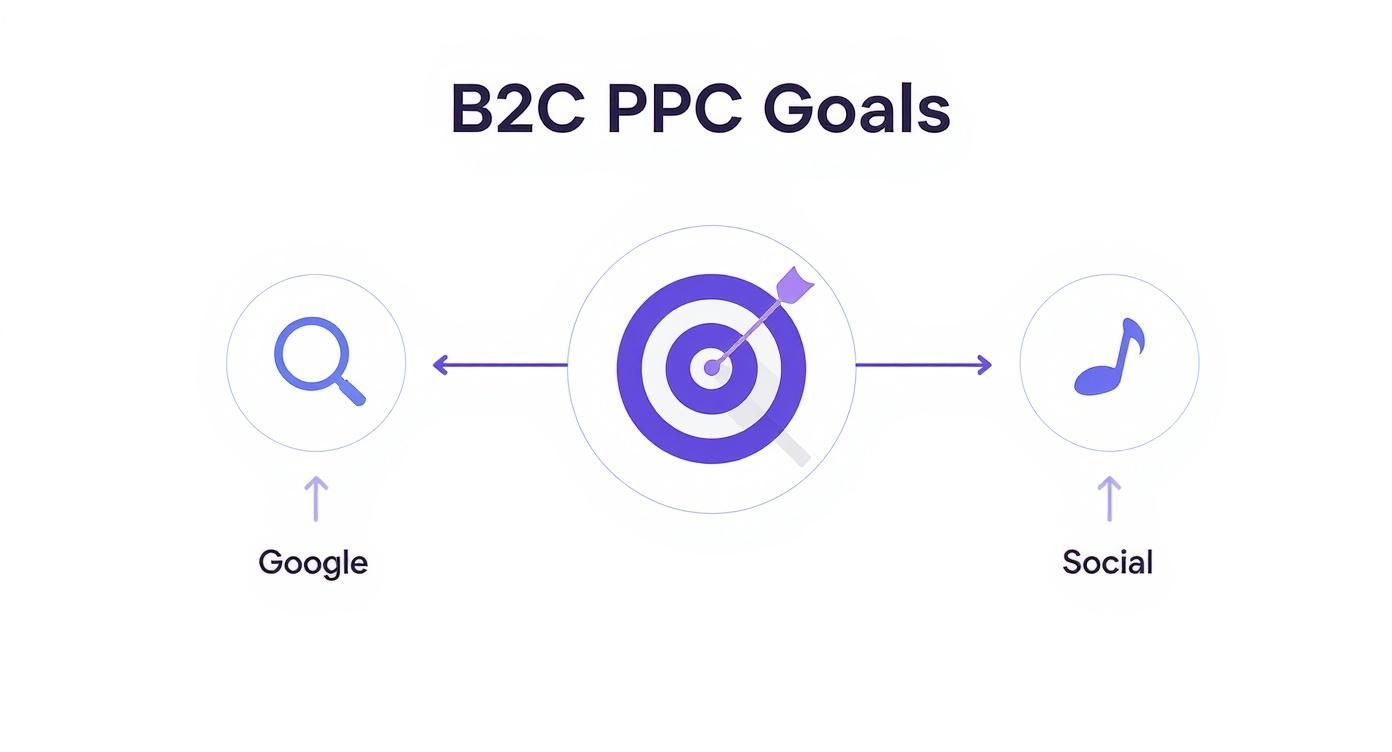
As you can see, a solid strategy needs to cover both bases: catching high-intent users on platforms like Google while also reaching more passive audiences on social media. This is how you capture the full spectrum of customer behaviour.
To help you navigate this, here’s a quick guide to the main players and where they fit into a typical UK B2C strategy.
B2C PPC Channel Selection Guide for UK Businesses
| Channel | Best For | Audience Intent | Typical UK B2C Use Case |
|---|---|---|---|
| Google Ads (Search & Shopping) | Capturing immediate, active demand from people ready to buy. | High | A user searches “next day flower delivery London.” Your florist’s ad appears instantly. |
| Performance Max | Maximising reach and conversions across all of Google’s channels automatically. | Varies (High to Low) | An online fashion brand wants to drive sales across YouTube, Search, and Gmail in one campaign. |
| Meta Ads (Facebook & Instagram) | Creating new demand and building brand awareness with visual, engaging ads. | Low to Medium | A new vegan snack brand targets users interested in health and wellness to introduce their product. |
| Microsoft Advertising | Reaching a slightly different, often older demographic with less competition. | High | A financial services company targets professionals searching for “ISA accounts” on Bing. |
| Amazon Ads | Dominating the point of sale for products sold directly on Amazon. | Very High | A seller of phone cases runs sponsored product ads to appear at the top of search results on Amazon. |
Let’s dig a little deeper into how these channels work in practice.
Capturing Active Demand with Google Ads
When a UK consumer has a problem they need to solve right now, their first port of call is almost always Google. This is where you find your hottest prospects—people who are actively looking to buy what you sell.
- Google Search Ads: These are the classic text ads you see at the top of the search results. They are perfect for grabbing someone who types in exactly what you offer, like “waterproof walking boots for women.” You’re providing an immediate answer to their specific need.
- Google Shopping Ads: If you run an ecommerce brand, these are an absolute must. That visual carousel of products lets people compare prices and pictures right there on the results page, making it a ridiculously powerful way to drive direct sales.
- Performance Max (PMax): This is Google’s all-in-one, goal-based campaign type. It uses machine learning to plaster your ads across Google’s entire network—Search, Display, YouTube, Gmail, you name it—to hunt down converting customers wherever they might be.
B2C PPC: Creating Demand on Social and Other Platforms
While Google is brilliant for capturing existing demand, social media is where you create it.
Platforms like Meta (Facebook & Instagram) are masters at helping you find new audiences who didn’t even know they needed your product yet. Their targeting is incredibly powerful, letting you zero in on users based on their interests, demographics, and online behaviours. It’s the perfect playground for sparking impulse buys and building that all-important brand awareness.
Paid social is becoming a huge part of the B2C PPC mix here in the UK. In fact, spending is projected to grow at an annual rate of 14%, driven by the unstoppable rise of platforms like TikTok. This shows just how much confidence businesses have in social PPC for generating leads and getting their name out there.
For a head-to-head on the two biggest players, check out our deep dive on Google Ads vs Facebook Ads.
Key Takeaway: A smart B2C PPC strategy doesn’t choose between search and social; it uses both. Use Google to mop up customers who are ready to buy today, and use social media to build a pipeline of future customers by getting your brand on their radar.
And don’t forget these other vital channels for UK businesses:
- Microsoft Ads: Often overlooked, but this platform can be a proper goldmine. It typically has less competition and a lower cost-per-click than Google, and it reaches a slightly different demographic that can be incredibly valuable.
- Amazon Ads: If you sell products on Amazon, running ads on the platform is non-negotiable. It’s the best way to cut through the noise, stand out from the competition, and drive sales right at the point of purchase.
Structuring Your B2C PPC Campaigns for Maximum Impact
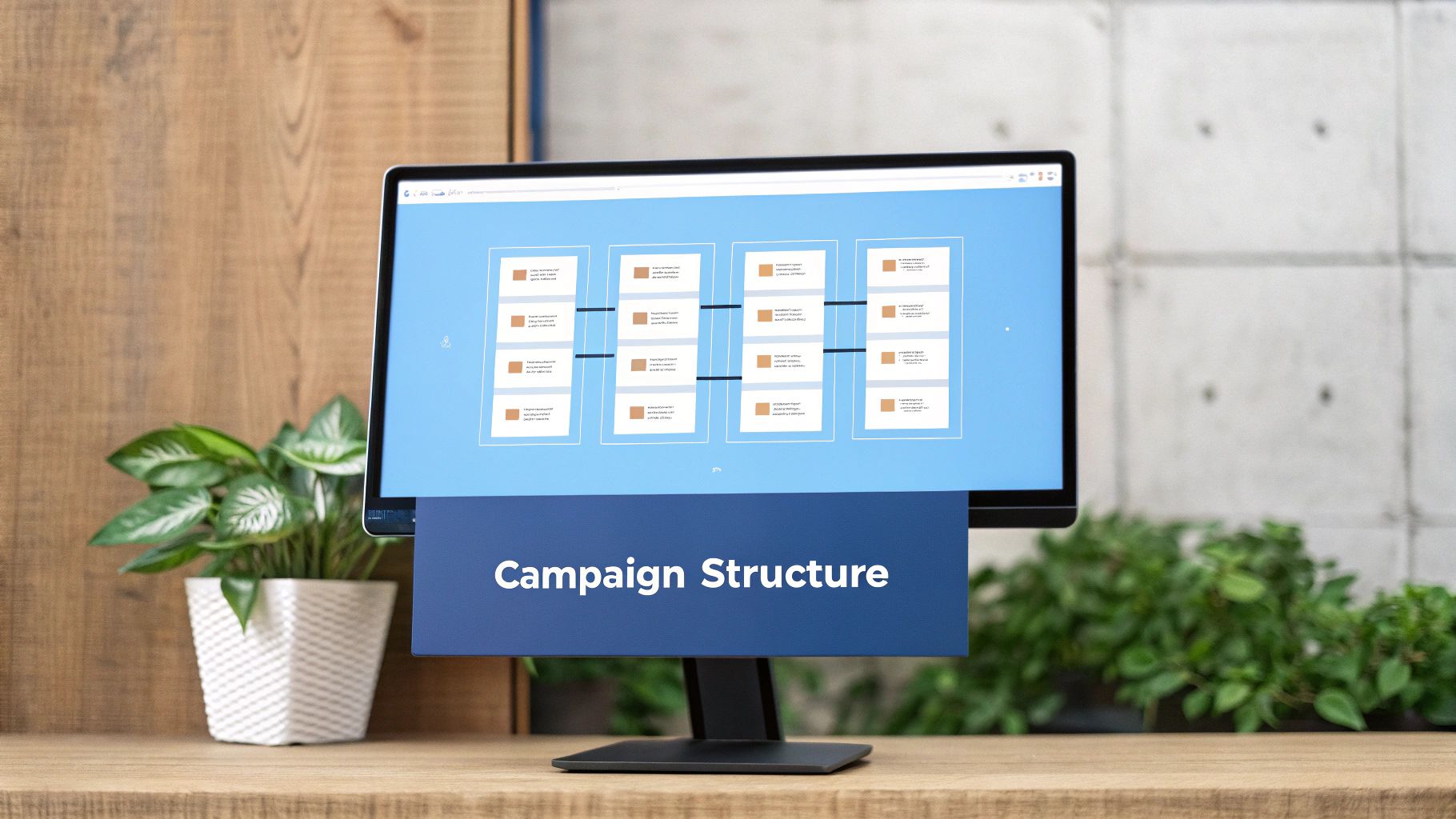
A messy, disorganised campaign structure is one of the fastest ways to burn through your ad spend. Think of your PPC account like a well-run shop. A good one has clear aisles and sections, making it dead easy for customers to find what they need and for you to manage your stock. A bad one is a jumble sale where everything’s thrown together, leaving customers confused and you with no clue what’s actually selling.
Your B2C PPC campaigns need that same level of organisation. A logical structure ensures your ads are hyper-relevant to what people are searching for, and Google rewards that relevance with better ad positions and lower costs. It also makes your account infinitely easier to manage, analyse, and scale up. Without it, you’re just guessing.
The goal is to build a setup where every keyword, ad, and landing page works together in perfect harmony. This alignment creates a smooth customer journey that dramatically boosts your chances of making a sale.
Building Your Campaign Foundation
The highest level of organisation is the campaign. This is where you set your core budget, location targeting, and overall goals. Best practice is to create separate campaigns for different parts of your business, which gives you complete control over where your budget goes.
You can split your campaigns in a few logical ways:
- Product or Service Categories: This is the most common and effective method for ecommerce. For example, a clothing brand would have separate campaigns for ‘Men’s Trousers’, ‘Women’s Dresses’, and ‘Children’s Shoes’.
- Brands You Sell: If you stock multiple brands, creating campaigns for each one (e.g., a ‘Nike’ campaign and an ‘Adidas’ campaign) lets you tailor messaging and budgets specifically to those brand-loyal searchers.
- Promotions or Sales: Running a special offer? A dedicated campaign for your ‘Summer Sale’ or ‘Black Friday Deals’ lets you control its budget and schedule without messing with your evergreen campaigns.
Getting this top-level separation right is your first big step toward an efficient and scalable account.
Getting Granular with Ad Groups (B2C PPC)
Once your campaigns are set, the next layer down is the ad group. Each campaign will hold multiple ad groups, and this is where the real magic of relevance happens. An ad group is simply a small, tightly-themed collection of keywords that all trigger the same set of ads.
The golden rule of ad groups is to keep them specific. A well-structured ad group focuses on a single, narrow theme. This ensures the user’s search query is a near-perfect match for the ad they see and the landing page they visit.
For instance, within your ‘Men’s Trousers’ campaign, you wouldn’t just chuck all your keywords in together. Instead, you’d create separate, granular ad groups:
- Ad Group 1: Keywords like “men’s slim fit jeans,” “dark wash slim jeans.”
- Ad Group 2: Keywords like “men’s formal work trousers,” “black smart trousers.”
- Ad Group 3: Keywords like “men’s comfortable joggers,” “grey cotton joggers.”
Each of these ad groups would have its own specific ad copy. The ‘slim fit jeans’ group gets ads talking about denim styles and fits, while the ‘formal trousers’ group gets ads focused on office wear. This precision is exactly what drives higher click-through rates and, ultimately, better conversion rates.
Choosing Your Bidding Strategy
With your structure in place, you need to tell Google how you want to bid in the ad auction. Bidding strategies range from full manual control to complete automation, each with its own pros and cons for B2C advertisers.
- Manual CPC (Cost-Per-Click): You set the maximum amount you’re willing to pay for each individual click. This gives you ultimate control but requires constant monitoring and adjustment. It’s often best for small campaigns or for experienced managers who want to be very hands-on.
- Automated Bidding: This is where you let Google’s machine learning do the heavy lifting. You set a goal, and the algorithm adjusts your bids in real-time to hit it.
The two most popular automated strategies for B2C ecommerce are:
- Target CPA (Cost Per Acquisition): You tell Google the maximum you’re willing to pay for a conversion (like a sale), and it will aim to deliver conversions at that average cost.
- Target ROAS (Return On Ad Spend): You set a target return for every pound you spend. For example, a target ROAS of 500% means you want to generate £5 in revenue for every £1 of ad spend.
For most UK SMEs, automated or Smart Bidding is the way forward. It saves a huge amount of time and can analyse thousands of signals in real-time to set the perfect bid—something no human could ever do. To get a better handle on these powerful options, it’s worth reading more about how Google Ads Smart Bidding can work for your business. This approach lets you focus on the big-picture strategy while the machine handles the minute-to-minute tactics.
B2C PPC: Crafting Ad Copy That Actually Converts
You can have the most perfectly structured campaign in the world, but if your ad copy doesn’t speak to real people, you’re essentially just renting expensive, empty ad space. Great ad copy is the absolute engine of your B2C PPC campaigns. It’s the critical bridge between someone typing a query into Google and deciding your website is worth a visit.
Your copy needs to do more than just list what you sell; it has to persuade, entice, and build a flicker of trust, all within a few seconds.
Think of your ad headline as your shop window. It has to be eye-catching and instantly show the customer you have what they’re looking for. The description that follows? That’s your friendly shop assistant, pointing out the best bits and giving them a compelling reason to come inside. On the crowded digital high street, bland, generic ads are just scrolled past and forgotten.
Speaking Your Customer’s Language
The best ad copy works because it tunes into the customer’s needs and emotions, not just your product’s specs. Someone searching for a “waterproof jacket” isn’t just buying a piece of fabric; they’re buying the feeling of being warm and dry on a drizzly hike. Your copy has to tap into that desire.
This means highlighting your Unique Selling Points (USPs) in a way that truly matters to a UK shopper. Simple promises like ‘Free UK Delivery’ or ‘Next-Day Shipping Available’ are incredibly powerful. They tackle common worries about hidden costs and waiting times head-on, smoothing the path to a purchase.
Your ad’s job isn’t to sell the product—it’s to sell the click. It must create enough curiosity and trust to convince someone that your website holds the answer they are looking for.
Lead with the benefit, always. Instead of a flat “We Sell Durable Hiking Boots,” try something like “Stay Dry on Any Trail with Our Waterproof Hiking Boots.” The first one is all about you; the second is all about them. To get this right consistently, it’s worth exploring different ad copy frameworks that provide a solid structure for your messaging.
Good vs Bad Ad Copy Examples (B2C PPC)
Let’s break down a couple of real-world examples. It’s amazing what a few small tweaks can do.
Scenario 1: A UK Fashion Brand
- Bad Copy: ‘Summer Dresses for Sale – Various Styles Available – Shop Our Collection Now’
- Why it’s bad: It’s generic, dull, and tells the user nothing they couldn’t have guessed. It will blend into the background with every other clothing ad.
- Good Copy: ‘Effortless Summer Dresses | Free UK Delivery – 100% Organic Cotton. Lightweight & Breathable. Shop New Season Styles!’
- Why it works: This is packed with value. It highlights tangible benefits (organic cotton, lightweight), a killer USP (free delivery), and creates urgency (‘New Season’).
Scenario 2: A Home Services Business (e.g., Plumbing)
- Bad Copy: ‘Plumber in Manchester – Call Us for a Quote’
- Why it’s bad: It’s functional but builds zero trust. When your pipe has burst, you need reassurance, not just a phone number.
- Good Copy: ’24/7 Emergency Plumber Manchester | No Call-Out Fee – Gas Safe Registered. 5-Star Rated. Get a Fast, Free Quote Online!’
- Why it works: This copy hits all the right notes for someone in a panic. It addresses the immediate need (24/7, emergency) while building instant credibility with social proof (‘5-Star Rated’) and trust signals (‘Gas Safe Registered’). And offering ‘No Call-Out Fee’ is a massive USP that will make it stand out.
The Power of Ad Extensions
Think of ad extensions as your secret weapon. They are extra bits of information you can bolt onto your main ads, making them bigger, more useful, and far more likely to get clicked. Frankly, using them is non-negotiable.
Extensions make your ad take up more prime real estate on the results page, which shoves your competitors further down and can give your Click-Through Rate (CTR) a serious boost.
Make sure you’re using a healthy mix of relevant extensions:
- Sitelinks: Add direct links to important pages like ‘Shop the Sale’, ‘New Arrivals’, or ‘Contact Us’.
- Callouts: Use short, punchy phrases to highlight key benefits, such as ‘Next-Day Delivery’ or ‘Easy Returns’.
- Structured Snippets: Show off specific aspects of what you offer, like listing the ‘Brands’ or ‘Styles’ you stock.
- Image Extensions: Nothing grabs attention like a picture. Adding a visual to your search ad makes it pop off the page.
Finally, every single ad needs a strong, clear Call-to-Action (CTA). Don’t leave people guessing. Tell them exactly what to do next. Use active, commanding language like ‘Shop the Sale Now’, ‘Get Your Free Quote’, or ‘Book Your Appointment Today’. A simple instruction makes all the difference.
Measuring Performance to Drive Profitability
Getting your B2C PPC campaigns live is just the first step. The real work—and the path to profitability—begins now. It’s all about listening to what the data is telling you and making smart, calculated tweaks along the way. Without solid measurement, you’re essentially flying blind, throwing money at ads and just hoping for the best.
Data is your compass in the world of PPC. It cuts through the guesswork and gut feelings, showing you exactly which ads are hitting the mark with your customers and which are just wasting your budget. This isn’t about finding one single magic number. It’s about understanding a handful of core metrics that, together, paint a full picture of your campaign’s health and its real impact on your bottom line.
Your Core PPC Performance Indicators
To make any sense of your performance, you need to track the right Key Performance Indicators (KPIs). Think of these as the vital signs of your campaign. Each one tells a different part of the story, from the very first click right through to the final sale. Focusing on these core few will keep you from getting lost in a sea of data.
Here are the absolute non-negotiables for any B2C campaign:
- Click-Through Rate (CTR): This is simply the percentage of people who see your ad and actually bother to click it. A high CTR is a fantastic sign that your ad copy and targeting are resonating with your audience.
- Conversion Rate: This metric tracks the percentage of clicks that turn into something valuable, like a purchase, a form fill, or even a phone call. This is where you find out if your landing page is doing its job and turning visitors into customers.
- Cost Per Acquisition (CPA): This is the average amount you pay to get one new customer. Nailing down your CPA is crucial for understanding if your PPC efforts are genuinely profitable. A good customer acquisition cost calculator can make this much simpler.
- Return On Ad Spend (ROAS): This is the big one—the ultimate measure of profitability. It tells you how much revenue you’re generating for every pound you put into advertising. A 5:1 ROAS, for instance, means you’re making £5 for every £1 you spend.
Getting to grips with these key performance indicators for digital marketing is the bedrock of smart campaign management. It’s what allows you to move beyond just driving traffic and start driving real, measurable profit.
Creating a Rhythm of Optimisation
Consistent, proactive optimisation is what separates the campaigns that succeed from the ones that just burn cash. You need a repeatable schedule—a checklist of tasks for each week and month—to stay on top of performance and constantly refine your strategy. This isn’t about making massive changes every day; it’s about making small, informed improvements that compound over time.
Keeping an eye on industry benchmarks gives you valuable context. On average, UK Google Ads see a click-through rate of around 7.37% and conversion rates near 6.96%. This routine ensures you’re always steering your campaigns in the right direction.
Optimisation isn’t a one-off task; it’s a continuous cycle of analysing data, testing hypotheses, and implementing changes. This methodical process is your key to unlocking sustainable, long-term growth.
A structured approach like this stops you from making panicked, reactive decisions and instead builds a solid foundation for scalable success.
Your Practical Optimisation Checklist
To make this manageable, I’ve put together a simple checklist broken down by frequency. This helps create a routine that keeps your campaigns healthy without feeling overwhelming.
| UK B2C PPC Optimisation Checklist |
| :— | :— | :— | :— |
| Frequency | Task | Key Metric to Check | Action to Consider |
| Weekly | Review Search Term Reports | Irrelevant search terms | Add irrelevant terms as negative keywords to stop wasting budget. |
| Weekly | Analyse Ad Performance | CTR, Conversion Rate | Pause the worst-performing ads. Test a new headline on your best ad. |
| Weekly | Check Budgets | Daily budget spend | Reallocate budget from underperforming campaigns to your winners. |
| Monthly | Analyse Device Performance | CPA, Conversion Rate by device | Increase or decrease bids on mobile, desktop, and tablet based on profitability. |
| Monthly | Review Geographic Performance | Conversions, CPA by location | Focus more budget on high-performing cities or regions. Exclude poor ones. |
| Monthly | Evaluate Bidding Strategy | Target CPA/ROAS vs Actual | Assess if your automated bid strategy is hitting its goal. Is the target realistic? |
This structured approach is your best bet for turning good campaigns into great ones. Sticking to a schedule ensures you’re always making data-led decisions to improve performance and drive more profit for your business.
Your B2C PPC Questions Answered
Even the most buttoned-up PPC strategy throws up a few curveballs now and then. In this section, we’ll tackle some of the most common head-scratchers we hear from UK businesses, giving you straightforward answers to help you get unstuck and back to growing.
How Much Should I Spend on PPC?
There’s no magic number here, but the best way to figure it out is to work backwards from what you want to achieve. Start by looking at your average customer lifetime value (LTV) and decide what you’re happy to pay for a new customer – your target CPA.
As a rule of thumb, your starting budget needs to be chunky enough to get you at least 10-20 conversions a month. This gives the ad platforms enough data to learn what’s working and start optimising properly. For a small UK ecommerce brand, that might mean starting with a budget somewhere between £500 to £1,500 per month. Think of this initial spend as an investment in data. Once you see what’s delivering, you can pour more fuel on the fire with confidence.
Why Are My Ads Getting Clicks but No Sales?
Ah, the classic PPC problem! Nine times out of ten, the issue isn’t your ad – it’s the handshake between your ad and your landing page. When someone clicks your ad, they’re arriving with a specific expectation. If your landing page doesn’t instantly meet that expectation, they’re gone.
Have a look for these common culprits:
- Message Mismatch: Does the headline on your landing page perfectly match the promise in your ad?
- Poor User Experience: Is the page a nightmare to load on mobile? Is it confusing to get around?
- Unclear Call-to-Action: Is it blindingly obvious what you want them to do next?
A click is just the beginning of the conversation. The landing page is where you close the deal. Ensure it provides a seamless, trustworthy experience that makes it easy for the visitor to convert.
Should I Bid on My Own Brand Name?
Yes, absolutely. It might feel like you’re paying for clicks you’d get for free anyway, but bidding on your brand name is a crucial defensive move. If you don’t, you can bet your competitors will. They’ll happily stick their ads above your organic result, pinching customers who were looking for you specifically.
Plus, bidding on your own brand is incredibly cheap. Clicks are usually pennies, click-through rates are sky-high, and they convert like a dream. It’s a tiny price to pay to protect your most valuable traffic and completely own the message right at the finish line.
Ready to stop guessing and start getting real results from your PPC spend? The team at PPC Geeks builds data-driven campaigns that increase traffic, leads, and sales while eliminating wasted budget. Get your free, in-depth PPC audit today.
Author

Search Blog
Free PPC Audit
Subscribe to our Newsletter

The Voices of Our Success: Your Words, Our Pride
Don't just take our word for it. With over 100+ five-star reviews, we let our work-and our satisfied clients-speak for us.

"We have been working with PPC Geeks for around 6 months and have found Mark and the team to be very impressive. Having worked with a few companies in this and similar sectors, I rate PPC Geeks as the strongest I have come across. They have taken time to understand our business, our market and competitors and supported us to devise a strategy to generate business. I value the expertise Mark and his team provide and trust them to make the best recommendations for the long-term."
~ Just Go, Alasdair Anderson