




Let’s get one thing straight: you don’t pay for “ChatGPT ad pricing” like you’d buy a billboard or a TV slot. You’re not buying ad space on ChatGPT. Instead, you’re paying to access a seriously powerful AI tool that can help you create, fine-tune, and even automate your advertising campaigns on platforms like Google and Meta. The cost really just boils down to which version of the tool you use – it could be a simple monthly subscription or a more flexible pay-as-you-go model.
Understanding ChatGPT Pricing for Advertising
Think of ChatGPT less as an advertising platform and more as your new super-skilled copywriter, data analyst, and creative strategist all rolled into one. The money you spend is for its brainpower, not for placing an ad. For UK businesses, getting your head around this difference is the first crucial step to budgeting for AI in your marketing mix.
To really see why this is different, it helps to know how traditional digital advertising works. This complete guide to PPC advertising explains how costs are usually tied directly to clicks or views, which is a world away from ChatGPT’s utility-based pricing.
The Core Pricing Tiers for Ad Creation
The “price” for using ChatGPT in your advertising essentially falls into three main buckets. Each one is built for a different kind of user, from a solo entrepreneur tinkering with ideas to a massive agency churning out campaigns.
Let’s break them down.
ChatGPT Ad Pricing Models for Advertising at a Glance
To make it simple, here’s a quick comparison of the main ways you can pay to use ChatGPT for your advertising tasks. This should help you figure out which option aligns best with your needs and budget.
| Pricing Model | Cost Structure | Ideal for Ad Use Case | Best Suited For |
|---|---|---|---|
| ChatGPT Plus | Fixed monthly subscription | Brainstorming ad copy, keyword ideas, creating customer personas | Individuals, freelancers, and small teams |
| API Access | Pay-as-you-go (per token) | Automating ad creation, generating thousands of variations, custom integrations | Agencies, developers, businesses needing scalability |
| Enterprise Plan | Custom pricing | Large-scale automation, advanced security, dedicated team support | Large organisations with complex security and usage needs |
Each of these tiers offers a different level of power and control. A small e-commerce shop might find everything it needs in a simple Plus subscription, whereas a digital marketing agency will quickly see the value in the API’s sheer scalability.
- ChatGPT Plus: This is your straightforward monthly subscription. It’s perfect for individuals and small teams who need a creative partner for brainstorming ad copy, dreaming up keyword lists, or fleshing out customer personas.
- API Access: This is a pay-as-you-go model where you’re charged for the amount of text you process. It’s the go-to for anyone looking to automate tasks, like generating hundreds of ad variations for A/B testing or plugging AI directly into their existing software.
- Enterprise Plan: This is the bespoke, custom-priced solution for big players. It’s designed for large organisations that need top-tier security, basically unlimited usage, and dedicated support for their teams.
The UK has jumped on the AI bandwagon in a big way. Consumers are already spending around £5 million every week on ChatGPT Plus subscriptions alone, which shows just how hungry businesses are to weave AI into their daily work.
The real win here isn’t just making ads faster. It’s about discovering creative angles and testing campaign ideas that would have been far too time-consuming or expensive to even attempt manually. ChatGPT puts high-volume creative testing within reach for everyone.
So, which tier is right for you? It all comes down to your advertising goals and how much you need to produce. A small online shop will likely get massive value from the Plus subscription, while a busy marketing agency managing multiple clients will want the power and scalability of the API.
For a deeper look at how to put this all into practice, check out our guide on mastering ChatGPT for UK brands.
ChatGPT Ad Pricing: How API Token Costs Actually Work
So, you’ve decided the standard ChatGPT Plus subscription is a bit too restrictive for your advertising ambitions. It’s time to look under the bonnet at the API. Now, don’t let terms like “API” and “tokens” throw you off – the concept is actually pretty simple.
Think of it like a pay-as-you-go mobile plan. Instead of a flat monthly fee, you only pay for what you actually use.
In the world of ChatGPT, tokens are the currency. A token is just a small piece of a word, and on average, one token equals about four characters of English text. Every single thing you do through the API—from feeding it a prompt to getting back some fresh ad copy—is measured and billed in these tokens. This super-granular approach means you only ever pay for the exact amount of AI brainpower you tap into.
Input vs Output: The Two-Way Cost
Here’s a crucial detail you need to get your head around: API pricing makes a distinction between “input” and “output” tokens. You get charged for both the text you send to the model (input) and the text the model generates for you (output).
Why? Because both actions chew up computing power. Giving the AI a detailed brief for a new Facebook campaign uses up input tokens, and the killer ad variations it spits out in return will cost you output tokens.
You’ll often notice that output tokens are a tad more expensive. That’s because it’s a much heavier lift for the AI to generate brand new, coherent text than it is to simply read and process your initial request. For instance, with the powerful GPT-4o model, you might be looking at around £3.95 per million input tokens but £11.85 per million output tokens.
This screenshot from OpenAI’s own pricing page lays out the different rates for various models.
As you can see, the newer, more capable models like GPT-4o have different price points compared to the older versions. It’s a classic trade-off between power and price.
What This Means for Creating Ads (ChatGPT Ad Pricing)
Right, let’s bring this back to the real world of making ads. How do tokens stack up in a practical sense?
- Generating 10 Ad Headlines: Your prompt, “Create 10 catchy headlines for a summer shoe sale,” is your input. The 10 headlines ChatGPT creates are your output. A quick prompt like that might only be 15 tokens, while the headlines it generates could be around 150 tokens.
The pay-as-you-go model puts seriously sophisticated AI within reach. For just a few pence, you can generate hundreds of ad variations—a job that would take a human copywriter hours. This opens the door to rapid A/B testing and creative brainstorming on a scale that was previously unimaginable for most small businesses.
This model is a game-changer, especially for e-commerce brands needing to pump out product descriptions or ad copy in bulk. As you start to explore automation, getting a grip on these costs is vital. You can find out more about how new monetisation features affect brands by reading our guide on OpenAI’s commission model in ChatGPT.
Ultimately, every character counts, which makes learning to write efficient prompts a key skill for keeping your spending in check.
So, What Does This Cost in the Real World?
Theory is one thing, but let’s talk brass tacks. How do these token costs translate into actual pounds and pence when you’re creating a real advertising campaign for your UK business?
Seeing these numbers in action is where it all starts to make sense. Once you break down a few common scenarios, you’ll see just how ridiculously cheap the API can be. A tiny investment unlocks a massive amount of creative firepower, completely changing how you can approach your campaigns.
Scenario 1: Generating Google Ads Variations
Picture this: you’re launching a new product and want to A/B test your ad copy properly. Your goal is to create 50 unique ad variations for a Google Search campaign. Each one needs two headlines and a description.
- Your Prompt (Input): A good, detailed prompt explaining your product, who you’re selling to, and your key selling points might come in at around 300 tokens.
- The AI’s Response (Output): The 50 unique ads, with all their different headlines and descriptions, would probably generate about 4,000 tokens of text.
Running this through GPT-4o’s current pricing (roughly £3.95 per million input tokens and £11.85 per million output tokens), the maths is simple. The input cost is so small it’s basically free—less than a penny. The output cost for those 4,000 tokens works out to about £0.05.
That’s right. For just five pence, you get 50 different ads ready to test.
This infographic breaks down that fundamental cost difference between what you send (input) and what you get back (output).
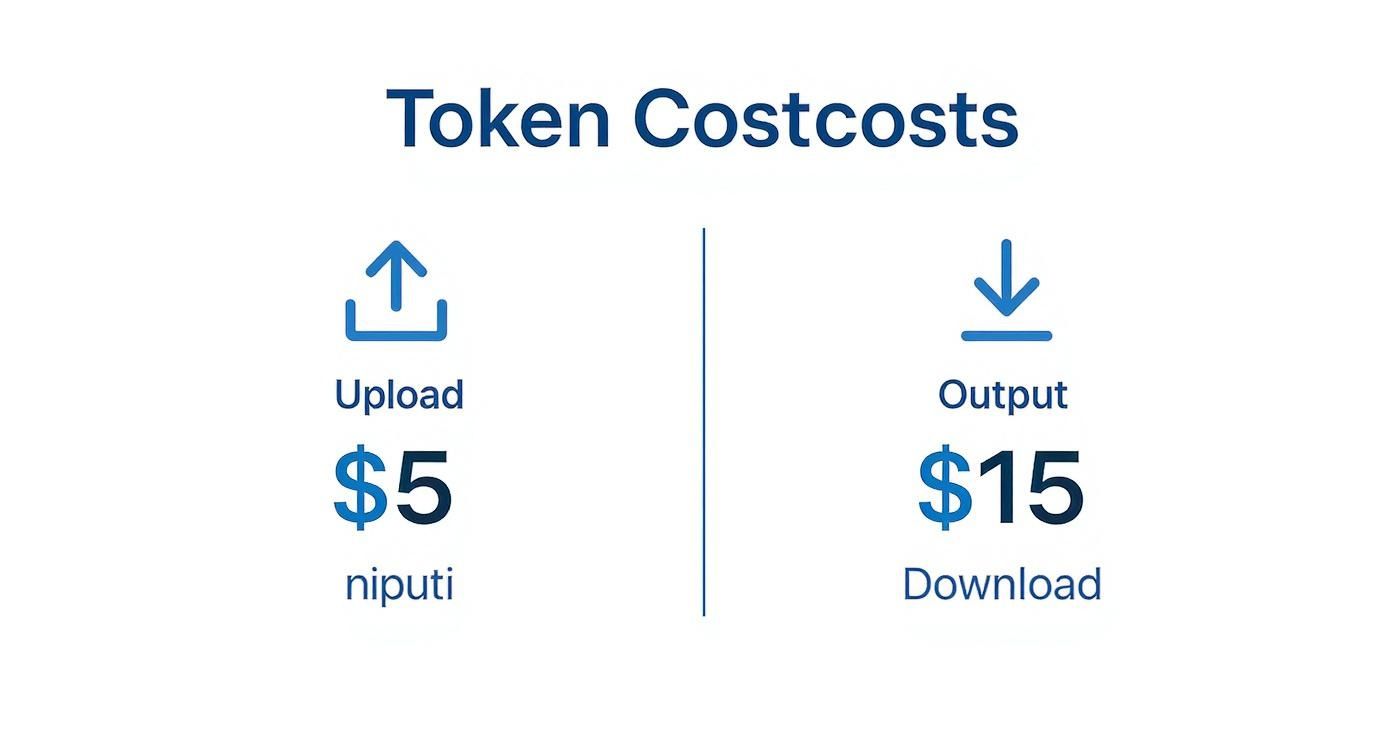
As you can see, the real cost is in the content the AI creates for you. This is why learning to write sharp, efficient prompts is your secret weapon for keeping costs down.
To help you get a sense of typical costs, here’s a quick breakdown of what you might expect to pay for common advertising jobs using the GPT-4o API.
Sample ChatGPT Ad Task Cost Breakdown (Using GPT-4o API)
| Advertising Task | Estimated Tokens | Estimated Cost (£) |
|---|---|---|
| Generate 50 Google Ad variations | 4,300 (300 in, 4,000 out) | £0.05 |
| Brainstorm 100 long-tail keywords | 2,200 (200 in, 2,000 out) | £0.02 |
| Create 5 detailed customer personas | 3,300 (300 in, 3,000 out) | £0.04 |
| Draft a 500-word landing page | 1,250 (150 in, 1,100 out) | £0.01 |
| Write 10 engaging social media posts | 2,700 (200 in, 2,500 out) | £0.03 |
These numbers show that the power of the API isn’t about one big, expensive task. It’s about running thousands of tiny, creative jobs at scale for pennies each time.
Scenario 2: Brainstorming Keywords and Building Personas
Let’s try another one. You’re building a new campaign from scratch and need a solid foundation. The job is to brainstorm 100 new long-tail keywords and develop five detailed customer personas to make sure your targeting and messaging are spot on.
- Your Prompt (Input): You’d need to provide some business context, a few seed keywords, and what you want in your personas. This might use about 400 tokens.
- The AI’s Response (Output): A list of 100 keywords plus five rich, detailed personas would likely generate around 5,000 tokens.
The total cost for all that strategic groundwork? Roughly £0.06. For six pence, you’ve got a solid strategic base that could easily take a marketing team hours, if not days, to pull together by hand.
The cost isn’t in single big charges but in the cumulative total of thousands of small, efficient tasks. The power of the API lies in its ability to execute these creative jobs at scale for pennies.
Getting a handle on these micro-costs is crucial because they feed directly into your campaign’s profitability. To see the bigger picture, you can plug these savings into our customer acquisition cost calculator and see how cutting content creation time impacts your bottom line. Armed with these numbers, you can start building a realistic budget for bringing AI into your advertising workflow.
ChatGPT Ad Pricing: How to Maximise ROI and Minimise Your Spend

Getting a handle on your potential ChatGPT ad costs is one thing, but optimising that spend is where you really start to pull ahead of the competition. The game isn’t just about spending less; it’s about making every single penny you put into AI work harder for your ad campaigns. It all comes down to being clever about how and when you use different AI models.
If you can get a few smart habits dialled in, you can slash your token consumption and funnel your AI budget directly into better ad performance and a much stronger return on investment. It all starts with picking the right tool for the job.
Be Strategic with Model Selection
Not every advertising task needs the most powerful—and most expensive—AI model you can get your hands on. The absolute key to cost control is matching the model to the complexity of the task. It stops you from overpaying for simple jobs.
Think of it like choosing a vehicle for a delivery. You wouldn’t fire up a massive lorry just to drop a letter at the local post office; a bicycle is way more efficient. It’s the same principle here. You should save the powerhouse models like GPT-4o for tasks that demand real creativity and nuance, like crafting a brand’s entire voice from scratch or brainstorming a high-level campaign strategy.
For the more straightforward jobs, drop down to a more affordable model like GPT-3.5 Turbo. It’s perfect for things like:
- Basic Keyword Generation: Quickly rattling off hundreds of initial keyword ideas.
- Simple Ad Copy Rewrites: Rephrasing existing headlines or descriptions with a different spin.
- Data Formatting: Tidying up messy lists or organising product info into neat tables.
Using the right model for the right task is easily the most effective way to cut your API bill without losing quality where it counts.
Master the Art of the Prompt (ChatGPT Ad Pricing)
The quality of your input has a direct impact on the cost and quality of your output. A vague, lazy prompt will almost always give you a generic, unhelpful response, forcing you to try again… and again. Every one of those attempts eats up more tokens, wasting both your time and your money.
Prompt engineering is your greatest cost-saving skill. Crafting a precise, detailed instruction set gets you the perfect output on the first try, effectively halving your token cost for that task.
For instance, instead of just asking, “Write some ad copy,” a much better prompt would be: “Act as a senior copywriter for a UK-based sustainable shoe brand. Write three Google Ads headlines (max 30 characters each) and one description (max 90 characters) for our new vegan leather trainers. Highlight our free UK delivery and use an encouraging, eco-conscious tone.” This level of detail practically guarantees you’ll get usable results right away.
To really nail down the impact of your marketing efforts, tools like an ROI calculator can give you brilliant insights into what’s actually working.
Finally, and this is a big one, always set usage limits in your OpenAI account dashboard. Setting both a soft limit (which pings you with an alert) and a hard limit (which cuts off usage) is a crucial safety net. It means a runaway script or an experiment gone wrong won’t land you with a shock bill, giving you complete peace of mind over your ChatGPT ad pricing.
Of course. Here is the rewritten section, crafted to sound like an experienced human expert, following your specific style and formatting requirements.
ChatGPT Ad Pricing: When to Consider Enterprise and Fine-Tuning
While ChatGPT Plus and the API pack a serious punch for most businesses, there comes a tipping point where the standard options just don’t cut it anymore.
If you’re a larger agency juggling dozens of client accounts, or a brand operating at a massive scale, you’ll eventually need to look at more specialised, heavy-duty solutions like Enterprise and fine-tuning. These aren’t just small upgrades; they’re a completely different way of weaving AI into your advertising workflow.
Knowing when to make that jump is crucial. Are your teams constantly hitting usage limits? Have data security and compliance suddenly become top-of-mind conversations? If so, that’s a pretty clear sign you’ve outgrown the pay-as-you-go model.
Stepping Up to ChatGPT Enterprise
Think of ChatGPT Enterprise as the all-inclusive, premium package built for serious, large-scale operations. It ditches the token-based ChatGPT ad pricing for a custom setup that puts performance, security, and control front and centre. For a busy advertising agency, this is a total game-changer.
Here’s how it directly impacts ad creation:
- Unlimited High-Speed Access: No more frustrating slowdowns or getting throttled. Your team can pump out campaigns, analyse performance data, and brainstorm ideas without a single interruption. Productivity won’t take a nosedive, even during your busiest periods.
- Enhanced Security and Privacy: Enterprise-level security is a big deal. It means your client’s data, your secret-sauce campaign strategies, and all that proprietary ad copy stay completely confidential. Crucially, none of it gets used to train OpenAI’s public models.
- Larger Context Windows: This is a huge one. It lets you feed the AI much more information in one go. You can upload an entire brand style guide or pull in performance reports from multiple campaigns to make sure every single ad is perfectly on-brand and backed by real data.
Brand consistency is everything for a large agency. Enterprise makes sure that whether you’re creating ads for Client A or Client B, the AI sticks to their unique voice every time, using that bigger context window to stay accurate across thousands of different outputs.
Fine-Tuning for a Custom-Built Edge (ChatGPT Ad Pricing)
Beyond Enterprise, there’s an even more powerful play: fine-tuning. This is where you graduate from using a generalist AI to training a specialist model on your own data.
Imagine teaching ChatGPT to write ads in your specific brand voice by showing it thousands of your best-performing campaigns from the past. That’s fine-tuning.
You’re essentially taking a base model, like GPT-4, and giving it extra schooling with your own dataset. The result is a bespoke AI that just gets what makes your audience tick. Instead of wasting time prompting it with your brand voice, it already knows it inside and out. It’s a more complex and costly route, for sure, but it allows the AI to generate hyper-relevant ad copy that’s already optimised for your goals from the very first word.
ChatGPT vs a Digital Marketing Agency
With AI making waves in marketing, it’s the big question on every business owner’s mind: can ChatGPT just replace my digital marketing agency?
The honest answer is no. But that’s the wrong question to be asking. The real magic happens when you understand what each brings to the table and use them together.
Think of ChatGPT as a phenomenal execution tool. It’s your tireless junior copywriter, ready to churn out hundreds of ad variations for A/B testing in minutes. Need a dozen creative angles before your morning coffee? Done. For high-volume, tactical jobs that would otherwise eat up hours of manual work, its speed and cost-effectiveness are simply unbeatable.
An agency, on the other hand, provides something AI just can’t: strategic oversight.
Where Human Expertise Wins
A top-tier agency doesn’t just write ads; they build a comprehensive strategy. This is the deep work – analysing the market, figuring out where your competitors are vulnerable, and translating complex performance data into smart, actionable decisions.
An agency brings the human insight needed to answer the crucial “why” behind the numbers, a skill AI has yet to crack. They provide accountability and years of experience, steering your entire campaign towards real business goals, not just vanity metrics. They feel the subtle shifts in audience sentiment and know how to pivot your strategy before you start losing money.
For a deeper dive, take a look at this comparison of a ChatGPT-powered campaign versus an agency-led one – it really highlights the difference.
The smartest play isn’t picking one over the other. It’s about letting ChatGPT handle the heavy lifting of tactical execution, which frees up your agency to focus on high-level strategy, deep analysis, and genuine growth.
Ultimately, ChatGPT is the engine, but a great agency is the experienced driver who knows the destination, the shortcuts, and how to navigate the inevitable roadblocks. Combine the raw power of AI with human strategic expertise, and you’ve got a recipe for allocating your budget more effectively, nailing both tactical efficiency and long-term growth.
Frequently Asked Questions
Is a ChatGPT Plus Subscription Enough for My Small Business?
For a lot of small businesses, jumping on the £20 per month ChatGPT Plus plan is a fantastic first step. It’s ideal for kicking around ad ideas, bashing out copy for a couple of campaigns, or drafting a few social media updates.
But here’s the thing: if your ambition is to start automating ad creation or pumping out hundreds of ad variations, you’ll hit the limits of Plus pretty quickly. That’s when you’ll need to step up to the API, which works on a separate pay-as-you-go model built for that kind of heavy lifting.
How Do I Keep Track of My ChatGPT API Spending?
OpenAI gives you a handy dashboard right in your account settings. Just head over to the ‘Usage’ tab, and you can see your token consumption in almost real-time. More importantly, this is where you can set your spending limits.
We can’t stress this enough: set both soft limits (which just ping you a notification) and hard limits (which stop API access cold). Think of it as a crucial safety net to stop any runaway costs from blowing a hole in your budget.
Honestly, getting these controls in place is a must-do before you even think about automating anything.
Does This ChatGPT Pricing Include My Actual Ad Spend?
No, and it’s vital to get this straight. The ChatGPT ad pricing we’re talking about here is completely separate from the money you pay platforms like Google or Meta to actually run your ads.
The costs covered in this guide are purely for using the AI tool to create the ad content itself. You still need to budget for and pay your advertising platforms directly for the media placement. It’s like paying a copywriter for the script, not the TV station for the airtime.
Feeling a bit lost in the technical weeds? The expert team at PPC Geeks can take the reins, managing your campaigns from top to bottom. We use advanced tools to get the most out of your budget, without the headache. Get your free PPC audit today.