




Using ChatGPT for your paid campaigns is a bit like having a super-sharp junior strategist on your team. It can seriously speed things up, from brainstorming ad copy and researching audiences to analysing what’s actually working. The end goal? Better results, faster.
ChatGPT Paid Campaigns: Setting the Stage for AI-Powered PPC Success
Jumping straight into writing prompts without a clear plan is like setting sail without a map. To get genuinely useful results from ChatGPT for your paid campaigns, you first need to lay a solid foundation. Honestly, this initial setup is the most important part of the whole process because it dictates the quality of everything the AI spits out.
Success starts with knowing exactly what you want to achieve. Are you after qualified B2B leads, more e-commerce sales, or just getting your brand name out there? Your answer shapes the entire campaign. Vague goals like “get more traffic” will only get you generic, uninspired outputs from the AI.
You need to be specific. A goal like “increase marketing qualified leads by 15% in Q3″ gives the AI a clear target to work towards. This level of focus is why so many businesses are sticking with it; in the UK, the retention rate for paid ChatGPT users is a massive 82%, which shows people are pretty happy once they get it dialled in.
Defining Your Core Campaign Elements
Once your main objective is locked in, you need to brief the AI with all the essential context. Think of ChatGPT as a new team member who needs to be brought up to speed on your brand and what you’re trying to do.
A good brief should cover:
- Target Audience Persona: Who are you actually talking to? Get into the details – their demographics, what keeps them up at night, what motivates them, and where they hang out online.
- Brand Voice and Tone: Show, don’t just tell. Paste in some examples of your marketing copy. Are you professional and serious, or witty and informal?
- Unique Value Proposition (UVP): In simple terms, what makes you different from everyone else? Nail this down clearly.
- Key Performance Indicators (KPIs): How will you measure success? Be specific about metrics like Cost Per Acquisition (CPA), Click-Through Rate (CTR), or Return on Ad Spend (ROAS).
To get the best out of any AI tool, you have to feed it quality information first. Bad inputs will always lead to bad outputs. The table below breaks down the essential information you should provide to ChatGPT before asking it to create anything for your campaigns.
Essential Inputs for High-Quality AI Outputs
| Information Category | Why It’s Important | Example Input Snippet |
|---|---|---|
| Detailed Persona | Ensures the tone, language, and messaging resonate with your ideal customer. Generic outputs won’t connect. | “Our target customer is ‘Eco-conscious Ellie,’ a 32-year-old urban professional who values sustainability and ethical sourcing. Her pain point is finding stylish, eco-friendly home goods that don’t cost a fortune.” |
| Brand Voice Guide | Keeps all AI-generated copy consistent with your established brand identity, avoiding a robotic or off-brand feel. | “Our brand voice is witty, slightly irreverent, but always helpful. Think Innocent Drinks but for SaaS. Avoid corporate jargon at all costs. Here’s a recent blog post for reference: [link]” |
| Product/Service UVP | Helps the AI craft compelling ad copy that highlights what makes you the best choice over competitors. | “Our unique value proposition is that we offer the only carbon-neutral delivery service in London, backed by a 100% satisfaction guarantee. Competitors are faster, but we are greener.” |
| Campaign Goal & KPIs | Aligns the AI’s suggestions with your specific business objectives, ensuring the outputs are strategic, not just creative. | “The primary goal of this campaign is to drive free trial sign-ups. Our target CPA is £25, and we’re aiming for a 5% conversion rate on the landing page.” |
Providing this level of detail transforms ChatGPT from a generic writing tool into a focused campaign assistant that understands your specific needs.
This simple process flow shows how you can structure your setup for any campaign you’re building with AI.
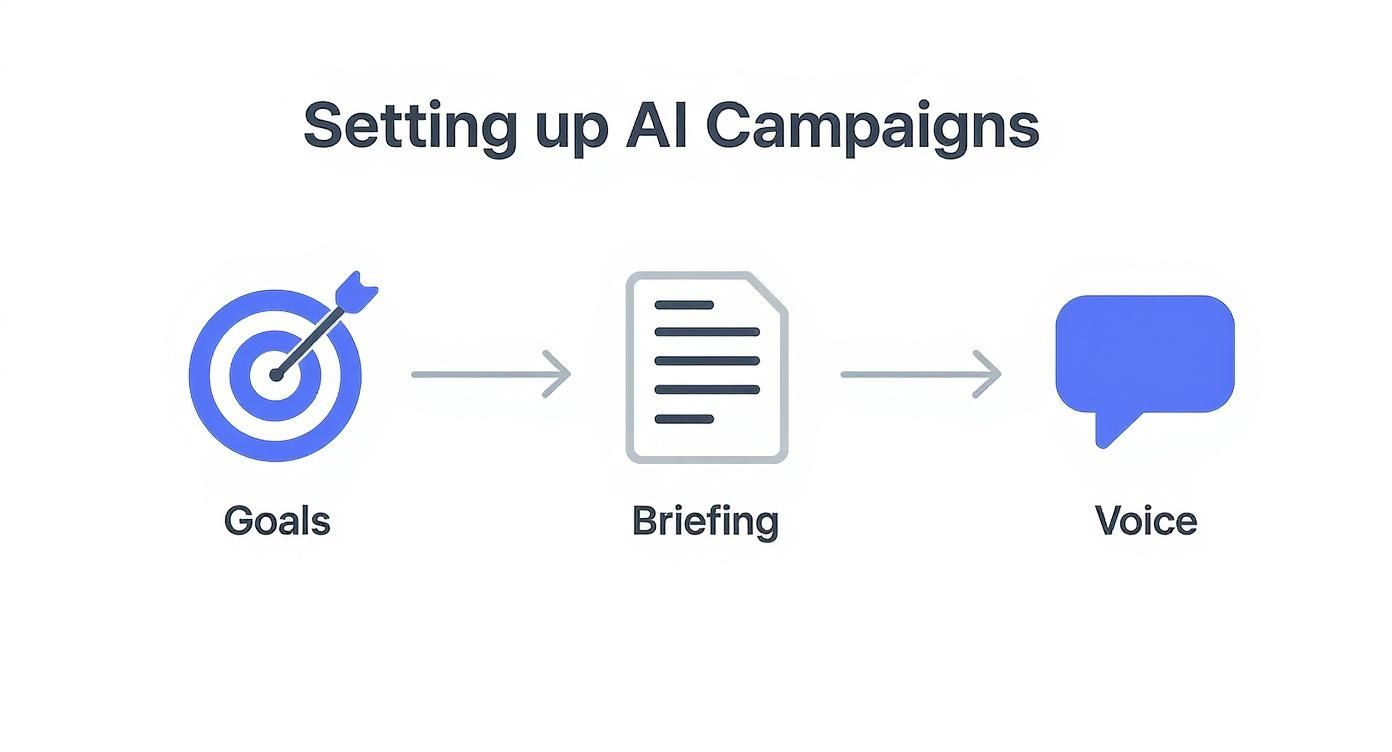
As the visual shows, a clear goal directly informs your briefing, which then defines the voice and style of everything that follows.
To really nail this, it helps to understand a bit about what makes the AI tick. Grasping the key ChatGPT ranking factors can help you write prompts that get you better results. This strategic thinking is becoming even more vital as we head into a new era of search where AI is baked right into the results pages, as you can read more about here: https://ppcgeeks.co.uk/ppc/ads-in-ai-overviews-and-ai-mode-a-new-era-of-search-advertising/.
Get this foundational work right, and you’ll ensure every piece of content the AI generates is sharp, on-brand, and laser-focused on hitting your targets.
Generating High-Converting Ad Copy with ChatGPT
This is where the theory hits the road. Using ChatGPT to come up with ad copy that actually works is where you see the real value. It’s time to move beyond simple, one-line requests and start crafting prompts that get you copy that drives genuine action. The secret isn’t just asking for “an ad” – it’s telling the AI how to write it.
What does that look like in practice? It means instructing ChatGPT to adopt specific emotional tones that match where your customer is in their journey. Someone just realising they have a problem needs a reassuring, educational tone. On the other hand, a user who’s ready to pull the trigger and buy will respond much better to a sense of urgency.
Think about the massive difference between promoting a complex B2B SaaS product and a local plumbing service. The SaaS campaign needs copy hammering home efficiency, ROI, and security. The plumber? They need copy that screams trust, speed, and reliability. Getting this right comes down to your prompting skills. By exploring modern prompt engineering techniques, you can take precise control of the AI’s output for pretty much any scenario you can think of.
Crafting Specific and Actionable Prompts (ChatGPT Paid Campaigns)
Vague prompts get you vague, useless copy. It’s that simple. To get something compelling, you have to feed the AI detailed instructions and context. So, instead of a lazy prompt like “headlines for my SaaS product,” try giving it a proper brief.
A much better prompt for, say, a project management tool would be:
“Act as an expert PPC copywriter. Generate five unique Google Ads headlines (30 characters max) and two descriptions (90 characters max) for our project management tool, ‘TaskFlow.’ Our target audience is marketing managers in the UK who struggle with missed deadlines. Emphasise our key benefit: ‘centralised team collaboration that saves 10 hours per week.’ Use an aspirational and efficient tone.”
See the difference? This level of detail forces the output to be laser-focused on the right audience, their specific pain point, and the most powerful benefit. You’re already miles ahead of generic AI copy. For a deeper dive into crafting prompts like this, check out our ultimate guide to mastering ChatGPT for UK brands over at https://ppcgeeks.co.uk/marketing/mastering-chatgpt-the-ultimate-guide-for-uk-brands/.
Scaling A/B Testing with AI Variations
Here’s where ChatGPT becomes a serious superpower for any paid media specialist: generating ad variations at scale. It allows you to rapidly churn out multiple versions of headlines and descriptions for A/B testing, which is the absolute bedrock of campaign optimisation.
Instead of sitting there trying to manually brainstorm different angles, you can just tell ChatGPT to reframe your core message in countless ways.
- Hit a Pain Point: “Rewrite this ad description to really focus on the frustration of using spreadsheets for project management.”
- Shout About a Benefit: “Create three new headlines that highlight the ’10 hours saved per week’ benefit.”
- Switch Up the Tone: “Adapt this ad copy to sound more urgent, using phrases like ‘Limited Time’ or ‘Don’t Miss Out’.”
- Target a Niche Segment: “Tweak this ad so it speaks directly to managers of remote teams.”
This isn’t just about saving time, though that’s a huge plus. It gives you a structured way to test different psychological triggers and messaging frameworks. By systematically creating and testing these AI-powered variations, you can quickly discover what truly resonates with your audience. The result? Higher click-through rates and, most importantly, a much better return on your ad spend.
ChatGPT Paid Campaigns: Uncovering Keywords and Audience Insights
Winning ChatGPT paid campaigns aren’t just about throwing clever ad copy at the wall and seeing what sticks. They’re built on a solid foundation of understanding who you’re talking to and exactly what they’re searching for. This is where you can turn ChatGPT into a powerful research partner, helping you dig deeper than the obvious and spot strategic opportunities your competitors might be missing.
Great campaigns start with precise targeting. While many of us are familiar with the best free keyword research tools (you can find a great list here: https://ppcgeeks.co.uk/ppc/best-free-keyword-research-tools/), ChatGPT brings a new layer of speed and creativity to the game. It’s not just about spitting out a list of keywords; it’s about grasping the intent behind them.
For instance, you can prompt the AI to group terms by user intent. Think separating informational queries like “how to fix a leaky tap” from high-value transactional ones like “emergency plumber near me.” This simple step allows you to tailor your ad groups and messaging far more effectively from the get-go.
From Keywords to Personas
Keywords are only half the story. To truly connect, you need to know the person behind the search query. This is where ChatGPT really shines, helping you build out detailed audience personas based on the information you feed it. You can ask it to flesh out their pain points, what drives them, and even where they hang out online.
Prompt Example: “Act as a market researcher. Our product is a sustainable coffee subscription box. Create a detailed persona for our ideal customer. I want to know their daily challenges, what they value in a brand, where they get their news, and the key phrases they’d use when searching for eco-friendly products.”
Getting this level of deep insight is invaluable. It completely changes how you write your ads, shifting from generic copy to messaging that speaks directly to your audience’s real needs and desires. That’s how you make your campaigns more resonant and, ultimately, more effective.
Analysing Competitors and Finding Gaps
Another brilliant use case is competitive analysis. You can feed ChatGPT the ad copy or landing page text from your main rivals and ask it to identify their core messaging, unique selling points, and potential weaknesses. This gives you a serious strategic edge, helping you spot gaps in the market that your campaign can fill.
- Expand Your Reach: Use it to brainstorm long-tail keywords your competitors are probably ignoring.
- Refine Your Negatives: Ask it to generate a solid list of negative keywords to stop you from wasting money on irrelevant clicks.
- Group by Intent: Instruct it to organise a messy keyword list into practical themes like ‘problem-aware’ or ‘solution-seeking’.
It’s no surprise that marketers are adopting these techniques so quickly. Recent data shows that ChatGPT’s audience in the UK shot up by 112% in just one year, reaching a massive 15.1 million monthly users. It’s fast becoming a standard tool in the marketing toolkit. Using it for research not only saves a huge amount of time but also provides a fresh perspective, helping you build campaigns that are more targeted and, in the end, more profitable.
Writing Landing Page Copy That Converts
Getting someone to click your ad is only half the battle. If your landing page doesn’t deliver on the ad’s promise, that click is just wasted budget. The real magic happens when you convert that hard-won traffic, and for that, your landing page is everything. Using ChatGPT to nail your landing page copy can be a game-changer for your conversion rates.
It all starts with something we call message match. Think about it: if a user clicks your ad because it shouts “50% discount on winter jackets,” the very first thing they see on the landing page should echo that exact offer. Anything less feels like a bait-and-switch. This consistency is crucial—it builds instant trust and tells visitors they’re in the right place.
Crafting Page Elements That Actually Persuade (ChatGPT Paid Campaigns)
A landing page that converts is much more than a killer headline. It’s a well-oiled machine, with every part working together to guide the visitor toward one clear action. You can actually use ChatGPT to write compelling copy for each piece of the puzzle.
- Benefit-Driven Headlines: Don’t just state what your product is. Ask the AI to frame the headline around what the customer actually gets out of it—the desired result.
- Persuasive Body Copy: Your goal here is clarity, not a wall of text. Get ChatGPT to write short, easy-to-scan paragraphs that build on your main benefits, tackle common objections head-on, and make a solid case for why you’re the best choice.
- Trust-Building Social Proof: Got some glowing customer testimonials or case studies? Feed the summaries to the AI and ask it to weave them naturally into the page copy. Nothing builds credibility like hearing from happy customers.
- Clear Calls-to-Action (CTAs): A weak CTA can kill your conversion rate. Have the AI generate a few different versions that are direct, action-focused, and maybe even create a little urgency. Think “Get Your Free Quote Now” or “Claim Your Discount Today.”
When every word on the page has a clear purpose, you’re on the right track. For a much deeper dive into what makes a landing page work, check out our guide on landing page best practices.
A Smart Framework for AI-Powered A/B Testing
This is where ChatGPT really shines: generating A/B testing ideas without the usual guesswork. Instead of just trying random things, you can set up a structured way to test different angles on your page.
Prompt Example: “Act as a conversion rate optimisation expert. I’m testing the headline on my landing page. Based on this copy [paste your landing page copy], generate three alternative headlines. Hypothesis A should focus on scarcity, Hypothesis B should highlight a key benefit, and Hypothesis C needs to use social proof.”
This approach gives you a strategic way to test different psychological triggers to see what clicks with your audience. It’s so effective that top industries in the UK using ChatGPT, like advertising, legal, and media, lean on it heavily for this kind of creative generation. Systematically testing these AI-generated variations is one of the fastest ways to figure out what messaging truly resonates, helping you steadily improve your campaign’s ROI.
ChatGPT Paid Campaigns: Using AI for Performance Analysis and Reporting

Once your campaigns are humming along and the data starts trickling in, the real graft begins. But instead of getting lost in a sea of spreadsheets, you can bring in ChatGPT as your analytical co-pilot. This is where it moves beyond just writing content and becomes a seriously powerful tool for making smart decisions with your ChatGPT paid campaigns.
The trick is to treat it like a keen junior analyst. You can literally copy-paste raw data straight from your Google Ads or Facebook Ads exports and ask it to find the story hidden in the numbers. This one move can slash the time you spend sifting through data, freeing you up to think about the bigger picture and strategy.
Turning Raw Data Into Clear Insights
Picture this: you’ve just downloaded your weekly performance report. It’s an intimidating wall of metrics – impressions, clicks, conversions, and cost-per-acquisition (CPA) scattered across dozens of ad groups. Forget about manual filtering and pivot tables. Instead, give the AI a direct instruction.
Prompt Example: “Here is my campaign data for the last seven days [paste data]. Summarise the key performance trends in bullet points. Identify the top 3 best-performing ad groups by conversion volume and the worst-performing ad group by CPA. Suggest one potential reason for the poor performance.”
A simple prompt like that instantly cuts through the noise. The AI will crunch the numbers, do the calculations, and lay out the most critical information in plain English. You’ll be able to spot your wins and tackle problems in a fraction of the time.
This approach turns reporting from a tedious chore into a proper strategic exercise. You’re not just describing what happened; you’re starting a conversation about why it happened and what you should do next.
Asking Deeper Diagnostic Questions
After you’ve got that high-level summary, it’s time to dig in. If ChatGPT points out a sudden drop in your Click-Through Rate (CTR), your next prompt can get much more specific.
For instance, you could follow up with:
- “My CTR for the ‘London Plumbers’ ad group dropped by 40% this week. What are the most common external factors that could cause this?”
- “Based on the ad copy I provided earlier, suggest three A/B testing hypotheses to improve the CTR for this underperforming ad group.”
- “Can you draft a brief, two-paragraph summary of this week’s performance highlights for a client who is not familiar with PPC metrics?”
This method allows you to rapidly generate hypotheses, whip up client communications, and build a data-driven action plan without getting bogged down in the minutiae.
To give you a better idea, here’s a simple matrix showing how you can use different prompts to pull specific insights from the very same dataset.
ChatGPT Prompt Matrix for Campaign Analysis
This table breaks down how to frame your questions to get exactly the kind of analysis you need, whether it’s a quick summary or a deep dive into a specific problem.
| Analytical Goal | Sample Prompt Template | Expected AI Insight |
|---|---|---|
| Performance Summary | “Summarise this campaign data, focusing on ROAS and total conversions.” | A concise, top-level overview of key performance indicators. |
| Trend Identification | “Analyse this weekly data. Are there any clear upward or downward trends in CTR or CPC?” | Highlights significant performance shifts over time. |
| Troubleshooting | “My conversion rate dropped last Tuesday. What are five potential reasons for a sudden drop?” | A list of common diagnostic causes to investigate. |
| Client Reporting | “Explain what a 7.5% conversion rate means in simple terms for a small business owner.” | A jargon-free explanation suitable for non-expert stakeholders. |
By tailoring your prompts, you can guide the AI to act as a data analyst, a strategist, or even a client-facing communicator, making your entire reporting process faster and more effective.
Common Questions About AI-Powered Campaigns
Jumping into ChatGPT paid campaigns always sparks a few good questions. As more marketers and business owners start using these tools, it’s only natural to wonder where the lines are drawn, what the risks are, and how to get it right. Let’s tackle some of the most common queries to give you a bit of clarity and confidence.
One of the first questions I always hear is, “Will an AI tool replace my PPC manager?” The short answer is a definite no.
It’s much better to think of ChatGPT as an incredibly fast and efficient co-pilot, not the one flying the plane. It’s brilliant for speeding up certain tasks – think brainstorming dozens of ad variations in minutes or summarising performance data. But it has zero strategic oversight or real-world business context, which is where an experienced human is irreplaceable.
The best results always, always come from a skilled strategist guiding the AI. A human manager gets the nuances of the market, knows the competitive pressures inside out, and understands the long-term business goals in a way AI just can’t. The tool does the heavy lifting; the manager steers the ship.
Ensuring Brand Voice and Policy Compliance (ChatGPT Paid Campaigns)
Another big worry is about brand identity. How do you stop AI-generated copy from sounding generic or, worse, completely off-brand? It all comes down to the quality of your initial brief. Before you even think about asking for a headline, you need to feed ChatGPT your brand style guide, show it examples of your best-performing copy, and give it a detailed rundown of who you’re talking to.
You can then polish this with specific commands in your prompts, like asking for a “professional but approachable” tone. But never, ever skip the final human review. Always have someone edit the output to make sure it perfectly captures your brand’s unique voice.
Crucial Takeaway: At the end of the day, the advertiser is always responsible for the final ad content. Using AI to generate copy doesn’t violate Google or Meta policies, but you must ensure the output is accurate, isn’t misleading, and follows all platform rules on claims, trademarks, and restricted content.
Avoiding Common Implementation Mistakes
So, what are the most common slip-ups people make when getting started with ChatGPT for their paid campaigns? I see three main pitfalls, but the good news is they’re all easily avoided with a bit of discipline.
- Using Generic Prompts: Vague inputs like “write an ad for my product” will get you exactly what you deserve: generic, useless copy. You have to provide detailed context.
- Blindly Trusting the Output: Never just copy and paste without a thorough check. Treat the AI’s output as a first draft that needs human refinement, strategic approval, and a solid fact-check.
- Failing to Provide Business Context: The AI has no idea about your campaign goals, budget constraints, or what makes you special unless you tell it. Context is everything if you want relevant, effective assets.
Ultimately, ChatGPT is a powerful assistant that makes your own expertise go further. By treating it as a collaborative partner and keeping a firm hand on the strategy, you can sidestep these common errors and properly scale your campaign efforts.
Ready to stop guessing and start getting real results from your paid campaigns? The team of experts at PPC Geeks builds data-driven strategies that increase traffic, leads, and sales while eliminating wasted ad spend. Get your free, in-depth PPC audit today.