
The Real Cost Of Adwords: A UK Business Guide

The Real Cost Of Adwords: A UK Business Guide — Asking “what is the cost of Google Ads” is a bit like asking “how much does a car cost?” – the answer depends entirely on what you’re trying to achieve. Are you after a reliable runaround or a high-performance sports car? For UK businesses, the investment can be anything from a few hundred pounds to tens of thousands a month.
As a rule of thumb, most small businesses find themselves allocating between £750 and £7,500 monthly to really make a dent and stay competitive. But that number isn’t plucked out of thin air; it’s the result of your industry, your goals, and the strategy you bring to the table.
The Real Cost Of Adwords: Decoding The Cost Of Google Ads For UK Businesses
Most business owners we speak to come to us with one burning question: “How much should I actually be spending on this?” While it’s impossible to give a magic number without digging into your specific situation, getting a feel for the typical cost ranges is the first step towards a profitable campaign.
Think of your Google Ads budget not as a fixed, unavoidable expense, but as a tap you can turn up or down. It’s a controllable investment with the potential to deliver a serious return when handled correctly. This guide will demystify the pricing puzzle, giving you a clear, practical framework for budgeting and optimising your ad spend.
Establishing A Realistic Budget
Before you dive in, it’s vital to set some realistic expectations. The cost per click (CPC)—the amount you pay every time someone clicks on your ad—can vary wildly from one sector to another. It’s not uncommon to see CPCs as low as £0.50, but for fiercely competitive keywords in industries like law or finance, they can easily soar past £15.00.
If you’re new to the auction-based model, our guide on what pay-per-click marketing is breaks down the mechanics. This huge variation in cost is precisely why a one-size-fits-all budget just doesn’t work. Your investment will hinge on a few key factors:
- Industry Competitiveness: A local florist is going to pay a lot less for a click than a national insurance firm.
- Campaign Goals: Are you just trying to get your name out there, or are you chasing hard leads and sales?
- Geographic Targeting: Focusing on Manchester is a lot cheaper than targeting the entire UK.
- Management & Optimisation: An unmanaged account is like a leaky bucket, often wasting money on clicks that go nowhere.
A well-run Google Ads campaign is an engine for growth. The aim isn’t just to spend money; it’s to invest every pound where it generates the highest possible return. That’s what effective management is all about.
Ultimately, your budget is a tool. With the right strategy, even a modest investment can deliver powerful results. This guide will show you how to use that tool effectively, turning potential costs into predictable profits.
Average Monthly Google Ads Spend For UK Businesses (The Real Cost Of Adwords)
To give you a clearer picture, here’s a quick look at what different types of UK businesses might typically budget for their Google Ads campaigns. This isn’t a set of rules, but it provides a useful starting point for where you might fit in.
| Business Profile | Typical Monthly Budget Range | Primary Objective |
|---|---|---|
| Small Local Business | £500 – £2,000 | Driving local foot traffic, phone calls, and form submissions. |
| Growing SME / E-commerce | £2,000 – £7,500 | Scaling lead generation, increasing online sales, and expanding reach. |
| National Company / High-Competition Sector | £7,500 – £25,000+ | Dominating competitive keywords, maximising market share, and large-scale branding. |
Remember, these are just benchmarks. Your ideal budget will be unique to your business, your market, and how aggressively you want to pursue growth. The key is to start with a budget that’s comfortable and scale up as you start seeing a positive return.
The Real Cost Of Adwords: How The Google Ads Auction Really Works
To get a real grip on your AdWords costs, you first have to understand the engine driving it all: the Google Ads auction. Now, this isn’t your typical auction where the person flashing the most cash automatically wins. It’s a much smarter system, designed to find the most relevant and helpful ad for whatever a user is searching for.
Think of it less like a frantic bidding war and more like a job interview. Simply offering the biggest salary (your bid) won’t land you the best candidate (the top ad spot). Google also cares deeply about qualifications, experience, and overall fit – which, in this world, is all about the quality and relevance of your ad.
This whole process happens billions of times a day, all in the blink of an eye between someone typing their search and the results popping up. Every single time an ad spot is up for grabs, Google runs an auction to decide which ads get shown and in what order. Getting your head around this is the key to spending smarter, not just spending more.
Meet The Two Key Players: Bid And Quality
To nab a top spot, you need to impress Google in two critical areas: your maximum bid and your Quality Score.
- Maximum Bid: This is simply the most you’re willing to shell out for a single click on your ad. You set this at the campaign or ad group level, but here’s the good news: you’ll often pay less than this. It’s just your price ceiling.
- Quality Score: This is Google’s rating, out of 10, for the overall quality of your ads, keywords, and landing pages. It’s Google’s way of asking, “How relevant and useful is this ad to the person who’s about to see it?”
A high Quality Score is like getting a gold star from Google. It signals to the system that your ad is a fantastic match for what the user wants. As a reward, Google is more likely to show it, and often at a lower cost to you. Honestly, ignoring this metric is one of the quickest ways to watch your advertising costs spiral.
The Winning Formula: Ad Rank (The Real Cost Of Adwords)
So, how do your bid and Quality Score actually work together? They combine to create your Ad Rank – the final score that determines your ad’s position on the results page.
The basic formula is beautifully simple:
Ad Rank = Your Maximum Bid x Your Quality Score
This little equation reveals a powerful truth: a lower bid can easily beat a higher bid, as long as it’s backed by a superior Quality Score. For a deeper look into the mechanics, check out our guide on how Google Ads work in more detail.
Let’s say two advertisers are bidding on the keyword “emergency plumber London.”
- Advertiser A bids £8 but has a sloppy, irrelevant ad, giving them a Quality Score of 2/10. Their Ad Rank is 16 (8 x 2).
- Advertiser B only bids £4 but has a super-relevant ad and a great landing page, earning them a Quality Score of 8/10. Their Ad Rank is 32 (4 x 8).
Even though they bid half the amount, Advertiser B secures the better ad position. Why? Because their higher quality creates a better experience for the searcher. Google rewards this relevance with better visibility and a lower actual cost per click. This is the core principle that allows savvy advertisers with smaller budgets to go toe-to-toe with the big spenders.
The Real Cost Of Adwords: The Key Factors Driving Your Adwords Costs
Okay, so you’ve got the basics of the Google Ads auction down. Now, let’s zoom in on the specific levers that directly control how much you actually spend. The cost of running ads isn’t a fixed price—it’s a dynamic figure that dances to the tune of several interconnected factors. Getting a solid grip on these is the key to predicting, managing, and ultimately shrinking your ad spend.
Think of it like being at a sound mixing desk. Each factor is a different dial or slider. A tiny tweak to one can have a huge impact on the final sound. Your final ad cost is simply the result of how all these dials are set in relation to each other.
Industry And Competition
The single biggest influence on your costs will always be the industry you’re in. It’s simple, really: some sectors are just more crowded and competitive than others, which naturally drives up the price for every single click. This is classic supply and demand at play.
For instance, a solicitor in London specialising in commercial law is playing in a fiercely competitive sandbox. Keywords like “commercial litigation lawyer” can cost a fortune because the potential value of just one new client is massive. On the other hand, a local bakery in Leeds advertising “artisan sourdough delivery” faces way less competition, leading to a much lower cost per click (CPC). In the UK, it’s not uncommon to see average CPCs in the legal industry soar past £6.00, while e-commerce clicks can be found closer to £1.00.
Geographic Targeting (The Real Cost Of Adwords)
Where you choose to show your ads has a direct and immediate impact on your budget. It makes sense that targeting the entire United Kingdom is going to be more expensive and competitive than focusing on a specific city like Bristol or a region like the North West. The more densely populated and commercially buzzing an area is, the higher the bids will be.
An estate agent targeting “flats for sale in Manchester” will pay a very different rate than one targeting “houses for sale in the Scottish Highlands.” By narrowing your focus to where your customers actually are, you can cut out a huge amount of wasted spend and bring down your costs significantly.
Keyword Intent And Commercial Value
Not all keywords are created equal. The intent behind what someone types into Google reveals how close they are to pulling out their wallet, and Google’s auction prices keywords accordingly. This is a crucial concept to grasp if you want to manage your budget effectively.
Let’s take a plumbing business. The keyword “plumbing services” is pretty broad. The user could be doing research, looking for DIY tips, or just browsing. But the keyword “emergency plumber near me” screams urgent, high commercial intent—this person has a problem right now and is ready to pay to fix it. As you’d expect, the bid for that emergency keyword will be substantially higher.
The more specific and action-oriented a keyword is, the more it will generally cost. Your job is to find that sweet spot between high intent and an affordable CPC to get the best possible return on your investment.
Ad Quality And Relevance (The Real Cost Of Adwords)
Now for the good news. This is the one factor you have the most direct control over, and it’s your secret weapon for earning what is essentially a “discount” from Google. Remember Ad Rank? A higher Quality Score lets you win better ad positions for a lower cost. Google actively rewards advertisers who give users a great experience.
A high-quality, super-relevant ad that perfectly matches the user’s search will naturally get a higher click-through rate (CTR). Combine that with a landing page that delivers exactly what the ad promised, and your Quality Score will climb. Our deep dive into the Google Ads Quality Score walks you through exactly how to nail this crucial metric. Consistently working on your ads is one of the most reliable ways to lower your ad costs over the long term.
Seasonality And Bidding Trends
Finally, don’t forget that costs will naturally fluctuate with the time of year and wider market trends. Many industries have predictable peaks and troughs in demand, which heats up the ad auction and sends bids climbing.
Just think about retail in the run-up to Black Friday or Christmas. Competition gets intense as every business scraps for a piece of the holiday spending pie, causing CPCs to spike. In the same way, a travel company will see bids for “summer holiday deals” shoot up between January and March. Being aware of these seasonal shifts lets you adjust your budget and bidding strategy proactively, so you can stay competitive without burning cash when the auction is at its most frantic.
The Real Cost Of Adwords: Budgeting Scenarios For UK Businesses
Theory and averages are all well and good, but what does the cost of Google Ads look like out in the wild? To really bring these numbers to life, let’s walk through a couple of real-world scenarios. We’ll follow two different UK businesses, each starting with the same monthly ad spend of £2,500.
Their stories really drive home how your strategy—not just the size of your budget—is what truly dictates your success. All those variables we’ve touched on, like competition, keyword choice, and targeting, play a massive part in the final results.
This infographic breaks down the core factors that pull the strings on your ad spend.
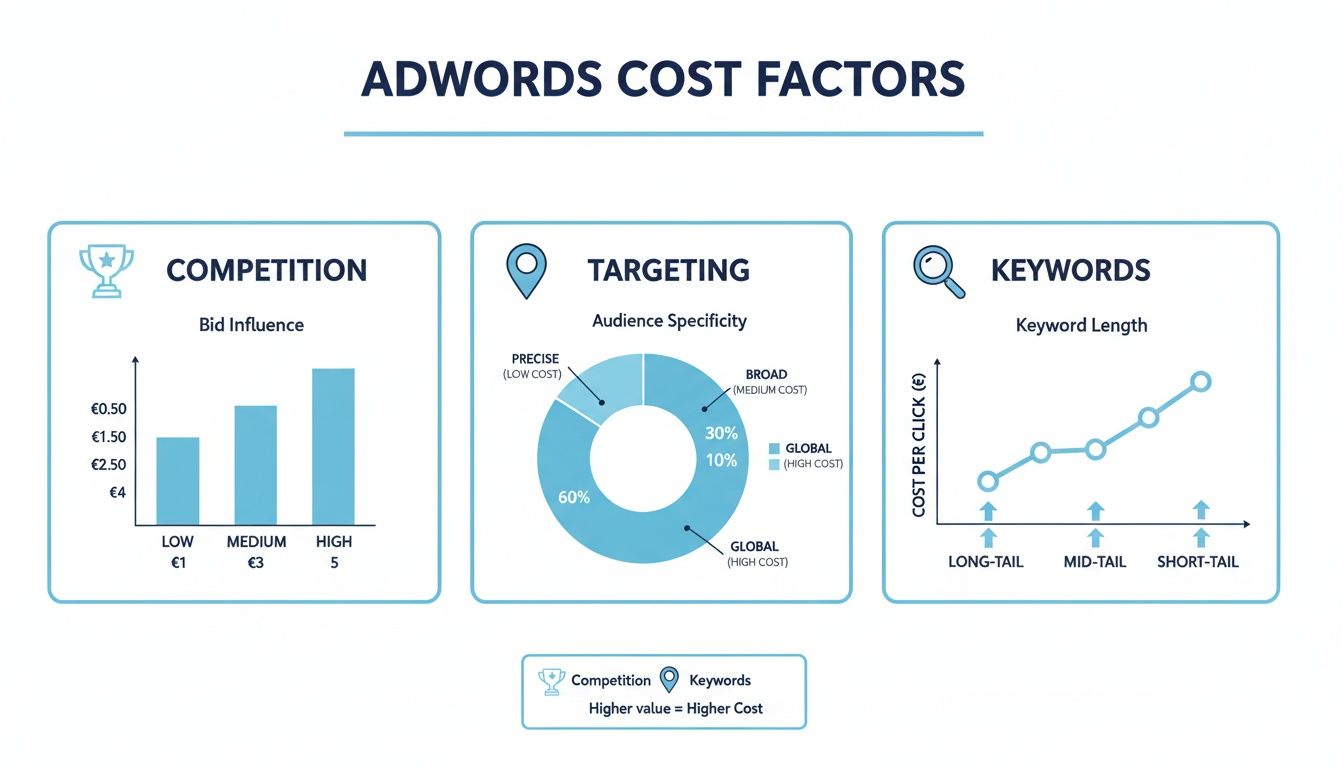
As you can see, it’s the constant interplay between your industry’s competitiveness, your keyword game plan, and how precisely you define your audience that directly shapes what you end up paying for each click.
Example 1: Sarah’s Ecommerce Boutique In Bristol
Sarah runs an online boutique selling gorgeous, handmade jewellery. Her main goal is simple: drive direct online sales. With her £2,500 budget, she’s smart and focuses on super-specific, long-tail keywords.
- Keywords: Instead of getting into a bidding war over the eye-wateringly expensive term “jewellery,” she targets phrases like “silver filigree earrings UK” and “Bristol handmade necklace gift.”
- Average CPC: Ecommerce is a tough crowd, but her niche keywords help keep her costs sensible. Her average CPC settles around £1.15.
- Targeting: She targets the whole of the UK but layers her audiences to zero in on users interested in ethical fashion and artisan crafts.
With this approach, Sarah’s £2,500 budget could pull in roughly 2,173 clicks a month. Given that e-commerce conversion rates hover around 2.81%, she might see about 61 sales roll in from her campaign.
This scenario is a perfect example of the power of being specific. By sidestepping a head-on clash with the big high-street names, Sarah carves out her own profitable corner of the market, making a modest budget work incredibly hard to generate real revenue.
Example 2: David’s B2B Consultancy In Birmingham (The Real Cost Of Adwords)
David offers specialised IT consultancy services to other businesses. His goal is all about lead generation—getting potential clients to fill out a contact form for a free consultation. He’s also working with a £2,500 budget.
- Keywords: David is in the B2B tech world, where keywords are notoriously pricey. He’s targeting terms like “IT support services Birmingham” and “business cybersecurity consultant.”
- Average CPC: The massive value of a single client sends competition—and costs—through the roof. His average CPC is much higher, around £3.80.
- Targeting: He keeps his geographic targeting on a tight leash, focusing only on the West Midlands to make sure his leads are local and highly relevant.
David’s £2,500 budget brings in far fewer clicks—somewhere around 657 per month. But here’s the kicker: B2B conversion rates for lead generation are often stronger, averaging about 3.04%. That means he could generate approximately 20 top-quality leads.
Comparing The Outcomes
Both businesses spent the exact same amount of money, yet their results couldn’t be more different.
| Metric | Sarah’s Ecommerce Boutique | David’s B2B Consultancy |
|---|---|---|
| Monthly Budget | £2,500 | £2,500 |
| Avg. CPC | £1.15 | £3.80 |
| Est. Clicks | 2,173 | 657 |
| Avg. Conversion Rate | 2.81% | 3.04% |
| Est. Conversions | 61 Sales | 20 Leads |
This isn’t about deciding who did “better.” It’s about showing how crucial it is to align your budget and strategy with your specific business goals and the industry you operate in. Sarah needed a high volume of clicks to drive sales, whereas David needed fewer, but extremely high-quality, clicks to secure valuable client leads.
Getting your head around these dynamics is the first step toward building a budget that actually works. For a much deeper dive, our comprehensive guide explains how much you should spend on Google PPC based on your unique business needs. These examples should empower you to move beyond pure guesswork and start forecasting your own success based on tangible data.
The Real Cost Of Adwords: Proven Tactics To Reduce Wasted Ad Spend
Getting your head around the factors that drive up Google Ads costs is half the battle. The other, more important half, is actually getting those costs under control. A truly smart Google Ads strategy isn’t about throwing a bigger budget at the auction; it’s about making every single pound work as hard as it possibly can to bring you a return.
Wasted ad spend is the silent killer of your budget. It’s the money you burn on clicks from people who were never going to buy, searches that have nothing to do with what you sell, or ads that show up at 2 AM on a Sunday. This section is your playbook for plugging those leaks and turning your ad budget into a finely-tuned growth engine.
We’ll walk through some proven, hands-on strategies you can start using right away to slash your cost per acquisition (CPA) and maximise your return.
Master Your Keyword Match Types
One of the fastest ways to haemorrhage cash is by using the wrong keyword match types. Think of them as the reins you hold on your keywords—they tell Google just how closely a user’s search needs to match your keyword before your ad can appear.
- Broad Match: This is the default setting and by far the loosest. It gives Google maximum freedom to show your ad for searches it thinks are related, which often means synonyms, vaguely related topics, and even misspellings. It can be good for discovering new search ideas, but it’s a notorious budget-drainer if you’re not careful.
- Phrase Match: This option gives you a lot more control. Your ad will show up for searches that include the meaning of your keyword. For example, the phrase match keyword “garden renovation services” could still show for a search like “local services for garden renovation.”
- Exact Match: This is the most restrictive and gives you the tightest control. Your ad will only appear for searches that share the same meaning or intent as your keyword. It’s perfect for high-intent keywords where you know exactly what the searcher is after.
By moving away from a complete reliance on broad match and strategically using more precise phrase and exact match keywords, you can cut down dramatically on irrelevant clicks from people who aren’t your customers.
Build A Powerful Negative Keyword List (The Real Cost Of Adwords)
Just as crucial as telling Google which keywords to bid on is telling it which ones to avoid. This is where a negative keyword list becomes your absolute best friend. A negative keyword stops your ad from being shown for any search that includes that term.
Let’s say you sell premium, high-end office furniture. You’re bidding on “office chairs,” but you keep getting clicks from people searching for “cheap office chairs” or “free office chairs.” Every single one of those clicks is wasted money.
By adding words like “cheap,” “free,” “DIY,” and “second-hand” to your negative keyword list, you instantly filter out bargain-hunters and unqualified searchers. This simple move ensures your budget is spent only on prospects who are genuinely in the market for your products.
Make a habit of checking your “Search Terms” report in Google Ads. It’s a goldmine for spotting irrelevant queries that are triggering your ads, helping you continually discover new negative keywords to add to your list. This constant refinement is key to cutting wasted spend over time.
Relentlessly Improve Your Quality Score
As we’ve covered, Quality Score is your secret weapon for getting more for less. A higher Quality Score directly leads to a lower cost per click and better ad positions. It’s Google’s way of rewarding you for providing a great experience for its users.
Improving it isn’t a one-and-done fix; it’s an ongoing process that revolves around three core areas:
- Ad Relevance: Does your ad copy directly relate to the keyword someone just searched for? Use tightly-themed ad groups to make sure your ads are a perfect match for the search.
- Expected Click-Through Rate (CTR): Is your ad compelling enough to actually earn the click? Test out different headlines, descriptions, and calls-to-action to see what really grabs your audience’s attention.
- Landing Page Experience: After they click, does your landing page deliver on the promise your ad made? Make sure it loads fast, works perfectly on mobile, and gives them a clear, easy path to converting.
Putting consistent effort into these elements sends strong positive signals to Google that you’re a high-quality advertiser, and they’ll reward you with lower ad costs.
Use Ad Scheduling To Your Advantage (The Real Cost Of Adwords)
Does your business only operate from 9 am to 5 pm, Monday to Friday? If so, why on earth are you paying for ads at 2 am on a Sunday? Unless you’re an e-commerce store taking orders 24/7, running ads outside your business hours can be a massive source of wasted spend.
Ad scheduling allows you to tell Google the specific hours or days of the week you want your ads to run. By digging into your conversion data, you can pinpoint your peak performance times—the days and hours when you generate the most leads or sales.
You can then set your campaigns to run only during these times, or even bid more aggressively during those peak hours to be more competitive when it really counts. This simple tactic ensures your budget is focused where it has the highest chance of generating a return, stopping you from paying for clicks when there’s no one there to answer the phone.
Frequently Asked Questions About Adwords Costs
Even with a good handle on how Google Ads works, it’s completely normal to have questions about the nuts and bolts of budgets, timelines, and what you should really expect. This section is here to cut through the noise and give you clear, straight-up answers to the queries we hear most often from UK business owners.
We’ll get into the practical side of setting a budget, managing your expectations for results, and understanding why your ad spend might fluctuate.
How Much Should A Small UK Business Spend On Google Ads?
There’s no magic number that fits everyone, but a solid, effective starting point for a small UK business is usually somewhere between £500 and £2,000 per month. This budget is typically enough to gather the data you need to figure out what’s working and start making smart optimisations.
The trick is to think of this initial spend as an investment in learning. Start with a budget you’re comfortable testing, get laser-focused on a tight set of keywords in a specific location, and then be ready to scale up once you see which ads are actually bringing in conversions and a positive return.
How Long Until I See Results From My Adwords Campaign?
You’ll start seeing clicks and impressions almost as soon as your campaign goes live. But it’s absolutely crucial to separate these top-line metrics from the results that actually matter to your business – things like leads, phone calls, and sales.
Think of the first one to three months of any new campaign as the “learning phase.” During this time, the Google Ads algorithm is gathering data, and you’re figuring out what clicks with your audience. Expect to see your return on investment improve steadily after this period, not overnight.
Patience is a virtue in PPC. The most profitable campaigns are built on weeks and months of careful data analysis and continuous optimisation, not on a single day’s performance.
Is A Higher Budget A Guarantee For Better Results?
Not at all. This is one of the biggest myths about Adwords costs. It’s incredibly easy to burn through a large budget by bidding on the wrong keywords, running poorly written ads, or targeting an audience that just isn’t a good fit.
A smaller, well-managed budget that’s tightly focused on high-quality ads and super-relevant keywords will almost always beat a large, scattergun approach. Success on Google Ads comes from smart strategy and constant tweaking, not just from outspending the other guy. Your Ad Rank, which leans heavily on your Quality Score, is the ultimate proof of this.
Can My Adwords Costs Change Over Time?
Yes, and you should 100% expect them to. The cost of Adwords isn’t set in stone; it’s a dynamic marketplace where prices are always shifting based on a bunch of different factors.
Several things can make your costs move around:
- Seasonality: A landscaping business will naturally see costs and demand rise in spring, while retailers get hit with higher bids in the run-up to Christmas.
- New Competitors: When new players enter the auction for your keywords, more competition can drive up the price of a click.
- Changes in User Behaviour: Search trends are always evolving. A keyword that’s a hot ticket today might be old news in six months.
A winning campaign strategy means keeping a close eye on things and being ready to adjust your budget. What works brilliantly in July might need a total rethink by November, which is exactly why ongoing, active management is essential for long-term success and a stable cost per acquisition.
Ready to stop guessing and start getting a real return from your Google Ads budget? The experts at PPC Geeks can help. Request a free, in-depth audit of your account today and discover exactly where you can cut wasted spend and unlock growth.
Author

Search Blog
Free PPC Audit
Subscribe to our Newsletter

The Voices of Our Success: Your Words, Our Pride
Don't just take our word for it. With over 100+ five-star reviews, we let our work-and our satisfied clients-speak for us.

"We have been working with PPC Geeks for around 6 months and have found Mark and the team to be very impressive. Having worked with a few companies in this and similar sectors, I rate PPC Geeks as the strongest I have come across. They have taken time to understand our business, our market and competitors and supported us to devise a strategy to generate business. I value the expertise Mark and his team provide and trust them to make the best recommendations for the long-term."
~ Just Go, Alasdair Anderson
