




Reduce Customer Acquisition Cost: A UK Business Guide — To bring your customer acquisition cost back down to earth, UK businesses need a serious rethink. It’s time to ditch the wide-net, hope-for-the-best campaigns and adopt a laser-focused, data-led approach that prioritises efficiency. This means getting forensic about tracking your true CAC, nailing your high-intent audience targeting, and seriously improving conversion rates with better ads and landing pages.
The goal? Make every single pound of your ad spend work harder, boosting profitability without hitting the brakes on growth.
Reduce Customer Acquisition Cost: Why Your Customer Acquisition Cost Is Skyrocketing
If your marketing budget feels like it’s vanishing into thin air, you’re not imagining it. Many UK businesses, especially in the cut-throat ecommerce and SME spaces, are facing a harsh new reality: the cost of winning a single new customer is climbing to eye-watering levels. This isn’t just a hunch; it’s a measurable trend, fuelled by a perfect storm of economic headwinds and digital pressures.
With the current financial climate, shoppers are holding their wallets tighter than ever, making every conversion a hard-fought battle. At the same time, the ad platforms we all rely on, like Google and Meta, have become incredibly crowded and, as a result, more expensive. More competition for the same ad space naturally drives up bidding costs, putting a real squeeze on your return on ad spend (ROAS).
The New Challenges for UK Marketers
On top of all that, we’re dealing with much stricter data privacy rules. Things like Apple’s iOS updates and the slow death of third-party cookies have made it significantly harder to track what people are doing and prove that our campaigns are actually working. It’s a tough environment where the old acquisition playbooks are simply delivering worse and worse results. For UK brands, the problem is particularly sharp.
Recent figures show that UK companies are seeing their customer acquisition costs soar, now running 15-25% higher than in the US. That’s a massive difference and it shines a spotlight on a brutal market where any inefficiency gets punished, hard. You can get more of the story on these ecommerce CAC trends to see the full picture.
Key Takeaway: You can’t afford to ignore rising CAC anymore. It’s a direct threat to your profitability and your ability to grow sustainably. The strategies that worked a couple of years ago are fast becoming obsolete, forcing us to get smarter and more strategic with paid media.
This guide is all about moving past the theory and giving you a practical playbook. We’ll break down the exact tactics you need to not just fight these rising costs, but actually turn them into a competitive advantage. It all starts with realising that expert PPC management isn’t a ‘nice-to-have’ anymore—it’s a critical lever for surviving in this new landscape. By focusing on ruthless efficiency and solid data, you can make customer acquisition a predictable and profitable engine for your business once again.
Reduce Customer Acquisition Cost: Building Your Foundation for Lower CAC
Before you can even think about reducing your customer acquisition cost, you have to stop guessing and start measuring. So many businesses I see are just looking at the default CAC figures inside their ad platforms like Google Ads. The problem is, these numbers only tell a fraction of the story.
They conveniently leave out a whole host of essential expenses, giving you a dangerously rosy picture of your actual costs. You can’t make smart decisions based on bad data.
Calculating Your True Customer Acquisition Cost
To really get a grip on performance, you absolutely must calculate your ‘true’ CAC. This means looking beyond just the ad spend and folding in every single associated cost.
Think of it this way: your true CAC is a full, honest accounting of your total sales and marketing spend, divided by the number of new customers you brought in over a set period.
Make sure your calculation includes:
- Ad Spend: The obvious one. This is the direct cost from your paid media channels.
- Salaries and Wages: A portion of the salaries for your marketing team, sales staff, and any content creators involved in your acquisition campaigns.
- Tool Subscriptions: Don’t forget the costs for your CRM, analytics software, email platforms, and any other tools you use to attract and convert customers.
- Creative and Production Costs: All those expenses for graphic design, video production, copywriting, and any agency fees.
Once you’ve summed all this up, you finally have a realistic baseline. Only from this point of clarity can you begin making moves to actually lower your CAC. To make life easier, you can use a dedicated customer acquisition cost calculator to ensure you’re not missing any crucial variables.
It’s tougher than ever out there. The current economic climate, fierce competition, and ever-changing privacy rules are all constantly pushing acquisition costs up.
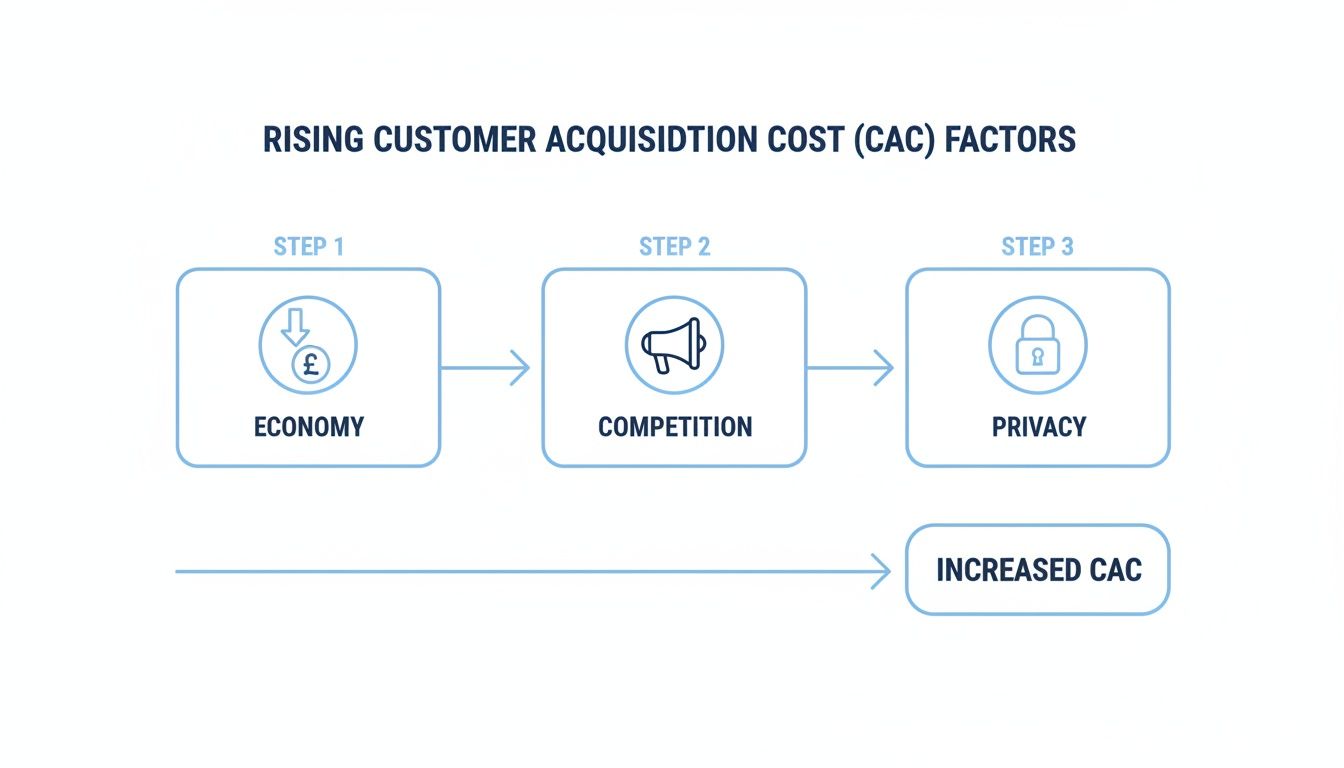
This just hammers home the point: with so many external factors working against you, getting your internal measurement and controls dialled in is non-negotiable.
Auditing Your Conversion Tracking (Reduce Customer Acquisition Cost)
Right, so you know your true CAC. The very next job is to make sure the data feeding into it is rock-solid. Faulty conversion tracking is one of the most common—and costly—mistakes I see in digital marketing. If you can’t trust your numbers, your budget allocation is basically a shot in the dark.
An inaccurate setup means you end up optimising for the wrong things, pouring money into campaigns that look like they’re working but are actually duds. This is where creating a single source of truth becomes critical.
A business running on broken conversion tracking is like a captain navigating with a faulty compass. You’re moving, but you have no reliable way of knowing if it’s in the right direction. You could be sailing straight into financial trouble.
Your goal is to build a seamless data flow from the first ad click right through to the final sale getting logged in your CRM. This demands a thorough audit of your entire tracking setup. It’s time to run a health check and find the weak links in your data chain.
Before you touch a single campaign, use this checklist to audit your tracking setup. Getting these fundamentals right is the quickest way to find and plug leaks in your budget.
Essential Conversion Tracking Health Check
| Checklist Item | Why It Matters for Accurate CAC | Common Mistake |
|---|---|---|
| Google Tag Manager Setup | Ensures all your tracking tags (Google Ads, Analytics, Meta Pixel) fire correctly without bogging down your site. | Placing tracking codes directly on the website, which often leads to conflicts and painfully slow page loads. |
| Google Analytics 4 Goals | Properly set up events and conversions in GA4 are vital for understanding user behaviour and what’s actually working. | Relying on default events and failing to set up custom conversions for key actions like form submissions or purchases. |
| CRM Integration | This connects your marketing efforts to actual sales, letting you track lead quality and attribute real revenue to campaigns. | Forgetting to use UTM parameters, making it impossible to trace a sale back to the specific campaign or ad that drove it. |
| Enhanced Conversions | Uses consented, first-party data to fill the tracking gaps created by privacy updates and the death of cookies. | Not enabling this crucial feature in Google Ads, which leads to underreported conversions and completely skewed performance data. |
Fixing these foundational elements is hands down the most impactful step you can take toward a lower customer acquisition cost. It gives you reliable data to make sharp, strategic decisions, setting the stage for every optimisation tactic that follows.
Reduce Customer Acquisition Cost: Smarter Targeting and Bidding Strategies
Once your data foundation is solid, you can stop fixing what’s broken and start making your campaigns genuinely smarter. The fastest way to slash your customer acquisition cost without killing volume is to stop wasting money on the wrong people. This means getting surgical with your audience selection and moving far beyond broad, demographic-based targeting.
Forget just targeting “men aged 25-40 in London.” It’s time to find the users who are actively signalling their intent to buy, right now. Pouring your budget into these high-intent segments is where the magic happens for efficiency and driving down your cost per conversion.
This is more critical than ever. Recent industry data shows a staggering jump in acquisition costs, climbing by 40-60% between 2023 and 2025. This surge is fuelled by fierce competition and those persistent attribution headaches. What cost a UK business £50 to acquire in 2023 could now easily demand £70-£80. For B2B campaigns on paid search, it’s even more eye-watering, hitting an average of £642 per customer. If you want to see the numbers for yourself, you can explore more on these escalating CAC benchmarks and their impact on UK businesses.
Refining Your Audience Targeting
The goal is simple: concentrate your spend where it will have the biggest impact. This involves layering different audience types to pinpoint your most profitable pockets of customers.
Start by digging into these more nuanced options:
- In-Market Segments: These are users Google has already identified as actively researching or planning to buy products or services just like yours. Think “in the market for used cars” or “in the market for home gym equipment.” It’s a massive leap forward from basic demographics.
- Custom Audiences: This is where you can get really specific. You can build audiences based on keywords people have searched for, websites they’ve visited, or apps they use. For a UK-based sustainable clothing brand, for instance, you could create a custom audience of users who have recently searched for “organic cotton t-shirts” and visited competitor websites.
- Lookalike Audiences: Your first-party data becomes a superpower here. You can upload a list of your best customers (those with the highest lifetime value), and platforms like Google or Meta will find new users who share similar characteristics. It’s an incredibly powerful way to scale your acquisition efforts efficiently.
By combining these targeting methods, you create a powerful filter. You’re ensuring your ads are shown predominantly to people who are not just aware of their problem but are actively looking for a solution.
Choosing the Right Bidding Strategy (Reduce Customer Acquisition Cost)
Your bidding strategy is the engine of your campaign, and picking the right one is absolutely crucial for controlling costs. The days of painstakingly manual bidding are mostly behind us; today, it’s all about giving the algorithms the right instructions to follow.
Expert Insight: Don’t treat automated bidding as a “set it and forget it” tool. Your job is to feed it high-quality data and clear objectives. The machine is only as smart as the information you provide.
Let’s break down the most common automated bidding strategies and when you should use them to lower your customer acquisition cost.
- Maximise Conversions: This strategy tells the algorithm to get you the most conversions possible within your daily budget. It’s a great option when you’re launching a new campaign and need to gather data quickly. But be warned: it can sometimes prioritise quantity over quality, which can lead to a higher CAC if you leave it unchecked.
- Target CPA (Cost Per Acquisition): With this, you set a specific cost you’re happy to pay for a conversion. The algorithm then works to hit that average. This is ideal for lead generation campaigns where you have a very clear idea of what a lead is worth to your business.
- Target ROAS (Return On Ad Spend): For e-commerce, this is often the gold standard. You tell Google the return you want for every pound spent (e.g., 500% ROAS means you want £5 in revenue for every £1 of ad spend). It optimises for profitability, not just raw conversion numbers.
Navigating these options can feel complex, but getting your head around the nuances is key. For a proper deep dive, our comprehensive guide on Google Ads Smart Bidding breaks down each strategy in much more detail.
Performance Max campaigns also lean heavily on these principles. The real key to success with PMax is providing strong audience signals—feeding it your best customer lists and custom audiences—and creating distinct asset groups for different products. This guides the machine learning towards your most profitable segments, making it a powerful tool for reducing your customer acquisition cost at scale.
Reduce Customer Acquisition Cost: Optimising Your Ad Creatives and Landing Pages
Getting the click is a great start, but what happens after the click is what really moves the needle on your customer acquisition cost. You can have the most sophisticated targeting and bidding strategy in the world, but it all falls apart if the user journey breaks down post-click. This is where your ad creatives and landing pages become the most important battleground.
A disjointed experience between your ad and your landing page is one of the fastest ways to burn through your budget. Think about it: a user clicks an ad promising a specific solution, only to land on a generic homepage. They’re gone in seconds. You’ve just paid for a click that had zero chance of ever converting. That’s why message matching isn’t just a best practice; it’s non-negotiable.
Crafting Ad Creatives That Actually Convert
Your ad creative—whether it’s simple text, an image, or a full-blown video—is your opening line. It needs to do more than just catch the eye; it has to connect with your target audience’s problems and motivations on a deeper level. The days of generic, one-size-fits-all messaging are long gone.
To really see what works, you need to get methodical with A/B testing. Don’t just throw random ideas at the wall; be scientific about it.
- Test one variable at a time. Is it the headline? The call-to-action (CTA)? The image? Isolate a single element so you know exactly what caused the shift in performance.
- Focus on the core message. Try out different angles. A skincare brand, for instance, might test an ad focusing on “anti-ageing benefits” against another that highlights “natural, organic ingredients.” Each one speaks to a completely different customer motivation.
- Look at both click-through rate (CTR) and conversion rate. A sky-high CTR with a rock-bottom conversion rate is a classic red flag. It usually means your ad is making a promise that your landing page isn’t keeping.
For a real-world example, a UK-based software company targeting SMEs could test a headline like “Simplify Your Invoicing Today” against “Get Paid 2x Faster.” The second option hits on a critical business pain point (cash flow) and is much more likely to pull in high-intent clicks.
The Anatomy of a High-Converting Landing Page (Reduce Customer Acquisition Cost)
Once you’ve earned the click, your landing page has a single job: convert. Every element on that page needs to work towards that one goal, removing any friction and guiding the user straight to the action you want them to take. I always tell my clients to think of the landing page as the final, crucial step in the sales conversation that the ad started.
A great landing page isn’t about flashy design; it’s about clarity and momentum. It should instantly reassure the visitor they’re in the right place and make it incredibly easy for them to take the next step.
Here’s what every landing page needs if it’s going to help lower your acquisition costs by boosting conversions:
- A Compelling Headline: This absolutely must mirror the message from your ad. If your ad promised “50% Off Your First Order,” that exact phrase needs to be the first thing people see.
- Clear, Concise Copy: Use bullet points and short paragraphs to lay out the key benefits. Always focus on what the user gets, not just what your product does.
- A Strong Call-to-Action (CTA): Your CTA button needs to stand out visually and use action-oriented language. “Get Your Free Quote” is far more powerful than a passive “Submit.”
- Social Proof: Nothing builds trust faster. Add customer testimonials, reviews, or logos of well-known clients to validate your claims.
- A Frictionless Form: Only ask for what you absolutely need. Every extra field you add to a form is another reason for someone to give up and leave.
At the end of the day, a seamless user journey is everything. If you’re stuck for ideas, checking out examples of a great lead generation landing page can give you some practical inspiration you can adapt for your own campaigns.
Don’t Forget Page Load Speed
All this hard work on messaging and design goes straight out the window if your page takes an age to load. In this day and age, even a one-second delay can send your conversion rates plummeting. Study after study confirms that slower page speeds lead directly to higher bounce rates.
Use free tools like Google’s PageSpeed Insights to see how you’re doing and get some solid recommendations. Simple things like compressing images, cleaning up your code, and using a decent hosting provider are all essential. A faster, smoother experience doesn’t just improve your conversion rate—it can also give your Quality Score in Google Ads a nice little boost, helping to reduce customer acquisition cost even further over time.
The LTV & Retention Play: A Smarter Way to Slash Acquisition Costs
So far, we’ve been deep in the trenches of the front-end funnel—nailing your targeting, outsmarting the algorithms with better bidding, and crafting pages that convert. All mission-critical stuff.
But what if I told you one of the single most effective ways to drive down your customer acquisition cost has almost nothing to do with acquiring new customers?
Real, sustainable growth isn’t just a mad dash for the next sale. It’s about building a solid, profitable business. That means shifting your mindset from the first transaction to the entire customer relationship. This is where Customer Lifetime Value (LTV) walks in and completely changes how you approach growth.
The LTV and CAC Connection
LTV is the total revenue you can reasonably expect from a single customer over their entire time with your brand. Once you have a handle on this number, you can make much smarter, more confident decisions about what you can actually afford to spend to get a customer through the door.
A higher LTV is a massive strategic advantage. It gives you the breathing room to afford a higher CAC while staying comfortably in the black. While your competitors are nervously pulling back on ad spend to protect their razor-thin margins, you can keep your foot on the gas, knowing every new customer will pay dividends for months or even years to come.
A business solely focused on lowering front-end CAC is playing defence. A business focused on increasing LTV is playing offence, building a moat around its profitability that competitors will struggle to cross.
Think about it this way: the old marketing adage says acquiring a new customer is anywhere from five to twenty-five times more expensive than keeping an existing one. By investing in the post-purchase journey, you’re not just making people happy. You’re building a powerful economic engine that makes your ad spend work exponentially harder.
For a deeper dive into this crucial metric, our guide on how to understand and leverage Customer Lifetime Value breaks it all down.
Actionable Strategies for Boosting Retention (Reduce Customer Acquisition Cost)
Increasing LTV and keeping customers around isn’t about fluffy concepts like “customer delight.” It’s about implementing specific, measurable tactics that give people a real reason to come back.
Here are some high-impact strategies you can roll out right away:
- Roll Out Targeted Email Flows: Go way beyond the generic weekly newsletter. Set up automated email sequences that trigger based on what a customer actually does. This means post-purchase follow-ups, abandoned cart reminders that actually help, and win-back campaigns for customers who’ve gone quiet. Personalised product recommendations based on their last purchase? Gold.
- Launch a Simple Loyalty Programme: You don’t need a crazy, multi-tiered behemoth from day one. Start simple. A basic points-for-pounds-spent programme creates a powerful, tangible reason for them to choose you over a competitor next time they’re ready to buy.
- Develop Smart Remarketing Campaigns: Get surgical with your customer data. Create highly segmented remarketing lists. For example, why not target customers who bought a specific product six months ago with an ad for the perfect complementary item? It’s infinitely more effective than blasting generic brand ads at everyone who has ever visited your site.
These retention efforts create a powerful feedback loop. The more you invest in your existing customers, the higher their LTV climbs. This, in turn, allows you to be more aggressive and flexible with your acquisition budget, fuelling a sustainable cycle of profitable growth.
To illustrate the financial impact, let’s compare some common retention tactics against the raw cost of acquisition.
High-Impact Retention Tactics vs. Acquisition Channels
| Strategy | Typical Cost | Potential LTV Increase | Equivalent CAC Savings |
|---|---|---|---|
| Email Marketing Flow | Low (Software subscription) | 10-15% | Can save hundreds in ad spend per retained customer. |
| Loyalty Programme | Low-Medium (Discounts, points) | 15-25% | Every repeat purchase negates the need for a new acquisition. |
| SMS Nurturing | Low (Cost per message) | 5-10% | High open rates lead to quick, low-cost repeat sales. |
| Personalised Remarketing | Medium (Ad Spend) | 5-15% | Reactivates past buyers for a fraction of new acquisition cost. |
As you can see, investing a small amount in keeping the customers you already have can save you a fortune on the front end. This shift in perspective is the key to truly mastering your customer acquisition costs for the long haul.
Advanced Campaign Structures for Ecommerce
If you’re running an ecommerce business, your Google Shopping feed is much more than a simple product list—it’s the engine that powers your profitability. A generic, one-size-fits-all campaign structure is one of the fastest ways to leak budget and send your acquisition costs soaring. To really reduce customer acquisition cost, you have to get beyond the basics and start implementing more sophisticated structures that give you granular control over every penny of your ad spend.
This all comes down to treating different products with different strategies. A low-margin, high-volume item should never be fighting for the same budget as a high-margin, best-selling hero product. The real goal here is to channel your most valuable traffic towards your most profitable items, and that journey starts with smart campaign segmentation.

Implementing Query Sculpting for Shopping
One of the most powerful techniques in our playbook is known as ‘Query Sculpting’. This clever method uses a combination of campaign priorities and a strategic network of negative keywords to essentially force Google to show the right products for the right search terms. It’s all about taking back control from the algorithm and telling it exactly how you want your money spent.
Here’s how it works in practice:
- Set up multiple Shopping campaigns for the exact same products, but assign them different priority levels (High, Medium, and Low).
- The High Priority campaign acts as a net for broad, generic searches like “running shoes”. You’ll load this campaign up with an exhaustive list of brand and product-specific negative keywords. The bids here are kept low because the purchase intent is naturally weaker.
- The Medium and Low Priority campaigns get the higher bids. They’re designed to catch the more specific, high-intent searches (e.g., “Nike Air Zoom Pegasus men’s size 10”). Why? Because the negative keywords in your high-priority campaign push that super-valuable traffic down to these campaigns.
This structure stops you from wasting your highest bids on window shoppers. Instead, you save your premium budget for users who know precisely what they’re looking for, which can dramatically improve your ROAS.
Optimising Your Product Feed
Your product feed is the absolute foundation of any Shopping campaign. A poorly optimised feed leads to low ad relevance, a dismal Quality Score, and, you guessed it, a higher cost-per-click. Think of your feed as a CV for your products; it needs to be flawless to get the interview.
Here’s where you should focus your energy:
- Product Titles: This is your most valuable real estate. You need to front-load your titles with the most important keywords. A great formula is Brand + Product Type + Key Attributes (Colour, Size, Material). For instance, “Nike Air Max 90 Men’s Trainers White Size 9” is infinitely better than a lazy “White Nike Trainers.”
- Custom Labels: Get familiar with custom labels (
custom_label_0throughcustom_label_4). Use them to segment products based on performance metrics you care about. You could label items as ‘Bestseller’, ‘High Margin’, ‘Clearance’, or ‘Seasonal’. This unlocks the ability to set different bids and budgets for each group, letting you funnel investment towards your most profitable stock. - High-Quality Images: Your main product image should always be on a clean, white background. But don’t stop there. Use the additional image slots to show the product in action or from different angles. This visual context can give your click-through rates a serious lift.
By meticulously enriching your product feed with relevant data and structuring your campaigns to isolate top performers, you create a highly efficient system. This approach directly reduces customer acquisition cost by ensuring your ad spend is precisely allocated to the products and search queries most likely to drive a profitable sale.
Your CAC Questions Answered
How long does it actually take to see CAC come down?
This is the million-dollar question, isn’t it? The honest answer is: it depends. You can usually spot some quick wins within the first 30-60 days. This is when we’ve sorted out the foundational stuff, like fixing dodgy conversion tracking or tweaking bidding strategies. Those initial changes often move the needle pretty fast.
But for those really significant, long-lasting drops in CAC, you’re looking at more of a 3-6 month timeframe. That gives you enough runway to collect solid data, test different creatives and landing pages properly, and really dial in your targeting. Think of it as an ongoing refinement process, not a one-and-done job.
What’s a “good” CAC for a UK e-commerce brand?
Everyone wants a magic number, but there isn’t one. A ‘good’ CAC is completely relative to your business. It hinges on your average order value (AOV), your margins, and most importantly, your customer lifetime value (LTV).
Instead of obsessing over a specific CAC figure, shift your focus to the LTV:CAC ratio.
A healthy benchmark for a sustainable business is a 3:1 ratio. Basically, for every pound you spend to get a customer, you should be getting at least three pounds back over their lifetime. That’s the real metric you want to protect and improve.
Can I really lower my CAC without just slashing my ad spend?
Absolutely. In fact, cutting your budget is often the wrong move. The whole point of optimising your campaigns is to improve efficiency, not just turn off the taps.
When you reduce your customer acquisition cost the right way, you’re making every single pound work harder. You do this by getting smarter with your targeting, boosting conversion rates with better landing pages, and finding ways to increase your customer LTV. It means you can acquire more customers for the same budget or keep your customer numbers steady while spending less—either way, your profitability gets a serious boost.
Ready to stop burning through your ad budget and start acquiring customers profitably? The team at PPC Geeks lives and breathes this stuff. We build data-driven strategies that cut your acquisition costs and send your ROI soaring.
Book your free, in-depth PPC audit today and let’s get you on the right track.