
How to Find Competitors Keywords for PPC Success

To find your competitors’ keywords, you’ll need to roll up your sleeves and dig into their websites and ad campaigns. This involves a mix of free tools like Google Keyword Planner and more powerful paid platforms such as Semrush or Ahrefs.
This process uncovers the exact paid and organic terms that are driving their traffic, essentially handing you a direct blueprint for your own strategy. But it’s not just about copying; it’s about spotting the gaps they’ve missed and claiming that territory for yourself.
How to Find Competitors Keywords: Your Hidden Advantage in a Crowded Market

Before we get into the nuts and bolts, let’s be clear on why this matters so much. Analysing a rival’s keyword strategy isn’t just another task to tick off your list; it’s how you carve out a genuine competitive edge in what’s often a very saturated market. For busy marketing managers and e-commerce owners, this one activity can directly move the needle on your most important goals.
Getting a clear view of what your competitors are bidding on and ranking for helps you:
- Boost Sales and Market Share: Target proven, high-converting keywords to attract customers who are already primed to buy.
- Achieve a Stronger ROI: Stop wasting your ad spend on hyper-competitive or irrelevant terms and focus your budget where it will actually deliver results.
- Uncover Untapped Opportunities: Find valuable keywords your competitors are completely ignoring, giving you a clear path to new customers.
The Real-World Impact on Your Bottom Line
Let’s make this real. Imagine you sell handmade leather bags in the UK. A quick bit of digging might show your main competitor is throwing a huge budget at the broad term “leather bags.”
But you also spot they’re completely neglecting “sustainable leather work bags for laptops.” That’s your opening. It’s a less competitive, high-intent keyword that lets you attract a specific, valuable audience without needing a massive budget to compete.
This kind of strategic intelligence gives you a clear window into your competitors’ marketing funnels. You can see what they think is working, learn from their successes, and, most importantly, capitalise on their weaknesses. It shifts your marketing from guesswork to a data-driven operation.
This process isn’t about mimicry; it’s about intelligence. The goal is to understand the battlefield before you commit your resources, ensuring every pound spent on advertising has a purpose and a greater chance of success.
In the fiercely competitive UK digital advertising landscape, where the market is projected to hit USD 95,727.8 million by 2030, this insight is a game-changer for small and medium-sized businesses. With smartphone ads already dominating 58.54% of the market, businesses that ignore competitor keyword strategies are essentially handing over prime search real estate to their rivals. You can learn more about the UK digital advertising market growth and see why this matters more than ever.
How to Find Competitors Keywords: Assembling Your Competitor Research Toolkit
Every good investigation starts with the right gear. To really dig into what your competitors are doing, you need a smart mix of free and paid tools. They work together to give you the full picture of their keyword strategy. It’s not about having the flashiest, most expensive software; it’s about using the right tool for the right job.
Starting with the free stuff is a no-brainer. It’s the most cost-effective way to gather some initial intel, and you’d be surprised how much these tools can uncover. Often, it’s more than enough to get the ball rolling and build a more competitive campaign.
Kicking Off with Free Tools
Your first port of call should always be the tools you already have access to. Google provides a fantastic foundation for competitor keyword research, and the best part is, it won’t cost you a penny.
- Google Search Console: I know, I know—it mostly shows your own data. But hear me out. You can cross-reference the keywords you already rank for against your top competitors to find where you overlap and, more importantly, where the gaps are. Seeing where you both show up for the same terms gives you a solid baseline of your competitive landscape.
- Google Keyword Planner: This is your secret weapon for a quick peek into a rival’s playbook. Instead of starting with a keyword, flip it on its head. Choose the “Start with a website” option and pop in your competitor’s URL. Google will spit out a list of keyword suggestions based on their site’s content, giving you a brilliant starting list of terms they’re likely targeting.
These free methods give you a solid, data-backed launchpad. They help you build an initial keyword list and get a feel for your competitor’s focus before you even think about opening your wallet for more advanced software.
Graduating to Paid Platforms (How to Find Competitors Keywords)
When you’re ready to dig deeper and get your hands dirty, paid tools offer a level of detail that free options just can’t touch. There’s a reason platforms like Semrush, Ahrefs, and SpyFu are industry standards—they hand you the keys to your competitors’ paid and organic keyword strategies.
With these, you can see things like their estimated ad spend, track historical keyword performance, and even see the exact ad copy they’re running. That level of detail is gold when it comes to making smart decisions for your own campaigns. Just take a look at the kind of data you can pull from a tool like Semrush.
This dashboard doesn’t just show the keywords a competitor is bidding on; it reveals their estimated traffic cost and the specific ads driving those clicks. It’s an absolute treasure trove of actionable intelligence.
Before you start signing up for every tool under the sun, it’s worth taking a moment to figure out which one is the right fit.
Your Competitor Keyword Analysis Toolkit
Choosing the right tool depends on your budget, your goals, and how deep you need to go. Here’s a quick rundown of the heavy hitters to help you decide.
| Tool Name | Primary Use Case | Cost Level | Best For |
|---|---|---|---|
| Google Keyword Planner | Finding keyword ideas based on a competitor’s website content. | Free | Marketers on a tight budget or those just starting their research. |
| Google Search Console | Identifying keyword overlaps and gaps by comparing your performance data. | Free | Getting a baseline understanding of your current competitive position. |
| Semrush | In-depth analysis of paid/organic keywords, ad copy, and estimated ad spend. | Mid-High | PPC managers who need comprehensive, all-in-one competitive intelligence. |
| Ahrefs | Powerful organic keyword and backlink analysis with strong content gap features. | Mid-High | SEO specialists and content marketers focused on organic strategy. |
| SpyFu | Historical competitor data, showing ad spend and keyword performance over time. | Mid-Range | Businesses looking for a deep dive into a competitor’s long-term strategy. |
Ultimately, the goal is to arm yourself with the information you need without getting overwhelmed. Each of these tools offers a unique window into your competitor’s world.
A common mistake I see is people assuming they need every single paid tool out there. Honestly, it’s overkill. Start with one, really get to grips with its features for competitor analysis, and only expand your toolkit when you hit a wall and have a specific need that isn’t being met.
For anyone serious about PPC, these platforms are a non-negotiable investment. They shift your approach from educated guesswork to a precise, data-driven strategy. To see how a specialist agency puts these tools into practice, check out our guide on leveraging Semrush for PPC dominance. Choosing the right platform depends on your goals, but investing in one will, without a doubt, give you the competitive edge you need to win.
How to Find Competitors Keywords: Uncovering Organic and Paid Keyword Strategies
Alright, with your toolkit assembled, it’s time to roll up your sleeves and get into the real investigative work. This is where we shift from planning to action, peeling back the layers of your competitors’ online presence to figure out what’s actually driving their traffic and sales. We’re going to dig into both their long-game organic efforts and their immediate, cash-driven paid campaigns.
Think of it like being a detective. There’s no single magic clue; instead, you’re piecing together evidence from different sources. You’ll be looking at their website’s architecture for organic signals and then using specialist tools to expose their entire paid advertising playbook. When you combine these two angles, you get a powerful, three-dimensional view of their complete keyword strategy.
This flowchart shows the straightforward process of getting your research toolkit ready, starting with free tools, moving to paid platforms, and then diving into the analysis.
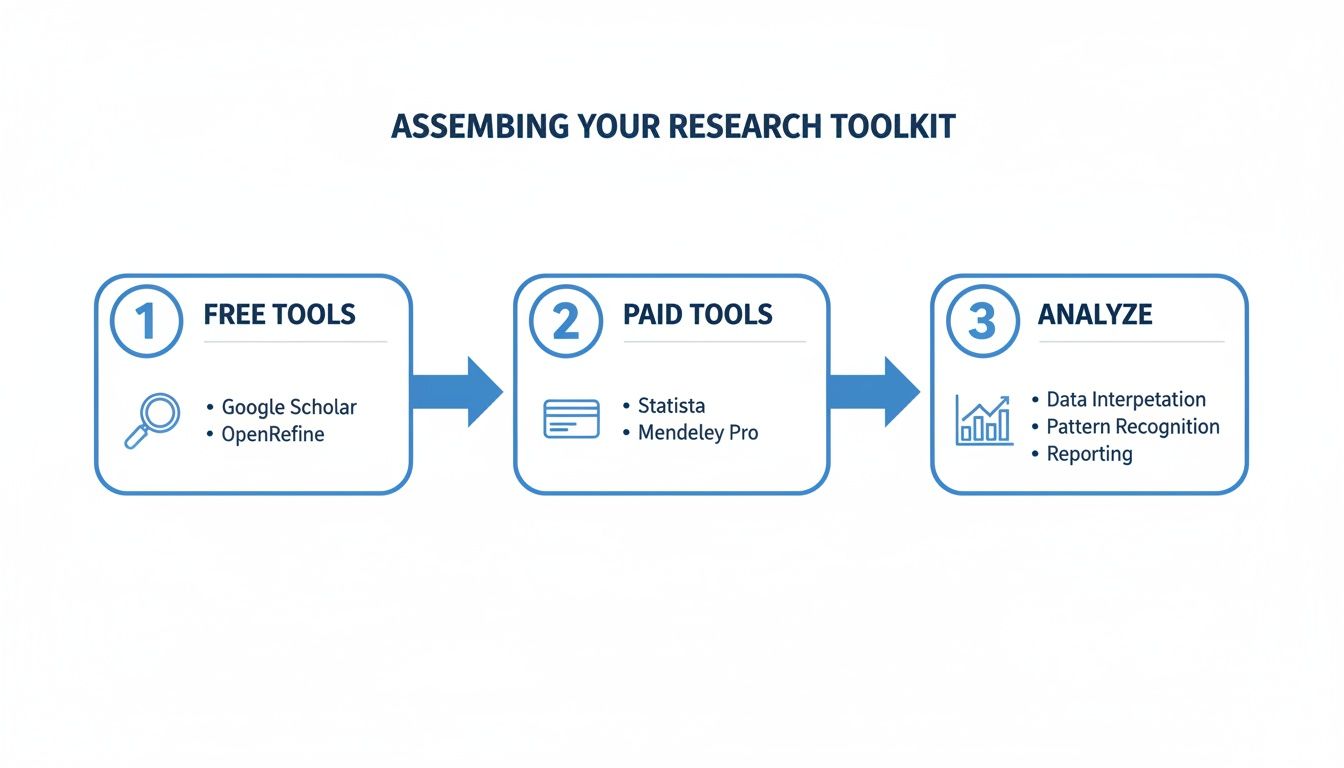
As you can see, effective research isn’t just a random scramble for data. It’s a structured process that starts with the tools you already have before you scale up your efforts.
Deconstructing Their Organic SEO Blueprint
Your first port of call should always be a manual analysis of their website. This hands-on approach shows you the foundational keywords they’ve bet on—the ones they consider important enough to build their entire site around. It’s like getting a look at the architectural plans of their SEO strategy.
Start by checking these key on-page elements:
- Meta Titles and Descriptions: What are the main keywords in the page titles you see in Google search results? These are almost always their highest-priority terms.
- Header Tags (H1, H2, H3): Look at the headlines on their core pages. The H1 is their primary topic, while the H2s and H3s often drill down into related, long-tail variations.
- Internal Linking: Pay attention to the anchor text they use to link between their own pages. If they’re constantly linking to a product page with the phrase “eco-friendly coffee beans,” that’s a massive clue about a keyword they’re targeting.
This manual review gives you a qualitative feel for their priorities that you just can’t get from raw data alone. You start to understand not just what keywords they’re after, but how they position them for their audience.
Exposing Their Paid Advertising Playbook (How to Find Competitors Keywords)
While the organic analysis shows you their long-term ambitions, digging into their paid campaigns reveals their immediate commercial priorities. This is where you find out which keywords they believe are valuable enough to put their money behind right now. For this, paid search intelligence platforms like SEMrush or SpyFu are absolutely essential.
With these tools, a treasure trove of information is at your fingertips:
- Top Paid Keywords: See the exact search terms they are bidding on.
- Estimated Ad Spend: Get a feel for their budget and which keywords get the lion’s share of their investment.
- Effective Ad Copy: Analyse the language, offers, and calls-to-action (CTAs) in their most successful ads.
This isn’t just about swiping their keyword list. It’s about understanding their messaging. If their top-performing ad for “UK business insurance” hammers home the benefit of “24/7 claims support,” you’ve just learned what they believe is a key selling point for that specific audience.
Analysing the Live SERP Battlefield
Tools give you the data, but the live Search Engine Results Page (SERP) shows you what’s actually happening on the ground. Go and perform searches for the keywords you’ve uncovered and just observe. Are they dominating the top of the page with Shopping Ads? Are their Text Ads punchy and compelling?
Look for patterns in their ad copy, the unique selling points they push, and any ad extensions they’re using. Most importantly, click through their ads and scrutinise their landing pages. Does the page actually deliver on the promise made in the ad? Is it clearly optimised for conversions? This final step connects their keyword choice directly to their conversion strategy, giving you the complete picture.
A solid grasp of this entire process is crucial for success, which is why our complete guide on keyword research for PPC is a great resource for filling in any gaps.
How to Find Competitors Keywords: Finding Opportunities and Strategic Market Gaps
Collecting long lists of competitor keywords is the easy part. The real work begins when you need to turn that raw data into a coherent strategy that actually wins you more business. This is where the magic happens—sifting through the noise to find the nuggets of gold.
The goal here is to move past just knowing what keywords your competitors are bidding on. You need to understand where your best chances to make an impact lie. It’s all about sorting and prioritising to pinpoint the easy wins and the battlegrounds you can’t afford to lose.
Categorising Your Keyword Opportunities
To stop yourself from getting bogged down in endless spreadsheets, you need a simple framework. I always sort keywords into buckets based on four key metrics: relevance, search volume, Cost Per Click (CPC), and competitive difficulty. This gives you an immediate, organised plan of attack.
Once you start sorting, you’ll see a few distinct categories emerge:
- Low-Hanging Fruit: These are terms with decent search volume and high relevance to your business, but for whatever reason, your competitors are either ignoring them or doing a terrible job. Think weak ad copy or landing pages that don’t match the searcher’s intent.
- Must-Win Terms: These are the high-volume, high-relevance keywords right at the heart of what you do. Your competitors are almost certainly bidding heavily here, but this is ground you simply can’t give up.
- Long-Tail Opportunities: These are the more specific, lower-volume phrases like “handmade leather satchel for 15-inch laptop”. While one of these won’t bring a flood of traffic, collectively they drive highly qualified customers who know exactly what they want and are ready to buy.
In the UK, where digital marketing employs over 1.5 million people and is projected to hit revenues of £40+ billion, every penny of ad spend has to count. With 51% of retail leaders looking to AI for growth, using competitor keyword data to spot these opportunities is fundamental to PPC success. For UK SMEs trying to navigate complex campaigns, this kind of analysis is what cuts through the inefficiency in a crowded market. Discover more insights about UK digital marketing facts on SearchHog.
Unearthing Strategic Keyword Gaps
One of the most valuable things you can get from this process is identifying keyword gaps. These are relevant, valuable search terms that your ideal customers are using, but none of your main competitors are actively targeting—either organically or with paid ads.
Tools like Ahrefs make this incredibly easy with their dedicated “Content Gap” feature. You just pop in your domain and a few of your top competitors, and it spits out a list of keywords they rank for that you don’t.
Here’s a look at what the Content Gap tool’s interface in Ahrefs looks like. It lets you see exactly where your rivals have an edge.
This kind of analysis can instantly highlight untapped corners of the market, giving you a clear runway to attract new customers with little to no direct competition.
A classic mistake is to focus only on the keywords your competitors are targeting. The real strategic advantage often comes from discovering the valuable territory they’ve completely overlooked. These gaps are your chance to build authority and capture an audience without a fight.
Let’s say you run an online furniture shop. Your analysis shows a competitor ranks for “sustainable oak dining tables,” but their ad copy is generic and the landing page takes forever to load. That’s an obvious opening for you to create a better ad and landing page to snatch that traffic.
But an even bigger win would be discovering that nobody is properly targeting “reclaimed wood coffee tables UK,” even though it has decent search volume. That’s a keyword gap you can own. This is where you can learn more about understanding auction insights to see who you’re really up against on the SERP.
How to Find Competitors Keywords: Putting Your Competitor Insights Into Action

Right, all that digging and analysis has brought you here. This is where the data turns into profit, translating your research into real, tangible changes in your PPC accounts. The intelligence you’ve gathered is essentially a battle plan for building smarter, more cost-effective campaigns that actually deliver.
Think of it this way: you’ve done the reconnaissance, mapped the terrain, and you know exactly where your rivals are strongest and, more importantly, where they’re vulnerable. Now it’s time to act on that knowledge and start winning over their customers.
Building Tightly Themed Ad Groups
One of the most immediate wins you can get from competitor research is the ability to structure incredibly relevant ad groups. Forget about chucking loosely related keywords into one big bucket. You now have the intel to build campaigns around the specific themes and long-tail terms you’ve seen them winning on. This level of precision is absolute gold for your Quality Score.
Let’s say you discovered a competitor is cleaning up with conversions from “vegan leather tote bags for work.” That’s your cue to create a dedicated ad group for that exact theme.
- Keywords: Pack it with close variations like “work tote bag vegan leather,” “professional vegan tote,” and “laptop bag vegan leather.”
- Ad Copy: Your ads need to speak directly to that search. Talk about the durability, professional style, and ethical materials. Make it obvious you have what they’re looking for.
- Landing Page: Don’t just dump them on a generic ‘all bags’ page. Send them straight to a curated page showing only your vegan work totes.
This laser-focused alignment between keyword, ad, and landing page signals to Google that you’re highly relevant, which almost always leads to lower CPCs and better ad positions.
Crafting Superior Ad Copy and Bidding Strategies
Your competitor’s ad copy is a treasure trove of ideas. You’ve seen the messages they’re pushing, the offers they’re promoting, and the CTAs they rely on. Your mission isn’t to plagiarise them – it’s to one-up them.
Look for their weak spots. Is their ad copy a bit bland and generic? Do they forget to mention a killer benefit you offer, like free next-day delivery? That’s your opening to write something far more compelling and steal the click.
The smartest move is often to address a pain point their ad copy completely ignores. If their ads scream “low prices,” you can hit back with copy that emphasises “superior quality and a 5-year guarantee,” which will appeal to a completely different—and often more valuable—type of customer.
This intelligence also sharpens your bidding strategy. Do you go head-to-head on their top keywords, or do you focus on the gaps you found? I’ve found a balanced approach usually works best. Compete on a handful of ‘must-win’ terms where you know you have an edge, but bid aggressively on the underserved keyword gaps to hoover up that uncontested traffic.
Just be sure you don’t waste that fresh budget on irrelevant clicks. It’s crucial to have a rock-solid strategy for your negative keywords in Google Ads to make sure you’re only paying for clicks that count.
Common Questions About Competitor Keyword Research
Even with the best plan, you’re bound to have questions once you start digging into your competitors’ keywords. It’s completely normal as you move from theory to real-world application. We get asked these all the time by marketing managers and business owners, so let’s clear up some of the most common ones.
Getting these fundamentals right will give you the confidence to approach your analysis properly and squeeze every last drop of value from your efforts.
How Often Should I Analyse My Competitors’ Keywords?
Competitor keyword analysis isn’t a “set it and forget it” task. For most businesses, doing a comprehensive deep-dive every quarter is a great starting point. This rhythm is usually frequent enough to catch new campaigns, adjust for seasonal trends, and react to major strategic shifts without drowning in data.
However, if you’re in a cut-throat, fast-paced industry like fashion ecommerce or consumer tech, you’ll want to be much quicker. A monthly check-in is a smarter move. A quick review of their top paid keywords and ad copy each month can be the difference between leading the pack and playing catch-up.
Is It Legal to Track My Competitors’ Keywords? (How to Find Competitors Keywords)
Absolutely. There’s a common misconception that this kind of research is a bit shady, but it’s 100% above board. All the tools and methods we’ve discussed rely on analysing data that’s already publicly available. You’re not hacking into anyone’s accounts or accessing private information.
You are simply using sophisticated tools to gather and make sense of data from public search engine results pages (SERPs) and other online sources. This is a standard, essential marketing practice known as competitive intelligence, used by smart businesses of all sizes to understand their market.
Can I Compete Against a Much Larger Competitor?
Yes, and this is exactly where sharp competitor keyword research becomes your secret weapon. You’re never going to win a spending war against a massive rival on broad, eye-wateringly expensive terms like “women’s shoes.” That’s a fool’s errand.
Instead, your analysis should be laser-focused on finding the gaps they’ve missed:
- Niche Long-Tail Keywords: Go after hyper-specific phrases they’re almost certainly ignoring, like “waterproof vegan hiking boots for wide feet.”
- Keyword Gaps: Pinpoint valuable terms your audience is searching for that none of your main competitors are even bidding on.
- Location-Specific Terms: Zero in on localised searches if you have a geographic advantage they can’t match.
By being smarter and more tactical with your targeting, you can carve out a profitable niche for yourself against even the biggest names in the game.
Ready to turn competitor insights into a winning PPC strategy? The expert team at PPC Geeks can help you uncover hidden opportunities and build campaigns that deliver real results. Explore our services and get your free audit at https://ppcgeeks.co.uk.
Author

Search Blog
Free PPC Audit
Subscribe to our Newsletter

The Voices of Our Success: Your Words, Our Pride
Don't just take our word for it. With over 100+ five-star reviews, we let our work-and our satisfied clients-speak for us.

"We have been working with PPC Geeks for around 6 months and have found Mark and the team to be very impressive. Having worked with a few companies in this and similar sectors, I rate PPC Geeks as the strongest I have come across. They have taken time to understand our business, our market and competitors and supported us to devise a strategy to generate business. I value the expertise Mark and his team provide and trust them to make the best recommendations for the long-term."
~ Just Go, Alasdair Anderson