
How UK Building Suppliers Can Compete with Screwfix and B&Q on Google Ads

How UK Building Suppliers Can Compete with Screwfix and B&Q on Google Ads: Going head-to-head with Screwfix and B&Q on Google Ads can feel like you’re bringing a trowel to a bulldozer fight. Let’s be honest, you’re not going to outspend them. Their budgets are colossal, allowing them to dominate the broad, high-traffic keywords.
But here’s the thing: their biggest strength—their sheer scale—is also their greatest weakness. They have to paint with broad strokes, leaving massive gaps that a smarter, more agile supplier like you can slip right into.
How UK Building Suppliers Can Compete with Screwfix and B&Q on Google Ads: Challenging the Giants
The UK construction supplies wholesale market is a massive £42.9 billion battleground and has been growing steadily for the past five years. Even with behemoths like Travis Perkins and STARK throwing their weight around, the intense competition actually creates opportunities for smaller, specialised businesses to thrive. You just need to know where to look.
This playbook isn’t about matching their ad spend; it’s about making every penny of yours work harder. It’s about precision, relevance, and playing up the unique value you bring to the table.
Your Competitive Edge
Think about what you have that they don’t. Your local knowledge, deep product expertise, and the ability to offer genuinely personal service are things that can’t be automated or scaled up to a national level. The trick is to translate these real-world strengths into your digital strategy.
This is how you do it:
- Niche Expertise: Go after long-tail keywords for the specialist products the big-box stores either don’t stock or don’t bother advertising properly.
- Local Dominance: Use tight geotargeting to absolutely own your service area. Make your ads scream about rapid, reliable local delivery that they can’t match.
- Superior Service: Write ad copy that speaks directly to trade professionals. Forget fluffy marketing speak; talk about expert advice, tailored support, and solving their specific problems.
The core idea is simple: stop playing their game. Don’t waste your budget fighting for a term like “power tools.” Instead, focus on winning searches like “next-day delivery Festool track saw in Manchester.” This is where your agility becomes your most potent weapon.
A question that always comes up is whether you should bid on competitors’ brand names. It’s tempting, but it can be a quick way to burn through your budget if you don’t have a watertight strategy. For a proper deep dive, check out our guide on the pros and cons of bidding on competitor brand terms.
Stick with us, and we’ll show you how to build a lean, profitable Google Ads machine that consistently brings in high-quality trade leads, turning your size from a disadvantage into a decisive victory.
How UK Building Suppliers Can Compete with Screwfix and B&Q on Google Ads: Winning the Keyword Battle with Niche Targeting
Let’s be honest. Trying to outbid Screwfix or B&Q on massive, broad terms like “timber” or “plasterboard” is a surefire way to burn through your budget in record time. It’s a game you can’t win. Their entire strategy is built on colossal scale and brand power, allowing them to throw money at the most obvious search terms.
Your path to victory isn’t about matching their firepower; it’s about precision. It’s about finding and exploiting the gaps their catch-all approach inevitably leaves wide open. This means a complete shift in focus from high-volume, generic keywords to hyper-specific, long-tail keywords. These longer, more detailed search phrases signal incredibly strong buying intent. The person typing them in isn’t just browsing; they know exactly what they need and they’re ready to buy it.
From Broad Strokes to Surgical Strikes
Think of it like this: B&Q has to bid on “roofing tiles.” That net has to be big enough to catch everyone from a DIY novice fixing one cracked tile to a major contractor pricing a whole development. It’s broad and inefficient.
You, on the other hand, can go after “reclaimed Welsh slate roofing tiles near Bristol.” The search volume will be lower, absolutely. But the user behind that query is a far more qualified, high-value lead for a specialist supplier like you. That’s the sweet spot.
This is the very essence of niche targeting. Your job is to identify the specific, detailed searches your ideal trade customers are making every day and then build your campaigns to utterly dominate those results.
Key Takeaway: The goal isn’t to get the most clicks; it’s to get the right clicks. A dozen clicks from local builders looking for a specific product are infinitely more valuable than a thousand clicks from tyre-kickers.
Take a local timber merchant, for instance. Instead of getting obliterated on a term like “wood,” they should be focusing on the long-tail variations the big retailers often ignore:
- “C24 graded carcassing timber 4.8m lengths”
- “Siberian larch cladding suppliers West Midlands”
- “Moisture resistant MDF sheets cut to size”
Every one of those terms represents a real customer with a real project and an immediate need. B&Q’s generic ads just can’t compete with an ad that speaks directly to that level of detail. By owning these niches, you’re not just competing – you’re positioning yourself as the go-to expert. To really get to grips with unearthing these golden nuggets, a deep dive into keyword research for PPC is a brilliant next step.
Uncovering Your Niche Keyword Opportunities (How UK Building Suppliers Can Compete with Screwfix and B&Q on Google Ads)
Finding these long-tail gems starts with putting yourself in your customers’ boots. What trade jargon do they use? How do they specify dimensions, materials, or compliance standards like BS EN codes?
Start by brainstorming your most specialised product lines. What do you offer that the big sheds don’t? Think specific brands, unique materials, or valuable services like cutting to size. You can even use free tools like Google’s Keyword Planner or simply type your core products into the search bar and see what Google suggests in the “People also ask” and “Related searches” sections.
Let’s say you’re a plumbing supplier. Instead of the money pit that is “copper pipe,” your niche targets might look more like this:
- Product Specificity: “15mm press fit copper fittings”
- Brand Loyalty: “John Guest Speedfit pipe inserts”
- Problem-Solving: “Best pipe for underfloor heating”
Each of these represents a distinct customer need that a perfectly targeted ad campaign can intercept and win.
This table really highlights the fundamental difference in strategy between a big-box giant and a savvy independent supplier.
Keyword Strategy Comparison Broad vs Niche Long-Tail
| Metric | Big-Box Retailer Approach (e.g., Screwfix) | Independent Supplier Strategy |
|---|---|---|
| Keyword Type | Short-tail (e.g., “power tools”) | Long-tail (e.g., “DeWalt 18V brushless combi drill”) |
| Target Audience | Broad (DIY & Trade) | Niche (Specific trade professionals) |
| Ad Copy Focus | Price & General Availability | Expertise, Service & Local Delivery |
| Cost-Per-Click | High | Lower to Moderate |
| Conversion Rate | Lower | Higher |
| Campaign Goal | Mass Market Share & Brand Awareness | High-Quality Leads & Profitability |
By zeroing in on these niche, high-intent keywords, you cleverly sidestep a direct bidding war with the giants. You’re not playing their game; you’re changing the rules entirely, turning your specialist knowledge and product range into your most powerful weapon on Google Ads. This is how UK building suppliers can genuinely compete and win.
How UK Building Suppliers Can Compete with Screwfix and B&Q on Google Ads: Building Google Ads Campaigns for Surgical Precision
Throwing your entire product catalogue into one generic campaign is a bit like using a sledgehammer to hang a picture – messy, inefficient, and a total waste of money. To even think about competing with the giants, your Google Ads account needs to be a model of precision. A scattered approach just burns cash; a structured one makes every pound work harder.
A well-built account is your foundation. This isn’t just about being tidy; it directly feeds into your Quality Score, ad relevance, and ultimately, what you pay per click (CPC). Think of it as setting up different departments in your digital store, each perfectly tuned for a specific customer and product.
Segmenting for Success
First things first, let go of the idea of a single, all-encompassing campaign. You need to segment your campaigns based on logical splits in your business. This is how you make sure your ad copy and landing pages are laser-focused on what the user actually searched for.
Start by splitting campaigns by your core product categories. Your strategy for selling bulk timber is worlds away from how you’d shift high-end plumbing fittings.
- Product Category: Create separate campaigns for “Plumbing Supplies,” “Timber & Sheet Materials,” and “Power Tools.” This stops your budget for fast-moving, low-margin items like sand from being swallowed by clicks for your more profitable, specialist tools.
- Customer Type: Are you talking to trade or DIYers? Set up campaigns that speak their language. A trade campaign can shout about bulk discounts and account benefits, while a DIY campaign might focus on project guides and smaller quantities.
- Geographic Focus: If you offer rapid local delivery within a 20-mile radius, that’s your secret weapon. Build a campaign that only targets that area with ads screaming about your “next-day delivery to Manchester” service. That’s a local advantage Screwfix can’t easily match.
A clean, segmented account structure isn’t just good housekeeping; it’s a competitive necessity. It lets you funnel budget into your most profitable areas, making sure every single pound is pulling its weight to deliver a return.
Choosing the Right Campaign Type (How UK Building Suppliers Can Compete with Screwfix and B&Q on Google Ads)
Within this neat structure, Google gives you a few different tools for the job. A blended approach is almost always the right answer.
Standard Shopping campaigns are your scalpel. They give you pinpoint control over individual product bids, which is perfect for your highest-margin products or specific items you want to push hard. This granular control means you can ramp up bids on your winners and pull back on items with tighter margins, maximising your return on ad spend (ROAS).
Performance Max (PMax) is your wider net. It uses Google’s AI to hunt for customers across all its channels—Search, YouTube, Display, the lot. PMax is fantastic for getting broader reach and uncovering new customer segments, but it demands top-notch assets (images, videos, text) and a perfectly optimised product feed to really sing. It’s often best used for broader product categories where you just want to maximise eyeballs. To get the most from Google’s automation, you need to understand its quirks. You can learn more about how to effectively use Google Ads smart bidding strategies which are the engine behind campaigns like Performance Max.
A Practical Checklist for Campaign Structure
Getting this right from day one saves a world of pain later on. Run through this checklist to make sure your account is built to perform and scale.
- Logical Naming Convention: Name your campaigns clearly so you know what’s what at a glance (e.g.,
SHOP | Timber | Local Delivery). It makes reporting and tweaking things so much easier down the line. - Separate Budgets: Give each campaign its own budget based on priority and profitability. Don’t let a general campaign cannibalise the funds from your high-performers.
- Specific Ad Groups: Inside each campaign, create tightly themed ad groups. For a “Power Tools” campaign, you’d have ad groups for “Combi Drills,” “Circular Saws,” and “Angle Grinders.”
- Hyper-Relevant Ads & Landing Pages: Each ad group needs its own tailored ad copy. And for goodness sake, send users to the most relevant category or product page, not your homepage!
This flow shows how you can funnel a broad, vague search into a specific, high-intent keyword that finds your ideal customer.
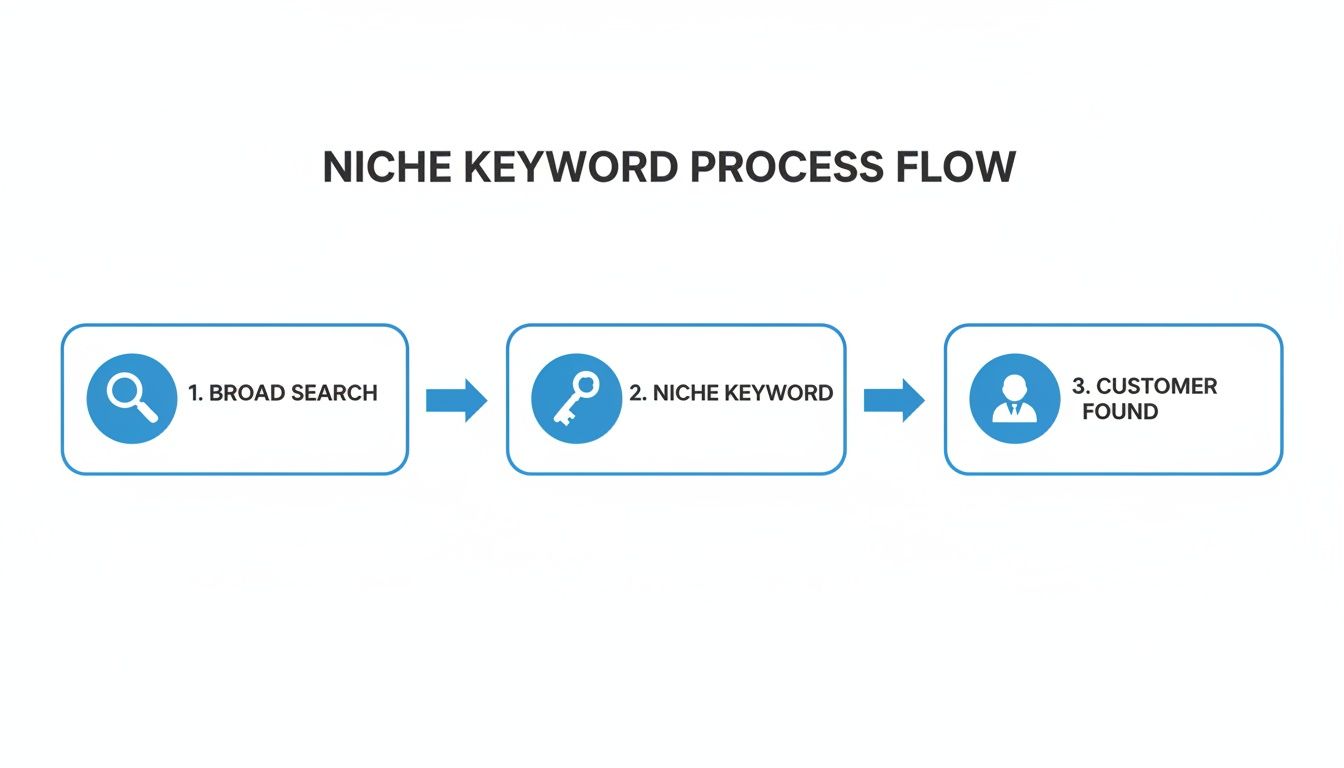
The image drives the point home: success isn’t about catching every single search. It’s about strategically intercepting the ones that signal a customer has their wallet out and is ready to buy.
How UK Building Suppliers Can Compete with Screwfix and B&Q on Google Ads: Crafting Ad Copy and Landing Pages That Actually Convert
A perfectly structured account is a brilliant start, but it’s only half the battle. The other half is what your potential customers actually see. Your ad copy and landing pages are where all that behind-the-scenes strategy turns into clicks and, crucially, sales.
This is your moment to shout about what makes you a better choice for a trade professional than some faceless national chain. Forget trying to compete on price alone; your ads need to scream value beyond the number on the invoice.
Your unique selling points (USPs) are your most potent weapons here. You aren’t just another supplier; you’re a partner on the job.
Let’s get practical. Your ad copy needs to reflect this partnership loud and clear.
- Highlight Expertise: Think headlines like “Expert Advice from Real Builders” or “Trade-Only Support Desk.” This instantly tells a pro they’re talking to someone who gets it, not a call centre reading from a script.
- Emphasise Service: Use phrases like “Free Next-Day Delivery By Our Own Fleet.” That simple line builds enormous trust. It means their order won’t get lost in some third-party courier maze.
- Lean into Your Story: Don’t shy away from your heritage. “Family-Run Since 1985” or “Your Local Independent Merchant” resonates. People still value personal accountability and want to support local businesses.
These aren’t just fluffy marketing lines. They are direct counter-punches to the big-box model. Screwfix can’t claim this level of personal service or local heritage, so make it the absolute cornerstone of your messaging.
From Click to Conversion: The Landing Page Experience (How UK Building Suppliers Can Compete with Screwfix and B&Q on Google Ads)
Getting the click is great, but the job is far from done. The journey from the ad to your landing page has to be completely seamless.
Sending someone who clicked an ad for “18mm marine plywood” to your homepage is a cardinal sin in PPC. It creates friction, confusion, and they’ll be gone in a heartbeat. Your landing page must instantly reassure them they’ve landed in the right place. It needs to be clear, fast, and built for one thing and one thing only: conversion.
Pro Tip: A high-converting landing page for a building supplier isn’t fancy. It’s functional. It prioritises clarity and speed over flashy design, giving trade customers the info they need, fast.
Just think about the current market pressures. Recent data shows that while deliveries of some materials like bricks have dipped, the overall material price index keeps climbing, squeezing everyone’s margins. This economic reality, as highlighted in the latest construction material trends from GOV.UK, means trade buyers are more value-conscious than ever. They’re hunting for reliable suppliers with transparent pricing and dependable stock. Your landing page can tackle this head-on, cementing your position as a trusted partner.
Here’s the main Google Ads interface, where you’ll bring these vital assets to life.
This dashboard is your command centre for deploying the specific, value-driven messaging that will set your business apart from the giants.
The Power of Dynamic Personalisation
To really take your ad copy to the next level, you need to be using ad customisers. These are powerful little tools that let you dynamically insert specific details into your ads based on things like the user’s location, the date, or even the device they’re on.
Imagine a roofer in Leeds searching for tiles. Instead of a generic ad, they see this:
- Headline 1: Reclaimed Roof Tiles in Leeds
- Headline 2: Next-Day Delivery Available
- Description: Your local, independent roofing supplier. Trade accounts welcome.
That level of personalisation creates an instant connection. It tells the user that you’re not just some national website; you are their local supplier. This is exactly how UK building suppliers can outmanoeuvre Screwfix and B&Q on Google Ads—by being more relevant and more local. It builds immediate trust and sends click-through rates soaring, turning a simple search into a high-quality lead.
How UK Building Suppliers Can Compete with Screwfix and B&Q on Google Ads: Optimising Your Secret Weapon: The Product Feed

If your campaigns are the engine, then your product feed is the fuel. It’s as simple as that. A poorly optimised feed will cripple even the most brilliantly structured Google Ads account, especially for Shopping and Performance Max campaigns where the quality of your product data is everything.
The big-box retailers often have enormous, unwieldy feeds managed by huge teams, which often leads to generic and sometimes inaccurate data. This is your opening. By treating your product feed with the meticulous care of a master craftsperson, you can feed Google’s algorithm the rich, detailed information it craves to show your products to the right people.
We’re not just talking about filling in mandatory fields like GTINs and brand names. It’s about going deeper, enriching every product listing with the kind of detail that turns a vague search into a highly qualified click.
Structuring Product Titles for Maximum Impact
Your product title is arguably the single most important element in the entire feed. It’s the first thing a potential customer sees and the biggest factor in which searches you show up for. A generic title is a completely wasted opportunity.
You need to think like your trade customer and cram the most critical information right at the front. We swear by a consistent, battle-tested formula:
Brand + Product Type + Key Attribute + Size/Dimensions
Let’s see it in action. Instead of a lazy title like “DeWalt Drill,” you create a search-magnet like this:
DeWalt + DCD796P1 18V XR + Brushless Combi Drill + with 1x 5.0Ah Battery
This one title immediately answers multiple potential searches. It nails the brand, the exact model number, the product type, and crucial features. This level of detail is exactly how you can outmanoeuvre the big players, beating their often-simplified titles with sheer relevance.
Going Beyond the Basics with Attributes (How UK Building Suppliers Can Compete with Screwfix and B&Q on Google Ads)
While the title is king, other attributes provide the crucial context Google’s AI needs. Don’t skip these. The more high-quality data you provide, the better Google can match your products to specific, long-tail searches.
Here are the key attributes to spend time on:
- Product Type: Be more specific than Google’s own categories. Instead of just
Hardware > Building Materials > Timber, drill down toTimber & Sheet Materials > Carcassing Timber > C24 Graded. This granular detail helps Google understand exactly what you’re selling. - High-Quality Images: Ditch the generic manufacturer stock photos everyone else is using. If you can, show the product in a real-world setting or use multiple high-res images from different angles. Make it stand out.
- Detailed Descriptions: Use this space to answer common questions before they’re asked. Include technical specs, compatible accessories, and even relevant building regulation codes. For a full breakdown of every field, our in-depth guide to Google Shopping product feeds is an invaluable resource.
Unlocking Strategic Bidding with Custom Labels
Now, this is where you gain a true strategic edge. Custom labels (custom_label_0 through custom_label_4) are blank fields in your feed that you can use for anything you want. They’re invisible to customers but are immensely powerful for slicing and dicing your products inside Google Ads.
By using custom labels, you can move beyond bidding on simple product categories and start bidding based on actual business objectives. This allows you to push high-margin items harder and manage stock levels with precision.
Here are a few practical ways we use them:
- Profit Margin: Label products as
high-margin,medium-margin, orlow-margin. You can then build campaigns that bid much more aggressively on your most profitable items. - Stock Levels: Tag items as
clearance,overstock, orbest-seller. This is perfect for building campaigns designed to shift excess inventory or double down on your most popular products. - Seasonality: A label like
seasonal_summerfor landscaping products makes it easy to activate or pause these items as demand changes throughout the year.
This level of feed organisation gives you the data you need to make smarter, more profitable decisions. With the UK construction market projected to hit £204.12 billion by 2029, and the private sector making up nearly 75% of all activity, a precisely tuned feed lets you target this hugely valuable segment with surgical accuracy. A superior feed is your direct line to these high-value trade customers.
Got Questions About Google Ads? Let’s Talk.
Stepping into the Google Ads arena can feel like you’re about to go a few rounds with a heavyweight, especially when you see the colossal budgets of the big national chains. It’s completely natural to have questions before you commit your hard-earned cash.
Let’s cut through the noise and tackle the most common (and important) questions we hear from independent UK building suppliers. No jargon, just straight-talking, practical answers.
How Much Do I Realistically Need to Spend to Compete?
You absolutely do not need Screwfix’s war chest. Forget trying to match their spend; the game is won on efficiency and intelligence, not brute force.
For a tightly focused local campaign, zeroing in on a specific, high-margin product category, a starting budget of £500-£1000 per month is more than enough to start delivering tangible results and, crucially, valuable data.
The goal here isn’t to dominate the entire market overnight. It’s about proving a concept. Start small, pick a niche you know you can win, and measure your Return On Ad Spend (ROAS) like a hawk. Once you’ve got a profitable model, you can confidently reinvest and scale up. Our entire strategy is built on getting a much higher ROAS on targeted spend, not on sheer volume.
Can I Really Win Clicks If My Prices Aren’t Rock-Bottom?
Yes, and this is a point that can’t be stressed enough. For your trade customers, the sticker price is just one small part of a much bigger picture. Time is money, reliability is everything, and expert advice is priceless. Your real advantage isn’t the cost of a bag of cement; it’s the service and value wrapped around it.
Your ad copy is the perfect place to shout about this.
- Highlight Your Service: Use trust-building phrases that the big boys can’t, like “Expert Phone Support from Real Tradespeople” or “Next-Day Local Delivery by Our Own Drivers.”
- Emphasise Reliability: Talk about “Guaranteed Stock on Key Lines” or “Hassle-Free Returns for Trade Accounts.” This is music to a tradesperson’s ears.
- Sell Your Expertise: Make it clear you’re a specialist partner, not just another checkout.
Most trade professionals will happily pay a bit more for the peace of mind that comes from dealing with a supplier who gets it, delivers on time, and can actually solve a problem over the phone. Use Google Ads to sell this entire package, not just a product.
What’s the Single Biggest Mistake Suppliers Make?
The most common and costly mistake we see is trying to be a smaller, less-funded version of Screwfix. It’s a battle you are guaranteed to lose every single time. Launching broad campaigns with generic ads, a messy product feed, and sending all your traffic to the homepage is just setting fire to your budget.
The secret is to lean into what makes you different. Focus on your niche product expertise, hammer home your local delivery advantage, and build campaigns with surgical precision. Be the specialist, not the generalist.
Another huge error is neglecting conversion tracking. If you don’t have accurate data showing which keywords, ads, and products are actually driving phone calls and online sales, you’re flying blind. It always leads to wasted money and missed opportunities. Setting up robust tracking from day one is non-negotiable.
Should I Use Performance Max or Standard Shopping Campaigns?
This isn’t an either/or question; it’s about using the right tool for the right job. Thinking you have to choose just one is a common misconception that will hold you back. A smart, modern Google Ads account will almost always use both to achieve different goals.
Use Standard Shopping for:
Your highest-margin, hero products where you need granular control. It lets you set specific bids on individual items and see exactly which search terms are triggering your ads. This is your tool for precision and profitability.
Use Performance Max (PMax) for:
Broader product categories or when your goal is to maximise your reach across Google’s entire network (Search, YouTube, Display, the lot). PMax is incredibly powerful but it absolutely needs a perfectly optimised product feed and top-notch creative to really sing.
Honestly, a hybrid approach almost always gets the best results. You might use Standard Shopping to go hard after your most profitable lines, while using PMax to drive awareness and sales for a wider range of stock. It gives you the control you need and the reach you want.
Ready to stop wasting money and start winning against the giants? The team at PPC Geeks builds data-driven, profitable Google Ads strategies for UK businesses just like yours. Get your free, no-obligation PPC audit today and see exactly how we can help you grow.
Author

Search Blog
Free PPC Audit
Subscribe to our Newsletter

The Voices of Our Success: Your Words, Our Pride
Don't just take our word for it. With over 100+ five-star reviews, we let our work-and our satisfied clients-speak for us.

"We have been working with PPC Geeks for around 6 months and have found Mark and the team to be very impressive. Having worked with a few companies in this and similar sectors, I rate PPC Geeks as the strongest I have come across. They have taken time to understand our business, our market and competitors and supported us to devise a strategy to generate business. I value the expertise Mark and his team provide and trust them to make the best recommendations for the long-term."
~ Just Go, Alasdair Anderson