




In House vs Agency Marketing: A UK Business Guide — Choosing between an in-house marketing team and a dedicated agency boils down to a fundamental trade-off. Bringing marketing inside gives you deep brand immersion and direct, hands-on control, weaving it into the very fabric of your company culture. On the other hand, an agency delivers a broad spectrum of specialised skills and scalable resources on demand, giving you instant access to seasoned experts.
In House vs Agency Marketing: Framing Your Marketing Decision
The in-house vs agency marketing debate isn’t about finding one “right” answer. It’s about being honest about your business’s current resources, long-term ambitions, and how you need to operate day-to-day. An internal team lives and breathes your brand every single day, which builds an unmatched level of agility and a profound understanding of your products and customers.
Then there’s the agency perspective. They bring a wealth of experience from tackling challenges across countless industries. That outside view can be invaluable for spotting opportunities or weaknesses an internal team, deep in the weeds, might completely miss. This is especially true for highly technical areas like paid advertising; understanding the key factors when choosing the right PPC agency for your business quickly shows just how much value that external expertise can bring to the table.
This initial comparison helps frame your thinking. It allows you to immediately see which model might be a better fit for your company’s immediate situation before we dive into the nitty-gritty of cost, scalability, and control.
At a Glance Comparing In-House and Agency Models
To kick things off, let’s look at a high-level overview. This table breaks down the core differences between building your own team and hiring an external one, helping to frame the decision-making process.
| Attribute | In-House Team | Marketing Agency |
|---|---|---|
| Control | High degree of direct, daily control over priorities and tasks. | Lower direct control; operates based on briefs and retainers. |
| Brand Knowledge | Deep, intrinsic understanding of company culture and products. | Surface-level understanding that develops over time. |
| Cost Structure | Fixed overheads (salaries, benefits, training). | Variable costs (retainers, project fees); no long-term overheads. |
| Expertise | Deep expertise in one brand but potentially limited skill breadth. | Broad expertise across many disciplines and industries. |
| Scalability | Scaling is slow and requires recruitment and training. | Highly scalable; resources can be increased or decreased quickly. |
This table gives you a quick snapshot, but the real story is in the numbers and practical application.
The following chart provides a data-driven look at the average costs, launch times, and expertise ratings for each model.
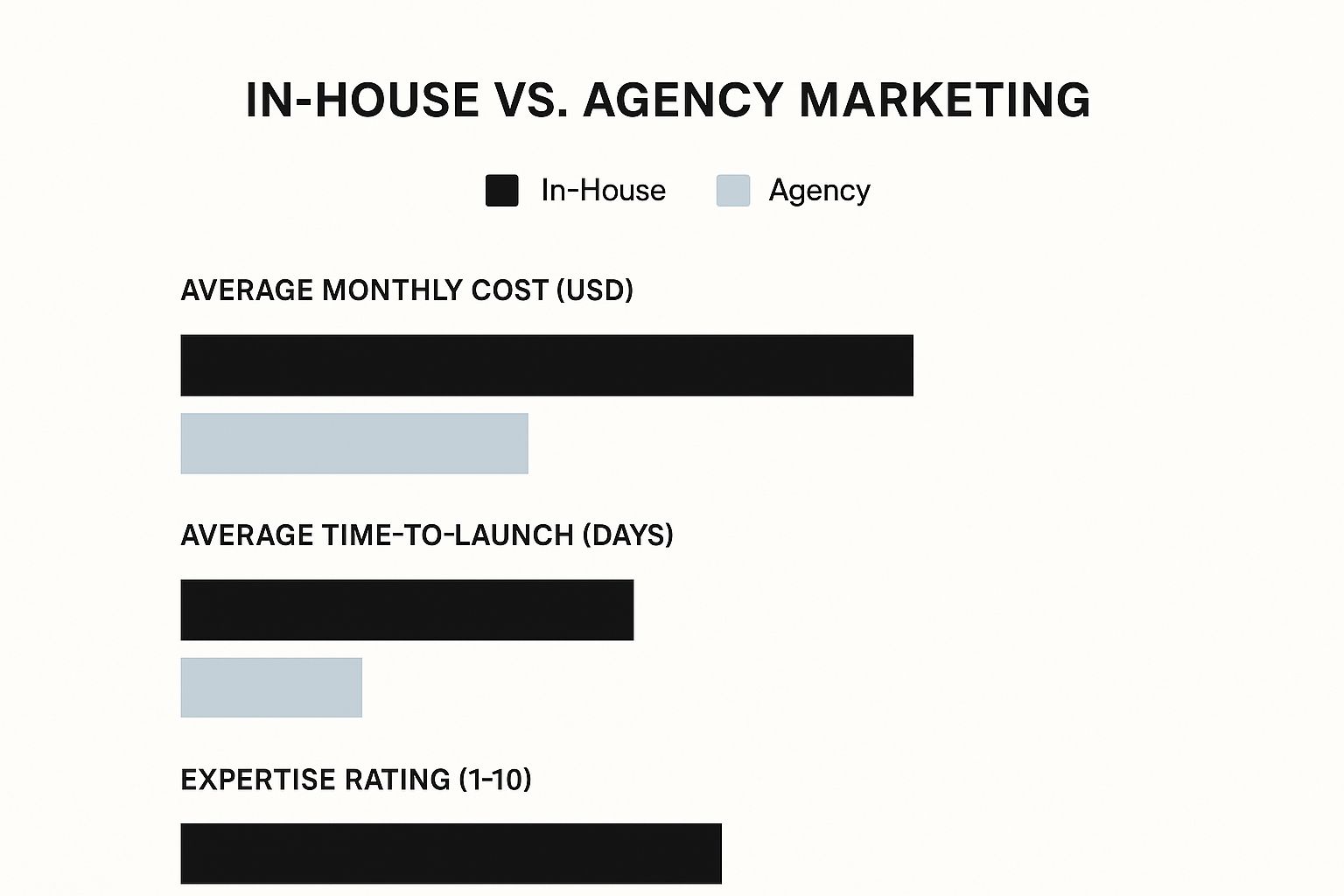
The data tells a clear story. While an in-house team can be more expensive and slower to get off the ground, it offers unparalleled expertise focused exclusively on your brand.
In House vs Agency Marketing: Why UK Businesses Are Building In-house Teams

The old debate of in-house vs. agency has seen a clear winner emerge across the UK. More and more businesses are now choosing to build their own marketing departments from the ground up. This isn’t just about outsourcing a few tasks; it’s a fundamental shift towards embedding marketing right into the core of the business. It’s a strategic play for more agility, tighter control, and a brand that feels truly authentic.
When your marketers are in the same building—or even the same virtual meetings—as your sales and product teams, you create a powerful, instant feedback loop. Communication just flows. This closeness allows for lightning-fast campaign tweaks based on real-time sales figures or customer comments, a level of speed that agencies, working from the outside, can rarely match.
An in-house team has the home-field advantage. They have direct access to all the internal data and key people, no filter. They don’t have to wait for a weekly report or a scheduled call to get the lay of the land. Instead, they can react to market shifts or campaign performance immediately, turning insights into action in hours, not days.
The Rise of Brand Ownership and Accountability (In House vs Agency Marketing)
Building an in-house team does more than just bring skills under one roof; it creates a genuine sense of ownership. When employees are deeply invested in the company’s future, they naturally become more accountable for the results they deliver. This cultivates a culture where every campaign is crafted with a deep, intuitive understanding of the brand’s voice, mission, and values.
When your team lives and breathes your brand every single day, their work has an authenticity that’s almost impossible for an external partner to replicate. This kind of consistent messaging builds much stronger, more trusted customer relationships in the long run.
This internal ownership also means that all the knowledge gained stays within the company. Every lesson from a campaign, whether it soared or flopped, adds to a growing bank of internal expertise. Your team just gets smarter and more effective over time.
A Dominant Trend Backed by Data
This isn’t just a feeling; it’s a major movement backed by hard numbers. In 2023, reports from the Institute of Practitioners in Advertising (IPA) revealed that around 90% of UK marketers are now using or at least considering an in-house model. The success stories are piling up, too. A separate 2023 report found an 87% satisfaction rate among marketers working with their in-house teams, a clear sign of widespread adoption and positive results.
The massive shift towards remote work has also poured fuel on this fire. With access to a much wider talent pool and other key remote work benefits, putting together a skilled, dedicated in-house team is more achievable than ever. It’s quickly becoming a winning strategy for countless UK businesses.
In House vs Agency Marketing: Understanding the True Cost of Each Model

When you’re weighing up in-house vs. agency marketing, it’s all too easy to just look at the headline price tag. That’s a classic mistake. A proper financial breakdown reveals a far more complex picture, especially here in the UK. The real choice isn’t just about a salary versus a retainer; it’s about figuring out the total cost of ownership for each path.
With an in-house team, the salary is only the beginning. You’ve got to add National Insurance contributions, mandatory pension schemes, and the often-forgotten costs of recruitment, which can be eye-wateringly high. These fixed overheads give you a predictable monthly outgoing, but they also lock you into a long-term financial commitment.
An agency, on the other hand, shows up as a variable cost. You pay a retainer or a project fee, which sounds simple enough. But the devil is in the detail – you have to get crystal clear on what that fee includes and what might land you with extra charges, like ad-hoc creative work or deep-dive reports.
Calculating the In-House Investment (In House vs Agency Marketing)
To get a real sense of the in-house cost, you have to look beyond the payslip. These “hidden” costs stack up fast and are absolutely critical for a fair comparison.
- Recruitment and Onboarding: Finding top talent means paying agency fees or sinking serious time into hiring platforms. Then comes the time and resources needed to get that new hire up to speed.
- Essential Tools and Software: Your team will need subscriptions to marketing automation platforms, SEO tools, analytics software, and creative suites. These can easily cost thousands of pounds every single year.
- Ongoing Professional Development: The marketing world moves at lightning speed. You’ll need to budget for training, courses, and conferences just to keep your team’s skills sharp and effective.
When you’re weighing up the financials, understanding the broader benefits of outsourcing can help you see the full value an agency brings, which goes way beyond just ticking off tasks.
Analysing Agency Value
The agency financial model is a completely different beast. A monthly retainer for a specialised service like PPC might look steep at first glance, but it actually replaces a whole host of fixed costs. Our guide on how much it costs to hire a PPC agency breaks this down in detail. For a single, predictable fee, you get instant access to a full team of specialists—strategists, copywriters, and data analysts.
This structure gives you huge financial flexibility. You can scale your marketing spend up or down depending on your campaign needs, without the headache of hiring or making redundancies.
From a resource point of view, UK businesses face a clear trade-off. In-house teams come with fixed salary costs and require investment in training to build that deep brand knowledge. A 2023 analysis showed that internal teams are often stretched thin, with one marketer juggling multiple roles. In contrast, agencies might cost more per project but give you flexible access to specialist skills without the long-term overheads of employment.
Comparing Expertise: Depth vs Breadth

When you’re weighing up in-house versus agency marketing, one of the biggest questions comes down to the kind of expertise you really need. It’s the classic depth versus breadth debate. Getting this right is absolutely vital for aligning your marketing with where your business is headed. Neither is better than the other; they just solve different problems.
An in-house team lives and breathes your business. Over time, they become true masters of your brand’s voice, the quirks of your audience, and the little details of your industry that an outsider would miss. This kind of deep, institutional knowledge is gold for creating authentic campaigns and keeping your strategy consistent for the long haul.
On the other hand, an agency brings a whole toolkit of specialists to your doorstep. Their roster might include a technical SEO wizard, a programmatic ads guru, and a creative content strategist—all with experience sharpened across dozens of different industries. This gives you instant access to a diverse talent pool that would be incredibly expensive to build yourself.
When Deep Institutional Knowledge Wins (In House vs Agency Marketing)
Sometimes, that deep, focused knowledge from an in-house team gives you a serious competitive edge. This setup really shines when brand authenticity and a subtle understanding of a complex product are what truly matter.
Think about these scenarios:
- Highly Niche Industries: If you’re in a sector with a steep learning curve—like specialised fintech or medical devices—an in-house team that’s completely immersed in the subject will always communicate more convincingly.
- Strong Founder-Led Brands: For businesses where the brand is wrapped up in a specific personality or ethos, an internal team is far better at protecting and projecting that identity with unwavering consistency.
- Rapid Product Iteration: When you’re constantly updating product features, an in-house team can pivot messaging and campaigns in real-time, staying perfectly in sync with your development cycles.
The real power of an in-house team is its cumulative knowledge. Every campaign, whether it flies or flops, adds to a bank of proprietary insight. This knowledge compounds over time, making every future marketing effort that much smarter.
When Broad, On-Demand Proficiency Is Better
An agency’s wide-ranging experience becomes the smart choice when you need to pull off complex, multi-channel campaigns or need specialised skills for a one-off project. They offer instant firepower and a fresh pair of eyes that can spot the blind spots your own team might not see. This is particularly true as marketing gets more and more complicated.
While the US made a big shift to in-house teams a while back, the UK has been catching up fast. The sheer complexity of modern digital marketing, covering everything from SEO to content, has pushed UK businesses to bring these skills under one roof. A huge driver for this is the ability for in-house teams to use proprietary customer data in real-time to fine-tune campaigns—something agencies often struggle with due to limited data access. You can dive deeper into how UK businesses are handling this on EMR Recruitment\’s blog.
Ultimately, the choice between depth and breadth comes down to an honest look at your immediate needs and your long-term ambitions.
In House vs Agency Marketing: How to Choose for Your Business Stage
The best choice in the in-house vs. agency marketing debate often boils down to one simple question: what does your business need right now? The right model for a scrappy start-up is rarely the best fit for an established enterprise. Matching your marketing structure to your business stage is essential for sustainable growth.
A fast-growing tech start-up, for example, often prioritises building a strong, authentic brand from day one. In this scenario, an in-house team is usually the smarter choice. They become deeply embedded in the company culture, making sure every piece of content and every campaign message perfectly reflects the founder’s vision. Their sole focus is on one brand, which allows for rapid learning and iteration as the business finds its feet.
Finding the Right Fit for Growth and Scale
Contrast this with an established retailer planning a large, multi-channel Christmas campaign. They need immediate, specialised firepower across several disciplines like PPC, social media advertising, and email marketing. For them, bringing in a marketing agency is the most effective route. It provides instant access to a full team of experts without the slow and costly process of recruitment.
This is especially true for highly technical areas. If a huge part of your campaign relies on paid search, understanding why hiring a specialist PPC agency trumps in-house management can make the decision a whole lot clearer. An agency brings battle-tested strategies and platform expertise that an internal generalist simply can’t match overnight.
But the choice isn’t always one or the other. In fact, many businesses find immense value in a third option.
The hybrid model offers a powerful “best of both worlds” solution. It combines a core internal team for brand strategy and daily tasks with specialist agency support for high-stakes, technical campaigns.
This structure gives you strategic control and brand consistency while tapping into external expertise where it matters most. For instance, your in-house marketing manager can oversee content and social media, while an agency handles the complexities of your Google Ads account. This blend of dedicated internal knowledge and on-demand specialist skill provides a flexible and potent framework for scaling your marketing efforts. It lets you build internal capacity over time while still accessing top-tier talent for critical projects, ensuring you’re always ready for the next stage of growth.
Which Model Fits Best? A Scenario-Based Guide (In House vs Agency Marketing)
Making the right call often comes down to your current situation and primary needs. This table breaks down common business scenarios to help guide your decision.
| Business Scenario | Primary Need | Recommended Model | Justification |
|---|---|---|---|
| Early-Stage Start-up | Brand Building & Culture Fit | In-House | Needs a team deeply immersed in the company’s vision and values to create an authentic brand voice from scratch. |
| Established SME | Predictable Growth & Efficiency | Hybrid Model | An in-house manager handles strategy and brand, while a specialist agency optimises technical channels like PPC for better ROI. |
| High-Growth Scale-up | Rapid Scaling & Specialised Skills | Agency-Led | Requires immediate access to a full suite of experts across multiple channels to fuel aggressive growth without hiring delays. |
| Enterprise-Level Company | Strategic Oversight & Niche Expertise | Hybrid Model | A large in-house team manages core operations, while multiple specialist agencies are brought in for specific projects or channels. |
| Business Launching a New Product | Speed to Market & Campaign Expertise | Agency | Needs a dedicated team to plan and execute a complex, multi-channel launch campaign quickly and effectively. |
| Company with Volatile Needs | Flexibility & On-Demand Support | Agency | Allows the business to scale marketing efforts up or down in line with seasonal demand or project-based requirements. |
Ultimately, the goal is to build a marketing function that supports, not strains, your business. Whether that’s fully in-house, completely outsourced, or a smart combination of both depends entirely on where you are and where you’re headed next.
In House vs Agency Marketing: Measuring Success and Long-Term Value
Figuring out the true return on your marketing investment goes way beyond looking at immediate campaign results. Whether you’ve gone in-house or brought in an agency, the real test of success is long-term business value, not just a few short-term wins. This is where the in-house vs agency debate really comes to a head.
With an in-house team, the real value builds up over time. Forget just conversions and click-through rates for a second. You have to measure the worth of the institutional knowledge you’re building. Every campaign, win or lose, adds to a bank of internal expertise that makes your team smarter and more efficient—that’s an asset that doesn’t just walk out the door. Think about the faster turnaround times and perfect brand consistency; these are valuable returns that won’t show up on a standard performance dashboard.
Assessing True Return on Investment
When you’re working with an agency, success is measured differently. It’s all about clear Key Performance Indicators (KPIs) and how cost-effective they are on a project-by-project basis. Their value comes from bringing in an external, strategic perspective that’s been sharpened across multiple industries. You’re judging an agency on its ability to deliver specialised results efficiently, giving you access to top-tier skills without the overheads of another full-time salary.
The ultimate measure of success is whether your chosen structure acts as a strategic asset. An in-house team should be building a lasting internal capability, while an agency should provide a clear, quantifiable return that justifies its cost.
At the end of the day, your goal is a marketing function that drives sustainable growth. This means looking at the whole picture. For example, when it comes to paid advertising, you need a solid framework for maximising your ROI with effective PPC management strategies, whether you nurture that expertise internally or hire it in.
You have to constantly ask yourself if your setup is delivering this long-term value. Doing so ensures your marketing isn’t just another cost centre, but a powerful engine for your business’s future.
In House vs Agency Marketing: Frequently Asked Questions
When you’re weighing up in-house versus agency marketing, a lot of practical questions come to mind. We see these pop up all the time with UK businesses. Here are some straightforward answers to the common dilemmas you’re likely facing.
When Should We Switch from an Agency to an In-House Team?
The tipping point usually comes when your marketing needs a level of brand immersion and speed that an external partner just can’t provide. The biggest trigger? When you find that your marketing has become so intertwined with your product development, sales, and leadership teams that you need someone living and breathing it every single day.
If you feel like you’re spending more time briefing the agency on company culture and product nuances than they are on the actual work, that’s a massive red flag. Another sign is when your marketing strategy is no longer just a function but the core engine of your business growth. At that point, you need dedicated, full-time ownership to really drive it forward.
How Do We Manage Skill Gaps in a Small In-House Team?
This is probably the single biggest headache for small in-house teams. The smartest way to tackle it is by not trying to do everything yourself. Right from the start, plan for a hybrid model.
Hire for the core skills you need day in, day out—like a brilliant content creator or a brand manager who truly gets your voice. For the technical, specialised stuff, bring in freelancers or a specialist agency to plug the gaps.
For example, let a dedicated PPC agency handle your paid advertising campaigns while your internal person nails the organic social media and email newsletters. This gives you the best of both worlds: a stable, in-house core with expert backup where it counts, all without the hefty cost of hiring multiple full-time specialists.
What Is the Best Way to Structure a Hybrid Marketing Model?
A rock-solid hybrid model is all about crystal-clear roles and responsibilities. Your in-house person or team should be the strategic heart, owning the brand voice, the overall marketing calendar, and the deep customer insights. Think of them as the brand guardian and project manager.
Your agency partner then becomes a specialist extension of your team, plugging in to execute technical or high-volume tasks. For this to work smoothly, you need precise workflows. The in-house manager must be the single point of contact, responsible for delivering clear, concise briefs and gathering all internal feedback before it goes to the agency. This structure stops communication from getting messy and ensures the agency’s output is perfectly aligned with your strategy.
How Do I Calculate the True Cost of an In-House Hire?
To get the real number, you have to look way beyond just the salary. Start with the base salary, then add at least 20-30% on top for overheads. This covers things like National Insurance contributions, pension schemes, office space, a laptop, and other essential equipment.
Next, you need to account for recruitment fees, which can easily be 15-25% of the first year’s salary. And don’t forget the ongoing annual costs for software subscriptions (like marketing automation tools or design software) and professional development to keep their skills sharp. Add all that up, and you’ll get the true cost of ownership—a much more accurate figure to compare against an agency’s monthly retainer.
Ready to see what a specialist agency can do for you? The team of experts at PPC Geeks offers a free, in-depth audit to show you exactly how to improve your PPC performance and maximise your ROI. Get your free PPC audit today.