




Think of pay-per-click software as the strategic co-pilot for your digital advertising campaigns. It’s the brains behind the operation, automating thousands of complex decisions to squeeze every last drop of value from your investment. While platforms like Google Ads are the aircraft, PPC software is the advanced navigation and real-time flight control you need to outfly competitors.
What Is Pay Per Click Software and Why Does It Matter?
Trying to manage a modern pay-per-click (PPC) campaign without specialised software is like trying to manually adjust the sails on a huge ship every second to catch the perfect gust of wind. It’s a losing battle. The digital ad space is constantly in flux, with auction prices, competitor moves, and customer behaviour changing by the minute.
PPC software acts as your central command centre, layering on top of native ad platforms like Google Ads or Microsoft Ads. It takes over the tedious, soul-crushing tasks while delivering insights the standard dashboards just can’t offer. No more waking up at 3 AM to check bids or guessing which ad copy is hitting the mark—the software handles it with cold, hard algorithmic precision.
The Shift From Manual Labour To Strategic Oversight
The real magic of this software is how it elevates your role. You stop being a button-pusher and become a high-level strategist. Instead of drowning in repetitive tasks, you can finally focus on the bigger picture.
Here are the key functions that make this happen:
- Automated Bid Management: Smart algorithms analyse hundreds of signals in real-time to set the perfect bid for every single click. A human just can’t compete with that speed and scale.
- Intelligent Budget Allocation: The software automatically funnels your ad spend towards the campaigns, keywords, or audiences that are actually making you money, stopping wasteful spending in its tracks.
- Advanced Analytics and Reporting: It pulls data from all your platforms into one clean, easy-to-read dashboard, spotting trends and opportunities you’d almost certainly miss otherwise.
- Competitive Intelligence: Many tools let you peek over your competitors’ shoulders, showing you the keywords they’re bidding on and the ad copy they’re running.
The Tangible Impact On Your Bottom Line (Best Pay Per Click Software)
Using PPC software isn’t just a matter of convenience; it’s about gaining a genuine competitive edge. The numbers don’t lie: paid search is a serious driver for UK businesses. PPC traffic is known to convert around 50% better than organic traffic, and with average conversion rates sitting near 2.55%, every tiny optimisation makes a huge difference.
Take a look at the native Google Ads platform, the foundation for so many PPC campaigns.
While it’s a powerful tool, managing complex campaigns effectively through this interface alone requires a massive amount of manual work. This is exactly where automation software comes in, adding layers of intelligence that simplify management and boost your results.
To truly understand the difference, it helps to see the tasks side-by-side.
Manual PPC Management vs PPC Software
| Task | Manual Management | Using PPC Software |
|---|---|---|
| Bid Adjustments | Time-consuming, manual updates based on past data. | Real-time, algorithmic bidding based on hundreds of signals. |
| Budget Pacing | Constant monitoring and manual shifts to avoid overspending. | Automated allocation to top-performing areas, maximising ROI. |
| Performance Reporting | Exporting data from multiple sources and combining it in spreadsheets. | Consolidated, easy-to-read dashboards with actionable insights. |
| Keyword Optimisation | Guesswork and periodic reviews of what might be working. | Data-driven suggestions for new keywords and elimination of poor ones. |
| A/B Testing | A slow, manual process to set up and track ad variations. | Automated testing of ad copy, headlines, and calls-to-action at scale. |
It’s clear that relying on software gives you an almost unfair advantage in terms of efficiency and effectiveness.
In essence, pay per click software doesn’t replace platforms like Google Ads; it enhances them. It turns a powerful but complex tool into a smarter, more efficient engine for business growth.
Ultimately, these tools are no longer a luxury. If you’re serious about making your ad spend work harder, saving precious time, and making decisions based on data instead of guesswork, they are an absolute necessity. Getting to grips with the basics is your first step, and you can learn more about what is PPC advertising in our detailed guide.
Best Pay Per Click Software: The Core Features That Drive Campaign Success
When you’re sizing up pay per click software, it’s easy to get lost in a long list of features. But the real magic isn’t just in what a tool does, but why it does it. The best platforms are built around core capabilities that directly solve the biggest headaches in PPC management, turning mountains of data into genuine strategic advantages.
You need to look past the marketing fluff and understand how these features will actually impact your campaigns. It’s like buying a car. One might shout about its top speed, but another might have brilliant traction control that helps you get where you’re going safely and efficiently when the roads are slick. It’s the same idea here.
The most powerful features in PPC software really boil down to three main areas: automation, bid management, and analytics.
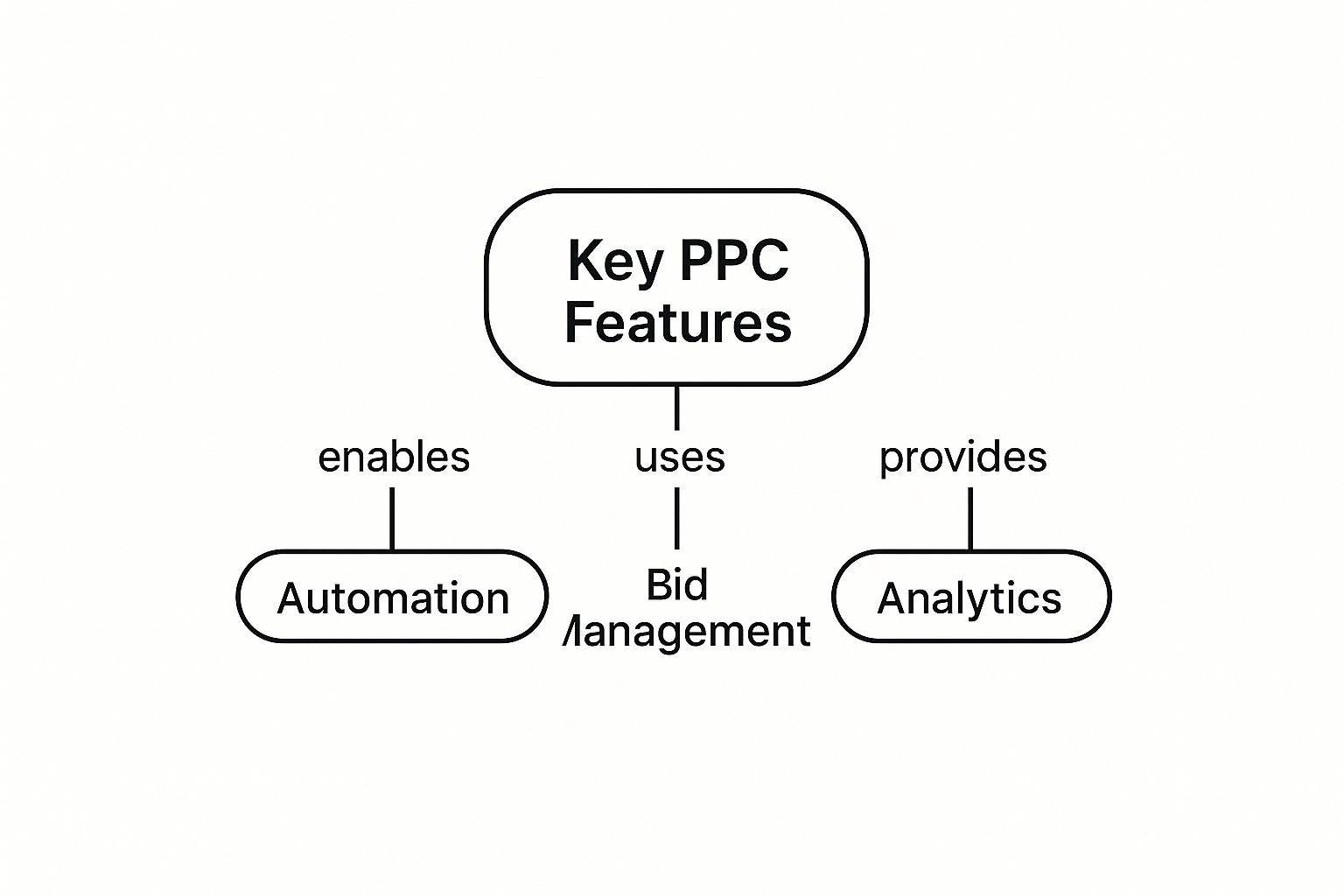
As you can see, a successful campaign depends on these three pillars working together. Each one supports and strengthens the others.
Automated Bid Management
This is usually the headline feature, and for good reason. Automated bid management is the software’s ability to tweak your keyword bids around the clock, 24/7, using hundreds of different performance signals. It’s a job no human could ever do effectively at scale.
Just imagine trying to manually change bids for thousands of keywords based on someone’s device, the time of day, their location, and whether they’ve converted before—all in the split second of a search auction. It’s flat-out impossible. This is where algorithms shine.
The software’s main job is to find that sweet spot: the perfect bid that wins the click for the lowest possible price while giving you the best shot at a conversion. It’s all about precision, not just throwing more money at it.
For instance, the software might bid a bit higher for someone searching on their phone in Central London at lunchtime, because that profile has historically brought in more sales for your online shop. On the flip side, it might drop the bid for a desktop user in a different area late at night.
Intelligent Keyword Research Tools (Best Pay Per Click Software)
While the ad platforms themselves have keyword research tools, dedicated pay per click software adds a much more strategic layer. These tools don’t just spit out search volumes; they help you uncover those hidden gems your competitors have probably overlooked.
They can pinpoint long-tail keywords that signal a strong intent to buy or highlight “adjacent” keywords that are less crowded but still highly relevant. This is how you broaden your reach without getting dragged into expensive bidding wars for the most obvious terms. It’s a vital step in building a campaign that catches customers at every point in their journey.
Automated A/B Ad Testing
Writing great ad copy is part art, part science. A/B testing is what automates the science bit. Instead of manually creating different ad versions and painstakingly tracking them in spreadsheets, the software does all the heavy lifting for you.
You can feed it multiple headlines, descriptions, and calls-to-action, and the platform will automatically rotate them to find the winning formula. It then cleverly shifts more budget towards the top-performing ads, making sure your spend is always backing your most powerful message. This constant tweaking leads to higher click-through rates (CTR) and, of course, more conversions. For a better handle on how to measure these results, check out our in-depth guide on Google Ads conversion tracking.
Advanced Performance Dashboards (Best Pay Per Click Software)
The standard dashboards in ad platforms get the job done, but they can be a bit of a data-dump. You often have to export everything just to find any real insights. Good PPC software cuts through the noise with clean, customisable dashboards that show you the metrics that actually matter to your business.
A few key benefits of these advanced dashboards include:
- Cross-Platform Reporting: See how you’re doing across Google Ads, Microsoft Ads, and social media, all in one place.
- Trend Identification: Quickly spot performance dips or spikes that could signal a problem or a golden opportunity.
- Customisable Views: Create tailored reports for different people, from high-level ROI summaries for the boss to granular campaign data for your marketing team.
These dashboards turn raw numbers into a clear story, helping you make smarter decisions, faster.
Competitor Intelligence Tracking
Finally, one of the most powerful features is the ability to keep an eye on your competition. This isn’t about simply copying their strategy; it’s about understanding it so you can find your own unique edge.
This functionality can show you:
- Which keywords your competitors are bidding on.
- The exact ad copy they’re running right now.
- Their estimated monthly ad spend and traffic.
Armed with this kind of intel, you can spot gaps in their approach, find less-contested keywords to target, and write ad copy that makes your unique selling points shine. It transforms the competitive landscape from an unknown threat into a source of powerful, actionable data.
Best Pay Per Click Software: Unlocking Strategic Wins with PPC Automation
When you start using pay-per-click software, you’re not just adding another tool to your marketing kit. You’re fundamentally changing how your entire marketing operation works. It’s a shift from being bogged down in the nitty-gritty to focusing on high-impact, forward-thinking strategy—the kind of work that delivers wins you can see on your bottom line.
These benefits aren’t just buzzwords on a sales page; they are tangible, measurable results that are crucial for any business serious about competing. These platforms are built to solve the biggest headaches in campaign management, turning chaos into clarity and guesswork into data-backed confidence.
Let’s break down the four core strategic wins that PPC automation puts on the table.
Achieve Superior Time and Resource Efficiency
The first thing you’ll notice is the sheer amount of time your team gets back. Manually managing bids, pulling reports, and tweaking campaigns across multiple platforms is a massive drain on resources. A single PPC manager can easily burn hours every week just on routine maintenance.
This is where automation flips the script. By handing over the repetitive, data-heavy lifting to the software, you free up your skilled team to focus on what humans do best: strategy, creativity, and seeing the bigger picture. Instead of getting lost in keyword bids, they can be analysing market trends, brainstorming new ad creative, or planning your next big campaign launch. It’s not about working faster; it’s about working smarter.
Enhance ROI and Optimise Your Budget (Best Pay Per Click Software)
Every single pound you spend on advertising needs to pull its weight. Pay-per-click software acts as a vigilant guardian of your budget, making sure it’s allocated with algorithmic precision to stamp out wasted ad spend. The system is constantly on the lookout for underperforming keywords, ads, and campaigns, automatically dialling back their budget or pausing them altogether.
At the same time, it smartly reallocates that cash to the areas that are delivering the highest return on investment (ROI). This dynamic optimisation runs 24/7, something that’s simply impossible for a human to replicate. Many platforms also have advanced features, and you can dig deeper into how Google Ads Smart Bidding works to really push performance. The outcome is a self-improving system that constantly refines your spend to maximise conversions and slash your cost per acquisition (CPA).
A key advantage here is the software’s ability to analyse hundreds of real-time signals—like device, location, time of day, and user behaviour—to make instant bidding decisions. This ensures you pay the right price for every single click, every single time.
Make Confident Data-Driven Decisions
Great PPC management is built on data, but raw metrics can be a confusing mess. One of the biggest perks of dedicated software is its ability to pull all your performance data into clean, actionable dashboards. Instead of logging into Google Ads, Microsoft Ads, and all your social platforms separately, you get one unified view of what’s happening.
Here’s a great example of a clear, consolidated dashboard from WordStream, which makes it easy to visualise your key performance indicators at a glance.
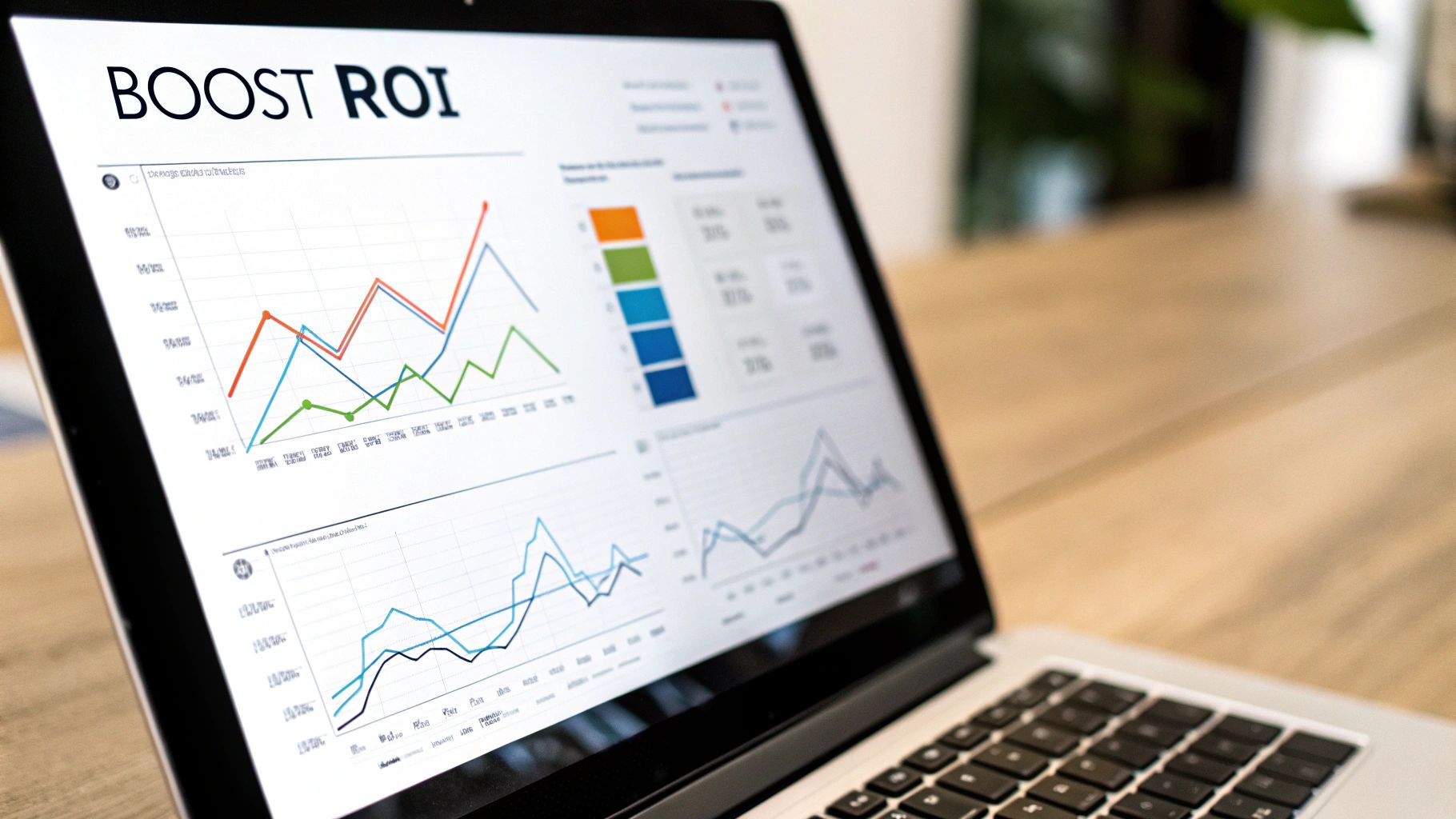
This kind of centralised reporting transforms complicated spreadsheets into clear insights. It helps you spot trends, identify new opportunities, and make much smarter strategic decisions that lead to sustainable growth.
Scale Your Campaigns Effortlessly (Best Pay Per Click Software)
As your business grows, your advertising gets more complex. Managing a handful of campaigns is one thing, but scaling to hundreds or thousands across different channels and countries is a whole different beast. Without the right tools, this kind of growth would mean hiring a small army.
PPC software makes scaling up feel effortless and cost-effective. It gives you the framework to manage incredibly complex, multi-channel campaigns without having to expand your team. Whether you’re launching in a new country or adding a new product line, the software handles the extra workload seamlessly, allowing your advertising to grow right alongside your business ambitions.
How to Choose the Right and Best Pay Per Click Software
Picking the right pay per click software feels like a massive decision, doesn’t it? The market’s flooded with options, all shouting about how they’ll change your business overnight. Get it wrong, and you’re stuck with a tool that bleeds your budget and causes endless headaches. But get it right? You’ve got a genuine asset that will power your growth for years.
Think of it like hiring a key team member. You wouldn’t just pick someone at random. You’d figure out what you need, check their track record, and make sure they’re a good fit. It’s the exact same process here. Let’s walk through the steps to get you from browsing to buying with confidence.
First Things First: What Are Your Business Goals?
Before you even glance at a feature list, you need to be crystal clear on what success actually looks like for you. The “best” software is a myth; the right software is the one that directly helps you hit your specific targets. Are you an e-commerce brand trying to shift more products, or are you a service business focused on getting high-quality leads in the door?
Your answer cuts through the noise and instantly shortens your list.
- Selling Products Online? You’ll need a tool that’s brilliant at Google Shopping feed optimisation, dynamic remarketing, and managing Return On Ad Spend (ROAS) bidding.
- Need More Leads? Your focus should be on software that nails conversion tracking—think form fills and phone calls—and helps you drive down your Cost Per Acquisition (CPA).
- Building Brand Awareness? Look for platforms that give you clear, easy-to-read reports on things like reach, impressions, and how your audience is engaging.
Sorting this out first means you’re judging every tool on its ability to impact what really matters: your bottom line.
Get Your Head Around the Pricing Models (Best Pay Per Click Software)
PPC software pricing isn’t a one-size-fits-all deal. You’ll mostly come across two models: a flat monthly fee or a percentage of your total ad spend. Each has its place, and the best fit for you depends on your budget and your growth plans.
A flat-fee model gives you predictable costs, which is great if your budget is pretty stable. On the other hand, a model based on a percentage of ad spend can be more affordable for smaller advertisers, as the cost only goes up as your campaigns get bigger. Do the maths for both models based on what you spend now and what you plan to spend, so there are no nasty surprises down the road.
Don’t Skip the Integration Check
Your new software has to play nicely with the tools you’re already using. This is non-negotiable. Here in the United Kingdom, Google Ads is the undisputed king of PPC advertising.
A 2023 survey showed that a massive 97% of PPC marketers in the UK and Ireland use Google search ads. Microsoft’s Bing Ads comes in second, with 73% of marketers using it, so that’s another key integration to look for. You can see the full breakdown of UK PPC platform usage on Statista.com.
But it’s not just about the ad platforms. Think about your whole setup. Does the software need to talk to your CRM, like Salesforce or HubSpot, to send lead info across? How about your e-commerce platform, like Shopify or Magento? If the integrations are clunky, you’ll create data silos and give yourself a mountain of manual work.
Choosing the right software is a critical step, but it requires a structured approach. To help you stay organised and make an informed decision, we’ve put together a simple checklist. Use this to compare your options and ensure you’re asking the right questions before committing.
PPC Software Selection Checklist
| Evaluation Criteria | Questions to Ask | Importance (High/Medium/Low) |
|---|---|---|
| Business Goal Alignment | Does this software have the features needed to hit our main KPIs (e.g., ROAS, CPA)? | High |
| Pricing Model | Is the cost predictable? Does it align with our current and future ad spend? | High |
| Ad Platform Integrations | Does it connect seamlessly with Google Ads, Microsoft Ads, and social platforms we use? | High |
| CRM/E-commerce Integration | Can it integrate with our CRM (e.g., Salesforce) or e-commerce platform (e.g., Shopify)? | High |
| Usability & User Interface | Is the dashboard intuitive? Can our team learn to use it without extensive training? | Medium |
| Reporting & Analytics | Are the reports customisable? Do they provide the deep insights we need? | Medium |
| Automation Features | Does it offer rule-based automation for bidding, budget management, and alerts? | High |
| Customer Support | What support channels are available (live chat, phone)? What are their response times? | Medium |
| Scalability | Will this software grow with us as our ad spend and campaign complexity increase? | Low |
This checklist isn’t exhaustive, but it covers the core areas you absolutely need to consider. By working through it for each of your shortlisted tools, you’ll build a much clearer picture of which one is the right long-term partner for your business.
Make Sure It’s Usable (And Has Great Support)
Even the most feature-packed software is completely worthless if your team can’t figure out how to use it. The user interface should be clean, logical, and feel intuitive to the people who’ll be in it every day. Don’t ever underestimate the value of a well-designed dashboard.
This is where free trials and product demos are your best friends. Get your team to actually use your top choices. Can they find the reports they need without a map? Is setting up a simple automated rule a five-minute job or a five-hour nightmare? This hands-on time is your chance to see if the platform clicks with your team’s skills.
Just as important is the quality of customer support. Because trust me, you will run into a problem at some point. When that happens, how quickly and effectively can their team help you? Look for providers who offer solid support through live chat, email, and phone. Choosing a tool with top-notch support is an investment in your own sanity.
Best Pay Per Click Software: Maximising Your Investment from Day One
Getting your hands on powerful pay-per-click software is just the start of the journey; the real magic happens when you unlock everything it can do. It’s a bit like buying a top-of-the-range performance car. The purchase is exciting, but you only feel the thrill once you learn to master the controls, understand its limits, and take it for a spin on the right roads. This is your roadmap to a successful rollout.
The implementation phase is where your strategy and the software’s automation finally shake hands. It’s not as simple as flicking a switch. A bit of thought at this stage ensures you get off to a flying start, protect your valuable historical data, and get a clear picture of performance from the get-go. This is what sets the stage for every win that follows.
The Essential Setup Process
A smooth start now will save you countless headaches later. The initial setup is all about creating a secure, seamless connection between your ad accounts and your new software, making sure no data gets lost along the way. Get this right, because every future optimisation is built on this foundation.
Here’s a typical flow for getting your software live and kicking:
- Securely Connect Your Ad Accounts: First things first, you need to authorise the software to access your Google Ads, Microsoft Ads, and any other ad platforms you’re using. This is usually a straightforward process using your secure logins, giving the tool the permissions it needs to manage your campaigns.
- Import Existing Campaigns: You’re not starting from a blank slate. The software will pull in all your existing campaigns, ad groups, keywords, and performance history. This step is absolutely vital because it feeds the algorithms the data they need to understand what’s worked for you in the past.
- Configure Conversion Tracking: Double-check, and then triple-check, that your conversion tracking is set up correctly and the new platform can see it. Accurate conversion data is the fuel for any automation engine; without it, the software is flying blind.
Best Practices for the First 90 Days (Best Pay Per Click Software)
The first three months with new pay per click software are a critical learning period—for you and for the platform’s algorithms. This is when you set your benchmarks and teach the system what success actually looks like for your business. Rushing this phase is a recipe for poor, misinformed automated decisions down the line.
Your main goal in this initial period isn’t to chase dramatic, overnight results. It’s to feed the system high-quality data and establish a reliable performance baseline. Patience in the first 90 days pays dividends for months to come.
To make the most of this time, focus on a few key activities. These steps will help the software learn faster and give you the insights needed to guide its automated processes effectively.
- Establish Performance Baselines: Before you let the automation off the leash, let the software run for a week or two just to gather baseline data. This gives you a clear ‘before’ picture, making it much easier to measure the impact of any changes later on.
- Set Up Smart Alerts: Create custom alerts that ping you when there are significant changes in performance, like a sudden spike in cost-per-acquisition (CPA) or a drop in click-through rate (CTR). Think of it as a safety net while you’re still building trust in the automation.
- Create Custom Dashboards: Don’t just stick with the default reports. Build dashboards that show the key performance indicators (KPIs) that actually matter to your business. Whether it’s Return On Ad Spend (ROAS) for an e-commerce store or lead volume for a service business, make sure your most important metrics are front and centre.
By following this structured approach, you’ll move smoothly from manual management to a powerful partnership between your strategic brain and the software’s automation. This disciplined implementation lets you continuously refine your campaigns, make sense of the data, and truly maximise your return on investment from day one.
The Future of PPC Is Smarter Not Harder
The days of PPC being a frantic race of who could click buttons the fastest are long gone. Today, winning in this space is all about working smarter, not harder.
It’s time to move on from the hamster wheel of endless manual tweaks and instead embrace the strategic oversight that powerful pay per click software brings to the table. Let’s be clear: these platforms are no longer a nice-to-have advantage; they’re an absolute necessity for modern advertising.
By swapping out guesswork for data-driven automation, these tools give businesses a real shot at achieving a superior return on investment. They are the engine that powers efficiency, freeing you from the mundane tasks so you can focus on what really matters – high-level strategy and creative thinking.
At the end of the day, it’s simple: your strategic expertise combined with intelligent automation is the unbeatable formula for profitable campaign management. Use these tools to build a more efficient and scalable advertising operation.
Looking ahead, the role of artificial intelligence is only going to get bigger. AI-powered predictive analytics and automated creative optimisation are already changing the game. To stay ahead, you need to understand the future of PPC and AI-driven strategies and how they will dictate campaign success from now on.
Ultimately, these platforms are about empowerment. They arm you with the insights and automation needed to build a more strategic, efficient, and profitable approach to PPC, setting you up for sustainable business growth for years to come.
Frequently Asked Questions
When you’re digging into the world of pay-per-click software, a few questions always seem to pop up. It’s only natural, especially when you’re figuring out if it’s the right move for your business. We’ve gathered some of the most common queries to give you clear, straight-up answers.
Can PPC Software Completely Replace a Human Manager?
Not a chance. Think of the software as an incredibly efficient co-pilot, not the pilot. It’s designed to be a powerful collaborator, handling the grunt work that humans just can’t keep up with.
It excels at automating the repetitive, data-heavy tasks like real-time bidding, processing thousands of data points a second to make adjustments. No person could ever match that speed. But the strategy? The creative ad copy, understanding subtle market shifts, and making those big-picture budget calls? That still needs a sharp human mind. The software frees up the strategist to focus on what really drives growth, rather than getting bogged down in manual tweaks.
Is There a Free Pay Per Click Software for a Small Business?
Yes and no. There are free tools out there, and the native platforms like Google Ads Editor are surprisingly powerful. For any business just starting out with a minimal budget, getting to grips with these is a very smart first step.
However, they just don’t have the sophisticated automation and neat cross-platform reporting you get with paid software. As your ad spend and the number of campaigns you’re juggling grows, the time savings and performance boosts from a dedicated paid tool almost always pay for themselves. The efficiency gains alone can justify the cost, letting you get much more done with the same resources.
The key is to weigh the cost against the value it’s delivering. A paid tool that saves you ten hours a month and bumps your ROAS by 15% has paid for itself almost instantly.
How Long Does It Take to See Results After Implementation?
You’ll feel the time-saving benefits from day one, which is an immediate win. In terms of actual performance gains, though, most pay per click software needs a bit of a ‘learning period’. It usually takes a few weeks to gather enough data for its algorithms to start making genuinely smart optimisations.
You can typically expect to see measurable improvements in key metrics like Cost Per Acquisition (CPA) or Return On Ad Spend (ROAS) within the first 30 to 60 days. Real, lasting success, however, comes from combining the software’s automated power with your own ongoing strategic input and analysis. It’s a partnership.
Ready to stop wasting time on manual PPC tasks and start seeing real results? The team at PPC Geeks offers a free, in-depth PPC audit to show you exactly where your campaigns can be improved. Let our UK-based experts build a data-driven strategy to increase your traffic, leads, and sales. Get in touch with us today at https://ppcgeeks.co.uk/.