




Picture your product sitting on the best shelf in a busy supermarket, right at eye level. That’s exactly what PPC does for your brand on Amazon. It’s a straightforward advertising system where you only pay a small fee when a shopper actually clicks on your ad, giving your products that all-important premium visibility in a seriously crowded marketplace.
Mastering PPC in Amazon: Why PPC on Amazon Is Essential for UK Sellers
In the simplest terms, Amazon Pay-Per-Click (PPC) is an advertising model that lets sellers create campaigns for their products, placing them in prime locations like the top of search results or even on competitor product pages. The best part? You only pay when a potential customer is interested enough to click.
Think of it as jumping the queue. Instead of waiting months for your product to climb the organic rankings, PPC gives you immediate visibility. This is an absolute game-changer for launching new products, shifting stock quickly, or just defending your patch from aggressive competitors. For UK sellers, it’s often the difference between being seen and being completely buried.
Before we dive deeper, let’s quickly break down the core ideas you’ll need to get your head around.
Amazon PPC at a Glance Key Concepts
This table offers a quick snapshot of the key components of Amazon PPC. Think of it as your foundation for understanding everything that follows.
| Concept | Brief Explanation | Why It Matters for UK Sellers |
|---|---|---|
| PPC | Pay-Per-Click. An advertising model where you pay a fee each time your ad is clicked. | It’s a cost-effective way to drive traffic because you’re only paying for genuine interest. |
| Keywords | The search terms shoppers use to find products on Amazon. You bid on these terms. | Nailing your keyword strategy means you show up in front of buyers who are ready to purchase. |
| Campaigns | The structure for your ads. You can create different types (e.g., Sponsored Products). | Good campaign structure is key to controlling your budget and targeting the right customers. |
| ACoS | Advertising Cost of Sale. The percentage of attributed sales spent on advertising. | This is your go-to metric for measuring the direct profitability of your ad campaigns. |
| Bidding | The maximum amount you’re willing to pay for a click on your ad for a specific keyword. | Smart bidding ensures you stay competitive without blowing your budget. |
Getting a grip on these concepts is the first step. Now, let’s explore why this matters so much in the bustling UK market.
Standing Out in a Competitive Market (Mastering PPC in Amazon)
The Amazon UK platform is buzzing. It’s a fantastic place to do business, but that also means it’s incredibly competitive. Strategic advertising isn’t just a ‘nice-to-have’ anymore; it’s a fundamental pillar for growth. Without a solid PPC strategy, even the most brilliant products can get lost in the noise.
The challenge isn’t just selling a great product; it’s making sure the right customers can actually find it. Amazon PPC is your digital megaphone, broadcasting your product’s value directly to shoppers actively looking for what you offer.
The numbers really drive this home. In the fiercely competitive Amazon UK marketplace of 2025, over 330,000 active sellers are all vying for customer attention. That fact alone makes PPC an essential tool for standing out. This positions the UK as Europe’s second-largest marketplace, and you can bet a huge number of those sellers are using ads to target UK shoppers effectively.
Driving Growth and Building Your Brand
Beyond the instant sales hit, a well-run PPC campaign is fuel for your long-term success. By funnelling targeted traffic to your listings, you increase sales velocity. This, in turn, helps boost your organic search ranking over time, creating a powerful feedback loop where paid ads lift your organic performance.
Mastering PPC means you can:
- Get your hands on valuable data: Discover which keywords actually convert and get inside your customers’ heads.
- Boost your brand awareness: Get your brand and products in front of thousands of relevant shoppers.
- Control the narrative: Test different ad copy and images to figure out what truly resonates with your audience.
This advertising system gives you the control and insight you need to scale your business predictably. For a much deeper dive into the mechanics, our complete guide on Amazon Pay-Per-Click advertising breaks it all down. It’s the key to turning clicks into loyal customers and building a brand that lasts.
Choosing Your Tools: Sponsored Products, Brands, and Display
So, you see the potential of Amazon PPC. What’s next? It’s time to pick the right tools for the job. Amazon Advertising gives you a powerful toolkit with three core ad types, each built for a different purpose. Think of them as a spotlight, a billboard, and a friendly reminder—all working together to grow your business.
Getting the ad type right is absolutely critical to your campaign’s success. You wouldn’t use a hammer to saw wood, right? It’s the same principle here. Using the wrong ad format will just lead to wasted ad spend and disappointing results. Let’s unpack the big three: Sponsored Products, Sponsored Brands, and Sponsored Display.
Sponsored Products: The Digital Spotlight
Sponsored Product ads are the bread and butter of Amazon PPC. These are the ads you see for individual product listings that pop up directly within search results and on other product detail pages. Their number one job is to drive sales for specific items. Simple as that.
Imagine you sell high-quality, eco-friendly dog toys. When a shopper types in “durable dog chew toy,” a Sponsored Product ad can place your best-selling toy right at the top of their search results. It’s a direct, powerful way to grab the attention of customers who are ready to buy.
These ads are a must for:
- New Product Launches: Get instant visibility for a product that has zero sales history.
- Boosting Bestsellers: Defend your top products from competitors and keep the sales momentum going.
- Clearing Inventory: Push specific items that you need to shift quickly.
They’re also pretty straightforward to set up, making them the perfect entry point for sellers just dipping their toes into Amazon advertising. Because they’re laser-focused on conversions, they provide a clear and measurable return on your investment.
This visual shows how all the different parts of PPC work together to hit those core business goals like visibility and sales.
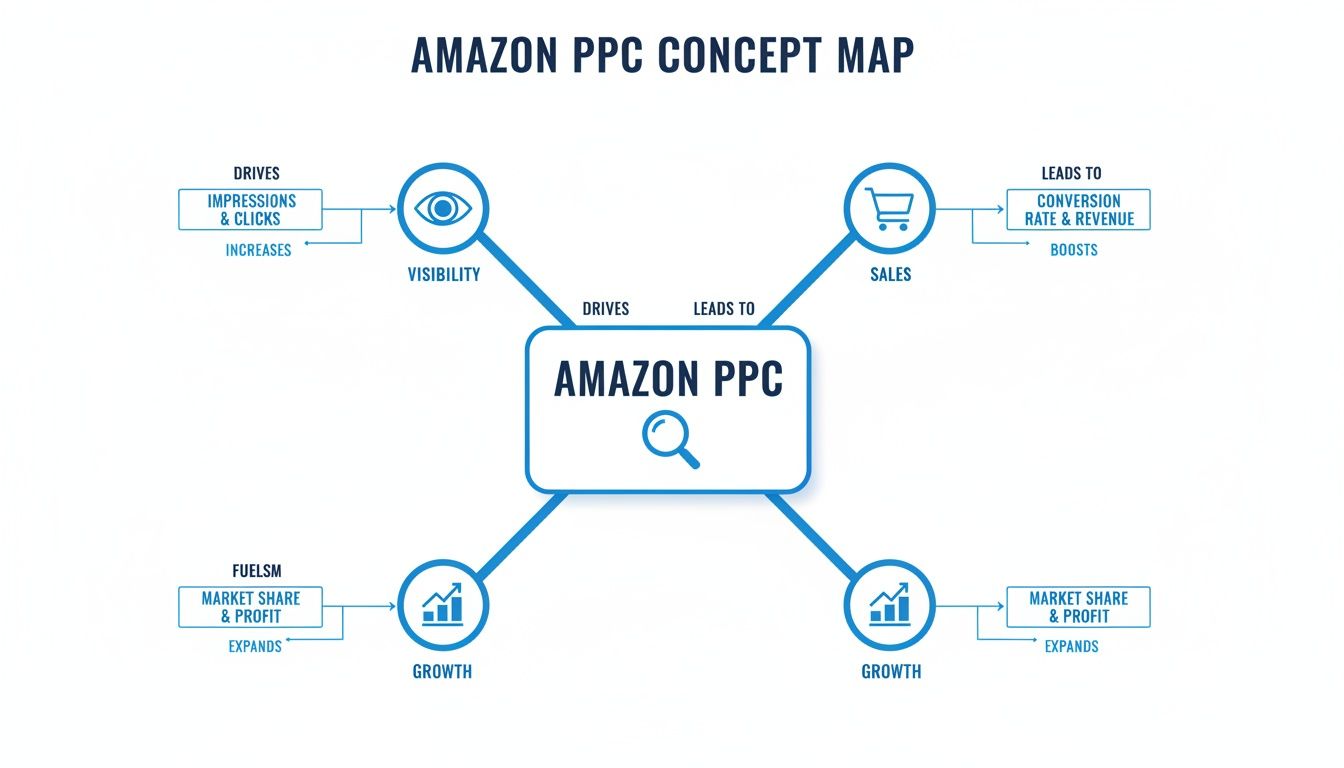
As you can see, visibility is the first domino to fall. It leads directly to more sales and fuels your overall business growth.
Sponsored Brands: The Brand Billboard (Mastering PPC in Amazon)
While Sponsored Products zoom in on individual items, Sponsored Brands are all about building brand awareness. These ads typically show up as a banner at the very top of search results, featuring your brand logo, a custom headline, and a collection of up to three of your products.
Think of it as your brand’s billboard on Amazon’s busiest high street. When a shopper clicks on your logo or headline, you can send them straight to your Amazon Storefront or a custom landing page that showcases a whole range of your products. It’s your chance to tell a bigger story and introduce customers to your entire product line, not just one item.
Sponsored Brands shift the focus from a single transaction to building a lasting customer relationship. They answer the question, “Who is this brand?” and invite shoppers to explore what you’re all about.
This ad type is perfect for cementing your brand identity and encouraging loyal customers to come back for more.
Sponsored Display: The Friendly Reminder
Finally, we have Sponsored Display ads. This format is a bit different because it lets you reach shoppers both on and off Amazon. These ads are less about what people are typing into the search bar and more about their recent shopping behaviour.
You can use Sponsored Display to retarget shoppers who have visited your product pages but didn’t buy anything. Your ad can then follow them around as they browse other websites and apps, gently reminding them of that product they were interested in. It’s an incredibly effective way to bring potential customers back into the fold to complete their purchase.
This ad type is also brilliant for cross-selling and up-selling, allowing you to show ads on the product pages of complementary items. For a more detailed breakdown, you can learn more about how Amazon Sponsored Display ads can boost your strategy in our dedicated guide.
Choosing the right mix of these three ad types is the foundation of any killer PPC strategy on Amazon.
Mastering PPC in Amazon: Winning the Targeting Game with Keywords and ASINs
Targeting is the engine that drives your entire Amazon PPC strategy. Get it right, and you’re connecting with shoppers who are literally telling you they’re ready to buy. Get it wrong, and you might as well be setting fire to your ad budget. This is where you tell Amazon exactly who should see your ads, using a smart mix of keyword research and direct product targeting.
Think of yourself as a detective. Your job is to uncover the precise clues—the search terms and products—that lead you straight to your ideal customer. The sharper your targeting, the more efficient your ad spend becomes. It’s the difference between shouting into a crowded room and having a quiet, direct conversation with someone already interested in what you have to say.
This section is your practical playbook for building a targeting strategy that puts you firmly back in control of your campaign performance.
Mastering Keyword Targeting Match Types
When a shopper types something into the Amazon search bar, that’s your keyword. Keyword targeting is all about bidding on these specific phrases to get your product ad right in front of them at that exact moment of interest. Amazon gives you three main levers to control how closely a customer’s search has to match your keyword.
Nailing these match types is absolutely fundamental to managing your budget and reach.
- Broad Match: This is your widest net. Your ad might show for searches that include your keyword in any order, plus plurals, variations, and other loosely related terms. For example, bidding on “leather dog lead” could trigger your ad for “dog lead leather” or even “canine walking leash.” It’s great for discovery.
- Phrase Match: This gives you a bit more control. Your ad appears when someone searches for your exact keyword phrase, but they can add words before or after it. For “leather dog lead,” your ad might show for “strong leather dog lead” but not for “leather lead for a dog.”
- Exact Match: This is your sniper rifle. The shopper’s search must match your keyword almost perfectly, with only tiny variations like plurals allowed. Your ad for “leather dog lead” will pretty much only show for that specific search.
Your keyword strategy shouldn’t be a choice of one match type over another. A robust campaign structure uses all three. Broad and Phrase match are brilliant for discovering new, high-converting customer search terms, while Exact match is for doubling down on the proven winners with a higher, more aggressive bid.
The Power of Negative Keywords (Mastering PPC in Amazon)
Just as crucial as telling Amazon which keywords to target is telling it which ones to avoid. A negative keyword stops your ad from showing up for irrelevant searches, which can save you a ridiculous amount of money on wasted clicks.
Let’s say you sell premium, high-end leather dog leads. You’d want to add words like “cheap” and “discount” as negative keywords. This simple move stops your ad from appearing in front of bargain hunters who were never going to buy your product anyway. Simple, but so effective.
Product Targeting: Placing Your Ads Strategically
Beyond keywords, Amazon also lets you target specific products or categories directly. This is called Product Attribute Targeting (PAT), and it’s an incredibly powerful way to get in front of customers at the very final stage of their buying journey.
With PAT, you can put your ads on:
- Competitor Product Pages: A brilliant tactic. You can catch the eye of a customer just as they’re about to buy from a rival. If your product has a better price, superior features, or stronger reviews, this is a fantastic way to steal the sale at the last second.
- Complementary Product Pages: Sell dog leads? Why not advertise on the product pages for popular dog collars or harnesses? This lets you cross-sell to customers who are already in the process of buying related items. It just makes sense.
This strategy lets you pinpoint your audience based on the products they are actively browsing, not just the words they are typing. By combining intelligent keyword targeting with strategic product targeting, you build a comprehensive approach that captures customer interest at every critical touchpoint.
Mastering PPC in Amazon: Smart Bidding Strategies and Budget Management
Getting to grips with the financial side of Amazon PPC can feel a bit like wading into the stock market. You’re dealing with bids, budgets, and a lightning-fast auction system. But if you play it smart, you can turn that complexity into a serious competitive advantage, making sure every pound you spend is working overtime for your business.
Think of your ad budget as an investment portfolio. You need a balanced strategy, mixing your reliable, high-performing campaigns with a few experimental ones designed to uncover new growth opportunities. Let’s break down how Amazon’s ad auction works so you can manage your spend with confidence, sidestep costly mistakes, and maximise your returns.
Understanding the Amazon Ad Auction and Bidding
Every time a shopper hits ‘search’ on Amazon, a frantic, split-second auction kicks off behind the scenes. This auction decides which ads get shown and in what order. Your bid is simply the most you’re willing to pay for a single click on your ad.
But here’s the kicker: it’s not just about who bids the highest. Amazon also weighs up your product’s relevance and past performance. A massive bid won’t guarantee you the top spot if your ad is a poor match for the search.
Amazon gives you a few different ways to manage your bids, each designed for different goals and levels of confidence.
- Fixed Bids: You call the shots. You set a specific bid, and Amazon won’t touch it. This gives you maximum control but means you have to constantly keep an eye on things to stay competitive. It’s perfect for those super-important, high-priority keywords where you absolutely want to maintain a consistent ad position.
- Dynamic Bids (Down Only): This is the safest automated option and a great place to start. Amazon will automatically lower your bid in auctions where it thinks a sale is unlikely. It’s a brilliant way to dip your toes in without wasting money on low-quality clicks.
- Dynamic Bids (Up and Down): Ready to get a bit more aggressive? With this setting, Amazon can increase your bid (by up to 100% for top-of-search spots) when it sniffs a likely conversion, while still lowering it for weaker opportunities. This is the go-to for well-optimised, proven campaigns where you want to really push for sales.
Choosing the right bidding strategy is all about balancing control with efficiency. Our advice? Start new campaigns with ‘Down Only’ to gather data safely. Once you’ve identified your winners, switch them to ‘Up and Down’ to really let them fly.
Setting and Managing Your Campaign Budget
Your budget is the safety net for your campaigns. Amazon lets you set a daily budget—the absolute maximum you’re prepared to spend on a campaign each day. Once you hit that limit, your ads pause until the next day. This is vital for controlling your overall spend and stopping one rogue campaign from swallowing your entire marketing fund.
When you’re starting out, it’s a smart move to funnel more of your budget towards campaigns targeting high-intent, exact-match keywords that you know already convert well. As the performance data rolls in, you can confidently shift money away from the weaker campaigns and double down on your top performers.
It’s also helpful to have a realistic idea of the costs. The UK market for Amazon PPC can be volatile, with Sponsored Products CPCs often falling anywhere between £0.20 to £3.00 per click. This is massively influenced by competition and seasonality. As you’d expect, top-of-search positions command a premium, but lower placements can offer much more cost-effective options, especially for smaller businesses. For a deeper dive into these trends, check out these insights on the cost of Amazon advertising in the UK.
By meshing smart bidding rules with careful budget allocation, you create a solid financial framework. This lets your campaigns run efficiently, adapt to the market, and ultimately deliver a much stronger return on every pound you invest.
Mastering PPC in Amazon: Measuring Success with ACoS, ROAS and TACoS
You can’t improve what you don’t measure. It’s an old saying, but it’s the golden rule of Amazon PPC. Once your campaigns are live, diving into your advertising reports without a clear plan is like sailing without a compass—you’re definitely moving, but you have no idea if it’s in the right direction.
This is where a few key acronyms become your best friends: ACoS, ROAS, and TACoS. Getting a solid grip on these will turn that confusing jumble of numbers into a clear story about what’s working, what isn’t, and exactly where your ad spend is going.
Decoding ACoS and ROAS
ACoS (Advertising Cost of Sale) is the first metric most sellers get to know. It simply measures how much of your ad-generated sales revenue was eaten up by your ad spend, shown as a percentage. For example, if you spent £10 on ads and made £100 in sales directly from those ads, your ACoS would be 10%. A lower ACoS usually means your ads are more efficient.
ROAS (Return on Ad Spend) is the flip side of the same coin. It tells you how many pounds you get back for every single pound you put into advertising. Using the same numbers, a £10 ad spend that brings in £100 gives you a ROAS of 10 (or 10x). A higher ROAS is what you’re aiming for.
Many sellers get fixated on chasing the lowest possible ACoS, but context is everything. A brand-new product launch might need a sky-high ACoS to get off the ground and gather data. On the other hand, a mature, best-selling product should be humming along with a lean, efficient ACoS. To figure out a solid target for your brand, check out our deep dive on what is a good ROAS.
Before we move on, let’s break these core metrics down side-by-side. Understanding the nuances of each one is the first step to making smarter, data-driven decisions for your campaigns.
Core Amazon PPC Metrics Explained (Mastering PPC in Amazon)
| Metric | What It Measures | Simple Formula | When to Focus on It |
|---|---|---|---|
| ACoS | The percentage of sales revenue spent on advertising. It measures efficiency. | (Ad Spend ÷ Ad Sales) x 100 | When your primary goal is profitability and keeping ad costs tightly controlled. |
| ROAS | How much revenue you earn for every pound spent on ads. It measures return. | Ad Sales ÷ Ad Spend | When you’re focused on growth and scale, and want to communicate the top-line return. |
| TACoS | Your ad spend as a percentage of total sales. It measures overall health. | (Ad Spend ÷ Total Sales) x 100 | When you need to see the “halo effect” and judge the long-term health of your brand. |
Each metric tells a different part of your performance story. ACoS and ROAS are about your ads in isolation, while TACoS gives you the bigger picture.
The Bigger Picture with TACoS
While ACoS is great for judging individual campaigns, it misses a huge part of the story: the impact your ads have on your total sales, including all the organic ones. This is where TACoS (Total Advertising Cost of Sale) shines. It calculates your ad spend against your total revenue.
TACoS is the true health check for your Amazon business. It reveals whether your advertising is creating a ‘halo effect’ that lifts your organic sales, leading to sustainable, long-term growth.
A declining TACoS over time is a brilliant sign. It means your PPC campaigns are boosting your organic rank and brand awareness, making your business less reliant on paid ads to make sales. This holistic view is crucial for proving the real value of your advertising budget.
And in today’s crowded marketplace, this matters more than ever. With daily impressions on Amazon averaging 61,017 per user in 2025 and Amazon UK growing to over 330,000 active sellers, making sharp, data-driven decisions is the only way to stand out and build a truly resilient brand.
Mastering PPC in Amazon: From Strategy to Success with Expert Support
So, we’ve walked through the A to Z of Amazon PPC. You now have the map to run effective campaigns, but the landscape itself is constantly shifting. Let’s be honest: getting consistent results from Amazon ads demands more than just knowing which buttons to press. It requires relentless analysis, non-stop optimisation, and a real feel for the marketplace’s ever-changing moods. That’s a serious commitment of time and resources.
For many UK sellers, the biggest roadblocks aren’t about strategy—they’re about capacity. Finding the time, figuring out how to scale up without profits tanking, and navigating the sheer complexity of the ad platform can quickly become overwhelming. Trying to juggle keyword research, bid adjustments, and performance reports on top of your day-to-day business is a fast track to burnout and missed chances.
This is exactly where getting some expert help can flip the script, turning your advertising from a headache into a powerful growth engine.
Reclaim Your Time and Fast-Track Your Growth
Partnering with a specialist agency like ours means you can offload all those intricate, time-sucking campaign management tasks. Instead of being buried in ad reports for hours, you can get back to what you do best—sourcing brilliant products, looking after your customers, and building your brand. A dedicated team lives and breathes Amazon advertising, staying on top of every algorithm update and new feature so you don’t have to.
This focused expertise gets you tangible results, faster. An agency can roll out sophisticated, proven strategies from day one, putting you on an accelerated path to profitability. We provide the structure and discipline needed to scale your ad spend responsibly, making sure every pound you invest generates a measurable return.
An expert partnership shifts your business from just reacting to the market to proactively carving out its own growth. It’s about using specialised knowledge to hit targets that are incredibly tough to reach on your own.
Why a UK-Based Partner Makes a Difference
Choosing a UK-based team like PPC Geeks means you’re working with people who genuinely understand the local market. We get the nuances of British consumer behaviour and the competitive pressures you’re facing because we’re right here in it with you. Our data-driven approach is built to help you navigate these specific challenges and grab the opportunities right on your doorstep. We give you clear, actionable insights and transparent reports, so you’re always in the loop and in control.
Ultimately, the goal is to make your PPC in Amazon a predictable, scalable driver of revenue for your business. If you’re ready to take things to the next level and achieve proper, sustained growth, seeing how a dedicated partner can help is the logical next step. You can get a much clearer picture by reading our guide on what an Amazon PPC agency does and how we can make a real difference to your brand.
Got Questions About Amazon PPC? We’ve Got Answers.
Jumping into the world of Amazon PPC always sparks a few big questions. If you’re feeling a bit overwhelmed, don’t worry – you’re not alone. To help you get your bearings, we’ve broken down three of the most common queries we hear from UK sellers just starting their advertising journey.
How Long Does It Take for Amazon PPC to Actually Make a Profit?
This is the million-dollar question, and the honest answer is: it varies. There’s no magic button for instant profitability. The first phase of any Amazon PPC campaign, which usually lasts about two to four weeks, is all about gathering data, not raking in profits.
During this initial period, you’re essentially paying Amazon for market intelligence. You’re learning which keywords actually lead to sales, how shoppers react to your ads, and where your budget delivers the best bang for your buck. Expect your Advertising Cost of Sale (ACoS) to be pretty high to start with. Real, stable profitability typically begins to take shape after the first month, once you’ve used that crucial initial data to sharpen your targeting and bids.
Think of that first month as an investment in a powerful research project. You’re spending a bit of money now to learn exactly how to make a lot more money later. A little patience at the start is the key to building a winning long-term strategy.
Can I Actually Run Effective Campaigns with a Small Budget?
Absolutely. You don’t need a massive war chest to get started and make a real impact. The trick is to be smart and focused. With a smaller budget, you have to concentrate your spending where it will have the biggest effect.
Here are a few tips for starting lean:
- Zero in on Exact Match Keywords: Start with a small, highly specific list of exact match keywords. This stops you from wasting money on broad, irrelevant searches.
- Back Your Winners: Put your budget behind one or two of your products that already have great reviews and a solid sales history.
- Be Ruthless with Negative Keywords: Actively add negative keywords to prevent your ads from showing up for searches that are just burning through your budget.
Starting small lets you test the waters, prove your approach works, and then scale up your budget with confidence once the profits start coming in.
What’s the Biggest Mistake New Sellers Make?
By a long shot, the most common and costly error is the ‘set it and forget it’ mentality. So many new sellers launch a campaign, see a bit of early action, and then just leave it running on autopilot for weeks, or even months. This is a guaranteed way to waste your ad spend.
The Amazon marketplace is constantly changing. Customer habits shift, competitors adjust their bids, and search trends evolve daily. A successful PPC strategy demands constant attention and tweaking. You need to be in your reports regularly, adjusting bids, cutting out keywords that aren’t working, and trying new things. Without that hands-on management, your campaigns will quickly lose steam and stop delivering results.
Keeping on top of all this takes time and genuine expertise. At PPC Geeks, we provide the dedicated, expert management needed to transform your Amazon advertising from a cost into a powerful engine for growth. Let us handle the day-to-day grind so you can focus on what you do best. Find out how we can help at https://ppcgeeks.co.uk/.