




The Real Price of AdWords for UK Businesses: So, what’s the real price of getting started with Google Ads? For UK businesses, there’s no single price tag. Monthly spends can swing from a modest £500 right up to £10,000 and beyond. Think of it less as a fixed cost and more as a flexible investment shaped by your industry, your goals, and just how fierce the competition is.
The Real Price of AdWords: How Much Should Your UK Business Budget for AdWords?
Figuring out your AdWords budget is a bit like renting a shop on the high street. There’s no one-size-fits-all rent. The price depends entirely on the location (the keywords you’re targeting), how many other shops want the same spot (your competition), and how enticing your window display is (your ad quality).
A law firm bidding on “personal injury solicitor” is going for the equivalent of a Bond Street storefront and will pay a premium. In contrast, a niche ecommerce shop selling handmade crafts is like a charming boutique in a quiet village—the rent is much more manageable. Your budget isn’t just a number; it’s a direct reflection of the value of the customers you’re trying to attract.
Understanding the Auction Dynamic
At its heart, Google Ads runs on a massive, lightning-fast auction. Every single time someone searches for one of your target keywords, Google kicks off an instant bidding war between all the interested advertisers. But here’s the crucial part: the winner isn’t always the one with the deepest pockets.
The Google Ads auction is unique because it rewards relevance, not just the highest bid. A well-crafted, highly relevant ad can often win a better position at a lower cost than a competitor with a huge budget but a poorly matched ad.
Google designed the system this way to give users the best possible experience. This means your ad’s quality and relevance are just as important as your bid. For small and medium-sized businesses, this is fantastic news. It levels the playing field, allowing a smart strategy to outperform a bigger budget. You really can achieve a solid return on investment without having to break the bank.
Here’s a quick rundown of the main levers that pull your costs up or down:
| Factor | Impact on Cost | Why It Matters for Your Budget |
|---|---|---|
| Industry Competition | High | More advertisers bidding on the same keywords drives up the price for each click. |
| Keyword Choice | High | High-value, commercial-intent keywords cost more than niche, long-tail phrases. |
| Ad Quality Score | Medium to High | Better ads get preferential treatment from Google, resulting in lower costs and better positions. |
| Geographic Targeting | Medium | Targeting competitive urban areas like London will cost more than focusing on smaller towns. |
| Bidding Strategy | High | Your choice of bidding (e.g., for clicks, conversions, or visibility) directly sets your spending pattern. |
| Ad Scheduling | Low to Medium | Running ads only during peak business hours can concentrate your budget but may increase competition. |
Ultimately, these factors all work together. A strong Quality Score can help offset the high cost of a competitive keyword, while poor ad relevance can make even a cheap keyword an expensive waste of money. Getting a handle on these elements is the first step to building a budget that works for you.
Setting a Realistic Starting Point (The Real Price of AdWords)
For most UK SMEs, the best place to start is with your business goals. Are you just trying to get your brand name out there, or do you need a specific number of sales leads coming in every month? A local service business might see great results with a modest budget, whereas a national ecommerce brand will naturally need to invest more to make a splash.
Thankfully, the UK advertising market is pretty competitive. Data shows the average cost-per-click (CPC) in the United Kingdom is around $1.30 USD (£1.02). That’s a good bit cheaper than in the US ($2.64) but more expensive than in emerging markets. You can find out more about how UK pricing compares to global benchmarks, but this figure gives us a solid baseline to start with.
For many businesses just dipping their toes in, a budget of £500-£1,500 per month is a common and sensible range. It’s enough to test the waters, see what works, and gather the crucial performance data you’ll need to scale up smartly.
The Real Price of AdWords: Understanding the Google Ads Auction and Quality Score
When you bid on Google Ads, you’re not just buying an ad slot. You’re stepping into a lightning-fast auction where the highest bidder doesn’t always win. The real price you pay is worked out by a formula that cleverly balances what you’re willing to spend with how useful Google thinks your ad is.
The whole system is designed to reward quality. Think of it like an exam where your bid is only one part of the final mark. The other, far more important part, is your Quality Score—a rating from 1 to 10 that Google assigns to your ads and keywords. A high score acts like a massive discount, helping you win a better ad position for less money.
The diagram below shows how your budget is directly tied to core factors like your industry, your business goals, and just how competitive your market is.
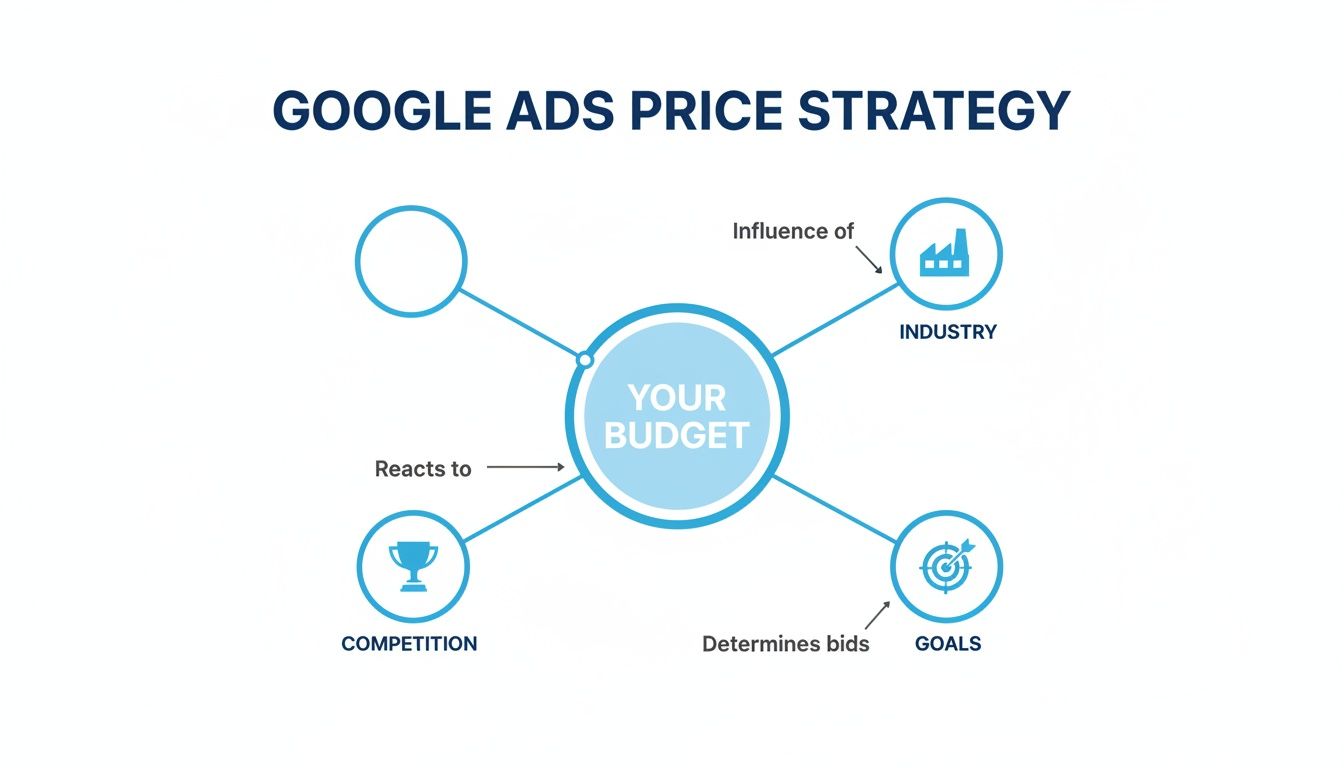
As you can see, your budget isn’t just a number you pick out of thin air. It’s a strategic decision that has to react to what’s happening in the market and what you’re trying to achieve as a business.
The Three Pillars of Quality Score
Your Quality Score isn’t some random number Google plucks from the sky. It’s calculated using three core ingredients, each looking at a different piece of your campaign’s puzzle. Getting these right is the secret to bringing down your ad costs.
- Expected Click-Through Rate (CTR): This is Google’s prediction of how likely people are to click your ad when it shows up. It’s based on your past performance, so a good track record really helps.
- Ad Relevance: This simply measures how well your ad copy matches what the user is actually searching for. An ad for “men’s running shoes” is a perfect match for that search, but not so much for someone looking for “women’s trainers.”
- Landing Page Experience: Once someone clicks, does your landing page deliver? Google checks how relevant and user-friendly your page is, looking at things like loading speed, mobile-friendliness, and whether the content actually delivers on the ad’s promise.
For a UK business owner, this all boils down to creating a smooth, logical journey for your customers. If someone in Manchester searches for an “emergency plumber,” they need to see an ad that screams “emergency services” and a landing page that lets them call you instantly.
Your final Ad Rank—the thing that decides your ad’s position on the page—is calculated by multiplying your maximum bid by your Quality Score. This means a competitor with a £4 bid and a Quality Score of 3 (Ad Rank: 12) can be beaten by you with a £2.50 bid and a Quality Score of 8 (Ad Rank: 20).
This formula is the secret weapon for small and medium-sized businesses. You don’t need the deepest pockets; you just need the smartest campaign.
Why a High Quality Score Matters (The Real Price of AdWords)
Pouring your effort into improving your Quality Score is one of the single most effective things you can do to slash your advertising costs and boost your returns. A higher score gives you tangible, real-world benefits.
A strong Quality Score leads to:
- Lower Cost Per Click (CPC): Google literally gives you a discount for high-quality ads. You pay less every single time someone clicks.
- Better Ad Positions: Even if you’re bidding less than your competitors, a top-notch Quality Score can vault your ad higher up the search results page.
- Increased Eligibility for Ad Extensions: Better ads are more likely to be shown with all the bells and whistles, like sitelinks and callouts, that make them stand out from the crowd.
Improving this metric takes a focused effort. To get stuck in, you can learn more about how to diagnose and improve your Google Ads Quality Score in our detailed guide. It all comes back to creating a highly relevant and positive experience for the user—which is exactly what Google wants, too. When your goals align with Google’s, you’re setting your campaigns up for a win.
The Real Price of AdWords: Average AdWords Cost Per Click Across UK Industries
Now that you’re familiar with the nuts and bolts of the Google Ads auction, you’re probably wondering where your own industry fits into the big picture. The average price of AdWords, specifically the Cost Per Click (CPC), isn’t some flat rate. It swings wildly from one sector to another, and knowing where you stand gives you a realistic starting point for your budget.
Some industries are just brutally competitive, which pushes the price you pay right up. A high CPC is often a massive clue that the value of a single new customer is incredibly high, making businesses willing to bid aggressively to win that click. It’s not just about spending more; it’s about the potential return on every pound spent.
The High-Stakes Industries
Think about sectors where a single conversion can be worth thousands. This is where you’ll find the eye-watering CPCs. A solicitor landing a new personal injury case or an insurance company signing a new policyholder can easily justify a hefty advertising cost because the lifetime value of that customer is so massive.
This high-value, high-competition environment creates an intense bidding war for the most profitable keywords. For example, recent UK market data shows just how pricey certain verticals can get. The insurance sector leads the pack with an average CPC of $7.24 USD (approximately £5.70). Legal services aren’t far behind, making them some of the most expensive keywords to target. You can dig into more UK advertising costs on Statista to see how different sectors stack up.
The price you pay per click is a direct reflection of what a potential customer is worth in your industry. High CPCs aren’t necessarily a bad thing—they’re a sign that your competitors are successfully turning those expensive clicks into highly profitable business.
Getting your head around this is vital. You’re not just paying for a click; you’re investing in what could be a long and profitable customer relationship.
A Comparative Look at UK Sector Costs (The Real Price of AdWords)
While legal and financial services are paying premium prices, other industries enjoy much more affordable advertising costs. The trick is to know what’s considered “normal” for your market so you can set realistic expectations and actually measure your performance effectively. A well-run campaign can often beat the industry average CPC.
To give you a clearer picture, here’s a snapshot of how different industries in the UK compare when it comes to the average CPC on the Google Search Network.
Average Google Ads CPC by UK Industry
This table offers a comparative look at the average Cost Per Click (CPC) across various business sectors in the UK, highlighting the significant differences in advertising costs.
| Industry Sector | Average CPC (USD) | Level of Competition |
|---|---|---|
| Legal | $6.75 | Very High |
| Consumer Services | $6.40 | Very High |
| Technology | $3.80 | High |
| Finance & Insurance | $3.44 | High |
| Home Goods | $2.94 | Medium |
| Health & Medical | $2.62 | Medium |
| Automotive | $2.46 | Medium-High |
| E-commerce | $1.16 | Low-Medium |
As you can see, the spectrum of advertising costs is huge. An e-commerce business selling clothes, for instance, is playing in a completely different ballpark than a B2B tech firm.
Using Benchmarks to Your Advantage (The Real Price of AdWords)
Don’t let high industry averages put you off. These numbers are just that—averages. They include businesses with enormous budgets as well as those with terribly managed campaigns. That’s your opportunity right there.
By focusing on the things you can control—like nailing your Quality Score, refining your keyword targeting, and writing ads that people actually want to click—you can perform better than the average. Your goal shouldn’t be to just meet the benchmark, but to smash it. A smarter strategy, not just a bigger budget, is almost always the key to a lower AdWords price and a much healthier return on your investment.
The Real Price of AdWords: Calculating a Realistic Monthly AdWords Budget
Alright, let’s move from theory to action. This is where the rubber meets the road in controlling your Google Ads spend. A properly calculated budget isn’t just a wild guess; it’s a strategic forecast built on your business goals and real-world data. It’s about taking the uncertainty out of the equation and giving yourself a sensible starting point.
The trick is to work backwards from what you want to achieve. Stop asking, “How much should I spend?” and start asking, “What results do I need, and what’s it going to cost to get them?”
This approach uses a simple but powerful formula that ties your sales targets directly to your ad budget. It gives you a clear, logical framework you can tweak for your own business, whether you’re a local service provider or a national e-commerce brand.
The Budget Calculation Formula
At its core, estimating your monthly spend comes down to three key numbers: the number of leads or sales you’re aiming for, your website’s conversion rate, and the average cost you’ll pay for each click.
The formula is pretty straightforward:
(Target Leads ÷ Conversion Rate) × Average CPC = Estimated Monthly Budget
Let’s break that down piece by piece.
- Target Leads or Sales: This is your goal. How many new customers or sales do you want your ads to bring in each month? Be realistic here.
- Conversion Rate (CR): This is the percentage of people who visit your website and actually do the thing you want them to do (buy something, fill out a form, etc.). A typical website conversion rate sits somewhere around 2-5%.
- Average Cost Per Click (CPC): This is what you can expect to pay every time someone clicks on your ad. Tools like Google’s Keyword Planner are your best friend for digging up this info.
By plugging your own numbers into this, you can generate a data-driven budget that’s perfectly aligned with where you want to take your business.
Worked Example: A Bristol Electrician (The Real Price of AdWords)
Let’s put this into practice. Imagine you run an electrical services company in Bristol and you want to generate 10 new qualified leads every month from Google Ads.
First, you need some data. A quick look at the Google Keyword Planner shows that keywords like “emergency electrician Bristol” have an average CPC of around £3.50. You also know from looking at your website analytics that your landing page turns about 5% (or 0.05) of its visitors into actual enquiries.
Now, we just apply the formula:
- Calculate Required Clicks: To hit 10 leads with a 5% conversion rate, you’ll need
10 leads ÷ 0.05 CR = **200 clicks**. Simple as that. - Calculate Estimated Budget: Next, multiply those 200 clicks by the average cost for each one. That’s
200 clicks × £3.50 CPC = **£700 per month**.
So, a starting budget of £700 per month is a realistic figure to shoot for to hit that goal of 10 new leads.
Worked Example: A National Ecommerce Brand
Now for a different scenario. Let’s say you’re an e-commerce store selling high-end leather bags across the UK. Your goal is more ambitious: 50 sales per month.
Because the average order value is high, you’re targeting competitive keywords like “premium leather weekend bag,” which come with an average CPC of £2.10. Your online shop has a solid conversion rate of 2% (or 0.02) from paid traffic.
Let’s run the numbers:
- Calculate Required Clicks: To secure those 50 sales with a 2% conversion rate, you’ll need
50 sales ÷ 0.02 CR = **2,500 clicks**. - Calculate Estimated Budget: To get that many clicks, your budget would need to be
2,500 clicks × £2.10 CPC = **£5,250 per month**.
It’s a much bigger budget, of course, but it’s directly tied to a specific sales target. This approach lets you properly assess if the price of AdWords is a worthwhile investment. You can even go a step further and use a customer acquisition cost calculator to make sure your campaigns are actually profitable. This kind of forward-planning is what separates the campaigns that succeed from the ones that just burn through cash.
The Real Price of AdWords: Actionable Strategies to Lower Your AdWords Price
Knowing the numbers is one thing, but getting them under control is where you really start to win. Bringing down your AdWords price isn’t about gutting your budget until there’s nothing left. It’s about spending smarter, plugging the leaks, and making sure every single pound you invest is pulling its weight to grow your business.
By putting a few proven tactics into play, you can seriously boost your campaign’s efficiency, cut your effective costs, and get a much better return. This means going beyond simple bidding and getting into the details that separate a profitable campaign from a money pit. Let’s get into the practical strategies that will make a real difference.
Master Your Negative Keywords
Think of negative keywords as the bouncer for your ad campaign. Their job is to stand at the door and turn away irrelevant search traffic before it ever gets a chance to cost you money. Every single time your ad shows for a search that has zero chance of converting, you’re risking a click that’s completely worthless.
For example, a business selling premium “wooden picture frames” has no interest in paying for clicks from someone searching for “free wooden picture frames” or “how to make wooden picture frames.” By adding “free” and “how to” to your negative keyword list, you instantly filter out that dead-end traffic.
Regularly digging into your search terms report to find these irrelevant queries is one of the quickest and most powerful ways to slash wasted spend. You can find out more in our detailed guide on building a rock-solid list of negative keywords for Google Ads. This simple bit of housekeeping directly lowers your costs and sharpens your campaign’s performance by focusing your budget only on people who are actually likely to buy.
Relentlessly Improve Your Quality Score (The Real Price of AdWords)
As we’ve mentioned, Quality Score is Google’s ‘relevance grade’ for your ads, and it has a massive impact on your AdWords price. A higher score is Google’s way of rewarding you with a lower Cost Per Click (CPC) and better ad positions. Ignoring it is like choosing to pay more for the exact same thing.
To give your Quality Score a boost, you need to work on its three main pillars:
- Ad Relevance: Make sure your ad copy is a perfect match for your keywords. Create tightly-themed ad groups for small clusters of similar keywords instead of dumping hundreds into one big group.
- Expected Click-Through Rate (CTR): Write compelling ad copy that solves a problem or highlights a key benefit. You need to grab attention and make people want to click. Ad extensions are your friend here—use them to add more info and take up more valuable screen real estate.
- Landing Page Experience: Your landing page has to deliver on the promise your ad made. It needs to be fast, work flawlessly on mobile, and make it ridiculously easy for the user to do what you want them to do.
Constantly testing and tweaking these elements will nudge your Quality Score higher, which in turn pushes your advertising costs lower.
Optimise Your Landing Pages for Conversions
Paying for the click is only the first step. If the user lands on a confusing, slow, or clunky page and immediately hits the ‘back’ button, you’ve just thrown that money down the drain. A highly optimised landing page is absolutely essential for turning those clicks into actual customers and making your ad spend profitable.
A great landing page is focused. It has one job and one job only: to get the user to take a specific action. By removing distractions and making the conversion process seamless, you increase the chances of getting a return on your ad spend.
Focus on a clear headline that mirrors your ad, persuasive copy that speaks to the user’s needs, a strong call-to-action (CTA), and a simple form. Even tiny improvements in your conversion rate can have a huge impact on your overall profitability. In the UK market, Google Search Ads typically see conversion rates between 3.1% and 6%, and a top-notch landing page is your ticket to hitting the higher end of that range. Every click you convert is a victory for your budget.
The Real Price of AdWords: When to Partner with a PPC Agency
Managing a Google Ads account can feel like a simple task at first, but it often spirals into a full-time job. While a DIY approach is a fantastic way to get your feet wet, there’s a tipping point where the platform’s complexity and the demands of your actual business mean it’s time to call in the experts.
Recognising that moment is crucial. It’s not about admitting defeat; it’s a strategic move to invest in specialised expertise that can seriously accelerate your growth and fatten up your bottom line.
Signs It’s Time to Hire an Expert
So, how do you know when you’ve hit the ceiling of what you can achieve on your own? There are a few tell-tale signs that your campaign management is getting a bit leaky and inefficient. If you find yourself nodding along to any of these, it might be time for a chat.
These are the common headaches that signal a change is needed:
- Your Results Have Plateaued: Are your leads, sales, and traffic stuck in a rut, month after month, no matter what you tweak?
- Costs Are Creeping Up: Is your Cost Per Acquisition (CPA) steadily climbing without a matching lift in performance?
- You’re Overwhelmed by Complexity: Do new features like Performance Max and the ever-changing bidding strategies leave you feeling like you’re constantly playing catch-up?
- You Lack the Time: Are you spending more time fiddling with campaigns than you are actually running your business?
If this all sounds painfully familiar, you’re not alone. Many successful businesses get to a point where bringing in professional management is simply the most cost-effective way forward.
Viewing an Agency as an Investment
Thinking of a PPC agency‘s fee as just another expense completely misses the point. A specialist agency isn’t another bill to pay—it’s an investment in efficiency, expertise, and, ultimately, profit. Their entire job is to generate a return that makes their fee look like a bargain.
A great PPC agency pays for itself. By stamping out wasted ad spend, rolling out advanced strategies, and obsessing over conversions, they unlock growth that a time-poor business owner could never manage alone.
An expert team brings years of experience from across countless industries. They know what works, what bombs, and how to quickly spot problems that might take you months to even notice.
They can claw back the budget you’re losing to irrelevant clicks, sloppy targeting, and poor Quality Scores, funnelling that cash into campaigns that actually deliver. The conversation shifts from just managing the price of AdWords to maximising the return on every single pound you spend.
For any business that’s serious about scaling, this partnership is essential. An agency gives you the strategic brain and technical muscle needed to compete, turning your ad budget into a reliable engine for growth. If you’re considering this step, it’s worth exploring different models; understanding Google Ads agency pricing is the first step to finding a partner that fits your financial and business goals.
Got Questions About AdWords Pricing? We’ve Got Answers.
Even with the mechanics laid out, a few questions about Google Ads pricing always pop up. Let’s tackle the most common ones we hear from UK businesses, giving you straight, simple answers so you can plan your budget with confidence.
Is There a Minimum Spend on Google Ads?
Technically, no. Google doesn’t have a gatekeeper demanding a minimum daily or monthly spend. You could, in theory, start a campaign with just £5 a day.
But the real question isn’t about the technical minimum, it’s about the effective minimum. A budget that’s too small is like trying to fill a swimming pool with a teaspoon – it won’t gather enough data for you or Google’s algorithm to learn anything. This just leads to poor decisions and wasted cash. For most UK SMEs, we find a starting budget of £500 per month is a much more realistic minimum to actually test the waters and see what’s working.
How Long Does It Take to See Results? (The Real Price of AdWords)
You can get clicks and traffic within hours of your campaign going live, that’s the easy part. But “results”—the kind that actually matter, like profitable leads or sales—take a bit more patience.
You should brace yourself for an initial period of one to three months dedicated purely to testing and tweaking. This is the learning phase where you’re gathering data, cutting dud keywords, sharpening your ad copy, and letting the algorithm figure things out. Expecting a flood of profitable sales on day one is a classic mistake that causes too many businesses to pull the plug just before things start to click.
Think of that first month as an investment in data. You’re paying to learn what works and, just as importantly, what doesn’t. This initial spend is the foundation you build a profitable, long-term campaign on.
Can You Guarantee a Top Position on Google?
Absolutely not. If an agency ever promises you the number one spot, you should run for the hills. Your ad’s position is decided by the Ad Rank formula (Max Bid x Quality Score), which is re-calculated in a live, split-second auction for every single search.
Even if you have the deepest pockets, a competitor with a brilliant Quality Score can leapfrog you. The real goal isn’t to be number one 24/7; it’s to find the most profitable position that delivers a solid return on your investment. Believe it or not, sometimes sitting in position two or three can bring in a much better return on ad spend (ROAS).
Ready to stop guessing and start getting real, profitable results from your advertising spend? The team at PPC Geeks are experts at cutting through the complexity to deliver campaigns that drive growth. Get your free, in-depth Google Ads audit today and discover how to make your budget work harder.