
Scaling a B2C Brand with Performance Max: Proven Growth Playbook

Scaling a B2C Brand with Performance Max: Proven Growth Playbook — Before you even think about launching a Performance Max campaign, we need to talk about the foundation. Getting this right is what separates the campaigns that just spend money from the ones that actually make money and scale your B2C brand.
Success with PMax isn’t about just flicking a switch. It’s about being meticulous with your planning – defining your objectives, setting your KPIs, and getting your data in order. This prep work is what fuels the AI with high-quality signals, teaching it how to find your most valuable customers from day one.
Scaling a B2C Brand with Performance Max: Building Your Foundation for PMax Success
Before you can scale, you have to define what success actually looks like for your brand. I’ve seen too many advertisers jump straight into creating assets and setting budgets, completely skipping the strategic planning. That’s like building a house without a blueprint; it might look okay for a bit, but it’s not going to hold up when you try to expand.
A solid foundation ensures your PMax campaigns are actively driving your most important business goals. This all comes down to three things: clarifying your business objectives, setting realistic KPIs, and making sure your data is clean and ready to go. Get this right, and you’re not just feeding Google’s AI – you’re training it to understand what a high-value customer looks like for your business.
Defining Clear Campaign Objectives
Your PMax objectives need to be a direct reflection of your wider business goals. Are you a new brand trying to aggressively grab market share, or are you an established name looking to boost customer lifetime value (LTV)? The answer completely changes how you set things up.
For example, a brand chasing market share might prioritise acquiring new customers, even if it means a lower initial return on ad spend (ROAS). On the flip side, a brand focused on pure profitability will set a much higher tROAS target to get the most out of every pound spent. Your objective is the instruction you give the PMax algorithm.
The diagram below maps this out perfectly, showing how clear business objectives flow down into measurable KPIs and the data you need to feed the machine.
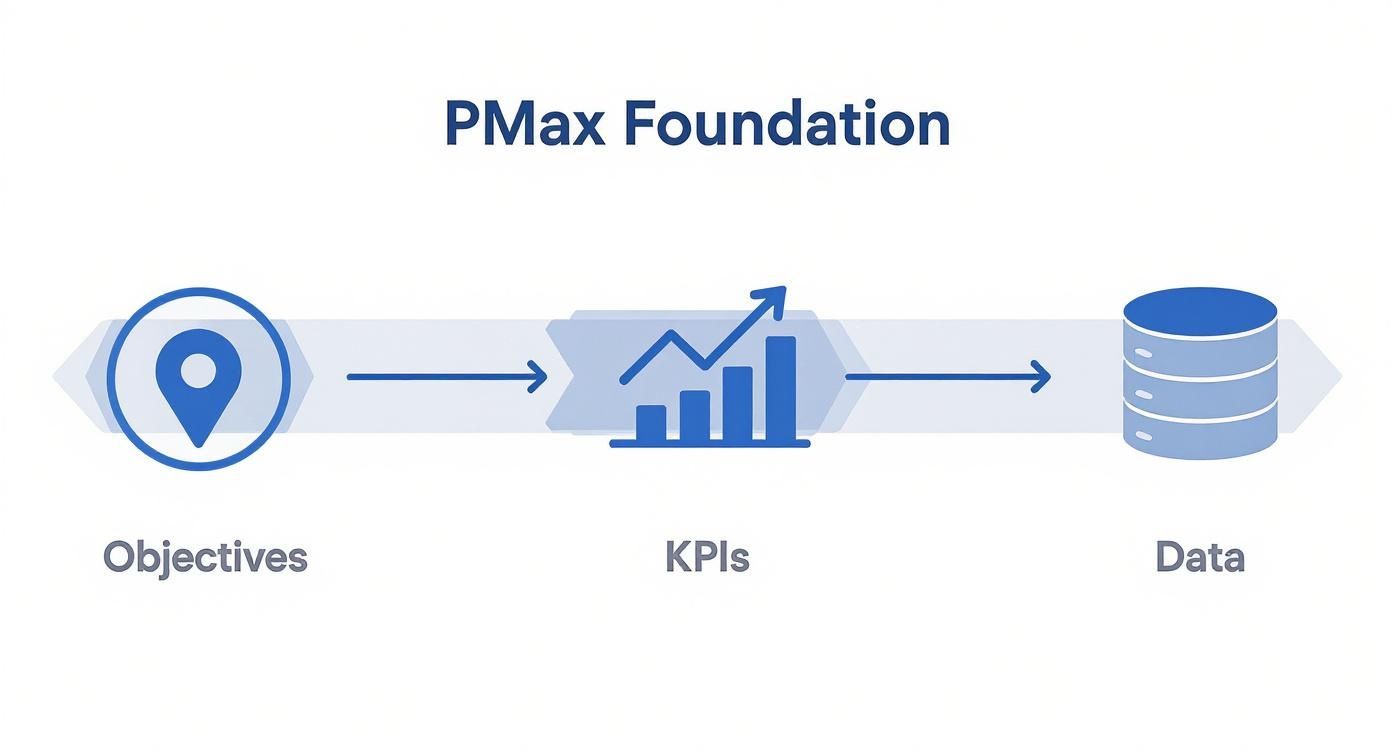
As you can see, data preparation isn’t just a final step; it’s the bedrock that allows you to measure and hit your strategic goals.
To make this crystal clear, here’s how your business goals should translate directly into PMax objectives and the KPIs you’ll use to measure them.
Aligning PMax Objectives with B2C Goals (Scaling a B2C Brand with Performance Max)
| B2C Scaling Goal | Primary PMax Objective | Key Performance Indicator (KPI) |
|---|---|---|
| Maximise Online Sales | Drive Online Sales | Target Return on Ad Spend (tROAS) or Maximise Conversion Value |
| Generate High-Quality Leads | Generate Leads | Target Cost Per Acquisition (tCPA) or Maximise Conversions |
| Increase Brand Awareness | Increase Awareness & Consideration | Impressions, Reach, Ad Recall Lift |
| Drive In-Store Foot Traffic | Promote Local Stores | Store Visits, Local Actions (calls, clicks for directions) |
| Acquire New Customers | New Customer Acquisition | New Customer Value, New Customer ROAS |
This table helps you connect the dots, ensuring the levers you pull inside Google Ads are directly tied to the results that matter to your business’s bottom line.
Establishing Ambigious Yet Realistic KPIs
With your objectives locked in, you can now set the KPIs that will steer the campaign. These aren’t just metrics for a report; they are the core signals that guide the AI’s learning and optimisation process.
For B2C brands, the main players are:
- Target ROAS (tROAS): Perfect for ecommerce brands focused on keeping things profitable as they scale up sales.
- Target CPA (tCPA): The go-to for lead generation or for businesses where every conversion holds a similar value.
- Conversion Value: Use this when your goal is to maximise the total revenue from your campaigns, even if ROAS bounces around a bit.
Your starting KPIs need to hit a sweet spot: ambitious enough to push the campaign, but realistic based on your account’s history. Set a tROAS target that’s way too high from the get-go and you’ll choke the learning phase. Set it too low, and you’ll burn through your budget without seeing profitable returns.
Preparing Your Data Infrastructure (Scaling a B2C Brand with Performance Max)
This is easily the most overlooked step, but it’s where the magic happens. High-quality data is the fuel for Google’s AI, plain and simple.
This means getting your product feed in Google Merchant Centre into top shape with high-res images, descriptive titles, and every relevant attribute filled out. It also means segmenting and cleaning your CRM data to create powerful first-party audience signals. The quality of what you put in has a direct impact on the performance you get out.
And don’t forget the user journey after the click. For more on that, have a look at our guide on landing page best practices.
The UK market has jumped on PMax in a big way, with an expected 84% of advertisers using it by early 2025. The results speak for themselves; one study saw a PMax campaign slash CPC by 90% and CPA by up to 75%, all while boosting revenue by a massive 227%. Another advertiser saw PMax bring in 54% of their total monthly revenue with a ROAS 12.1 times higher than the previous month. It just goes to show the incredible potential when you set it up right from the start.
Scaling a B2C Brand with Performance Max: Crafting High-Impact Asset Groups
In Performance Max, your creative assets are the main levers you get to pull. Everything else is largely automated, so your images, videos, and copy are where you can really make a difference. Think of asset groups as individual toolkits you hand over to Google’s AI. A well-organised toolkit lets the machine build the perfect ad for any customer, on any channel, at any given moment.
Simply dumping all your creative into one giant, messy asset group is a classic mistake we see all the time. It completely stifles performance. The real goal is to create tightly-themed groups that give the AI clear context and relevance. This strategic segmentation is what truly unlocks higher performance and gives you much better insights.
Structuring Your Asset Groups for Maximum Relevance
The best way to structure your asset groups is to mirror how you already think about your business. By creating distinct groups based on your products or customers, you’re giving the algorithm much clearer instructions, helping it match the right message with the right audience faster.
Here are a few proven structures we use for B2C brands:
- By Product Category: This is the go-to method and usually the most effective. If you’re a fashion retailer, you might have separate asset groups for ‘Women’s Summer Dresses’, ‘Men’s Trainers’, and ‘Children’s Outerwear’. This ensures your headlines, images, and videos are all hyper-relevant to what you’re selling.
- By Customer Persona: Got well-defined customer personas? Build asset groups around them. A home goods store, for example, could have an asset group for ‘First-Time Homeowners’ with creative that talks about essential starter kits. They could have another for ‘Luxury Renovators’ filled with high-end, aspirational imagery.
- By Promotion or Season: Running a Black Friday sale or a big summer clearance? Create a dedicated, time-sensitive asset group. This lets you use specific offer language and visuals that you can simply pause once the event is over, without messing up your evergreen campaigns.
The key is to create logical separations. Each asset group needs a distinct theme and purpose. This prevents mixed messaging and helps the AI learn what works for each segment much quicker.
Supplying a Rich Mix of Creative Assets (Scaling a B2C Brand with Performance Max)
Once you’ve got your structure sorted, it’s time to fill each asset group with a diverse range of creative. The more high-quality options you give the system, the more combinations it can test to find that winning formula. Your aim should be to max out every available slot for each asset type.
Remember, the Performance Max algorithm is a permutation engine. Its job is to test countless combinations of your assets to find what resonates. Starving it of options is like asking a chef to cook a gourmet meal with only three ingredients—the result will always be limited.
Your creative inventory for each asset group needs to be robust:
- Headlines and Descriptions: Write copy that speaks directly to your customers’ problems and desires. Don’t just list product features; spell out the benefits. For a skincare brand, instead of “Contains Hyaluronic Acid,” try “Get Visibly Plumper, Hydrated Skin.” Pack in calls to action, social proof (“As seen in…”), and what makes you unique.
- High-Quality Images: Provide a healthy mix of lifestyle shots and clean product-focused images. Show your products being used by real people. Make sure everything is high-resolution and formatted correctly for different placements (square, landscape, portrait). A pro tip: avoid text overlays on images, as they can seriously limit reach.
- Thumb-Stopping Videos: In today’s market, video is non-negotiable for scaling. You need at least one video per asset group, but more is always better. Create short, snappy videos (10-30 seconds) designed for platforms like YouTube Shorts and Display. They absolutely must grab attention within the first three seconds, even with the sound off.
Google Ads gives you a clear overview of the asset requirements and performance ratings right inside the platform.
Here’s a look at the asset group interface, which is your command centre for managing all these creative elements.

This is where you’ll see how your assets are performing, with ratings from ‘Low’ to ‘Best’. These ratings are direct feedback from the AI, telling you exactly which assets are driving results. Make it a regular habit to swap out any ‘Low’ performing assets with fresh variations. This constant cycle of testing and refining is how you keep improving your campaign’s effectiveness.
Scaling a B2C Brand with Performance Max: Using Audience Signals to Guide the AI
Think of Performance Max’s AI as a seriously smart, but brand-new, employee. If you just let it loose, it will eventually figure things out, but you’ll burn through a lot of time and cash in the process. Audience signals are your way of giving this new hire a proper induction, pointing it directly at your most valuable customer profiles from day one. This massively speeds up the learning phase and makes your campaigns more efficient right from the start.
Audience signals don’t restrict who PMax can target; they’re simply the starting line. The algorithm uses these signals to build a model of your ideal customer and then hunts for more people just like them across all of Google’s channels. This is a massive shift in how you should think about what audience targeting is for automated campaigns.

Harnessing the Power of Your First-Party Data
Your own data is, without a doubt, the most powerful signal you can feed the machine. It’s totally unique to your business and shows Google exactly what your best customers look like. When you’re trying to scale a B2C brand with Performance Max, using this data isn’t just a good idea—it’s essential for profitability.
Get started by building signals from these core sources:
- Customer Lists: Upload segmented lists straight from your CRM. Don’t just dump in one massive “all customers” list. Get granular. Create specific audiences like ‘High LTV Customers,’ ‘Repeat Purchasers,’ or ‘Newsletter Subscribers.’ This gives the AI a much richer, more nuanced starting point.
- Website Visitors: Use your Google Ads tag to create remarketing lists based on what people do on your site. Go beyond the basic ‘all visitors’ list. Segment users who browsed specific product categories, abandoned their cart, or spent more than five minutes on-site.
- Past Converters: Create audiences of users who have already bought something or filled out a form. This is one of the strongest signals you can provide, essentially telling the algorithm, “Find me more people who do this.”
The quality of your first-party data has a direct impact on your campaign’s initial success. A clean, well-segmented list of your top 1,000 customers is infinitely more valuable as a signal than a messy, outdated list of 50,000 low-value leads.
Expanding Reach with Google Audiences (Scaling a B2C Brand with Performance Max)
Once you’ve anchored your campaign with solid first-party data, you can start layering in Google’s own audiences to guide its expansion. This helps the AI understand the broader interests and purchase intentions floating around your target market.
I’d recommend focusing on these two types:
- In-Market Segments: These are users Google has flagged as actively researching or planning to buy products or services just like yours. If you’re a furniture retailer, this could be ‘In-market for Sofas’ or ‘In-market for Home Office Furniture.’ Simple, but effective.
- Custom Segments (Search Terms): Now this is a seriously powerful tactic. You can build a custom audience based on the search terms people are typing into Google. Think about what your ideal customer would be searching for—this could be competitor brand names, specific product models, or problem-solving queries like “best running shoes for flat feet.”
By blending your own data with these broader signals, you create a robust profile that helps the algorithm find both high-intent users ready to buy now and new pockets of potential customers you hadn’t reached before.
Real-World Scenarios for B2C Brands
Let’s make this practical. Imagine a UK-based skincare brand launching a new anti-ageing serum. An effective audience signal here would combine a customer list of ‘Previous purchasers of moisturiser’ with a custom segment built around search terms like “best retinol serum UK” and key competitor brand names.
This kind of data-led approach works wonders in the UK. For example, UK advertisers who integrate their CRM data with Performance Max have seen sales-qualified lead rates hit around 68%. One of our Manchester-based clients saw a 41% jump in qualified leads after we implemented geo-targeted campaigns. Another dental clinic client managed to slash their cost-per-lead by 28% just by syncing their campaign with offline sales data.
These examples all prove the same point: when you guide the AI with precise, relevant data, you get much better, more predictable results.
Scaling a B2C Brand with Performance Max: Developing a Smart Budget and Bidding Strategy
To aggressively scale your B2C brand with Performance Max, you need a nimble approach to your budget and bidding. This isn’t a “set and forget” situation. It’s more like tending a fire – you need to add the right amount of fuel at the right time to keep it burning strong without getting out of control. It’s a constant balancing act between feeding the campaign enough cash to perform and keeping an eye on profitability.
Everything starts with setting an initial budget that actually gives the campaign a fighting chance. One of the most common—and costly—mistakes I see is underfunding PMax right out of the gate. You’re essentially starving the algorithm of the data it needs to find your customers, which just prolongs the painful learning phase and leads to rubbish, inconsistent results.
Setting Your Initial Budget and Scaling Safely
A solid rule of thumb is to set your initial daily budget at least five to ten times your target cost per acquisition (tCPA). This gives the campaign enough breathing room to explore across Google’s entire network and come out of the one-to-two-week learning phase with some decent data under its belt.
Once the campaign settles down and starts consistently hitting your performance targets for a few days, it’s time to think about scaling up. But don’t just throw a massive chunk of cash at it. That’s a surefire way to shock the system. Instead, increase your daily spend bit by bit, say around 10-20% every few days. Keep a close eye on your key metrics like ROAS or CPA as you go. This gradual ramp-up lets the algorithm adjust smoothly without tripping it back into a volatile learning phase.
Here’s a key signal I always look for: sustained performance. If your campaign has met or beaten its tROAS target for five days straight on the current budget, that’s a massive green light. It tells you the system has found a sweet spot of profitable customers and is ready for more investment.
Choosing the Right Bidding Strategy for Growth (Scaling a B2C Brand with Performance Max)
Your bidding strategy is basically the main instruction you give the PMax algorithm. For B2C brands, it nearly always boils down to two heavy hitters. Getting the nuance between them right is absolutely crucial for scaling profitably. If you want to go deeper on this, our complete guide on how Google Ads Smart Bidding works is a great read.
Here’s how they stack up for different B2C goals:
- Target ROAS (tROAS): This is the go-to for most e-commerce businesses obsessed with profitability. You tell Google the return you want for every pound spent, and it goes off to find sales that hit that value. When setting your first tROAS, be realistic. Don’t just pick a number out of thin air. Base it on your account’s actual performance over the last 30 days.
- Target CPA (tCPA): This one works a treat for lead generation or for businesses where every conversion is worth roughly the same amount. You set a target for how much you’re willing to pay for a lead or sale, and the algorithm hunts down as many as it can at that cost.
The choice you make here will directly dictate how PMax juggles sales volume against your profit margins.
Navigating Seasonality and Market Trends
Your budget and bidding strategy can’t live in a bubble. It has to react to what’s happening in the real world, like seasonal demand and wider market shifts. For example, during peak shopping seasons like Black Friday, you know competition and conversion rates are going to spike. That’s your cue to strategically increase your budget and maybe even relax your tROAS target a little to hoover up as much sales volume as possible while everyone’s in a buying mood.
This kind of proactive management is vital, especially in a dynamic market like the UK. Recent data shows that UK ad spend hit a whopping £10.6 billion in Q1 2025, which is an 8% jump year-on-year. That growth is being driven hard by digital channels like search and retail media. It shows just how much businesses are pouring into platforms like Performance Max to connect with consumers and get results they can actually measure. You can check out the full report on UK ad spend growth for more on these trends.
On the flip side, during quieter months, you might want to tighten your tROAS targets and focus purely on efficiency. The real skill is aligning your investment with consumer behaviour—scaling up when intent is high and optimising for profit when it’s not. Reading those signals correctly is what separates steady, sustainable growth from a chaotic boom-and-bust campaign cycle.
Scaling a B2C Brand with Performance Max: Getting to Grips with Optimisation and Performance Analysis
Right, your campaigns are live. This is where the real fun begins. Scaling a B2C brand with Performance Max isn’t a “set it and forget it” job. It’s all about building a solid, repeatable optimisation routine that turns raw data into actual, tangible growth. This ongoing analysis is what separates the campaigns that just tick over from the ones that smash targets month after month.
The trick is knowing where to look and what levers to pull. Diving into the right reports will tell you exactly what’s working, what’s flopping, and where your next big win is hiding.
Decoding Your Asset Group Performance
Think of your asset groups as the creative engine of your whole campaign. The good news is, Google gives you direct feedback on how every single part is doing. Inside each asset group, you’ll find a performance rating next to your headlines, descriptions, images, and videos. They’ll be labelled from ‘Low’ all the way up to ‘Best’.
Honestly, these ratings are your creative roadmap.
- Low: This is the algorithm screaming at you. The asset isn’t resonating, it’s not driving clicks or conversions, and it needs swapping out. Yesterday.
- Good: This asset is pulling its weight. You can leave it running, but I’d suggest creating new variations based on what makes it successful and testing them against it.
- Best: This is your creative all-star. Whatever you do, don’t touch it. Instead, treat it like a blueprint for future assets. Is it the copy? The style of the image? Figure out its secret sauce and replicate it.
It’s easy to get attached to a piece of creative you personally love. But here’s the hard truth: the data doesn’t care about your favourite image. It only cares about what converts. You have to be ruthless and data-led, constantly swapping out ‘Low’ performers. It’s absolutely essential.
Digging for Gold in the Insights Tab (Scaling a B2C Brand with Performance Max)
The Insights tab is probably one of the most valuable—and criminally underused—tools within PMax. It’s where Google practically hands you actionable intelligence on a silver platter, showing you trends and customer behaviours you can use to sharpen your strategy.
I’d focus on three key areas here:
- Search Term Insights: You get to see the actual search categories that are triggering your ads and driving sales. I’ve uncovered completely new customer needs and product uses here, sparking brilliant ideas for new asset groups or landing pages.
- Audience Insights: Find out which audience segments are actually converting. The AI might discover that ‘home fitness enthusiasts’ are a goldmine for your sportswear brand, even if you never explicitly targeted them. You can then feed this audience back into the campaign as a signal to double down on what’s working.
- Demand Forecasts: This little gem helps you get ahead of seasonal peaks and trends. It means you can proactively tweak budgets and creative to capture demand before your competitors even know what’s happening.
Keep Your Brand Safe by Analysing Placements
While you can’t hand-pick where your PMax ads show up, you absolutely can—and should—monitor it. The placement report shows you the websites and YouTube channels where your ads have appeared. It’s crucial to give this a scan periodically to make sure your brand isn’t showing up next to anything inappropriate or just plain weird.
If you spot any dodgy placements, you can block them using account-level placement exclusions. It’s a vital brand safety check. To really get into the weeds on this, you can learn more about PMax channel reporting in our guide, which lifts the veil on this often-misunderstood feature.
Your PMax Optimisation Checklist (Scaling a B2C Brand with Performance Max)
To keep things simple and consistent, it helps to have a routine. Sticking to a weekly and monthly checklist ensures you’re always on top of performance and never miss an opportunity. It’s less about massive, sweeping changes and more about small, consistent improvements.
| Frequency | Optimization Task | Key Metric to Review |
|---|---|---|
| Weekly | Review Asset Group performance | Asset ratings (‘Low’, ‘Good’, ‘Best’) |
| Weekly | Check Search Term Insights for new opportunities | Conversion volume by search category |
| Weekly | Monitor Placement Reports for brand safety | List of websites/YouTube channels |
| Weekly | Analyse Budget Pacing vs. Target Spend | Daily/Weekly Spend |
| Monthly | Review Audience Insights for top converters | Conversion Rate by Audience Segment |
| Monthly | Check overall campaign ROAS/CPA vs. goal | ROAS or CPA |
| Monthly | Plan creative refresh based on ‘Best’ assets | Performance of new vs. old assets |
| Monthly | Review Demand Forecasts for upcoming trends | Upcoming search interest trends |
This simple checklist turns optimisation from a daunting task into a manageable habit. Over time, these small, regular checks compound to create significant performance gains.
Advanced Tactics for B2C Scaling
Once you’ve nailed the fundamentals, you can start layering in more advanced strategies to really squeeze every last drop of performance out of your campaigns.
A powerful technique is using value-based bidding, especially if you can feed Customer Lifetime Value (LTV) data into the system. By passing this richer data back to Google Ads, you teach the algorithm to hunt for customers who will be more valuable over the long term, not just those who make a one-off big purchase.
Another brilliant tool is data exclusions. Let’s say you run a massive Black Friday sale that causes a huge, temporary spike in your conversion rate. You can tell Google to ignore that specific period when it’s learning. This stops the algorithm from getting confused by weird data and making bad decisions once things return to normal. It’s a lifesaver for maintaining stability.
Got PMax Questions? We’ve Got Answers.
As powerful as Performance Max is, it’s understandable why it raises so many questions, especially for B2C brands trying to scale. Its “black box” nature can feel a bit unnerving at first.
But don’t worry. Knowing the mechanics behind the most common queries will give you the confidence to pull the right levers. Let’s get into the questions we hear all the time from ambitious B2C marketers.
How Long Is the PMax Learning Phase, Really?
This is easily the most frequent question. Google will tell you the learning phase lasts about one to two weeks, but from our experience, it’s not that clear-cut. Think of it less like a fixed countdown and more like a data-gathering exercise.
The campaign needs enough conversion data—usually around 50 conversions—to really figure out who your ideal customer is and how to bid for them. For a brand-new B2C campaign on a smaller budget, hitting that number might take a lot longer than two weeks. On the flip side, a big, established account with loads of traffic might speed through it.
Your best friend here is patience. Seriously. Fight the urge to make big changes to your budget, bidding, or creative during this initial period. Every major tweak resets the learning process, trapping you in a frustrating cycle where the campaign never gets a chance to find its groove.
Should I Run PMax Alongside My Standard Search Campaigns?
Ah, the great debate. The answer for B2C brands is a bit nuanced. When you’re first starting out, running PMax alongside your existing Search campaigns is actually a pretty smart move, especially if those campaigns are already solid performers. PMax will usually get priority for most searches, but your standard campaigns act as a reliable safety net.
Over time, though, you’ll want to consolidate. Running both long-term can lead to you bidding against yourself and making your data a mess. The end goal is to let PMax take the reins once it’s proven it can consistently hit your targets.
Here’s a phased approach that works well:
- Phase 1 (Launch): Run both in parallel. This lets you gather data and benchmark PMax’s performance against your tried-and-tested Search campaigns.
- Phase 2 (Optimisation): Once PMax is consistently hitting or beating your target ROAS or CPA, start pausing keywords in your standard Search campaigns that PMax is clearly picking up.
- Phase 3 (Consolidation): Fully hand over the product categories or services where PMax is excelling. You might keep a small, standard Search campaign running, but only for very specific, brand-protection queries if you feel you need it.
What Are the Biggest Mistakes to Avoid When Scaling?
When you’re hungry to scale, it’s incredibly easy to make expensive mistakes. Trying to move too fast without a solid strategy is the quickest way to burn through your budget and have nothing to show for it.
Here are the three most common pitfalls we see B2C brands fall into when they try to scale up their Performance Max campaigns:
- Impatience and Constant Tinkering: We’ve already mentioned it, but it’s worth repeating. Constantly fiddling with settings during the learning phase is a recipe for disaster. The algorithm needs stable data to learn. Just trust the process for the first few weeks.
- Poor Quality Assets and Feed: Treating your creative as an afterthought is a fatal mistake. PMax is entirely dependent on the assets and product feed you give it. Low-quality images, bland copy, and an unoptimised feed will cripple your campaign before it even gets going.
- Vague or Unsegmented Asset Groups: Don’t just lump all your products and messages into one giant asset group. It’s lazy and it doesn’t work. Create tightly themed asset groups for different product categories or customer types. This gives the AI clear, relevant signals, which leads to much better ad combinations and stronger performance.
Steering clear of these common errors will put you miles ahead of the competition. It’s all about giving the system the high-quality inputs and stable environment it needs to find your customers and drive profitable growth.
Ready to unlock the full potential of your B2C brand without the guesswork? At PPC Geeks, we specialise in creating data-driven Performance Max strategies that deliver real, measurable growth. Book your free PPC audit today and let our award-winning UK team build a campaign that hits your scaling goals.
Author

Search Blog
Free PPC Audit
Subscribe to our Newsletter

The Voices of Our Success: Your Words, Our Pride
Don't just take our word for it. With over 100+ five-star reviews, we let our work-and our satisfied clients-speak for us.

"We have been working with PPC Geeks for around 6 months and have found Mark and the team to be very impressive. Having worked with a few companies in this and similar sectors, I rate PPC Geeks as the strongest I have come across. They have taken time to understand our business, our market and competitors and supported us to devise a strategy to generate business. I value the expertise Mark and his team provide and trust them to make the best recommendations for the long-term."
~ Just Go, Alasdair Anderson