




In a competitive market, relying on last year’s tactics is a direct path to stagnation. For small and medium-sized enterprises, a successful marketing strategy is not about having the largest budget; it’s about being agile, creative, and strategic. The difference between a thriving business and one that merely survives often comes down to implementing the right small business marketing ideas at the right time. For busy brand owners, marketing managers, and entrepreneurs in the UK, finding cost-effective, high-impact methods is paramount for scalable growth.
This guide is designed to be your definitive resource for 2025. We have stripped away the generic advice and filler content to provide a curated list of ten proven, actionable marketing strategies tailored for businesses aiming to maximise their digital advertising ROI and build a lasting brand presence. You won’t find vague theories here-just practical, step-by-step guidance.
We will explore a powerful mix of digital and offline tactics, from optimising your local SEO and Google Business Profile to launching effective email campaigns and fostering genuine community engagement. Each of the following sections provides clear implementation details and real-world examples to help you:
- Attract more high-quality leads and customers.
- Increase brand visibility and recognition.
- Build a loyal customer base that champions your business.
- Maximise your return on investment, no matter the size of your budget.
This article is your roadmap to refreshing your marketing approach. Let’s dive into the powerful strategies that will drive your success and help you achieve sustainable, scalable growth this year and beyond.
1. Content Marketing & Blogging (10 Powerful Small Business Marketing Ideas for 2025)
Content marketing is a strategic approach focused on creating and distributing valuable, relevant, and consistent content to attract and retain a specific audience. Unlike direct advertising, which pushes a product, content marketing pulls customers in by offering genuine value first. For small businesses, this is one of the most powerful and cost-effective small business marketing ideas for building trust and establishing authority in a niche.
Why It Works for Small Businesses
Instead of overtly selling, you are solving your audience’s problems. A local bakery, for instance, could blog about “10 Tips for the Perfect Sourdough Starter,” attracting baking enthusiasts who are then more likely to trust and buy from them. This method builds a loyal community around your brand, turning passive viewers into active customers. Companies like HubSpot built their entire empire on this principle, offering extensive marketing resources that attract millions of qualified leads.
How to Get Started
- Identify Your Audience: Understand their pain points, questions, and interests. What information are they searching for online?
- Create a Content Calendar: Plan your topics and maintain a consistent publishing schedule. Consistency is crucial for building momentum and keeping your audience engaged.
- Focus on Quality and SEO: Write comprehensive, helpful articles optimised with relevant keywords. This helps your content rank on search engines, driving organic traffic over the long term.
- Promote and Repurpose: Share your blog posts on social media, in email newsletters, and consider turning a successful post into a video or infographic to reach a wider audience.
This infographic summarises the key investment and return expectations for a content marketing strategy.
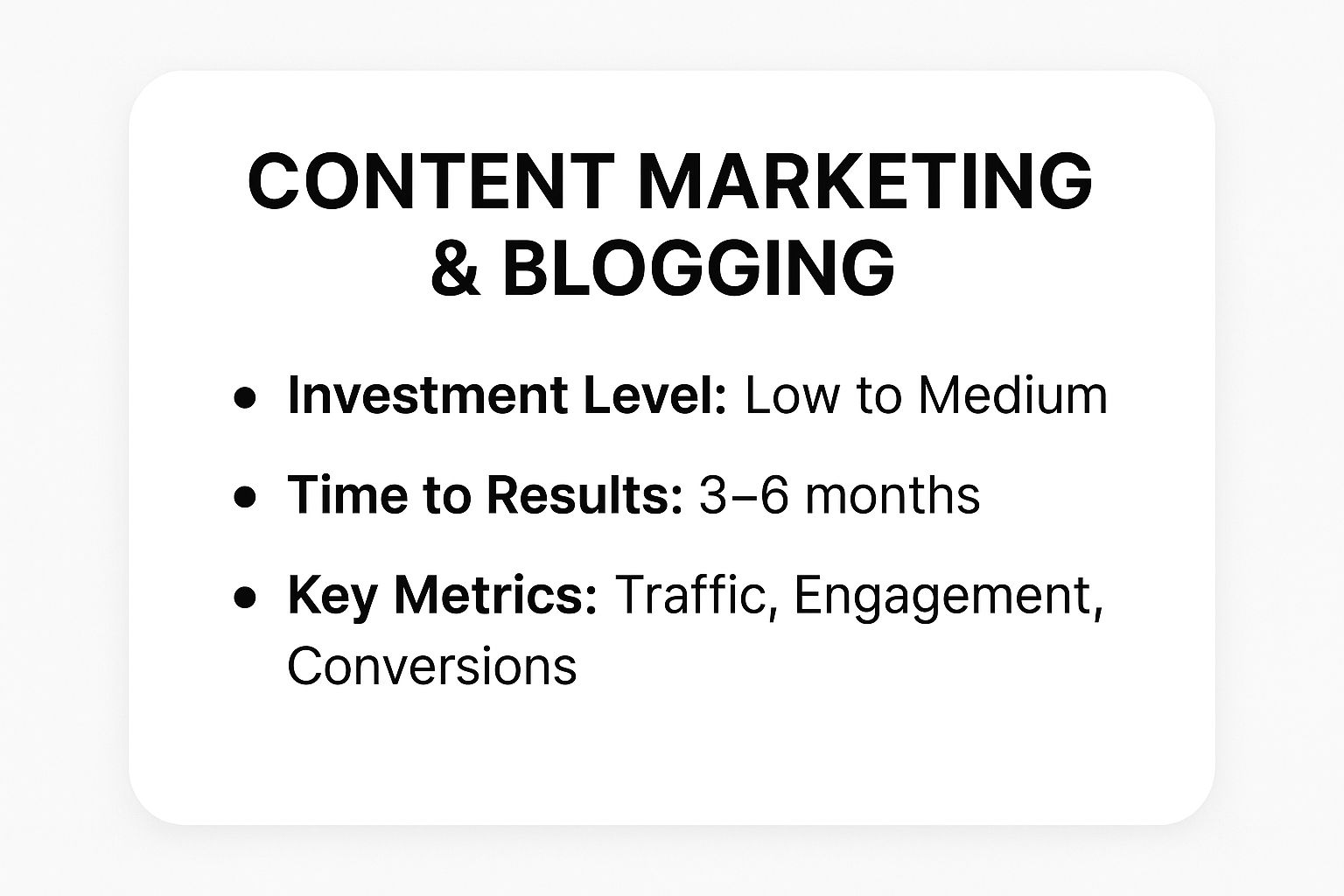
As the data shows, while the initial investment is relatively low, content marketing is a long-term game that requires patience before you see significant returns in traffic and conversions.
2. Social Media Marketing
Social media marketing is the practice of using platforms like Instagram, Facebook, LinkedIn, and TikTok to connect with your audience, build your brand, and drive sales. It goes beyond simply posting updates; it’s about creating a community, fostering engagement, and turning followers into loyal customers. For small businesses, it represents one of the most direct and impactful small business marketing ideas for building relationships and brand personality.
Why It Works for Small Businesses (10 Powerful Small Business Marketing Ideas for 2025)
Social media allows you to interact directly with current and potential customers in a space where they are already spending their time. A local coffee shop, for instance, can use Instagram to post high-quality photos of its lattes and pastries, run polls about new flavours, and share user-generated content from happy customers. This authentic engagement builds a loyal local following far more effectively than traditional advertising. Brands like Glossier built their entire empire on this model, using Instagram to create a powerful community that drove their growth.
How to Get Started
- Choose the Right Platforms: Don’t try to be everywhere. Focus on the one or two platforms where your target audience is most active. A B2B consultancy will find more value on LinkedIn, while a fashion brand will thrive on Instagram and TikTok.
- Post Consistently and Authentically: Develop a content schedule and stick to it. Your voice should be authentic to your brand; if you’re a fun, quirky brand, let that shine through in your posts and replies.
- Engage with Your Community: Social media is a two-way street. Respond to comments and messages promptly, ask questions, and encourage user-generated content.
- Utilise High-Quality Visuals: Platforms like Instagram are visually driven. Invest in good photography and video to make your products or services stand out. Your smartphone can often produce excellent results with good lighting.
3. Email Marketing (10 Powerful Small Business Marketing Ideas for 2025)
Email marketing is a powerful and direct communication channel used to send targeted messages to prospects and customers. Far from being outdated, it remains one of the most effective small business marketing ideas for nurturing leads, promoting offers, and building lasting customer relationships. It allows you to speak directly to an audience that has already expressed interest in your brand, offering an impressive return on investment.
Why It Works for Small Businesses
Unlike social media, where algorithms dictate your reach, email gives you a direct line to your audience’s inbox. This ownership of your contact list is a huge asset. For example, a local boutique can send exclusive discount codes to its subscribers, driving immediate footfall and sales. Newsletters like Morning Brew or TheSkimm have built entire media empires by providing daily value through email, proving that a well-executed strategy can turn subscribers into a loyal and engaged community.
How to Get Started
- Build Your List Organically: Offer a valuable incentive, like a discount, a free guide, or exclusive content (a lead magnet), in exchange for an email address. Never buy lists; focus on quality over quantity.
- Segment Your Audience: Group subscribers based on their interests, purchase history, or engagement level. This allows you to send highly relevant and personalised messages that resonate more deeply.
- Write Compelling Subject Lines: Your subject line is the first, and sometimes only, impression you make. Make it intriguing, urgent, or valuable to entice subscribers to open the email.
- Automate Where Possible: Set up welcome sequences for new subscribers or abandoned cart reminders to engage customers at crucial moments. Many of these processes are part of broader marketing automation strategies that can save you significant time.
- Include a Clear Call-to-Action (CTA): Every email should have a purpose. Make it obvious what you want the reader to do next, whether it’s “Shop Now,” “Read More,” or “Book a Consultation.”
4. Local SEO and Google My Business Optimisation
Local Search Engine Optimisation (SEO) is a specialised strategy designed to boost your business’s visibility in local search results. When a potential customer searches for “plumber near me” or “best coffee in Manchester,” local SEO is what helps your business appear in those top results, particularly in Google’s “Local Pack” and on Google Maps. It is one of the most critical small business marketing ideas for any company with a physical location or service area.
Why It Works for Small Businesses (10 Powerful Small Business Marketing Ideas for 2025)
For businesses that rely on local foot traffic or serve a specific geographic area, local SEO is non-negotiable. It connects you with customers who have high purchase intent at the exact moment they are looking for your services. A local solicitor, for example, can dominate searches for “family law advice in Leeds” by optimising their Google Business Profile, ensuring they are the first option potential clients see. This method levels the playing field, allowing smaller local businesses to compete effectively against larger, national brands in their immediate vicinity.
How to Get Started
- Claim and Fully Optimise Your Google Business Profile (GBP): This is your most powerful local SEO tool. Fill out every single section, including services, opening hours, photos, and a detailed business description.
- Encourage and Respond to Reviews: Positive reviews are a significant local ranking factor. Actively ask satisfied customers for a review and make sure to respond professionally to both positive and negative feedback.
- Build Local Citations: Ensure your business name, address, and phone number (NAP) are consistent across all online directories like Yelp, Yell, and industry-specific sites.
- Create Location-Specific Content: Develop website pages or blog posts targeting your service areas. For instance, a pest control company could write about “Common Ant Problems in Bristol,” directly targeting a local audience. For a deeper dive, you can learn more about how to optimise your online marketing for a local business.
5. Influencer and Partnership Marketing (10 Powerful Small Business Marketing Ideas for 2025)
Influencer and partnership marketing is a collaborative strategy where businesses team up with individuals or other companies that hold sway over their target audience. This approach leverages the trust and credibility that influencers, industry experts, or complementary businesses have already built with their followers. For small businesses, it’s a powerful way to tap into a pre-existing, engaged community and gain authentic endorsements.
Why It Works for Small Businesses
This strategy allows you to borrow trust from a source your ideal customers already respect. Instead of you saying your product is great, a trusted voice says it for you. For example, a local gym partnering with a nearby nutrition store for cross-promotion benefits both parties by offering comprehensive wellness solutions to their respective customer bases. This is one of the most effective small business marketing ideas because it provides social proof and reaches niche audiences with precision, often generating a higher return on investment than traditional advertising. Daniel Wellington famously used this model with micro-influencers to build a $200 million brand from the ground up.
How to Get Started
- Identify Aligned Partners: Look for influencers or businesses whose brand values and audience demographics align perfectly with yours. Authenticity is key to a successful collaboration.
- Start with Micro-Influencers: These influencers often have smaller, more dedicated followings, leading to higher engagement rates and a more personal connection with their audience.
- Provide Clear Guidelines but Allow Creative Freedom: Offer a clear brief on your campaign goals and key messages, but let the creator’s unique voice shine through to maintain authenticity. New platforms are emerging to simplify this process; you can read more about Google’s creator partnerships here.
- Track Performance: Use unique discount codes, affiliate links, or dedicated landing pages to measure the direct impact of each partnership and calculate your return on investment.
- Foster Long-Term Relationships: Aim to build lasting relationships rather than executing one-off campaigns. This turns partners into genuine brand ambassadors over time.
6. Referral and Word-of-Mouth Programs
Referral marketing formalises word-of-mouth by creating structured programmes that incentivise existing customers to recommend your business to their network. It transforms happy clients into a proactive sales force, leveraging the immense power of personal trust. For small businesses, this is one of the most authentic and high-converting small business marketing ideas because a recommendation from a friend is far more persuasive than any traditional advertisement.
Why It Works for Small Businesses (10 Powerful Small Business Marketing Ideas for 2025)
A referral programme harnesses the trust you have already built with your customer base. When a current customer advocates for your brand, their recommendation carries built-in credibility, significantly shortening the sales cycle for the new lead. Dropbox famously achieved 3900% growth in 15 months with its “give storage, get storage” system, rewarding both the referrer and the new user. This creates a viral loop where customer acquisition fuels further acquisition.
How to Get Started
- Make It Simple: Design a referral process that is effortless. A customer should be able to share a unique link or code in just a few clicks.
- Offer Dual-Sided Rewards: Incentivise both the referrer and the new customer. Airbnb’s travel credit system is a perfect example, giving both parties a reason to participate.
- Promote the Programme: Don’t hide your referral scheme. Feature it on your website, in email signatures, and within post-purchase communications to ensure customers know it exists.
- Track and Acknowledge: Use tools like ReferralCandy to manage and analyse your programme. Always send a personalised thank you message to advocates to show your appreciation and encourage future referrals.
7. Video Marketing (10 Powerful Small Business Marketing Ideas for 2025)
Video marketing involves using video content to promote and market your brand, products, or services. It’s a highly engaging medium that captures attention better than text or static images, making it a powerful tool for storytelling and connecting with audiences on a more personal level. For small businesses, it offers a dynamic way to showcase personality, demonstrate value, and stand out in a crowded digital landscape.

Why It Works for Small Businesses
Video content is exceptionally versatile and highly shareable, increasing brand visibility across platforms like YouTube, Instagram, and TikTok. A local dog grooming business, for example, could create short, charming videos of “before and after” transformations, which are far more compelling than a simple photo. The classic “Will It Blend?” series by Blendtec is a prime example of how creative, low-budget videos can generate massive brand awareness and sales by being entertaining first and promotional second. This is one of the most effective small business marketing ideas for building an emotional connection and driving engagement.
How to Get Started
- Start Simple and Be Authentic: You don’t need expensive equipment to begin. Modern smartphones record high-quality video, and authenticity often resonates more with audiences than a polished, corporate production.
- Hook Viewers Immediately: The first 3-5 seconds are critical. Start with a compelling question, a surprising statement, or dynamic visuals to capture attention before viewers scroll away.
- Optimise for Each Platform: Tailor your video length and format for the specific platform. Short, vertical videos work best for Instagram Reels and TikTok, while longer, horizontal videos are suited for YouTube.
- Add Captions and a Call-to-Action: Many users watch videos with the sound off, so captions are essential for accessibility and message delivery. Always end with a clear call-to-action (CTA), guiding viewers on what to do next, whether it’s visiting your website or following your page.
8. Community Building and Customer Engagement
Community building is the strategic process of creating and nurturing a space where customers can connect with your brand and each other. It transforms the traditional one-way marketing relationship into a multi-directional conversation, fostering loyalty and turning customers into advocates. This is one of the most powerful small business marketing ideas for creating lasting brand affinity and generating word-of-mouth growth.
Why It Works for Small Businesses (10 Powerful Small Business Marketing Ideas for 2025)
Instead of constantly searching for new customers, community building focuses on deeply engaging the ones you already have. A local coffee shop, for example, could create a Facebook Group for its regulars to share their favourite brew combinations or organise local meetups. This creates a powerful sense of belonging that extends beyond the product itself. Big brands like Sephora have mastered this with their Beauty Insider Community, a platform where millions of members share tips and reviews, creating a vast network of user-generated content and trust.
How to Get Started
- Define Your Community’s Purpose: Will it be for support, sharing ideas, or exclusive access? Establish clear guidelines to maintain a positive and organised environment.
- Choose the Right Platform: Start where your audience already is. This could be a Facebook Group, a Discord server for tech-savvy audiences, or a dedicated platform like Circle.
- Be an Active Leader: Don’t just create the space and leave. Actively participate, answer questions, and start conversations to encourage member-to-member interactions.
- Provide Exclusive Value: Reward your members with exclusive content, behind-the-scenes glimpses, or early access to new products. This makes them feel valued and keeps them engaged.
9. Free Samples, Trials, and Lead Magnets (10 Powerful Small Business Marketing Ideas for 2025)
Offering something of value for free is a time-tested strategy to lower the barrier to entry and capture a potential customer’s interest. This approach involves providing free product samples, service trials, or valuable content (lead magnets) in exchange for contact information. For small businesses, this is one of the most direct small business marketing ideas for demonstrating your product’s value and building an email list of qualified leads.
Why It Works for Small Businesses
This tactic operates on the psychological principle of reciprocity; when you give someone something for free, they are more inclined to give you something in return, such as their business. A SaaS company offering a 14-day free trial allows users to experience its benefits firsthand, making the decision to purchase much easier. Similarly, a local cake decorator could offer a downloadable guide to “5 Icing Techniques for Beginners,” capturing the email addresses of local baking enthusiasts who are prime future customers. Companies like Canva and Mailchimp popularised this model, attracting millions of users with free versions who later upgrade for premium features.
How to Get Started
- Define Your Offer: Determine what you can provide for free that showcases your core value. This could be a physical sample, a limited-time trial, a detailed eBook, a checklist, or a free consultation.
- Create a High-Converting Landing Page: Gate your free offering behind a simple sign-up form on a dedicated webpage that clearly explains the benefits of what the user will receive.
- Plan Your Nurture Sequence: Once you capture a lead, have an automated email sequence ready to follow up. This should provide more value, build trust, and gently guide them towards a paid product or service. Explore an effective PPC strategy for lead generation on ppcgeeks.co.uk/ to drive traffic to your offer.
- Track and Optimise: Monitor how many people sign up for your free offer and what percentage convert into paying customers. Use this data to refine your offer and follow-up process for better results.
10. Event Marketing and Networking
Event marketing moves your brand from the digital screen to the real world, creating opportunities for genuine, face-to-face interaction. This strategy involves participating in, hosting, or sponsoring events to build relationships, generate leads, and increase brand awareness. For small businesses, connecting with potential customers in person is a powerful way to build trust and leave a lasting impression that digital-only methods often cannot replicate.
Why It Works for Small Businesses (10 Powerful Small Business Marketing Ideas for 2025)
In a crowded online marketplace, personal connections stand out. A local real estate agent hosting a “First-Time Homebuyer” workshop, for example, positions themselves as a helpful expert, not just a salesperson. This direct engagement allows you to understand customer needs, answer questions immediately, and build a rapport that online channels can’t match. Tech giant Salesforce grew its Dreamforce conference from a small gathering into the industry’s largest tech event, proving that even in a digital-first world, events are a cornerstone of community and lead generation.
How to Get Started
- Choose the Right Events: Focus on industry trade shows, local community gatherings, or conferences where your target audience is concentrated. Don’t waste resources on irrelevant events.
- Prepare an Engaging Presence: Whether you have a booth or are a guest speaker, create professional, eye-catching materials. Have a clear, concise pitch ready to explain what your business does.
- Systematise Lead Capture: Use a simple app, a sign-up sheet, or a business card scanner to collect contact information efficiently. Make sure you have permission to follow up.
- Follow Up Promptly: The real work begins after the event. Contact new leads within 48 hours to reinforce your connection while the memory is still fresh. A personalised email referencing your conversation is highly effective.
Small Business Marketing Ideas Comparison
| Marketing Strategy | Implementation Complexity 🔄 | Resource Requirements ⚡ | Expected Outcomes 📊 | Ideal Use Cases 💡 | Key Advantages ⭐ |
|---|---|---|---|---|---|
| Content Marketing & Blogging | Medium – requires content strategy and ongoing creation | Low to Medium – mainly time and skill-based | Long-term growth in SEO, engagement, and conversions | Building brand authority, SEO, long-term audience | Cost-effective, builds trust, supports SEO |
| Social Media Marketing | High – daily engagement and platform management | Low to High – varies with paid ads and content | Real-time engagement, brand awareness, viral potential | Customer engagement, brand awareness, direct feedback | Direct audience access, viral potential, rich analytics |
| Email Marketing | Medium – requires automation setup and list building | Low – mainly software and content creation | High ROI, measurable conversions | Nurturing leads, direct promotions, retention | Highest ROI, automation saves time, measurable |
| Local SEO & Google My Business Optimisation | Medium – ongoing optimisation and review management | Low – mostly time investment | Increased local visibility and high conversion rates | Businesses targeting local customers | Targets ready-to-buy locals, free tools, trust building |
| Influencer & Partnership Marketing | Medium to High – partner vetting and management | Medium – compensation and relationship effort | Increased brand credibility and access to engaged audiences | Brand awareness via authentic endorsements | Access to engaged audiences, authentic promotion |
| Referral & Word-of-Mouth Programs | Medium – setup and ongoing management | Low to Medium – incentives and program tools | High conversion from warm leads, increased loyalty | Customer base expansion via trusted recommendations | Highest conversions, lowers acquisition cost |
| Video Marketing | High – requires production skills and equipment | Medium to High – equipment, editing, hosting | High engagement, SEO boost, brand connection | Product demos, storytelling, complex info sharing | High engagement, SEO benefits, viral potential |
| Community Building & Customer Engagement | High – requires constant moderation and content | Medium – platform costs and time investment | Increased loyalty, user-generated content, feedback | Building loyal brand advocates and peer support | Builds long-term loyalty, valuable feedback |
| Free Samples, Trials, Lead Magnets | Medium – content creation and delivery management | Medium – production and follow-up systems | Lead generation, authority building, demo product value | Lead capture and nurturing | Low entry barrier, builds leads, demo value |
| Event Marketing & Networking | High – event planning and follow-up | High – costs, travel, and preparation | Quality lead generation, brand visibility, partnership | Direct relationship building, industry presence | High-quality leads, face-to-face engagement |
Turning Ideas Into Action: Your Next Steps
You’ve just explored ten powerful and diverse small business marketing ideas, from the foundational pillars of content and email marketing to the community-centric power of local SEO and referral programmes. The journey from a list of concepts to a tangible, revenue-generating strategy begins now, with the first decisive step you take. The sheer volume of options can feel overwhelming, but the secret to success isn’t attempting to master everything at once. It’s about strategic selection and focused execution.
The true value lies in understanding that these are not isolated tactics but interconnected components of a holistic marketing ecosystem. Your video content can fuel your social media channels, your community engagement can supercharge your word-of-mouth referrals, and a compelling lead magnet can become the cornerstone of a highly effective email marketing campaign. The key is to find the synergies that make sense for your specific business model and customer base.
Building Your Customised Marketing Blueprint
To transform this inspiration into implementation, resist the urge to spread your resources too thinly. A scattered approach leads to mediocre results across the board. Instead, a focused, strategic methodology will deliver a far greater return on your investment of time and money.
Follow this simple, three-step process to get started:
- Audit and Align: Begin by reviewing your current marketing efforts and business objectives. Which of these ideas aligns most closely with your immediate goals? If you need to increase local footfall, optimising your Google Business Profile is a non-negotiable starting point. If your goal is to nurture long-term customer relationships, an email marketing or community-building initiative should be your priority.
- Select and Sequence: Choose just one or two strategies to implement first. A great way to decide is by using an “impact vs. effort” matrix. Identify the ideas that offer the highest potential impact for the most reasonable amount of effort. For instance, creating a simple customer referral programme might be a quick win that generates immediate results, while building a comprehensive content marketing engine is a longer-term investment.
- Measure and Master: Once you’ve launched your chosen initiatives, establish clear key performance indicators (KPIs) to track your progress. For a local SEO campaign, this might be your ranking for key search terms or the number of calls from your Google profile. For an email campaign, it could be your open rates and click-through rates. Focus on mastering these one or two areas, learning from the data, and optimising your approach before adding another marketing activity to the mix.
The Power of Consistent, Focused Action
Ultimately, the most successful small businesses are not the ones that do everything, but the ones that do a few things exceptionally well. Each of the small business marketing ideas we’ve covered has the potential to become a powerful engine for growth, driving brand awareness, fostering customer loyalty, and boosting your bottom line. By taking a deliberate, measured, and strategic approach, you can build a marketing function that is not just a cost centre, but a predictable and scalable driver of revenue for your business in 2025 and beyond. The power is in your hands; it’s time to take action.
Ready to amplify your marketing with precision-targeted advertising but lack the time or expertise? Partner with PPC Geeks to turn your advertising budget into a powerful lead and sales generation machine. Visit PPC Geeks to discover how our expert PPC management can deliver measurable results for your business.