
The Secret to B2B Google Ads Success: It’s Not Just About Keywords

The Secret to B2B Google Ads Success: It’s Not Just About Keywords — Forget everything you think you know about winning at Google Ads. In a world of sky-high ad costs and complex buyer journeys, the secret to B2B success isn’t some clever keyword hack. It’s a full-blown, data-driven system built on three core pillars: deciphering user intent, strategic audience layering, and seamless CRM integration for true ROI tracking.
Moving Beyond Keywords: The Real B2B Google Ads Secret
For years, B2B brands have been stuck in a firefight, battling for visibility by tweaking keyword bids and making minor ad copy adjustments. While that stuff still has its place, it’s a losing game on its own. Customer acquisition costs are through the roof, and attributing a lead to its true source feels like a nightmare.
The B2B brands that are crushing it today aren’t just outspending the competition; they’re outsmarting them by building a more resilient advertising engine focused on signals, not just search terms.
This modern playbook is a total shift in focus. We’re moving away from just buying clicks and instead building a sustainable lead generation system. It’s about ditching outdated tactics and creating a Google Ads strategy that uncovers high-value prospects based on their behaviour, not just what they type into a search box. The goal? To turn your own first-party data from your CRM into your most powerful targeting asset.
The Three Pillars of a Modern B2B PPC System (The Secret to B2B Google Ads Success)
This isn’t about running three separate things; it’s an integrated approach where each component feeds and strengthens the others. Get these right, and you’re building a machine that’s designed for generating qualified leads and tracking true business impact.
- Intent Signals & Audience Layering: This is the bedrock. It’s all about giving platforms like Google a crystal-clear picture of who your ideal customer profile (ICP) is. When you layer behavioural and firmographic data, the algorithms can find high-value prospects, even when their search queries are ambiguous.
- CRM Integration: Think of this as your truth serum. By connecting your CRM directly to Google Ads, you can pass back data on which leads actually turned into qualified opportunities and, ultimately, closed-won deals. This tells the algorithm what a good lead really looks like.
- True ROI Tracking: This is where you light the fuse. You take those high-quality audience signals and the real-world conversion data from your CRM and use them to optimise for what truly matters: pipeline and revenue, not just form fills.
This interconnected system creates a powerful feedback loop. Better audience signals lead to higher quality leads. CRM data then tells Google which leads were valuable, which in turn refines the targeting to find more high-quality prospects, continuously improving campaign ROI over time.
Before we dive into building this machine, let’s summarise the key components and their goals for a typical B2B brand.
Core Components of a Modern B2B Google Ads Strategy
| Strategy Component | Primary Goal for B2B Brands |
|---|---|
| Intent Signals & Audience Layering | To move beyond keywords and target users based on their behaviour, job titles, and company data, improving lead quality. |
| CRM Integration | To connect ad spend to real business outcomes by tracking leads through the entire sales funnel, from MQL to closed-won. |
| True ROI Tracking | To optimise campaigns based on pipeline generated and actual revenue, not just vanity metrics like clicks or form submissions. |
This table provides a high-level view, but the real magic is in how these pillars work together to create a resilient, self-improving system.
This guide will give you the step-by-step breakdown of how to build this exact Google Ads machine for your business. It’s about creating a strategy that doesn’t just survive in today’s competitive B2B world—it thrives. To get a better sense of how this fits into the customer’s perspective, check out our guide on mapping the D2C buyer journey through PPC to see how every touchpoint can be optimised.
The Secret to B2B Google Ads Success: Building Your Unshakeable Data Foundation
Trying to run a modern Google Ads campaign without a solid data foundation is like building a skyscraper on sand. Sooner or later, it’s all going to come crashing down. For any B2B brand, this foundation isn’t just about slapping a tracking pixel on your site; it’s about creating a rich, accurate, and totally reliable stream of information that teaches the ad algorithms exactly who your most valuable customers are. Honestly, this is the first and most critical step.
The days of just counting form fills and hoping for the best are long gone. Thanks to privacy updates, complex buying committees, and long sales cycles, your typical client-side (browser-based) tracking can miss a huge part of the story. That incomplete picture leads ad platforms to make poor optimisation decisions and waste your budget on completely the wrong audiences.
To build a truly unshakeable foundation, you have to shift your focus to robust tracking methods that connect to your business’s single source of truth: your CRM. It’s about capturing the full story of a prospect’s journey from click to close. This is where advanced solutions become non-negotiable for any B2B brand serious about growth.
Beyond the Basic Conversion Pixel
The secret to success for the most effective B2B brands is built on clean, meaningful data. To get there, you need to move beyond basic lead tracking and implement a much more resilient setup. This means connecting your marketing and sales data to squeeze out every drop of accuracy and insight, giving you a massive edge over competitors still stuck in the past.
Your primary goal here is simple: create a complete and trustworthy dataset. These are the key components you’ll need:
- Server-Side Tagging: Instead of relying on the user’s browser (which is easily blocked), this method sends data directly from your website’s server to platforms like Google. This neatly bypasses most common tracking blockers and gives you a far more accurate count of initial conversions.
- Google’s Enhanced Conversions for Leads: This clever feature securely uses hashed first-party data (like email addresses) from your lead forms to fill in the gaps. When a user converts, this hashed data helps Google match the conversion back to an ad click, even if a cookie wasn’t there to tell the story.
- Offline Conversion Tracking (CRM Integration): This is your goldmine. By connecting your CRM (like HubSpot or Salesforce) directly to your ad accounts, you can import data on what happens after the initial lead capture. You can tell Google which leads became MQLs, SQLs, and ultimately, customers. This teaches the algorithm the true value of a lead.
Think of it like this: Basic pixel tracking tells the ad algorithm, “We got a lead.” Advanced CRM integration tells it, “We got a lead from a VP of Engineering at a 500-person tech company, who then booked a demo and is now in our sales pipeline with a value of £20,000.” Which one do you think will lead to better targeting?
Pouring the Concrete Foundation (The Secret to B2B Google Ads Success)
Putting this advanced data infrastructure in place is the most important investment you can make in your Google Ads success. It’s what makes smart bidding work for you, not against you. Without this clean, downstream data, the algorithm is essentially flying blind, optimising for anyone who will fill out a form, regardless of their quality.
With a solid data foundation, you are feeding the machine learning models with the highest quality business intelligence available. This leads to more precise audience targeting, better ad delivery, and, crucially, a much more accurate measurement of your true return on investment (ROI). It’s the difference between guessing what works and knowing with certainty. For a deeper dive, our guide on how to ensure your data measurements are driving real decisions offers more actionable steps.
Getting this right isn’t just a technical task; it’s a strategic imperative. It ensures every pound you spend is informed by the most accurate data possible, turning your advertising from an expense into a predictable growth engine.
The Secret to B2B Google Ads Success: Turning Your Product Feed Into a Conversion Engine
Too many D2C brands treat their product feed like a simple inventory checklist for Google. Honestly, it’s a massive missed opportunity. It’s time to change how you see it: your product feed isn’t just a spreadsheet; it’s the digital window display for your entire shop. It’s often the very first time a potential customer sees your products, making it one of the most powerful conversion tools you have.
An unoptimised feed quietly kills your campaigns from the inside. It sends vague, uninspired signals to automated systems like Performance Max, which means your ads get shown to the wrong people or, even worse, not at all. A meticulously crafted feed, on the other hand, does the exact opposite. It becomes a detailed instruction manual for the algorithm, telling it precisely which products to show, who to show them to, and what makes them so special.
This whole process turns a boring data file into a dynamic marketing asset that actively fuels your campaign’s success. It’s a core part of the secret weapon for D2C PPC brands that are serious about scaling profitably.
From Simple List to Sales Powerhouse
Transforming your feed starts with enriching the basic data. Google’s algorithms are hungry for information; the more context you give them, the better they can match your products with shoppers who are ready to buy. Think way beyond just the product name and price. You need to tell a compelling story with every single data field you can get your hands on.
This means getting granular with the details that actually matter to a buyer. A weak title like “Blue T-Shirt” becomes “Men’s Organic Cotton Crew Neck T-Shirt in Navy Blue | [Your Brand]”. Just look at the difference. That simple change now includes gender, material, style, colour, and your brand, hitting multiple potential search queries all at once.
Here’s how to start enriching your core product data:
- SEO-Optimised Titles: Structure your titles with the most important details first. Follow a clear formula like: Brand + Product Type + Key Attributes (e.g., Material, Colour, Size) + Gender/Age Group.
- Compelling Descriptions: Don’t just copy and paste from your product page. Write unique, keyword-rich descriptions that highlight the main benefits and solve a customer’s problem. Tell a little story about the product and how it fits into their life.
- High-Quality Images: Use multiple, high-resolution images showing the product from different angles, in use, and with close-up details. Your main image needs to be on a clean, white background to meet Google’s rules and really make it pop.
Using Custom Labels for Strategic Bidding (The Secret to B2B Google Ads Success)
Right, this is where you can really start to guide the algorithm with your own business intelligence. Custom labels are basically empty fields in your feed that you can fill with any data you choose. They’re invisible to customers but incredibly powerful for managing your campaigns, letting you slice and dice your products based on your specific business goals.
For instance, you can create labels to tell your campaigns which products to prioritise. This lets you strategically push the items that have the biggest impact on your bottom line, rather than just letting the algorithm take a wild guess.
By segmenting your products with custom labels, you’re no longer treating every item equally. You’re giving Google’s smart bidding the business context it needs to focus your ad spend on the products that matter most to your profitability.
Strategic custom labels could include things like:
- Margin Level:
high-margin,medium-margin,low-margin - Sales Velocity:
bestseller,slow-mover,new-arrival - Seasonality:
summer-collection,winter-special,valentines-gift - Promotion Status:
on-sale,clearance,exclusive-offer
These labels allow you to create specific asset groups or even whole campaigns in Performance Max that target, for example, only your high-margin bestsellers. This ensures your budget is being spent where it’s going to generate the highest return. For more advanced strategies, check out our detailed guide on optimising your Google Merchant Center feed to really unlock its full potential.
By combining rich, descriptive data with these strategic custom labels, your feed becomes an intelligent engine. It doesn’t just list what you sell; it actively communicates your business priorities to Google, turning your product data into a formidable, conversion-driving machine.
The Secret to B2B Google Ads Success: Mastering Automation with Full-Funnel Campaigns
You’ve done the hard graft. Your data foundation is rock-solid and your product feed is a thing of beauty. You’ve built the launchpad. Now, it’s time to light the fuse.
This is where automation, especially through full-funnel campaigns like Google’s Performance Max, grabs your high-quality inputs and turns them into scalable, profitable growth. These campaigns are the engine that powers the secret weapon for D2C PPC brands, hunting down new customers in every corner of Google’s network.
A lot of marketers see these campaigns as a ‘black box’, and I get it. But that’s not the full picture. The truth is, their output is a direct reflection of your input. Think of it less like some unknowable algorithm and more like a highly skilled, data-obsessed employee. Give it messy data and vague instructions, and you’ll get garbage results. But feed it crystal-clear conversion goals, a perfectly detailed product feed, and rich audience signals? It will work tirelessly to find your ideal customer.
This section is your step-by-step guide to structuring these campaigns for maximum D2C impact. We’re going way beyond the basic setup to show you how to strategically guide the algorithm, turning automation from a gamble into a predictable growth machine.
Structuring Campaigns for D2C Success
The real key to winning with automation isn’t to ‘set it and forget it’. Far from it. Your new job is to become the algorithm’s strategic guide. You do this by feeding it powerful signals and structuring your campaigns to perfectly match your business goals. A well-structured campaign gives the machine learning models the context they need to make smart decisions for you.
Here’s how we break down the essentials for a winning D2C setup:
- Goal-Oriented Campaign Objectives: Always, always start by defining what a win looks like. For most D2C brands, this means setting clear Return on Ad Spend (ROAS) or Customer Acquisition Cost (CAC) targets. These goals tell the campaign precisely what you value, making sure it optimises for profit, not just clicks.
- Targeted Asset Groups: For the love of all that is holy, don’t just dump all your products and creative into one massive asset group. Segment them logically. A brilliant place to start is mirroring your custom labels from the feed, creating separate asset groups for ‘bestsellers’, ‘high-margin items’, or ‘seasonal collections’. This lets you tailor your ad copy, images, and videos specifically to each category, which sends relevance through the roof.
The diagram below really shows how a beautifully optimised feed—with its structured titles, rich data, and clever labels—becomes the backbone of these targeted asset groups.
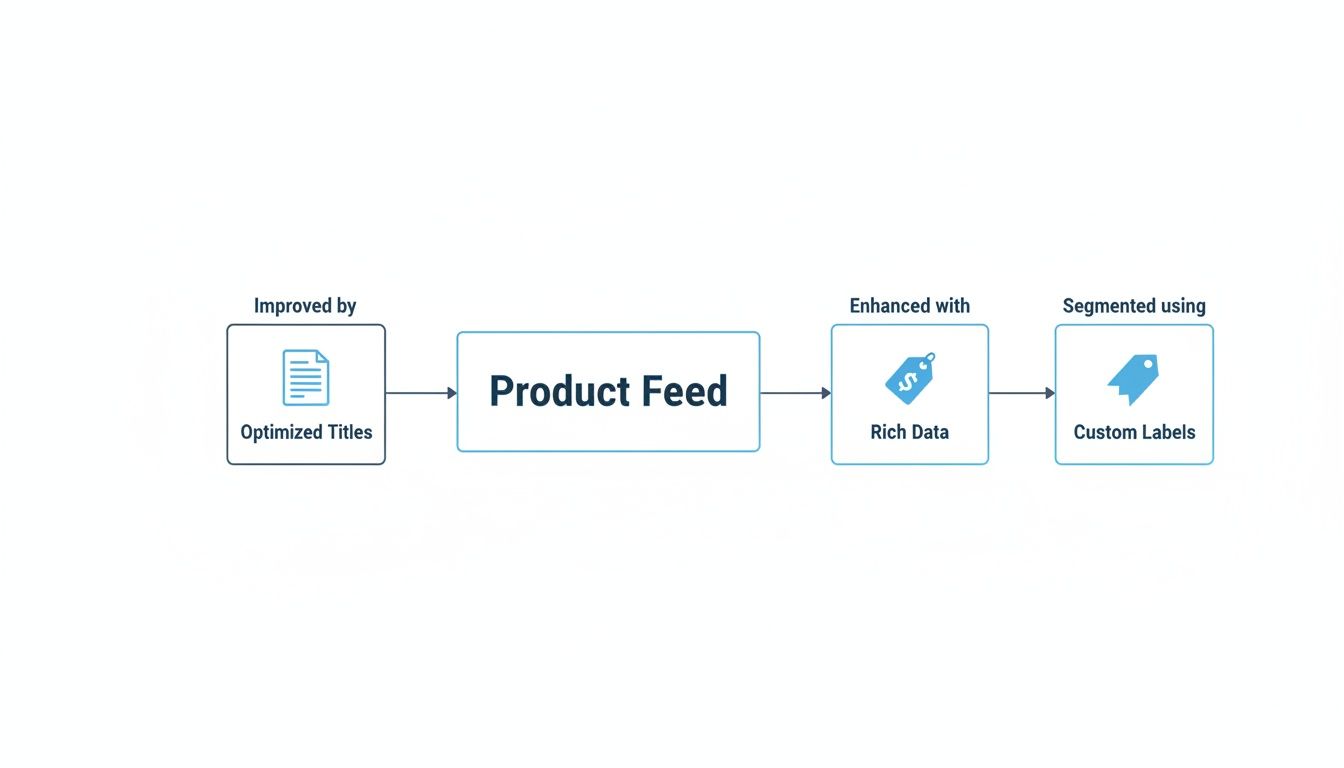
This visual flow makes it clear: a strong feed isn’t just data entry. It’s the strategic blueprint that tells your automated campaigns exactly how to segment and target for the best results.
Feeding the Algorithm with Powerful Audience Signals (The Secret to B2B Google Ads Success)
This is where you give the algorithm its real superpower. Audience signals are your way of saying, “Here’s a head start—go find more people who look just like this.” The more precise your signals, the faster the campaign learns and the more efficiently it will spend your budget. This is where your first-party data becomes priceless.
By providing your own customer data as an audience signal, you are giving the automated campaign a high-resolution portrait of your ideal buyer. The algorithm then uses this as a ‘lookalike’ template to discover new, high-intent shoppers across the entire Google network.
Here are the most impactful signals you can feed it:
- Customer Lists: This is the big one. Upload lists of your past purchasers, especially repeat buyers or high-LTV customers, straight from your CRM or platforms like Shopify. It’s the single most powerful signal you can provide.
- Website Visitors: Create audiences based on people who’ve visited specific product pages, added items to their basket, or started the checkout process. You’re targeting users who have already shown they’re ready to buy.
- Custom Segments: Build audiences based on the search terms people have used or the types of websites they visit. For example, you could create a segment of people who have searched for your main competitors’ brand names. A cheeky but effective tactic!
This data-first approach is becoming non-negotiable for UK brands. For example, dynamic creative optimisation is driving 19% higher display conversions when combined with smart retargeting. And with 87% of advertisers now using smart bidding, feeding the machine high-quality audience signals is no longer a nice-to-have; it’s essential if you want to stay competitive and hit those conversion goals.
Ultimately, mastering automation is all about this strategic partnership. You provide the top-notch data, the killer creative, and the clear business goals. The algorithm then takes these ingredients and scales your message across millions of touchpoints with incredible efficiency. For a deeper dive into the nuts and bolts, our comprehensive guide to Google Ads Performance Max campaigns is an excellent next step.
The Secret to B2B Google Ads Success: Measuring for Profit, Not Just Clicks
A high click-through rate feels great, but it doesn’t pay the bills. For too long, D2C brands have been obsessed with vanity metrics—clicks, impressions, even top-line revenue—that paint an incomplete and often misleading picture. To truly master the secret weapon for D2C PPC brands, you have to stop chasing traffic and start measuring what actually hits your bottom line.
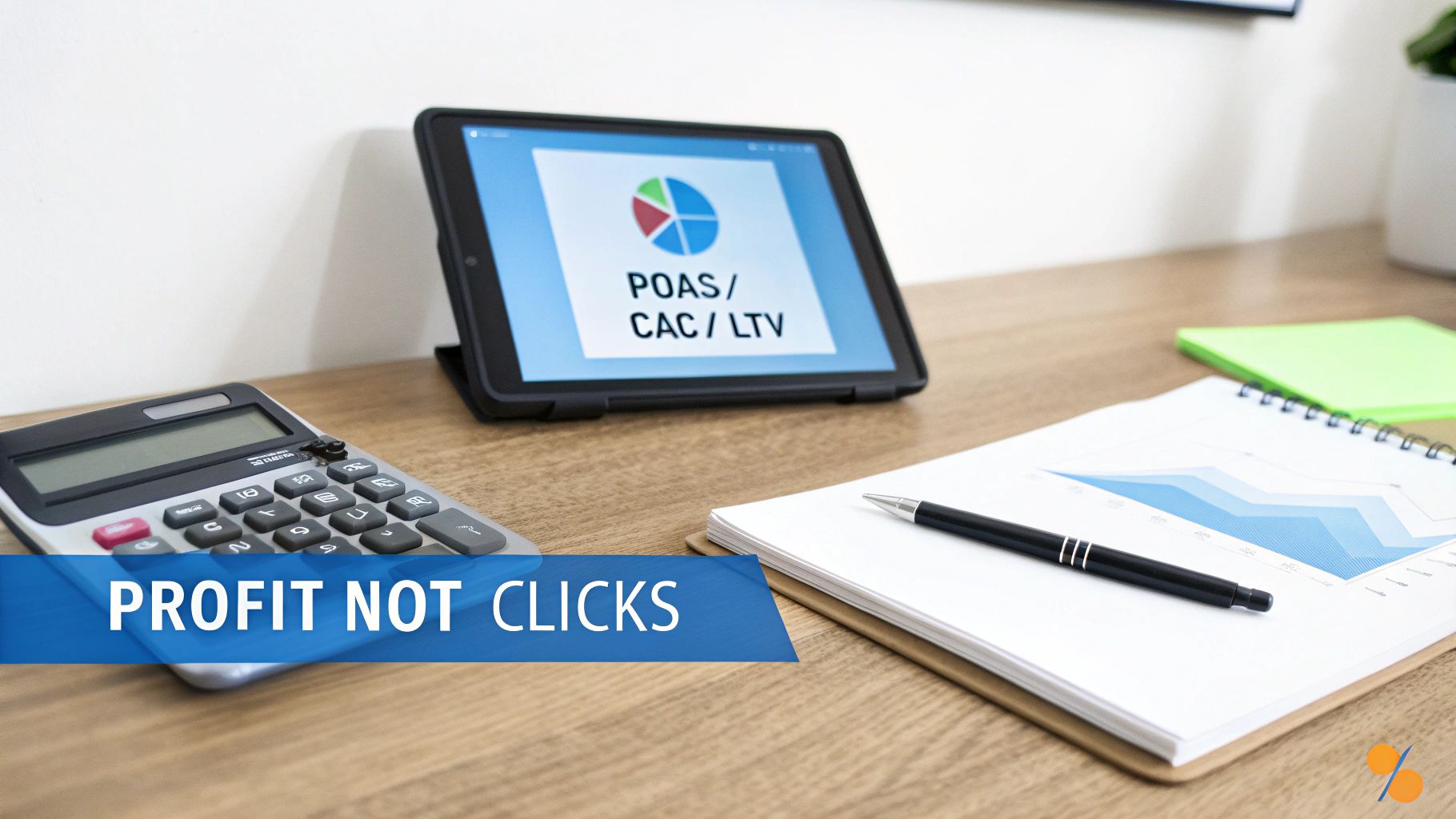
This is all about moving beyond the standard ROAS (Return on Ad Spend) and embracing metrics that tell the whole story of profitability. It’s about making data-driven choices that directly fuel growth, turning your advertising from a cost centre into a predictable profit engine.
The Metrics That Truly Define D2C Success
To build a sustainable advertising machine, you need to track the numbers that reflect real business health. This isn’t just about what a campaign brings in; it’s about what it costs to get a customer through the door and how much that customer is worth over their lifetime.
Get to know these three core profitability metrics intimately:
- Profit on Ad Spend (POAS): This is the natural evolution of ROAS. Instead of just tracking revenue, POAS calculates your actual profit after factoring in your Cost of Goods Sold (COGS) and ad spend. It answers the most critical question: “For every pound I spend on ads, how much pure profit am I making?”
- Customer Acquisition Cost (CAC): This metric tells you exactly what it costs to win a new customer. Simply divide your total ad spend by the number of new customers you’ve brought in. Your goal is to drive this number down as low as you can.
- Customer Lifetime Value (LTV): This is the total profit you expect to make from a single customer over their entire relationship with your brand. A high LTV means your customers are loyal and keep coming back for more—the absolute cornerstone of a healthy D2C business.
A winning D2C strategy is beautifully simple: your LTV must be significantly higher than your CAC. A common benchmark to aim for is an LTV to CAC ratio of 3:1 or better. If you’re spending more to get customers than they’re worth, your business is on a countdown timer.
An Optimisation Playbook for Profitability (The Secret to B2B Google Ads Success)
With these metrics as your North Star, you can build a clear playbook for diagnosing performance, making smart adjustments, and scaling your budget without torching your margins. This is about reacting to data with precision, not guesswork.
Diagnosing a Performance Drop
When you see POAS or your LTV:CAC ratio take a nosedive, don’t panic. Start investigating methodically. Is it a problem with traffic quality (a rising CAC) or an issue with post-click conversion (a lower LTV)? Dig into your data to find the weak link in the chain—it could be anything from ad creative fatigue to a clunky checkout process.
Refreshing Creative Assets Smartly
Automated campaigns like Performance Max thrive on fresh creative, but constantly swapping assets can reset the algorithm’s learning phase. The trick is not to replace everything at once. Instead, add new creative to your asset groups. This lets the system test the new stuff alongside the old, gradually phasing out the underperformers without killing your campaign’s momentum. Aim to introduce fresh assets every 4-6 weeks to avoid creative burnout.
Scaling Your Budget Without Sacrificing Profit
The biggest mistake brands make is trying to scale too fast. A sudden, massive budget increase can force the algorithm to chase lower-quality traffic, causing your CAC to skyrocket and your profits to evaporate.
Follow this simple three-step rule for profitable scaling:
- Wait for Stability: Make sure your campaign has been consistently hitting its POAS or CAC target for at least one to two weeks. Don’t jump the gun.
- Increase Incrementally: Raise your budget by no more than 15-20% at a time. Small, steady steps win the race.
- Monitor and Repeat: Let the campaign run for several days to stabilise at the new budget level. If it’s still hitting your profitability targets, you’re clear to repeat the process.
This methodical approach is how you scale up while keeping a firm grip on your margins, ensuring every extra pound you spend contributes directly to profitable growth.
The Secret to B2B Google Ads Success: Building Resilience with a Diversified PPC Portfolio
Putting all your advertising eggs in the Google basket is a seriously high-risk game. We’ve all seen it happen – market volatility, a surge in competition, or one of Google’s infamous algorithm shifts can destabilise even the most successful campaigns practically overnight.
If you want to build genuine resilience, you need a diversified PPC portfolio. And for many D2C brands, the secret weapon for stability is an often-overlooked powerhouse: Microsoft Ads.
The trick is to stop thinking of Microsoft Ads as a replacement for Google and start seeing it as a strategic complement. It unlocks a different, often older and more affluent audience segment that might not be glued to Google’s platforms. This isn’t just about reaching new people; it’s about reaching them in a far less crowded and expensive environment.
Tapping into an Underserved Market
The core advantage of Microsoft Ads boils down to simple economics: lower competition means lower costs. While your rivals are locked in a brutal bidding war on Google, you can be quietly capturing high-intent traffic on Microsoft’s network for a fraction of the price. That’s an immediate efficiency boost for your entire advertising operation.
For UK D2C brands battling those ever-rising costs, Microsoft Ads is an absolute gem. With 34% of marketers having started campaigns there in the past year, it’s clear the smart money is moving towards less saturated alternatives. Bing, Microsoft’s search engine, often delivers cost-per-clicks that are significantly cheaper. We’ve seen some display CPCs hover around £0.66—a dream scenario for bootstrapped e-commerce brands in competitive sectors like home goods. You can dig into more UK digital marketing statistics at Localiq.co.uk.
Diversifying your ad spend to platforms like Microsoft Ads is like adding a second, highly efficient engine to your growth machine. It reduces your dependency on a single channel, lowers your blended customer acquisition cost, and provides a crucial safety net against market instability.
Streamlining Your Expansion (The Secret to B2B Google Ads Success)
Getting started is surprisingly simple. Microsoft Ads lets you directly import your successful Google Ads campaigns, pulling across everything from ad groups and keywords to your campaign settings. This feature massively lowers the barrier to entry, letting you test the waters and start capturing valuable market share with minimal faff.
This multi-platform approach isn’t just a defensive move; it’s a proactive strategy for sustainable growth. By adding this layer to your PPC efforts, you strengthen your brand’s presence across the board, capture customers your competitors are completely ignoring, and build a more robust, profitable, and resilient marketing machine.
The Secret to B2B Google Ads Success: Your Top Questions Answered
Switching gears to a more modern, data-driven PPC approach is a big move, and it’s totally normal to have a few questions rattling around. This final section tackles some of the most common queries we get from D2C owners and marketers when they’re ready to make the jump.
How Much Conversion Data Do I Need for Performance Max to Really Work?
While there isn’t a single magic number, a good benchmark to aim for is at least 30-50 conversions within the last 30 days. Think of this as the initial fuel for the algorithm – it gives it a solid starting point to begin learning who your ideal customers are.
The more high-quality data you feed it through rock-solid tracking and first-party lists, the faster and smarter it gets. A great tactic is to kick off with a modest budget, let the campaign gather its intelligence for a couple of weeks, and then start scaling up once performance finds its groove and hits your targets.
Is This Advanced Strategy Only for Brands with Huge Budgets? (The Secret to B2B Google Ads Success)
Not at all. In fact, you could argue this data-first approach is even more crucial for smaller D2C brands with tighter budgets. It forces every single pound of your ad spend to work as hard as possible, right from day one.
By focusing on a perfect product feed and meticulously accurate tracking, you gain a competitive edge that has nothing to do with having the deepest pockets. What’s more, branching out to less saturated (and often cheaper) platforms like Microsoft Ads can deliver a much higher return on smaller investments, making it a perfect play for ambitious, growth-focused brands.
How Often Should I Be Messing with the Creative in Automated Campaigns?
It’s tempting to constantly tinker, but you’ve got to resist. Frequent, drastic changes can disrupt the algorithm’s learning phase, essentially resetting its progress. Instead of constant meddling, keep a close eye on your asset group performance.
A good rule of thumb is to refresh any underperforming creative elements every 4-6 weeks. When you do, introduce new images, videos, or headlines as additions rather than wholesale replacements. This lets the system test the new kids on the block against the proven winners, continuously optimising for the best combinations without losing momentum.
Can I Still Target Specific Keywords with Performance Max? (The Secret to B2B Google Ads Success)
Performance Max doesn’t work with direct keyword targeting like traditional search campaigns. It’s goal-based. But you can absolutely steer it in the right direction by feeding it powerful signals through your ad copy, landing pages, and, most importantly, your audience lists.
And while you don’t bid on keywords directly, the system still heavily relies on search intent to show ads. This means optimising your product feed titles and website content for the search terms your customers use is still an absolutely vital piece of the puzzle.
Ready to stop guessing and start building a profitable, data-driven PPC machine? The team at PPC Geeks lives and breathes these advanced strategies for ambitious UK D2C brands. Book your free PPC audit today and let’s find out how much more you could be getting from your ad spend.
Author

Search Blog
Free PPC Audit
Subscribe to our Newsletter

The Voices of Our Success: Your Words, Our Pride
Don't just take our word for it. With over 100+ five-star reviews, we let our work-and our satisfied clients-speak for us.

"We have been working with PPC Geeks for around 6 months and have found Mark and the team to be very impressive. Having worked with a few companies in this and similar sectors, I rate PPC Geeks as the strongest I have come across. They have taken time to understand our business, our market and competitors and supported us to devise a strategy to generate business. I value the expertise Mark and his team provide and trust them to make the best recommendations for the long-term."
~ Just Go, Alasdair Anderson
