




Let’s be honest, what’s a ‘good’ Cost Per Click (CPC)? It’s not some magic number you can just pluck out of the air. It’s the cost that actually fuels profitable growth for your specific business.
Think of it this way: you wouldn’t judge the cost of ingredients for a cake without knowing how much you’ll sell the cake for. A ‘good’ CPC works the exact same way – it only makes sense when you know your final selling price and profit margin.
Redefining a Good Cost Per Click
Too many advertisers get completely fixated on driving their Cost Per Click (CPC) down, convinced that cheaper is always better. While the idea of paying less for a click is tempting, this laser focus misses the entire point.
A genuinely “good” CPC is one that slots comfortably into your overall customer acquisition cost while driving a fantastic Return on Ad Spend (ROAS).
Let’s imagine you run an online shoe shop. A £0.50 CPC looks amazing on paper, right? But if it takes 200 of those clicks to land a single £80 sale, you’ve just spent £100 to make £80. That’s a losing game.
Now, flip that. A £4.00 CPC might feel steep, but what if every tenth click turns into a £250 sale? You’ve spent £40 to make £250. Now we’re talking – that’s a seriously profitable campaign. This simple shift in thinking is crucial. The focus shouldn’t be on the cost of the click itself, but on what that click actually delivers for your business.
Setting a Realistic Benchmark
So, where’s a sensible place to start? Looking at the UK Google Ads landscape for 2025, a good CPC for many mainstream industries typically lands somewhere between £0.50 and £3.50. This range is often the sweet spot for SMEs looking to scale up.
But remember, a ‘good’ CPC isn’t just about being low. It’s about leading to a Cost Per Acquisition (CPA) that sits below the 2025 UK benchmark of £52.58. That’s how you know each click is pulling its weight and contributing to profitable sales. You can dig into more insights about 2025 Google Ads costs and see exactly how your business stacks up.
Ultimately, a good CPC is defined by how it connects to your core business metrics:
- Cost Per Acquisition (CPA): The total amount you spend to win one new customer.
- Return on Ad Spend (ROAS): The revenue you generate for every pound you put into your ads.
- Customer Lifetime Value (LTV): The total revenue you can expect from a single customer over the long haul.
Once you understand how your CPC influences these numbers, you can move past generic benchmarks and start making decisions that truly drive your business forward. Want to get a better handle on your own numbers? Learn more about how to calculate your Google PPC costs in our detailed guide.
UK CPC Benchmarks Across Key Industries
To really get a handle on what a ‘good’ CPC is, we have to ditch the idea of a single, magic number. The reality is, what you pay for a click is deeply tied to your specific industry – how competitive it is, what a new lead is actually worth, and how much a typical customer spends. There’s simply no such thing as a one-size-fits-all ‘good’ CPC.
Think about it this way: a local roofing supplier in Derby might be perfectly happy paying around £1 for a click on keywords like ‘roofing supplies’. With a modest monthly budget of £500, that’s a smart target that can pull in some decent traffic without breaking the bank.
But that’s a completely different world from, say, the high-stakes finance sector. There, a single click for a hot keyword could easily rocket past £20, and it could still be a bargain if it leads to a high-value client.
This image gives you a solid visual breakdown of what a ‘good’ CPC looks like in the UK, alongside the all-important target Cost Per Acquisition (CPA).
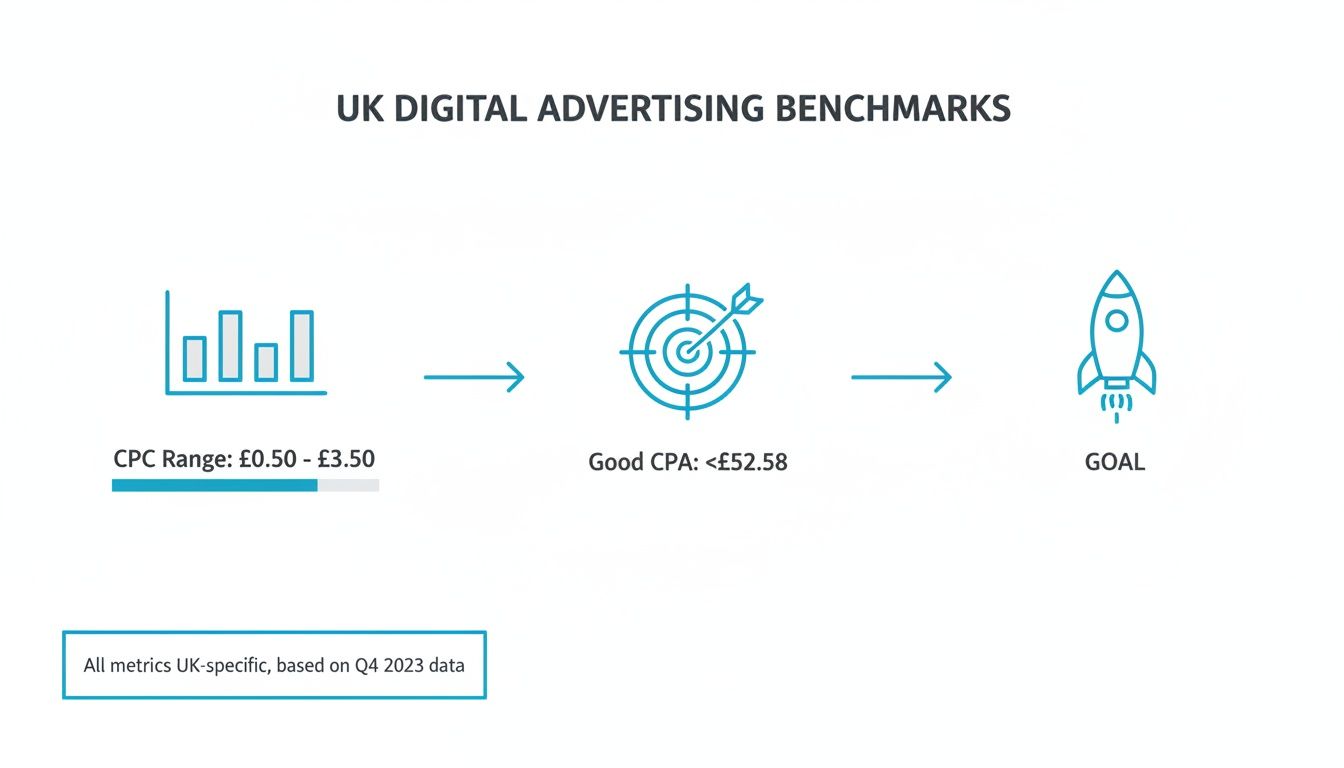
As you can see, the aim isn’t just to get the cheapest clicks possible. It’s about finding a CPC that leads to profitable new business, which is why a holistic view is absolutely critical.
Comparing Costs Across Different Sectors
The gap in ad spend between industries can be massive. An online fashion retailer might see a CPC of £1.50 as totally reasonable. On the other hand, a law firm chasing high-value personal injury cases could pay ten times that amount and still get a fantastic return on their investment.
A “good” CPC is never just about the number itself. It’s about profitability. A high CPC that brings in a high-value client is infinitely better than a cheap click that never converts.
To give you a clearer picture, let’s look at some typical CPC ranges for a few key UK business sectors. The table below really highlights how costs can swing wildly depending on the industry and just how fierce the competition is for certain keywords.
Average UK CPC by Industry
This table shows a comparison of typical Cost-Per-Click ranges for different UK business sectors, highlighting the variance in advertising costs.
| Industry Sector | Average CPC Range (Low Competition) | Average CPC Range (High Competition) |
|---|---|---|
| Retail & Ecommerce | £0.50 – £1.20 | £1.20 – £3.50+ |
| Home Services | £1.00 – £3.00 | £3.00 – £8.00+ |
| Professional Services | £2.50 – £6.00 | £6.00 – £20.00+ |
| B2B & Technology | £1.50 – £4.50 | £4.50 – £12.00+ |
Seeing this data laid out makes it obvious why you must benchmark against your own industry. It stops you from chasing unrealistic cost targets and helps you set a budget that reflects the reality of your market. Understanding how much Google Ads should cost for your specific sector is the first real step toward building a PPC strategy that’s both sustainable and profitable.
The Three Factors That Control Your CPC
Ever look at your cost-per-click and wonder how Google actually came up with that number? It’s a common question. The good news is that the Google Ads auction isn’t just about who has the deepest pockets. It’s a clever system designed to reward relevance and quality, not just the highest bidder.
Getting your head around how this auction works is the first step to taking back control of your ad spend. Instead of a mind-bendingly complex algorithm, you can boil it all down to three core components. Master these, and you can start strategically lowering your costs while actually improving your ad positions.
1. Quality Score
Think of Quality Score as Google’s “helpfulness” rating for your ads. It’s a simple score from 1 to 10 that looks at the quality of your ads, keywords, and landing pages. A high Quality Score is a signal to Google that your ad is a great match for what the user is searching for.
And Google rewards you for being helpful. Advertisers with higher Quality Scores get a discount on their cost-per-click. This means a better score can land you a higher ad position for less money than a competitor with a poor score, even if they’re bidding more than you. Our complete guide explains everything you need to know about improving your Google Ads Quality Score.
A high Quality Score is your single most powerful tool for reducing your CPC. It’s Google’s way of saying, “Thanks for making our search results better. Here’s a discount.”
2. Ad Rank
Your ad’s position on the search results page isn’t just decided by your bid. It’s determined by a calculation called Ad Rank, and this is what ultimately decides if and where your ad shows up.
The formula itself is beautifully simple but incredibly powerful:
Ad Rank = Your Maximum Bid x Your Quality Score
This formula is why an advertiser with a modest bid but a stellar Quality Score can easily outrank a competitor who’s throwing a huge budget at their ads but failing on relevance. It’s how Google ensures users see the most useful results, not just ads from the companies with the most cash to burn. Your goal should always be to improve your Ad Rank through quality, not just by cranking up your bids.
3. Competitor Bidding
The final piece of the CPC puzzle is your competition. You’re not bidding in a vacuum; you’re in a live auction against other businesses all going after the same keywords. How aggressively they bid has a direct impact on what you end up paying.
If you have a bunch of competitors all bidding high on a particular keyword, the auction gets more expensive for everyone. This is where your Quality Score becomes your secret weapon. You can’t control what your competitors are willing to spend, but a superior Quality Score lets you stay in the game without getting dragged into a bidding war.
This is especially true for businesses here in the UK. For a UK business in 2025, a good CPC is one that drives maximum ROI. This often means hitting strong benchmarks like an average CPA of £52.58 and a 4:1 ROAS, which is typically achieved with clicks costing between £0.50-£5.00. You can discover more about how UK businesses budget for PPC and see just how much localised data matters.
By focusing on these three controllable factors, you shift from just paying for clicks to strategically winning them.
Focusing on Metrics That Actually Drive Growth
Chasing a low cost-per-click can feel productive, but let’s be honest, it’s often just a vanity metric. A cheap click is completely worthless if it never turns into a sale or a valuable lead. If you want to build an advertising strategy that genuinely works, you have to shift your focus from the cost of a single click to the numbers that actually impact your bottom line.
This means looking beyond CPC and embracing the metrics that measure real business growth. These are the indicators that tell you whether your ad spend is a smart investment or just another expense.
The Metrics That Matter Most
Instead of asking, “what is a good CPC?”, the better question is, “what CPC leads to a profitable outcome?”. To answer that, you need to get comfortable with three crucial metrics that paint the full picture of your campaign’s financial health.
-
Cost Per Acquisition (CPA): This is the bottom-line cost to get one new customer through your campaign. It’s the real-world price of a conversion, whether that’s a sale, a signed contract, or a qualified lead for your sales team.
-
Return on Ad Spend (ROAS): This shows you the total revenue you’re generating for every pound you put into advertising. A 4:1 ROAS, for example, means you’re making £4 for every £1 you spend. Simple as that.
-
Customer Lifetime Value (LTV): This metric looks at the bigger picture, forecasting the total revenue a single customer will bring to your business over their entire relationship with you. It’s vital for figuring out how much you can really afford to spend to acquire them in the first place.
Thinking in these terms completely reframes the conversation. A low CPC is no longer the goal; a profitable CPA and a healthy ROAS are what truly matter.
Putting Profitability into Practice
Let’s make this crystal clear with an ecommerce example. Imagine you’re selling bespoke leather bags and have two different campaigns running.
Campaign A:
- Cost-Per-Click (CPC): £0.50
- Clicks to get one sale: 100
- Cost Per Acquisition (CPA): £50 (£0.50 x 100)
- Product Price: £40
- Result: You lose £10 on every single sale.
That £0.50 CPC looks fantastic on a report, doesn’t it? But in reality, the campaign is a financial drain. It costs more to get the customer than they actually spend.
A low CPC that results in a negative return is the classic example of a vanity metric. It looks good on the surface but is actively damaging your business’s profitability.
Now, let’s look at a different approach.
Campaign B:
- Cost-Per-Click (CPC): £5.00
- Clicks to get one sale: 5
- Cost Per Acquisition (CPA): £25 (£5.00 x 5)
- Product Price: £200
- Result: A seriously profitable campaign.
At first glance, a £5.00 CPC might seem terrifyingly high. But because these clicks are coming from higher-intent buyers who convert efficiently, the campaign is a massive success. It proves that a higher CPC can be infinitely more valuable than a cheaper one if it drives profitable growth.
By prioritising CPA and ROAS, you stop just buying traffic and start strategically investing in your business’s future.
Actionable Strategies to Lower Your CPC
Knowing the theory is one thing, but actually rolling up your sleeves to lower your CPC while boosting campaign quality is where the real growth happens. High costs aren’t just bad luck; they’re usually a symptom of deeper issues in your account, from sloppy targeting to irrelevant ads.
The good news? These are all things you can fix.
With a few proven optimisation tactics, you can start systematically trimming your ad spend, pushing up your click-through rates, and ultimately getting a much better return on your investment. This isn’t about chasing cheap, low-quality clicks. It’s about making every single pound in your budget work harder and smarter.
Supercharge Your Quality Score
If there’s one lever you need to pull to slash your CPC, it’s your Quality Score. It’s that powerful. Google actively rewards advertisers who give users a great experience, offering up lower costs and better ad positions as a prize. A high score is your signal to Google that your ads and landing pages are a perfect match for what people are searching for.
To get that score climbing, you need to nail these three core components:
- Ad Relevance: Your ad copy needs to be a direct mirror of the keywords in its ad group. If someone types in “men’s black leather trainers,” your headline and description had better mention those exact terms. It’s that simple.
- Expected Click-Through Rate (CTR): You need to write ad copy that people actually want to click. Make it compelling, focus on the benefits, and grab their attention. A strong call-to-action like “Shop Now & Get Free UK Delivery” or “Download Your Free Guide Today” can make all the difference.
- Landing Page Experience: The page you send people to must deliver on the promise your ad made. It needs to load quickly, look great on mobile, and make it ridiculously easy for users to find what they want and convert.
Focusing on Quality Score is non-negotiable. A higher score directly translates to a lower cost-per-click, giving you an immediate competitive advantage without increasing your bid.
Master Your Keyword Strategy
The keywords you choose are the very foundation of your campaign. Get them wrong, and you’re just throwing money away. Targeting terms that are too broad or fiercely competitive is a fast track to a sky-high CPC and a dismal return. The real skill is finding that sweet spot between search volume and user intent.
Take a keyword like “shoes”. It’s incredibly broad and eye-wateringly expensive. Now, compare that to a specific long-tail keyword like “waterproof trail running shoes for wide feet”. It’s much cheaper and targets someone who is miles closer to pulling out their credit card. This approach doesn’t just get you clicks; it gets you high-quality traffic that’s far more likely to convert.
You also need to be absolutely relentless with your negative keywords. These are the terms you explicitly tell Google not to show your ads for. If you sell premium coffee beans, you’d add negatives like “free,” “cheap,” and “instant” to filter out bargain hunters who were never going to buy from you anyway. Our in-depth guide offers more expert advice on using negative keywords in Google Ads to cut down on wasted spend.
By constantly refining your keyword targeting, you ensure your budget is spent only on clicks from people who are genuinely interested. This naturally lowers your effective CPC and makes your entire campaign more profitable.
To help you put all this into practice, here’s a quick checklist of the key actions you can take to get your Quality Score up and your costs down.
CPC Optimisation Checklist
| Optimisation Tactic | Impact on CPC | How to Implement |
|---|---|---|
| Improve Ad Relevance | High | Tightly theme ad groups. Ensure ad copy directly reflects your keywords. |
| Boost CTR | High | Write compelling, benefit-led ad copy. Use strong calls-to-action and ad extensions. |
| Enhance Landing Page | High | Ensure page content is relevant, fast-loading, and mobile-friendly. |
| Refine Keyword Targeting | Medium-High | Focus on long-tail keywords with clear purchase intent. |
| Build Negative Keyword Lists | Medium-High | Actively add irrelevant search terms to prevent wasted clicks and spend. |
Following these steps isn’t a one-time fix; it’s an ongoing process of refinement. But by consistently focusing on these areas, you’ll see a tangible drop in your CPC and a significant improvement in your campaign’s overall efficiency.
When Is It Time to Call in a PPC Expert?
Let’s be honest, managing a Google Ads account properly can quickly turn into a full-time job. It’s one of those tasks that pulls you away from what you should be doing: actually running and growing your business. While getting your hands dirty at the start is a great way to learn, there’s a tipping point where bringing in an expert isn’t just a good idea—it’s the logical next step for any ambitious UK business.
So, when is that moment? How do you know it’s time to pass the baton to a specialist? There are a few classic signs that tell you you could be getting a whole lot more from your budget by partnering with an expert.
Telltale Signs You Need a PPC Agency
Think about calling for backup if any of these sound painfully familiar:
- You’ve Hit a Wall: Your results have gone flat. You’re tweaking things here and there, but you’re just not sure which levers to pull to get things moving upwards again.
- Costs Are Climbing, but Conversions Aren’t: You’ve noticed your average CPC is creeping up, but the phone isn’t ringing any more than it used to. Your sales and leads are stagnant, or worse, declining.
- You’re Always Playing Catch-Up: You’re constantly putting out fires and fixing problems rather than proactively hunting for new opportunities. Your management style has become purely reactive.
- The Platform Updates Are Leaving You Behind: Google Ads never stands still. From Performance Max rolling out new features to constant policy changes, just keeping up feels like a mammoth task.
If you find you’re spending more time tinkering inside the ad account than you are working on your business, that’s your signal. It means your time and your budget could both be working much, much harder.
Here at PPC Geeks, we live and breathe UK advertising. It’s what we do, day in and day out. We can help you smash through those plateaus and unlock the real potential hiding in your account. It’s time to get your focus back and make every single pound of your ad spend count.
Get a free, no-obligation PPC audit today and see exactly what your campaigns are capable of.
A Few Final Thoughts on CPC
We’ve dug deep into the mechanics of cost-per-click, but a few common questions always seem to pop up. Let’s tackle them head-on so you can move forward with your PPC strategy with a bit more confidence.
Is a CPC of £5 Too High?
It depends entirely on what that click is worth to you. On its own, £5 tells you nothing.
For example, let’s say you sell a high-ticket item where the average customer is worth £1,000 over their lifetime. If one in every ten of those £5 clicks converts into a customer, your Cost Per Acquisition (CPA) is £50. Spending £50 to make £1,000? That’s not just good; it’s a phenomenal return.
The golden rule is to never judge a CPC in isolation. A high CPC that brings in profitable customers will always beat a cheap click that goes nowhere. It’s all about your Return On Ad Spend (ROAS) and bottom-line profitability.
How Quickly Can I Reduce My CPC?
You can often see the needle move in the right direction within a few weeks, especially after making some quick-win optimisations. Things like tightening up your negative keyword lists or improving ad copy to boost your Quality Score can have a fairly immediate impact.
But achieving a significant, lasting reduction in your CPC isn’t a one-and-done job. It’s an ongoing process of testing, learning, and refining your campaigns over several months. Think of it more as a marathon of continuous improvement, not a sprint to a quick fix.
Does Performance Max Affect My Average CPC?
Absolutely. Performance Max campaigns have a major influence on your account’s overall average CPC.
Because PMax works its magic across all of Google’s channels—Search, Display, YouTube, you name it—your costs can swing wildly. It might pull your average CPC down by finding some cheap clicks over on the Display Network, but that’s not the metric you should be obsessing over with PMax. The real measure of success is your overall CPA and ROAS. That’s what tells you if the campaign is actually efficient and making you money.
Ready to stop guessing what a “good” CPC is and start building a truly profitable advertising strategy? The team at PPC Geeks can dive into your account and show you exactly where the opportunities are.
Get Your Free, No-Obligation PPC Audit Today!