




So, what exactly is a ChatGPT brand partnership? Think of it as a team-up where a business brings OpenAI’s language models into its world—whether that’s inside a product, a service, or a big marketing splash. These collaborations can be as simple as adding a smart chatbot using an API or as complex as building a completely new AI-powered tool together. It’s a strategic move that gives brands a serious competitive edge.
ChatGPT Brand Partnerships: The New Frontier of Brand Collaboration
Picture having an expert consultant on call 24/7, someone who can help every single customer, dream up killer marketing copy, or crunch complex data in seconds. That’s the power you unlock with a ChatGPT brand partnership. This isn’t just some tech fad; it’s a fundamental shift in how UK businesses are operating, driven by the need to innovate, work smarter, and build real connections with customers.
For many, the thought of partnering with an advanced AI sounds complicated, but it’s simpler than you might think. It’s like hiring a specialist. You’d partner with a logistics company to handle your shipping, right? In the same way, you partner with ChatGPT to manage sophisticated language tasks at a massive scale. This lets you play to your strengths while beefing up your capabilities with world-class artificial intelligence.
Why This Matters for UK Businesses
The motivation here is straightforward. In today’s crowded markets, everyone’s looking for a way to stand out, and AI provides a clear path. By bringing ChatGPT into the fold, businesses can offer hyper-personalised customer interactions, put routine tasks on autopilot, and come up with creative ideas faster than ever. These aren’t just vague benefits; they have a direct impact on the bottom line.
Here’s what’s driving businesses to form these partnerships:
- Enhanced Customer Experience: Offering instant, intelligent support around the clock that solves problems faster and more accurately.
- Operational Efficiency: Automating things like content creation, data analysis, and internal comms. This frees up your team to focus on the big-picture strategic work.
- Product Innovation: Creating brand-new features or even entire products powered by generative AI, opening up fresh revenue streams. A great example is how ChatGPT’s shopping layer shows a new frontier in AI-driven commerce for retail brands.
A partnership with ChatGPT isn’t about replacing people. It’s about giving them superpowers. It’s a tool that helps your team achieve more, innovate faster, and connect with customers in a way that truly matters.
Ultimately, these partnerships are about making your business ready for what’s next. As AI becomes a bigger part of our daily lives, customers will come to expect smarter, more intuitive services. The brands that jump on this now aren’t just getting a temporary leg up; they’re building the skills and foundations to win in an AI-first world. This guide is your roadmap to get started, from figuring out the right partnership model to launching your first AI-powered project.
Exploring The Models Of AI Partnership
Before you can jump into a successful ChatGPT brand partnership, you need to get your head around the options. Think of it like buying a car: the right model for you depends entirely on where you want to go, your budget, and how much control you want behind the wheel. For UK businesses, these collaborations usually boil down to three main models, each with its own strategic purpose.
Picking the right path isn’t just a tech decision; it’s a strategic one that needs to lock in perfectly with your business goals. That’s why it’s so important to understand what each model brings to the table.
This infographic breaks down the main goals that usually drive these partnerships—Innovation, Efficiency, and Connection.
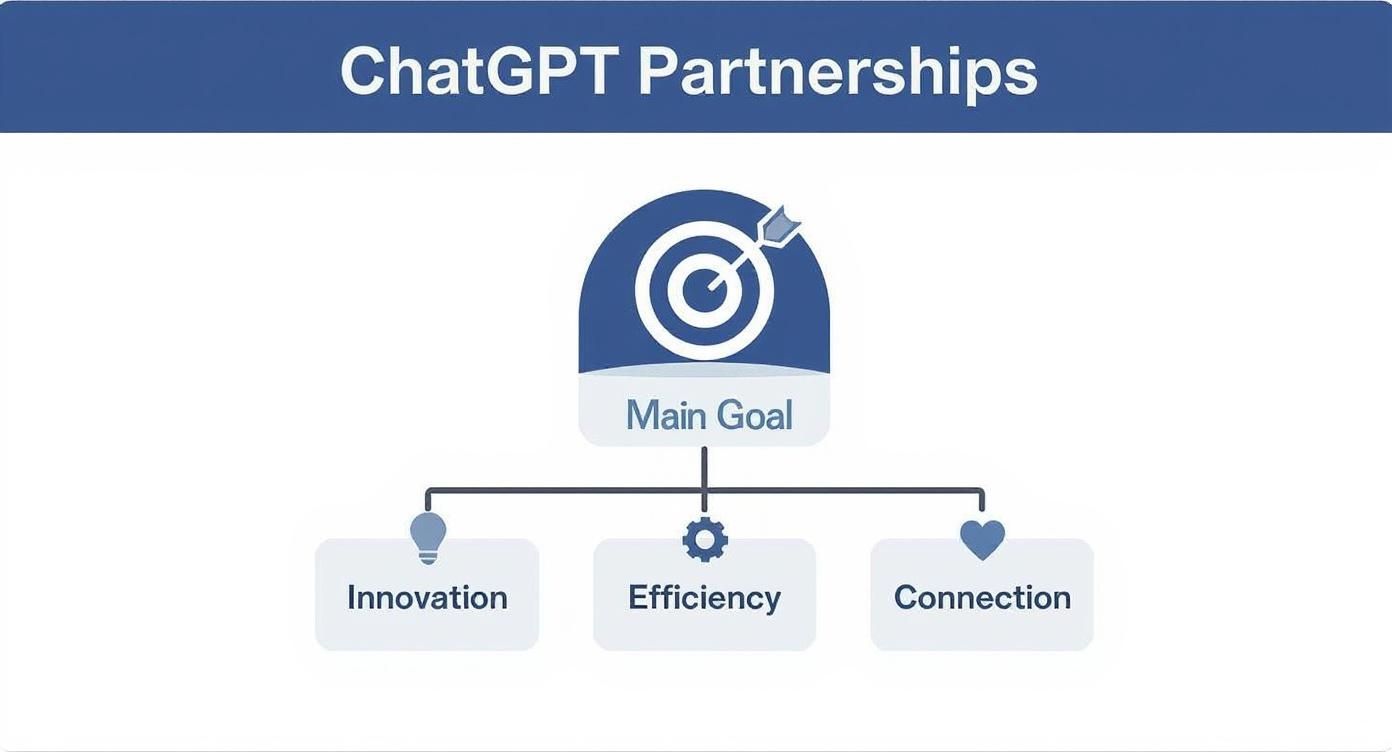
As you can see, every solid partnership starts with a clear objective. Are you trying to build something totally new, make your current operations slicker, or create stronger bonds with your customers? Your answer will point you in the right direction.
Let’s dive into the three main partnership models you can choose from.
Comparing ChatGPT Partnership Models
To help you figure out which model is the right fit, this table breaks down the three primary options across some key business considerations. It’s a quick way to compare them side-by-side.
| Partnership Model | Best For | Primary Benefit | Technical Effort | Typical Use Case |
|---|---|---|---|---|
| API Integration | Seamlessly embedding AI into existing products/services. | Full control over the user experience and branding. | Medium to High | A personal shopper bot on an e-commerce site. |
| Co-Branding | New products where AI is a key selling point. | Building credibility and trust by association. | Low | A new analytics tool marketed as “Powered by ChatGPT”. |
| Custom GPT | Highly specialised internal or customer-facing tasks. | An AI expert trained on your specific business data. | Medium | An internal knowledge base for staff trained on company docs. |
Each model offers a unique way to tap into ChatGPT’s power. The best choice really comes down to your specific goals, resources, and how you want your customers to experience the AI.
API Integration: The Direct Connection
Think of an API (Application Programming Interface) as a direct, secure line into ChatGPT’s brain. This is easily the most common and flexible way to partner up, letting you plug its intelligence straight into your own website, app, or internal software. You get to keep total control over the user experience while the AI does its magic behind the scenes.
For an e-commerce brand, this might look like a personal shopper bot that dishes out tailored product recommendations. A B2B software company could use it to build a smart feature that summarises complex reports for its users. It’s a powerful approach because you’re adding genuine value to what you already offer, without sending your customers off somewhere else.
The uptake of this model in the UK has been huge. In fact, while a massive 83% of European IT professionals are using generative AI tools, only 31% of companies have official policies in place. This points to a huge wave of grassroots adoption, with the vast majority of these setups involving API integrations powering over 18,000 commercial apps worldwide. You can find more details in this ChatGPT trends and statistics report.
Co-Branding: The ‘Powered By’ Stamp
Next up is co-branding, where you publicly tie your product to the ChatGPT or OpenAI name. This one is less about deep technical work and more about marketing and building credibility. By slapping a “Powered by ChatGPT” badge on your product, you’re essentially borrowing the brand recognition and trust that comes with a world-leading AI.
This strategy is a great shout for new products or features where the AI is the star of the show. It’s a clear signal to your customers that your service is built on seriously advanced tech. A new market research tool, for example, could advertise that its powerful analytics are generated by ChatGPT, giving it an instant leg-up on the competition.
Key Takeaway: Co-branding is a strategic move to build market confidence. It tells your customers that you’re at the forefront of technology, using a trusted and powerful AI to deliver a better service.
Custom GPT Development: The Trained Specialist
The third route is to create a Custom GPT. This is like hiring a new team member who already knows your business inside and out from day one. Instead of using a generalist AI, you build a specialist version of ChatGPT that has been fed your own company data, documents, and brand guidelines.
This model is perfect for improving internal efficiency or for highly specific customer-facing roles. A law firm could create a custom GPT trained on its entire case history to help with legal research. An e-commerce brand might build one that acts as the ultimate expert on its product catalogue, able to answer incredibly niche customer questions. For brands thinking about this path, understanding OpenAI’s commission model for GPTs is a must, as it even opens up new ways to monetise your creation.
ChatGPT Brand Partnerships: Weighing the Strategic Benefits and Risks
Jumping into a ChatGPT brand partnership can feel like strapping a rocket to your business. The potential for growth is massive, but you absolutely need to know how to steer it and what happens if things go sideways. A realistic, clear-eyed view of both the incredible benefits and the very real risks is essential before you hit the launch button.
This isn’t just about slapping a fancy chatbot on your website. We’re talking about a fundamental shift in how your business operates, from the way you talk to customers to how you create new products. Get it right, and the rewards can be huge, setting you miles apart from the competition.
The Upside: Unlocking New Capabilities
The most immediate benefit of a ChatGPT partnership is the power to deliver hyper-personalisation at a scale that was previously unthinkable. Just imagine giving every single person on your website a dedicated, expert assistant who can instantly guide them to the right product or answer their most specific questions.
But the advantages run much deeper than just beefing up your customer support. Here are some of the game-changing benefits:
- Rapid Content Generation: Your marketing team can go from a blank page to a finished draft in a fraction of the time. This means more blog posts, more social media updates, and more targeted email campaigns, all customised for different parts of your audience.
- Accelerated Product Innovation: By building AI into your products, you can create features that were simply out of reach before. Think of an analytics tool that doesn’t just spit out data but actually explains what it means in plain English, or a fashion app that acts as a genuine personal stylist.
- Data-Driven Insights: ChatGPT can chew through massive amounts of customer feedback, reviews, and support tickets to spot trends, pain points, and opportunities a human team might easily miss. This feedback loop is pure gold for making your products and services better.
The economic impact in the UK is already making waves. Recent figures show OpenAI’s services have snapped up a huge 29% market share of the European AI chatbot sector in 2025. This, paired with an average brand trust rating of 4.6 out of 5, shows the immense market confidence that’s driving these partnership opportunities. You can dig into more of these ChatGPT statistics and trends.
Navigating the Potential Pitfalls
Of course, with great power comes the need for great caution. A badly handled partnership can cause more harm than good, creating technical nightmares and even tarnishing your brand’s reputation. It’s vital to be aware of the potential risks right from the start.
One of the biggest worries for any UK business is data privacy. Handling customer data means you have to follow UK GDPR to the letter, and bringing an AI partner into the mix adds a whole new layer of complexity. You must have crystal-clear policies on what data is being processed and be completely transparent with your users.
A ChatGPT brand partnership is a strategic commitment, not just a technical one. Relying too heavily on any single technology can leave you vulnerable, while AI mistakes can quickly destroy customer trust if you’re not on top of them.
Beyond data compliance, other risks need your full attention.
- Brand Damage from AI Errors: If the AI gives out wrong information, behaves oddly, or shows biases, that reflects directly on your brand. Solid testing and clear “guardrails” are non-negotiable to prevent this.
- Over-Reliance on a Single Provider: Tying your core business functions too tightly to one external tech partner is risky. What’s your plan B if there are API outages, sudden price hikes, or changes to their terms of service?
- Loss of Human Touch: While efficiency is a huge plus, automating every customer interaction can feel cold and impersonal. Finding that sweet spot between AI-driven speed and genuine human connection is the key to keeping customers happy for the long haul.
Ultimately, the goal isn’t to be scared off by the risks, but to be ready for them. By understanding both sides of the coin, you can put the right safeguards and strategies in place. This ensures your ChatGPT brand partnership fuels growth and innovation, rather than just creating a new set of problems to solve.
ChatGPT Brand Partnerships: Your Step-by-Step Launch Playbook
Right, moving from the drawing board to the real world is where the fun really starts. A successful ChatGPT brand partnership doesn’t just fall into your lap; it’s the outcome of a smart, carefully executed plan. This playbook breaks the whole process down into five clear stages, walking you through everything from that first lightbulb moment to a flawless launch.
Think of it like building a house. You wouldn’t just start laying bricks without a detailed blueprint. This section is that blueprint, making sure you build on solid ground, get the right people on side, and ultimately launch something that genuinely solves a problem for your business or your customers.
Stage 1: Define Your Core Objective
Before a single line of code is written or your marketing team gets a brief, you need to answer one crucial question: What specific problem is this AI partnership going to solve? A fuzzy goal like “we want to use AI” is a fast track to a project that costs a fortune and goes nowhere. You need to be sharp and specific.
Get granular with your goal. Are you looking to:
- Slash customer support tickets by 30% by rolling out an AI-powered knowledge base?
- Hike up lead qualification rates by 15% by automating those initial sales chats?
- Bump up the average order value by 10% with a personalised product recommendation engine?
A clear, measurable objective acts as your North Star. It guides every single decision you make from here on out, from the type of partnership you choose to how you’ll actually measure success.
Stage 2: Conduct Thorough Due Diligence (ChatGPT Brand Partnerships)
With a clear objective locked in, it’s time for a reality check. This bit is all about understanding what you’re getting yourself into. Start by taking a hard look at your current tech stack. Can your existing systems actually talk to an API without a major headache? Do you have the dev talent in-house, or are you going to need to bring someone in?
Next, get stuck into OpenAI’s terms of service and usage policies. These aren’t just boring legal documents; they spell out exactly how you can use the tech, who owns the data, and what you’re responsible for. Pay extra close attention to the data privacy bits to make sure you’re staying on the right side of UK GDPR.
Critical Takeaway: Think of due diligence as your project’s insurance policy. Skipping it is like setting sail without checking the weather—you might get lucky, but you’re risking a proper storm.
Stage 3: Pitch the Vision Internally
Now for the tricky part: getting everyone else on board. A ChatGPT partnership will likely need time and resources from several departments—marketing, IT, legal, finance. You absolutely have to get buy-in from the key players early on to secure the budget and backing you need.
Build your pitch around that core objective you defined earlier. Don’t start with the tech; start with the business problem it cracks. Frame the whole project in terms of its potential ROI, showing clear projections for cost savings, efficiency boosts, or new revenue streams.
- For the CFO: Lay out a crystal-clear cost-benefit analysis.
- For the Head of Marketing: Talk about the impact on customer engagement and lead gen.
- For the CTO: Give them the technical requirements and a solid integration plan.
When you speak their language, the project stops being a “tech experiment” and becomes a strategic business move that everyone has a stake in.
Stage 4: Navigate the Technical Integration (ChatGPT Brand Partnerships)
This is where the plan hits the pavement. The technical integration can feel complicated, but with good planning, it’s perfectly doable. The number one job for your development team is to create a secure, scalable connection to the ChatGPT API.
A few key things to keep on your radar:
- Authentication and Security: Making sure your API keys are locked down and all data is encrypted.
- Scalability and Performance: Building a system that can handle spikes in traffic without falling over.
- Error Handling: Having a plan for what happens if the API goes down or gives a weird response.
- Testing and Quality Assurance: Hammering the integration with tests to squash bugs and ensure the AI’s answers match your brand voice and accuracy standards.
Starting with a small-scale pilot or a beta test is always a smart move. It lets you get real-world feedback and make tweaks before you go live to the public.
Stage 5: Plan Your Go-To-Market Strategy
Finally, it’s time to shout about it. How you launch your new AI-powered feature is just as important as the tech itself. Your go-to-market strategy needs to build a bit of buzz and show your users how to get real value out of the new tool.
Pull together a coordinated launch plan that covers:
- Internal Training: Your customer support and sales teams need to be the absolute experts on the new feature.
- Marketing Communications: Plan out a series of emails, blog posts, and social media announcements.
- Onboarding Materials: Create easy-to-follow tutorials, FAQs, or video guides to get people started.
A strong launch makes the most of the novelty factor. It can turn your innovative ChatGPT brand partnership into a powerful marketing moment that drives people to use the new feature and cements your brand’s reputation as a leader.
Measuring Success and Proving ROI
A brilliant idea for a ChatGPT brand partnership is one thing, but proving it actually delivers value is what truly matters. Without solid data, your innovative project is just a costly experiment. To justify the investment and secure future buy-in, you need a clear way of measuring success and showing a positive return on investment (ROI).
This means looking beyond surface-level numbers like chatbot interactions or the number of content pieces generated. Those stats are interesting, but they don’t tell the whole story. The real goal is to connect your AI partnership directly to tangible business results that stakeholders—especially the finance team—actually care about.
Identifying Your Core KPIs (ChatGPT Brand Partnerships)
First things first, you need to link your metrics directly back to the main objective you set out in the planning stage. If your goal was to improve efficiency, your Key Performance Indicators (KPIs) should reflect that. Likewise, if the aim was to boost sales, your metrics must track the money coming in.
Think about what success really looks like for your specific partnership model.
- For Customer Support Automation: Keep a close eye on Customer Support Cost Reduction. Measure the drop in human-agent hours or the number of support tickets the AI handles on its own. You should also monitor Average Resolution Time to show how much faster problems are getting solved.
- For Lead Generation: The big one here is Lead Conversion Rate Increase. Compare the conversion rates of leads who chat with the AI versus those who don’t. Another key metric is your Cost Per Qualified Lead (CPQL), which should hopefully drop as the AI does the initial screening.
- For Content Creation: Track the Reduction in Content Production Time. Work out how many hours your marketing team is saving, and then put a monetary value on that time. You can also look at engagement on AI-assisted content to prove it’s hitting the mark.
The most powerful KPIs are those that directly translate into pounds and pence. It’s not just about what the AI does; it’s about what that action saves or earns for the business.
Calculating Your Return on Investment
Once you’ve got your KPIs sorted, you can build a straightforward ROI calculation. This doesn’t need to be over-the-top complicated. At its heart, ROI is all about comparing what you gained from the partnership against what it cost to run.
The basic formula is simple enough:
(Gain from Investment – Cost of Investment) / Cost of Investment
To make this work, you need to be completely honest about all your costs.
- Direct Costs: This is the most obvious bit. It includes your monthly OpenAI API fees, which are based on how much you use it (token consumption).
- Development and Integration Costs: You’ll need to factor in the hours your developers spent building and maintaining the integration. If you hired outside help, include those invoices.
- Ongoing Maintenance: Don’t forget to account for the time your team will spend monitoring, updating, and tweaking the AI’s performance.
With all your costs tallied up, you can calculate the “gain” by putting a monetary value on your KPIs. For example, if the AI saved your support team 200 hours in a month and an agent’s time costs £20 an hour, your gain from efficiency is a cool £4,000. If your new AI sales assistant generated an extra £10,000 in sales, that’s your gain.
Getting these calculations right is absolutely key to showing the partnership’s value. For a deeper dive, our guide explains how to calculate marketing ROI with practical examples you can easily apply here.
By presenting a clear, data-backed business case, you turn your ChatGPT partnership from a “nice-to-have” tech project into a proven strategic asset that contributes directly to the bottom line.
ChatGPT Brand Partnerships: How UK Businesses Are Winning with AI

Theory is one thing, but seeing how these AI partnerships actually work on the ground is where the real magic happens. Let’s step away from the abstract and look at some proper, practical examples for UK businesses. These stories show how everyday small and medium-sized enterprises (SMEs) are using ChatGPT to sort out common headaches, boost sales, and just get things done more efficiently.
The best part about these collaborations is how flexible they are. You don’t need a massive team of developers or a bottomless bank account to get going. A clear goal and a smart approach can deliver some seriously impressive results, whether you’re shifting products online or offering professional services.
The UK Fashion Retailer’s Personal Stylist
Picture a small, independent fashion boutique in Manchester. They’ve got a great local following but find it tough to offer the slick, personalised shopping experience online that the big high-street names do. Their main goal? To get customers buying more in one go by helping them pull together complete outfits.
This is a perfect job for a Custom GPT.
- The Solution: The retailer builds a “Virtual Stylist” GPT. They feed it their entire product catalogue, seasonal lookbooks, and brand style guides. This custom AI gets to know which jumpers go with which trousers and what accessories will finish off a particular look perfectly.
- The Application: They embed this Virtual Stylist right onto their e-commerce site. Now, shoppers can ask it things like, “What can I wear with these new boots for a casual weekend?” or “Find me an outfit for a spring wedding.”
- The Outcome: The AI fires back with instant, on-brand suggestions, upselling customers by showing them full outfits instead of just single items. This directly helps increase the average basket size and creates a genuinely helpful, memorable shopping experience that builds loyalty.
This type of ChatGPT brand partnership turns a standard online shop into a proper consultative service. It gives a small UK brand a powerful way to compete with the big players on customer experience, not just on price.
The B2B Service Firm’s Lead Qualifier
Now, let’s think about a B2B marketing agency in Bristol. Their sales team spends a huge chunk of time on initial calls, trying to figure out if new leads are a good fit. Too many of these chats end up going nowhere, wasting time that could be spent on prospects who are actually ready to buy.
This agency decides to go with an API Integration.
- The Solution: They integrate the ChatGPT API with the “Contact Us” form on their website. As soon as a potential client fills out the form, it kicks off an intelligent, automated chat sequence.
- The Application: The AI asks all the key qualifying questions in a natural, conversational way: “What’s your estimated monthly marketing budget?” or “What are your main business goals for the next quarter?”
- The Outcome: The AI sifts through the answers and scores each lead. The hot ones get flagged and booked straight into a senior salesperson’s calendar, complete with a summary of the chat. This frees up the sales team to focus purely on closing deals with qualified prospects, pushing up both efficiency and conversion rates.
These examples really show the practical power of AI partnerships for UK businesses. For a much deeper dive into AI’s role, our ultimate guide for UK brands mastering ChatGPT has even more insights for you.
https://ppcgeeks.co.uk/marketing/mastering-chatgpt-the-ultimate-guide-for-uk-brands/
ChatGPT Brand Partnerships: Frequently Asked Questions
Jumping into something new like this always throws up a few questions. We get it. Here are some straightforward answers to the queries we hear most often from UK businesses thinking about a ChatGPT brand partnership.
How Much Does A ChatGPT Brand Partnership Typically Cost?
Honestly, it varies massively depending on which route you take. If you’re looking at an API integration, you’re on a usage-based model. You pay per ‘token’ (which are tiny pieces of words), so your monthly bill could be anything from a few quid to several thousand pounds, depending on volume.
Building a custom GPT is a different story. It’s more of an upfront time investment to get it built, but the ongoing running costs are often much lower. Co-branding deals are the most bespoke of the lot, usually involving complex revenue-share agreements or custom contracts. Your best bet is to play around with OpenAI’s pricing calculator to get a ballpark figure for API costs.
Do We Need A Team Of AI Experts To Start?
Not at all. You can build a custom GPT with absolutely zero coding skills, which is a massive win for smaller teams. If you’re aiming for a more complex API integration, then yes, you’ll need a developer who’s comfortable working with APIs.
But you don’t need to go out and hire a dedicated AI research department. OpenAI has heaps of documentation to guide you, and loads of modern platforms now offer simple, built-in integrations. The key is having some skilled technical hands available for the more ambitious projects.
It’s a common myth that you need a huge, specialist team to get started. The reality is, most businesses begin small. They might use a single developer or even no-code tools to prove the concept before they scale up their investment in a ChatGPT brand partnership.
What Are The Key Legal Considerations For UK Businesses?
For any UK business, the two big red flags are data privacy (specifically UK GDPR) and intellectual property. You’ve got to be absolutely certain your use of the API is compliant, especially if you’re handling any personal data. Being crystal clear with your users about how and where AI is involved is non-negotiable.
On top of that, you need to pore over OpenAI’s terms of service. Get familiar with who owns the inputs and outputs of the model and make sure you’re not accidentally breaking their usage policies. Our advice? Always have a chat with a legal pro who knows their stuff when it comes to tech and data protection before you go live.
Ready to see how a data-driven approach can supercharge your advertising? The team at PPC Geeks offers a free, in-depth audit to show you exactly where your campaigns can improve. Get your free PPC audit today!