




Most 2027 marketing calendar UK round-ups tell you to show up on every awareness day. That advice fails once you're spending £5,000 or more a month. A loosely relevant day doesn't create search demand, and one national schedule ignores the days Scotland and Northern Ireland take off.
I would fund fewer dates, and only the ones tied to a real buying moment. New Year clearance, Mothering Sunday, an early Easter, the April tax year for B2B, selected bank holidays, Black Friday if the margin survives, and Christmas. Days with no query, no stock plan and no regional fit stay off the paid plan.
The calendar below is a budget decision, not a poster. Each row names who should pay, and the week the ads should start.
2027 UK Key Dates at a Glance
The national calendar is a starting point, not a UK-wide spend schedule. The GOV.UK bank holiday list gives England and Wales bank holidays on 1 January, 26 March, 29 March, 3 May, 31 May and 30 August. Christmas and Boxing Day fall at the weekend, so substitute holidays are 27 and 28 December. For Easter campaigns, work back from late March to allow time for creative and stock decisions.
Scotland and Northern Ireland have different dates to plan around. Scotland's substitute New Year holiday is 4 January, with St Andrew's Day on 30 November. Northern Ireland adds St Patrick's Day on 17 March and the Battle of the Boyne on 12 July.
| Date (2027) | Event | Who it matters to | When to start ads |
|---|---|---|---|
| 1 January (Friday) | New Year's Day bank holiday, all UK | Ecommerce, local services | Late December, for January clearance |
| 4 January (Monday) | Substitute New Year holiday, Scotland only | Scottish B2B and retail | Late December, Scotland only |
| 7 March (Sunday) | Mothering Sunday | Ecommerce, local services, hospitality | Mid to late January |
| 17 March (Wednesday) | St Patrick's Day, Northern Ireland | Northern Ireland consumer and hospitality | Early March, Northern Ireland only |
| 26–29 March | Good Friday (26), Easter Sunday (28), Easter Monday (29) | Ecommerce, leisure, local services; B2B quieter | Early to mid February, for seasonal creative and stock tests |
| 6 April (Tuesday) | Start of 2027–28 tax year | B2B: accountancy, payroll, pensions, finance, professional services | Late February, for audience building |
| 3 May | Early May bank holiday | Leisure, hospitality, local services | Late April, for weekend promotions |
| 31 May | Spring bank holiday | Leisure, ecommerce, local services | Mid May |
| 12 July | Battle of the Boyne, Northern Ireland | Northern Ireland consumer | Early July, Northern Ireland only |
| 30 August | Summer bank holiday | Leisure, ecommerce, local services | Mid August |
| 26 November (Friday) | Black Friday, with Cyber Monday on 29 November | Ecommerce; selective B2B and local services | 1–15 October for planning, live by early November |
| 30 November | St Andrew's Day, Scotland | Scottish consumer and leisure | With Black Friday planning, Scotland only |
| Date TBC | Prime Day, UK | Amazon sellers and ecommerce | Prepare structures before the date is announced |
| 25–28 December | Christmas, Boxing Day and substitute holidays on 27 and 28 December | Ecommerce, retail, leisure; B2B quieter | Early November, alongside Black Friday planning |
Why one national schedule misfires
A single schedule can spend in the wrong place. An England and Wales campaign may overlook Scotland's 4 January and 30 November holidays; a Northern Ireland account may miss demand around 17 March and 12 July. Set regional budgets and copy to match local buying occasions, rather than assuming every date matters equally.
Practical rule: Fund a date when it matches the customer's buying moment and the business can serve the resulting demand.
Prime Day's 2027 date is not listed here. Prepare reusable campaign structures, then set the timing once Amazon announces its date.
Bank Holiday Scheduling for B2B and Consumer Accounts
Bank holidays aren't a universal pause, and they aren't a universal push. B2B buyers are often away, so extra spend buys empty searches. Consumer and leisure demand often rises into a long weekend, provided stock and delivery cut-offs can take the orders.
| Business type | Bank holidays | Christmas to New Year | Suggested action |
|---|---|---|---|
| B2B services and professional firms | Scale back or pause non-essential bids | Scale back, as buyers are away | Schedule for working days and keep tests running |
| B2B software and equipment | Reduce bids, keep brand and high-intent terms | Scale back | Protect brand terms and hold budget for the first week back |
| Ecommerce consumer goods | Raise bids for promotional weekends | Push, if stock and delivery cut-offs allow | Use seasonality bid adjustments after checking stock |
| Leisure, hospitality and local services | Raise bids for long-weekend booking demand | Push for gift and booking demand | Set bid adjustments for the weekend booking window |
Two schedules, one method
Use ad scheduling and seasonality bid adjustments. Don't switch the campaign off. A paused campaign drops the signals it has already built, and you pay to relearn them on the Tuesday everyone is back.
Say a B2B services account keeps Monday to Friday delivery only, holds brand and high-intent terms, and lets non-essential bids fall on the May and August Mondays. A local leisure business does the reverse for Easter, lifting bids from Good Friday through Easter Monday for weekend bookings, then returning to the normal schedule on Tuesday.
Quieter weeks are for tests, not for vanishing. Launch one new ad and one landing page while volume is low, and write the success measure before the test starts. After each bank holiday, check whether lead quality or sales matched the adjustment. Our guide to seasonality in Google Ads walks through bid adjustments you can reuse across the year. Write the first-half 2027 schedule before 1 January arrives.
Planning Around the April Tax Year and Market Shifts

The UK tax year starts on 6 April, making the date a useful B2B planning prompt, not a guaranteed sales peak. Its value depends on whether your buyers work to annual budgets and when they move from planning to procurement.
Who should fund 6 April
Accountancy, payroll, pensions, finance and professional services may find the date relevant, as may businesses selling equipment, software, commercial vehicles or services bought from annual budgets. Ecommerce and local services belong in the plan only when the buyer is spending a company budget rather than household money.
For relevant audiences, start educational and audience-building activity six to eight weeks ahead. Keep deadline or budget-availability messages back until the offer, eligibility rules and compliance wording are final. Separate research, lead generation and high-intent search so you can judge lead quality as buyers move towards procurement.
HMRC's Making Tax Digital for Income Tax guidance gives the start date and qualifying-income rules for the scheme. Eligible accounting and tax-service advertisers can build messages around those rules, rather than relying on a vague “new tax year” line. Fiscal statements can also change buyer priorities, so factor the Autumn Budget's implications for marketing plans into budget decisions.
When the market moves faster than the calendar
A market shift can change which offer deserves spend, even when the seasonal pattern stays the same. If buyer needs change, adjust the message and campaign focus to match them. Keep the seasonal shape where it still reflects demand, but avoid treating April as a fixed reason to increase budget.
Black Friday as a Test, Not a Default
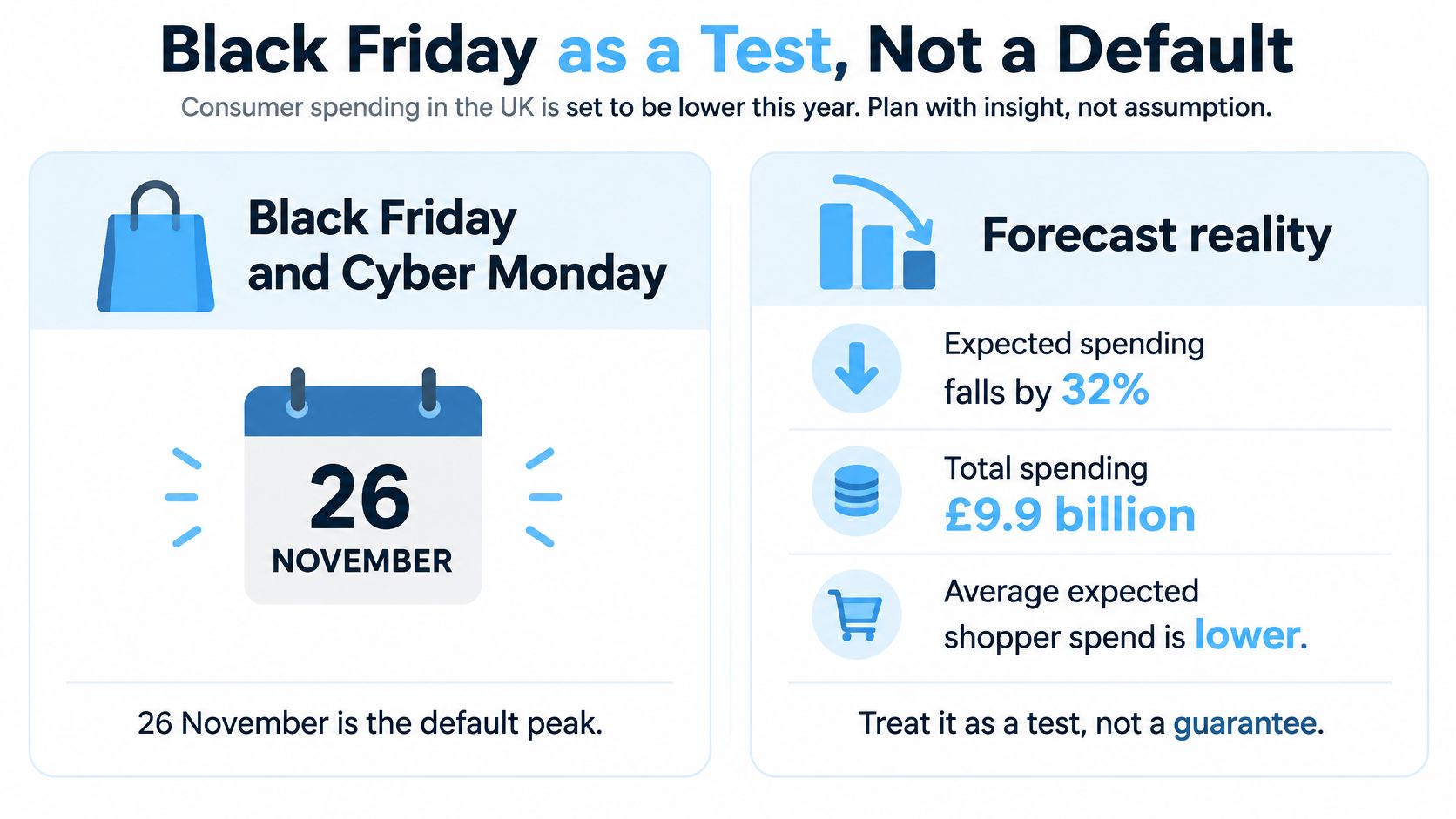
Black Friday is a budget decision, not a required peak. A UK forecast reported by Retail Gazette expected Black Friday and Cyber Monday spending to fall 32% to £9.9 billion, with average expected shopper spend declining from £390 to £267. Those forecasts support testing the opportunity, not assuming every retailer should increase spend.
Separate the money from the discount
Set one target for new-customer acquisition and another for profitability. Discount-led revenue can rise while margins fall. Compare the weekend with quieter periods using measures that show both sales quality and the cost of winning them.
| Metric | What it shows | What it can hide |
|---|---|---|
| Contribution margin | Profit left after product and fulfilment costs | Revenue growth that masks thin margin |
| Impression share | How much of the eligible search demand the account won | Budget caps that held share back on peak days |
| Conversion rate | Whether discount traffic actually buys | Shoppers who convert once and never return |
| Incremental profit | Profit the promotion added beyond normal sales | Sales that would have happened without the promotion |
Before raising exposure, check stock depth, delivery cut-offs, returns capacity, feed readiness and landing-page speed. If any of these cannot support the promotion, extra traffic may cost more than it returns. Use the Black Friday Google Ads checklist to review campaign readiness before changing bids.
Prime Day planning should follow Amazon's announcement. Prepare campaign structures and creative variants in advance, but publish date-specific claims only once the UK schedule is confirmed. Cyber Monday on 29 November needs its own margin check. Treat it as a separate decision, not an automatic extension of the same offer.
Treat the weekend as one testable event. If incremental profit loses to a quieter week, move the budget.
Work Back From Each Date and Lock Budgets
A date on the calendar does not earn a budget by itself. Work backwards from the customer's buying window, then set the preparation time and spend according to the account's stock, margins and regional demand. The sequence below uses Black Friday as a planning example; apply the same steps to other dates that matter to your customers.
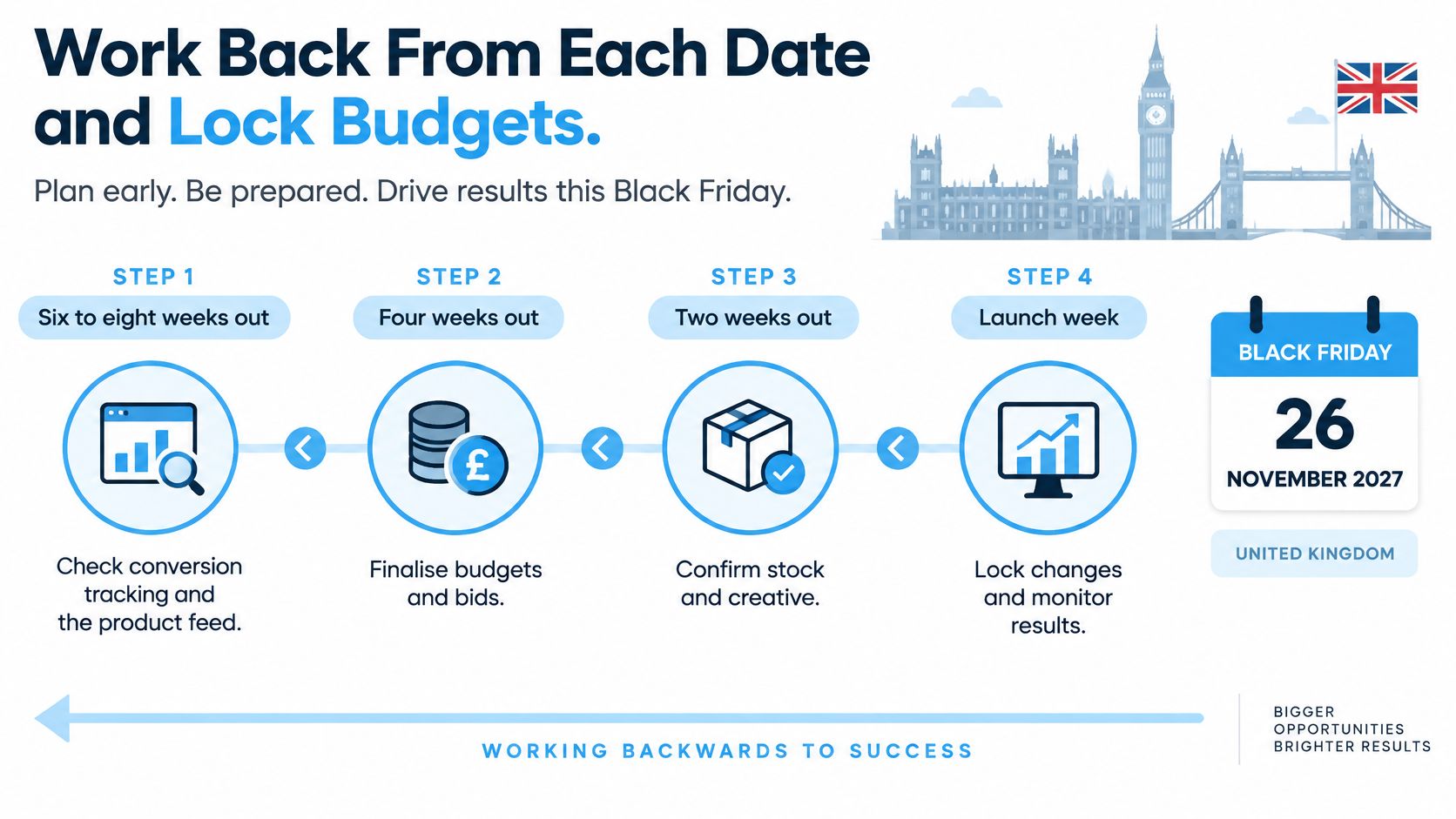
- Six to eight weeks ahead, check conversion tracking and the product feed. A price or availability mismatch can send paid traffic to an offer that is no longer valid. Fix feed issues before promotion activity increases.
- Set the budget and guardrails. Agree the target CPA or ROAS, contribution-margin floor, stock threshold and stop-loss rule. These limits help distinguish a sales lift from conversions that cost more than they return.
- Prepare ads, promotion assets and landing pages. Keep prospecting separate from high-intent promotional activity so changes to the offer do not disrupt prospecting performance.
- Allow two to three weeks for campaigns to run before the main date. This gives the account time to collect signals and lets you address weak ads or landing-page issues before the busiest period.
- After the event, review incremental profit and reallocate spend. Check that campaigns stop when promoted products sell out, then use the results to decide whether the next seasonal window merits a similar budget.
Lock the year, then test one window
An Advanced Television report on UK advertising spend forecasts that the market could reach £52.6 billion in 2027, with 5.6% growth and search accounting for 38.3% of investment. Treat that as market context, not an account target. Build scenarios from your own conversion rate, average order value, gross margin and inventory instead.
Reserve Q4 budget by the end of Q2, then use July to September to test creative, audiences and promotion economics. Compare monthly performance with official retail sales releases for Great Britain before increasing spend. For B2B, review the April tax-year budget window separately: an annual budget reset can make it a stronger planning opportunity than a consumer awareness date, but only if buyers are actively evaluating suppliers.
PPC Geeks guides clients step by step through a bespoke plan that accounts for several customer touchpoints. Use this guide to setting a 2027 Google Ads budget to structure the budget discussion, then check whether Scottish or Northern Irish dates change the relevant buying window.
Start this week by comparing performance from last Easter and the previous November. Identify which window paid back, then check tracking, budgets and seasonal structure with a Google Ads audit and strategy review. PPC Geeks also offers free audits for Google Ads, ecommerce ads, Shopping feeds and major social and marketplace accounts.
PPC Geeks builds paid search and Shopping plans around customer buying dates, with tracking, feeds and budgets set before peak periods. If your 2027 calendar is still a list of awareness days, review which dates justify paid activity with PPC Geeks.