




For D2C brands, pay-per-click (PPC) advertising is your direct line to the customer. It’s a strategy where you use ads on platforms like Google or Facebook to bring people straight to your website, cutting out the traditional retail middleman. This gives you complete control over your brand’s story, the customer journey, and—crucially—all that valuable first-party data.
Building Your D2C PPC Advertising Foundation
So, why can’t a direct-to-consumer brand just borrow the PPC playbook from a giant like John Lewis or Tesco? The short answer is: you’re playing a completely different sport. The big retailers are coasting on decades of brand recognition and high-street foot traffic. As a D2C brand, you’re building everything from the ground up – the brand, the audience, and the trust.
Think of it like this: a major retailer’s advertising is a massive, brightly lit sign on a busy motorway, catching the eye of people who are already driving past. Your D2C PPC advertising is more like creating a destination boutique in a cool, up-and-coming part of town. You have to give people a seriously compelling reason to find you, visit, and buy directly. Your strategy needs its own unique blueprint, not some generic, off-the-shelf template.
Start with Clear Business Objectives
Before you even think about spending a single penny on ads, you need to know what winning looks like. Your goals will shape every single decision you make, from which channels you choose to how you slice up your budget. Are you chasing explosive growth and grabbing market share, or is slow, steady, and sustainable profit the name of the game?
There’s no single correct answer, but you absolutely have to be clear. Some common D2C objectives include:
- Rapid Customer Acquisition: Going all-in on getting as many new customers through the door as possible, even if that means a higher cost per acquisition (CPA) at the start. This is a classic move for venture-backed startups needing to show growth.
- Profitability and ROAS: Making sure every pound you spend on ads brings back a profitable return from day one. This is all about prioritising a strong Return on Ad Spend (ROAS).
- Brand Awareness: Using PPC to get your name out there. Success here is measured less by immediate sales and more by things like impressions, reach, and a growing number of people searching for your brand by name.
- Lead Generation: If you sell high-ticket items or subscription services, your goal might be to capture email addresses or get people to sign up for a free trial.
Think of your main business goal as the North Star for your entire D2C PPC strategy. An aggressive growth target demands a very different budget and attitude to risk than a goal built around maximising profit margins on every single sale.
Pinpoint Your Ideal Customer (D2C PPC Advertising)
The biggest weapon in the D2C arsenal is the direct line you have to your customers. There’s no retailer standing in the way, so you can gather priceless information on who’s buying from you, what they care about, and how they shop. It all starts with painting a detailed picture of your ideal customer.
This goes way beyond basic demographics like age and location. You need to get into their heads and understand their psychographics—their hobbies, their biggest problems, their values, and where they hang out online. For a proper deep dive on this, our guide explains how to create buyer personas that will become the absolute bedrock of your ad targeting.
Analyse Your Competitors
Finally, a solid foundation requires a good look at the battlefield. You need to know exactly who you’re up against in the ad auctions. Is it other nimble D2C brands, established giants, or a mix of both?
Use tools to snoop on their ad copy, their landing pages, and the offers they’re running. The goal here isn’t to copy them; it’s to spot the gaps. What aren’t they talking about? Which customer frustrations are they completely ignoring? This kind of analysis is how you carve out your own unique space and craft a message that makes your brand the obvious choice.
D2C PPC Advertising: Choosing the Right PPC Channels for Your Brand
Navigating the world of D2C PPC advertising can feel like trying to pick a single restaurant in a massive food market. With so many options shouting for your attention, where do you spend your budget for the best results? The key is to stop thinking about platforms and start thinking about purpose. Let’s frame this not as a list of channels, but as a “jobs-to-be-done” approach to match the right platform to your specific business goal.
This simplifies things massively. Each platform has a core strength, a specific job it does better than any other. Your task is to align that strength with what your D2C brand needs to achieve right now, whether that’s driving immediate sales or building your brand for the long haul.
Demand Capture vs. Demand Generation
At the heart of it all, there are two main “jobs” in PPC: capturing existing demand and generating new demand.
Think of demand capture as being a fisherman with a net in a well-stocked river. You’re simply catching customers who are already out there, actively looking for a product like yours. On the other hand, demand generation is like creating a popular new fishing spot from scratch, attracting people who didn’t even know they wanted to fish in the first place.
- Demand Capture Channels: These platforms are all about intent. They connect you with users who are actively searching for a solution. The big players here are Google Ads and Microsoft Advertising.
- Demand Generation Channels: These are discovery platforms. They put your brand in front of curated audiences who fit your ideal customer profile but aren’t necessarily looking to buy right now. Meta (Facebook & Instagram) is the undisputed champion here.
To help you visualise this, think about whether your main goal is rapid growth or immediate profitability. This simple decision tree shows how your primary objective can guide your initial channel focus.
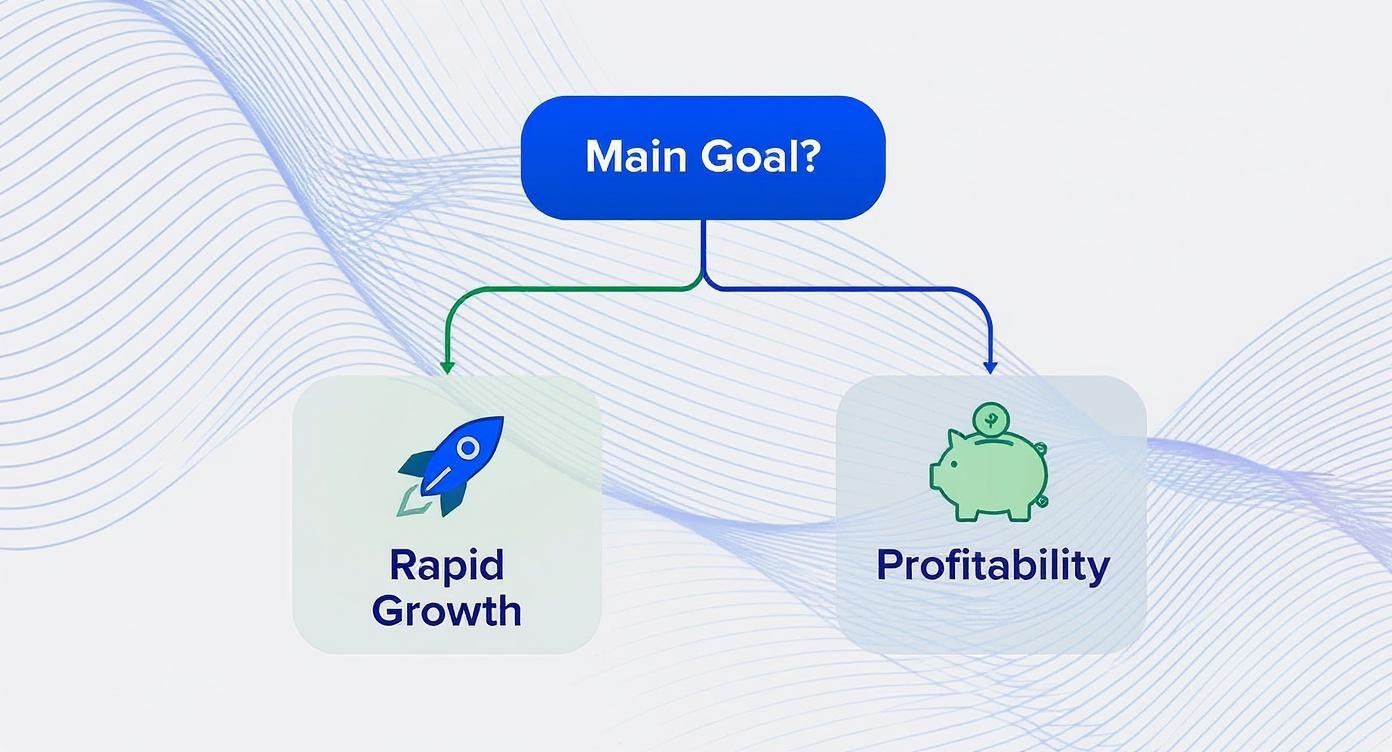
As the infographic shows, a push for rapid growth often needs a blend of channels to both create and capture demand. In contrast, a focus on profitability typically starts by capturing those high-intent searches first.
The Core D2C PPC Channels Explained
Here’s a quick overview of the main channels, designed to give you a strategic snapshot of where each platform shines for UK D2C brands.
PPC Channel Comparison for UK D2C Brands
| Channel | Primary Use Case | Typical Audience | Key D2C Strength |
|---|---|---|---|
| Google Ads | Capturing active search intent | Users actively seeking products/solutions | High conversion rates from bottom-of-funnel traffic. |
| Meta (Facebook & Instagram) | Generating new demand and brand awareness | Users browsing based on interests/demographics | Powerful audience building and visual storytelling. |
| Amazon Ads | Driving sales on the Amazon marketplace | Shoppers with very high purchase intent | Capturing sales directly at the point of purchase. |
| Microsoft Advertising | Capturing search intent on a different network | Often an older, more affluent demographic | Lower CPCs and less competition than Google. |
Now, let’s unpack what makes each of these channels tick for a D2C brand.
Google Ads: The Intent Engine (D2C PPC Advertising)
Google is the undisputed king of demand capture. Period. When someone needs a “natural dog food subscription” or an “eco-friendly yoga mat,” their first stop is almost always a Google search. For D2C brands in the UK, Google Ads isn’t optional; it’s essential. Being there means you catch potential customers at the absolute peak of their buying intent.
Meta (Facebook & Instagram): The Discovery Powerhouse
If Google is for finding, Meta is for discovering. Nobody logs onto Instagram actively searching for a new moisturiser, but they are incredibly receptive to finding one through a compelling video ad that pops up in their feed. Meta’s powerful targeting lets you build audiences based on interests, behaviours, and demographics, making it the perfect tool for generating new demand and telling your brand’s story. For a deeper dive, our guide breaks down the nuances of Google Ads vs Facebook Ads.
Amazon Ads: The Retail Giant (D2C PPC Advertising)
If you sell your products on Amazon as well as your own site, running Amazon Ads is an absolute no-brainer. Users on Amazon have the highest purchase intent of any platform—they are logged in, their payment details are saved, and they are there for one reason: to shop. It’s a fiercely competitive space, but it’s a must for any D2C brand using Amazon as a sales channel.
Microsoft Advertising: The Overlooked Opportunity
Often dismissed as a smaller version of Google, Microsoft Advertising (formerly Bing Ads) is a seriously valuable and frequently overlooked channel. It often delivers a lower cost-per-click (CPC) and faces much less competition. The audience also tends to be slightly older and more affluent, which can be a perfect match for certain D2C brands looking for a hidden advantage.
A winning D2C PPC advertising strategy rarely relies on a single channel. The real magic happens when you use these platforms together—using Meta to introduce your brand, and then using Google Remarketing to close the sale with a search ad when they’re finally ready to buy.
D2C PPC Advertising: How to Structure High-Performing PPC Campaigns
A disorganised PPC account is like a messy stockroom. You know the stuff you need is in there somewhere, but finding it is a nightmare, and you’re losing time and money in the process. A solid, well-thought-out campaign structure is the absolute foundation of good D2C PPC. It gives you control, clarity, and the room to grow without everything falling apart.
Think of your account like a library. The whole building is your Account. Each major section, like ‘Fiction’ or ‘Non-Fiction’, is a Campaign. Within those sections, the shelves organise books by genre – Sci-Fi, History, and so on. These are your Ad Groups. And on each shelf, the individual books are your Ads. This simple hierarchy brings order to the potential chaos.
This isn’t just about being tidy for the sake of it. This logical separation is what allows you to manage budgets at the campaign level while fine-tuning your ad copy and keywords within each ad group. It’s essential for making your campaigns profitable.
Structuring Your Google Ads Campaigns
When it comes to Google Ads, the game is all about isolating variables. You want to create separate campaigns for different networks, targeting methods, and even different stages of the customer journey. The biggest mistake we see is people throwing everything into one pot, which just muddies the data and makes controlling your budget impossible.
Here’s a tried-and-tested structure for D2C brands that just works:
- Brand vs. Non-Brand Search: This one’s non-negotiable. You need one campaign that bids only on your brand name (e.g., “PPC Geeks”) and another for generic, discovery terms (e.g., “ppc agency london“). Your brand campaign mops up cheap, high-intent traffic, while your non-brand campaign is your engine for finding new customers.
- Separate Shopping Campaigns: Always, always run Shopping campaigns separately from your Search campaigns. They’re different beasts and need completely different optimisation strategies. You can take this even further by segmenting Shopping campaigns by product category, brand, or even creating a “top performers” campaign to really push your bestsellers.
- Dynamic Search Ads (DSA): Think of a DSA campaign as your safety net. It’s brilliant for hoovering up traffic from obscure, long-tail searches you’d never think of targeting. Google uses its index of your website to generate the ads automatically, acting as a valuable catch-all.
Of course, a huge part of this is getting your head around the different keyword match types. Using them correctly is what stops you from haemorrhaging cash on irrelevant clicks.
Organising Your Meta Ads for the Full Funnel
While Google Ads is all about capturing existing intent, Meta (Facebook and Instagram) is about creating it. You’re building an audience and guiding them gently towards a purchase. Your campaign structure needs to reflect that customer journey, moving people logically from awareness right through to conversion.
A full-funnel structure on Meta ensures you’re not just shouting the same message at everyone. It means you can talk to a cold audience, who’ve never heard of you, in a completely different way than you would to someone who’s already been on your site. This relevance is what drives conversions up.
Your Meta structure should break down into three clear stages:
- Top of Funnel (Prospecting): This is for your cold audiences. These people have no idea who you are yet. The goal here is simple: brand awareness and getting that first click through to your website. You’ll be using interest-based targeting, lookalike audiences, and broad targeting here.
- Middle of Funnel (Retargeting): Now you’re talking to a warm audience – people who’ve shown some interest but haven’t bought. They might have visited your website, engaged with your social posts, or watched one of your videos. Your job is to bring them back and give them a reason to buy.
- Bottom of Funnel (Retention): This campaign is all about your existing customers. The goal is to drive repeat purchases, upsell them to new products, and build that all-important loyalty. Honestly, this is often the most profitable part of your entire D2C advertising effort.
By segmenting your campaigns like this across both platforms, you build a robust and scalable machine. This organisation gives you the clarity you need to make smart, data-driven decisions that will properly fuel your D2C brand’s growth.
D2C PPC Advertising: Optimising Your Ad Creatives and Product Feeds
If a logical campaign structure is the engine of your D2C advertising, then your ad creatives and product feeds are the fuel that makes it roar. Think of your ads as your digital shop window on a bustling high street. They have to be compelling enough to stop someone in their tracks, mid-scroll, and lure them inside.
This means you need to get good at two things: writing persuasive copy and mastering the science of a perfectly tuned product feed.
A brilliant framework for writing ad copy that genuinely connects is Problem-Agitate-Solution (PAS). It’s simple but incredibly effective. First, you state the customer’s problem. Then, you agitate it a bit by poking at the frustrations it causes. Finally, you ride in on a white horse with your product as the ultimate solution.
Take a D2C brand selling ergonomic office chairs. They wouldn’t just say, “Buy our comfy chair.” That’s boring. Using PAS, they’d do this:
- Problem: “Is working from home giving you a sore back?”
- Agitate: “That nagging ache makes it impossible to focus and ruins your evenings.”
- Solution: “Our ergonomic chair is designed to support your posture, so you can work pain-free and reclaim your day.”
See the difference? It hits a real pain point and offers a clear, desirable outcome.
Crafting Mobile-First Visuals That Convert
On platforms like Meta, your visuals are arguably even more important than your copy. In the UK, mobile isn’t just a channel; it’s the channel. We’re not talking about a small trend here – over half of all UK internet traffic now comes from mobile devices, and a similar chunk of ad clicks happen on phones.
Optimising for mobile isn’t just a good idea; it’s absolutely essential. This mobile-first reality calls for a specific approach:
- Design for the Vertical Screen: Most people will see your ads on their phones. Your images and videos need to be formatted for vertical viewing (9:16 aspect ratio) to command as much screen space as possible.
- Embrace User-Generated Content (UGC): Authentic photos and videos from real customers are pure marketing gold. They build trust and act as powerful social proof, often outperforming glossy, professional studio shots because they just feel more real.
- Use Bold Text Overlays: Always assume your video ads will be watched with the sound off. Use clear, punchy text overlays to get your message across instantly.
Your product feed is not just a spreadsheet; it’s the DNA of your Shopping campaigns. An unoptimised feed is like sending a salesperson to a meeting with incomplete notes—they’ll struggle to make the sale.
Supercharging Your Product Feed (D2C PPC Advertising)
When it comes to Google Shopping and Facebook Shops, your product feed is everything. It’s the data file that tells these platforms all the crucial details about what you’re selling. A well-optimised feed directly boosts your ad visibility, relevance, and ultimately, your click-through rate (CTR).
To get started, zero in on these key areas:
- Product Titles: This is the most important element, hands down. Don’t just slap the product name in there. Structure your titles with the key attributes people search for, like Brand + Product Type + Colour + Size. “Nike Air Max Trainers Blue Size 9” is infinitely better than just “Air Max”.
- High-Quality Images: Use crisp, high-resolution images with a clean, uncluttered background. Make sure to include lifestyle shots showing the product in use – these help customers imagine themselves using it.
- Detailed Descriptions: This is your chance to elaborate on features, benefits, and materials. Weave in relevant keywords naturally to help Google match your product to the right search queries.
Optimising your feed can feel a bit technical, but trust me, it’s one of the highest-impact things you can do in D2C PPC. For a full breakdown, our guide offers step-by-step advice on mastering your Google Shopping product feed. Getting this right ensures your digital shop window shows off your products in the best possible light.
D2C PPC Advertising: Managing Your Budgets and Bidding Strategy
Let’s talk numbers. This is where your grand D2C strategy meets the real world, and honestly, it’s what separates the brands that scale from those that fizzle out. Setting a budget isn’t just about plucking a number from thin air; it’s a strategic decision rooted in one simple question: what is a new customer actually worth to your business?
To figure that out, we need to get comfortable with two crucial metrics: Customer Acquisition Cost (CAC) and Lifetime Value (LTV). Think of CAC as everything you spend to get a single new customer through the door. On the flip side, LTV is the total amount of money you expect to make from that customer over their entire relationship with you.
A healthy D2C business is built on a simple, non-negotiable rule: your LTV must be significantly higher than your CAC. If you spend £30 to acquire a customer (your CAC) who then spends £150 with you over the next couple of years (your LTV), you’ve got a profitable growth engine on your hands. This ratio is your north star for setting a budget that makes sense and allows you to grow.
Choosing Your Bidding Strategy
Once you’ve got a budget, you need to tell the ad platforms how to spend it. This is where bidding strategies come into play, and they really boil down to two main camps: manual or automated. There’s no single “best” option here; the right choice really depends on your campaign’s goals and how much data you have.
Manual Bidding puts you firmly in the driver’s seat. With Manual CPC (Cost-Per-Click), you set the absolute maximum you’re willing to pay for any single click. It’s a fantastic approach when you’re just starting out. You can dip your toes in the water, gather some initial data, and get a feel for the auction without letting an algorithm run wild with your cash.
Automated Bidding hands the reins over to machine learning to chase your specific goals. As your campaigns start racking up conversion data, these strategies become incredibly powerful.
For D2C brands, these are the automated strategies you’ll use most often:
- Maximise Conversions: This tells the platform to get as many sales as possible within your daily budget. It’s brilliant for driving sheer volume but doesn’t care much about the value of each sale.
- Target CPA (Cost Per Acquisition): You set a specific cost you’re happy to pay for a sale, and the algorithm does its best to hit that average. This is a solid choice if all your products have similar profit margins.
- Target ROAS (Return On Ad Spend): This is the go-to for most D2C ecommerce brands. You tell the platform you want a specific return for every pound spent (e.g., “for every £1 I spend, I want £4 back in revenue”). It directly connects your ad spend to profitability, making it a powerful tool for scaling.
If you really want to get under the bonnet of how Google’s machine learning works, our article on Google Ads smart bidding is a great place to start.
Setting Up Robust Conversion Tracking
Let me be blunt: you can’t manage what you don’t measure. Flawless conversion tracking isn’t just important; it’s the absolute, non-negotiable foundation of any successful D2C PPC campaign. Without it, you’re just gambling. You have no real way of knowing which campaigns, ads, or keywords are actually making you money.
Your tracking setup must have these pieces in place:
- Platform Pixels: Get the Google Ads tag and the Meta Pixel installed across every single page of your website. These little snippets of code are your eyes and ears, tracking what users do and feeding that vital information back to the ad platforms.
- Google Tag Manager (GTM): Think of GTM as your master toolkit. It lets you manage all your tracking tags (like the two above) from one central dashboard, so you don’t have to pester a developer every time you need to add or change something.
- Enhanced Conversions: In a world where privacy is tightening, Enhanced Conversions is your secret weapon. It securely sends hashed, first-party customer data (like email addresses) to the platforms. This helps fill in the tracking gaps created by privacy updates, giving you a much more accurate picture of what’s really working.
The proof is in the numbers. By 2025, the average conversion rate for Google Ads search campaigns in the UK hit a solid 6.69%. For D2C brands like yours, this shows that properly tracked PPC isn’t just about clicks—it’s about delivering real business results. In fact, simple retargeting alone can boost conversion rates by a whopping 19%. You can learn more about the latest PPC trends and their impact.
D2C PPC Advertising: Measuring the Metrics That Actually Matter
Jumping into your D2C advertising data can feel like trying to drink from a firehose. You’re hit with a wall of acronyms and numbers, but not all of them tell you the real story about your business’s health. The secret to good reporting isn’t about tracking everything; it’s about knowing what to watch and what to ignore.
Too many D2C brands get fixated on vanity metrics. These are the numbers like impressions and clicks that look great on a slide but don’t actually signal growth or, more importantly, profit. Sure, high impressions mean lots of people saw your ad, but that doesn’t mean they did anything that matters.
Your focus needs to shift to actionable Key Performance Indicators (KPIs) – the ones that are directly tied to your bottom line. These are the metrics that tell you if your ad spend is actually making you money and growing your customer base.
The KPIs That Drive D2C Growth
For any D2C brand, performance really boils down to a handful of core numbers. Get these on your dashboard and track them religiously in your weekly and monthly reports.
- Return on Ad Spend (ROAS): This is the ultimate measure of profitability. It’s brutally simple: how much revenue are you getting back for every pound you put in? A ROAS of 4:1 means that for every £1 spent, you made £4 back.
- Cost Per Acquisition (CPA): Sometimes called Cost Per Purchase, this is what it costs, on average, to win one new customer through your PPC campaigns. This number absolutely must be lower than your product’s profit margin to be sustainable.
- New Customer Rate: This metric shows what percentage of your sales are coming from brand-new customers versus your existing fans. It’s a vital sign of whether your campaigns are genuinely growing your business or just reselling to people who already love you.
Ultimately, your D2C PPC campaigns live and die by their ability to drive sales. And a massive part of that is figuring out how to improve conversion rates once people actually land on your site.
Understanding How Credit Is Given
Another huge piece of the puzzle is attribution. Imagine a customer sees your ad on Instagram, clicks a Google Shopping ad a week later, and finally buys after clicking a retargeting ad on Facebook. So, which ad gets the credit? This is exactly what attribution models help you figure out.
The default setting in most ad accounts is “last-click” attribution. This gives 100% of the credit to the very last touchpoint before the sale. It’s simple, but it’s often dead wrong because it completely ignores all the earlier interactions that introduced the customer to your brand and warmed them up.
For a much clearer picture, D2C brands should be looking at data-driven attribution. This smarter model uses machine learning to analyse the entire customer journey, assigning partial credit to each touchpoint along the way. It understands that the first Instagram ad played a role, just as the final retargeting ad did.
Adopting this mindset helps you tell a far more accurate story about your D2C advertising performance. You start to see how different channels work together, which stops you from mistakenly switching off a top-of-funnel campaign that’s actually feeding your entire sales pipeline. By focusing on ROAS, CPA, and a smarter attribution model, you can make decisions that lead to real, sustainable growth.
Got Questions About D2C PPC Advertising? We’ve Got Answers.
Diving into the world of D2C PPC can feel a bit like learning a new language. There are a lot of moving parts, and it’s natural to have questions, especially when you’re starting out. Here are some of the most common queries we get from UK brands, answered in plain English to help you get started with confidence.
How Much Should a New D2C Brand Budget for PPC?
There’s no magic number here, but a great way to land on a sensible starting figure is to work backwards from what you want to achieve.
First, figure out your target Cost Per Acquisition (CPA). This is all about your profit margins. For example, if you make £30 profit on every sale, then aiming for a CPA of £25 gives you a bit of breathing room.
Next, think about how many new customers you want to bring in each month. Let’s say your goal is 50 new customers. Just multiply that by your target CPA: 50 customers x £25 CPA = £1,250 per month. That’s your starting budget. We always recommend sticking with a test budget for at least three months – it gives you enough time to gather solid data before you decide to ramp things up.
Should I Start with Google Ads or Meta Ads?
This really boils down to your product and how people discover it.
If you’re selling something people are already looking for – think “organic cotton baby clothes” or “refillable cleaning products” – then you absolutely want to start with Google Ads. You’re basically putting your shop right in front of people who are actively trying to buy. It’s the fastest way to capture existing demand and often leads to quicker sales.
On the other hand, if your product is brand new, innovative, or just looks incredible on camera (like a unique piece of smart home tech), you’re better off starting with Meta Ads (that’s Facebook and Instagram). Here, you’re not capturing demand, you’re creating it. It’s perfect for building awareness and getting people excited about something they didn’t even know they needed.
For most new D2C brands, the classic route is to begin with Google Ads to prove the business model with high-intent traffic. Once that’s ticking along nicely, expand to Meta to build your brand and really start to scale up.
Eventually, the goal is to have both running in harmony, creating a powerful marketing machine.
How Long Does It Take to See Results From PPC?
You’ll see data like clicks and traffic rolling in almost immediately, sometimes within hours of launching a campaign. But getting meaningful results—like a stable and profitable Return on Ad Spend (ROAS)—takes a bit more patience.
Expect an initial “learning phase” of 2-4 weeks. During this time, the ad platforms are crunching the numbers, figuring out who your best customers are and how to reach them efficiently. You need to be prepared to invest for at least three months to gather enough performance history to make smart, data-backed decisions.
Profitability might not happen overnight. The initial goal isn’t just to make sales; it’s to learn what works. Once you’ve cracked that code, you can confidently increase your spend and watch the real growth happen.
At PPC Geeks, we live and breathe this stuff. We specialise in building and managing high-performance PPC campaigns that drive real, measurable growth for D2C brands just like yours. If you’re ready to stop guessing and start getting results, let’s talk.
Get your free, in-depth PPC audit today. Visit us at https://ppcgeeks.co.uk/ to find out more.