




Lead Generation in UK Markets: Generating leads in the UK is a different beast altogether. What works wonders in the US often falls flat over here, and it usually comes down to different consumer attitudes and regulations. The secret isn’t a hard sell; it’s about building trust with value-first content and genuine relationships. A nuanced, UK-specific approach isn’t just a nice-to-have—it’s absolutely essential for any kind of sustainable growth.
Understanding the UK Lead Generation Landscape
Too many businesses make the mistake of applying a generic, one-size-fits-all template to their lead generation, then wonder why their messages are being ignored. The British market has its own personality, defined by cultural quirks, specific communication styles, and a healthy dose of scepticism towards anything that looks too much like a sales pitch. Getting your head around this is the first real step towards building a strategy that actually gets results.
An aggressive, in-your-face approach that might be common elsewhere can feel incredibly jarring to a UK audience. People here generally prefer a more understated and informative style. They want to see the proof, understand the value, and feel like they’re making a smart decision, not being strong-armed into one.
Lead Generation in UK Markets: The GDPR Factor
You can’t talk about UK marketing without mentioning GDPR. The General Data Protection Regulation has completely reshaped how businesses collect data and communicate with customers. It’s not just a list of rules; it has genuinely empowered consumers, making them far more aware and protective of their personal information.
This means transparency is non-negotiable. To generate leads effectively in the UK, you have to be crystal clear about a few things:
- What data you are collecting and exactly why you need it.
- How you plan to use their information in any future contact.
- Providing a simple, no-fuss way to opt-out whenever they want.
Get this wrong, and you’re not just risking a fine; you’re destroying the very trust you’re trying to build. A potential lead who feels their data is being played with will be gone in a flash.
The biggest shift is from “selling” to “helping.” British consumers and businesses respond to genuine expertise and authenticity. Your goal should be to become a trusted advisor through your content and interactions. The sale then becomes the natural outcome of a strong relationship, not the aggressive start of one.
Communication and Cultural Nuances
How you say something is just as important as what you’re saying. The tone of voice, the language you use, and even the type of humour can make or break a campaign. For example, littering your copy with Americanisms or corporate jargon is a quick way to alienate a UK audience. The preference is almost always for straightforward, polite, and professional language that gets to the point without all the hype.
This is where so many automated, cookie-cutter strategies fall short. Writing PPC ads and landing page copy that truly connects requires a deep understanding of these subtle differences. It’s why working with a dedicated team can make such a difference; a PPC agency focused on lead generation will know precisely how to tailor every single element to resonate with a local audience. By focusing on building that rapport and showing your value, you lay the groundwork for a lead generation engine that is not only effective but built to last.
Building Your Organic Engine with UK-Focused SEO
Lead Generation in UK Markets: While paid campaigns are brilliant for getting quick results, a solid organic strategy is the real bedrock of sustainable lead generation here in the UK. Search Engine Optimisation (SEO) isn’t just about climbing the rankings; it’s about building a long-term business asset. An asset that consistently pulls in high-intent prospects who are actively looking for exactly what you do.
It’s the crucial difference between interrupting potential customers and being the answer they were searching for all along.
Forget the generic keyword lists and US-centric advice that floods the internet. To do SEO properly for a British audience, you need a localised approach from the very beginning. This means getting to grips with the unique language, regional quirks, and search habits that define the UK market.

Uncovering UK-Specific Keywords
The starting point for any successful SEO campaign is nailing down the exact phrases your audience uses. In the UK, this means digging deeper than standard industry terms and getting familiar with local vernacular.
For example, a law firm needs to be found for “solicitors in Manchester,” not just “lawyers in Manchester.” An online clothing shop selling jumpers has to optimise for that term, not the American “sweaters.” These small linguistic shifts make a massive difference in connecting with the right people.
To build a keyword list that actually works, think about:
- Regional Terminology: Things like “lorry” vs. “truck” or “flats” vs. “apartments.” It all adds up.
- Local Intent Modifiers: Keywords appended with phrases like “near me,” “in London,” or “best [product] UK” are goldmines, signalling strong local buying intent.
- Problem-Based Queries: UK businesses are often searching for solutions to specific problems. Think “how to comply with UK payroll regulations” or “GDPR advice for small businesses.”
Lead Generation in UK Markets: Creating Content That Actually Converts UK Leads
Once you know what people are searching for, you need to create content that gives them real value. This is where so many businesses fall flat, churning out generic blog posts that just don’t hit the mark. Your content absolutely must address the specific pain points and priorities of a British audience.
This focus on quality content is vital. Research shows that lead generation is a top priority for roughly 50% of UK marketers, and about 76% use content marketing specifically to hit that goal. With the average cost per lead creeping up to $198, creating effective, targeted content isn’t just a nice-to-have—it’s a financial necessity.
A strong content plan for UK lead generation should include:
- Practical Blog Posts: Write articles that solve real-world problems. A UK-based accounting firm could smash it with a post on “Navigating HMRC Self-Assessment for Freelancers.”
- Detailed Case Studies: Show, don’t just tell. Showcase how you’ve helped other UK businesses succeed. This builds huge trust and social proof.
- Location-Specific Landing Pages: If you serve multiple areas, create dedicated pages for each one (e.g., “PPC Services Bristol,” “IT Support Glasgow”).
Your content’s primary job is to build authority and trust. By consistently publishing helpful, UK-focused information, you become the go-to resource in your industry. Leads will naturally follow when prospects see you as an expert who understands their specific challenges.
Mastering Local and Technical SEO
Lead Generation in UK Markets: Beyond the right words and great content, your website’s technical health is absolutely critical. UK users have high expectations for how a site performs; a slow-loading or confusing website will send potential leads running straight to your competitors.
First, make sure your technical SEO is flawless. This means fast page speeds, being mobile-friendly, and having a clean site structure that search engines can easily crawl and understand.
And for any business with a physical presence or a defined service area, local SEO is completely non-negotiable. This involves:
- Google Business Profile: Get your profile fully optimised with accurate information, glowing reviews, and UK-specific business categories.
- Local Citations: Make sure your business name, address, and phone number (NAP) are perfectly consistent across all relevant UK directories.
- Schema Markup: Use local business schema to give search engines clear, structured information about your location and what you offer.
Combining a deep understanding of UK search behaviour with high-quality content and a technically sound website creates a powerful inbound lead machine. While SEO definitely requires patience, the payoff is a steady stream of qualified, relevant leads for years to come. For those looking to turbocharge this organic growth, exploring a dedicated PPC strategy for lead generation can deliver more immediate results to complement your long-term efforts.
Need Leads Now? Time for a Paid UK Ad Campaign
Organic growth is a marathon, not a sprint. While good SEO builds a fantastic long-term asset, sometimes you just need the phone to ring right now. This is where a sharp, well-executed paid advertising strategy becomes your best friend for immediate lead generation in the UK.
Paid campaigns on platforms like Google Ads and key social media channels put you squarely in the driver’s seat. You get to decide exactly who sees your ads, switch them on and off with a click, and see real, measurable results almost instantly. It’s all about turning your ad spend into a predictable, scalable stream of qualified enquiries.

Lead Generation in UK Markets: Getting Google Ads Right for the UK Market
When it comes to paid lead generation, Google Ads is still the undisputed heavyweight champion. Think about it: when someone in the UK has a problem they need solving, their first stop is almost always a Google search. Your job is to make sure your business is the solution they find staring back at them from the top of the page.
But just throwing money at a bunch of keywords and hoping for the best is a recipe for disaster. The real magic is in the details – from the language you use in your ads to the specific postcodes you target.
A classic mistake we see all the time is using generic, Americanised ad copy. A phrase like “Get your free quote today!” might fly elsewhere, but a slightly more reserved tone often connects better in the UK. Try testing copy like, “Request a no-obligation quote” or “Arrange your complimentary consultation.” It’s a subtle shift, but it can make a world of difference because it aligns with British communication styles.
Fine-Tuning Your Targeting
Geo-targeting is another area where you can get a massive edge over lazy competitors. Don’t just set your campaign to “United Kingdom” and call it a day. You have to get more granular.
- Regional Focus: If you’re a service business in the North West, why waste money on clicks from London? Target specific counties like Greater Manchester, Merseyside, and Cheshire, and actively exclude areas you don’t serve.
- Postcode Targeting: For hyper-local businesses like a plumbing firm, you can drill right down to specific postcode areas. This ensures you only reach customers who are actually within your call-out radius.
- Income Demographics: Selling luxury goods or high-value services? You can use Google’s demographic targeting to focus on higher-income postcodes, making sure your ads are seen by people with the right purchasing power.
Beyond geography, always think about the device. A user frantically searching for “emergency roof repair” is almost certainly on their mobile. Your ad and, crucially, your landing page need to be built for that experience, with a big, obvious click-to-call button.
The best paid campaigns don’t feel like ads at all. They feel like the perfect answer, appearing at the exact moment someone needs it. You achieve this through a deep understanding of UK search intent, precise targeting, and copy that speaks a local language.
Winning on Social Media
While Google is brilliant for capturing people who are actively searching, social media platforms let you find potential customers before they even realise they need you. For UK lead generation, success means picking the right platform where your ideal audience actually spends their time.
LinkedIn for B2B Excellence
If you’re a B2B business, LinkedIn is non-negotiable. Its targeting is second to none, letting you reach specific decision-makers based on:
- Job Title (e.g., “Operations Director”)
- Industry (e.g., “Logistics and Supply Chain”)
- Company Size (e.g., “51-200 employees”)
- Specific UK-based companies
A campaign promoting a whitepaper on “Improving Warehouse Efficiency for UK Manufacturers” targeted directly at Operations Directors is a classic, high-impact B2B lead generation play.
Facebook and Instagram for B2C Success
For B2C brands, Facebook and Instagram offer enormous audiences and incredibly powerful interest-based targeting. A home renovation company, for example, could target users in specific regions who’ve shown an interest in pages like “Grand Designs” or “Ideal Home.” Using eye-catching ads with stunning images of your finished projects is absolutely vital here.
The Make-or-Break Landing Page
Here’s a hard truth: driving traffic is only half the battle. The single biggest point of failure in most paid campaigns is a poor landing page. You can craft the world’s greatest ad, but if it sends people to a slow, confusing homepage, you’ve just thrown your money down the drain.
A high-converting UK landing page absolutely must be:
- Laser-Focused: It has to match the ad’s promise perfectly. If your ad talks about a “guide to loft conversions,” the page better be about loft conversions, not your general building services.
- Trust-Building: Load it with UK-specific trust signals. Think testimonials from British clients, logos of UK companies you work with, or memberships to UK trade bodies.
- Frictionless: Keep the contact form simple. Only ask for the absolute essentials – name, email, and phone number is often all you need. Every extra field you add will lower your conversion rate.
Lead Generation in UK Markets: Ultimately, paid campaigns give you speed and control that other channels can’t match. By combining the intent-driven power of Google Ads with the proactive audience targeting of social media—and funnelling that traffic to a perfectly tuned landing page—you can build a powerful engine for immediate lead generation in UK markets.
To take your strategy even further, especially with Google’s newer, more automated tools, it’s well worth looking into how to manage Google Ads Performance Max campaigns. This can be an incredibly efficient way to reach customers across all of Google’s channels.
Using LinkedIn to Find High-Value B2B Leads
If you’re in B2B and serious about generating leads in the UK, LinkedIn isn’t just another social platform—it’s the main event. Think of it as the country’s biggest business conference, running 24/7. But just showing up isn’t enough; you need a solid game plan to turn those digital handshakes into real commercial opportunities.
The platform has become an absolute goldmine for B2B marketers. In fact, over half (53%) of them in the UK are on LinkedIn actively looking for prospects. Better yet, its native Lead Gen Forms convert at an average rate of 13%. That’s more than five times higher than your typical website landing page. The potential is massive if you know what you’re doing. You can dig into plenty of detailed industry reports that back this up.
Optimise Your Digital Handshake
Before you even think about sending a single message, get your house in order. Your personal and company profiles need to be flawless. For UK decision-makers, an incomplete or sloppy profile is an instant red flag that screams unprofessional.
Start with the basics. Get a professional headshot and write a headline that clearly states the value you bring, not just your job title. Instead of “Sales Manager,” try something like, “Helping UK Logistics Firms Reduce Overheads with SaaS Solutions.” See the difference? You’ve immediately positioned yourself as a problem-solver.
Your ‘About’ section should tell a compelling story. Weave in specific outcomes and hard numbers you’ve achieved for other British businesses. This is how you build instant trust and relevance.
So many people make the mistake of treating LinkedIn like a CV. It’s not. It’s a dynamic sales and marketing tool. Your entire profile should be written for your ideal customer, hitting on their pain points and showing them how you’re the one who can help.
Master Sales Navigator for Precision Targeting
Just using LinkedIn’s standard search bar is like trying to fish in the North Sea with a single line and hoping for the best. To get serious, you need the right gear, and for B2B prospecting, that tool is LinkedIn Sales Navigator.
Sales Navigator lets you get incredibly specific with your targeting in a way the free version just can’t match. You can build meticulously curated lead lists based on criteria that really matter for UK businesses, such as:
- Geography: Zero in on prospects by postcode, city, or region to focus your efforts exactly where you want them.
- Company Headcount: Filter for SMEs or larger enterprises that perfectly match your ideal customer profile.
- Keywords in Profile: Find people who mention specific skills, software, or technologies relevant to what you’re selling.
This is where you move from guesswork to a data-driven strategy.
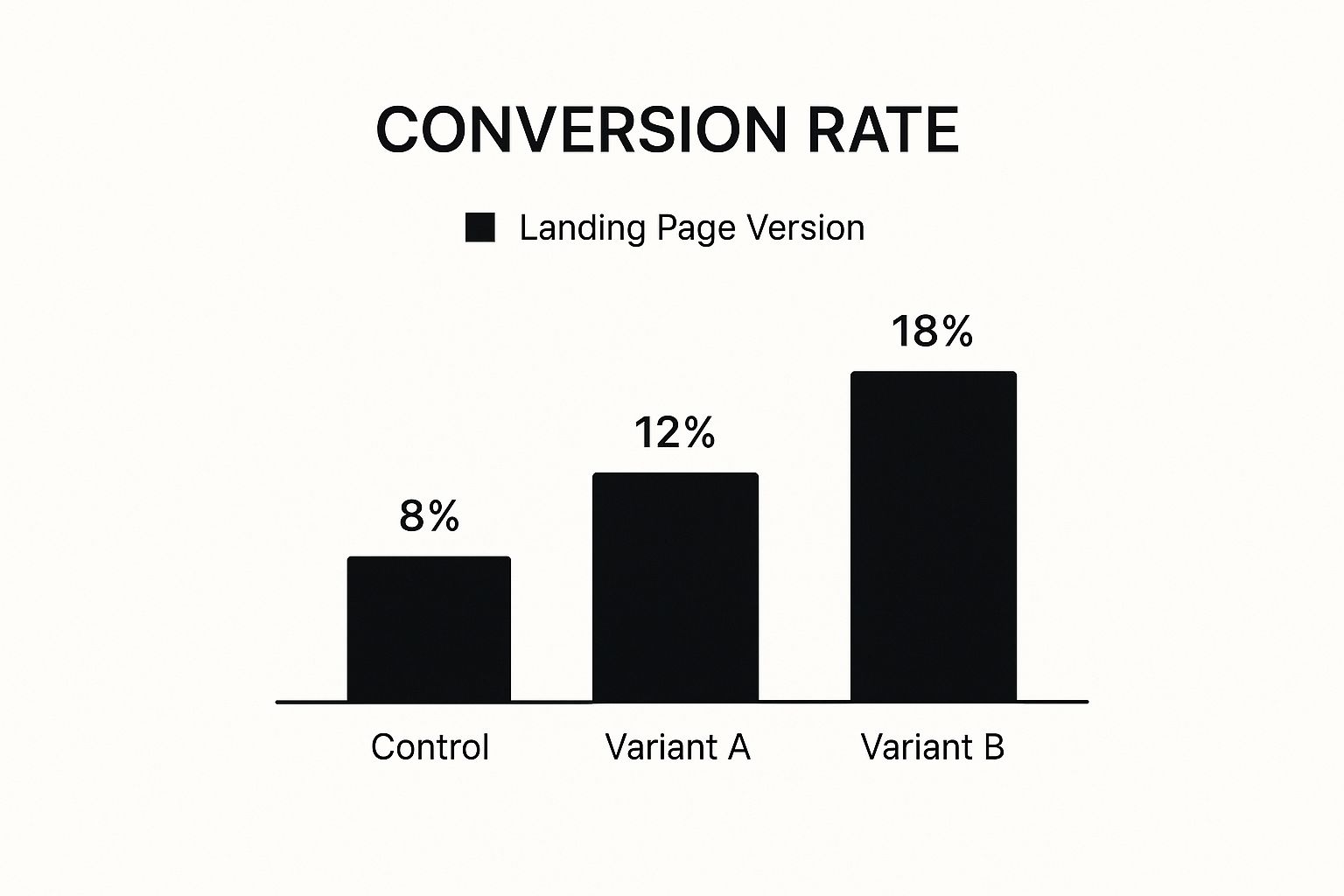
As you can see, a little bit of optimisation makes a huge difference. You can’t just throw up a generic page and expect results.
Speaking of optimisation, LinkedIn’s native forms are often a much smarter choice than sending traffic off-platform. They pre-fill a user’s information, making the whole process seamless and dramatically boosting conversion rates.
LinkedIn Lead Gen Forms vs. Traditional Landing Pages
Here’s a quick breakdown of why staying on LinkedIn is often the smarter move for capturing B2B leads in the UK.
| Feature | LinkedIn Lead Gen Forms | Traditional Landing Pages |
|---|---|---|
| User Experience | Seamless. Forms are pre-filled with the user’s profile data. | Clunky. Requires manual data entry, often on a mobile device. |
| Conversion Rate | Significantly higher (average 13%). | Much lower (typically 2-3%). |
| Friction | Minimal. A couple of clicks and it’s done without leaving the app. | High. Users leave LinkedIn, wait for a page to load, and type. |
| Mobile Friendliness | Natively optimised for all devices. | Varies. Can be poorly optimised, leading to high drop-off rates. |
| Data Accuracy | High, as it pulls directly from verified professional profiles. | Prone to typos, fake emails, and incomplete information. |
While landing pages have their place for more detailed content, for straightforward lead capture, the path of least resistance offered by Lead Gen Forms is almost always going to win.
Adopt a Value-First Outreach Approach
Right, you’ve found your prospects. Now for the outreach. This is where most people fall flat on their face. Sending a generic, copy-pasted sales pitch the second someone accepts your connection request is the quickest way to get ignored or deleted. UK professionals, in particular, are not fans of the hard sell.
Your goal here is to build a relationship, not just make a sale. A much better approach looks something like this:
- Personalise the Connection Request: Always add a note. It’s not optional. Reference a shared connection, a post they recently shared, or some news about their company. Show you’ve actually looked at their profile.
- Give, Don’t Take: Once they accept, do not pitch them. Instead, share something of value—a relevant article, an insightful case study, or even just a congratulations on a recent company milestone.
- Stay on Their Radar: For the next week or two, engage with their content. Like their posts and, more importantly, leave thoughtful comments. This keeps you visible in a non-intrusive way.
- Make the Ask: Only after you’ve built some rapport should you ask for a brief chat. And when you do, frame it around solving one of their problems, not just selling your product.
This patient, value-driven method respects British business culture and builds the trust you need to turn a cold connection into a warm lead. It takes more work, sure, but the quality of leads you’ll generate makes it one of the most effective strategies for lead generation in UK B2B markets.
Turning New Leads into Loyal Customers
Lead Generation in UK Markets: Getting a new lead is a great start, but let’s be honest, it’s just the first hurdle. The real magic happens in what comes next. This is where we get into the nuts and bolts of lead nurturing – the process of carefully guiding someone from a casual enquiry to a loyal, paying customer.
It’s all about closing the gap between that initial form submission and a signed-off deal. In the UK, this takes a bit of finesse. You need to respect the local business culture, which means building genuine relationships, not just applying sales pressure. Come on too strong, and all your hard work getting the lead could go up in smoke.

Crafting Your Nurturing Sequences
The moment someone downloads your guide or asks for a quote, your first interaction sets the stage. This is where automated email sequences are your best friend, but they have to be clever. They need to feel helpful and distinctly British in their tone – polite, packed with value, and absolutely never pushy.
A solid nurturing sequence for a UK audience should look something like this:
- Deliver Value Straight Away: The first email needs to give them what they asked for, and maybe throw in a little something extra they weren’t expecting. A bonus resource always goes down well.
- Educate, Don’t Pitch: Your follow-up emails should tackle common problems, show off relevant case studies, or share some useful industry insights.
- Bring in a Human Touch: After a couple of automated emails, it’s time to offer a quick, no-strings-attached chat with a real person. Frame it as a helping hand, not a sales call.
The aim here is to position your brand as the go-to expert. You’re not chasing them for a sale; you’re building a relationship built on trust.
Setting Up a Simple Lead Scoring System
Let’s face it, not all leads are created equal. Your sales team’s time is precious, so you want them focused on the prospects who are genuinely ready to talk business. This is where a basic lead scoring system can be a total game-changer.
You don’t need anything massively complicated. Just start by giving points based on who the lead is and what they’ve done on your site.
For example, you could assign points like this:
| Action or Attribute | Points Awarded | Why it Matters |
|---|---|---|
| Job Title (e.g., Director) | +15 | Shows they have decision-making power. |
| Company Size (Ideal Profile) | +10 | They fit your perfect customer profile. |
| Visited Pricing Page | +20 | A clear sign of commercial interest. |
| Downloaded a Case Study | +10 | They’re actively researching solutions like yours. |
| Opened 3+ Emails | +5 | Shows they’re consistently engaged. |
Once a lead hits a certain score – say, 50 points – they get flagged as a ‘sales-qualified lead’ (SQL). At that point, they’re automatically passed over to the sales team for a proper, personal follow-up. It’s a simple, data-led way to make sure your team is always speaking to the warmest prospects first.
Getting to Grips with the UK Sales Cycle
Patience isn’t just a virtue in the UK sales game; it’s a requirement. The journey from lead to sale is often a much longer, more considered affair than in other parts of the world. Building a solid rapport and showing your value over time will get you much further than trying to rush a decision.
The data backs this up. The average conversion rate from a lead to a genuine sales opportunity in the UK is around 13%, and that stage alone can take an average of 84 days to reach. From that point, only about 6% of those opportunities will turn into a sale, which takes another 18 days on average. You can dig into more of these B2B marketing statistics to help set realistic targets for your campaigns.
Before we dive into industry benchmarks, it’s worth noting that conversion rates can vary wildly. What’s considered “good” in the tech world might be completely different for a manufacturing firm.
Average B2B Lead Conversion Rates by UK Industry
This table shows the typical lead-to-sale conversion rates across various key sectors in the United Kingdom, helping businesses set realistic benchmarks.
| Industry Sector | Average Lead Conversion Rate (%) |
|---|---|
| Technology/SaaS | 1.5 – 3.0 |
| Financial Services | 2.0 – 4.5 |
| Professional Services (Legal, Acct.) | 3.0 – 5.0 |
| Manufacturing & Engineering | 1.0 – 2.5 |
| Healthcare & Pharmaceuticals | 1.2 – 3.5 |
| Construction & Real Estate | 2.5 – 5.5 |
These figures give you a solid starting point for what to expect in your own campaigns.
If there’s one thing to remember about the UK market, it’s that the sales process is a marathon, not a sprint. Trying to close a deal on the first call is almost always the wrong move. Focus on being a consistent, reliable, and valuable resource. The sale will come when the customer is ready, not when you are.
This longer buying cycle means your nurturing strategy needs to have legs. Keep providing value with insightful content, check in from time to time without being a pest, and be ready to jump when they finally signal they’re ready to talk properly. It’s this thoughtful, patient approach that really turns a fresh lead into a lasting customer.
Your Top UK Lead Generation Questions Answered
Trying to generate leads in the UK can feel like navigating a maze. You’re dealing with unique regulations, cultural quirks, and benchmarks that seem to change every other week. Even with a decent strategy, questions always come up when you start trying to grow.
Let’s cut through the noise and tackle some of the most common queries we hear from businesses looking to scale up. Getting straight answers helps turn that uncertainty into a clear, actionable plan so you can move forward with confidence.
What Are the Most Effective B2B Lead Generation Channels in the UK?
Lead Generation in UK Markets: While you should never put all your eggs in one basket, a couple of channels consistently deliver the goods for B2B in the UK. Targeted SEO is still an absolute powerhouse for long-term, sustainable growth. It pulls in high-intent prospects who are actively looking for what you offer, forming the bedrock of any solid inbound strategy.
For getting in front of the right people quickly, you just can’t beat LinkedIn. Its ability to pinpoint key decision-makers by job title, industry, and company size is second to none. The key here is that it’s less about the hard sell and more about building professional relationships, a style that lands perfectly with British business culture.
The real magic happens when you blend the long-term authority of SEO with the pinpoint precision of LinkedIn. One builds your reputation as the go-to expert; the other puts you directly in front of the people you need to chat with.
How Does GDPR Affect Lead Generation Tactics?
Honestly, the General Data Protection Regulation (GDPR) isn’t the bogeyman it’s made out to be. Think of it as a framework for building trust. At its core, it just means you have to be upfront and have a proper reason for collecting and using someone’s personal data. For lead generation, it comes down to a few simple principles.
- Explicit Consent: You need clear, undeniable permission to contact someone. That pre-ticked box on a form? That’s not going to fly. People have to actively opt-in.
- Legitimate Interest: In B2B, you can sometimes use ‘legitimate interest’ as your reason for outreach, but the onus is on you to prove your services are genuinely relevant to them.
- Clarity and Transparency: You have to tell people exactly what you’ll do with their information and make it dead simple for them to opt out whenever they want.
Getting this right isn’t just about dodging fines. It’s about building a brand that people in the UK actually want to engage with.
Lead Generation in UK Markets: What Is a Good Cost Per Lead in the UK?
This is the classic “how long is a piece of string?” question. The answer really does depend on your industry, the channel you’re using, and the quality of the lead itself. A lead for a high-value B2B software package is obviously going to cost more than one for a local gardener.
That said, we can look at some ballpark figures. Across most UK industries, a CPL can fall anywhere between £20 to over £200. You’ll see costs at the higher end of that scale in super-competitive sectors like finance or legal services. For ecommerce businesses, getting a handle on paid campaign costs is make-or-break, and digging into expert advice on PPC for ecommerce can shed more light on how to get the best bang for your buck.
Ultimately, the most important metric isn’t just the CPL; it’s your Return on Ad Spend (ROAS). A £150 lead that converts into a £10,000 client is a fantastic investment. Your focus should always be on the quality of the lead and its final value, not just the initial cost.
At PPC Geeks, we live and breathe data-driven PPC campaigns that deliver high-quality leads and real growth for UK businesses. If you’re ready to build a predictable pipeline of customers, visit us at https://ppcgeeks.co.uk/ to book your free, in-depth audit today.