




Master How to Manage PPC Campaign with Proven Steps: Before you even think about keywords or ad copy, you need to lay the groundwork. A profitable PPC campaign isn’t built on guesswork; it’s a strategic business tool designed from the ground up to hit specific, measurable targets. Getting this foundation right is what separates campaigns that burn cash from those that drive real growth.
How to Manage PPC Campaign: Building Your Foundation for a Profitable PPC Campaign
Let’s be honest, diving straight into building ads without a clear plan is the fastest way to waste your budget. The first step isn’t about platforms or bids; it’s about looking at your own business and defining what success actually looks like.
Are you chasing direct ecommerce sales? Generating high-value leads for a sales team? Or maybe just getting your name out there in a crowded market? Each of these goals requires a completely different strategy. For an online store, success might be a 4:1 Return On Ad Spend (ROAS). For a local plumber, it might be keeping the Cost Per Acquisition (CPA) for a new job booking under £50.
Key Takeaway: Don’t get caught up in vanity metrics. Clicks and impressions mean nothing unless they’re directly contributing to your bottom line. Every decision you make—from keyword choice to ad creative—needs to be anchored to your core business goals.
Define Your Business Objectives and KPIs
This is where you translate your big-picture ambitions into concrete numbers your PPC campaigns can target. It’s the critical link that turns marketing spend into a measurable investment. If your goal is to grow the business, your KPIs have to reflect that.
Let’s look at a few real-world examples:
- Business Goal: Increase online revenue by 25% this quarter.
- PPC KPIs to Track: Return On Ad Spend (ROAS), Total Conversion Value, Average Order Value (AOV).
- Business Goal: Get 100 qualified leads over to the sales team each month.
- PPC KPIs to Track: Cost Per Lead (CPL), Lead-to-Close Rate, Conversion Rate on your contact forms.
- Business Goal: Make a splash with a new product launch in the UK.
- PPC KPIs to Track: Impression Share on key terms, Click-Through Rate (CTR), overall Reach and Frequency.
Getting this right ensures your day-to-day campaign management is always pushing the business in the right direction. For a deeper dive, check out our guide on what PPC advertising is and how it operates as a performance-first channel.
Conduct Insightful Competitor Analysis (How to Manage PPC Campaign)
With your own goals locked in, it’s time to see what you’re up against. Sizing up your competitors’ PPC game gives you vital context and often reveals gaps you can exploit. You’re not looking to copy them, but to understand their playbook so you can build a better one.
Here’s what to zero in on:
- Their Ad Copy and Offers: What are they pushing? Are they all about discounts and free shipping, or are they selling a premium service with free consultations? This tells you how they’re positioning themselves.
- Their Landing Pages: What happens after someone clicks their ad? Is the page a dead end, or is it a slick, conversion-focused experience with a clear call-to-action?
- The Keywords They’re Bidding On: What terms do they consistently show up for? This can highlight high-intent keywords you might have overlooked.
Tools like Semrush or Ahrefs are brilliant for this kind of digital reconnaissance. You can get a good idea of their estimated budgets, see their best-performing ads, and map out their keyword strategy. This homework gives you a massive advantage before you spend a single pound.
Choose the Right Advertising Platforms
Not all ad platforms are created equal, and where your customers spend their time should dictate where you spend your money. Recent UK data shows a real split in confidence among advertisers; while 46% are happy with their paid search results, a significant 35% are dissatisfied. That gap often comes down to choosing the wrong platform for the job.
Interestingly, 32% of UK marketing professionals are planning to increase their PPC spend, which shows there’s still a strong belief in its power when managed properly. You can get more insights on this by exploring the latest digital marketing statistics.
So, which platforms should be on your radar?
Platform Selection Framework for UK Businesses (How to Manage PPC Campaign)
To help you decide, here’s a quick-reference table breaking down the major players and where they shine for UK businesses, from small local enterprises to growing ecommerce brands.
| Platform | Best For | Audience Intent | Primary Ad Formats |
|---|---|---|---|
| Google Ads | Capturing active demand, lead generation, local services, ecommerce. | High (Active) – Users are actively searching for solutions. | Search, Shopping, Display, YouTube, Performance Max. |
| Microsoft Ads | Reaching an older, more affluent B2B and professional audience. | High (Active) – Similar to Google but often with less competition. | Search, Shopping, Audience Network (Display). |
| Facebook/Instagram Ads | Building brand awareness, demand generation, community engagement, ecommerce. | Low (Passive) – Users are browsing, not actively searching. | Image, Video, Carousel, Stories, Lead Ads. |
| Amazon Ads | Ecommerce brands selling products directly on Amazon. | Very High (Transactional) – Users are on the platform to buy. | Sponsored Products, Sponsored Brands, Sponsored Display. |
Choosing the right mix of platforms is fundamental. A local B2B service provider might focus almost exclusively on Google and Microsoft Ads to capture high-intent searches, whereas a fashion brand might pour its budget into visually-driven platforms like Instagram and Facebook to build demand before people even think to search. Getting this initial decision right sets the entire tone for your campaign’s success.
How to Manage PPC Campaign: Designing a Scalable and Efficient Account Structure
A disorganised PPC account is a nightmare. It’s like a chaotic warehouse where you know valuable stuff is hiding, but finding it is impossible and things constantly get lost. To manage a PPC campaign that actually delivers, you need a logical, scalable account structure from day one. This isn’t just about being tidy—it’s the very foundation of your performance, directly impacting your Quality Scores, ad relevance, and ultimately, your cost per acquisition.
Think of your account structure as the blueprint for your entire advertising operation. A solid setup lets you control budgets with pinpoint accuracy, tailor your messaging to specific audiences, and instantly see what’s working and what’s not. Without it, you’re just flying blind, burning cash without a clear path to scale your wins.
The hierarchy is simple: your business goals determine the platforms you use and the KPIs you track. Your account structure must be built to support all of that.
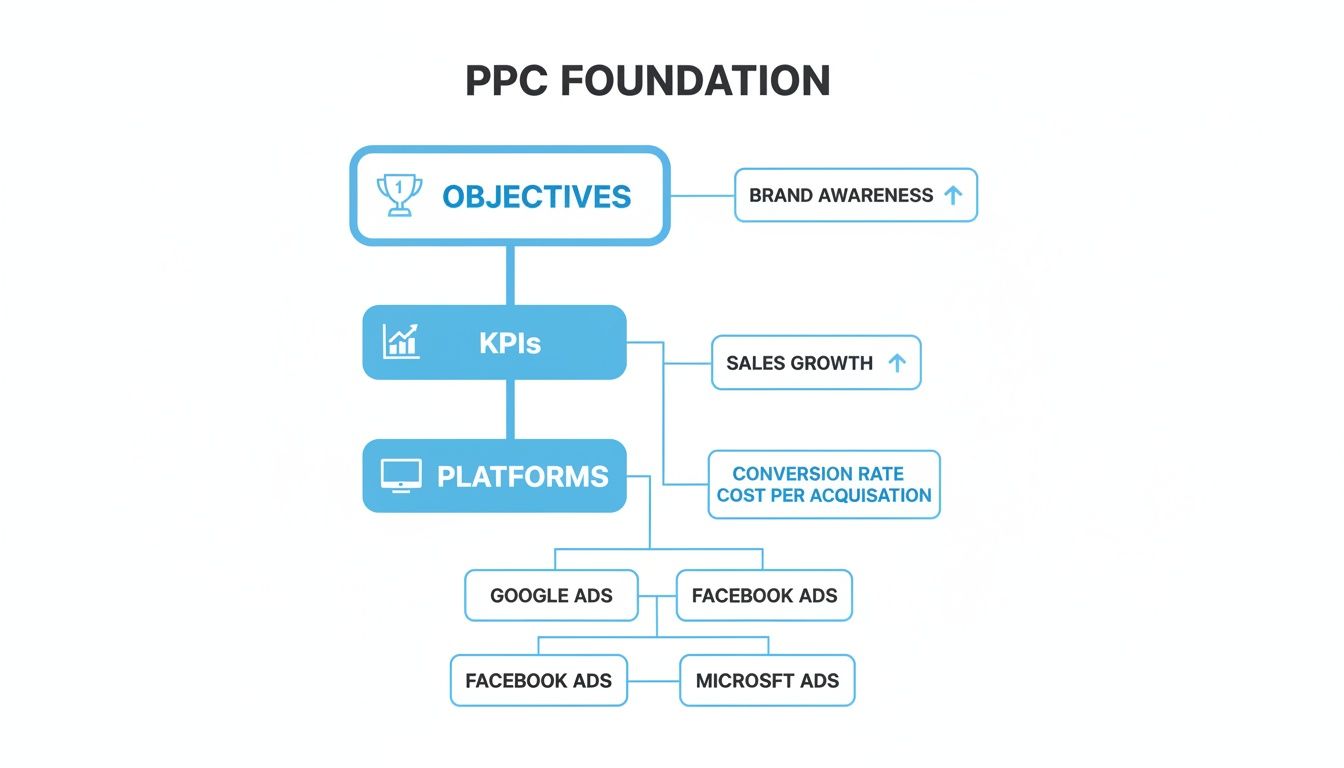
This flowchart shows exactly how it all connects. Strong account architecture starts with clear objectives, which then cascade down into your tactical choices. It’s the only way to ensure every single campaign serves a distinct, valuable purpose.
Thematic Structuring for Clarity and Control
The best way to organise your account is by theme. Forget lumping all your keywords into one massive campaign; that’s a recipe for disaster. Instead, create separate campaigns based on logical categories that mirror your actual business. This approach gives you granular control over everything that matters: budgets, bidding, and messaging.
Some common ways to structure thematically include:
- Product or Service Lines: An online clothing retailer would have separate campaigns for “Men’s Trainers,” “Women’s Dresses,” and “Children’s Outerwear.” Simple and effective.
- Customer Journey Stage: You could build campaigns for different buying stages. An ‘Awareness’ campaign might target broad terms, ‘Consideration’ could focus on brand comparisons, and a ‘Decision’ campaign would go after high-intent “buy now” keywords.
- Geographic Location: A national service provider should have a campaign for each major city it operates in, like London, Manchester, and Birmingham. This allows for localised ad copy and budget allocation.
Inside each of these campaigns, you’ll then create tightly-themed ad groups. For that “Men’s Trainers” campaign, you might have ad groups for “Running Trainers,” “Leather Trainers,” and “High-Top Trainers.” Each ad group needs a small, super-relevant set of keywords (usually 5-15 is the sweet spot) and ads written specifically for those terms. This tight alignment is absolutely critical for achieving high ad relevance and smashing your performance goals.
Granular Keyword Research and Negative Keywords (How to Manage PPC Campaign)
Your account structure is only as good as the keywords you put in it. The goal is to get past the obvious, high-competition head terms and dig up the high-intent phrases your ideal customers are actually typing into the search bar.
You need to become obsessed with long-tail keywords. These are the longer, more specific phrases like “waterproof trail running trainers for men size 10”. Sure, they have lower search volume individually, but their conversion rates are often much, much higher because the user’s intent is crystal clear. They know what they want.
Just as important is the aggressive use of negative keywords. These are the terms you add to your campaigns to stop your ads from showing for irrelevant searches. For instance, if you’re selling premium leather trainers, you’d add negatives like “cheap,” “discount,” and “second-hand” to stop wasting money on clicks from people who will never buy. Regularly checking your search term report to mine for new negative keywords is a non-negotiable part of good campaign management.
A well-curated negative keyword list is one of the most powerful levers you can pull to improve ROI. It’s your filter, ensuring your budget is only spent reaching people who are genuinely interested in what you sell.
Layering Audiences for Precision Targeting
Keywords tell you what someone is searching for, but audiences tell you who that person is. Modern PPC platforms let you layer audience signals on top of your keyword targeting, giving you incredible precision. This is how you move from showing ads to anyone searching for your product to showing them to the right people searching for your product.
Start layering these powerful audience types onto your campaigns:
- Demographics: Target users based on age, gender, parental status, or household income.
- In-Market Segments: Reach people the platforms have identified as actively researching and considering products or services like yours. It’s a goldmine.
- Affinity Audiences: Target users based on their long-term interests and passions. Great for brand awareness.
- Your Data (Remarketing): This is your most valuable asset. Re-engage users who have already visited your website, abandoned a basket, or made a purchase in the past.
By combining these elements, you can build an incredibly efficient targeting machine. To make sure you nail the setup from the start, we always recommend using a guide like The Ultimate Google Ads PPC Checklist for UK Digital Marketing Managers to ensure no critical steps are missed. This structured approach is the key to managing a PPC campaign that isn’t just organised, but primed for profitable growth from day one.
How to Manage PPC Campaign: Mastering Bids, Budgets, and Ad Creation
Okay, you’ve got a rock-solid account structure. Now it’s time to add the fuel. This is where your carefully laid plans turn into real-world actions: setting budgets, choosing how to bid for clicks, and writing ads that people can’t help but click on.
Getting this part right is the difference between a campaign that nervously inches forward and one that invests with confidence. It might seem complicated, but it all comes down to making smart, data-driven decisions instead of just crossing your fingers. Let’s break down how to manage your spend and write compelling ads that truly connect with your UK audience.

Navigating the World of Bidding Strategies
Your choice of bidding strategy is one of the most important decisions you’ll make. It’s you telling the ad platform exactly what you’re trying to achieve—be it maximum brand awareness, a flood of website traffic, or profitable sales. The big debate is usually ‘manual vs. automated’, but the real skill is knowing which one to use and when.
Manual bidding puts you in the driver’s seat. You set a maximum cost-per-click (Max CPC), giving you total control. This is a brilliant approach for brand new campaigns where you have zero performance data and want to test the waters without an algorithm spending your budget too quickly.
But let’s be honest, the real power these days is in automated, or ‘smart’, bidding. These strategies use machine learning to optimise for your goals in real-time, crunching thousands of signals at every single auction. No human can compete with that.
Expert Tip: Don’t be afraid of the algorithm. I often start new campaigns with a simple strategy like ‘Maximise Clicks’ just to get data flowing. Once you have a decent number of conversions coming in—aim for at least 15-20 a month—then it’s time to switch to a conversion-focused strategy like ‘Target CPA’ or ‘Maximise Conversions’. You’re giving the system the fuel it needs to perform.
Some of the most common automated strategies you’ll use are:
- Target CPA (Cost Per Acquisition): You tell the platform the most you’re willing to pay for a lead or a sale, and it works to hit that average.
- Target ROAS (Return On Ad Spend): This is an ecommerce favourite. You set a target return for every pound you spend (e.g., you want £5 back in revenue for every £1 of ad spend).
- Maximise Conversions: The system goes all out to get you the highest number of conversions possible within your daily budget.
For a deeper dive into these powerful options, it’s well worth getting familiar with the finer points of Google Ads smart bidding to see just how much machine learning can do for your results.
Setting and Allocating Your Budget (How to Manage PPC Campaign)
Your budget is what buys you visibility. A classic mistake I see all the time is spreading a small budget too thinly across too many campaigns. It’s far more effective to focus your spend on your one or two most promising campaigns, prove they’re profitable, and then scale up from there.
Start by setting a daily budget for each campaign. The ad platforms will aim to spend this on average across the month, sometimes going over on busy days and under on quiet ones. Keep a close eye on your budget pacing, especially in the first few weeks. If your best campaign is constantly hitting its budget cap, that’s your cue to shift funds from a weaker campaign and give your winner the room it needs to grow.
Crafting Ad Copy That Converts
Your ad is the only thing a potential customer sees before they decide whether or not to click. It has to be relevant, compelling, and trustworthy. Every single character matters.
For a UK audience, a winning text ad almost always has these three things:
- A Magnetic Headline: Get your main keyword in there, but also add a clear benefit. Instead of “Plumbers in Manchester,” try “24/7 Manchester Plumbers | Fixed-Price Quotes.” That second option instantly tackles a major customer worry (surprise costs).
- Benefit-Focused Descriptions: Don’t just list what you do; explain what it means for the customer. Instead of “We use advanced tools,” write “Fast, Non-Invasive Leak Detection. Find the problem without damaging your property.” See the difference?
- A Strong Call-to-Action (CTA): Tell people exactly what you want them to do next. Be direct. “Get a Free Quote Online,” “Shop the Spring Sale Now,” or “Book Your Consultation Today.”
Finally, use every single ad extension available to you. Sitelinks, callouts, and structured snippets literally make your ad bigger on the results page, pushing your competitors down and giving you more chances to shout about your value. An ad with extensions can see its click-through rate jump by an average of 10-15%. It’s one of the easiest wins you’ll get.
How to Manage PPC Campaign: Getting Your Tracking and Reporting Right
Honestly, running a PPC campaign without solid tracking is like driving blind. You’re burning through cash with no real idea if you’re heading in the right direction. Proper tracking and reporting isn’t just a nice-to-have; it’s the engine that powers every smart decision you’ll make.
This is where you prove the campaign’s value—to yourself, your boss, or your clients. It’s how you stop guessing and start engineering results. Without reliable data, every “optimisation” is just a shot in the dark.
Setting Up a Bulletproof Tracking System
First things first, you need to be absolutely sure you’re capturing every single valuable action a user takes after clicking your ad. Thankfully, tools like Google Tag Manager (GTM) have made this a whole lot easier, letting you manage tracking codes without having to constantly nag your dev team. Think of it as your central command for all tracking tags.
You can use GTM to deploy your platform-specific tags, like the Google Ads tag or the Meta Pixel, and pipe all that juicy data into Google Analytics 4 (GA4). This setup gives you a crystal-clear view of which keywords, ads, and campaigns are actually making you money. For a more detailed walkthrough, our guide on mastering tracking in Google Ads is a great place to start.
Key Insight: Don’t just track the final sale. The most valuable data often comes from tracking micro-conversions—smaller actions that signal interest and move a user down the funnel. This gives you a much richer picture of your campaign’s true influence.
So, what kind of micro-conversions should be on your radar?
- Lead Form Submissions: The bread and butter of lead generation.
- Email Newsletter Sign-ups: Perfect for capturing users who aren’t ready to buy just yet.
- PDF or Guide Downloads: A great way to show engagement and build authority.
- Video Views: Tracking up to 75% completion tells you how much of your message is actually landing.
Monitoring these smaller wins is especially critical for businesses with longer sales cycles. It proves your PPC spend is building a pipeline, not just chasing immediate sales.
Building Reports That Actually Drive Decisions (How to Manage PPC Campaign)
With your tracking locked in, the next hurdle is presenting the data in a way that’s clear, concise, and genuinely useful for stakeholders. A good report tells a story. It highlights what worked, what didn’t, and what you’re going to do about it next.
Forget dumping a massive spreadsheet on someone’s desk. The key is to zero in on the KPIs that really matter to the business. This isn’t just my opinion; it’s a major industry trend. Recent data shows that 72% of PPC managers now prioritise performance metrics like ROAS and CPA over old-school vanity metrics like clicks and impressions. It’s all about profitability. A great report doesn’t just show numbers; it connects them directly to business goals.
Essential PPC Reporting KPIs for Business Growth
To build a report that resonates with your stakeholders, you need to speak their language. This table breaks down the crucial metrics to include, what they mean, and why they’re so important for UK SMEs focused on growth.
| KPI | What It Measures | Why It’s Important for UK SMEs |
|---|---|---|
| Cost Per Acquisition (CPA) | The average cost to get one new customer or qualified lead. | This is your ultimate efficiency metric. It tells you point-blank if your customer acquisition is profitable. |
| Return On Ad Spend (ROAS) | The total revenue generated for every pound spent on advertising. | Absolutely critical for e-commerce. A ROAS of 4:1 means you’re making £4 for every £1 you spend. |
| Conversion Rate (CVR) | The percentage of clicks that result in a valuable action (like a sale or lead). | A key health check for your ads and landing pages. A low CVR usually points to a disconnect somewhere. |
| Total Conversion Value | The total monetary value of all conversions generated by your campaigns. | This moves the conversation beyond just the number of conversions to the real revenue impact on the business. |
When you focus your reporting on these outcome-driven KPIs, you start having much more productive conversations. It builds trust and makes it a whole lot easier to get buy-in when you want to double down on a winning campaign.
How to Manage PPC Campaign: Your Ongoing PPC Optimisation Routine
A PPC campaign that’s set and forgotten is a campaign that’s destined to fail. The truth is, successful paid search is never static. It’s a living, breathing system that needs constant attention, analysis, and refinement to hit its peak performance. This is where so many businesses miss the mark—they do the hard work of launching a campaign, then let it drift.
What separates average results from a powerful engine for growth is a sustainable, repeatable routine for optimisation. It’s about getting into a rhythm of daily, weekly, and monthly checks that keep your campaigns healthy, profitable, and always improving, without completely taking over your life.
Establishing Your Optimisation Cadence
Consistency is everything in campaign management. Instead of constantly putting out fires, a structured routine lets you get ahead of the game. You’ll start spotting trends and opportunities long before they become massive problems. This cadence is what builds momentum, allowing small, incremental improvements to compound over time into serious results.
The best way to do this without getting overwhelmed is to break your tasks down into manageable chunks. Not every metric needs to be obsessively checked every single day. By creating dedicated slots for daily, weekly, and monthly tasks, you can stay on top of performance and keep moving forward.
Daily Health Checks: The Non-Negotiables (How to Manage PPC Campaign)
Your daily checks should be quick and to the point—no more than 15-20 minutes. The goal here is simple: spot any major red flags that could be torching your budget. Think of it as a quick pulse check on your account’s vital signs.
Your daily to-do list should look something like this:
- Budget Pacing: Are any campaigns about to fly past their daily budget or, just as bad, barely spend anything at all? A campaign hitting its cap early in the day is a clear signal of missed opportunity.
- Ad Status and Approvals: Scan for any disapproved ads or policy violations. A single disapproved ad can grind an entire ad group to a halt, so getting these sorted quickly is non-negotiable.
- Performance Spikes or Dips: Have a quick look for any wild swings in key metrics like clicks, impressions, or cost-per-click (CPC) compared to yesterday. A sudden nosedive in impressions might point to a bidding issue, while a sharp spike in CPC could mean a new competitor just showed up to the party.
Weekly Deep Dives Into Performance
This is where you roll up your sleeves and dedicate some real time to strategic analysis. Your weekly review is your chance to look at performance trends and start making adjustments backed by solid data. Block out an hour or two each week for this—it’s that important.
One of the most valuable habits you can build is a weekly dive into your Search Term Report. This report is an absolute goldmine, showing you the actual search queries that triggered your ads. It’s brilliant for two key tasks:
- Finding New Negative Keywords: Root out all the irrelevant searches that are wasting your money. If you sell premium leather shoes, you’ll want to immediately add terms like “cheap,” “repair,” and “second-hand” as negatives.
- Discovering New Keyword Opportunities: Uncover high-intent, long-tail keywords you never would have thought of yourself. You might stumble upon a specific product model or a feature-led search query that converts like crazy.
Honestly, a weekly review of your search terms is probably the single highest-impact activity you can do. It directly sharpens your ad relevance and, crucially, stops you from paying for clicks from people who were never going to buy from you anyway.
Beyond search terms, your weekly session should cover a wider performance analysis. See which campaigns, ad groups, and keywords are your heavy hitters driving conversions, and which ones are just dragging the account down. Don’t be afraid to pause underperforming keywords and shift that budget over to your top performers.
Monthly Strategic Reviews and Automation (How to Manage PPC Campaign)
Your monthly review is all about zooming out to see the bigger picture. This is where you measure your overall performance against your core KPIs and map out your strategy for the month ahead. Are you actually hitting your target Cost Per Acquisition (CPA) or Return On Ad Spend (ROAS)? If not, why not?
This is also the perfect time to get smarter with automation. Simple automated rules can handle many of your routine checks, freeing you up to focus on strategy. For example, you could set up a rule that automatically pauses any keyword that has spent over £20 in the last 30 days without a single conversion. It’s a simple fix that saves you money.
While automation is incredibly powerful, there’s a massive opportunity for businesses to use it more effectively. Right now, a staggering 70% of PPC accounts are running with 10 or fewer automation scripts. The average number of Google Ads scripts per account did climb by 37% from 3.8 in 2023 to 5.2 in 2024, but that gap shows that most advertisers aren’t taking full advantage of the tools at their disposal. You can see more insights like this in the latest State of PPC report.
By building this layered routine, you can start managing your PPC campaigns with real confidence. You’ll shift from a reactive state of just fixing problems to a proactive cycle of continuous improvement—ensuring your investment delivers consistent, measurable growth.
Got Questions About Managing PPC Campaigns?
Once you dive into actively managing a PPC campaign, the theory quickly gives way to practical questions. Suddenly, you’re grappling with real-world decisions about budgets, timelines, and whether you’ve got the right people on the job. Let’s tackle some of the most common questions we hear from UK businesses trying to make their paid ads pay off.
These aren’t textbook answers; they come from years of being in the trenches, helping businesses just like yours turn ad spend into actual, measurable growth.
How Much Should a Small Business Be Spending on PPC?
There’s no magic number here. Your ideal budget comes down to your industry, how competitive it is, where you’re targeting, and what you’re trying to achieve. The best way to start is by figuring out your ideal Cost Per Acquisition (CPA). What’s a new customer really worth to you? Once you know that, you can work backwards to set a test budget you’re comfortable with.
For most UK SMEs, a starting budget somewhere between £500 and £1,500 a month is a solid starting point. It’s enough to gather meaningful data without taking a massive financial risk right out of the gate.
In the early days, the goal isn’t just to spend money—it’s to invest it wisely. Every pound should be treated as a data-gathering exercise. Track everything, find what works, and only then should you think about scaling up the profitable campaigns.
How Long Until I See Results From a PPC Campaign?
You’ll start seeing data like traffic and impressions almost as soon as your campaigns go live. But let’s be clear: that’s not the same as seeing real business results. Getting a steady stream of quality leads or profitable sales takes time and a bit of patience. The first 30 days are all about collecting data and making those first critical tweaks.
Think of that initial month as a learning phase for both you and the ad platform’s algorithms. To be realistic, it usually takes a good 60 to 90 days of consistent, hands-on management to get to a place of stable, predictable performance and a positive return on your investment. The biggest mistake is making huge, knee-jerk changes too early. Success comes from data-led decisions, not gut reactions.
Should I Manage PPC In-House or Hire an Agency?
This really boils down to three things: time, expertise, and resources. Properly managing a PPC campaign is a serious time sink. It demands specialised knowledge that needs to be constantly updated, and it’s a world away from a “set it and forget it” task.
If you have someone on your team who genuinely knows their way around PPC and has the hours in the week to dedicate to daily, weekly, and monthly optimisations, then keeping it in-house can work. For most UK businesses, though, that’s a big ask.
Working with a specialist agency gives you instant access to expert strategy, powerful tools you likely wouldn’t pay for yourself, and years of industry experience. This route almost always gets you better results, faster, and frees you and your team up to do what you do best—run your business.
If you’re ready to get better results faster and win back your time, the team at PPC Geeks is here to help. The first step is our free, in-depth PPC audit, which gives you a data-driven strategy for measurable growth. See how our expert UK team can transform your campaigns by visiting us at https://ppcgeeks.co.uk/.