




Mapping your PPC campaigns to the D2C buyer journey is all about alignment. It means you stop throwing ads at a wall and start guiding customers through each specific stage, from their first glance at your brand to becoming a repeat buyer. You’ll use different PPC tactics for each phase – think broad, brand-building ads for discovery, detailed comparison ads for the research phase, and sharp, focused retargeting ads to close the sale.
D2C Buyer Journey: Why Your PPC Strategy Needs a Journey Map
Forget the old-school, linear sales funnel. Today’s D2C customers in the UK don’t walk a straight line; they pinball between social media feeds, Google searches, and product review sites before even thinking about buying. If you’re only chasing that final click with conversion-focused ads, you’re missing countless chances to get in front of them and influence their decision much earlier.
PPC is the thread that ties all these scattered touchpoints together. It lets you show up with the right message at exactly the right moment, whether a potential customer is just realising they have a problem or they’re literally reaching for their credit card. A journey-based approach turns your advertising from a blunt instrument into a precision tool.
From Funnel to Flywheel
When you start thinking in terms of a journey map, you build momentum. Each stage seamlessly feeds into the next, creating a self-sustaining cycle of getting new customers and keeping them around. This framework helps you organise your campaigns around four crucial stages.
This diagram breaks down the four-step flow of the modern D2C buyer journey, from that initial brand discovery right through to loyal advocacy.
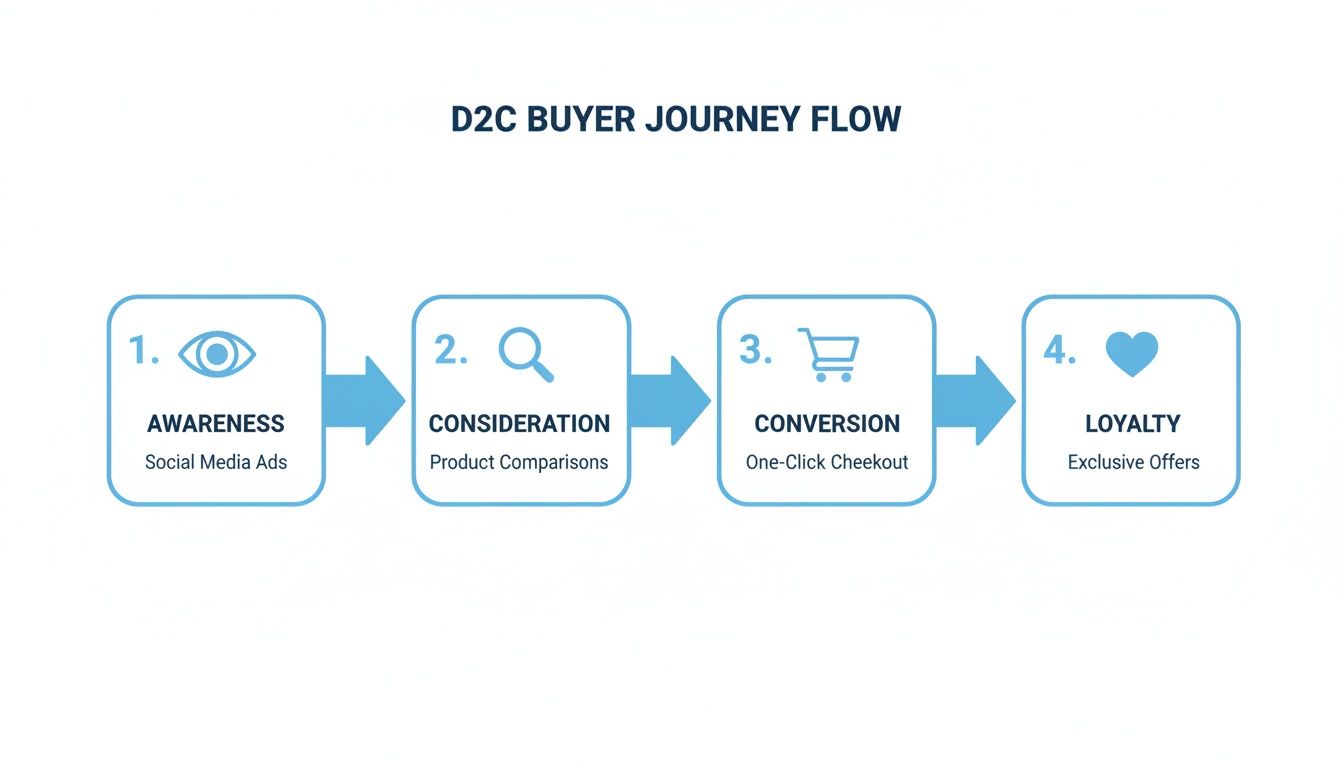
By building campaigns around these distinct phases, you can perfectly align your messaging and budget with what your customers are thinking and doing at that exact moment.
The data backs this up, too. In the UK, 67% of B2B marketers see PPC as essential for lead generation, and that same principle applies directly to guiding D2C prospects. More importantly, paid search traffic often converts 50% better than organic traffic, proving that a smart PPC investment isn’t just about getting seen—it’s about building a higher-quality path to purchase. You can explore more UK digital marketing facts over on searchhog.co.uk.
By mapping your PPC efforts to the customer journey, you stop shouting at everyone and start having meaningful conversations with the right people at the right time. This shift is fundamental to scaling a D2C brand profitably.
A Quick Glance at the D2C Buyer Journey
Before we get into the nuts and bolts of each stage, here’s a high-level look at how all the pieces fit together. This table acts as a quick roadmap, outlining the goals, channels, and metrics we’ll be exploring for each phase of the D2C buyer journey.
PPC Strategies Across the D2C Buyer Journey
| Journey Stage | Primary Goal | Key PPC Channels | Core KPIs |
|---|---|---|---|
| Awareness | Build brand recognition and fill the top of the funnel | Google Display, YouTube Ads, Meta Ads | Impressions, Reach, Video Views |
| Consideration | Intercept active research and provide solutions | Google Search, Shopping, Dynamic Retargeting | CTR, CPC, Engagement Rate |
| Conversion | Drive immediate sales and acquire new customers | Branded Search, Performance Max, Remarketing | ROAS, CPA, Conversion Rate |
| Loyalty | Increase lifetime value and encourage repeat purchases | Customer List Targeting, RLSA, Email Ads | Repeat Purchase Rate, CLV |
This overview gives you a solid foundation for understanding how to structure a full-funnel PPC strategy that doesn’t just chase sales but builds a loyal customer base from the ground up.
D2C Buyer Journey: Capturing Attention at the Awareness Stage
This is where it all kicks off. In the awareness stage, your would-be customers have no idea you exist. They might not even know they have a problem your product can solve. So, your primary goal isn’t to make a sale—it’s to make an introduction. You’re planting a seed of recognition that, hopefully, will blossom later on.
Forget about hard-sell tactics and direct response metrics for now. Success here is measured by how many of the right people you can reach and how well your message sticks. We’re building audiences and creating demand, not just capturing what’s already there.
Choosing Your Channels for Maximum Impact
Your channel selection is make-or-break for reaching a broad yet relevant audience. At this top-of-funnel stage, you’re looking for platforms that are brilliant at visual storytelling and have sophisticated targeting options to find people based on their interests and behaviours, not just what they’re typing into a search bar.
Three platforms are particularly powerful for this:
- Google Display Network (GDN): This network gives you a ticket to millions of websites, apps, and videos. It’s perfect for placing visually striking banner or responsive display ads right in front of users as they browse content related to your niche.
- YouTube Ads: As the world’s second-largest search engine, YouTube is in a league of its own for video. Skippable in-stream ads or punchy six-second bumper ads are fantastic formats for grabbing attention with a compelling story about your brand or the problem you solve.
- Meta Ads (Facebook & Instagram): These platforms are the masters of discovery. People are in a relaxed, scrolling mindset, making them much more open to discovering new brands through video ads, carousels, or eye-catching image ads in their feeds and stories.
By focusing your initial efforts here, you create a wide net to catch potential customers, introducing your brand in the digital spaces where they already hang out.
Smart Targeting Beyond Keywords (D2C Buyer Journey)
Since people at this stage aren’t actively searching for your product, keyword-based targeting is pretty much useless. Instead, we have to lean on audience signals to find people who fit your ideal customer profile. It’s less about what they type and more about who they are.
Your targeting strategy should be built around these key audience types:
- Lookalike Audiences: Built from your existing customer lists or website converters, these audiences let platforms like Meta and Google find new users who share similar characteristics and online behaviours. A 1-3% lookalike is usually a great starting point, giving you a nice balance between scale and relevance.
- In-Market Segments: Google‘s in-market audiences group users who have shown recent behaviour that suggests they are actively researching or “in the market” for a particular product category. Think “women’s athletic shoes” or “sustainable home goods.”
- Affinity Audiences: These are much broader interest-based groups. While less targeted than in-market segments, they’re brilliant for building mass awareness with users who have a long-term interest in your area, like “fitness enthusiasts” or “home decorating fans.”
Combining these targeting methods lets you reach a huge pool of prospects who are statistically far more likely to be interested in what you have to offer, even if they’ve never heard of you.
The real goal of awareness-stage PPC isn’t immediate sales. It’s to cost-effectively fill your retargeting pools with qualified prospects. Every person who watches your video or engages with your ad is a warm lead you can nurture in the next stage.
Crafting Creative That Stops the Scroll
Your ad creative is your handshake. At this stage, it needs to be engaging enough to interrupt someone’s mindless scrolling and leave a lasting impression. Focus on storytelling and emotional connection rather than price points and discounts.
A great example is a D2C brand selling eco-friendly cleaning products. Instead of an ad screaming “10% Off All-Purpose Cleaner,” a much better awareness ad would be a short, vibrant video showing how their product helps a family create a healthier, chemical-free home. The focus is on the benefit and the brand’s values, not the transaction. To dive deeper into creating this initial spark, our complete guide on how to improve brand awareness offers more practical strategies you can implement right away.
Measuring What Matters Most (D2C Buyer Journey)
Direct ROI and Return On Ad Spend (ROAS) are the wrong metrics here. If you chase them at the awareness stage, you’ll end up killing effective campaigns just because they aren’t driving immediate sales. You have to shift your focus to top-of-funnel KPIs that tell you if you’re successfully capturing attention.
Track these metrics to see how you’re really doing:
- Impressions & Reach: How many people are seeing your ad, and how often?
- Video View-Through Rate (VTR): What percentage of people are watching a good chunk of your video ad? A high VTR is a clear sign your creative is hitting the mark.
- Cost Per Mille (CPM): How much does it cost for your ad to be shown 1,000 times? A lower CPM means you’re reaching more people for your budget.
- Audience Growth: Are your website visitor and retargeting lists actually growing as a result of these campaigns?
By focusing on these KPIs, you can confidently invest in building your brand’s presence, knowing that you are setting the stage for profitable conversions down the line.
D2C Buyer Journey: Winning the Mid-Funnel with Consideration Campaigns
So, the awareness stage did its job. You’ve successfully planted your brand’s flag in the minds of potential customers. Fantastic. But now the real work begins as the buyer journey moves into the crucial consideration phase. This is where active shoppers start digging in, comparing their options, and looking for the absolute best solution to their problem. Your goal is no longer just to be seen; it’s to be the definitive answer they’re searching for.

This mid-funnel battleground is where mapping the D2C buyer journey through PPC truly pays off. The focus pivots from broad reach to razor-sharp relevance. Your metrics shift from impressions to things like Click-Through Rate (CTR) and Cost Per Click (CPC), which are clear signals of active interest. Your campaigns need to be ready to intercept this high-intent behaviour with absolute precision.
Intercepting Active Shoppers with Search
When someone starts seriously researching a purchase, their first port of call is almost always Google. This means your Search and Shopping campaigns have to be structured to capture that intent, moving way beyond simple branded terms.
You need to think like your customer. They aren’t just typing in “running shoes”; they’re searching for “best running shoes for flat feet UK” or “lightweight waterproof jacket for hiking”. These are what we call problem-aware, long-tail keywords, and they’re a dead giveaway that a user is deep in the consideration phase. Your search ad groups should be organised around these specific problems and use cases.
For instance, a D2C skincare brand might build out ad groups for:
- “Skincare for sensitive skin”
- “Cruelty-free anti-ageing serum UK”
- “Hyaluronic acid for dry skin”
Crucially, each ad group must click through to a highly relevant landing page that speaks directly to the user’s query, reinforcing the idea that your product is exactly what they need.
Dominating the Digital Shelf with Google Shopping (D2C Buyer Journey)
For any D2C brand selling physical goods, Google Shopping is non-negotiable in the mid-funnel. It’s the digital equivalent of a shop shelf, and you need your product to pop. A well-optimised product feed is your greatest weapon here.
Make sure your product titles are descriptive and packed with keywords that match how people actually search. Instead of a lazy “Men’s T-Shirt,” go for something like “Organic Cotton Crew Neck T-Shirt in Navy Blue.” High-quality imagery is also vital—show your product from multiple angles and in a lifestyle context so people can picture themselves using it.
A classic mistake I see all the time is treating every product equally in Shopping campaigns. You absolutely must segment your products into different campaigns based on profit margin, price point, or category. This lets you bid more aggressively on your bestsellers or high-margin items, maximising your visibility where it counts the most.
Re-Engaging Prospects with Dynamic Retargeting
Right, so someone visited your product page but didn’t buy. They’re clearly interested but needed another nudge. This is where dynamic retargeting on platforms like Meta becomes incredibly powerful.
Unlike generic retargeting ads that just show your logo again, dynamic product ads automatically serve up the exact products a user viewed on your website. This level of personalisation is extremely effective. Seeing that specific pair of trainers or that particular coffee table follow them over to their Facebook or Instagram feed keeps your brand top of mind and makes it ridiculously easy for them to come back and finish the purchase.
To get this right, you need a clean product catalogue connected to your Meta Business Manager and the Meta Pixel (or Conversion API) correctly installed to track user behaviour. Understanding the principles behind this is key, and you can learn more about what audience targeting is and how it creates these powerful feedback loops.
Building Trust with Ad Extensions and Social Proof (D2C Buyer Journey)
In the consideration stage, users are actively hunting for reasons to trust one brand over another. You can build this confidence directly within your Google Ads by using ad extensions.
These little additions pack your ads with valuable info without any extra cost per click, making your listings bigger, more informative, and more trustworthy.
- Seller Ratings: This is an automated extension that pulls in your star rating from trusted review sites. Seeing a 4.5-star rating next to your ad is an instant credibility booster.
- Price Extensions: Show specific product prices right in the ad. This pre-qualifies clicks from people who are comfortable with your price point.
- Sitelink Extensions: Direct users to specific pages like “About Us,” “Customer Reviews,” or “Delivery Information,” helping them answer their own questions without any extra effort.
- Promotion Extensions: Highlight current sales or offers, like “20% Off All Orders,” which creates a sense of urgency and encourages that click.
By strategically using these elements, you’re providing crucial decision-making information upfront. This positions your brand as a transparent and trustworthy choice, which is central to winning the mid-funnel and guiding interested shoppers smoothly towards that final conversion.
D2C Buyer Journey: Closing the Sale with Conversion-Focused PPC
You’ve guided your potential customers through the awareness and consideration stages, and now they’re standing at the digital checkout counter. They’ve done their research, they’re familiar with your brand, and the credit card is practically in hand. This is it. Every click from here on out has to be laser-focused on one thing: turning that strong intent into actual revenue. This is the final, make-or-break step in our D2C buyer journey.

At this point, your key performance indicators (KPIs) get brutally simple. We’re talking Return On Ad Spend (ROAS), Cost Per Acquisition (CPA), and Conversion Rate. Every penny of your ad spend has a job to do, and that job is to drive a profitable sale. Let’s dig into the campaigns that actually get it done.
Protecting Your Brand with Branded Search
It can feel a bit weird to bid on your own brand name, especially if you’re already ranking number one organically. But trust me, branded search campaigns are non-negotiable. They are a defensive powerhouse. Your competitors can—and absolutely will—bid on your brand terms to try and poach your customers at the very last second.
Running a branded search campaign ensures you completely dominate the search results for your own name. You get to control the message, the landing page, and the entire experience. These campaigns almost always deliver the highest ROAS you’ll see, acting as a low-cost insurance policy to scoop up customers who are already looking for you by name.
Leveraging Performance Max as Your Secret Weapon (D2C Buyer Journey)
For D2C brands, Google’s Performance Max (PMax) campaigns are an absolute game-changer for this conversion stage. Think of it as an all-in-one campaign that uses machine learning to tap into all of Google’s ad inventory—Search, Shopping, YouTube, Display, you name it. You just need to feed it the right ingredients: your ad copy, images, and videos, plus some strong audience signals. Then, Google’s AI does the heavy lifting, hunting down customers who are primed to convert.
To really get the most out of PMax, give it high-quality data to work with:
- Customer Lists: Upload lists of your past purchasers. This is gold dust.
- Website Visitors: Use data from people who have already been browsing your site.
- Cart Abandoners: Create specific signals for users who got this close to buying.
By providing these rich audience signals, you’re not asking the algorithm to start from scratch. You’re giving it a massive head start in identifying your ideal bottom-of-funnel customer across its entire network.
Winning Back Lost Sales with Aggressive Retargeting
Did you know that the average cart abandonment rate is hovering around 70%? That’s a huge pile of potential revenue just sitting there, waiting to be reclaimed. This is where timely, aggressive retargeting becomes your best friend, bringing those high-intent shoppers back to finish what they started.
But this isn’t about just showing them a generic brand ad and hoping for the best. Your retargeting needs to be specific and compelling.
Pro Tip: Structure your retargeting audiences based on recency. A user who abandoned their cart 24 hours ago is in a different mindset to someone who left a week ago. The first group might just need a simple “Complete Your Order” reminder. The second might need a little nudge, like a “10% Off Your First Order” incentive to create that urgency and close the deal.
This kind of segmentation keeps your message relevant, avoids annoying your audience, and makes it far more likely you’ll convince a hesitant buyer to come back.
Optimising for Profitability with ROAS Bidding (D2C Buyer Journey)
At the conversion stage, your bidding strategy needs to be all about profitability. This is where target ROAS (tROAS) bidding in Google Ads is essential. Instead of telling Google what you’re willing to pay per click (CPC) or per acquisition (CPA), you tell it the return you expect for every pound spent.
For example, setting a tROAS target of 500% means you’re aiming to generate £5 in revenue for every £1 of ad spend. Google’s algorithm then gets to work, adjusting your bids in real-time to prioritise showing your ads to users it believes will help you hit that specific target. It’s the most direct way to align your PPC efforts with your bottom-line business goals.
Sealing the Deal on Your Landing Page
Finally, you can do all the brilliant PPC work in the world, but it all falls apart if your website can’t convert the traffic. Your landing page and checkout process are the final hurdles. A slow, confusing, or clunky experience is the fastest way to send a motivated customer straight to a competitor.
Your landing page must be a seamless extension of your ad. It needs a clear call-to-action (CTA), social proof like customer reviews, and a completely frictionless path to purchase. Cut down the number of clicks and form fields needed to check out. Every bit of friction you remove will boost your conversion rate. For a deeper dive, check out our guide on PPC landing page best practices and make sure your site is built to sell.
D2C Buyer Journey: Building Loyalty and Lifetime Value After the Purchase
Getting that initial sale feels great, but in reality, it’s just the starting block. The real money in D2C is made in the long run. Acquiring a new customer is expensive; turning them into a repeat buyer is where you see genuine, sustainable growth. Post-purchase PPC is your secret weapon for transforming one-time buyers into loyal brand advocates, massively boosting their lifetime value.
But this isn’t about just hammering new customers with more ads. The game has changed. Your focus needs to pivot from acquisition to nurturing. It’s time to move beyond generic campaigns and start using the data you’ve collected to create genuinely helpful, hyper-relevant ads that make your customers feel seen.
Segmenting for Smarter Retention
Your existing customer list is an absolute goldmine, and it’s time to start digging. The first move in any solid post-purchase PPC strategy is segmenting this audience inside platforms like Google Ads and Meta. A generic “past purchasers” list is okay, but the real magic happens when you get more granular.
Try creating distinct audience lists based on actual behaviour:
- Product Purchased: Group customers who bought a specific item. Someone who just bought a new coffee machine from you is the perfect audience for an ad showcasing your premium, single-origin coffee beans a week later.
- Purchase Frequency: You need to talk to one-time buyers differently than you do your die-hard fans. Separate them out. Your messaging to a loyal, repeat customer should feel exclusive, while a lapsed customer might need a gentle nudge to come back.
- Purchase Value: Roll out the red carpet for your big spenders. Create a VIP list for customers with a high average order value and hit them with exclusive offers or early access to new product drops.
With these segments, you can run incredibly precise campaigns to upsell complementary items or cross-sell entirely new product lines. It’s targeted, it’s relevant, and it works.
Crafting Ads That Build Community (D2C Buyer Journey)
The tone of your ads has to shift completely for existing customers. The hard sell is over; they’ve already bought into your brand. Now, it’s all about reinforcement and making them feel part of a community. Your ads should feel less like an interruption and more like a helpful suggestion from a brand they know and trust.
Imagine a D2C skincare brand targeting customers who bought a cleanser 30 days ago. A simple, elegant ad that says, “Loving that glow? The next step in your routine is here. Discover our best-selling moisturiser” acknowledges their journey and gently guides them forward.
When you target existing customers, you’re not just selling another product. You’re reinforcing their good decision to buy from you in the first place. Make them feel like a valued member of your brand’s community, not just another number on a sales report.
Measuring the Metrics That Matter
For retention campaigns, ROAS alone doesn’t tell the whole story. You need to be tracking KPIs that reflect long-term health and loyalty. The two most critical metrics at this stage are Repeat Purchase Rate and Customer Lifetime Value (CLV).
An increasing CLV is the ultimate proof that your retention strategy is firing on all cylinders. It shows that customers are not only returning but are also spending more with you over time. To get this right, it’s vital to understand what customer lifetime value is and how to calculate it properly.
A small, strategic investment in post-purchase PPC doesn’t just drive the next sale. It builds a resilient, loyal customer base that fuels sustainable, long-term growth for your D2C brand.
Got Questions About D2C PPC Journeys?
Mapping the entire D2C buyer journey is one thing; putting it into practice with real budgets and daily management is another. This is where the practical questions always pop up. Getting these details right is what turns a solid strategy into a profitable one, so let’s tackle a few of the most common queries I hear.
One of the first hurdles is always budget. How on earth do you split your funds across the different funnel stages? While every brand’s needs are unique, a great starting point I often recommend is the 20-30-50 rule.
- 20% on Awareness: Use this slice to consistently fill the top of your funnel.
- 30% on Consideration: This part is for capturing people who are actively researching and comparing.
- 50% on Conversion: Dedicate the biggest chunk here to drive immediate sales and prove your return on investment.
Over time, as your brand becomes more recognisable, you can start dialling up the awareness spend, reinvesting your profits to fuel that long-term growth.
How to Track Users Across Different Channels
This is a big one. Without solid cross-channel tracking, you’re flying blind. The key is a unified approach that combines platform tools with your own internal discipline. The first non-negotiable step is implementing a strict UTM parameter structure for every single campaign. This ensures you can clearly see the source, medium, and campaign name right inside Google Analytics 4 (GA4).
Next, you absolutely need to layer your tracking. Use both the platform pixels (like the Meta Pixel) and server-side tracking via Conversion APIs – for example, Meta’s CAPI. This dual approach gives you a much more reliable data set, especially as browser privacy features get tighter.
GA4’s attribution modelling is your best friend here. It’s time to move beyond last-click attribution. A proper model will help you understand the full path a user takes, giving the right amount of credit to the awareness and consideration touchpoints that warmed them up for the final sale.
How Often to Optimise D2C PPC Campaigns
Finally, how often should you be tinkering with your campaigns? It all comes down to data volume.
Your high-spend, bottom-of-funnel conversion campaigns need daily check-ins for any major red flags, but I’d only make strategic bid adjustments every 3-7 days. For your lower-spend awareness campaigns, a weekly or bi-weekly review is more than enough. The golden rule? Avoid knee-jerk reactions based on a single day’s performance.
Ready to stop guessing and start growing? The experts at PPC Geeks build data-driven PPC strategies that map perfectly to your customer’s journey, maximising ROI at every stage. Get your free, in-depth PPC audit today at https://ppcgeeks.co.uk/.