




The Complete PPC Management Checklist for Growing Businesses: Your business is probably in the awkward middle stage right now. PPC worked well enough when spend was lower, the campaign count was manageable, and one person could keep an eye on everything. Then growth arrived. More products, more locations, more lead types, more stakeholders, more platform options, and more chances to waste budget unobserved.
That’s when ad accounts stop responding to ad hoc management. Random tweaks don’t scale. A proper operating rhythm does.
The complete PPC management checklist for growing businesses isn’t just a list of tasks. It’s the working system that keeps acquisition efficient while your business gets more complex. For UK SMEs in particular, that means managing rising click costs, tighter privacy rules, limited conversion volume in smaller markets, and the constant pressure to prove that every pound is doing real work.
Why Your Growing Business Needs a PPC Management Checklist
Growth exposes weaknesses in PPC fast. What looked fine at a smaller spend often starts to unravel once budgets rise. Search terms widen, campaigns overlap, reporting gets messy, and small tracking errors turn into expensive decisions.
That pressure is harder now because UK click costs have risen. In the UK, the average cost-per-click across all industries reached £1.55 in 2026, a 12% year-on-year increase from £1.38 in 2025, according to Visionary Marketing’s PPC cost forecasting data for 2026. When clicks get more expensive, loose management stops being a nuisance and becomes a margin problem.
A checklist fixes that by turning PPC into a repeatable management process instead of a reactive one. If you need a quick grounding in channel basics first, this guide to what PPC advertising is gives the right context.
What usually goes wrong without one
Most underperforming accounts don’t fail because of one dramatic mistake. They leak money through routine neglect.
- Tracking drifts out of line and teams optimise for the wrong actions.
- Search terms expand unchecked so spend creeps into low-intent traffic.
- Budgets stay in the wrong places because no one moves them decisively.
- Ad tests linger too long without clear winners or next steps.
- Monthly reporting becomes descriptive, not strategic.
Practical rule: If your team can’t say what gets checked weekly, monthly, and before scale, you don’t have a management process. You have activity.
What a proper PPC management checklist changes
A strong PPC checklist does three jobs at once:
| Area | What it controls | Why it matters |
|---|---|---|
| Foundation | Tracking, structure, audiences, feeds, landing pages | Stops bad data and weak setup from distorting every decision |
| Optimisation cadence | Weekly search term, budget, ad, and lead quality checks | Cuts wasted spend before it compounds |
| Strategic review | Monthly channel, audience, and scaling decisions | Keeps PPC aligned with commercial goals, not just platform metrics |
That’s the shift growing businesses need. Not more dashboards. Better operating discipline.
PPC Management Checklist: The Foundational Audit Checklist
Before any account can scale, it needs a hard reset on fundamentals. Most PPC problems blamed on bidding or competition start lower down. Poor conversion setup, cluttered campaign architecture, weak audience handling, and mismatched landing pages create noise that no amount of optimisation can clean up later.
A proper audit is one of the few activities in PPC that repays itself almost immediately. It removes false signals and gives the account room to perform properly.

If you want a deeper process for assessing an account, this PPC audit guide for businesses is a useful companion to the checklist below.
Audit the account like an operator, not a platform rep
The first question is simple. Can you trust the data enough to make budget decisions?
Start with conversion tracking. Check that your primary actions reflect commercial value, not just platform convenience. Form fills, qualified calls, booked demos, purchases, and imported offline outcomes should be clearly separated. If everything is marked as a conversion, nothing is.
Then inspect account structure. Campaigns should map to a clear business logic such as service line, product category, geography, or funnel stage. Ad groups should still make sense to a human reading them. If your naming convention is inconsistent or your reporting requires interpretation every week, the structure is already costing you time and clarity.
The non-negotiable audit items
Use this checklist once in full, then revisit parts of it when performance stalls.
- Conversion integrity. Confirm that Google Ads, GA4, CRM imports, and call tracking all point to the same meaningful outcomes.
- Campaign architecture. Separate branded, non-branded, competitor, remarketing, and prospecting activity where relevant.
- Keyword control. Review match types, remove duplication, and build an active negative keyword framework.
- Ad asset quality. Rewrite vague copy, improve offer clarity, and make sure extensions support the search intent.
- Landing page alignment. Every high-spend ad group needs a page that matches the message, offer, and next step.
- Audience setup. Validate observation audiences, remarketing lists, customer lists, and exclusions.
- Budget logic. Make sure spend follows priority, not habit.
A clean account structure won’t win on its own, but a messy one makes every later improvement slower, less reliable, and more expensive.
First-party data now belongs in the foundation (PPC Management Checklist )
Many SME checklists are already outdated; for example, UK advertisers who fail to integrate first-party data such as CRM records and GA4 customer lists are seeing a 15% to 20% drop in remarketing conversion rates due to stricter privacy rules and lower audience match rates, according to Digitangle’s PPC checklist and routine check-up resource.
That changes the audit standard. Customer Match lists, CRM syncing, offline conversion imports, and consent-aware tracking aren’t advanced extras anymore. They’re part of the minimum setup for reliable remarketing and attribution.
What good looks like
A strong foundational audit leaves you with three outcomes:
- Clean measurement
- Scalable structure
- Usable audience data
If one of those is missing, weekly optimisation becomes guesswork. That’s why good operators audit before they accelerate.
PPC Management Checklist: Your Weekly PPC Optimisation Checklist
Weekly management is where good accounts stay good. This isn’t the place for big strategic reinventions. It’s where you catch waste early, protect what’s already working, and create enough control for the monthly review to be useful.
Small businesses often skip this discipline because they’re busy. Larger businesses skip it because they assume automation is handling more than it is. Both approaches create the same result. Spend drifts.

For a wider view of account maintenance, this guide on how to optimise PPC campaigns covers the principles behind the checklist.
The weekly checks that actually matter
The first review each week should go to search term quality. Search query reports still reveal problems faster than most dashboards. Look for irrelevant intent, low-value informational phrases, job seekers, price-sensitive traffic, and anything that suggests your ad is being matched too broadly.
Then check budget pacing. Not in isolation, but against lead quality and conversion efficiency. An overspending campaign that’s producing strong outcomes may deserve more room. An underspending campaign may be constrained for a good reason. Weekly pacing only works when paired with commercial context.
Ad review comes next. Pause weak assets when there’s enough evidence they’re consistently underperforming. Don’t force endless micro-tests if the landing page is the issue. In growth-stage accounts, teams often waste time rewriting ads when the page experience is doing the damage.
The trigger point for intervention (PPC Management Checklist)
A useful weekly benchmark in UK PPC management is this. Any campaign with a Cost Per Lead exceeding 20% above target should be flagged for immediate review and budget reallocation, based on Click2Leads’ PPC campaign management best practices.
That threshold matters because it forces action. It stops teams from “watching it for another week” while poor-fit traffic keeps spending.
When a campaign breaches that line, work through the likely causes in order:
-
Search term mismatch
Add negatives for queries that clearly don’t belong. Terms like “free” or “jobs” are classic examples when they appear in commercial lead generation accounts. -
Landing page relevance
If intent and offer don’t line up, fix the page before rewriting ads again. -
Ad-message mismatch
Tighten the copy so the promise matches the click and the page. -
Budget misallocation
Move spend away from weak campaigns and into campaigns already converting efficiently.
If lead cost is running high, check the landing page before blaming the bid strategy. In practice, that’s often where the recovery starts.
A practical walkthrough can help teams stay consistent:
A weekly rhythm that scales
Use the same order every week so problems surface faster.
| Weekly task | What to review | Typical action |
|---|---|---|
| Search terms | Query intent and wasted spend | Add negatives, tighten match types |
| Budget pacing | Spend against lead quality | Reallocate budget |
| Ads and assets | Clear underperformance | Pause, replace, test |
| Landing page fit | Message match and friction | Prioritise page fixes |
| Lead cost check | CPL against target | Escalate if above threshold |
That rhythm is boring. Good. Boring weekly PPC management usually beats erratic bursts of “optimisation”.
PPC Management Checklist: The Monthly Strategic Review Checklist
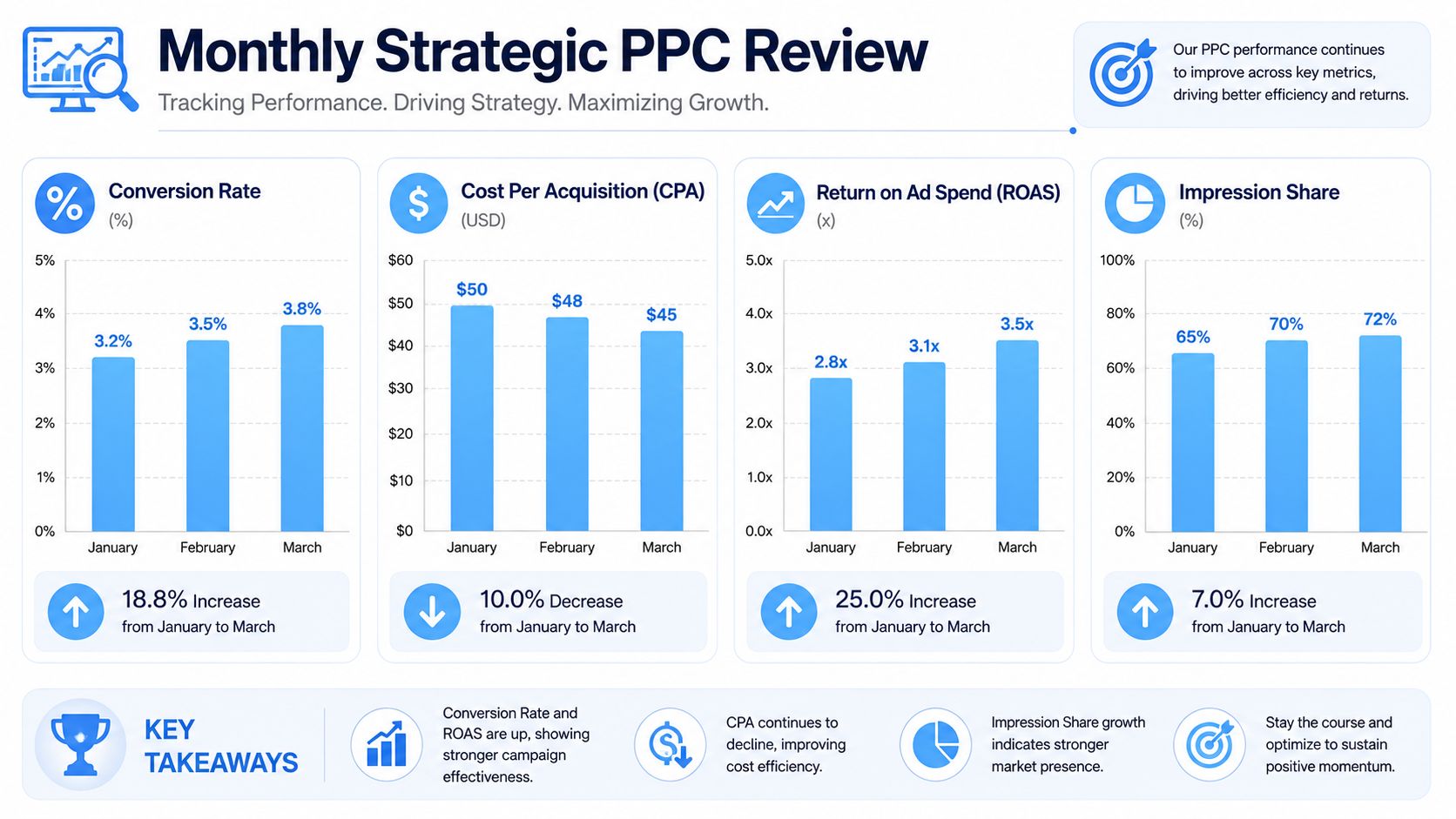
Weekly checks keep campaigns under control. Monthly reviews decide whether the account is moving in the right direction at all.
A lot of teams struggle at this point. They produce reports, comment on winners and losers, then roll into the next month without making a meaningful decision. A strategic review needs to answer harder questions. Which parts of the account deserve more investment? Which audiences aren’t worth preserving? Which messages are pulling in the wrong lead type? Where is the account becoming harder to scale?
Read trends, not platform stories
A monthly review should compare periods with enough context to expose patterns, not just fluctuations. One strong week can distort judgement. One poor week can trigger unnecessary changes.
Focus on directional questions such as:
- Are conversion patterns stable or fragile
- Are some campaigns generating volume but weaker downstream quality
- Is one device segment consuming spend without producing business value
- Are branded and non-branded campaigns being judged separately
- Is the account becoming over-reliant on one narrow pocket of demand
This is also the right time to bring CRM feedback into the room. Platform conversions matter, but businesses scale on qualified revenue, not dashboard neatness.
What the monthly review should include (PPC Management Checklist)
The strongest monthly reviews usually combine narrative, segmentation, and decisions. A simple checklist works well:
| Review area | What to ask | Decision type |
|---|---|---|
| Audience quality | Which segments convert into real opportunities | Increase, reduce, or exclude |
| Device performance | Does mobile, desktop, or tablet create different lead quality | Adjust modifiers, page UX, or call routing |
| Geography | Are some locations efficient but underfunded | Shift budget by region |
| Campaign role | Which campaigns capture demand versus support it | Judge by role, not one shared KPI |
| Landing page contribution | Where is page friction suppressing strong traffic | Prioritise CRO work |
Monthly reporting should end with decisions, not observations. If nothing changes after the review, it wasn’t strategic.
The questions worth asking in the room
A good monthly PPC review sounds less like a platform update and more like a commercial conversation.
Ask questions such as:
- Are we paying for traffic that sales wouldn’t want more of?
- Has the account become too broad in pursuit of volume?
- Are we still targeting the business we were three months ago, or the one we are now?
- Which campaign should receive the next pound of budget, and why?
Those questions matter more than polished charts. They force your PPC programme to stay tied to growth, margin, and sales reality.
PPC Management Checklist: The Growth and Scaling Checklist
Scaling PPC isn’t the same as increasing spend. Plenty of accounts spend more, only to expose the same inefficiencies at a higher cost. Real scaling happens when a business knows what it can repeat, what it can expand, and what it should leave alone.
That distinction matters for UK SMEs because growth often happens with limited data. Volume may be concentrated in one city, one service line, one product category, or one high-intent search theme. If you scale too early, you end up buying weaker traffic under the illusion of progress.

Expand in layers, not all at once
The safest growth path is usually sequential.
Start by expanding what’s already proving intent. That could mean widening keyword coverage within a profitable service area, pushing stronger campaigns into nearby regions, or opening ad schedules where performance has been stable. After that, test adjacent channels or more advanced campaign types.
For UK B2B businesses, one practical allocation model is a three-platform mix of 60% to 70% on Google Ads, 20% to 25% on LinkedIn Ads, and 10% to 15% on Microsoft Ads, according to White Hat SEO’s PPC management guidance. The logic is straightforward. Google provides the broadest demand capture, LinkedIn gives precise job-title and company targeting, and Microsoft can pick up enterprise traffic that is often lower volume but commercially valuable.
Use this scaling decision filter (PPC Management Checklist)
Before increasing budget or adding channels, check these conditions.
- Lead quality is stable. More volume only helps if the downstream quality holds up.
- Tracking is already reliable. Scaling bad measurement just creates expensive confusion.
- Search term control is mature. Broad expansion without tight negatives usually inflates waste.
- Landing pages are conversion-ready. If pages already struggle at current traffic levels, more spend magnifies the problem.
- There is a clear expansion hypothesis. “Let’s spend more” isn’t a strategy.
Scale the parts of the account you understand. Leave the rest in testing mode until the data earns trust.
Be careful with Performance Max
Performance Max can work well, but it is commonly launched too early in SME accounts. Google’s algorithms typically need 30 to 50 conversions per month per campaign to move beyond the learning phase and produce more stable ROI, according to Citric Media’s UK SME PPC campaign checklist.
That threshold changes the conversation. If you don’t have enough conversion volume in a campaign, PMax often behaves like a black box with too little signal. That’s especially problematic in UK accounts where demand can be split regionally rather than concentrated nationally.
A practical scaling path looks like this:
- Prove demand in Search first
- Consolidate conversion tracking and audience signals
- Reach sustainable monthly conversion volume
- Launch PMax with clear asset groups and exclusions
- Judge it against account-wide contribution, not novelty
The same rule applies to any automation. Automation works best when the account already has strong inputs.
PPC Management Checklist: The Agency and Tools Checklist
There comes a point where the internal team can’t keep carrying PPC properly. That point usually arrives before the business admits it. Campaigns become too numerous, reporting expectations rise, tracking needs get more technical, and no one has the time to both manage the account and challenge its direction.
That’s when you need to decide whether better tooling is enough or whether specialist support will save more than it costs.
What to check before hiring an agency
A good agency should bring structure, challenge, and accountability. A weak one will only add meetings to an already messy process.
One credential is worth checking early. Only 3% of UK PPC agencies achieve Google Premier Partner status, according to Aether Agency’s guide to expert Google Ads management in the UK. That doesn’t guarantee fit, but it does tell you the agency operates at a high level of spend and performance management.
The same source also notes that average monthly retainers for SMEs typically range from 10% to 20% of ad spend. That’s useful because it gives you a commercial benchmark before you enter sales conversations.
The right evaluation criteria (PPC Management Checklist)
Don’t judge an agency on confidence alone. Judge it on operating behaviour.
- Account ownership. You should retain access and visibility.
- Tracking competence. Ask how they handle CRM imports, GA4 alignment, and conversion definitions.
- Reporting quality. Look for decision-ready reporting, not decorative dashboards.
- Optimisation cadence. Ask what gets reviewed weekly, monthly, and at scaling points.
- Commercial understanding. They should talk about lead quality, sales outcomes, and margin, not just clicks.
If you’re reviewing software support alongside agency help, this overview of pay-per-click software is a useful reference point for what tools can and can’t solve on their own.
When tools are enough, and when they aren’t
Tools are helpful for visibility, reporting, scripts, feed management, and workflow discipline. They are not a substitute for judgement.
Use tools when the problem is operational. Bring in specialists when the problem is strategic, technical, or commercial. That includes situations such as:
| Situation | Tools may help | An agency usually helps more |
|---|---|---|
| Reporting is slow | Yes | Sometimes |
| Feed issues need monitoring | Yes | Sometimes |
| Tracking and attribution are unreliable | Limited | Yes |
| Budget allocation is unclear | Limited | Yes |
| Scale decisions feel risky | Limited | Yes |
The right partner should make the account simpler to understand, not harder. If their process adds mystery, keep looking.
The best agencies don’t just manage platforms. They create decision-making discipline your business can keep using as it grows.
From Checklist to Continuous Growth
Strong PPC management has a rhythm. First you fix the foundation. Then you maintain the account weekly. Then you review performance monthly with enough distance to make better decisions. Then, only when the account has earned it, you scale.
That cycle is what turns PPC from a stressful spend line into a controllable growth channel.
For growing UK businesses, that matters more than ever. Costs are tighter, privacy rules are stricter, and automation rewards clean inputs rather than wishful thinking. A checklist gives you control over those variables. It helps your team spot waste earlier, act with more confidence, and scale based on evidence instead of urgency.
Use the complete PPC management checklist for growing businesses as an operating standard, not a one-off exercise. The businesses that do this well aren’t necessarily the ones spending the most. They’re the ones making better decisions more consistently.
If you want an expert second opinion on your account, PPC Geeks can help. Their UK team specialises in Google Ads and multi-platform PPC management for SMEs, ecommerce brands, and busy marketing teams that need cleaner tracking, tighter optimisation, and a clearer path to profitable growth.