




Trying to get a rapid increase in website traffic often feels like a simple equation: drive good visitors through ads and SEO, then make sure your website converts them. But hold on. Before you spend a single pound on a campaign, you need to build a solid foundation. Get this wrong, and you’re just throwing money away.
Build a Powerful Foundation for Sustainable Website Traffic Increase
Pouring cash into ads without a proper setup is like trying to fill a leaky bucket. You might see a short-lived spike in visitors, but real, profitable growth will always feel just out of reach. The secret isn’t just about getting more clicks; it’s about making every single one of them count.
It all starts with measurement. If you can’t track what’s working and what isn’t, you’re flying blind. Setting up precise conversion tracking is absolutely non-negotiable, yet it’s shocking how many UK SMEs get this wrong.
Master Your Metrics with Conversion Tracking
Think of conversion tracking as your business’s GPS. It shows you exactly which ads, keywords, and channels are actually driving valuable actions – think form fills, phone calls, or actual sales. Without this data, you’re left guessing, optimising your campaigns based on vanity metrics like clicks and impressions.
Imagine a local plumbing service running Google Ads. They might get 200 clicks a day, which sounds great. But if they have no idea how many of those clicks turned into a booked appointment, the data is useless. Proper tracking ties that final sale directly back to the specific ad that brought them in.
Here’s what you can do with effective tracking:
- Spot the Winners: Pinpoint which campaigns are delivering the best return, so you can double down on what works.
- Cut the Losers: See which keywords or ad copy are just burning cash and either pause them or completely rethink your message.
- Calculate True ROI: Finally move beyond guesswork and know your exact Cost Per Acquisition (CPA) and Return on Ad Spend (ROAS).
The core principle is simple: what gets measured gets managed. Accurate tracking is the bedrock of any successful digital marketing effort, turning ambiguous data into actionable intelligence that drives real business growth.
Define Goals That Actually Drive Business Growth (Website Traffic Increase)
Once your tracking is locked in, you need to define what success really looks like. So many businesses make the mistake of chasing traffic for traffic’s sake. Your goals have to be tied to tangible business outcomes.
Instead of a vague aim like “get more website visitors,” set specific, measurable Key Performance Indicators (KPIs). For an ecommerce brand, a great goal might be to hit a 4:1 ROAS – for every £1 you spend on ads, you generate £4 in revenue. For a B2B service, it might be generating 50 qualified leads a month at a CPA of under £50.
These concrete targets give you clarity and focus, guiding every single decision you make. You can find more practical advice in our guide on digital marketing for small businesses, which dives deeper into setting goals that matter.
Create a High-Performing Website Experience
Your website is the final destination for all this traffic you’re working so hard to get. If the user experience is poor, you’ve wasted your time and money.
These days, your site absolutely must be mobile-first. With over 66% of UK web traffic now coming from mobile devices, a clunky mobile site is a conversion killer. On top of that, you need to pay attention to Google’s Core Web Vitals. These are the metrics Google uses to judge your site’s loading speed, interactivity, and visual stability. A slow website doesn’t just frustrate users; it gets penalised by Google, hurting your organic rankings and even making your ads more expensive.
Understand Your Ideal Customer
Lastly, every single marketing action you take should be aimed at a clearly defined audience. If you don’t know who you’re talking to, your message will fall flat.
Creating detailed customer personas helps you get inside the head of your ideal buyers. You’ll understand their motivations, their biggest pain points, and where they hang out online. For example, a luxury skincare brand’s persona might be “Marketing Manager Maria,” a 35-year-old professional who values sustainable ingredients and follows specific beauty blogs. This insight shapes everything—from the ad copy you write to the social media platforms you target—ensuring your message truly connects with the right people.
Website Traffic Increase: Drive Immediate Traffic with Paid Advertising Channels
While SEO is your long game for building a sustainable, organic asset, sometimes you just need results now. When you need to see a rapid traffic website increase, paid advertising is the accelerator pedal. It puts your brand squarely in front of high-intent customers the very moment you flick the switch on a campaign.
Essentially, you’re buying speed and precision. Paid channels offer a direct line to qualified visitors who are actively searching for what you do. Instead of waiting months for organic rankings to climb, you can start generating leads and sales almost overnight, bringing in crucial cash flow and giving you invaluable market data from day one.
The real trick is to move beyond just boosting posts or running a few basic search ads. A proper, multi-platform strategy lets you intercept different parts of your audience at various stages of their buying journey, ensuring every penny of your budget works harder and smarter.
Mastering Google Ads for Immediate Impact
For the vast majority of UK businesses, Google Ads is the undisputed starting point. It’s an absolute powerhouse for capturing active demand—that is, people with a problem who are typing potential solutions into the search bar. But getting it right takes more than just throwing money at keywords.
A well-structured account is non-negotiable. Think of it like organising a shop. You wouldn’t just dump all your products in one big pile, would you? You’d group them into logical aisles (ad groups) and categories (campaigns). This structure is what allows you to write hyper-specific ad copy that speaks directly to a searcher’s query, which in turn dramatically improves your click-through rates and Quality Score.
For instance, a furniture retailer should never lump “oak dining tables” and “leather sofas” into the same ad group. By splitting them, they can create ads that talk about solid oak craftsmanship to one audience, and plush leather comfort to the other.
Beyond the classic search ad, you need to be using these powerful campaign types:
- Google Shopping: An absolute must for any ecommerce business. Your secret weapon here is a well-optimised product feed. Focus on high-quality images, keyword-rich titles and descriptions, and sharp pricing to win that click.
- Performance Max (PMax): This is Google’s all-in-one campaign type, using machine learning to push ads across Search, Display, YouTube, and more. It craves conversion data to work well, so make sure your tracking is flawless before you dive in.
- Search Ads: The bread and butter. This is where you target high-intent, money-in-hand keywords like “emergency plumber in Bristol” to capture people who are ready to buy or enquire right now. If you want to get the most out of your campaigns, check out our expert tips for optimising Google Ads with smart bidding.
A common mistake we see all the time is the “set it and forget it” approach. Paid advertising demands constant attention. Regularly digging into search term reports, making bid adjustments, and testing ad copy are what separate the profitable accounts from the ones that just burn cash.
The Hidden Opportunity in Microsoft (Bing) Ads (Website Traffic Increase)
While Google gets all the headlines, completely dismissing Microsoft Advertising (formerly Bing Ads) is a huge missed opportunity. Its user base often skews a little older, is more affluent, and typically has higher purchasing power—a dream demographic for many businesses.
But here’s the real kicker: less competition. This nearly always translates to a lower Cost Per Click (CPC) and a higher Return on Ad Spend (ROAS) compared to Google. For a UK SME, that means your advertising budget can stretch a lot further and deliver more profitable results. We often see clients achieve a 15-20% reduction in CPCs on Microsoft Ads for the exact same keywords.
Choosing where to invest your ad spend is a critical decision. Each platform has its own strengths and is suited for different business goals.
Table: Choosing Your Paid Channel for Maximum Impact
| Channel | Best For | Audience Targeting | Primary KPI |
|---|---|---|---|
| Google Ads | Capturing high-intent users actively searching for products or services. Ideal for lead generation and direct sales. | Keyword-based, targeting users based on what they’re searching for right now. | Cost Per Acquisition (CPA), Return on Ad Spend (ROAS) |
| Microsoft Ads | Reaching an older, often more affluent demographic with less competition and lower CPCs. | Similar to Google Ads but with a distinct user base on the Bing search engine. | Lower CPC, higher ROAS |
| Meta Ads (Facebook & Instagram) | Generating demand and building brand awareness through visual storytelling and precise audience segmentation. | Based on demographics, interests, behaviours, and lookalike audiences. | Reach, Engagement, Cost Per Lead (CPL) |
| TikTok Ads | Reaching a younger, highly engaged audience with creative, short-form video content. Excellent for brand discovery. | Based on interests, user interactions, and demographic data. | Video Views, Brand Awareness, Clicks |
By understanding the unique advantages of each channel, you can build a more robust, multi-faceted paid advertising strategy that covers all bases.
Connecting Through Social and Visual Platforms
Search ads are fantastic for capturing existing intent, but social ads are all about creating demand. Platforms like Meta (Facebook and Instagram) and TikTok let you get in front of potential customers before they even realise they need you, using incredibly sophisticated demographic, interest, and behavioural targeting.
Imagine you sell bespoke garden furniture. On Meta, you can build an audience of users who have shown an interest in gardening, home improvement shows, and even your competitors’ brands. With a compelling video or a slick carousel ad showcasing your products in beautiful settings, you can plant the seed of desire and drive them to your site.
This is especially powerful for ecommerce brands. With the rise of social commerce, you can now take a user from discovery to purchase without them ever having to leave the app. The UK internet advertising market is growing at a staggering rate, projected to hit £44 billion by 2028 and account for 85% of all ad spend. This boom is creating huge opportunities for SMEs to increase website traffic, particularly through retail media and video ads—formats perfectly suited for social platforms.
Ultimately, a multi-platform strategy is the surest way to achieve a significant and sustained increase in website traffic. By blending the immediate, high-intent traffic from search with the brand-building, demand-generating power of social media, you create a marketing engine that delivers a consistent stream of qualified visitors.
Website Traffic Increase: Achieve Long-Term Growth with Foundational SEO
Paid ads are great for a quick hit of traffic, but if you’re playing the long game, Search Engine Optimisation (SEO) is where you build real, sustainable value. Think of it as investing in your digital storefront. The work you put in now pays dividends for years, steadily bringing in free, organic traffic without you having to pay for every single click.
But let’s be clear: SEO isn’t some mystical dark art. It’s a methodical process that really boils down to three core pillars: a solid technical setup, smart on-page optimisation, and genuinely helpful content. Get these right, and you’ll build a powerful growth engine for your brand.
Building a Strong Technical Foundation
Before you do anything else, you need to get your technical house in order. This is the absolute bedrock of your SEO strategy. If search engines can’t easily find, crawl, and make sense of your pages, even the most brilliant content will be lost in the digital wilderness. It’s like having a fantastic shop with the doors bolted shut.
Start by getting a handle on these critical technical bits:
- Site Speed: People are impatient. They expect pages to load almost instantly. A slow site not only frustrates potential customers but also gets you penalised by Google, hurting your chances of a lasting traffic website increase.
- Mobile Usability: It’s no secret that most of your UK customers are browsing on their phones. Your site absolutely must deliver a seamless experience on mobile. This is non-negotiable.
- Logical Site Structure: A well-organised website with a clear hierarchy doesn’t just look good. It helps both users and search engine bots understand what your site is all about and find what they need, fast.
A common mistake I see is treating technical SEO as a one-and-done job. In reality, it needs constant attention. Regular health checks are crucial to make sure your site stays fast, secure, and accessible as it grows.
Mastering On-Page SEO for Maximum Relevance (Website Traffic Increase)
With a solid technical foundation in place, it’s time to zoom in on your individual pages. This is your chance to tell Google precisely what each page is about, making sure you appear for the searches that actually matter. On-page SEO is all about aligning your content with what your customers are looking for.
It all starts with keyword research. You have to get inside your customers’ heads and figure out the exact phrases they’re typing into Google. This isn’t about guesswork; it’s about using data to uncover real opportunities. To get you started, you can check out our guide on the best free keyword research tools.
Once you’ve got your target keywords, you need to use them wisely:
- Title Tags: This is your most powerful on-page signal. Make it compelling and be sure to include your primary keyword.
- Meta Descriptions: While not a direct ranking factor, a good meta description is your sales pitch in the search results. It needs to convince people to click on your link, not a competitor’s.
- Headings (H1, H2, H3): Use headings to give your content a logical structure. It makes it easier for people to read and helps you naturally work in your main and secondary keywords.
- Internal Linking: Don’t forget to link between relevant pages on your own site. This helps spread authority and guides users (and Google) to other useful content, keeping them engaged for longer.
Creating Content That Drives Organic Traffic
Content is the fuel that powers your entire SEO engine. High-quality, genuinely valuable content is what earns you top rankings, attracts links from other sites, and builds trust with your audience. Instead of just pushing product pages, the smartest brands create resources that actually solve their customers’ problems.
Imagine you sell running shoes. You could write blog posts like “The Ultimate Guide to Choosing Running Shoes for Beginners” or “5 Common Running Injuries and How to Prevent Them.” This kind of content catches potential customers early on, positioning your brand as a trusted authority before they’re even ready to buy.
The sheer scale of search in the UK makes this strategy incredibly powerful. Take Google.com, for instance—it remains the UK’s traffic powerhouse, pulling in 172 million unique visitors in a single month. A strong organic presence allows you to tap into this massive audience without paying for every visit.
By combining a clean technical setup, sharp on-page optimisation, and a strategy for creating genuinely useful content, you build a resilient foundation for long-term growth. This is how you stop renting traffic and start owning it.
Website Traffic Increase: Amplify Your Reach with Smart Content Distribution
Hitting ‘publish’ on a great blog post and just hoping for the best is a sure-fire way to go nowhere, fast. We see it all the time. Creating brilliant content is only half the battle; the other half is making absolutely certain the right people actually see it. This is where smart content distribution turns your one-off efforts into a reliable system for a lasting traffic website increase.
Without a clear plan to push each piece out there, even the most insightful article will just gather digital dust. Instead of a “publish and pray” mindset, you need to start treating every bit of content as a valuable asset with multiple lives. This approach squeezes every last drop of value from the time and money you’ve already invested.
Repurpose a Single Asset into Many
Think of a single, well-researched blog post not as a finished product, but as the raw material for a dozen smaller pieces of content. This strategy, known as content repurposing, extends the life and reach of your work far beyond its original format. It’s all about working smarter, not harder.
Let’s say you’ve written a comprehensive guide. You can easily atomise it into several different assets, each tailored for a specific platform and audience.
Here’s what that might look like in practice:
- Social Media Carousel: Pull out five key stats or takeaways and get a visually engaging carousel designed for Instagram or LinkedIn. Each slide can hammer home one point, driving clicks back to the full article.
- Short-Form Video Script: Turn the main arguments into a punchy script for a 60-second TikTok or YouTube Shorts video. You’ll capture a completely different audience segment that prefers watching over reading.
- Infographic: Visualise the core data or the step-by-step process from your post into a shareable infographic. These are fantastic for picking up backlinks and getting shared on platforms like Pinterest.
This method multiplies your touchpoints, letting you connect with potential customers on the channels they already live on—all from one foundational piece of content. For a deeper dive, our article on content marketing for ecommerce brands explores these ideas in more detail.
Leverage Your Warmest Audience with Email (Website Traffic Increase)
While repurposing content helps you find new audiences, your email list is pure gold. These are people who have already put their hands up and shown they’re interested in what you have to say. Ignoring them is a massive missed opportunity.
Don’t just fire off an email with a link to your new post. You need to frame it in a way that highlights the value for them. Tell a short story or share a killer insight from the article directly in the email to get them curious enough to click through. This simple act of distribution to a warm audience can kickstart a significant surge of high-quality traffic.
Your email subscribers are your most loyal audience. Treating them as a primary distribution channel not only drives immediate traffic but also strengthens your relationship, turning casual readers into dedicated brand advocates.
Close the Loop with Strategic Remarketing
Here’s where you bring everything full circle. Distribution doesn’t stop after the first promotional push. The final, crucial step is to re-engage the traffic you’ve worked so hard to attract using remarketing (or retargeting).
By using tracking pixels from Google and Meta, you can build custom audiences based on what people do on your site. For instance, you could create a specific audience of everyone who read a particular blog post in the last 30 days. This is an incredibly valuable segment.
Now, you can run highly targeted ads directly to this group. Instead of a generic brand ad, you can show them an offer that’s directly related to the content they just read. If they read your guide on choosing the right running shoes, you can hit them with an ad featuring your best-selling pair. This strategic cycle transforms one-time visitors into repeat customers, gently nurturing them through their buying journey.
Your 90-Day Roadmap for Increasing Website Traffic
Theory is one thing, but you need a proper plan to get results. Let’s turn everything we’ve talked about into a practical, 90-day action plan.
I’ve designed this roadmap specifically for busy UK business owners. It breaks down the often overwhelming process of boosting traffic into manageable, focused sprints. The goal is simple: achieve a measurable traffic website increase within a single business quarter.
This isn’t about trying to do everything at once. It’s about doing things in the right order—building solid foundations first, then scaling what works, and finally optimising for long-term, profitable growth.
Days 1 to 30: Building Your Foundation
The first month is all about nailing the fundamentals and grabbing some quick wins. You have to get this right before you can even think about scaling. So many businesses rush this stage, leading to wasted ad spend and missed opportunities down the line.
Your focus for the first 30 days is on measurement, auditing, and tackling the low-hanging fruit.
Your top priorities are:
- Analytics and Tracking Audit: Go through your tracking with a fine-tooth comb. Is your conversion tracking flawless? Are you accurately measuring every lead, sale, and key interaction? Make sure your Google Analytics 4 and ad platform pixels (like the Meta Pixel or TikTok Pixel) are implemented correctly.
- Paid Campaign Review: Conduct a thorough audit of any existing Google or social media ad campaigns. Hunt for obvious budget drains, like super broad keywords that aren’t converting or ads pointing to irrelevant landing pages. Pause the clear losers immediately.
- Landing Page Optimisation: Pinpoint your top five most important landing pages. These are the ones getting the most traffic or that are critical to your sales funnel. How are they performing? Could a better headline, a simpler form, or some stronger social proof lift conversion rates?
The first 30 days are less about massive traffic spikes and more about plugging the leaks in your bucket. A small improvement in conversion rate on a key page can be more valuable than thousands of untargeted new visitors.
Days 31 to 60: Scaling and Strategic Testing
With a stronger foundation in place, month two is when you start to press the accelerator. This is all about expanding your reach and gathering crucial data through structured tests.
You’ll move from fixing what’s broken to actively building new avenues for growth, based on what you learned in the first month. It’s time to get proactive with your content and advertising, launching new initiatives to attract fresh audiences and re-engage people who have visited before but haven’t converted.
Here’s a rough timeline for how your content efforts should flow, from initial creation all the way to re-engagement, making sure you squeeze every bit of value from each piece.
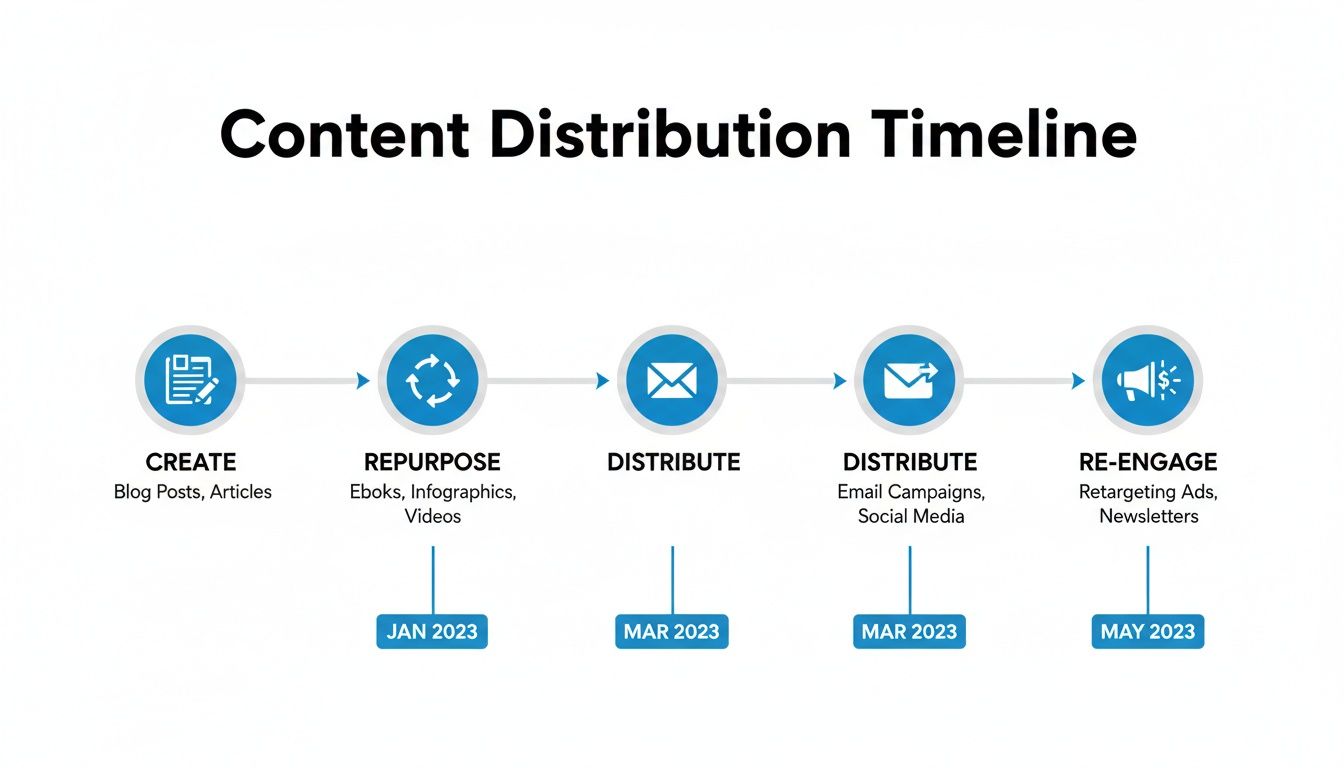
This process shows how one piece of content can be systematically repurposed and promoted across different channels to keep driving traffic over time.
Here’s what to focus on during this scaling phase:
- Launch New Ad Campaigns: Use your audit findings to launch one or two new, highly targeted campaigns. For an e-commerce brand, this could be a new Google Shopping campaign. For a B2B service, it might be a LinkedIn campaign targeting specific job titles.
- Publish Strategic Content: Create and publish at least two substantial pieces of content—think detailed blog posts or guides—targeting the keywords you identified during your initial SEO research. This is where you start building that long-term organic authority.
- Build Remarketing Audiences: Start segmenting your website visitors into custom audiences. As a minimum, create lists for “all website visitors” and “shopping cart abandoners.” Begin running simple remarketing ads to these warm audiences to bring them back.
Days 61 to 90: Optimising for Profitability
The final month is all about data-driven refinement. By now, you should have a steady stream of data coming in from both your paid and organic efforts. This is where you shift from testing and scaling to intelligent optimisation, making sure every pound in your budget is working as hard as possible.
You’ll analyse the performance from the previous 60 days to make smart decisions. That means doubling down on the strategies delivering the best return on investment and pulling back from those that aren’t.
Pay close attention to mobile performance. In the UK, mobile devices now account for over 66% of all web visits, a figure that screams for a mobile-first approach. You can learn more about these UK website traffic statistics on rebootonline.com.
During this final stretch, your key actions are:
- Analyse Performance Data: Dive deep into your analytics. Which ad campaigns have the best ROAS? Which content pieces are driving the most organic traffic?
- Refine Your Budget: Reallocate your budget based on what the data tells you. Shift more spend towards your winning campaigns and channels.
- Expand on Success: If a particular ad creative or blog topic has performed exceptionally well, create variations of it. Could you explore new channels that might attract a similar audience?
Following this 90-day plan gives you a structured, logical path to achieving a significant and sustainable traffic website increase.
Your Top Traffic Questions, Answered
Jumping into digital marketing can feel like opening a can of worms – one question just leads to another. To clear things up, we’ve tackled the most common queries we hear from UK business owners about driving a real, sustainable increase in website traffic. These are straight-talking answers from the trenches, designed to address your practical concerns.
What Should My Starting Budget Be?
There’s no magic number here, as it really boils down to how competitive your industry is and what you’re trying to achieve. That said, a realistic starting point for a UK SME dipping its toes into paid channels like Google Ads is at least £1,000–£2,000 per month.
This amount is enough to get the ball rolling and, more importantly, gather enough data for us to make smart decisions about what’s actually working. The figure you spend isn’t the most important metric; Return on Ad Spend (ROAS) is. The goal is always to invest profitably, not just burn through cash. We always advise starting with a test budget, measuring the results like a hawk, and then pouring fuel on what’s proven to work.
How Quickly Can I Expect to See Results?
This all comes down to the strategy you choose. The time it takes to see a noticeable jump in website traffic varies massively between different marketing channels.
With a well-run Pay-Per-Click (PPC) campaign on Google or Meta, you can see a significant surge in traffic within days. Seriously. The moment your ads go live, qualified visitors can start hitting your site, making PPC an incredible tool for immediate impact.
SEO, on the other hand, is a marathon, not a sprint. It’s a powerful, long-term asset that delivers incredible value over time, but you won’t see meaningful results overnight. You’re typically looking at three to six months before your organic efforts really start to bear fruit as your site builds authority and climbs the rankings.
Often, the best approach is a blend of both. Use PPC to get immediate results and gather priceless conversion data, while simultaneously building your SEO foundation for sustainable, low-cost traffic for years to come.
Should I Start with Paid Ads or SEO?
For most UK businesses that need to see rapid growth and get actionable data quickly, starting with paid advertising is almost always the smarter initial move. It brings in immediate traffic and, crucially, provides invaluable feedback on which keywords, ad copy, and offers actually convince people to buy.
You can then take these proven insights and apply them directly to your SEO strategy. This means you’re targeting keywords you know drive revenue, removing a massive amount of guesswork from your content plan.
Ideally, you’d run both in tandem. Use paid ads to capture the “ready-to-buy-now” crowd, while your SEO efforts build a resilient, long-term organic presence that reduces your reliance on ad spend and creates a much more robust engine for growth.
Ready to stop guessing and start growing? The experts at PPC Geeks create data-driven strategies that deliver a measurable increase in traffic, leads, and sales. Get your free, in-depth PPC audit today and discover how we can minimise wasted spend and maximise your ROI.


