




Seasonal PPC strategies are all about timing. It means syncing up your ad spend, your creative, and your targeting with the natural ebbs and flows of consumer demand to get the most out of every pound you spend.
It’s the simple difference between capturing a massive wave of interest during Black Friday and throwing your budget away during a quiet spell. A smart seasonal approach makes sure your ads hit the right people when they’re most ready to buy, turning those key moments in the calendar into real profit.
The Real Cost of Ignoring Seasonal PPC Trends
Overlooking seasonal shifts in your PPC strategy isn’t just a missed opportunity—it’s a direct hit to your bottom line. Too many UK B2C brands fall into the “set it and forget it” trap, running the exact same campaigns in July as they do in December. This static approach creates two massive financial holes: you overspend when demand is low and get completely outmuscled when shoppers are ready to spend.
Picture a high-street shop that doesn’t bother with Christmas decorations. While all its competitors are pulling in festive crowds with dazzling displays, its plain old storefront gets ignored. In the digital world, that mistake is a whole lot more expensive.
Putting a Number on the Damage
The data paints a pretty grim picture for businesses that don’t adapt. Recent research shows that UK companies are losing around £2.4 billion a year from various PPC mistakes. A huge chunk of that—about £98 million—is lost simply because they’re not making seasonal adjustments.
The study also found that 29% of UK businesses don’t properly change their PPC strategies to match seasonal demand. This leads to an average of 14% missed potential conversions during their most critical sales periods. You can dig into the findings on PPC performance loss to see just how widespread the problem is.
Ignoring seasonality is like trying to sell ice cream in a snowstorm. You might get a few takers, but you’re fundamentally misaligned with what the market wants, and you’re just wasting resources.
This goes way beyond tweaking a few keywords. It’s about a core misunderstanding of how your customers behave throughout the year.
The Hidden Costs Beyond Wasted Ad Spend (Seasonal PPC Strategies)
The damage doesn’t stop at your ad budget. When you fail to run timely, relevant campaigns, it creates a ripple effect that can hurt your brand in the long run.
- You look out of touch: When customers see generic ads during a major holiday, your brand seems disconnected from what’s on their minds. It screams irrelevance.
- Your Quality Scores plummet: Irrelevant ads get fewer clicks, which Google sees as a bad sign. Your Quality Scores drop, and your cost-per-click (CPC) goes up, making every lead more expensive.
- You lose ground to competitors: Your rivals who are running seasonal campaigns will snatch up the attention, clicks, and sales that should have been yours, chipping away at your market share.
Ultimately, a proactive seasonal strategy isn’t just a “nice-to-have.” It’s an essential part of doing business that protects your budget, cashes in on predictable opportunities, and strengthens your brand’s relationship with its audience. The cost of doing nothing is just too high to ignore.
Seasonal PPC Strategies: How to Build Your Year-Round PPC Calendar
A solid seasonal PPC strategy is all about preparation. If you’re waiting for the first Black Friday emails to land in your inbox, you’re already too late. By then, your competitors have already scooped up the early birds. A proactive, year-round PPC calendar is the single most important tool you have to stay ahead and launch with confidence, every single time.
This isn’t just about sticking Christmas on the calendar and calling it a day. It’s about building a strategic timeline that maps out every key moment for your specific UK audience, from major bank holidays to those niche industry peaks that others might miss.
Pinpoint Your High-Impact Periods
First things first, you need to figure out when your customers are most likely to buy. This is a mix of digging into your own data and keeping an eye on wider trends. Don’t just guess; let the numbers tell the story.
Start by looking at your own historical sales data in Google Analytics or your e-commerce platform. Go back at least two years and pinpoint the weeks and months where you saw natural spikes in revenue and conversions. This is your goldmine – it shows your unique business cycles.
Next, zoom out with a tool like Google Trends. You can analyse search interest for your main product categories over time. For example, a UK gardening supplier would see a predictable surge for “garden furniture” from March to June. This helps validate what you’re seeing in your own data and might even uncover opportunities you hadn’t considered.
Here’s a quick checklist to get you started:
- Major UK Holidays: Christmas, Easter, Bank Holidays (May, August).
- Retail Events: Black Friday, Cyber Monday, January Sales, Amazon Prime Day.
- Life Events: Back to School, Valentine’s Day, Mother’s Day, Father’s Day.
- Industry-Specific Peaks: “New Year, New Me” for fitness brands in January, festival season for fashion retailers in summer, or the home improvement rush in spring.
The following infographic really drives home the difference between a reactive approach and a strategic, well-planned seasonal calendar.
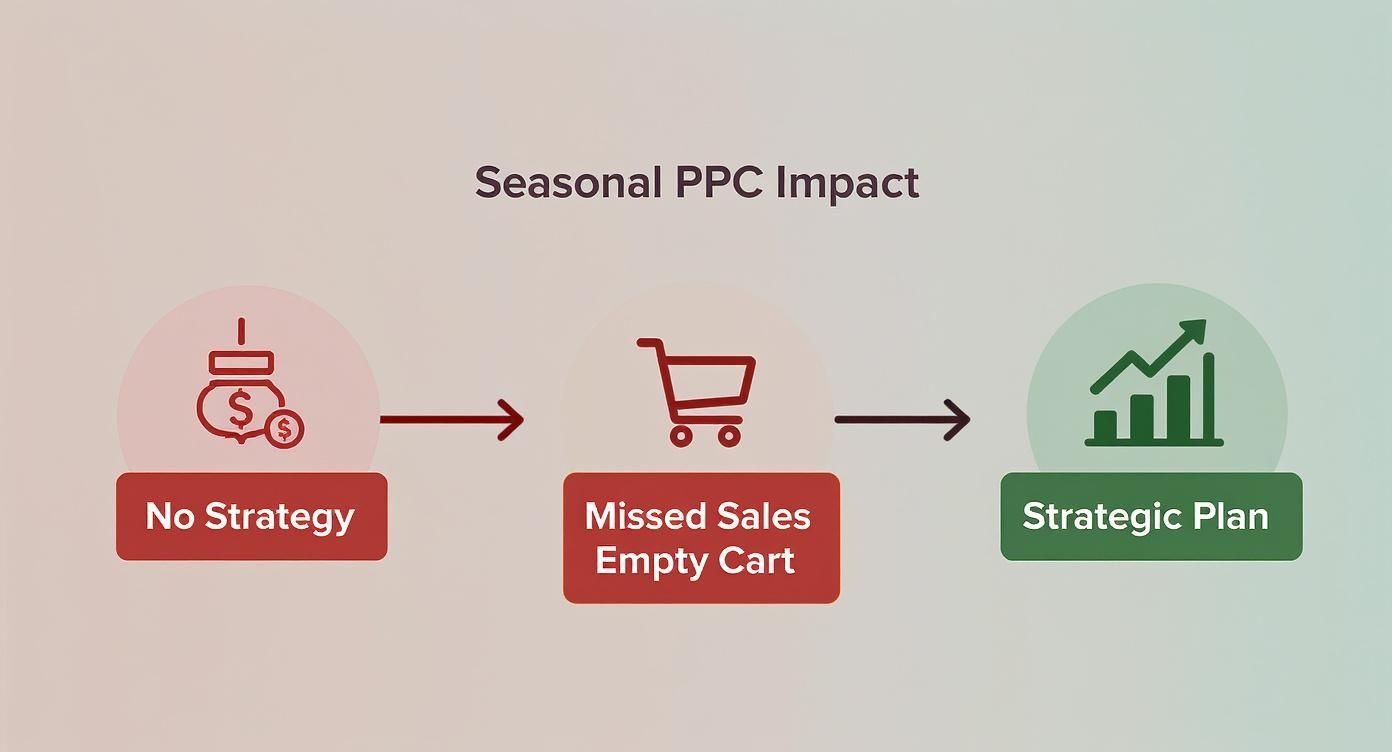
As you can see, shifting from no strategy to a well-defined plan is what turns wasted spend into profitable growth and stops you from leaving sales on the table.
Define Clear Seasonal Goals (Seasonal PPC Strategies)
Once you know your key seasons, you need to set specific, measurable goals for each one. Not every seasonal campaign is about the same thing.
For instance, your goal for a January fitness campaign might be brand awareness and lead generation, grabbing the attention of people with new resolutions. Your Black Friday goal, on the other hand, is almost certainly about immediate sales and maximising ROAS (Return on Ad Spend). Defining these goals upfront dictates your entire approach, from ad copy to budget. To get this right, it’s worth exploring different data strategies for PPC planning to ensure your goals are backed by solid insights.
A common mistake is treating every seasonal event as a direct sales push. Sometimes, the goal is to build your remarketing list or test a new product line before a bigger peak. Match the goal to the season’s intent.
Create a Reverse-Engineered Timeline
With your seasons and goals locked in, it’s time to build the actual calendar. I always recommend working backwards from your launch date. This simple trick prevents that last-minute scramble that always leads to sloppy mistakes and missed deadlines.
Let’s use a “Back to School” campaign launching in mid-August as an example:
- 8 Weeks Out (Mid-June): Finalise campaign goals, the overall budget, and core messaging concepts. Get the big picture sorted.
- 6 Weeks Out (End of June): Kick off creative development. This means briefing designers on ad imagery, video assets, and any banners for your landing pages.
- 4 Weeks Out (Mid-July): Start building the campaign structures in Google Ads. This is when you do your keyword research, organise ad groups, and set up your initial audience targeting.
- 2 Weeks Out (End of July): Get all creative assets finalised and uploaded. Double-check your product feeds for accuracy and make sure landing pages are live and working as they should.
- 1 Week Out (Early August): Run final quality assurance checks on everything – all campaigns, tracking, and links. No surprises on launch day.
- Launch Day: Activate the campaigns and start monitoring performance like a hawk.
As you map out your PPC calendar for the year, it’s also a great idea to build an effective social media content calendar. Aligning your PPC and social efforts ensures your message is consistent and powerful across all platforms. This structured approach transforms seasonal PPC from a chaotic rush into a predictable, manageable, and highly profitable process.
Seasonal PPC Strategies: Structuring Campaigns for Peak Performance
The biggest mistake I see brands make with seasonal PPC is just duplicating last year’s campaigns and hitting ‘go’. Honestly, that’s leaving money on the table. Real peak performance comes from building campaigns from the ground up, designed specifically for that moment in time.
It means getting into the nuts and bolts of your account structure across Google Ads, Meta, and wherever else you’re running ads. A generic, year-round campaign just can’t compete when things get heated. You need dedicated campaigns that speak directly to what a seasonal shopper is thinking, whether they’re desperately searching for “last-minute Christmas gifts for dad” or browsing for a “women’s summer dresses sale.” This granular approach is what gives you proper control over your budget, bidding, and messaging.
Tailoring Search and Shopping Campaigns
For your bread-and-butter Search and Shopping campaigns, the game is all about separation and specificity. Don’t just chuck a few seasonal keywords into your existing “always-on” campaigns. It dilutes your budget and makes it impossible to see the true impact of your seasonal push.
Instead, build out entirely new, season-specific campaigns. This is non-negotiable. It lets you ring-fence a dedicated budget and get aggressive with seasonal bidding strategies without messing up the performance of your core campaigns.
Let’s say you’re a fashion retailer. Your standard campaign might target “women’s dresses.” For peak season, the structure would look completely different:
- Summer Campaign: A dedicated campaign hitting keywords like “floral summer dresses,” “linen midi dress,” and “beach holiday outfits.” All the ad copy would be screaming about sunshine and warm weather.
- Winter Clearance Campaign: A totally separate campaign zeroed in on terms like “winter dress sale,” “long sleeve dress discount,” and “end of season clearance.” The ad copy here is all about urgency and grabbing a bargain.
This separation ensures your ads and landing pages are laser-focused on what the user is looking for, right now.
Pro Tip: Use campaign-level negative keyword lists to stop your seasonal and evergreen campaigns from fighting each other for traffic. For example, add “summer” and “holiday” as negatives to your core dress campaign. This forces all that juicy seasonal traffic into the right place.
Optimising Your Product Feeds (Seasonal PPC Strategies)
Your product feed is the absolute backbone of any good Shopping or Performance Max campaign, yet it’s so often overlooked during seasonal planning. Getting your feed prepped with seasonal attributes is a massive lever for improving relevance and performance.
You can add custom labels to your feed to segment products for different promotions. For instance, a gift shop could create labels like christmas_gift, valentines_day, or mothers_day_top_pick. You then use these labels to create specific product groups in your Shopping campaigns, which lets you bid much more aggressively on your hero seasonal products.
On top of that, tweaking your product titles and descriptions with seasonal terms can make a huge difference. A generic title like “Scented Candle” becomes so much more powerful when it’s “Luxury Spiced Apple Scented Christmas Candle.” It’s a simple change, but it directly answers a seasonal search and will boost your click-through rate.
Leveraging Performance Max for Seasonal Events
Performance Max (PMax) needs a slightly different mindset. Since PMax automates targeting across all of Google’s inventory, your control comes from the inputs you give it: asset groups and audience signals.
For a big seasonal event like Black Friday, create a dedicated, time-bound PMax campaign. Don’t just add new assets to your existing one. A fresh campaign signals to the algorithm that it needs to learn and optimise aggressively for this specific, short-term goal. To really nail the biggest shopping season, using a psychology-based Black Friday strategy to inform your campaign structure is a must.
Inside this new seasonal PMax campaign, build out asset groups that are tightly themed around the event.
- Asset Groups: Create distinct groups for different promotions or product categories. For a “Back to School” campaign, you might have one asset group for “laptops and tech,” another for “stationery essentials,” and a third for “student backpacks.” Each one needs its own tailored images, videos, and ad copy.
- Audience Signals: This is your chance to guide the PMax algorithm, and it’s crucial for speeding up the learning phase. Feed it strong signals like remarketing lists of past seasonal shoppers, customer match lists from last year’s event, and custom segments built around seasonal search terms and competitor websites.
By structuring your campaigns with this level of detail, you shift from simply taking part in a season to actually dominating it. You get the control you need to put your budget where it counts, deliver killer creative, and ultimately, drive more sales when it matters most.
Seasonal PPC Strategies: Mastering Your Seasonal Budgets and Bids
Nailing your PPC budget during a seasonal peak can feel like a high-wire act. If you go too low, you’ll miss the surge in demand. Spend too much, too early, and you’ll have nothing left in the tank just as conversion rates are hitting their peak. It’s all about finding that sweet spot to cash in on the excitement without just burning through your budget.
This isn’t simply about cranking up your daily spend. A smart seasonal budget strategy is about allocating your funds with surgical precision, making sure every pound works its hardest when it counts the most.
Front-Loading Budgets to Capture Early Birds
A classic mistake is saving the bulk of the budget for the last few days of a sale. But here’s the thing: savvy shoppers start their research weeks, sometimes months, in advance. In fact, research shows that a staggering 49% of consumers kick off their festive shopping in October or even earlier.
By front-loading a chunk of your budget, you get in front of these early birds while they’re still figuring out what to buy. This initial push is brilliant for building up your remarketing lists with high-intent users you can hit later on. It’s a strategic play that really pays off when the real rush begins.
To get a rough idea of what this might look like, you can use a specialised AdWords budget calculator to model different spending scenarios before the season officially starts.
Using Automated Bidding with Seasonal Adjustments (Seasonal PPC Strategies)
Trying to rely on manual bidding during a hectic seasonal event is a recipe for disaster. You just can’t react fast enough. Automated bidding strategies like Target CPA (Cost Per Acquisition) or Target ROAS (Return on Ad Spend) are absolutely essential for responding to real-time market shifts.
But even these clever algorithms need a bit of a helping hand to shine during short, sharp sales peaks. This is where Google Ads’ seasonality adjustments feature is an absolute game-changer.
Think of seasonality adjustments as giving your Smart Bidding algorithm a heads-up about a party you’re about to throw. You’re telling it, “Expect a huge spike in conversion rates from this date to this date, so don’t be afraid to bid more aggressively to get those sales.”
This is perfect for events like a bank holiday weekend sale or the week of Black Friday. By telling Google to expect, say, a 30% increase in conversion rates over a 72-hour period, you give the system permission to bid higher and capture that valuable traffic without being overly cautious.
Here’s a real-world example:
- Event: A 4-day Easter weekend sale for a home decor brand.
- Historical Data: Last year, conversion rates were 50% higher than usual during this period.
- Action: Create a seasonality adjustment for the 4-day window, telling Google to anticipate a +50% conversion rate. The Target ROAS strategy will then automatically push bids up to compete for those top spots during this critical time.
Monitoring Performance and Knowing When to Adapt
Even the best-laid plans can go sideways. Seasonal markets are unpredictable, so you have to be ready to pivot. Keep a close eye on your key metrics throughout the day—not just in your morning check-in.
Key Metrics to Watch:
- Cost Per Acquisition (CPA): Is your CPA staying within your target range? A slight increase during a peak is often fine if the conversion volume justifies it, but a runaway CPA needs immediate attention.
- Return on Ad Spend (ROAS): This is your ultimate measure of profitability. If ROAS starts dipping below your break-even point, it might be time to pull back on bids or shift the budget to campaigns that are actually delivering.
- Impression Share: Are you losing out to competitors because of budget or rank? If your impression share is low but your ROAS is high, that’s a massive green light to increase your budget and capture more of those profitable sales.
By combining proactive budget allocation with smart bidding tools and keeping a hawk-eye on performance, you stop just spending money and start strategically investing it. This approach transforms the chaos of a seasonal rush into a controlled, highly profitable exercise that ensures you capture the maximum B2C sales possible.
Seasonal PPC Strategies: Creating Ad Copy and Creative That Converts

All the strategic planning in the world means very little if your ads don’t actually resonate with people. Your creative—the mix of your ad copy, images, and videos—is that final, critical bridge between your campaign structure and a sale. During seasonal peaks, generic creative simply gets lost in the noise.
To truly stand out, your ads need to plug directly into the seasonal mindset. This means mirroring the excitement, urgency, and specific needs of your audience at that very moment. It’s about more than just slapping a Santa hat on your logo; it’s about crafting a message that feels immediate, relevant, and impossible to ignore.
Writing Headlines That Drive Immediate Action
During a seasonal rush, your ad headline has a split second to grab attention and create a powerful sense of urgency. The fear of missing out (FOMO) is your most effective tool here. People are actively hunting for deals and deadlines, so give them exactly what they’re looking for.
Vague offers like “Great Deals” or “Shop Now” are just weak. They don’t cut it. Instead, you need to be specific and time-sensitive, focusing on language that prompts an immediate click.
- Highlight Deadlines: “Last Day for Christmas Delivery” or “Bank Holiday Sale Ends Monday!”
- Show Scarcity: “Limited Stock – While It Lasts” or “Only 50 Left at This Price.”
- Emphasise the Event: “Black Friday Doorbusters Are Here” or “Our Biggest Easter Sale Ever.”
These headlines work because they create genuine urgency and align perfectly with a shopper’s mission-critical mindset during a sale.
Your ad copy needs to answer the user’s unspoken question: “Why should I click this right now?” If the answer isn’t compelling, they’ll scroll right past you and click on a competitor’s ad that is.
The Power of Hyper-Relevant Seasonal Creative (Seasonal PPC Strategies)
Let’s look at a practical example. Imagine a furniture store running ads for a sofa. The difference between a generic, evergreen ad and a hyper-relevant seasonal one is night and day.
Before: The Generic Ad
- Headline: High-Quality Sofas For Sale
- Description: Discover our range of comfortable and stylish sofas. Free delivery on all orders. Shop our collection today.
- Image: A standard product shot of a sofa in a plain white room.
After: The Hyper-Relevant Christmas Ad
- Headline: Get Your New Sofa Before Christmas!
- Description: Last chance for pre-Christmas delivery! Make room for the whole family this festive season. Order by 15th December.
- Image: The same sofa in a cosy, decorated living room with a Christmas tree and a family enjoying themselves.
The second ad is infinitely more powerful. It taps into a specific seasonal need (hosting family), creates a hard deadline, and uses imagery that helps the customer visualise the product in their own festive home. It’s no longer just a piece of furniture; it’s the solution to a seasonal problem. You can find more inspiration for compelling ad copy by looking at some top-tier ChatGPT ad examples that nail this kind of creative thinking.
Optimising the Journey From Ad to Checkout
A brilliant ad is completely wasted if it sends users to a generic, uninspiring landing page. That seasonal experience must continue seamlessly from the first click all the way to the checkout. Your landing page needs to instantly confirm that the user has landed in the right place.
Make sure your landing pages are kitted out with:
- Seasonal Banners: The hero image or banner should match the ad creative and seasonal theme. No disconnects.
- Curated Collections: Create dedicated sections like “Top Christmas Gifts for Her” or “Back to School Essentials.” This makes browsing easier and is a great way to increase the average order value.
- Countdown Timers: Add a dynamic countdown timer to your landing page that syncs with your ad’s deadline. Seeing the minutes tick down is a powerful psychological nudge to complete the purchase.
By aligning your ad creative, copy, and landing pages, you create a cohesive and persuasive journey. You’re guiding users from interest to conversion and making the absolute most of every click you pay for.
Seasonal PPC Strategies: Turning This Season’s Data Into Next Year’s Wins
Once the seasonal rush dies down and the last sale is tallied, the real work begins. The campaign might be over, but you’re now sitting on a goldmine of data. This post-season analysis is the crucial step that transforms a one-off successful event into a repeatable, long-term growth strategy.
Don’t just file the report and move on. The goal here is to dig into the raw numbers and pull out a powerful playbook for the future. By getting to the “why” behind your results, you ensure every seasonal PPC campaign you run from now on is smarter and more profitable than the last.
Measuring Performance Against Your Goals
First things first, pull up the goals you set way back in the planning phase. Did you hit that target Return on Ad Spend (ROAS)? What about the final conversion rate – how did it stack up against your forecast? This gives you a quick, high-level scorecard of how things went.
But the top-line metrics only tell part of the story. To get the full picture, you need to go deeper. A proper paid search analysis will uncover what really happened under the hood.
- New Customer Acquisition: How many brand-new customers did the campaign bring in? What was the cost to acquire each one?
- Average Order Value (AOV): Did your seasonal deals actually encourage shoppers to spend more per transaction?
- Click-Through Rate (CTR): Which ad copy and creative combos really grabbed people’s attention and earned the click?
This level of detail helps you understand not just what happened, but how it happened, giving you a solid foundation for your next campaign.
The most common mistake I see is teams focusing only on ROAS. A campaign might have a slightly lower ROAS but have acquired a ton of high-value new customers who will shop with you for years. You have to look at the complete picture.
Identifying Actionable Insights
Right, now it’s time to pinpoint the specific tactics that really moved the needle. I always recommend creating a simple document to log your key findings – this will become your bible for the next seasonal cycle.
Start asking yourself some targeted questions to pull out the key learnings:
- Top-Performing Ads: Which headline or image drove the highest conversion rate? Was there a clear winner?
- Winning Audience Segments: Did your loyal past purchasers outperform a new custom-intent audience, or was it the other way around?
- Most Effective Offer: Was it the “20% Off” promo or the “Free Shipping” deal that actually got people to checkout?
Documenting these concrete wins and losses is absolutely essential. This is how you turn abstract data into clear, actionable directives. Instead of guessing, you’ll have notes like, “Next year, lead with the free shipping offer in week one and push more budget towards our 35-44 female audience segment.” This is how you build a winning formula, season after season.
Your Seasonal PPC Questions Answered
When it comes to seasonal campaigns, a few questions always seem to crop up. Getting the answers right can be the difference between a bumper season and a wasted budget, so let’s tackle a few of the big ones with some straight-talking advice.
One of the first things people ask is, “When should I actually start?” It’s tempting to wait until November to kick off your Christmas campaigns, but the data tells a different story. In fact, 49% of consumers start their festive shopping in October or even earlier.
The smart money is on launching your awareness and consideration campaigns well ahead of time. This lets you build up valuable remarketing lists you can hit hard later on. Then, as the big day gets closer, you can switch gears to aggressive, conversion-focused ads.
Should I Increase My Budget or My Bids?
This is a classic dilemma. During a competitive peak season, the honest answer is you often need to do both. Start by giving your daily budget a healthy bump to make sure you’re not running out of steam by midday—a surprisingly common and costly mistake.
At the same time, you’ll want to use seasonality adjustments in Google Ads. This is a clever feature that tells your Smart Bidding strategy to bid more aggressively because you’re expecting a spike in conversion rates. It’s a much more intelligent approach than just manually cranking up your bids across the board.
The goal isn’t just to throw more money at your campaigns. It’s about spending smarter. Increase your budget to capture all the high-intent traffic available, and then use smart bidding adjustments to make sure you’re paying the right price for every single click.
Finally, we often get asked whether it’s better to create brand-new campaigns or just tweak existing ones. My advice? Always create new, dedicated seasonal campaigns. It might feel like more work up front, but the benefits are huge:
- Clean Data: This gives you a crystal-clear picture of your seasonal performance without muddying your year-round metrics.
- Budget Control: You can ring-fence a specific budget for the event, ensuring costs don’t spiral out of control.
- Targeted Creative: It forces you to build unique, seasonally relevant ad copy and assets from the ground up, which almost always performs better.
Taking this structured route makes it so much easier to run a tight ship, boost your B2C sales, and—crucially—gather clean, actionable data for planning next year’s blitz.
Ready to make every season your most profitable one? Let the experts at PPC Geeks build a data-driven strategy that drives real results. Get your free, in-depth PPC audit today!