
Programmatic Advertising Explained

So, what exactly is programmatic advertising?
At its heart, it’s the automated, real-time buying and selling of digital ad space. Imagine a lightning-fast stock market, but instead of trading company shares, advertisers are bidding for the chance to show you an ad the very instant you load a webpage.
Your Guide to Programmatic Advertising
This is a world away from the old-school method of advertising, which was all about lengthy negotiations and manual contracts between a business and a website owner. Programmatic advertising rips up that old playbook, using sophisticated software to make ad-buying decisions in the blink of an eye. This system is the engine that powers a massive chunk of modern digital marketing.
The moment you land on a webpage, a super-quick auction kicks off behind the scenes. The website puts its ad space up for sale in an automated marketplace. Advertisers, who have already set their budgets and defined who they want to reach, place their bids to win that spot. The highest bidder gets their ad shown to you, right then and there.
Programmatic Advertising: Why It Matters for Your Business
This automated way of doing things has huge advantages over traditional ad buying. It’s not just faster; it’s also far more targeted and efficient, which is a massive deal for any business in the UK. You’re no longer just buying space on a particular website—you’re buying access to a specific type of person, no matter where they are online.
Here’s a quick rundown of the main benefits:
- Precision Targeting: Get your ads in front of people based on their interests, demographics, online behaviour, and location with incredible accuracy.
- Real-Time Optimisation: You can adjust campaigns on the fly, shifting your budget to the ads and platforms that are actually delivering results.
- Increased Efficiency: Automation saves you a ton of time and resources. This frees you up to focus on the big-picture strategy instead of getting bogged down in manual ad placements.
This method is a cornerstone of modern pay-per-click (PPC) strategies because it’s all about making data-driven decisions to maximise your return on investment. It’s about putting the right ad in front of the right person at the perfect moment.
This guide will pull back the curtain on programmatic advertising, breaking down how it works, what the benefits are, and how it fits into the wider world of performance marketing. It might seem complicated at first, but getting your head around the basics is the first step to unlocking its power.
To get more context on how this fits with performance-based ads, you can learn more about what PPC is and how it works in our comprehensive guide.
Programmatic Advertising at a Glance
To simplify things even further, let’s break down the core components of programmatic advertising into a quick summary table. This gives you an at-a-glance view of the key players and what they do in this automated ecosystem.
| Component | What It Does |
|---|---|
| Advertiser | The business that wants to show ads to a target audience. |
| DSP (Demand-Side Platform) | Software used by advertisers to buy ad inventory automatically. |
| SSP (Supply-Side Platform) | Software used by publishers to sell their ad space automatically. |
| Ad Exchange | The digital marketplace where DSPs and SSPs connect to trade ad inventory. |
| Publisher | The website or app owner with ad space to sell. |
Ultimately, these components work together seamlessly to create a hyper-efficient advertising process that benefits both advertisers looking for customers and publishers looking to monetise their content.
How Programmatic Advertising Really Works
Ever wondered what happens in that split second after you load a webpage? It’s not magic, but it might as well be. In less time than it takes to blink, a high-speed auction takes place where advertisers compete to show you their ad.
Let’s follow a single ad space on its journey. The moment you land on a website, the publisher’s tech sends out a signal: “Ad space for sale!” This immediately kicks off a real-time bidding (RTB) auction.
To get your head around this, you need to know about the advertiser’s secret weapon: Demand-Side Platforms (DSPs) such as Ezmob. Think of a DSP as a ‘personal shopper’ for the advertiser. It instantly analyses the available ad space, checking it against the advertiser’s campaign goals, budget, and who they’re trying to reach.
Programmatic Advertising: The Key Players in the Auction
This whole ecosystem depends on a few bits of technology working together flawlessly. Each has a specific job, making sure the right ad gets to the right person for the right price.
While the DSP is getting ready to bid on the advertiser’s behalf, another platform is working for the publisher.
- Supply-Side Platform (SSP): This is the publisher’s ‘auctioneer’. Its main goal is to manage all the ad space (the inventory) and connect it to as many potential buyers as possible to get the best price. The SSP bundles up the ad space data and sends it over to the ad exchange.
- Ad Exchange: Think of this as the digital marketplace, like the London Stock Exchange but for ads. It’s the neutral territory where the SSP (representing the seller) meets all the DSPs (representing the buyers) to hold the auction.
- Demand-Side Platform (DSP): As we mentioned, this platform is all about the advertiser. It gets the ad space details from the exchange and decides in a flash whether to bid, based on the advertiser’s rules—like user demographics, what they’re interested in, and their browsing history. If it’s a good match, the DSP places a bid.
The entire back-and-forth between these platforms—from you arriving on the site to the final ad being served—happens in about 100 milliseconds. It’s a stunning example of how fast and efficient this process is.
The infographic below shows how these pieces fit together to get an ad on your screen.
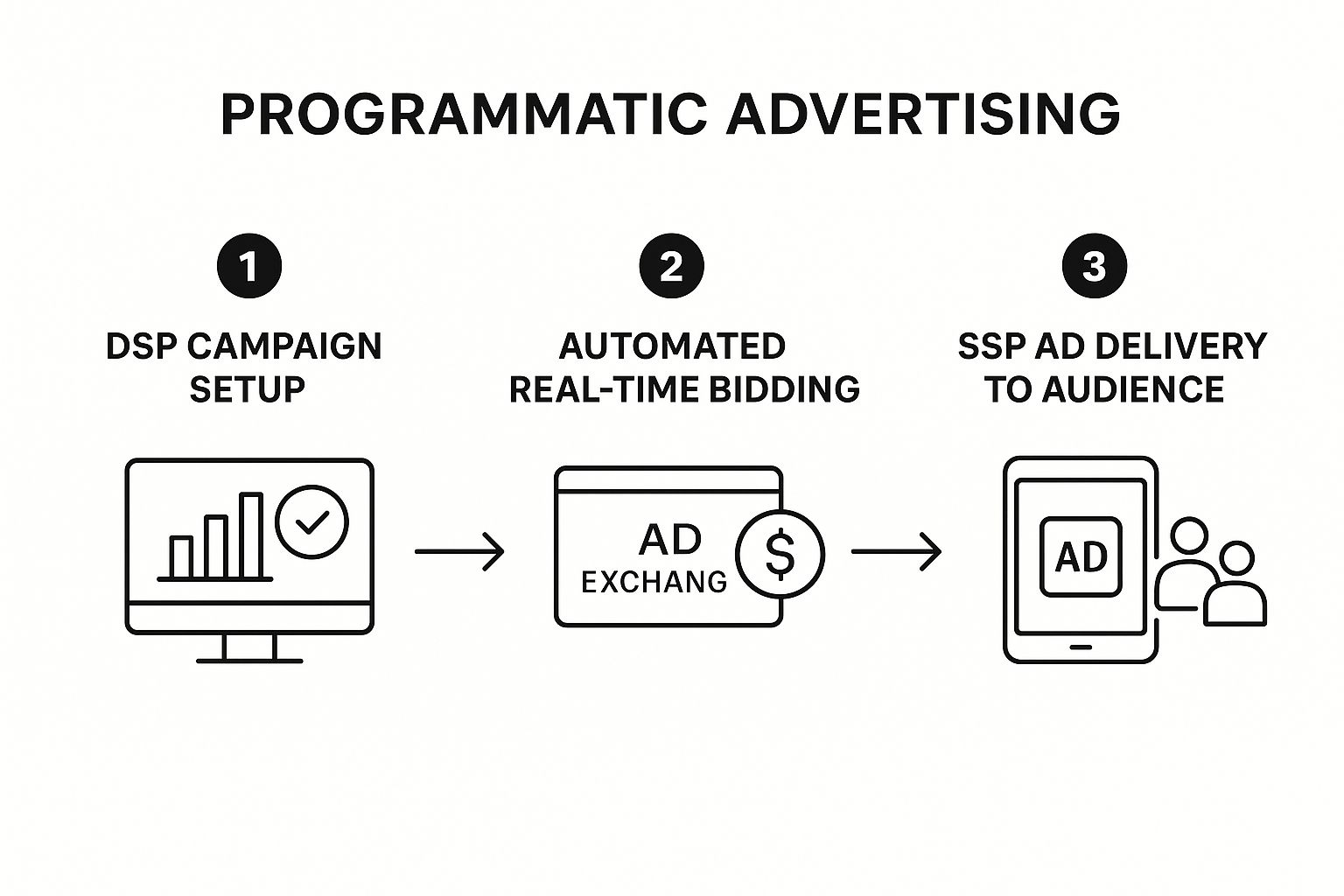
This visual breaks it down into a simple, three-stage journey, from setting up the campaign to the ad appearing on a user’s screen.
Deciding the Winner and Serving the Ad
Back in the ad exchange, all the bids from the different DSPs flood in. The exchange instantly finds the highest bidder and declares a winner.
This winning bid information is then relayed back down the chain. The ad exchange tells the SSP, which in turn tells the publisher’s website which ad creative it needs to load for the user. The winning advertiser’s ad is then pulled from its ad server and pops up on the webpage.
This complex, data-driven auction makes sure advertisers pay a fair market price for super-relevant ad spots, while publishers squeeze the most value out of their inventory. It’s a sophisticated system built for precision, scale, and speed—and it’s the very backbone of programmatic advertising.
The Real Benefits of Programmatic Advertising for UK Businesses

Sure, programmatic advertising is fast. But its real magic isn’t just about speed; it’s about the incredible precision and efficiency it brings to the table for UK businesses. This isn’t just about saving time – it’s about making every single pound in your ad budget pull its weight.
The biggest win here is hyper-precise targeting. Gone are the days of buying ad space on a website and just hoping the right audience stumbles upon it. With programmatic, you’re buying direct access to your ideal customer, pinpointing them based on their demographics, interests, online behaviour, and even their real-world location.
Let’s make this real. Imagine a speciality coffee roaster based in London. Instead of placing a generic ad on a food blog, they can use programmatic to show ads only to people who are within a 5-mile radius of their shop and have recently searched for “artisan coffee” or browsed a competitor’s site. It’s a game-changer for cutting out wasted ad spend.
Maximising Impact and Reach
Beyond pinpoint targeting, programmatic completely changes how you manage your budget and grow your brand’s footprint. The real-time bidding (RTB) system ensures you only pay the true market value for each impression, which stops you from overpaying. And if an ad isn’t hitting the mark? You can tweak your campaign on the fly, shifting your budget to what’s actually working.
This level of automation unlocks a vast world of advertising opportunities that would be impossible to juggle manually.
- Vast Inventory Access: A single campaign can pop up across thousands of websites, mobile apps, and video platforms.
- Diverse Formats: You can run display banners on news sites, video pre-roll ads on streaming services, and even audio ads on digital radio, all from one place.
- Emerging Channels: It also gives you a ticket to newer ad formats like Connected TV (CTV) and even Digital Out-of-Home (DOOH) billboards.
For a UK business, this is huge. It means you can achieve a scale and reach that was once only possible for the biggest corporations. You’re suddenly able to compete for the same eyeballs on premium digital real estate, truly levelling the playing field.
The UK market for this is absolutely massive. In 2023, programmatic ad spend in the UK hit around £31.71 billion, making us one of the largest markets in the world, right behind the US and China. If you want to dive into the numbers, check out the full programmatic ad spend report on eMarketer.com. This isn’t just a niche trend; it’s a core part of modern advertising, and getting it right gives you a serious competitive edge.
This data-driven approach is fundamental to getting a strong return on your investment. If you’re looking to bring this kind of thinking to other platforms, our guide on maximising Google Ads ROI for UK brands has more practical strategies. At the end of the day, programmatic gives you the power to connect with the right person, on the right device, at the perfect moment—all while keeping your costs firmly in check.
Exploring Programmatic Channels and Ad Formats
When you first hear “programmatic advertising,” your mind probably jumps straight to the banner ads you see on websites. That’s definitely part of the picture, but the reality today is so much bigger and more exciting. Programmatic tech has well and truly broken out of its original box, now powering campaigns across a massive range of digital channels.
What does this mean for your brand? It means you can connect with your target audience in more contexts than ever before. You can reach them while they’re browsing, watching videos, listening to music, or even when they’re out and about in the real world. It’s all about meeting customers where they are with a message that feels right for that moment.
Beyond the Banner Ad (Programmatic Advertising)
The real power of what is programmatic advertising today comes from its incredible versatility. It’s less of a single tool and more of a complete toolkit, packed with different formats that each have their own strengths. Getting to grips with these options is the first step towards building a truly effective, well-rounded campaign.
Let’s break down some of the most common and impactful channels you can use:
- Display Ads: These are the classic banner and sidebar ads. They are absolute workhorses for building brand awareness and are fantastic for remarketing campaigns to bring back people who’ve already visited your site.
- Video Ads: Think of the pre-roll or mid-roll ads you see on YouTube. Video is an incredibly powerful medium for telling a story and capturing attention, often driving much higher engagement than a static image ever could.
- Native Ads: These are the chameleons of the ad world. They’re designed to blend in seamlessly with the content around them, looking like a natural part of the webpage or app. A “sponsored article” on a news site is a perfect example of native advertising in action.
Reaching Audiences on New Screens
This is where things get really interesting. Programmatic has pushed into channels that used to be the exclusive playground of traditional media buyers, opening up brand-new frontiers for data-driven advertising. For any modern marketer looking for an edge, this is a huge opportunity.
Programmatic isn’t just an online tool anymore; it’s an omnichannel strategy. It connects your digital efforts to real-world experiences, creating a cohesive brand presence across multiple touchpoints in a customer’s day.
Take a local restaurant, for example. Using Digital Out-of-Home (DOOH) advertising, they can programmatically buy ad space on digital billboards near their location. They could even set the campaign to run only during lunchtime, targeting screens within a one-mile radius to tempt nearby office workers with a special offer.
In the same way, Connected TV (CTV) lets you place ads directly into streaming services on smart TVs. You can reach audiences during their “me time” on the sofa with the same pinpoint precision you get with online ads. And with programmatic audio, you can serve ads to listeners on music streaming platforms and digital radio, targeting them based on their music tastes, location, or demographics.
Choosing the right channel is all about matching its strengths to your goals. To help you figure out what might work best for your strategy, we’ve put together a quick comparison.
Comparison of Programmatic Advertising Channels
This table breaks down the different programmatic channels, highlighting what they’re best used for and what you can expect in terms of engagement and cost.
| Channel | Primary Use Case | Audience Engagement | Typical Cost (CPM) |
|---|---|---|---|
| Display | Brand awareness, remarketing | Low to Medium | £1 – £5 |
| Video | Storytelling, brand building | High | £10 – £30 |
| Native | Content promotion, engagement | Medium to High | £5 – £15 |
| CTV | Premium reach, brand impact | Very High | £25 – £50+ |
| Audio | Screen-free reach, awareness | Medium | £8 – £20 |
| DOOH | Geo-targeting, local impact | Medium | Varies by location |
As you can see, each channel offers a unique way to connect with your audience. By understanding what each one brings to the table, you can build a programmatic strategy that’s far more sophisticated than just running basic banner ads and delivers a much stronger return on your investment.
Programmatic Advertising: Navigating Future Challenges and Trends
The world of programmatic advertising never stands still. To stay ahead of the game, you need to keep one eye on the challenges looming on the horizon and the other on the exciting trends that are starting to take shape. While the basic mechanics of programmatic offer huge benefits, long-term success means adapting to a digital world that’s becoming much more focused on user privacy.
Right now, the industry is grappling with two major shifts: the slow death of third-party cookies and the ever-present threat of ad fraud. For years, cookies—those little data files that track user behaviour—have been the engine of audience targeting. But now, major browsers are phasing them out. This forces us all to find new ways to understand and reach our audiences without stepping on their privacy.
The Shift to a Cookieless Future
As cookies fade into the background, the focus is swinging towards smarter, privacy-first ways of targeting. This isn’t a step backwards; it’s an evolution towards more transparent and, frankly, often more effective advertising. Advertisers are now embracing new solutions that respect user consent while still delivering fantastic results.
Here are the key strategies leading the charge:
- Contextual Targeting: This is all about placing ads based on the content of a webpage, not the user’s browsing history. For example, a brand selling sports gear could place ads on articles about the Premier League, hitting a genuinely engaged and relevant audience without needing any personal data. It’s simple, but it works.
- First-Party Data: This is the goldmine of information you collect directly from your own customers—think email newsletter sign-ups or purchase history. Building and using your own first-party data is fast becoming the most valuable asset for any business. It gives you a direct, consent-based line to understanding what your audience actually wants.
The end of the cookie doesn’t mean the end of effective advertising. Far from it. It’s pushing brands to build stronger, more direct relationships with their customers and to use more intelligent, context-aware strategies to drive growth.
The Rise of Retail Media Networks (Programmatic Advertising)
One of the most powerful developments to come out of this new era is the Retail Media Network (RMN). These are advertising platforms set up by large retailers, like supermarkets and big-box stores, who use their own enormous pools of first-party customer data to offer incredibly effective ad placements. For marketers here in the UK, this is a massive opportunity.
The growth of RMNs is a huge part of programmatic’s evolution. We’re already seeing major UK retailers like Tesco with its Media & Insight Platform and Sainsbury’s with Nectar360 show just how powerful this is. They use rich, real-world customer data to fuel pinpoint-precise programmatic campaigns, offering a clear path forward in a privacy-first world. You can learn more about how retail data is shaping programmatic advertising and the impact it’s having.
By getting ready for these changes now, you can turn what looks like a challenge into a real competitive edge. Focusing on solid data practices and exploring new channels like RMNs is going to be vital. For anyone looking to sharpen up their approach across the board, learning how to optimise PPC campaigns provides a strong foundation for getting better results, no matter the channel.
Right, so you’ve got your head around the theory. Now for the exciting part: putting it all into action and launching your first programmatic campaign.
Getting started isn’t about just diving in and hoping for the best. It demands a clear, methodical approach to make sure your budget is invested wisely, especially in the crowded UK market.
Think of it as your pre-flight checklist. Before you spend a single penny, you need a clear flight path. This means setting concrete, measurable objectives that will guide every decision you make along the way.
Define Your Campaign Goals
First things first: what do you actually want to achieve? The entire shape of your campaign hinges on this answer. Are you trying to build brand awareness and get your name in front of as many relevant people as possible? Or are you laser-focused on driving immediate sales and leads?
- Brand Awareness: Here, you’ll be looking at metrics like impressions, reach, and video completion rates. The main aim is broad, memorable visibility.
- Lead Generation/Sales: Your focus shifts to conversions, cost per acquisition (CPA), and return on ad spend (ROAS). The goal is to get people to take direct action.
Nailing down this primary objective is the bedrock of your entire strategy. It dictates who you target, what your ads look like, and the tech you use. Without a clear goal, you’re essentially flying blind and hoping for a safe landing.
Setting specific goals is completely non-negotiable. It’s the difference between simply chucking money at ads and making a strategic investment in your business’s growth. This clarity is what separates the campaigns that smash it from those that just burn through cash.
Build Your Strategy and Choose Your Tools
With your goal locked in, it’s time to map out your audience with precision. Who are you trying to reach? Use demographic data, their interests, and what they do online to build a detailed picture of your ideal customer. Next up is choosing your Demand-Side Platform (DSP), which is the software that will automate all your ad buying.
Of course, your campaign also needs ads that people actually want to look at. Whether it’s a striking banner, an engaging video, or a native ad that fits right in, it has to grab attention and get your message across in seconds. This is where understanding your audience really pays off, because you can create ads that speak directly to what they care about. Our guide on how Google PPC works can give you some extra context on campaign mechanics that are really useful here.
Getting these fundamentals right is vital because the market is only getting busier. In 2024, UK programmatic budgets shot up by around 15% as more advertisers piled in to reach their audiences effectively. This trend isn’t slowing down, which makes a solid, well-planned strategy absolutely essential for getting a strong return. You can discover more insights about programmatic growth on IAB UK.
Frequently Asked Questions About Programmatic Ads
Even after getting to grips with the basics, a few common questions about programmatic advertising always seem to crop up. Let’s tackle them head-on to clear up any lingering confusion.
What’s the Minimum Budget I Need?
There’s no magic number here. The minimum spend isn’t universal; it really boils down to your specific situation. While some of the big-name Demand-Side Platforms (DSPs) expect hefty monthly commitments, plenty of others are much more welcoming to smaller businesses.
The right budget for you depends entirely on your campaign goals, who you’re trying to reach, and how competitive your market is. Often, starting with a small test budget is the smartest move—it can give you a wealth of initial data without breaking the bank.
How Is It Different From Google Ads?
It’s a common question, and the main difference is scope. Think of Google Ads as a specialist that focuses primarily on Google’s own turf—like Search, YouTube, and its partner network. It’s incredibly powerful within that ecosystem.
Programmatic advertising, on the other hand, throws the doors wide open. It gives you access to a much broader, more diverse world of ad inventory across thousands of different websites, apps, and digital platforms, all managed from one central hub.
It’s crucial to understand that programmatic isn’t a replacement for Google Ads. In fact, they work brilliantly together. Many of the most successful strategies use both: programmatic builds brand awareness far and wide, while Google Ads swoops in to capture high-intent search traffic. It’s a powerful combination that covers the entire customer journey.
Ready to stop wasting ad spend and see real results from your campaigns? The team at PPC Geeks creates data-driven strategies to boost traffic, leads, and sales. Get your free PPC audit today and discover your true potential.
Author

Search Blog
Free PPC Audit
Subscribe to our Newsletter

The Voices of Our Success: Your Words, Our Pride
Don't just take our word for it. With over 100+ five-star reviews, we let our work-and our satisfied clients-speak for us.

"We have been working with PPC Geeks for around 6 months and have found Mark and the team to be very impressive. Having worked with a few companies in this and similar sectors, I rate PPC Geeks as the strongest I have come across. They have taken time to understand our business, our market and competitors and supported us to devise a strategy to generate business. I value the expertise Mark and his team provide and trust them to make the best recommendations for the long-term."
~ Just Go, Alasdair Anderson