




It’s a story I’ve seen play out hundreds of times: a B2B brand pours money into PPC, only to find they’re chasing surface-level metrics like clicks and cost-per-lead. They completely ignore the metrics that actually matter – qualified pipeline and, ultimately, revenue.
This fundamental mistake creates a frustrating, expensive cycle of high ad spend and disappointingly low return.
The Critical Disconnect in B2B PPC
So many businesses treat their pay-per-click campaigns like a commercial fishing operation. They cast a massive, generic net, hoping to catch anything that swims by. Sure, this approach fills the boat, but it’s full of low-quality leads the sales team inevitably throws back. It’s a huge waste of time, budget, and morale.
This is a game of volume over value, and it’s a losing strategy in the complex world of B2B.
Successful B2B PPC is much more like fly fishing. It demands precision, patience, and knowing exactly which lure attracts the prize fish. Instead of a wide net, you’re using a targeted approach designed to hook high-value prospects who are genuinely looking for your solution. The goal shifts from simply generating leads to acquiring valuable future customers.
Measuring What Actually Matters (B2B PPC )
The root of the problem is what’s being measured. When a marketing team’s performance is judged solely on the number of leads or the cost-per-lead (CPL), they’re incentivised to cast that wide net. This naturally leads to campaigns optimised for cheap clicks from broad audiences, not for revenue.
This obsession with vanity metrics creates a massive chasm between marketing efforts and sales outcomes. Despite significant investment, many PPC campaigns are incredibly inefficient. Just look at the numbers: the average Marketing Qualified Lead (MQL) to Sales Qualified Lead (SQL) conversion rate in B2B is a mere 13%.
Think about that. For every 10,000 visitors you pull in, only about 1,300 are even considered real prospects by sales. You can explore more B2B lead generation benchmarks, but the story is the same across the board.
This disconnect is the single biggest reason why most B2B brands get PPC wrong. They celebrate filling the top of the funnel, completely oblivious to the fact that 87% of it is leaking before it ever reaches the sales team.
Shifting from Tactics to Strategy
Fixing this requires a complete strategic shift. The question can’t be, “How can we get more leads?” It has to become, “How can we attract leads that turn into profitable customers?”
Answering that question means getting a deep understanding of the entire customer journey, from the very first click to the final sale.
This guide is your roadmap to bridging that gap. We’ll break down the common mistakes and give you a strategic playbook to turn your PPC from a costly experiment into a predictable revenue engine. You’ll learn to move beyond superficial metrics and build a system that delivers not just leads, but real, sustainable growth.
Ignoring the Complex B2B PPC Buying Journey

Here’s one of the biggest mistakes we see B2B brands make: they treat their PPC campaigns like a B2C transaction. They go for the quick win, approaching it like a 100-metre sprint. But B2B marketing is a marathon. It’s a long, complex journey that demands strategy, stamina, and a whole lot of patience.
Think about it. A consumer sees an ad for a new pair of trainers and might buy them within minutes. A business, on the other hand, isn’t going to drop £50,000 on new software after seeing a single ad. The B2B buying process can drag on for months, and you’re not dealing with one person. You’re trying to convince a committee of, on average, six to ten decision-makers, each with their own headaches and priorities. They’ll do their homework, compare every option under the sun, and need multiple touchpoints before they even think about talking to sales.
This is where so many B2B PPC campaigns fall flat. They hit someone who’s just realised they have a problem with a hard-sell “Book a Demo” ad. It’s the digital equivalent of proposing on a first date. It’s just too much, too soon, and it shows you haven’t understood the situation at all.
Mapping Your Ads to the Buyer Journey (B2B PPC)
To get it right, your PPC strategy has to be a mirror image of this long, winding journey. You can’t use the same message for someone dipping their toes in the water as you would for someone ready to dive in. Failing to match your ads to the different stages of the buying process is the fastest way to burn through your budget.
What you need is a layered approach that guides people from their first flicker of awareness right through to signing on the dotted line.
- Awareness Stage (Top of Funnel): Your potential customer has a problem, but they’re not even sure what to call it yet. They’re looking for information, not a sales pitch. Your ads should point them to genuinely helpful, educational content that helps them frame their challenge.
- Consideration Stage (Middle of Funnel): Okay, now they understand the problem and they’re actively researching solutions. They’re sizing you up against your competitors. This is the time for ads that offer more in-depth content—think case studies or webinars—that proves you know your stuff.
- Decision Stage (Bottom of Funnel): They’ve whittled down their options and are about to make a call. This is the only time you should be hitting them with direct calls-to-action like “Request a Demo” or “Get a Quote”.
Trying to push a bottom-of-funnel offer on an awareness-stage audience doesn’t just fall flat; it can actively put them off. Nobody likes to feel pressured before they’re ready.
From Vague Targeting to Precise Nurturing
To actually build this layered approach, you need to know exactly who you’re talking to. And I mean really know them, far beyond basic demographics. You need to get inside their heads—understand their job titles, what keeps them up at night, and the exact questions they’re typing into Google at each stage.
This is where creating detailed buyer personas becomes non-negotiable. If you need a hand with this, our guide on how to create buyer personas is a great place to start.
The rookie mistake is blasting everyone with the same message. A winning B2B PPC strategy is all about segmentation. It’s about delivering the right message, to the right person, at the perfect moment.
This means building your campaigns to serve specific content based on how people behave. For instance, if someone downloads your top-of-funnel whitepaper, they should be added to a retargeting audience that sees your middle-of-funnel case study next. Only after they’ve engaged a few times should they see an ad for a product demo.
This methodical nurturing process does more than just sell; it builds trust. It positions your brand as a helpful expert. By the time a lead gets to your sales team, they’re not cold—they’re educated, engaged, and genuinely interested. That’s how you turn PPC from a costly gamble into a predictable pipeline of high-quality leads.
B2B PPC: Neglecting Modern Mobile User Behaviour

There’s a stubborn, old-fashioned image many B2B marketers can’t shake: the serious decision-maker, sat bolt upright at their desktop, meticulously researching solutions. While that person definitely still exists, they’re only telling you a tiny part of the story.
The truth? Today’s B2B buyer is always on the move. They’re doing that crucial first-pass research on their smartphones—on the train, between meetings, or grabbing a quick coffee. Ignoring this massive shift is one of the quickest ways to burn through your PPC budget.
Too many brands spend a fortune crafting the perfect ad and nailing the audience, only to funnel prospects to a clunky, slow-loading mobile landing page. It’s like creating a brilliant shop window display but jamming the front door shut for half your potential customers. That click you just paid for? Wasted.
The High Cost of a Poor Mobile Experience
This isn’t just a minor oversight; it’s a massive hole in the bucket. Mobile isn’t a “trend” in the B2B world anymore; it’s the standard. With mobile PPC ad spend expected to hit 66% of total digital ad spending, a mobile-first approach is simply non-negotiable.
B2B buyers are time-poor and information-hungry. They’ll often visit just one page from the search results, expecting an immediate, frictionless experience that answers their question. If they have to pinch, zoom, and fight to find what they need, they won’t stick around. They’ll just hit the back button and click on your competitor’s ad instead.
A frustrating mobile experience does more than just lose a single lead; it actively damages your brand’s reputation. It sends a clear signal that your company is out of touch and difficult to do business with. First impressions count, and a shoddy mobile site is an instant red flag for a potentially high-value client.
The core problem is a huge mismatch. B2B buyers are starting their journey on mobile, but brands are still overwhelmingly focused on the desktop experience. A perfect desktop site means next to nothing if the mobile journey—where the research begins—is broken.
And this isn’t just about feel-good user experience. It directly hammers your campaign performance. Google’s algorithms reward mobile-friendly sites. A poor mobile experience tanks your Quality Score, which drives up your cost-per-click and kills your ad visibility. You end up paying more to get worse results.
Practical Steps for Mobile-First B2B PPC
Optimising for mobile is more than just having a “responsive” site that shrinks to fit a phone screen. It demands a proper strategy that understands the mobile user’s mindset. They’re often distracted, looking for quick answers, and need an easy way to take the next step.
Here’s what you absolutely have to get right:
- Truly Responsive Landing Pages: Your pages must adapt flawlessly to any screen. Think big, tappable buttons, readable fonts without any zooming, and forms that are dead simple to fill out on a small keyboard. For a deeper dive, check out our guide to landing page best practices that actually convert.
- Punchy, Powerful Ad Copy: You have very little screen real estate on a mobile. Your headlines and descriptions need to be front-loaded with the most important info. Get straight to the point and state your value proposition immediately.
- Click-to-Call and Messaging Extensions: Make it ridiculously easy for a mobile user to get in touch. Click-to-call extensions let a prospect ring your sales team with a single tap—a perfect, low-effort action for someone on the go.
- Blazing-Fast Page Speed: Every single second counts. A slow-loading page is the number one killer of mobile conversions. Use tools to test and slash your page load times; it’s a massive factor for both users and your ad performance.
By building a mobile-first PPC strategy, you’re not just ticking a box. You’re aligning your campaigns with how modern B2B decision-makers actually behave, ensuring every pound you spend has the best possible chance of turning into a real business opportunity.
B2B PPC: Wasting Budgets on Flawed Targeting
One of the quickest ways for a B2B brand to burn through its PPC budget is to treat campaigns like a shotgun, blasting a wide area and hoping something sticks. This scattergun approach, often propped up by broad keywords and unchecked automated bidding, is a guaranteed recipe for wasting money on completely irrelevant clicks. In B2B, you need to be a sniper, not an artillery unit.
The goal isn’t just to get clicks; it’s to get the right clicks. A solid campaign needs surgical precision, making sure your ads land only in front of high-value decision-makers who are actively looking for what you sell. Anything less is just paying to attract the wrong crowd.
This flawed strategy usually comes from chasing big numbers. A marketing team sees a generic keyword like “project management software,” gets excited by the huge search volume, and dives in. The problem? That term attracts everyone from university students writing essays to job seekers and small business owners after free tools. Your £10 click is just as likely to come from an intern as it is from a C-suite executive.
The Perils of Imprecise Targeting
When your targeting is too broad, you’re basically paying for digital window shoppers who have no intention, or authority, to buy. This happens most often when brands don’t build their campaigns around specific user intent. They just lump dozens of keywords into a single ad group, showing the same generic ad to people with completely different needs.
Imagine one user searching for “CRM integration challenges” and another searching for “Salesforce CRM pricing”. The first person is in the research phase, miles away from a purchase. The second is clearly much further down the funnel. Showing both of them the same “Book a Demo” ad is a classic B2B PPC mistake—the first user isn’t ready, and that click is money down the drain.
To fix this, you have to get incredibly granular. Here’s how:
- Build Tight Ad Groups: Every ad group should focus on a tiny, highly-related cluster of keywords. This lets you write ad copy that speaks directly to that very specific search.
- Leverage Firmographic Targeting: On platforms like LinkedIn, you can target users based on their company size, industry, job title, and seniority. This ensures your ads are only ever seen by people who actually fit your ideal customer profile.
- Implement Audience Layering: This is where it gets clever. You combine keyword intent with audience data. For example, you can tell Google to only show your ads to people searching for your solution and who work in the finance industry at companies with over 500 employees. To get your head around this, you can learn more about what audience targeting is in our detailed guide.
Your Budget’s Best Defence: A Negative Keyword List
Even with the most precise targeting, some unwanted traffic will always find a way to slip through. This is where a robust negative keyword list becomes your campaign’s most important line of defence. A negative keyword simply tells Google Ads what searches you don’t want your ad to show up for, stopping you from paying for worthless clicks.
Without a comprehensive negative keyword list, you are practically inviting irrelevant users to click your ads and waste your money. It’s the single most effective tool for protecting your budget from unqualified traffic.
For instance, if you sell enterprise-level software, you’ll want to add negative keywords like “free,” “template,” “jobs,” “course,” and “salary.” These terms are dead giveaways that the user isn’t a potential buyer. A well-maintained list should be constantly updated based on the actual search terms triggering your ads. Having an ultimate negative keywords list for Google Ads, categorised by type, is invaluable for preventing these costly mistakes.
By combining the sniper-like precision of firmographic targeting with the defensive shield of a strong negative keyword list, you completely transform your campaigns. You stop wasting money on students and job seekers and start focusing your entire budget on attracting the C-suite executives who can actually sign the cheques.
B2B PPC: Measuring Vanity Metrics Instead of Revenue
One of the most damaging mistakes we see in B2B PPC is celebrating the wrong victories. It’s like a football team that dominates possession but never actually scores a goal. Too many brands proudly report on impressive click-through rates, sky-high impression numbers, and a low cost-per-click, all while the sales team is left wondering where the real opportunities are.
This obsession with surface-level activity creates a dangerous illusion of success. These are vanity metrics: numbers that look fantastic on a PowerPoint slide but have little to no connection to actual business growth. When your marketing team is judged on how many clicks they can generate, they will naturally optimise for cheap, high-volume traffic—regardless of its quality. This is a fundamental reason why most B2B brands get PPC wrong.
The real goal isn’t just to get clicks; it’s to generate revenue. This requires a profound shift in how you measure success, moving away from what’s happening on the ad platform and focusing intently on what’s happening in your CRM.
Shifting from Vanity Metrics to Business Impact
Making this shift means ditching the metrics that make you feel good for the ones that actually tell you if you’re doing good. Here’s a quick breakdown of what to stop tracking and what to focus on instead.
| Vanity Metric (What to Avoid) | Why It’s Misleading | Impact Metric (What to Measure) |
|---|---|---|
| Clicks / Impressions | High volume doesn’t equal high quality. It’s easy to get clicks from people who will never buy. | Marketing Qualified Leads (MQLs) & Sales Qualified Leads (SQLs) |
| Click-Through Rate (CTR) | A high CTR can simply mean your ad copy is enticing, not that it attracts the right audience. | Cost Per SQL |
| Cost Per Click (CPC) | Chasing a low CPC often leads to bidding on irrelevant keywords that bring in low-quality traffic. | Customer Lifetime Value (CLV) |
| Conversions (e.g., PDF download) | Not all conversions are created equal. A newsletter sign-up is miles away from a demo request. | Pipeline Value Generated |
| Cost Per Conversion/Lead (CPL) | A low CPL is meaningless if those leads never close. It often reflects quantity over quality. | Closed-Won Deals & Return on Ad Spend (ROAS) |
By focusing on these impact metrics, you tie your ad spend directly to business outcomes, turning your PPC campaigns into a predictable growth engine rather than just a source of website traffic.
Connecting Clicks to Closed Deals (B2B PPC)
For any B2B company with a long and complex sales cycle, tracking a lead from their very first ad click all the way to a closed-won deal is non-negotiable. Without this connection, you’re flying blind. You’re completely unable to distinguish between campaigns that generate tyre-kickers and those that attract high-value, ideal customers. This is where offline conversion tracking becomes absolutely essential.
This process involves importing conversion data from your CRM right back into your ad platforms, like Google Ads. It allows you to finally see which specific keywords, ads, and campaigns are responsible for generating not just initial leads, but also Marketing Qualified Leads (MQLs), Sales Qualified Leads (SQLs), and ultimately, paying customers.
Setting this up allows you to answer the business questions that actually matter:
- Which campaigns are driving the highest customer lifetime value (CLV)?
- What is our true return on ad spend (ROAS) when we factor in the final deal size?
- Are we spending our budget on keywords that attract decision-makers or just researchers?
The moment you start measuring pipeline and revenue, your entire PPC strategy changes. You stop chasing cheap leads and start investing in high-quality interactions that lead to profitable, long-term relationships.
Moving Beyond Last-Click Attribution
Another critical flaw in B2B measurement is clinging to simplistic attribution models. The default for many platforms is last-click attribution, which gives 100% of the credit for a conversion to the very last touchpoint a person interacted with. In a B2B context, this is almost always misleading.
Think about it. A typical B2B buyer might first discover your brand through a LinkedIn ad, later search for a solution on Google and click a PPC ad, then read a case study from an email, and finally request a demo after seeing a retargeting ad. A last-click model would completely ignore the first three interactions, giving all the glory to the final retargeting ad.
This flawed view leads to terrible decision-making, like cutting budgets for top-of-funnel campaigns that are crucial for introducing new prospects into your ecosystem. To truly grasp how your campaigns work together, it’s essential to master multi-touch attribution models. These models distribute credit across multiple touchpoints, painting a far more accurate picture of how your marketing efforts influence a purchase. Understanding how to properly measure advertising effectiveness with a more sophisticated lens is key to sustainable growth.
By implementing robust, CRM-integrated tracking and adopting a multi-touch view of the customer journey, you can finally move beyond vanity metrics. You’ll be able to report on what truly matters—pipeline, revenue, and ROAS—and build a PPC machine that doesn’t just generate activity, but drives predictable, profitable growth for your business.
Building a B2B PPC Strategy That Drives Growth
Knowing the common pitfalls is one thing; turning that knowledge into a revenue-generating machine is another. That requires a structured, actionable plan. A winning B2B PPC strategy isn’t just a random collection of tactics. It’s a cohesive system designed from the ground up to attract, nurture, and convert high-value customers. It’s time to stop chasing clicks and start building a predictable pipeline.
This whole process boils down to a fundamental shift in mindset: moving away from short-term lead generation and towards long-term customer acquisition. It means every single component, from defining your audience to handing leads over to sales, has to work in perfect harmony.
Define Your Ideal Customer and Their Journey
Everything—and I mean everything—starts with a crystal-clear picture of who you’re trying to reach. Before you spend a single pound on ads, you need to nail down your Ideal Customer Profile (ICP). Don’t just settle for basic demographics. Dig deeper to identify their specific job titles, their day-to-day frustrations, and the real business pains that your solution actually solves.
Once you know who you’re targeting, you have to map out their entire buying journey. Document the questions they’re asking and the information they need at each stage, from the moment they realise they have a problem to the final evaluation of different solutions. This map is the blueprint for your whole campaign structure, making sure you deliver the right message at exactly the right time.
Structure Campaigns Around User Intent (B2B PPC)
With your ICP and journey map in hand, you can finally build campaigns that align with user intent, not just a bunch of keywords. Instead of lumping all your keywords into a few messy ad groups, you should create distinct campaigns for each stage of the funnel.
- Top-of-Funnel Campaigns: Target problem-aware keywords with ads that lead to genuinely helpful content like whitepapers or practical guides.
- Mid-Funnel Campaigns: Focus on solution-comparison keywords and send users to compelling case studies, webinars, or detailed product pages.
- Bottom-of-Funnel Campaigns: Go all-in on high-intent, branded keywords, driving that precious traffic directly to your demo request or pricing pages.
This methodical, stage-aware approach stops you from haemorrhaging money on audiences who just aren’t ready to buy. It concentrates your ad spend on efficiently moving qualified prospects through your pipeline, turning your PPC efforts from a cost centre into a true growth driver.
Connect Your Measurement to Revenue
Finally, you absolutely must have a measurement framework that tracks success far beyond the initial click. True B2B PPC excellence is impossible without connecting your ad platform data directly to your CRM. This integration is non-negotiable. It’s what allows you to see which campaigns, ads, and keywords are generating not just leads, but qualified pipeline and, most importantly, closed-won deals.
This visual breaks down the ideal B2B measurement workflow, showing how to connect those initial ad clicks all the way through to tangible business outcomes like pipeline and revenue.
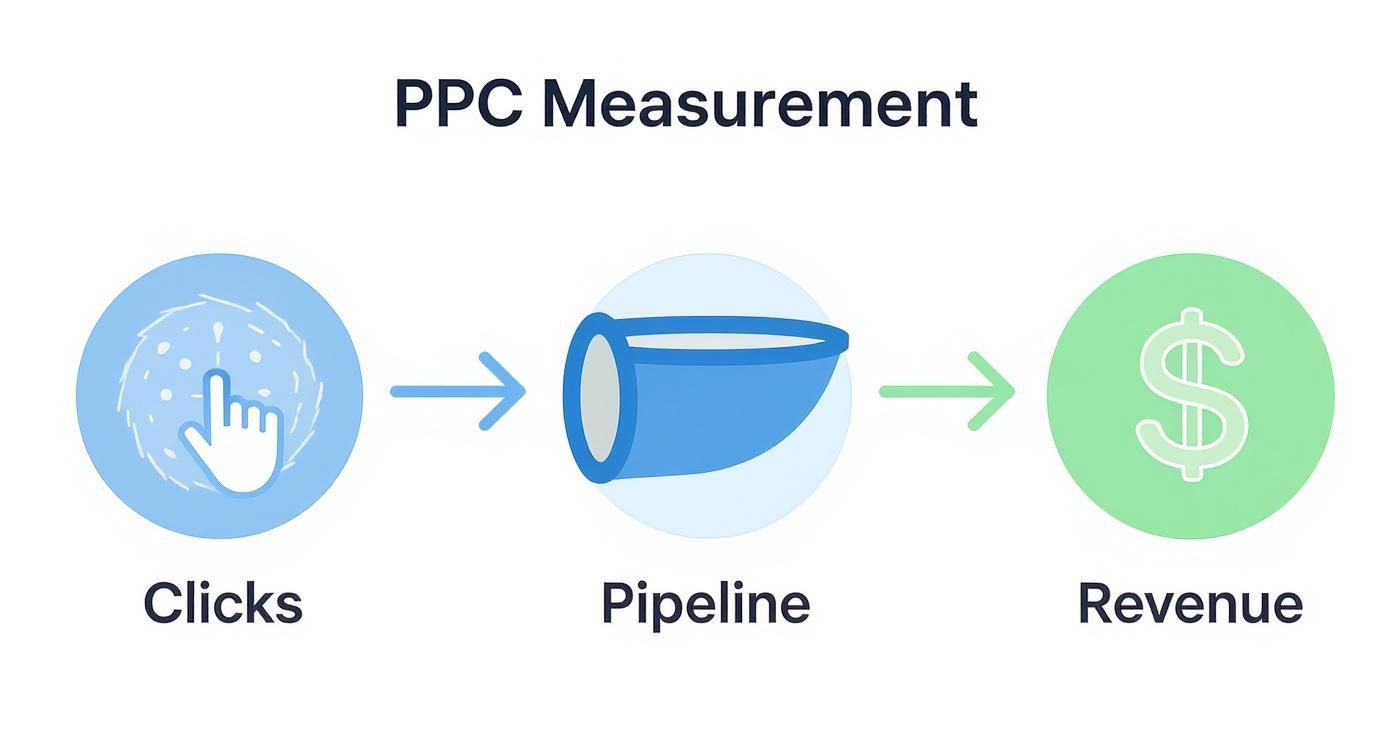
This model shifts the entire focus from flimsy vanity metrics to the real financial impact of your advertising. It enables a true return on ad spend (ROAS) calculation and builds a powerful feedback loop between marketing and sales, allowing for constant optimisation based on what actually grows the business.
Frequently Asked Questions About B2B PPC
Got questions about B2B pay-per-click? You’re not alone. It can be a confusing space, so we’ve answered a few of the most common queries we hear from marketers trying to get their campaigns on the right track.
How Much Should a B2B Company Budget for PPC?
There’s no magic number, but one of the biggest mistakes we see is brands not investing enough to get off the ground. To gather any meaningful data and give the algorithms a fighting chance to learn, you need a realistic baseline.
We recommend a starting budget of £3,000 to £5,000 per month. Anything less, and you’ll likely see sluggish progress and inconclusive results, leaving you guessing what’s actually working. The goal is to invest enough to move past the basic testing phase.
How Long Until We See a Return on Investment?
Patience is everything here. Unlike B2C, where you might see results almost instantly, a properly structured B2B PPC campaign usually needs 60 to 90 days to show a real, tangible return.
The first month is all about data collection and building those initial retargeting audiences. By the end of month three, you should have a clear picture of lead quality, your cost per qualified lead, and the impact on your sales pipeline. Rushing this is exactly why so many B2B brands get PPC wrong.
Should We Focus on Google Ads or LinkedIn Ads?
This really boils down to your product’s price point and how specific your target audience is.
- Google Ads: This is your go-to for capturing active buying intent. If people are out there searching for a solution like yours, you absolutely need to be on Google to meet them in that moment.
- LinkedIn Ads: Perfect for hyper-specific targeting. If you need to reach people based on their job title, company size, or industry, LinkedIn is unbeatable. It’s brilliant for getting in front of decision-makers who aren’t actively searching yet.
For most B2B businesses, the winning strategy is a mix of both. Use LinkedIn to create awareness and build your audience, then use Google to capture the demand you’ve generated.
At PPC Geeks, we turn underperforming campaigns into predictable revenue streams. If you’re tired of wasting your budget on campaigns that go nowhere and want a clear, data-driven strategy, it’s time for a change.
Get your free, in-depth PPC audit today and let us show you what’s really possible.