




So, what exactly is AI chatbot advertising? At its core, it’s about using smart, automated conversations to connect with potential customers the moment they click on your ad. This isn’t just about answering questions; it’s about turning a one-way ad view into a real, active conversation that qualifies leads and steers them towards a sale, 24 hours a day, 7 days a week.
Why Chatbots Are Your Next Advertising Advantage

Let’s cut through the noise. AI chatbot advertising isn’t some futuristic fantasy—it’s a seriously practical tool that’s giving UK businesses a real competitive edge right now. The real magic happens in that critical moment between an ad click and a conversion, a gap where far too many high-intent leads just fall away.
Your standard landing page is static. It makes a visitor do all the work: read, search for info, and then maybe fill out a form. A chatbot flips that entire dynamic on its head. It kicks off an interactive, two-way chat the second someone shows interest.
AI Chatbot Advertising: Bridge the Gap from Click to Conversion
Picture the journey. A potential customer sees your targeted Google Ad for “emergency plumbing services in Manchester” and gives it a click. But instead of being dumped on a generic contact page, they’re instantly greeted by a Google Business Messages chatbot: “Hi! Thanks for getting in touch. Are you dealing with a leak, a blockage, or something else?”
This immediate, helpful engagement ticks a lot of boxes:
- Instant Qualification: The bot quickly figures out the user’s problem, how urgent it is, and where they’re located.
- Frictionless Experience: No more hunting for a phone number or tapping away on a fiddly form. They just answer a few simple questions.
- 24/7 Availability: It captures that lead at 10 PM on a Saturday, long after your team has clocked off for the weekend.
This conversational approach doesn’t just bump up your conversion rates; it also frees up your team. They can spend their time closing deals with properly qualified, hot leads instead of fielding the same basic questions over and over again.
A well-designed chatbot acts as your most efficient salesperson—it never sleeps, handles unlimited queries simultaneously, and perfectly qualifies every lead according to your exact criteria.
From Passive Views to Active Engagement
AI Chatbot Advertising: The main benefit here is transforming a passive ad click into an active, productive conversation. For service-based businesses where gathering key details is the first hurdle, this shift is massive. The chatbot becomes a natural extension of your ad funnel, smoothly guiding people from initial interest to a booked appointment or a qualified sales call.
This whole process is becoming more and more integrated as AI develops, creating a much more connected shopping experience. In fact, you can find out more about how ChatGPT’s shopping layer is shaping AI-driven commerce for brands in our detailed guide.
Think of it as the ultimate digital concierge for your ad campaigns. It makes sure no lead is left hanging and every single pound you spend on ads works harder to deliver results you can actually measure. This is your roadmap to putting this powerful tech to work in your marketing.
Choosing the Right Channel for Your Chatbot Ads
Your chatbot’s success all comes down to being in the right place at the right time. A brilliantly written conversational script is completely useless if your target audience never actually sees it. Deciding on your channel isn’t just a box-ticking exercise; it’s a strategic move that directly impacts how well you capture and convert leads from your ad spend.
Think of it like picking a spot for a physical shop. You wouldn’t open a high-end boutique in the middle of an industrial estate, would you? It’s the same logic with AI chatbot advertising – you need to be where your ideal customers are already hanging out and actively looking for what you offer.
This isn’t about jumping on the most popular platform. It’s about matching the channel’s unique strengths to your specific business goals, your audience’s behaviour, and the kind of ad campaigns you’re running.
Google Business Messages for High-Intent Local Search
When someone in your local area searches for “emergency boiler repair” or “best Italian restaurant near me,” their intent is off the charts. They need a solution, and they need it now. This is precisely where Google Business Messages (GBM) comes into its own. It lets people start a chat with you straight from your Google Business Profile in search results or on Maps.
Imagine a local dental practice running Google Ads. A potential patient clicks their ad, but instead of calling, they tap the “Chat” button. Instantly, the bot engages: “Thanks for reaching out to City Dental! Are you looking to book a new patient check-up, a hygiene appointment, or do you have a dental emergency?”
This channel is an absolute game-changer for:
- Local service businesses: Plumbers, electricians, and cleaners can qualify jobs and get appointments booked in seconds.
- Hospitality: Restaurants and hotels can handle bookings and answer questions about availability without tying up the phone lines.
- Appointment-based services: Salons, clinics, and garages can fill their diaries 24/7.
By hooking up a chatbot to GBM, you grab these high-value leads right at their peak moment of interest, turning a simple search into a qualified appointment on your books.
The real magic of Google Business Messages is intercepting people with immediate, local problems. You’re giving them a completely seamless way to go from a problem-aware search to a direct conversation with your business.
Meta Messenger for Engaging Social Traffic
If your ad strategy is built around platforms like Facebook and Instagram, then a Meta Messenger bot isn’t just nice to have—it’s essential. This is your playground for engaging with people who have just stopped scrolling for a visually compelling ad and are curious to find out more. The vibe here is less about urgent need and more about discovery and consideration.
For example, a UK-based e-commerce brand selling custom pet portraits runs a carousel ad on Instagram. The call-to-action is “Message Us to Start.” When someone clicks, the Messenger bot greets them warmly: “Hello! So glad you’re interested in a portrait for your furry friend. To give you a price, could you let me know what kind of pet you have?”
This approach is fantastic for guiding people through a sales funnel. The bot can show off different options, answer common questions about sizing and delivery times, and even collect the photos and information needed to kick off an order. It’s like having a personal shopper on duty, 24/7. Understanding the different mindsets on paid search versus paid social is crucial here; you can dig deeper into that with this comparison of Google Ads vs Facebook Ads to really nail your channel strategy.
Website Bots for Converting Direct Visitors
Finally, don’t sleep on the power of an on-site chatbot for visitors who land directly on your website or a dedicated landing page. These people have already shown serious interest by clicking through from an ad, an email, or a direct link. Your website bot’s main job is to stop them from wandering off and gently guide them towards a conversion.
Picture a B2B software company advertising a new project management tool. A user clicks a LinkedIn ad and lands on the features page. After about 15 seconds, a small chat window pops up: “Hi there! Looking for a better way to manage your team’s projects? I can help you find the right plan or book a quick 15-minute demo.”
This proactive engagement is incredibly powerful. The bot can qualify leads by asking about company size or specific needs, route high-value prospects straight to a live sales agent, and capture contact details from those who aren’t quite ready to buy. It acts as a safety net, making sure every visitor has a clear and easy path to take the next step.
AI Chatbot Advertising Channel Comparison
Choosing the right channel is about aligning the platform’s user base and functionality with your advertising goals. The table below breaks down the main options to help you decide where to focus your efforts.
| Channel | Best For | Key Advantage | Considerations |
|---|---|---|---|
| Google Business Messages | Local service businesses, hospitality, appointment-based services. | Captures users with immediate, high-intent local search queries. | Requires a well-optimised Google Business Profile. |
| Meta Messenger | E-commerce, direct-to-consumer brands, lead generation via social ads. | Engages users in a familiar, conversational environment after ad interaction. | Best for discovery and consideration phases, not urgent needs. |
| Website Bots | B2B, SaaS, high-consideration purchases, lead generation. | Converts existing website traffic and prevents drop-offs from ad clicks. | Needs to be configured carefully to not be intrusive. |
| WhatsApp Business | Businesses with an international audience or where WhatsApp is dominant. | High open and engagement rates in a personal, trusted app. | Users must opt-in first; less suited for cold outreach. |
Ultimately, the best strategy might involve using a combination of these channels, each tailored to a different stage of the customer journey or a specific campaign objective. Start with the one that most closely matches where your customers already are, and expand from there.
Designing Conversations That Engage and Convert

This is where the magic really happens. A great AI chatbot advertising strategy lives or dies by the quality of its conversations. Let’s be honest, a clunky, robotic script will have potential customers bouncing faster than you can say “computer says no.” But get the dialogue right, and you can smoothly guide someone from an ad click all the way to a sale.
The goal isn’t to fool anyone into thinking they’re chatting with a person. It’s about designing a slick, efficient, and even pleasant automated experience that gets them what they need without the fuss. That means a clear beginning, middle, and end to every chat.
The Anatomy of a Winning Chatbot Flow
Every successful conversational ad has a logical structure. It’s not a random Q&A session; it’s a carefully mapped-out journey designed to hit a specific goal, whether that’s qualifying a lead or getting an appointment in the diary.
Here’s a look at the essential parts:
- The Welcome Message: This is your digital handshake. It needs to instantly confirm they’re in the right place and tell them what’s next. Something like: “Hi! Thanks for your interest in our kitchen renovation services. I can answer some quick questions or help you book a free consultation. What would you like to do?”
- The Qualification Questions: This is the core of your script. Keep your questions simple. Better yet, use buttons or multiple-choice options wherever you can to make life easy for the user. Steer clear of vague, open-ended questions like “How can I help you?” which are a recipe for confusing answers.
- Providing Value: Don’t just take, take, take. Give something back during the chat. This could be a link to a helpful case study, a quick price estimate, or answers to common questions. It builds trust and keeps them tapping.
- The Call-to-Action (CTA): Every single conversation needs a clear next step. This is your end game: “Book a Demo,” “Schedule Your Consultation,” or “Get Your Free Quote.” Make it compelling and dead simple to complete.
The best chatbot scripts feel less like an interrogation and more like a helpful consultation. Your job is to guide, not grill. Each question should flow logically to the next, making the user feel like you’re genuinely helping them solve their problem.
AI Chatbot Advertising: Adding a Human Touch to Your Bot
To stop your bot from feeling cold and impersonal, you need to inject a bit of personality. We’re not talking about creating a whole new character, just using small touches to make the interaction feel more natural.
Try these simple but very effective tricks:
- Use Emojis (Sparingly!): A well-placed emoji, like a 👋 or a 👍, can add a bit of warmth, especially if you’re a B2C brand. Just don’t go overboard.
- Vary Your Responses: Don’t use the same “Okay” after every answer. Mix it up with “Got it,” “Perfect,” and “Great.” It’s a small change that makes a big difference.
- Build in Tiny Delays: A bot that replies instantly feels, well, robotic. Adding a one or two-second typing delay before a message pops up mimics a real conversation and feels much more natural.
Getting inside the user’s head is the key to making these chats work. If you want to go deeper on this, our guide on the 7 psychological secrets every marketer needs to know to boost CRO is packed with insights you can apply directly to your bot scripts.
Real-World Script Frameworks
Theory is great, but seeing it in action is what makes it stick. Here are a couple of common scenarios for UK businesses.
Scenario 1: Lead Qualification for a B2B Service (e.g., a Digital Marketing Agency)
- Welcome: “Hi there! 👋 Thanks for clicking our ad. We help businesses like yours get more leads with Google Ads. Can I ask a couple of quick questions to see if we’re a good fit?”
- Buttons:
[Yes, let's do it][Just browsing] - Qualification 1: “Great! First, what is your approximate monthly ad spend?”
- Buttons:
[<£1k][£1k-£5k][>£5k] - Qualification 2: “Got it. And what industry are you in?” (Open text field)
- CTA: “Perfect, thanks! Based on your needs, it looks like a quick strategy call would be the best next step. What’s the best email to send some available times to?”
Scenario 2: Appointment Booking for a Local Clinic (e.g., a Physiotherapist)
- Welcome: “Hello! Welcome to The Physio Centre. I can help you book an appointment or answer questions about our services.”
- Buttons:
[Book an appointment][Ask a question] - Booking Flow 1: “Okay! Are you a new or returning patient?”
- Buttons:
[New Patient][Returning Patient] - Booking Flow 2: “Great, welcome! To find the right physio for you, what type of issue are you dealing with?”
- Buttons:
[Sports Injury][Back & Neck Pain][Post-Surgery Rehab][Other] - CTA: “Understood. We have specialists available for back & neck pain. Let’s find a time that works for you. Please click here to see our live calendar and book your spot.”
This kind of interaction works particularly well with younger audiences in the UK, who are more than comfortable with AI. Recent stats show that 63% of individuals aged 15-24 have used AI tools, and a massive 21% use them daily. With a 112% increase in AI tool usage from July 2024 to July 2025, it’s clear this is a massive opportunity for advertisers.
One final, crucial point: always give people an escape hatch. If the bot gets confused or the user is getting frustrated, make sure there’s an obvious button like “Talk to a Human” that connects them to a real person. This is non-negotiable for building trust and keeping the experience positive.
Integrating Chatbots with Your PPC and CRM
A chatbot on its own is a neat tool, but it truly becomes a powerhouse when it’s wired into the rest of your marketing machine. Think of it less like a helpful receptionist and more like the central nervous system connecting your advertising directly to your sales process. This is the integration that turns AI chatbot advertising from a gimmick into a measurable, high-return strategy.
The first step is building a direct bridge from your paid ads straight to your chatbot. This makes the user’s journey completely seamless from the moment they click, which is crucial for keeping them engaged and moving forward.
Linking Your PPC Campaigns to Your Chatbot
Hooking up your chatbot to platforms like Google Ads or Meta Ads is surprisingly straightforward. The goal here is simple: change the main call-to-action on your ad to something like “Message Us,” which kicks off a direct conversation instead of just dumping the user on a static landing page.
For instance, if you’re setting up a campaign in Facebook Ads Manager:
- Choose “Engagement” as your campaign objective.
- Under the ad set’s conversion settings, you’ll want to select “Messaging apps”.
- When you create the ad, the call-to-action will automatically switch to options like “Send Message,” which opens a chat in Meta Messenger.
This simple change dramatically shortens the distance between someone showing interest and you having a meaningful conversation with them. You’re catching them right where they are, in an app they use all the time, which cuts out the friction that causes so many potential leads to just drop off.
By swapping the classic “Learn More” button for a “Message Us” prompt, you’re doing more than just changing a button. You’re changing the entire dynamic. You’re inviting an immediate, two-way dialogue instead of asking a potential customer to go off and do more homework on their own.
That direct connection is everything. It means your ad spend is fuelling actual, qualified conversations, not just clicks to a webpage where people can lose interest in a heartbeat.
Creating a Closed-Loop System with Your CRM
AI Chatbot Advertising: Now for the really clever part: linking your bot to your Customer Relationship Management (CRM) system, whether that’s HubSpot, Salesforce, or Zoho. This is how you build a closed-loop system that tracks the entire customer journey from start to finish and actually proves your return on investment.
Without this link, your chatbot is just collecting info in a silo. But with it, every piece of data from a chat—every name, email, and pain point—is automatically piped into your central customer database. This is what triggers a whole cascade of useful, automated actions.
This process is a cornerstone of modern marketing. If you’re not familiar with the concept, getting your head around what marketing automation is and how it works is a great place to start. It really clarifies the power of this approach.
Imagine this scenario: a user clicks your Google Ad and starts talking to your chatbot. Here’s what a solid CRM integration makes happen behind the scenes:
- Automatic Lead Creation: The second the user shares their name and email, a new contact record pops up in your CRM. No more manual data entry, and absolutely zero chance of a lead slipping through the cracks.
- Data Enrichment: As the bot qualifies the lead by asking about their needs, budget, or company size, all of this juicy information is automatically added to their contact profile. Your sales team gets a rich, detailed picture before they even think about picking up the phone.
- Smart Segmentation: Based on their answers, the user can be automatically tagged. For example, a lead interested in “commercial services” gets added to one list, while someone asking about “residential packages” gets routed to another.
- Task Assignment: Once the bot has qualified the lead, a task can be automatically assigned to the right sales rep in the CRM. The best part? It comes with the full chat transcript attached for complete context.
This level of automation isn’t just a time-saver. It creates a seamless, intelligent system that nurtures leads from that very first click. It ensures every single pound of your ad spend is accounted for, letting you track a user from their initial ad click all the way to a closed deal. This is how you prove, without a shadow of a doubt, the ROI of your chatbot advertising.
Measuring and Optimising Chatbot Performance
Getting your AI chatbot live is a brilliant start, but it’s really just the beginning of the journey. The real magic in AI chatbot advertising happens when you stop seeing it as a static tool and start treating it like a dynamic asset that needs constant attention and improvement.
If you just let it run without looking at the data, you’re essentially driving blind. You might be moving forward, but who knows if you’re even on the right road? To get proper results, you have to be data-driven. That means digging deeper than vanity metrics like total chats and focusing on the numbers that actually move the needle for your business.
Defining Your Key Chatbot Metrics
Before you can fix anything, you need to know what “good” looks like. Tracking the right key performance indicators (KPIs) is the only way to know for sure how your chatbot is contributing to your ad campaigns. Without them, you’re just guessing.
I’d recommend starting with these essentials:
- Lead Qualification Rate: What percentage of conversations turn into a genuine, qualified lead? You define what “qualified” means—maybe they gave you an email, confirmed their budget, or booked a call. This tells you how good your script is at filtering out the tyre-kickers.
- Cost Per Qualified Lead (CPQL): This is the big one. Forget Cost Per Click (CPC) for a moment. Calculate this by dividing your total ad spend by the number of qualified leads the bot generated. This is the true acid test of your campaign’s efficiency.
- Conversation Completion Rate: How many people who start a chat actually make it to the end? A low number here is a massive red flag. It probably means your script is too long, confusing, or just plain boring.
- Human Handover Rate: How often does the conversation get passed to a real person? A high rate isn’t always a bad thing—you might have designed it that way for high-value leads. But a sudden spike could mean your bot is struggling with a common question.
This flow chart maps out the ideal process, connecting your ad spend directly to tangible results tracked in your CRM.
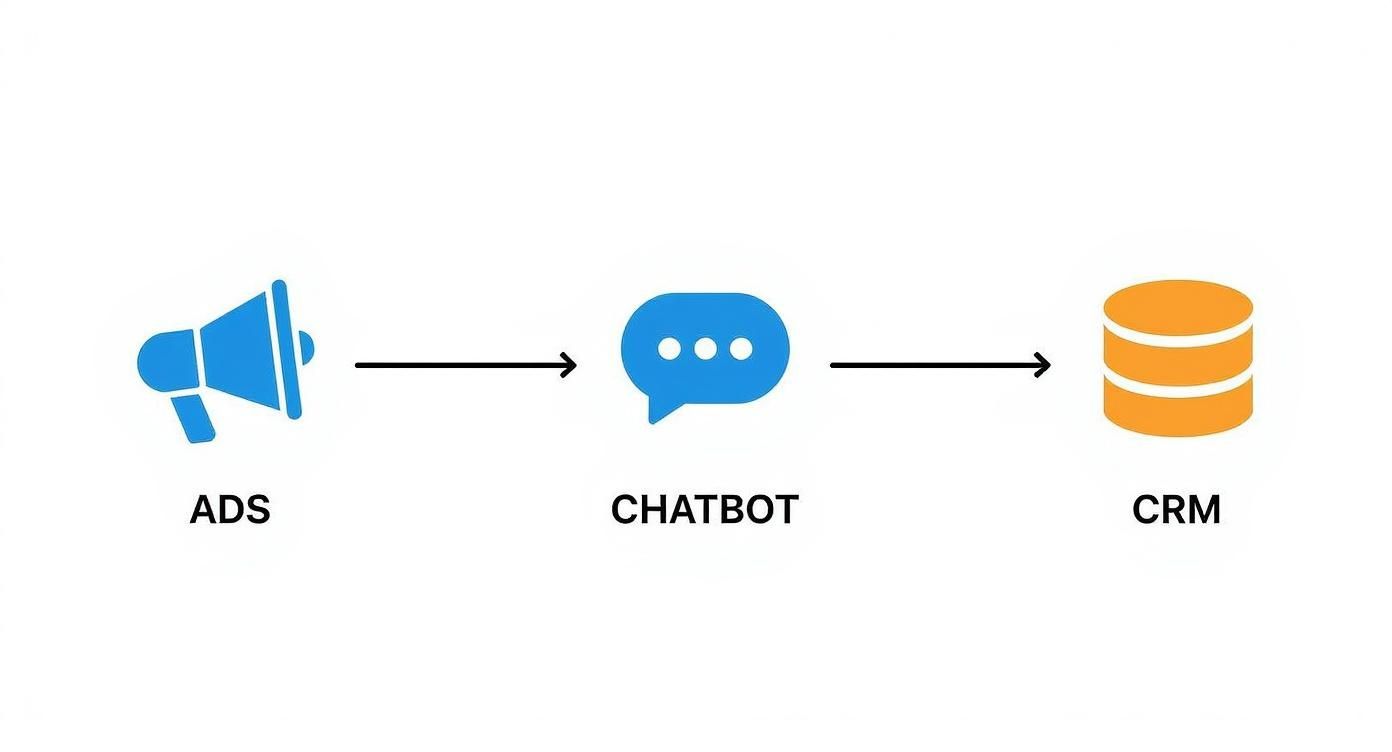
As you can see, each stage feeds into the next, creating a closed-loop system where every penny of ad spend is tied to a measurable business outcome.
Practical Optimisation Tactics
Once you have these metrics pouring in, you can start making smart, targeted improvements. The data gives you all the clues you need.
Think of yourself as a detective, piecing together the evidence to find weak spots and hidden opportunities in your conversational ad funnels. This cycle of refinement is what separates a basic chatbot from a genuine high-performing advertising asset.
The most powerful insights often come from failure points. Analysing where users drop off in a conversation is the single fastest way to identify weaknesses in your script and make immediate, impactful improvements.
Start by digging into your conversation logs. Find the exact point where a chunk of users just disappear. Is it after a particular question? Does the bot fail to understand something? Pinpointing these drop-off points lets you rewrite a confusing question, add clearer buttons, or provide better info right when it’s needed.
Another powerful tactic is A/B testing. Don’t just assume your first script is the best it can be. Test everything.
- Test your opening lines: Try a direct, straight-to-business opener versus a friendlier, more welcoming greeting.
- Experiment with button text: Does “Book a Demo” get more clicks than “See a Live Demo”? You’d be surprised how much these small tweaks can matter.
- Vary your calls-to-action: Test different offers or next steps. Maybe a downloadable guide converts better than an immediate call booking for a colder audience.
While businesses are jumping on AI for its efficiency, it’s vital to remember the person on the other end of the chat. In the UK, 82% of consumers still prefer talking to a human over a chatbot, yet the AI marketing sector is projected to hit $35.54 billion in 2025. This gap shows just how important it is for our chatbot experiences to be slick and genuinely helpful. You can get more insights on UK consumers and AI trends to understand this better.
Finally, don’t forget to just ask for feedback. At the end of a chat, pop in a simple thumbs up/down rating or ask, “Was this helpful?” This qualitative feedback is pure gold, giving you a feel for the user experience that raw numbers can’t. Combine the data with what users are telling you, and you’ve got a powerful optimisation cycle that will keep making your chatbot better and better.
Common Questions About AI Chatbot Advertising
Dipping your toes into AI chatbot advertising is exciting, but it’s completely normal to have a few questions buzzing around. It’s a seriously effective strategy, but things like cost, how it affects your team, and the legal stuff are all valid points to consider before you jump in. Let’s clear up some of the most common queries we hear from business owners.
Getting these details sorted upfront helps cut through the noise. It turns those “what ifs” into a solid plan of action, so you can move forward knowing you’re building a strategy that’s actually going to work.
How Much Does AI Chatbot Advertising Cost?
The cost can swing wildly, but you might be surprised at how affordable it is to get started. You certainly don’t need a massive pot of cash to begin seeing what’s possible.
For simpler, more straightforward bots on platforms like Meta Messenger, you can find tools that start from as little as £20-£80 per month. These are brilliant for handling basic queries coming from a Facebook ad. On the other end of the scale, for a sophisticated AI bot with complex conversation flows and slick CRM integrations, you’re looking at setup and monthly fees ranging from several hundred to thousands of pounds.
The best advice I can give is to start small. Carve out a modest budget for a single chatbot tied to one specific PPC campaign. Prove its ROI on that small scale, and once you’ve seen the results for yourself, you can reinvest those wins to expand your efforts with confidence.
Will a Chatbot Replace My Sales Team?
Absolutely not. A properly set up chatbot is more like a super-efficient assistant for your sales team, not its replacement. Think of it as a 24/7 filter, handling all the initial, time-consuming parts of the conversation so your team doesn’t have to.
Here’s how it typically works: the chatbot takes care of the repetitive, top-of-funnel work.
- It provides instant answers to common questions, any time of day or night.
- It qualifies leads against your specific criteria (things like budget, location, or need).
- It can even book appointments or demos straight into your team’s calendar.
This process frees up your actual sales pros to do what they do best: have meaningful, high-value conversations with warm, pre-vetted leads who are actually ready to talk. The bot sifts through the noise, letting your team focus on closing deals.
How Do I Manage Data Privacy and GDPR?
This is a big one. In the UK and Europe, compliance isn’t just a good idea—it’s completely non-negotiable. Your chatbot must be fully GDPR-compliant, and being transparent with users is the only way to build trust. Getting data handling wrong isn’t just bad practice; it can land you with some eye-watering fines.
Stick to these core principles, and you’ll be on the right track:
- Get Explicit Consent: You have to ask for, and get, clear permission before collecting personal data like names, emails, or phone numbers. No ambiguity.
- Be Transparent: Your privacy policy needs to be easy to find within the chat. It must clearly explain what data you’re collecting and how you’ll use and store it.
- Provide User Control: People have the right to see the data you hold on them and to ask for it to be deleted. Make sure this process is simple and accessible.
Always go with reputable chatbot platforms that have robust, built-in compliance features. It makes managing all this much more straightforward.
AI Chatbot Advertising: What Is the Biggest Mistake to Avoid?
If there’s one pitfall I see time and time again, it’s trying to build a chatbot that’s an all-knowing oracle for your entire business. People try to create a bot that can answer every conceivable question under the sun. This approach is a fast track to a confusing, frustrating user experience and, ultimately, a failed project.
Instead, give your chatbot one, clear, focused job that ties directly back to your advertising campaign. Is the goal to book a demo? Qualify a lead for a specific service? Register people for a webinar? A chatbot with a single, well-defined purpose will consistently outperform a complex one that tries to do everything at once. Focus is everything.
Ready to turn your ad clicks into qualified leads? The team at PPC Geeks are experts in creating data-driven campaigns that deliver measurable growth. https://ppcgeeks.co.uk/