




Guide to Google Ads Quality Score: Think of your Google Ads Quality Score a bit like a credit score for your ads. It’s Google’s own internal rating, on a simple 1 to 10 scale, that gives you a snapshot of the overall quality and relevance of your keywords and PPC ads.
A high score tells Google you’re providing a genuinely useful experience for searchers. The reward? Lower costs and better ad positions. It’s a win-win.
What Is Quality Score and Why Does It Matter?

If you’ve ever felt like your Google Ads campaigns are an uphill battle, the answer often comes down to your Google Ads Quality Score. This single metric is one of the most powerful forces humming away behind the scenes in your account, acting as an impartial judge of your advertising efforts. While it’s not a direct bidding factor in the ad auction, think of it as a crucial health check for your entire account.
Let’s imagine two advertisers bidding on the exact same keyword. Advertiser A has a fantastic Quality Score, but Advertiser B’s is pretty poor. In this scenario, Google sees Advertiser A as a much more reliable and relevant choice for its users. To say thanks, Google essentially gives Advertiser A a “discount,” letting them win a higher ad position for a lower cost-per-click (CPC).
Advertiser B, on the other hand, gets hit with a “tax.” To get that same ad spot, they’ll have to bid a whole lot more to make up for their low score. This is exactly why getting to grips with your Quality Score is non-negotiable for a healthy return on investment (ROI). It’s the secret to making your ad budget work smarter, not just harder.
The Core Components of Quality Score
Your score isn’t just some random number; it’s a combined rating built on three main pillars. Understanding these is the first step to levelling up your performance. A key aspect driving the success of Google Ads campaigns in the UK is how well advertisers manage this metric, which Google uses to figure out how relevant and useful your ads are to people.
The Quality Score is calculated based on three main factors: Expected Click-Through Rate (CTR), Ad Relevance, and Landing Page Experience. Each of these gets its own rating—’Below Average’, ‘Average’, or ‘Above Average’—giving you a clear idea of where you need to focus your efforts. For a deeper dive, you can learn more about how to boost your Google Ads Quality Score at ActiveWin.
These three elements come together to create your final score:
- Expected Click-Through Rate (CTR): This is Google’s prediction of how likely someone is to click your ad when it shows up for a specific keyword.
- Ad Relevance: This simply measures how well your ad copy matches what the user actually searched for.
- Landing Page Experience: This looks at your landing page after the click. Is it relevant, transparent, and easy for the user to navigate?
A strong Quality Score is a direct reflection of a great user journey. It proves you’ve successfully aligned your keywords, ad copy, and landing page to solve a user’s problem efficiently.
By focusing on these three areas, you aren’t just trying to please an algorithm. You’re actively making the experience better for potential customers, which naturally leads to better campaign results, lower costs, and a much healthier advertising account all around.
Guide to Google Ads Quality Score: The Three Pillars That Define Your Quality Score
To really get to grips with your Google Ads Quality Score, you need to look under the bonnet and see how the engine actually works. It isn’t just some random number Google plucks out of thin air; it’s a diagnostic score built from three core components that all work together. Mastering these pillars is the key to improving your score, which in turn lowers your ad costs and drives much better campaign results.
Think of these components as the legs of a stool. If one is short or wobbly, the whole thing becomes unstable. Google rates each one as ‘Above Average’, ‘Average’, or ‘Below Average’, giving you clear signposts showing exactly where you need to focus your optimisation efforts.
This diagram breaks down how the three core components combine to give you your overall Quality Score.
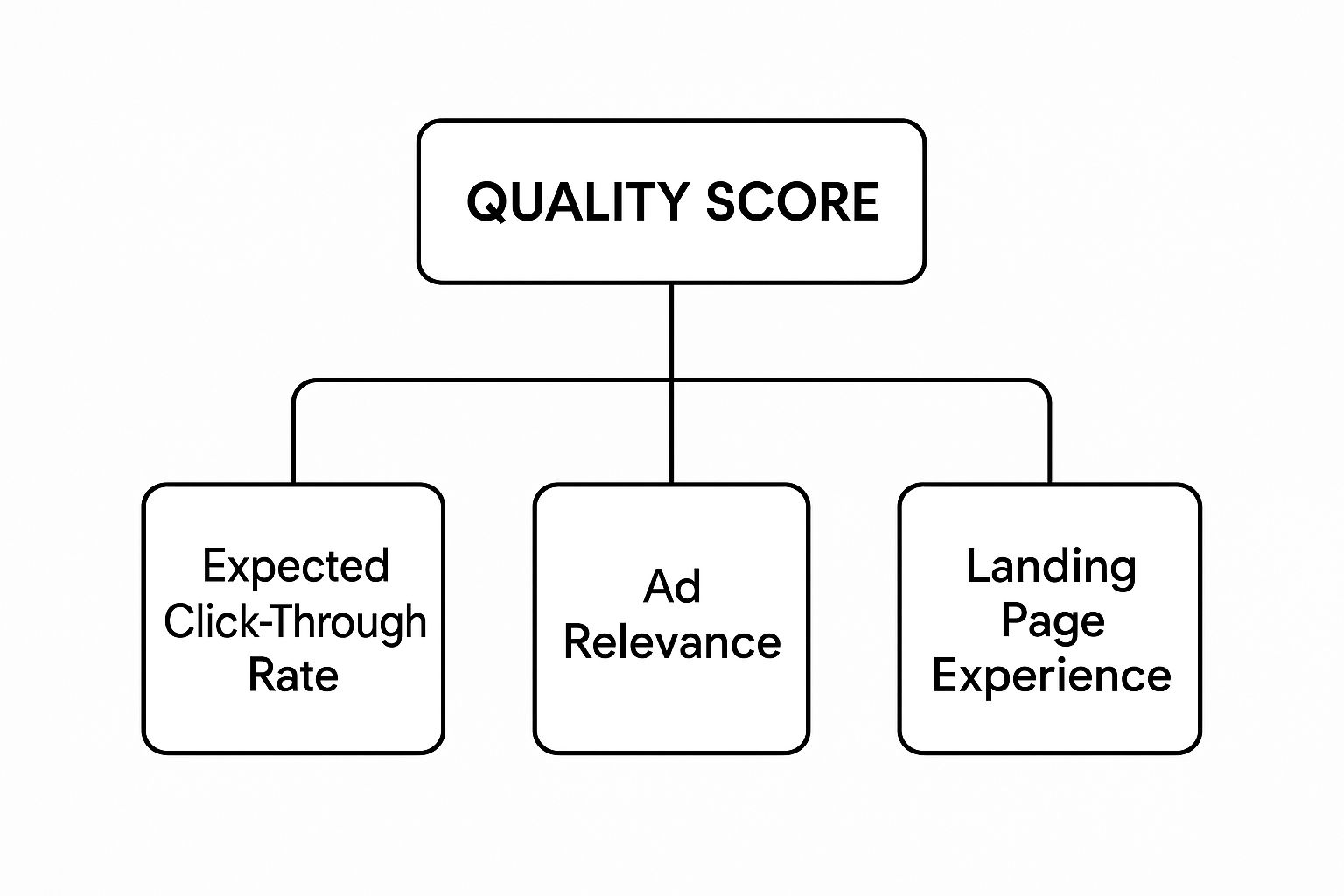
As you can see, your final score is a direct result of how well you’re doing across Expected CTR, Ad Relevance, and Landing Page Experience.
Expected Click-Through Rate
First up is Expected Click-Through Rate (CTR). This is Google’s prediction of how likely someone is to click your ad when it appears for a specific keyword. It’s crucial to understand this isn’t your actual CTR. Instead, it’s a forecast based on past performance—both for your own account and for every other advertiser bidding on that same keyword.
A high expected CTR tells Google your ad is compelling and spot-on for the search query. To get this number up, you need to focus on writing magnetic ad copy that grabs attention, includes a powerful call-to-action, and speaks directly to what the user is looking for.
Ad Relevance
Next, we have Ad Relevance. This measures how closely your ad copy matches the user’s search query. It’s simple, really: Google wants to show ads that are a direct answer to what someone is searching for. This means creating a rock-solid connection between your keywords, ad groups, and the ad text itself.
For example, if someone searches for “women’s waterproof running jackets,” your ad needs to shout about “waterproof running jackets for women.” A generic ad for “sports apparel” just won’t cut it and will get a poor relevance score. The solution is to build tightly-themed ad groups where every keyword is closely related, allowing you to write super-specific ads that resonate with users and earn that higher score.
Your Quality Score is a diagnostic tool. By reviewing its components—expected CTR, ad relevance, and landing page experience—you can identify precisely where improvements are needed for better overall ad performance.
This targeted approach doesn’t just bump up your Quality Score; it also brings in more qualified clicks from people who are genuinely interested in your offer. Juggling these elements is vital, especially when you consider that rising Google Ads costs can be offset by improved conversions.
Landing Page Experience
Finally, there’s Landing Page Experience, which looks at what happens after someone clicks your ad. Does your page deliver on the promise made in your ad? Google checks a few key things to decide:
- Relevant and Original Content: The page’s content must directly relate to the ad and keywords. No bait-and-switch.
- Easy Navigation: Users should find what they need in a flash, especially on mobile.
- Page Load Speed: A slow-loading page is a conversion killer and a one-way ticket to a high bounce rate.
- Transparency and Trust: Your site needs to be easy to get around, with clear business information.
Guide to Google Ads Quality Score: Optimising your landing pages is simply non-negotiable. Make sure they’re mobile-friendly, load quickly, and offer a smooth path from the ad right through to conversion. Google rewards pages that give users a positive, relevant experience.
Quality Score Component Performance Indicators
To help you figure out where your own campaigns might be falling short, this table breaks down what separates the good from the bad for each pillar.
| Component | Characteristics of ‘Above Average’ | Characteristics of ‘Below Average’ |
|---|---|---|
| Expected CTR | Ad copy is compelling and directly matches user search intent, often leading to a high historical click-through rate. | Ad copy is generic or vague, failing to capture user attention or align with the keywords in the ad group. |
| Ad Relevance | Keywords, ad groups, and ad copy are tightly aligned, creating a seamless connection from search to ad. | Ad copy does not reflect the specific keywords, resulting in a disconnect between what the user searched for and what the ad offers. |
| Landing Page Experience | The page loads quickly, is mobile-friendly, and its content is a direct extension of the ad’s promise. | The page is slow, difficult to navigate on mobile, and the content is not relevant to the ad, causing high bounce rates. |
Use these pointers as a checklist. If you spot a ‘Below Average’ characteristic in your own account, you’ll know exactly where to start making improvements for a healthier Quality Score and a better-performing campaign.
How Quality Score Directly Impacts Your Ad Spend

Right, let’s get down to brass tacks and connect Quality Score directly to your bank balance. This isn’t just some abstract metric Google uses for fun; it’s a powerful lever that directly controls how much you pay for every single click.
Think of it this way: a high score gets you a discount, while a low score slaps you with a penalty.
To really get our heads around this, we need to look at how Google decides which ads to show and in what order. It all comes down to a simple calculation called Ad Rank.
Ad Rank = (Your Maximum Cost-Per-Click Bid) x (Your Quality Score)
This little formula is the engine room of the entire Google Ads auction. It shows that your bid is only half the picture. Your Quality Score is just as important in winning those top ad spots, and a strong score can make even a modest bid surprisingly competitive.
The Google Discount Versus The Google Tax
Let’s make this real with an example. Picture two businesses, “Superb Stationery” and “Average Office Supplies,” both bidding on the keyword “luxury fountain pens.” They’re both happy to bid a maximum of £2.00 per click.
Here’s where it gets interesting. Their Quality Scores are worlds apart:
- Superb Stationery: Has a perfect Quality Score of 10/10.
- Average Office Supplies: Is struggling along with a Quality Score of 2/10.
Now, let’s plug these numbers into our Ad Rank formula:
- Superb Stationery’s Ad Rank: £2.00 (Max Bid) x 10 (QS) = 20
- Average Office Supplies’ Ad Rank: £2.00 (Max Bid) x 2 (QS) = 4
Even though they bid the exact same amount, Superb Stationery’s Ad Rank is five times higher. They’ll cruise into the top ad position with ease. This is the “Google discount” in action – their high-quality, relevant ad is rewarded with a better position without having to outbid anyone.
Meanwhile, Average Office Supplies gets hit with the “Google tax,” paying the same amount for a much lower position, assuming they even show up at all.
Guide to Google Ads Quality Score: Winning With A Lower Bid
The real power of a high Quality Score shines when you realise it lets you outrank competitors while spending less.
Let’s say Average Office Supplies decides to get aggressive. They crank their bid up to a hefty £6.00 to try and grab that top spot. Their new Ad Rank would be £6.00 x 2 = 12.
See what happened? Even with a bid three times higher, their Ad Rank of 12 is still nowhere near Superb Stationery’s 20. This means Superb Stationery holds onto its top position while bidding significantly less than its competitor, stretching its budget further and achieving a much healthier return on investment. This core principle of maximising your Google Ads ROI is absolutely critical for UK brands.
Why This Matters in Competitive UK Markets
This dynamic is especially crucial in the UK, where the cost of advertising can be all over the place. In standard UK industries, you might see average cost-per-click (CPC) rates from £0.50 to £3.50.
But jump into highly competitive sectors like finance, legal, or insurance, and those CPCs can skyrocket from £5.00 to over £15.00 for a single click.
In these high-stakes industries, a low Quality Score isn’t just a minor headache – it’s an expensive liability. Paying the “Google tax” on a £15.00 click will burn through your budget at an alarming rate. On the flip side, earning the “Google discount” gives you a massive competitive advantage, letting you secure more impressions, clicks, and conversions for the exact same ad spend.
Ultimately, your Quality Score is the key to your campaign’s financial efficiency. A high score lowers your cost-per-click and cost-per-acquisition, making your entire advertising budget work harder and smarter for you.
Proven Strategies to Improve Your Quality Score
Improving your Google Ads Quality Score isn’t some mystical secret; it’s a logical process of giving searchers exactly what they want. When you nail the three core components—Expected CTR, Ad Relevance, and Landing Page Experience—you create a seamless user journey. Google loves this and will reward you with lower costs and better ad positions.
Think of it as making a series of smart, deliberate tweaks rather than tearing everything down and starting again. Every little improvement you make, no matter how small it seems, builds towards a healthier, more powerful score. Let’s get into the practical, hands-on steps you can take to lift each component.
Craft Compelling Ads to Boost Expected CTR
Your Expected Click-Through Rate (CTR) is Google’s prediction of how likely someone is to click your ad. To push this number up, your ad copy needs to be a magnet for clicks. It has to pop on a crowded results page and give people a very good reason to choose you over the competition.
It all starts with getting your keyword selection right. Ditch the overly broad terms that pull in tyre-kickers and irrelevant clicks. Instead of just “shoes,” get specific with something like “women’s waterproof hiking boots.” This precision means your ad shows up for a much more motivated audience, which naturally makes a click more likely.
Next, it’s time to write ad copy that people can’t ignore. Your headlines and descriptions need to be a perfect match for your target keywords and what the searcher is actually looking for.
- Stick your primary keyword right in the headline to instantly show you’re relevant.
- Shout about your unique selling points (USPs) like “Free UK Delivery,” “24/7 Support,” or “Award-Winning Service.”
- Use a strong call-to-action (CTA) that tells people what to do next, like “Shop Now,” “Get a Free Quote,” or “Download Your Guide.”
- Pack your ads with extensions like sitelinks, callouts, and structured snippets to add more info and simply take up more space on the screen.
A/B testing isn’t just a good idea; it’s non-negotiable. Constantly test different headlines, descriptions, and CTAs to figure out what really clicks with your audience. Tiny changes can often lead to massive CTR gains over time.
Build Tightly-Themed Ad Groups for Ad Relevance
Guide to Google Ads Quality Score: Ad Relevance is all about how well your keyword, ad, and the user’s search query all line up. If your score here is low, it’s usually because of messy ad groups where one generic ad is trying to cover dozens of loosely related keywords. It just doesn’t work.
The answer is to create Single Keyword Ad Groups (SKAGs) or, at the very least, super tightly-themed ad groups. The idea is simple: build your campaigns around small, highly specific clusters of keywords. This lets you write incredibly focused ad copy that speaks directly to what that person is searching for.
For instance, instead of having one big ad group for “running shoes,” break it down:
- Ad Group 1: Keywords like “men’s trail running shoes,” “off-road running shoes for men.”
- Ad Group 2: Keywords like “women’s marathon running shoes,” “long-distance running shoes for women.”
This granular setup ensures that your ad for “men’s trail running shoes” only appears when someone is looking for that exact thing. This perfect alignment between keyword and ad is what Google wants to see, and your Ad Relevance score will thank you for it. While getting the structure right is crucial, regular maintenance is just as vital. You can find out more by exploring these essential strategies for a successful Google Ads PPC audit.
Optimise Your Landing Page Experience
Guide to Google Ads Quality Score: Your job isn’t over when someone clicks your ad. The Landing Page Experience is the final, crucial piece of the Quality Score puzzle, and it’s all about what happens after the click. A slick, relevant, and fast-loading landing page is an absolute must.
Google looks at a few key things here. Most importantly, your page must deliver on the promise you made in your ad. If your ad talks about a specific product, the click should take the user straight there, not to your generic homepage to start their search all over again.
Here’s a quick checklist for improving your landing page experience:
- Match Your Messaging: The headline and copy on your landing page should echo the language in your ad. This immediately tells users they’ve landed in the right spot.
- Make Speed a Priority: A slow-loading page is a conversion killer. Use tools like Google’s PageSpeed Insights to find and fix whatever is slowing you down.
- Optimise for Mobile: A huge chunk of searches happen on mobile phones, so your landing page has to look great and be easy to use on a small screen. No excuses.
- Keep Navigation Simple: The path forward should be obvious. Make it effortless for visitors to find what they need, with clear CTAs and a clean, uncluttered design.
- Be Trustworthy and Transparent: Show your contact information, privacy policy, and any terms and conditions clearly. Building trust is massive for both your users and for Google.
By working through these three pillars one by one, you can take real control over your Google Ads Quality Score. The payoff is a more efficient campaign that not only costs less but also gives your potential customers a much better experience.
Measuring the Full Impact of Your Optimisations

Improving your Google Ads Quality Score is much more than just chasing a number. Think of it as the start of a powerful ripple effect that touches every part of your campaign, turning all that hard work into real, measurable business results. A strong score is a brilliant predictor of success, tying directly into the KPIs that actually matter to your bottom line.
It’s a bit like tuning a high-performance engine. A tiny adjustment in one place doesn’t just fix that single component; it makes the whole car run faster, smoother, and more efficiently. In the same way, boosting your Quality Score builds positive momentum across your account, improving everything from how often you’re seen to how much profit you make.
The Link Between Quality Score and Core KPIs
When you get down to it and improve the core bits of your Quality Score—like ad relevance and landing page experience—you’re not just playing to an algorithm. You’re actually creating a better, more logical journey for your potential customers. This improved user experience shows up directly in your campaign’s most critical metrics.
A higher score is proven to deliver:
- Higher Click-Through Rates (CTR): It’s simple, really. More relevant ads get more clicks from people who are genuinely looking for what you’re selling.
- Increased Conversion Rates: When a user goes from a highly relevant ad to a fast, user-friendly landing page, you remove the friction. This makes it much easier for them to take that next step and convert.
- Dominant Impression Share: A strong Quality Score boosts your Ad Rank. This means your ads show up more often and in better positions than your competitors. Simple as that.
By putting your focus on Quality Score, you are systematically making the user journey better, which is hands-down the most sustainable way to drive long-term campaign performance.
Improving your Quality Score isn’t just an internal box-ticking exercise for Google. It’s a strategic move that translates directly into a more efficient ad spend, more engaged customers, and a healthier return on investment.
This direct connection between quality and performance is clear in UK market data. Statistics show the average Google Ads click-through rate in the UK hovers between 4% to 6%, a metric that’s closely tied to Quality Score factors like ad relevance. Likewise, typical conversion rates across UK Google Ads campaigns average around 7.5%, though this can vary massively by industry. These conversion numbers are often a direct result of well-managed Quality Scores. You can find more details on these advertising statistics at Amra & Elma.
From Diagnostic Tool to Profit Driver
Guide to Google Ads Quality Score: Ultimately, you need to see your Quality Score as more than just a grade. It’s your strategic guide, pointing you towards greater profitability. Every little improvement, whether it’s tweaking your ad copy or speeding up your landing page, is another step towards building a more efficient and effective advertising machine.
Connecting these dots is absolutely vital for long-term success. By tracking your KPIs right alongside your Quality Score, you can clearly see how your optimisations are hitting your business goals. For anyone looking to fine-tune their approach even further, it’s well worth exploring our expert Google Ads optimisation tips to make sure every penny you spend is working as hard as it possibly can.
Guide to Google Ads Quality Score: Your Top Quality Score Questions Answered
When you’re deep in the trenches of Google Ads, Quality Score can feel like a bit of a mystery. There are loads of myths and half-truths out there, so let’s cut through the noise and get straight to the facts.
One of the biggest head-scratchers is how often the score actually updates. Is it a fixed grade you get once and then you’re stuck with it? Absolutely not.
Your Google Ads Quality Score is calculated in real-time, every single time your keyword enters an auction. That 1-10 number you see in your account? Think of it as a diagnostic report card of your recent performance, but the real magic happens instantly with every search.
This means your ad’s potential is constantly being judged, which is exactly why you can’t just “set and forget” your campaigns. Consistent optimisation is the name of the game.
Can You Just Outbid a Poor Quality Score?
Guide to Google Ads Quality Score: This question comes up a lot: can you just throw more money at the problem to muscle your way to the top, even with a rubbish score? Well, you can try, but it’s a painfully expensive way to run your campaigns and it simply won’t last.
As we’ve covered, a low Quality Score basically acts as a tax on your bids. You’re forced to pay way more just to get the same Ad Rank as a competitor who has their act together. This strategy will bleed your budget dry in no time, leaving you with a terrible return on investment while your smarter competitors clean up.
Other Common Queries Explained
Let’s quickly tackle a few more questions we hear all the time:
- Does Quality Score affect my organic SEO? Nope, not directly. Quality Score is purely a paid search metric and has zero impact on your organic rankings. That said, when you improve your landing page for your ads, you often see a positive knock-on effect for user engagement, which is always a good thing for SEO.
- What’s a ‘good’ Quality Score anyway? While we all chase that perfect 10/10, anything between a 7 and 10 is generally considered pretty solid. It means your ads, keywords, and landing pages are well-aligned. If you’re seeing a 6 or below, that’s a massive red flag telling you there’s serious room for improvement.
At PPC Geeks, our job is to make sense of Google Ads and build campaigns that deliver real, measurable results. If you’re ready to stop guessing and start improving your Quality Score to maximise your ROI, check out our expert PPC management services.