
Your Guide to the Future OpenAI Ads Platform

Right now, there isn’t a big red button you can press to launch an OpenAI ads platform. But don’t be mistaken – the foundations for a seriously powerful advertising ecosystem are being laid as we speak. This isn’t about flipping a switch; it’s about gradually weaving sponsored, genuinely helpful content right into the fabric of AI conversations and creative tools. We’re talking about a monumental shift away from traditional search ads and into a new world of conversational, intent-driven marketing.
What an OpenAI Ads Platform Means for Marketers
Imagine getting past the rigid grid of search results and stepping into a fluid, intelligent conversation with your customers. The rise of an OpenAI ads platform isn’t about slapping a banner ad next to a chatbot’s answer. It’s about completely rethinking how your brand can show up and help someone at the exact moment they’re figuring out a need, solving a problem, or creating something from scratch.
This new approach embeds your brand’s message directly into AI-powered moments where people are actively looking for solutions, not just scrolling past things. It’s a move towards a much more natural and value-packed way of doing digital advertising, where the focus is on assisting, not interrupting.
A New Frontier of Ad Inventory
The potential for ad space within OpenAI’s tools is enormous and far more diverse than what we’re used to. Instead of being stuck on a search results page or a social media feed, ads could pop up contextually across all sorts of AI environments.
- Conversational Ads in ChatGPT: Someone planning a family trip to Cornwall might get a sponsored suggestion for a specific kid-friendly hotel, complete with booking links, right there in the chat.
- Creative Integrations in DALL-E: An architect using DALL-E to mock up a modern kitchen could be offered sponsored 3D models of specific appliance brands that slot perfectly into their design.
- Helpful Product Placements: A user asking for a vegan pasta recipe could see a sponsored mention of a particular dairy-free cheese, positioned as a useful ingredient tip.
This is less about casting a wide net with broad targeting and more about zeroing in on a user’s immediate goal. It’s a concept that feels very similar to the principles behind programmatic advertising, where automated systems serve ads based on real-time user signals. If you’re curious about the mechanics, our guide on what programmatic advertising is is a great place to start.
The Audience Is Ready and Waiting (OpenAI Ads)
The potential reach for a platform like this is already huge, especially in key markets. OpenAI’s footprint in the United Kingdom has grown at a remarkable pace, making it one of the company’s fastest-expanding regions. In the UK, about one in five people online say they use ChatGPT.
The numbers get even more interesting in London, where 30% of all residents were using the tool back in February 2024 – that’s nearly 3 million users. That figure skyrockets to 57% among young Londoners aged 15-25, showing a powerful generational shift that advertisers simply can’t afford to ignore. You can dig into more of these UK-specific stats over at Marketing Week.
This isn’t just advertising; it’s assisted commerce. The goal is to make the brand a helpful partner in the user’s journey, providing relevant solutions within the natural flow of an AI interaction.
Ultimately, the vision for an OpenAI ads platform is one where advertising becomes a seamless, valuable part of the user experience. It’s set to create a powerful new channel for businesses to connect with a highly engaged audience at the very moment of need.
OpenAI Ads: How AI-Powered Ad Mechanics Will Work
The arrival of an OpenAI ads platform isn’t just another update—it’s a fundamental shift in the engine room of digital advertising. The core mechanics that drive our campaigns—targeting, bidding, and measurement—are all on the verge of a major overhaul. We’re about to move beyond the familiar territory of keyword lists and audience segments, stepping into a world that’s more dynamic, conversational, and genuinely intent-driven.
This isn’t a simple upgrade; it’s a complete rethink of how brands connect with potential customers. The basic principles we know will stick around, but they’ll be powered by an AI that understands nuance, context, and intent in a way that today’s systems can only dream of.
Targeting True User Intent
For years, we’ve relied on proxies to figure out what users want. We target keywords typed into a search bar or demographics pulled from a social media profile. An OpenAI ads platform, however, promises to get much closer to the source by targeting the actual intent a user expresses in a conversation.
Picture this: a user isn’t just searching for “best running shoes.” They’re deep in a conversation with ChatGPT, explaining they have flat feet, are training for a half-marathon on pavement, and have a preference for a specific colour. This incredibly rich, contextual data is a goldmine for serving up hyper-relevant ads.
- From Keywords to Conversations: Your focus will shift from targeting broad keywords to homing in on specific conversational contexts and problem-solving moments.
- Proactive Suggestions: Instead of just reacting to a search query, the platform could proactively put your product forward as the perfect solution to the user’s clearly stated problem.
- Creative Context: For a tool like DALL-E, targeting could be based on the creative elements a user is trying to generate, allowing you to offer relevant assets, tools, or services right when they need them.
To get a sense of how AI already boosts advertising, look at existing AI-powered PPC optimisation platforms that automate and refine campaigns using performance data. The OpenAI platform would take this to the next level by weaving itself directly into the user’s initial discovery process.
New Frontiers in Bidding Strategy (OpenAI Ads)
Bidding is likely to evolve far beyond the standard cost-per-click (CPC) or cost-per-thousand-impressions (CPM) models we know today. When an ad is part of an AI-generated answer, its value is directly tied to the quality and helpfulness of that answer. This opens the door to some seriously innovative bidding strategies.
Instead of bidding for a click, you might bid on the ‘quality score’ of an AI-generated response that features your product. The goal becomes paying for genuine influence, not just a momentary interaction.
This new model could see us bidding on outcomes and influence. A travel company, for example, might bid to have its hotel recommended within a detailed, AI-generated travel itinerary. The real value isn’t the click on the hotel link; it’s the trusted placement inside a comprehensive plan that the user is highly likely to save and act on.
Redefining Measurement and Attribution
Finally, the way we measure success will have to adapt. Clicks and impressions start to lose their meaning when the main interaction is a conversation. We’ll need new metrics to capture the unique value this platform brings.
The focus will shift to metrics that can actually quantify influence and assistance.
- Assisted Influence Score: A metric to measure how often your brand was part of a helpful AI response that later led to a conversion, even if it wasn’t the final touchpoint.
- Conversational Engagement Rate: Tracking how users engage with sponsored suggestions in a chat. Do they ask follow-up questions or incorporate the idea into their plans?
- Problem Resolution Metric: Measuring the success rate of AI conversations where your brand was part of solving a user’s problem.
The incredible reach of OpenAI’s services provides a massive launchpad for these new mechanics. ChatGPT’s website traffic shot up by a staggering 3,433% in its first month, and it now boasts 400 million weekly active users. Adoption is especially strong among Gen Z and Millennials in the UK, showing a user base that’s more than ready for new ways of interacting online. This huge, engaged audience is the perfect testing ground for a new advertising paradigm.
Ultimately, getting your head around how machine learning in PPC currently works will give you a solid foundation for grasping the changes on the horizon.
How OpenAI Ads Stacks Up Against Google and Meta
To really grasp where a potential OpenAI ads platform could fit in, we need to look at the current heavyweights: Google and Meta. Each one has carved out its own territory based on user intent, and OpenAI is set to create a brand new one. This isn’t about one replacing another; it’s about adding a powerful new tool to your marketing arsenal.
Google Ads is the undisputed master of search intent. Someone types a query because they have a specific, immediate need. They’re actively looking for information, a product, or a service. The entire platform is built to connect advertisers with this direct, high-value demand. Simple as that.
Meta Ads, on the other hand, is all about social and demographic intent. It uses a deep well of data on user profiles, interests, and behaviours to show ads to people who fit a certain persona. It’s less about capturing an immediate need and more about creating demand based on who a person is.
An AI-driven ad platform will need to nail the same core mechanics, from targeting through to measurement, but the inputs and the user’s mindset will be completely different.
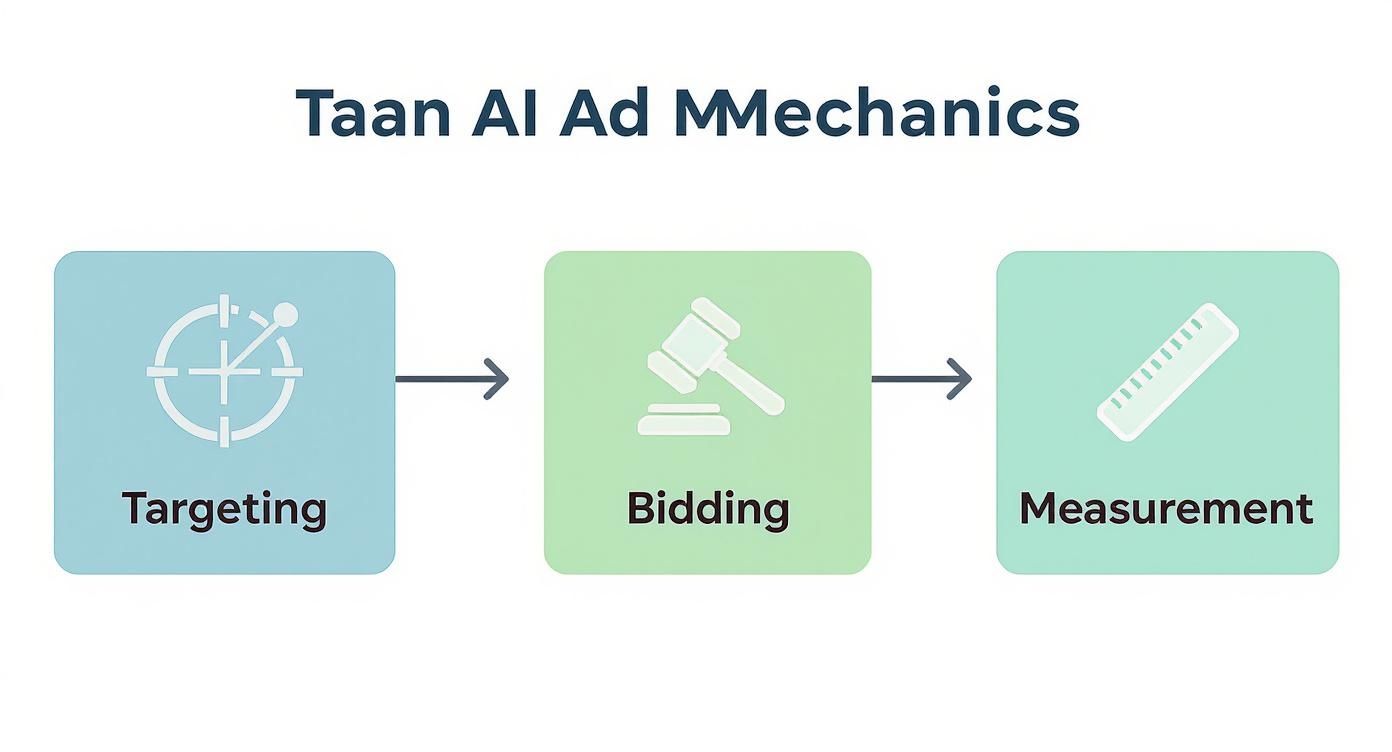
This process shows a major shift away from simple keyword-based systems towards something far more aware of context and nuance.
The New Frontier: Conversational Intent
An OpenAI ads platform would create a whole new category: conversational and creative intent. This is the mindset a user is in when they’re exploring ideas, trying to solve a tricky problem, or creating something from scratch. They aren’t just searching; they are actively collaborating with an AI.
This opens up a chance to engage with users in a totally different way. An ad in this context isn’t just an answer to a query; it’s a helpful suggestion dropped right into a creative or problem-solving flow. It’s a world away from the environments Google or Meta offer. For a deeper dive into how those two platforms differ, our Google Ads vs Facebook Ads comparison gives some excellent background.
The real difference is the user’s state of mind. Google targets the ‘I need to find’ moment. Meta targets the ‘I am this person’ profile. OpenAI will target the ‘I am trying to figure out’ process.
This distinction is massive. It changes everything about how ads are formatted, how targeting works, and what data sources are used. The entire advertising experience is shaped by the nature of that interaction.
Ad Formats and Data Sources (OpenAI Ads)
It follows that the ad formats themselves will look completely different. Google has its text and shopping ads, and Meta has its image and video creative. OpenAI’s formats would need to be woven directly into the AI-generated content.
- Sponsored Snippets: Think text or product links appearing naturally within a ChatGPT response.
- Creative Injections: Imagine branded tools or assets being suggested during a DALL-E session.
- Guided Workflows: A brand could sponsor a custom GPT to help a user complete a task, like planning a holiday or preparing their taxes.
The data fueling these ads would be just as unique. Google uses search history. Meta uses social profiles. OpenAI would pull from the conversation itself—the user’s goals, problems, and preferences, all stated in real-time. This immediate, first-party data is incredibly powerful for placing hyper-relevant ads.
Advertising Platform Feature Comparison
To really put things into perspective, let’s break down how these three platforms compare based on their core strengths and what we can expect from OpenAI.
| Feature | Google Ads | Meta Ads | OpenAI Ads Platform (Projected) |
|---|---|---|---|
| Primary User Intent | Search & Transactional | Social & Demographic | Conversational & Creative |
| Ad Environment | Search results, YouTube, websites | Social feeds, stories, messages | AI chat, creative tools, workflows |
| Key Data Source | Keyword queries, browsing history | User profiles, interests, connections | Live conversational context, prompts |
| Main Objective | Capture existing demand | Generate new demand | Assist and influence during exploration |
Ultimately, an OpenAI ads platform won’t be a direct competitor fighting for the exact same slice of the advertising pie. Instead, it gives us access to an entirely new stage of the customer journey, making it a crucial addition for brands wanting to connect with users in those deep moments of thought and creativity.
OpenAI Ads: Navigating Privacy and Brand Safety
As we start to imagine what an OpenAI ads platform might look like, two things immediately jump out as make-or-break factors: user privacy and brand safety. Let’s be honest, in a world that’s more and more sceptical about how personal data is handled, and with brands rightly protective of their image, OpenAI has to build this thing on a foundation of trust. Right from day one.
For advertisers, this isn’t just about ticking compliance boxes; it’s a strategic imperative. People are hyper-aware of their digital footprint. Any new platform has to tackle data privacy head-on, especially now the industry is finally moving on from third-party cookies. My guess is OpenAI will have to go with a privacy-first model, giving users absolute clarity and control over how their chat data is used for ads.

Protecting User Data in a Post-Cookie World
The challenge here for OpenAI is pretty unique. It’s not like Google, which has search history, or Meta with its social profiles. OpenAI’s goldmine of data would be the direct, often deeply personal, content of user conversations. This demands an incredibly high bar for data handling and anonymisation.
We should expect a system that takes its cues from regulations like GDPR, with a heavy focus on explicit user consent and using as little data as possible. The platform could potentially analyse the intent of a conversation in real-time to serve up a relevant ad, without needing to hang on to sensitive personal info long-term. This fits nicely with the broader industry shift towards privacy-safe measurement techniques. If you want to get your head around how performance is measured with large, anonymised datasets, it’s worth reading up on what marketing mix modelling is to see how it provides a bird’s-eye view without tracking individuals.
Safeguarding Your Brand from Unsafe Content (OpenAI Ads)
Beyond keeping user data safe, the next big headache for any brand manager is brand safety. Because the AI is generative, there’s always a risk—no matter how small—of an ad popping up next to dodgy, inaccurate, or just plain weird AI-generated content. Imagine a user asking a sensitive question, getting a flawed AI response, and seeing your brand’s ad sitting right beside it. That’s a PR nightmare waiting to happen.
An effective OpenAI ads platform must give advertisers powerful, granular controls to shut down these risks. We’re not just talking about blocking a few keywords; we need total control over the contextual environment where our brand shows up.
To make this work, the platform would need to offer safety tools that are far more sophisticated than what we have now.
- Advanced Contextual Filtering: This would mean AI-powered filters that can actually understand the nuance and sentiment of a conversation, blocking ad placements in chats that are sensitive, controversial, or just totally irrelevant.
- Advertiser-Controlled Exclusion Lists: We’d need the ability to build and maintain our own comprehensive lists of topics, themes, and conversational contexts we want to avoid at all costs.
- Approval and Review Mechanisms: Perhaps a system that lets brands pre-approve specific types of AI responses or conversation flows where their ads are allowed to appear, giving them the final say.
- Content Suitability Tiers: A bit like YouTube’s system, OpenAI could classify conversations into different safety tiers (e.g., family-friendly, business-focused, unrestricted). This would let advertisers choose the level of risk they’re comfortable with.
At the end of the day, success on a future OpenAI platform will demand a proactive approach. It’ll be as much about diligent brand safety management and ethical data handling as it is about smart creative and sharp targeting. The brands that win will be the ones that build trust—not just with the platform, but with its users too.
OpenAI Ads: What This Means for Your Marketing Workflow
The arrival of an OpenAI ads platform is about more than just slotting another channel into your marketing mix. It’s set to fundamentally rewire the daily grind for marketers. The familiar routines of keyword bidding and audience segmentation are on the verge of becoming a much more collaborative dance with AI. This changes not just what we do, but how we think about putting campaigns together.
Don’t expect an overnight flip of a switch. This is a gradual pivot in both skills and focus. The core mission—connecting with customers—remains the same, but the tools we’ll use to get there are about to look dramatically different. Get ready for a workflow that’s less about frantic manual tweaks and more about giving clear, strategic direction to a powerful AI.
The Shift from Keywords to Conversation
For years, the bedrock of search advertising has been keyword research. We’ve all spent countless hours digging up terms, checking search volumes, and tweaking bids to perfection. An OpenAI ads platform will shift that entire focus away from isolated keywords and towards the art and science of prompt engineering.
Instead of asking, “What keywords are my customers tapping into Google?”, the big question becomes, “What problems are my customers trying to solve, and how can I frame our product as the perfect solution within their conversation with an AI?”. Answering that requires a much deeper, more empathetic grasp of the entire customer journey.
Your day-to-day tasks are set for a major shake-up:
- From Researching Keywords to Crafting Prompts: You’ll be spending a lot less time in keyword planners and a lot more time developing clever prompts that guide the AI to position your products as the go-to solution.
- From Bidding on Clicks to Influencing Outcomes: Success won’t be about snagging the top ad spot. It will be about becoming the most genuinely helpful, integrated recommendation inside an AI-generated plan or response.
- From Analysing Search Queries to Interpreting Intent: Your analytical skills will be redirected towards understanding the subtle nuances of conversational data, spotting fresh opportunities hidden in the dialogue.
The new currency for PPC specialists will be their ability to collaborate with AI. It’s a move from being a campaign operator to becoming an AI strategist, guiding intelligent systems toward business goals.
AI-Guided Creative and Campaign Management (OpenAI Ads)
Beyond just targeting, the OpenAI platform will have a massive impact on how we develop creative and manage campaigns day-to-day. The whole process of writing ad copy, picking visuals, and allocating budgets will become a partnership between human insight and machine intelligence.
Just imagine an AI that doesn’t just suggest ad copy but actually generates multiple visual concepts from a simple creative brief. This instantly frees you up to focus on the big-picture strategy and testing, rather than getting bogged down in the nitty-gritty of production. According to a recent Adage article, features like ChatGPT Pulse are already creating personalised, AI-generated content, giving us a taste of a future where ad creation is far more automated.
This automation will run deep into campaign management, too. An AI-powered system can chew through performance data at a scale and speed that is simply impossible for a human.
- Automated Budget Allocation: The AI could instantly shift budgets between different conversational contexts, depending on which ones are driving the most valuable results.
- Predictive Performance Analysis: Forget just reporting on what happened last week. The system could forecast the potential impact of different creative tweaks or targeting adjustments before you make them.
- Dynamic Creative Optimisation: The platform could automatically test thousands of tiny variations of a sponsored message to find the perfect tone and format for different user conversations.
This level of automation means marketers can manage more complex campaigns with far greater efficiency. The focus shifts from constant manual tinkering to setting strategic guardrails and letting the AI optimise within those boundaries. The essential skills will be in understanding large language models (LLMs), interpreting AI-driven insights, and knowing exactly how to steer these powerful new tools. To survive and thrive in this next era of PPC, you’ll need to embrace your new role as a collaborator with AI.
OpenAI Ads: How Your Business Can Prepare Today
The future of AI advertising is hurtling towards us, but the time to build a genuine competitive advantage is right now. Smart businesses won’t wait for an official launch announcement from OpenAI. Instead, they’re taking practical steps to get ahead of the curve. This isn’t about ripping up your entire strategy overnight; it’s about building the foundational skills and organising your assets so you’re ‘AI-ready’ from day one.
The journey starts with the tools you already have. By treating platforms like ChatGPT as a training ground, your team can start developing the instincts and skills crucial for this new era. It’s a chance to stop reacting to market shifts and start proactively understanding what AI can really do.
Master the Art of Prompt Engineering
Without a doubt, the most valuable skill in this new landscape will be prompt engineering—the art of giving an AI clear, effective instructions to get exactly what you want. This is where your team can carve out a massive edge. Start weaving AI into your current marketing workflows, not just for a quick efficiency win, but as a deliberate practice.
- Content Creation: Get your team using ChatGPT to generate blog outlines, product descriptions, or social media posts. The goal isn’t just to get an output, but to tweak and refine prompts until the AI produces content that sounds exactly like your brand.
- Customer Persona Development: Use AI to build out incredibly detailed customer personas. Feed it your existing customer data and ask it to dig into common pain points, motivations, and the kind of language that resonates.
- Creative Brainstorming: Run brainstorming sessions for new campaign ideas or ad angles with AI as a creative partner. Learn how to ask the kind of questions that spark genuinely fresh thinking.
Mastering prompts now means you’ll be ready to write the sophisticated instructions needed to steer an AI ads platform later on.
Organise Your First-Party Data (OpenAI Ads)
Any AI advertising platform will run on data. To make the most of it, your first-party data—the information you collect directly from your customers—needs to be clean, organised, and ready to go. This is your secret weapon, a competitive asset no one else has.
Think of your first-party data as the proprietary fuel for your AI engine. The better the fuel, the more powerful and precise the engine’s performance will be.
Start getting your data in order today with a clear structure.
- Consolidate Your Data: Pull customer information from your CRM, email platform, and e-commerce site into one unified, accessible place.
- Segment Your Audiences: Go way beyond basic demographics. Create detailed segments based on purchasing behaviour, lifetime value, and engagement levels.
- Ensure Compliance: Double-check that your data collection and storage practices are fully compliant with GDPR and other UK privacy regulations. No cutting corners here.
Start Small-Scale Experimentation
You don’t need a huge budget to start experimenting. Kick things off with small, low-risk projects to build institutional knowledge and see what clicks for your brand. This hands-on experience is priceless. You could even use OpenAI’s existing API to build a custom tool, like a website chatbot that answers customer questions using your product info.
OpenAI’s explosive growth should tell you everything you need to know about the urgency here. Its revenue is on a steep climb, with some projections suggesting its annual recurring revenue could smash £9.6 billion in 2025. A huge chunk of this is driven by subscriptions like ChatGPT Plus, which already boasts over 600,000 paying business users—a figure that shot up by 275% in the last year alone. You can find more insights into OpenAI’s rapid growth and what it means for monetisation on aiprm.com.
This kind of momentum signals that an advertising platform isn’t some distant dream; it’s an imminent reality. By preparing now, you’re positioning your business to lead, not just to follow.
Frequently Asked Questions
When a new advertising frontier like OpenAI’s platform emerges, it’s natural for marketers and business owners to have a lot of questions. We’ve gathered some of the most common queries to give you a clearer picture of what to expect and how to prepare.
When Will the OpenAI Ads Platform Launch?
There’s no official date circled on the calendar just yet. Based on industry chatter, the most likely scenario is a phased rollout, kicking off with a pilot programme for a handful of select partners. Realistically, we’re probably looking at a timeline of the next 12 to 18 months.
For now, the best bet is to keep a close eye on official announcements from OpenAI and the major tech news outlets.
Will It Be Too Expensive for Small Businesses? (OpenAI Ads)
Initially? It might be. Whenever a new platform like this drops, big enterprise brands with deep pockets often jump in first, which can drive up the price.
But it’s almost certain to adopt a competitive bidding model, much like Google Ads. As the platform finds its feet, we expect to see more accessible options like cost-per-action (CPA) bidding. This levels the playing field, making it a viable channel for small businesses that can prove a strong return on investment.
The key for SMEs will be proving value. If a small brand can show that their sponsored suggestions lead to high engagement and conversions, the bidding system will likely reward that efficiency, making the OpenAI ads platform a viable channel.
What Will Ad Formats Look Like?
Forget what you know about banner ads and pop-ups. The ad formats here will be woven directly into the user’s experience, designed to be genuinely helpful rather than just another interruption.
Think along these lines:
- Sponsored Text Snippets: Short, useful product mentions or links that appear right inside an AI-generated answer.
- Interactive Product Carousels: If a user is asking for product recommendations, a scrollable list of relevant items could appear right in the chat.
- Branded Custom GPTs: Imagine a DIY brand sponsoring a GPT that walks a user step-by-step through a home renovation project.
The entire focus will be on non-disruptive advertising that actually helps the user achieve their goal.
How Is This Different from Google Performance Max? (OpenAI Ads)
While both platforms are powered by AI, they operate in fundamentally different arenas. The key difference is the user’s mindset and starting point.
Performance Max is all about optimising ad delivery across Google’s massive network (Search, YouTube, Display, etc.) to hit specific campaign goals. It catches users who are already on Google’s turf.
The OpenAI ads platform, on the other hand, serves ads within a conversational or generative context. It targets users while they’re in a creative, problem-solving, or exploratory mode—a completely different, and potentially more influential, moment than a simple search query.
At PPC Geeks, we make it our business to stay ahead of the curve, ensuring your campaigns are primed for success on the latest platforms. If you want a team of UK-based experts to manage your PPC and get your brand ready for the future of advertising, get in touch for a free, in-depth audit today.
Author

Search Blog
Free PPC Audit
Subscribe to our Newsletter

The Voices of Our Success: Your Words, Our Pride
Don't just take our word for it. With over 100+ five-star reviews, we let our work-and our satisfied clients-speak for us.

"We have been working with PPC Geeks for around 6 months and have found Mark and the team to be very impressive. Having worked with a few companies in this and similar sectors, I rate PPC Geeks as the strongest I have come across. They have taken time to understand our business, our market and competitors and supported us to devise a strategy to generate business. I value the expertise Mark and his team provide and trust them to make the best recommendations for the long-term."
~ Just Go, Alasdair Anderson