




So, what’s a “good” click-through rate? It’s the million-dollar question, but there’s no single magic number. The answer really depends on your industry, the channel you’re advertising on, and what you’re trying to achieve. That said, for UK businesses running ads on Google Search, a CTR between 5% and 7% is a solid target to aim for, putting you comfortably ahead of the pack.
Understanding Click-Through Rate and Why It Matters
Let’s break it down with a simple analogy. Imagine you own a boutique on a busy high street. The number of people who glance at your shop window as they walk past are your impressions. Now, the number of people who are so intrigued they actually open the door and step inside? Those are your clicks.
Click-Through Rate (CTR) is just the percentage of people who saw your “shop window” and decided to come in for a closer look.
It’s one of the most basic but powerful metrics in digital advertising. A high CTR is a great sign—it tells you that your ad is hitting the right notes with your target audience. On the flip side, a low CTR often signals a disconnect. Maybe the message is off, or perhaps you’re showing it to the wrong crowd entirely. If you want to get into the nitty-gritty, our guide on what click-through rate is is a great place to start.
How to Calculate Your CTR
Figuring out your CTR is dead simple. You just take the total number of clicks your ad got and divide it by the total number of times it was shown (impressions). Then, multiply by 100 to turn it into a percentage.
The CTR Formula: (Total Clicks ÷ Total Impressions) x 100 = CTR %
Let’s run through a quick example. Say a UK-based online shop that sells handmade leather bags runs a Google Ad. In one month, their ad is shown 10,000 times and gets 500 clicks.
- Clicks: 500
- Impressions: 10,000
- Calculation: (500 ÷ 10,000) x 100 = 5%
Easy. The retailer’s CTR for that ad is 5%. This straightforward calculation gives you an immediate pulse check on your ad’s performance.
Why CTR is More Than a Vanity Metric
It’s tempting to look at CTR as just another number on a dashboard, but it has a real, tangible impact on your campaign’s bottom line. Platforms like Google pay very close attention to it. In fact, CTR is a massive part of their Quality Score formula, which directly influences your ad rank and how much you end up paying for each click.
A higher CTR sends a strong signal to Google that your ads are relevant and useful to searchers. This can lead to some serious perks:
- Lower Cost Per Click (CPC): Google literally rewards you with cheaper ad costs for being relevant.
- Better Ad Positions: A strong CTR helps you climb the rankings, sometimes even leapfrogging competitors who are bidding more than you.
- More Website Traffic: It’s simple maths—a better CTR naturally funnels more potential customers to your website without you having to increase impressions.
Recent data from 2024 shows that the average CTR for search campaigns across UK SMEs was 4.3%. Hitting that 5-7% mark means your business isn’t just doing well; it’s outperforming the national average by a significant margin. Understanding where you stand against these benchmarks is the first step to figuring out what’s working and what needs fixing in your campaigns.
What Is a Good CTR? Benchmarking Across Ad Channels
Trying to define a single “good” CTR is a bit like asking for the perfect temperature; it completely depends on where you are and what you’re doing. A chilly 10°C might be glorious for a winter walk in London, but it’s a disaster for a beach day in Cornwall. It’s the same with your ads. A click-through rate that signals massive success on one channel could be a sign of total failure on another.
The biggest reason for this difference comes down to one thing: user intent.
Think about it. Someone typing “emergency plumber near me” into Google has a serious, immediate problem they need to solve. They are actively hunting for a solution. Now, compare that to someone idly scrolling through their social media feed, catching up with friends. Their mindset is worlds apart, making them far less likely to click an ad that interrupts their browsing.
Getting your head around these differences is vital for setting realistic goals and figuring out how well your campaigns are actually doing. Without this context, you’re just guessing, and that’s a quick way to make bad decisions.
Search Ads: Where Intent Is King
On platforms like Google Search, people are on a mission. They literally type their needs into a search box. This high-intent environment is exactly why search ads usually have the highest CTRs of any channel. When your ad is a perfect match for what someone is looking for, a click is the most natural next step.
So, what numbers should UK businesses be aiming for? Industry benchmarks for 2025 show that the average CTR for Google Search ads is 3.17%, while Display ads lag way behind at just 0.46%. For e-commerce brands using Google Shopping, the average CTR is a respectable 0.86%.
But here’s where it gets interesting. The top-performing search campaigns can hit a CTR of 5.8% or even higher. That’s a massive 83% performance gap between being average and being one of the best. You can dig deeper into these numbers by checking out the latest Google Ads benchmarks on StoreGrowers.com.
This chart breaks down what different performance tiers look like for UK advertisers.
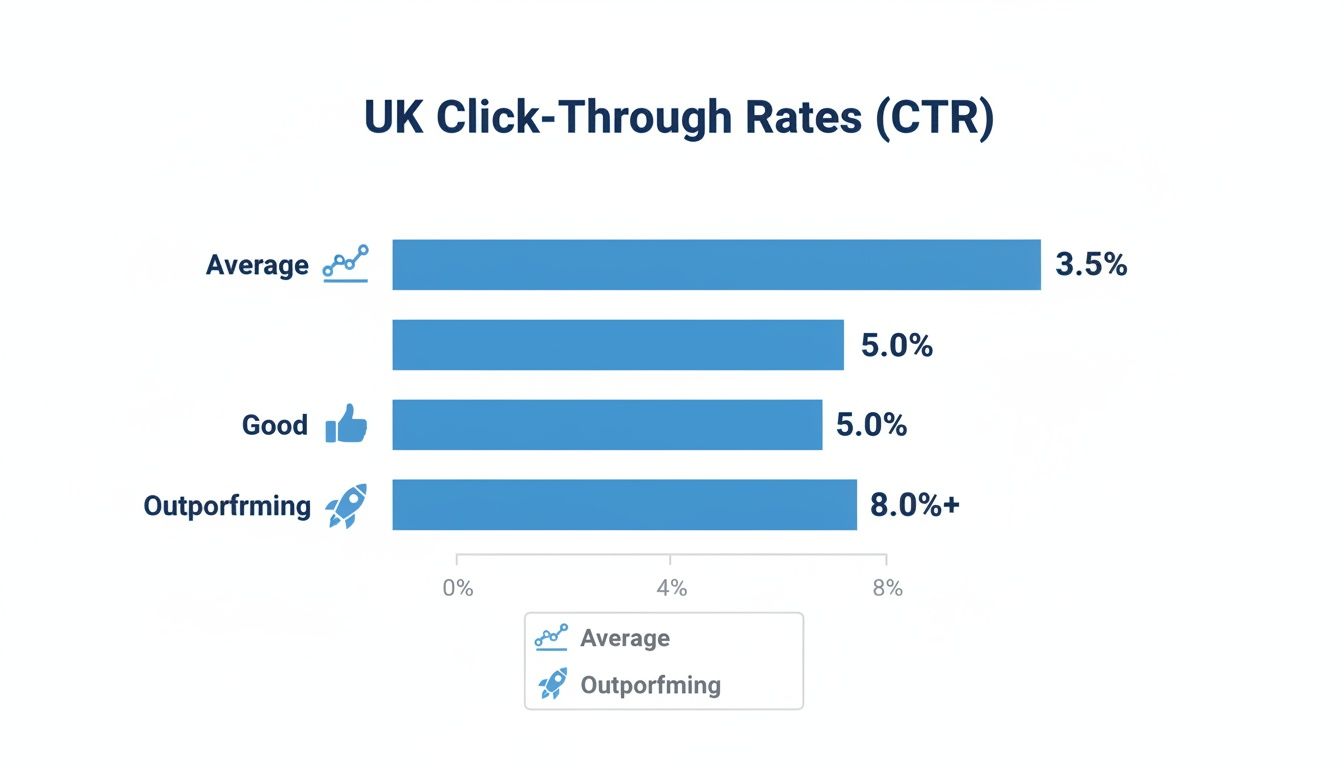
As you can see, the jump from ‘average’ to ‘good’ or ‘outperforming’ isn’t just a small step—it’s a huge leap in how well your ad is grabbing your audience’s attention.
Display and Social Ads: The Art of Interruption
Now, let’s switch gears to Display and Social Media ads. Here, you’re placing your ads alongside other content while people are browsing websites, watching videos, or scrolling through their social feeds. They aren’t looking for you. Your ad is an interruption, designed to spark interest or create demand where it didn’t exist a moment ago.
Because the user’s goal is entertainment or discovery—not buying something—CTRs on these channels are naturally much, much lower. A “good” CTR on the Google Display Network might be 0.5%, and on Facebook, you might be happy with 1%. Chasing a 5% CTR here would be a frustrating and pointless exercise.
Instead of comparing a Google Search CTR with a Facebook Ad CTR (which is like comparing apples and oranges), you need to benchmark each channel against its own standards. Our guide on Google Ads vs Facebook Ads performance offers a much deeper dive into what to expect from each platform.
To help set those expectations, we’ve put together a quick comparison of what you can typically expect across the main channels for UK businesses.
Average CTR Benchmarks by Advertising Channel
This table outlines the typical click-through rates you can expect across different digital ad platforms. Notice how user intent directly impacts performance, with high-intent search channels leading the way.
| Advertising Channel | Average CTR | Top 25% Performer CTR | Primary User Intent |
|---|---|---|---|
| Google Search | 3.17% | 5.8% + | High (Actively Searching) |
| Google Shopping | 0.86% | 1.2% + | High (Commercial Intent) |
| Google Display | 0.46% | 0.7% + | Low (Passive Browsing) |
| Social Media Ads | 0.9% – 1.1% | 1.5% + | Low (Discovery & Socialising) |
Understanding these channel-specific differences is key. It helps you set smarter goals, put your budget where it will work hardest, and avoid the classic mistake of applying a one-size-fits-all approach to your CTR analysis.
How Your Industry Shapes CTR Expectations
Trying to define a single, universal “good CTR” is a bit like asking for the perfect weather in the UK. A farmer in Lincolnshire is hoping for something completely different to a sun-seeker in Brighton. It’s the same in digital advertising. What counts as a brilliant click-through rate for a high-street fashion brand will look worlds apart from what a B2B software company sees.
Your industry is one of the biggest forces shaping what your CTR benchmarks should be. Why? Because it dictates everything from how fierce the competition is to the mindset of the person typing in that search query.
Think about it. Someone searching for “cheap summer dresses” is in a totally different headspace from someone looking for a “divorce solicitor London.” The first search is casual, maybe even a bit of fun, which usually leads to more clicks on eye-catching shopping ads. The second is a high-stakes, serious decision where people are far more cautious, leading to fewer but much more valuable clicks.
Why Your Industry Changes the Game
If you compare your CTR to a broad, all-in-one average, you’re setting yourself up for disappointment. It’s misleading and, frankly, a bit demoralising. To really get a handle on your performance, you need to look at benchmarks that are actually relevant to your sector.
Here’s why those industry numbers can be so dramatically different:
- The Level of Competition: Some industries are just more crowded. Legal and financial services, for example, are notoriously competitive arenas. You have a huge volume of advertisers all fighting for the same keywords, which often means more sophisticated ad strategies are needed, and that can push the average CTR down.
- Search Intent and Urgency: Someone frantically searching for “emergency roof repair” has a problem that needs solving right now. Ads that speak directly to that urgency are going to get a very high CTR. On the other hand, a person researching the “best investment platforms for beginners” is in an early, fact-finding stage and is much less likely to click on an ad straight away.
- Customer Lifetime Value (CLV): For industries with a high CLV, like legal services or enterprise software, a single click could be worth thousands of pounds. Advertisers are willing to fight tooth and nail for that click, which ramps up the competition and impacts the click-through rates for everyone.
- Who You’re Talking To: Different industries target different people. A campaign for a new video game will use language and visuals that click with a younger audience, who are often more likely to, well, click. A campaign for retirement planning needs a much more measured, trust-building tone, which naturally results in different click behaviour.
UK Industry Benchmarks for Google Ads
Understanding these differences helps you set realistic goals. The data shows just how wide the gaps between industries really are. A recent dataset for 2025 reveals that while the overall average Google Ads CTR is 6.66%, performance swings wildly from one sector to another.
For instance, the Arts & Entertainment industry pulls in an impressive average CTR of 13.10%—people are excited and ready to engage. Compare that to Attorneys & Legal Services, which averages a more sober 5.97% because of the serious nature of the searches. The Automotive sector, driven by high consumer interest, lands a strong 8.29%. You can dig into a more detailed breakdown by checking the latest Google Ads benchmarks on WordStream.com.
This industry-level data is absolutely vital. It shows that a 6% CTR, which would be lagging behind in the automotive space, is actually a solid performance for a legal firm. Without that context, you could end up trying to fix something that isn’t broken or celebrating a metric that’s actually trailing your direct competitors.
By stepping away from generic averages and homing in on industry-specific benchmarks, you get a much clearer, more accurate picture of what a “good CTR” really means for your business. It allows you to set smarter goals, make better-informed decisions, and properly measure your success against the rivals that truly matter.
The Key Factors That Influence Your Click-Through Rate
Knowing the benchmarks is one thing, but understanding which levers to pull to actually change your numbers is where the real power lies. A good click-through rate isn’t just a stroke of luck; it’s the direct result of a handful of critical factors all working in harmony.
Think of it like baking a cake. You need the right ingredients in the right proportions—miss one, and the whole thing falls flat.
It’s the same story with your ads. Every single element, from the words you choose to where your ad physically appears on the page, plays a vital role in convincing someone that your link is the one worth clicking. Once you get a grip on these core components, you can shift from just monitoring your CTR to actively improving it.
The Power of Ad Relevance and Compelling Copy
At its very heart, a high CTR is a sign of brilliant ad relevance. This simply means your ad is a near-perfect answer to what the user was searching for. Your ad copy—the headline and description—is your first and only shot at making that connection. It has to be clear, compelling, and speak directly to what the searcher wants.
For example, if someone searches for “emergency plumber in Manchester,” an ad with the headline “24/7 Manchester Plumbers | Call Now for Fast Service” will almost certainly get more clicks than a generic one like “Plumbing Services Available.” Why? The first ad instantly solves the user’s urgent need and confirms their location, making it incredibly relevant.
Key Takeaway: Your ad copy isn’t just filler text; it’s a direct response to a user’s problem. The more accurately you can mirror their language and intent in your headline and description, the higher your CTR will climb.
Keyword Intent and Match Types
The keywords you bid on are the very foundation of your campaign. They decide who sees your ad, and the intent behind those keywords has a massive impact on your click-through rates. Broad, informational keywords (like “what are hiking boots”) will naturally have a lower CTR than specific, commercial-intent keywords (like “buy waterproof hiking boots size 10”).
This is where keyword match types become so important. Using broad match might get you loads of impressions, but many will be irrelevant, dragging your CTR down with them. On the flip side, using more restrictive match types like phrase or exact match ensures your ads are only shown for the most relevant searches, which almost always results in a better CTR.
Ad Position and Visibility on the Page
Where your ad appears on the search results page is a huge factor. It’s a simple truth of human behaviour: the higher up the page, the more clicks you get. The ad in the top spot on Google gets a massively bigger share of clicks than the one down in position four.
While bidding more can help you secure a better position, Google’s Ad Rank isn’t just about who has the deepest pockets. It’s a mix of your bid and your Quality Score—a metric where CTR itself is a key ingredient. This creates a powerful feedback loop: a good CTR helps improve your Quality Score, which helps you earn better ad positions, which in turn leads to an even better CTR.
Precise Audience Targeting
Showing the right message is only half the battle; you also have to show it to the right people. This is where precise audience targeting comes into play. Modern ad platforms let you target users based on a massive range of signals, including:
- Demographics: Targeting based on age, gender, and location.
- Interests: Reaching people based on their hobbies and online behaviour.
- In-Market Audiences: Targeting users who are actively researching products or services just like yours.
- Remarketing: Showing ads to people who have already visited your website.
By layering these targeting options, you can zero in on the people most likely to be interested in your offer. A well-targeted ad shown to a relevant audience is almost guaranteed to get a higher CTR than a generic ad blasted out to everyone. Each of these elements is a dial you can turn to fine-tune your campaign’s performance.
Proven Strategies to Improve Your CTR
Right, you’ve got the benchmarks and you understand what makes your CTR tick. Now for the fun part: rolling up your sleeves and actually improving those numbers. A strong click-through rate isn’t a one-and-done deal; it’s the result of constantly testing, tweaking, and listening to what the data is telling you.
Think of yourself as a campaign scientist. Every change—a new headline, a different keyword, a fresh ad extension—is a hypothesis you’re testing. The goal is to discover that winning formula that makes your ad impossible for your target audience to ignore. This is your playbook for turning theory into action.

Master the Art of A/B Testing
Never assume you know what your audience wants to see. A/B testing (or split testing) is the single most reliable way to find out what really works. It’s simple: you create two or more versions of an ad and run them at the same time to see which one performs better.
The key is to start simple and test one thing at a time. If you change the headline, the description, and the call-to-action all at once, you’ll have no clue which change actually made the difference.
Here are a few elements to get you started:
- Headlines: Pit different emotional triggers against each other. Try a question like “Need a Reliable Plumber?” versus a direct benefit like “Fast & Affordable Plumbing Services.”
- Descriptions: Experiment with including prices, promotions (“20% Off Today”), or what makes you unique (“Family-Run Business Since 1995”).
- Calls-to-Action (CTAs): Compare a direct command like “Shop Now” with a softer invitation like “Explore Our Collection.”
Sharpen Your Targeting with Negative Keywords
One of the fastest ways to lift your CTR is to stop showing your ads to the wrong people. Negative keywords are your secret weapon for this. They stop your ads from showing up for search terms that might be related, but are totally irrelevant to your offer.
For example, a business selling premium “leather briefcases” doesn’t want to waste money on clicks from people searching for “cheap faux leather briefcases” or “how to repair a leather briefcase.” By adding “cheap,” “faux,” and “repair” as negative keywords, they filter out the window shoppers and DIY crowd, ensuring their ads are seen by genuinely interested buyers. This one move directly boosts CTR because a much higher percentage of people who see the ad will actually find it relevant.
Consistently reviewing your search term report to find and add new negative keywords is one of the highest-impact maintenance tasks you can do. It cuts wasted spend and boosts relevance in one simple action.
Maximise Visibility with Ad Extensions
Think of ad extensions as free real estate. They are extra bits of information that make your ad bigger, more informative, and much more clickable. They cost nothing to add and have a massive impact on CTR. In fact, Google itself has said that using ad extensions can improve click-through rates by an average of 10-15%.
You should be using every single extension that makes sense for your business.
- Sitelink Extensions: Add direct links to other important pages on your site, like “About Us” or “Contact Us.”
- Callout Extensions: Highlight key benefits like “Free UK Delivery” or “24/7 Customer Support.”
- Image Extensions: Add compelling visuals to your search ads to make them stand out.
- Price Extensions: Show off specific products or services with their prices, pre-qualifying clicks before they even happen.
Align Your Ad Promise with Your Landing Page
A great ad earns the click, but a great landing page secures the conversion. A high CTR is completely wasted if users click through to a page that doesn’t deliver on what the ad promised. This disconnect creates a jarring user experience, leading to high bounce rates and dismal conversion rates.
Make sure your landing page echoes the keywords, headlines, and offers from your ad. If your ad shouts about a “50% Discount on Winter Coats,” that exact offer needs to be front and centre on the landing page. This seamless journey reassures the user they’re in the right place, building trust and nudging them towards that final conversion.
If you’re hungry for more ideas, our team has put together 8 practical ways to improve your click-through rate that you can put into practice today.
Actionable CTR Optimisation Checklist
To bring all these strategies together, here’s a straightforward checklist you can use to systematically audit and improve your campaigns. Think of it as a roadmap to higher CTRs and better performance.
| Optimisation Area | Action to Take | Expected Impact on CTR |
|---|---|---|
| Ad Copy & Headlines | Set up A/B tests for headlines, descriptions, and CTAs. Focus on benefits, not just features. | High: Directly influences user engagement and click decisions. |
| Keyword Relevance | Review the Search Term Report weekly. Add irrelevant terms as negative keywords. | High: Stops wasted impressions on unqualified searchers, increasing the relevance of your audience. |
| Ad Extensions | Enable all relevant ad extensions (Sitelinks, Callouts, Images, Prices) for each campaign. | Medium-High: Increases ad size and visibility, providing more reasons to click. |
| Audience Targeting | Refine audience segments. Test different demographics, interests, or remarketing lists. | Medium: Ensures your ads are shown to the people most likely to be interested. |
| Landing Page Sync | Ensure the landing page headline and offer perfectly match the ad copy. | Indirect but Crucial: Improves Quality Score over time, which can lower costs and improve ad position. |
| Ad Position | Monitor your average position. Adjust bidding strategies to aim for top-of-page placements where feasible. | High: Top positions naturally receive significantly more clicks. |
| Mobile Optimisation | Create mobile-specific ad copy and ensure your landing page is fully responsive. | Medium: Improves user experience for the majority of searchers, reducing friction. |
Working through this checklist regularly will help you build a habit of continuous improvement, ensuring your CTR doesn’t just improve once, but stays strong over the long term.
Looking Beyond CTR to Measure Real Business Impact
Chasing a high click-through rate can feel like you’re winning the game. But it’s crucial to remember that clicks alone don’t pay the bills. A strong CTR is a fantastic sign that your ads are relevant and grabbing attention, but it’s only one piece of a much larger puzzle. Real success is measured by what happens after the click.
Think of it like this: imagine you own a high-end jewellery shop. An ad promising “Free Diamonds” would get an unbelievable CTR, but the people clicking through would leave your site disappointed and empty-handed. This is a classic case of a vanity metric; the clicks are high, but the impact on your business is zero. Your goal isn’t just to attract clicks; it’s to attract the right clicks from people genuinely interested in becoming customers.
This is exactly why a lower CTR isn’t always a bad thing, especially in B2B or for high-value products. An ad with a headline like “Enterprise Accounting Software for FTSE 100 Companies” might have a low CTR, but you can bet that nearly every click comes from a highly qualified, valuable lead.
From Clicks to Conversions and Profit
To get a true picture of performance, you have to look past the initial click and focus on the metrics that connect directly to your bottom line. These are the numbers that tell the full story of your campaign’s profitability.
- Conversion Rate: This is the percentage of people who clicked your ad and then took the action you wanted, like making a purchase or filling out a contact form. A high CTR paired with a dismal conversion rate often points to a major disconnect between your ad’s promise and your landing page’s reality.
- Cost Per Acquisition (CPA): This metric tells you exactly how much you’re spending to get one new customer. It puts your ad spend into a clear business context, answering the most important question of all: is this campaign actually profitable?
- Return On Ad Spend (ROAS): This is the ultimate measure of success. It calculates the total revenue generated for every pound you spend on advertising. A campaign with a modest CTR but a massive ROAS is infinitely more valuable than one with a sky-high CTR that loses you money.
A high CTR might boost your ego, but a strong ROAS builds your business. The best campaigns find that sweet spot where ad relevance drives not just clicks, but profitable conversions.
Ultimately, understanding what is a good CTR means seeing it as a leading indicator, not the final destination. It gets people in the door, but it’s the quality of that traffic and the conversions that follow which determine your true ROI. To get a complete view of your campaign’s health, you need to track a balanced set of metrics. You can learn more about the most important key performance indicators for digital marketing in our detailed guide.
Got Questions About CTR? We’ve Got Answers.
Even when you feel you’ve got a handle on CTR, some tricky questions always pop up once you start digging into your own campaign data. Here are some of the most common queries we hear from marketing managers and business owners, answered in plain English.
Is a 2% CTR Good for Google Ads in the UK?
Honestly, a 2% CTR is probably a bit on the low side. The average for Google Search campaigns here in the UK is closer to 4.3%. But before you panic, remember that context is everything.
If you’re in a hyper-competitive B2B niche like finance or legal services, a 2% CTR might actually be pretty decent, especially if those few clicks are turning into high-value clients. For most ecommerce stores or local service businesses, though, it’s a clear signal that there’s room to improve. It’s time to get forensic with your ad copy, keyword targeting, and ad extensions to make your ads more relevant and irresistible to searchers.
Just remember, a “good” CTR is always relative to your industry, your campaign goals, and most importantly, your bottom line. Chasing a high number is pointless if it doesn’t lead to profitable business.
Why Is My CTR High but My Conversions Are Rubbish?
Ah, the classic dilemma. This almost always points to a disconnect between what your ad promises and what your landing page delivers. Your ad is doing its job – it’s compelling enough to earn the click – but the user is hitting your site and feeling let down.
This usually boils down to a few culprits:
- A confusing landing page that doesn’t match the ad’s message or offer.
- Keywords that are too broad, pulling in traffic from people who are just browsing, not buying.
- A weak or non-existent call-to-action on the page, leaving users wondering what to do next.
The fix? Make sure your landing page is a seamless continuation of your ad. It should feel like the next logical step in the journey you’ve started.
How Quickly Will I See My CTR Improve?
You can often see the first flickers of change within a few days to a week after rolling out your optimisations. That initial feedback is great for spotting early wins.
However, to get data that’s actually solid enough to make confident decisions on – especially for A/B tests – you really need to let your campaigns run for at least two weeks. This smooths out any random daily spikes or dips and lets you base your next move on genuine performance trends, not just noise.
At PPC Geeks, we turn these kinds of insights into profitable action every day. Our team of UK-based experts can dive deep into your campaigns, build a data-driven strategy, and boost not just your CTR, but your overall profitability. Get your free, in-depth PPC audit today and see what you’ve been missing.