




In a fiercely competitive market, attracting a steady stream of new customers isn’t just a goal; it’s the fundamental engine for survival and growth. Yet, with a vast array of channels and tactics all vying for your attention and budget, identifying the most effective customer acquisition strategies can feel like a monumental task. Many businesses struggle to move beyond inconsistent, short-term gains, lacking a structured framework for sustainable expansion. The challenge lies not only in choosing the right methods but in executing them with precision to maximise return on investment (ROI).
This guide is designed to provide that clarity. We cut through the noise to deliver a comprehensive roadmap, detailing 10 of the most powerful and reliable strategies to build your customer base in 2026. You will not find vague theories here. Instead, we provide an in-depth exploration of each tactic, covering its core definition, tangible benefits, and crucial implementation steps. From the immediate, targeted reach of Pay-Per-Click (PPC) advertising and Google Shopping to the long-term brand authority built through strategic Content Marketing and SEO, we’ll equip you with practical knowledge.
Each section is structured to give you actionable insights, complete with real-world examples to illustrate how these strategies function in practice. Whether you are a UK-based ecommerce retailer looking to optimise ad spend, a marketing manager facing time constraints, or a startup founder aiming to scale lead generation, this article provides the toolkit you need. Prepare to transform your approach from guesswork to a deliberate, results-driven system that turns potential leads into loyal, profitable customers. Let’s begin building your ultimate acquisition engine.
1. Pay-Per-Click (PPC) Advertising
Pay-Per-Click (PPC) advertising is a powerful digital marketing model where businesses pay a fee each time one of their ads is clicked. By bidding on keywords relevant to their target audience, companies can place their ads at the top of search engine results pages on platforms like Google and Microsoft Bing, or across social media networks such as Facebook. This makes PPC one of the most direct and controllable customer acquisition strategies available today.
It offers an unparalleled level of speed and precision, allowing businesses to drive highly relevant traffic to their websites almost instantly. This is particularly beneficial for UK SMEs that need immediate results, as you can launch a campaign and start generating leads or sales within hours, rather than waiting weeks or months for organic strategies to gain traction.
Why Use PPC Advertising?
PPC is ideal when you need measurable results and a high degree of control over your budget and targeting. For example, an ecommerce retailer can use Google Shopping campaigns to display products directly to users searching for specific items, while a local service business can target customers within a tight geographic radius. The direct link between spend and engagement ensures a clear return on investment.
How to Implement a PPC Strategy
Successfully launching a PPC campaign involves several key steps. Following a structured approach ensures you allocate your budget effectively and maximise your chances of converting clicks into customers.
- Keyword Research: Identify high-intent keywords your potential customers are searching for. Use tools to analyse search volume, competition, and cost-per-click.
- Create Compelling Ad Copy: Write clear, persuasive headlines and descriptions that address user pain points and include a strong call-to-action (CTA).
- Build Dedicated Landing Pages: Direct traffic to a specific, optimised landing page that aligns perfectly with the ad’s message, rather than your generic homepage.
- Set Up Conversion Tracking: Implement tracking to measure key actions like form submissions, purchases, or phone calls. This is essential for understanding your campaign’s performance. For expert guidance, you can explore detailed resources to improve Google Ads performance.
- Monitor and Optimise: Regularly review campaign data, A/B test ad variations, and refine your keyword lists to improve your Quality Score and lower your costs.
2. Google Shopping Campaigns (Customer Acquisition Strategies)
Google Shopping campaigns are a highly visual and effective form of advertising for ecommerce businesses. Instead of text-based ads, this strategy displays product listings directly within Google search results, complete with images, prices, titles, and merchant information. These listings appear prominently at the top of the page, capturing the attention of users with high purchase intent.
This visual format makes Google Shopping one of the most powerful customer acquisition strategies for retailers. It allows potential buyers to see the product and its price before they even click, leading to more qualified traffic and higher conversion rates. For UK retailers, it’s an essential tool to showcase inventory, stand out from competitors, and drive direct sales from users who are actively searching for products to buy.
Why Use Google Shopping Campaigns?
Google Shopping is ideal for ecommerce brands that want to generate immediate sales and achieve a strong return on ad spend. For example, a fashion retailer can use Shopping campaigns to showcase a new seasonal collection, while an electronics seller can display detailed product specifications and competitive pricing. The direct visual appeal and prominent placement make it incredibly effective at converting active shoppers.
How to Implement a Google Shopping Strategy
A successful Google Shopping campaign relies on a well-organised and optimised product feed. This feed is a data file that contains all the essential information about your products, which Google uses to create your ads.
- Create and Optimise Your Product Feed: Ensure your product data is accurate, complete, and regularly updated in Google Merchant Center. High-quality data is the foundation of a successful campaign.
- Use High-Quality Imagery: Your product images are the first thing users see. Use clear, professional photos that accurately represent your products and make them stand out.
- Write Descriptive Product Titles: Craft detailed titles that include key attributes like brand, colour, size, and model number. This helps your products show up for relevant searches.
- Implement Smart Bidding Strategies: Utilise Google’s automated bidding strategies like Target ROAS (Return On Ad Spend) to automatically optimise your bids for conversions or conversion value.
- Segment Your Campaigns: Group products by category, brand, or even profit margin using custom labels. This gives you granular control over your bidding and budget allocation. For expert advice on this, you can learn more about how to master your Google Shopping product feed.
3. Remarketing (Retargeting) Campaigns
Remarketing is a powerful customer acquisition strategy that focuses on reconnecting with users who have already visited your website or engaged with your brand. By placing a tracking pixel on your site, you can display highly targeted ads to these “warm” audiences as they browse other websites on the Google Display Network, scroll through social media feeds like Facebook, or watch videos on YouTube. This approach keeps your brand top-of-mind and encourages previous visitors to return and convert.
This strategy is exceptionally cost-effective because it targets an audience with pre-existing interest in your products or services, rather than cold prospects. For UK SMEs aiming to maximise their return on investment, remarketing can significantly boost conversion rates by recovering potential lost sales and nurturing leads who weren’t quite ready to commit on their first visit.

Why Use Remarketing Campaigns?
Remarketing is ideal for businesses with longer sales cycles or for ecommerce stores looking to reduce cart abandonment. For instance, a travel company can show ads for a specific destination to a user who previously searched for flights, or a SaaS platform can remind free trial users of premium features. It capitalises on familiarity and intent, making it one of the most efficient customer acquisition strategies for driving final conversions.
How to Implement a Remarketing Strategy
A successful remarketing campaign requires careful segmentation and relevant messaging to re-engage users without being intrusive. A structured approach will ensure you deliver the right ad to the right person at the right time.
- Segment Your Audiences: Create distinct audience lists based on user behaviour. Group users by pages visited (e.g., product pages vs. pricing page), actions taken (e.g., added to cart), or time spent on your site.
- Use Dynamic Ads: For ecommerce, implement dynamic remarketing to automatically show users the exact products they previously viewed or added to their basket.
- Set Frequency Caps: To avoid ad fatigue, limit the number of times a user sees your ad. A cap of 5-8 impressions per user, per day, is a common best practice.
- Craft Compelling Creatives: Develop ad copy and visuals that acknowledge the user’s prior interest. Use urgent calls-to-action or special offers to create an incentive to return. You can find inspiration by exploring these examples of high-performing remarketing ads.
- Exclude Converters: Ensure you exclude existing customers or users who have already completed the desired action from your campaigns to avoid wasting your budget and annoying converted leads.
4. Customer Acquisition Strategies: Performance Max Campaigns
Performance Max (PMax) is a goal-based campaign type from Google Ads that uses AI and machine learning to automate bidding, targeting, and ad delivery across Google’s entire advertising network. By providing a single set of creative assets like images, videos, and text, businesses can reach customers on YouTube, Display, Search, Discover, Gmail, and Maps from one unified campaign. This makes PMax one of the most powerful and efficient customer acquisition strategies for modern marketers.
It streamlines campaign management by removing the need to manage separate campaigns for each channel. This automation allows Google’s AI to find converting customers wherever they are, optimising your ad spend in real-time towards the channels delivering the highest return. This is particularly valuable for UK SMEs aiming to scale their reach without a corresponding increase in manual campaign management.
Why Use Performance Max Campaigns?
Performance Max is ideal for advertisers who want to maximise their conversion value and reach new customer segments with minimal hands-on effort. For example, an ecommerce brand can use PMax to promote a new product line across all of Google’s channels simultaneously, while a B2B company can use it to generate high-quality leads by letting the algorithm identify the most profitable placements. Its goal-oriented approach ensures your budget is always working to achieve specific business outcomes.
How to Implement a Performance Max Strategy
A successful Performance Max campaign relies on providing the right inputs for Google’s AI to work effectively. Following a structured setup process is crucial for achieving optimal results.
- Provide High-Quality Creative Assets: Upload a diverse range of assets, including multiple high-resolution images, engaging videos, and compelling headlines and descriptions. The more options you provide, the better the AI can perform.
- Set Clear Conversion Goals: Define what a valuable conversion is for your business, such as a purchase, a form submission, or a phone call. Accurate conversion tracking is essential for the algorithm to optimise correctly.
- Guide AI with Audience Signals: Use your first-party data, such as customer lists and website visitor segments, as audience signals. This helps the AI learn faster and find similar audiences more efficiently. To see this in action, you can discover more about scaling a B2C brand with Performance Max.
- Allow for a Learning Period: Give the campaign at least 2-4 weeks to gather data and learn before making any significant changes to your strategy or budget.
- Review Asset Group Performance: Regularly check the insights tab to see which creative assets are performing best. Replace low-performing assets with new variations to continuously improve your results.
5. Content Marketing and SEO
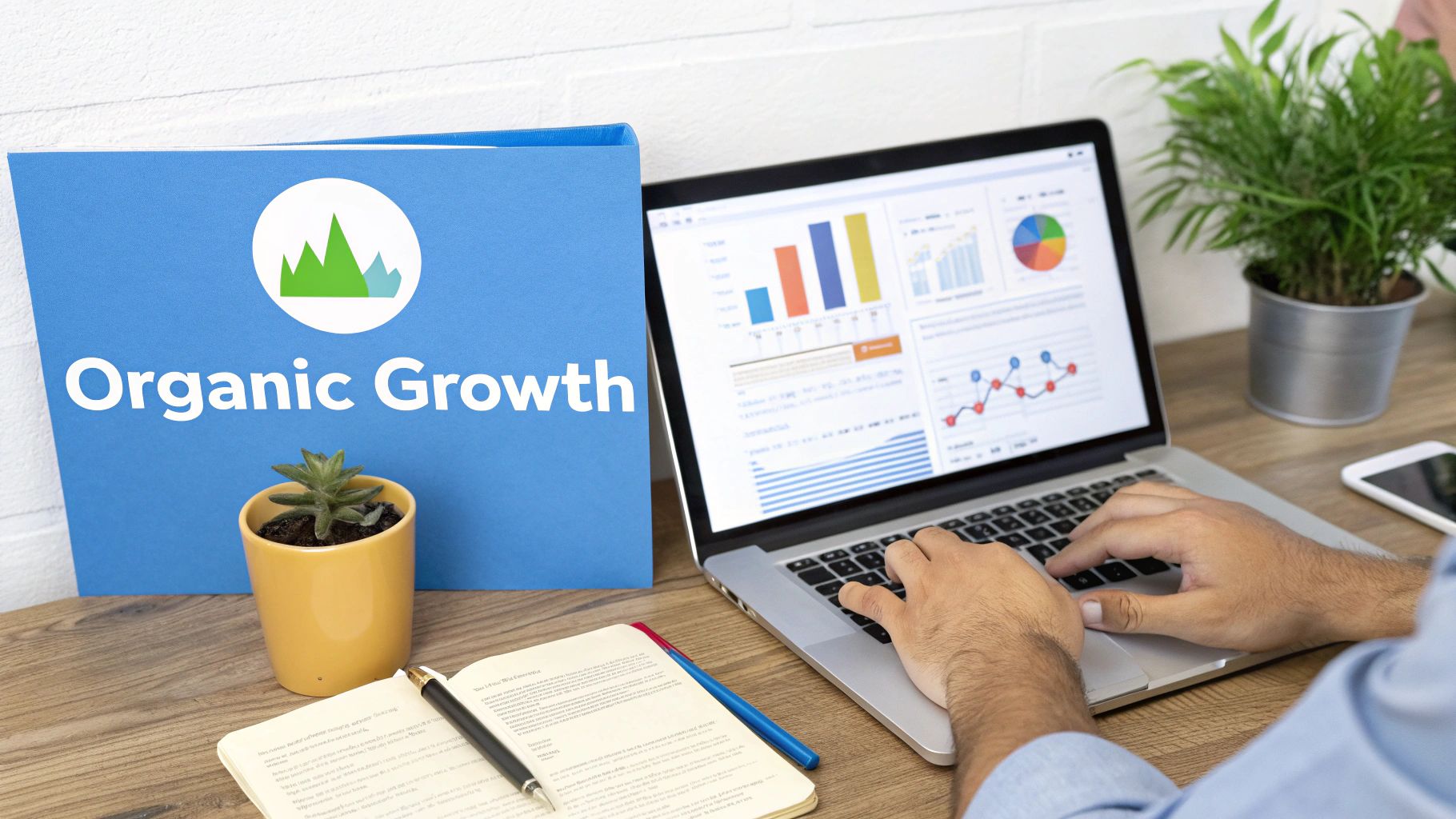
Content marketing is a long-term strategy focused on creating and distributing valuable, relevant, and consistent content to attract and retain a clearly defined audience. When combined with search engine optimisation (SEO), it becomes one of the most powerful organic customer acquisition strategies, driving qualified traffic by improving your website’s visibility on search engines like Google. Unlike paid advertising, this approach builds a sustainable asset that generates leads and sales over time.
For UK SMEs with limited marketing budgets, content and SEO offer a cost-effective way to build brand credibility and establish authority. By consistently publishing helpful information, you attract potential customers who are actively seeking solutions, positioning your brand as the go-to expert in your industry and reducing long-term reliance on paid channels.
Why Use Content Marketing and SEO?
This strategy is ideal for businesses aiming to build lasting brand authority and generate a continuous flow of high-quality leads. For instance, a SaaS company can create detailed software comparisons to attract users in the decision-making stage, while an ecommerce brand can publish in-depth product guides to help customers make informed purchasing choices. It builds trust and nurtures prospects through the entire buying journey.
How to Implement a Content and SEO Strategy
A successful content and SEO plan requires a structured, data-driven approach to ensure your efforts translate into tangible business results.
- Conduct Keyword Research: Use tools to identify topics and search terms your target audience uses. Focus on understanding the search intent behind keywords (informational, commercial, or transactional).
- Create Topic Clusters: Organise your content around core “pillar” topics and related “cluster” sub-topics. This structure helps search engines recognise your topical authority.
- Write High-Quality Content: Develop comprehensive, in-depth articles, guides, and resources that are more valuable than what competitors offer. Address customer pain points directly.
- Build Internal Links: Strategically link between relevant pages on your site to distribute page authority and help search engines understand your site structure.
- Develop a Content Calendar: Plan and schedule your content production to maintain consistency and align with your overall business objectives and marketing campaigns.
- Earn High-Quality Backlinks: Promote your content through outreach and digital PR to acquire links from reputable websites, a key factor in improving search rankings.
- Monitor and Measure Performance: Track key metrics like organic traffic, keyword rankings, and conversions to understand your ROI and identify areas for improvement.
6. Customer Acquisition Strategies: Social Media Advertising
Social Media Advertising involves running paid campaigns on platforms like Meta (Facebook and Instagram), TikTok, LinkedIn, and Pinterest to reach highly specific audiences. Unlike search advertising, which captures existing demand, social media ads excel at creating it. They allow businesses to place visually compelling content directly into the feeds of users based on granular targeting options, including demographics, interests, behaviours, and previous brand interactions.
This approach is one of the most effective customer acquisition strategies for building brand awareness and driving direct sales, especially for UK SMEs targeting lifestyle-focused products or younger demographics. The visual and interactive nature of platforms like Instagram and TikTok makes it possible to tell a brand story and showcase products in a way that resonates emotionally with potential customers, moving them from initial discovery to purchase.
Why Use Social Media Advertising?
Social media advertising is perfect for businesses that need to reach niche audiences with precision. For example, a UK fashion brand can run carousel ads showcasing a new collection to users who have shown interest in sustainable fashion, while a B2B software company can use LinkedIn to target marketing managers in the technology sector. The ability to build lookalike audiences from existing customer lists also provides a powerful way to find new customers who share traits with your best ones.
How to Implement a Social Media Advertising Strategy
A successful social media campaign requires a creative approach grounded in data. Following these steps helps ensure your budget is used efficiently to engage the right people and achieve your acquisition goals.
- Define Your Target Audience: Use the platform’s tools to build a detailed profile of your ideal customer, layering demographics, interests, and online behaviours.
- Create Platform-Specific Content: Design visually appealing ads tailored to each platform’s format, for instance, vertical video for TikTok and Instagram Stories or high-quality images for Pinterest.
- Install Tracking Pixels: Implement the Meta Pixel, TikTok Pixel, or LinkedIn Insight Tag on your website. This is crucial for tracking conversions, optimising campaigns, and building retargeting audiences.
- Leverage Custom and Lookalike Audiences: Upload your customer email list to create a Custom Audience for retargeting or build a Lookalike Audience to find new users with similar characteristics.
- Test and Refine: Continuously A/B test different ad creatives, headlines, audience segments, and placements. Monitor key metrics like click-through rate (CTR) and cost per acquisition (CPA), reallocating your budget to the best-performing ads.
7. Email Marketing and Automation
Email marketing is a highly effective digital strategy that involves sending targeted messages directly to a list of subscribers. By nurturing leads and building relationships, businesses can drive repeat purchases and guide prospects through the sales funnel. When combined with automation, it becomes one of the most powerful and cost-effective customer acquisition strategies, with a reported return on investment of up to £42 for every £1 spent.
This approach allows businesses to communicate directly with an engaged audience that has already expressed interest in their brand. Unlike other channels, you own your email list, providing a stable and reliable way to generate revenue. For UK SMEs, email marketing is essential for creating lasting customer loyalty and a predictable stream of income, making it a cornerstone of a well-rounded marketing plan.
Why Use Email Marketing and Automation?
Email marketing excels at nurturing relationships and driving conversions from an already-warm audience. It is ideal for ecommerce stores wanting to recover abandoned carts, SaaS companies educating free trial users, or any business looking to automate its lead-nurturing process. Automation triggers emails based on specific user actions, delivering the right message at the right time without manual intervention.
How to Implement an Email Marketing Strategy
A successful email strategy is built on providing value and respecting your subscribers’ inboxes. Following a structured approach ensures high engagement and a strong return on your efforts.
- Build an Opt-In List: Grow your audience ethically using lead magnets like free guides, webinars, or discounts offered through website signup forms. Never purchase lists.
- Segment Your Audience: Group subscribers based on behaviour, purchase history, or interests. This allows you to send more relevant and personalised content.
- Create Automated Workflows: Set up triggered email sequences for key actions. Common workflows include welcome series, abandoned cart reminders, and post-purchase follow-ups.
- Personalise Your Content: Use subscriber data, such as their name or past purchases, to make your emails feel more individual and increase engagement rates.
- Test and Monitor: Regularly A/B test subject lines, send times, and content to see what resonates best with your audience. Monitor key metrics like open rates, click-through rates, and unsubscribe rates.
8. Affiliate Marketing and Partnerships
Affiliate marketing is a performance-based customer acquisition strategy where businesses reward third-party partners, known as affiliates, for each customer brought in through their marketing efforts. These partners promote your products or services on their own channels, such as blogs, websites, or social media, and earn a commission for every sale or lead they generate. This makes it a highly cost-effective model, as you only pay for actual conversions.
This strategy essentially transforms your brand advocates into a powerful, results-driven sales team. For UK SMEs, it’s an excellent way to expand reach and build brand credibility through trusted voices without significant upfront investment. By partnering with relevant influencers or complementary businesses, you can tap into established audiences that align perfectly with your target market.
Why Use Affiliate Marketing?
Affiliate marketing is ideal for businesses looking to scale customer acquisition with a controlled, performance-based budget. An ecommerce brand, for instance, can partner with bloggers to review its products, generating sales from a trusted source. Similarly, a software company can leverage tech reviewers to drive sign-ups, paying only when a new user subscribes. The low-risk, high-reward nature of this model provides a clear and measurable return on investment.
How to Implement an Affiliate Strategy
Building a successful affiliate programme requires careful planning and active management. A structured approach ensures you attract the right partners and empower them to effectively promote your brand.
- Recruit High-Quality Affiliates: Identify partners whose audience and brand values align with yours. Look for bloggers, influencers, and publishers in your niche.
- Set Competitive Commissions: Offer a commission structure that is attractive enough to motivate top performers while remaining profitable for your business.
- Provide Marketing Materials: Equip your affiliates with high-quality banners, product images, promotional copy, and unique tracking links to make promotion easy.
- Use Tracking Software: Implement reliable affiliate tracking software to monitor clicks, conversions, and commissions accurately and prevent fraud.
- Communicate and Build Relationships: Regularly engage with your top-performing affiliates. Offer them exclusive deals, recognise their efforts, and treat them as true business partners to foster long-term loyalty.
9. Influencer Marketing
Influencer marketing is a strategy that involves partnering with individuals who have established credibility and a dedicated following in specific niches. These influencers promote your products or services through sponsored content on platforms like Instagram, TikTok, and YouTube. Unlike traditional advertising, recommendations from a trusted influencer feel more like an authentic peer review, which can significantly boost brand awareness and conversion rates.
This approach leverages the trust and relationship an influencer has built with their audience, making it one of the most effective customer acquisition strategies for engaging modern consumers. It is particularly powerful for ecommerce, lifestyle, fashion, and beauty brands targeting younger demographics, where authenticity is highly valued. From nano-influencers with under 10,000 followers to mega-stars, the model offers flexible and scalable options for any budget.
Why Use Influencer Marketing?
Influencer marketing is ideal for brands wanting to build trust and reach highly targeted, engaged communities. For example, a UK-based sustainable fashion brand could partner with micro-influencers in the ethical living space to reach an audience that is already passionate about their values. Similarly, a tech brand can send a new gadget to a trusted YouTube reviewer to generate credible, in-depth reviews that drive informed purchases.
How to Implement an Influencer Marketing Strategy
A successful influencer campaign requires careful planning, authentic partnerships, and clear performance tracking. A structured approach ensures your brand message resonates with the right audience and delivers a strong return on investment.
- Identify Relevant Influencers: Find creators whose audience and values align perfectly with your brand. Use discovery tools and manual research to vet their engagement metrics and audience demographics.
- Start with Micro-Influencers: For UK SMEs, partnering with micro-influencers (10k-100k followers) often provides higher engagement rates and better cost-efficiency than working with larger creators.
- Negotiate Clear Deliverables: Establish a clear agreement outlining the content format, number of posts, posting schedule, and usage rights. Ensure all sponsored content is disclosed in line with ASA guidelines.
- Grant Creative Freedom: Allow influencers to create content in their own authentic style. This ensures the promotion feels genuine to their audience rather than a forced advertisement.
- Track and Measure Results: Use unique discount codes, affiliate links, and custom landing pages to track conversions and attribute sales directly to each influencer. Monitor campaign performance to identify your most effective partners for future collaborations.
10. Conversion Rate Optimisation (CRO)
Conversion Rate Optimisation (CRO) is the systematic process of improving your website or landing pages to increase the percentage of visitors who complete a desired action. Instead of chasing more traffic, CRO focuses on getting more value from the visitors you already have, making it one of the most cost-effective customer acquisition strategies available.
By analysing user behaviour and methodically testing changes to design, copy, and functionality, businesses can significantly increase conversions like purchases, form submissions, or sign-ups. This process directly lowers your customer acquisition cost and maximises the return on every penny spent on marketing, whether through SEO, social media, or paid advertising.
Why Use Conversion Rate Optimisation?
CRO is essential for any business that wants to make its marketing budget work harder. For a UK-based ecommerce store, optimising the checkout process could dramatically reduce abandoned carts. For a B2B service provider, improving a PPC landing page can double the number of leads generated from the same ad spend. It turns your website into a more efficient engine for growth.
How to Implement a CRO Strategy
A successful CRO programme is built on data, not guesswork. Following a structured approach ensures your improvements are driven by genuine user insights and lead to statistically significant results.
- Establish a Baseline: Use analytics to understand your current conversion rates. Identify the key pages and user actions you want to improve, such as product pages or enquiry forms.
- Analyse User Behaviour: Employ tools like heatmaps and session recordings to see where users click, scroll, and drop off. This reveals friction points in the user journey.
- Formulate a Hypothesis: Based on your analysis, create a clear hypothesis. For example, “Reducing the number of form fields from seven to four will increase lead submissions by 15%.”
- Run A/B Tests: Test one change at a time using platforms like Google Optimize or VWO. This isolates the impact of your change, whether it’s a new headline, a different call-to-action button colour, or simplified navigation.
- Measure and Iterate: Let the test run long enough to gather sufficient data. Analyse the results to determine a winner and implement the successful variation. Use the learnings to inform your next test.
Top 10 Customer Acquisition Strategies Compared
| Strategy | 🔄 Complexity | ⚡ Resources | 📊 Expected outcomes | ⭐ Key advantages | 💡 Ideal use cases |
|---|---|---|---|---|---|
| Pay-Per-Click (PPC) Advertising | Moderate–High — ongoing optimisation and bid management | Budget for clicks, keyword tools, analytics, landing pages, ad creative | Immediate traffic and measurable conversions; ROI depends on optimisation | Instant visibility; precise targeting; scalable | Businesses needing instant, measurable customer acquisition |
| Google Shopping Campaigns | Moderate — feed setup and regular maintenance | Product feed, Merchant Center, high‑quality images, inventory sync | High‑intent product clicks and lower ecommerce CPA when feeds are good | Visual product listings; qualified shoppers; price/availability shown | Ecommerce retailers showcasing product inventory |
| Remarketing (Retargeting) Campaigns | Moderate — pixel/list setup and segmentation | Tracking pixels, audience lists, dynamic creative, analytics | Higher conversion rate from warm audiences; recovers lost sales | Cost‑effective targeting of interested users; reduces abandonment | Ecommerce and lead gen businesses recovering potential sales |
| Performance Max Campaigns | Low manual / High algorithmic — less hands‑on but needs monitoring | Diverse creative assets, conversion tracking, sufficient budget/data | Broad multi‑channel reach and potential ROAS improvements with data | Automated multi‑channel optimisation; scalable; time‑saving | Growth‑focused ecommerce and lead generation scaling efforts |
| Content Marketing and SEO | High — long‑term strategy, ongoing content and technical work | Content creators, SEO tools, link outreach, time and expertise | Sustainable organic traffic and authority over months; lower long‑term CPA | Long‑term traffic growth; brand authority; passive leads | SMEs aiming for sustainable, low‑cost customer acquisition |
| Social Media Advertising | Moderate — creative production and audience testing | Platform ad managers, creative assets (video/images), pixels | Strong awareness and engagement; conversions vary by intent | Granular audience targeting; lower CPC; high visual impact | Lifestyle, fashion, and brands targeting younger demographics |
| Email Marketing and Automation | Low–Moderate — setup of flows and list management | ESP, subscriber list, CRM integration, copywriting resources | High ROI from repeat purchases and nurtured leads; retention focus | Exceptional ROI; personalised automation; strong retention | Ecommerce and SaaS for repeat revenue and nurture funnels |
| Affiliate Marketing and Partnerships | Moderate — program setup and partner management | Affiliate platform, tracking links/codes, commission budget | Performance‑based sales growth; pay per actual conversions | Pay‑for‑performance; access to partner audiences; scalable | Ecommerce and SaaS seeking low upfront acquisition risk |
| Influencer Marketing | Variable — campaign coordination and creator vetting | Creator fees or product costs, contracts, tracking (codes/links) | High engagement and trust; sales uplift varies by match and authenticity | Authentic recommendations; niche reach; user‑generated content | Fashion, beauty, lifestyle brands targeting engagement and trust |
| Conversion Rate Optimisation (CRO) | Moderate–High — iterative testing and analysis | Analytics tools, A/B testing platform, design/dev resources, traffic | Improved conversion rates and lower CAC from existing traffic | Direct ROI improvements without extra ad spend; data‑driven gains | Any business seeking better ROI from current traffic sources |
Choosing Your Path to Growth
Navigating the landscape of modern digital marketing can feel overwhelming. We’ve explored an extensive array of powerful customer acquisition strategies, from the immediate impact of Pay-Per-Click (PPC) and Google Shopping campaigns to the long-term, sustainable growth driven by Content Marketing and SEO. Each strategy, whether it’s the precision of remarketing or the broad reach of Performance Max, offers a unique lever to pull in your quest for new customers. The key takeaway is not to chase every shiny object, but to build a coherent, integrated system that works for your specific business.
The most successful businesses don’t just implement these tactics; they synthesise them. They understand that a high-converting landing page (a product of CRO) is essential for maximising PPC spend. They realise that a strong email marketing funnel can nurture leads generated from social media advertising, transforming initial interest into loyal patronage. Your journey begins with a clear understanding of your ideal customer, your unique value proposition, and your business objectives.
From Knowledge to Action: Building Your Acquisition Engine
The transition from understanding these strategies to implementing them effectively is where the real challenge lies. Your next steps should not be to launch ten campaigns at once. Instead, adopt a methodical, data-driven approach to building your acquisition engine.
- Start with an Audit: Before you spend a single pound on a new campaign, assess your current position. Where do your best customers come from right now? Which channels are underperforming? Use tools like Google Analytics to establish a clear baseline. This audit will reveal immediate opportunities and highlight critical gaps in your current approach.
- Prioritise Based on Impact and Effort: Not all customer acquisition strategies are created equal in terms of resource requirements. Rank the strategies we’ve discussed based on two simple axes: potential impact on your business and the level of effort (time, budget, expertise) required to execute them. A small ecommerce business might prioritise Google Shopping and targeted Facebook ads for quick wins, while a B2B service provider might focus on content marketing and LinkedIn outreach for long-term lead generation.
- Create a Testing Framework: The digital landscape is in constant flux. What works today may not work in six months. Dedicate a portion of your marketing budget specifically for experimentation. Test new ad creatives, different audience segments, and emerging channels. Crucially, define what success looks like before you start. Is it cost per lead, return on ad spend (ROAS), or customer lifetime value? Track everything, learn from the data, and be prepared to pivot.
The Power of an Integrated Strategy
Ultimately, mastering customer acquisition is about creating a symbiotic relationship between your chosen channels. Your SEO efforts should inform your PPC keyword strategy. Insights from your social media campaigns can inspire new content ideas. The data from your CRO tests should be used to improve every single touchpoint, from ad copy to email subject lines. This holistic view transforms disparate activities into a powerful, self-reinforcing growth machine.
Building this machine requires expertise, dedication, and a relentless focus on performance data. For many SMEs and busy entrepreneurs, managing the complexities of paid advertising channels can divert focus from core business operations. Recognising when to seek expert help is a strategic advantage in itself. By applying the principles discussed and choosing the right combination of tactics, you are now equipped to make smarter decisions, test new channels with confidence, and build a truly powerful engine for sustainable customer growth.
Executing sophisticated paid customer acquisition strategies requires deep expertise and constant optimisation. If you want to ensure your advertising budget is delivering maximum ROI, consider partnering with a specialist. The team at PPC Geeks lives and breathes data-driven advertising, helping businesses like yours scale efficiently and achieve ambitious growth targets.