




Choosing the right partner from a sea of programmatic advertising companies can feel overwhelming for any UK business. The technology is complex, the acronyms are endless, and the promises are bold. Yet, mastering programmatic is key to reaching precise audiences at scale across every digital touchpoint, from Connected TV in the living room to digital billboards on the high street. This guide demystifies the options, breaking down the UK’s top platforms and partners to help you select a solution that drives tangible results for your brand.
We have compiled a comprehensive roundup of the leading platforms available to UK SMEs, including Google’s DV360, The Trade Desk, Amazon DSP, and emerging powerhouses like StackAdapt and Quantcast. For each company, we provide a detailed profile covering what they specialise in, their ideal client size, and crucial pros and cons. You’ll find direct links and practical insights to help you make an informed decision without wading through technical jargon.
This article is designed as a practical buyer’s checklist. Our goal is to move you from confusion to clarity, providing the actionable intelligence needed to find the best programmatic advertising partner for your specific business goals. Beyond the leading platforms, various agencies and specialised companies contribute to the programmatic ecosystem; you might also explore Intouch’s digital advertising services to see how a managed approach can deliver strategic outcomes. Let’s dive into the platforms that can help scale your brand’s digital presence in 2026.
1. Top Programmatic Advertising Companies in the UK: Google Display & Video 360 (DV360) — Google Marketing Platform
As the enterprise-level demand-side platform (DSP) within the Google Marketing Platform, Display & Video 360 (DV360) represents a significant step up from the standard Google Ads interface. It is engineered for large-scale, sophisticated programmatic campaigns, offering advertisers a unified tool to plan, buy, measure, and optimise media across a vast landscape of display, video, audio, and emerging channels like Connected TV (CTV). For UK businesses aiming for comprehensive control and deep integration, DV360 is a formidable option.
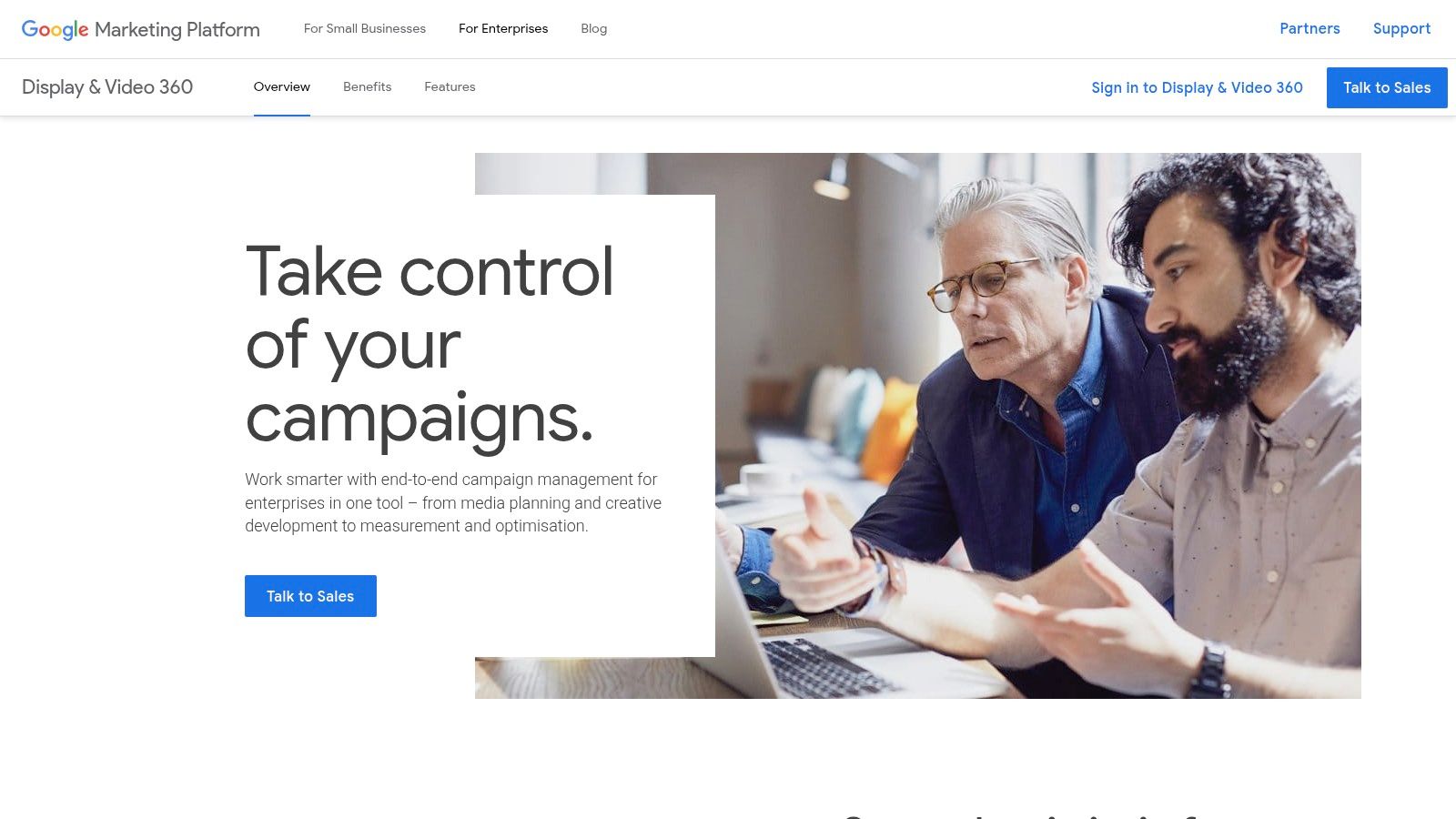
Unlike the more accessible Google Display Network, DV360 provides access to a much wider array of premium inventory through direct deals, private auctions, and programmatic guaranteed buys. This allows for strategic placements on top-tier publisher sites, going far beyond standard network reach. If you are interested in the fundamentals, you can explore the Google Ads Display Network here to understand the baseline from which DV360 expands.
Key Features and Specialisation
DV360’s power lies in its consolidated workflow and advanced capabilities. It is not just another DSP; it’s the central nervous system for complex digital strategies.
- Unified Campaign Management: It integrates planning, creative management, audience segmentation, and measurement into a single platform. This avoids the disjointed experience of using multiple tools for different channels.
- Exclusive YouTube & CTV Access: It offers the most advanced buying options for YouTube, including formats like TrueView and access to Google Preferred inventory. Its CTV capabilities allow advertisers to reach audiences on smart TVs and streaming devices with precision.
- Advanced Audience Tools: Advertisers can build intricate audience segments by combining first-party data, Google’s rich audience signals, and third-party data. Integration with Google Analytics 360 and Google Cloud enables highly sophisticated, data-driven targeting.
- Automated & Custom Bidding: Leveraging Google’s machine learning, DV360 provides powerful automated bidding strategies designed to achieve specific outcomes, such as maximising conversions or achieving a target cost-per-acquisition (CPA).
Expert Tip: To get the most out of DV360, start by integrating it with your Google Analytics 360 property. This unlocks the ability to build audiences based on detailed on-site behaviour and measure the true, cross-channel impact of your programmatic spend.
Ideal Client and Access
DV360 is squarely aimed at large enterprises or agencies managing substantial advertising budgets. Due to its complexity and cost structure, it’s generally not a fit for small businesses or those new to programmatic advertising. Access isn’t direct; it typically requires either a direct contract with Google (reserved for the largest spenders) or, more commonly for UK SMEs and mid-market companies, partnering with a certified Google Marketing Platform Partner or agency. These partners provide managed services, platform access, and the necessary expertise to navigate its powerful but complex interface.
| Feature Comparison | Google Display & Video 360 (DV360) | Standard Google Ads Display |
|---|---|---|
| Primary User | Large Advertisers, Agencies | Small to Large Businesses (Self-service) |
| Inventory Access | Open Auction, Private Deals, Programmatic Guaranteed | Primarily Open Auction |
| YouTube Buying | Advanced formats, Google Preferred, TrueView | Standard TrueView & Bumper Ads |
| Audience Sources | 1st, 2nd, 3rd-Party Data, Google Signals, Analytics 360 | 1st-Party Data, Google Signals |
| Data Integration | Native with Google Cloud/BigQuery, Analytics 360, Campaign Manager | Limited to Google Ads & Analytics (standard) |
| Pricing Model | Platform fees + Media Cost (not publicly listed) | Cost-Per-Click (CPC) or Cost-Per-Mille (CPM) |
Pros:
- Unrivalled access to Google’s ecosystem, especially YouTube and advanced TV inventory.
- Mature, machine-learning-driven automation for bidding and optimisation.
- Deep integration capabilities with the wider Google Marketing Platform and Google Cloud.
Cons:
- High barrier to entry; pricing is not public, and access is restricted.
- Steep learning curve, often requiring specialised training or agency management.
Website: marketingplatform.google.com/intl/en_uk/about/display-video-360/
2. The Trade Desk (UK)
As one of the largest independent demand-side platforms (DSPs) globally, The Trade Desk offers a powerful alternative to the walled gardens of Google and Meta. It is designed for advertisers and agencies seeking to execute sophisticated, data-driven campaigns across the open internet. For UK businesses wanting transparent control and omnichannel reach beyond search and social, The Trade Desk provides an enterprise-grade solution to connect with audiences across display, video, audio, and high-growth channels like Connected TV (CTV) and Digital Out-of-Home (DOOH).
The platform’s independence is a key differentiator, meaning it does not own media and is solely focused on the buy-side, aligning its interests with the advertiser. This objectivity allows for transparent reporting and media buying across a vast ecosystem of publishers and data partners. If you want to better understand the mechanics behind this technology, you can learn more about what programmatic advertising is here to grasp the fundamentals.
Key Features and Specialisation (Top Programmatic Advertising Companies in the UK )
The Trade Desk is built for omnichannel advertising, allowing marketers to manage diverse campaigns through a single, unified interface. Its strength lies in its extensive reach, data capabilities, and forward-thinking identity solutions.
- Omnichannel Campaign Execution: The platform enables buying across a full spectrum of digital channels, including CTV, audio streaming services, mobile apps, native, and traditional display, ensuring cohesive messaging wherever the audience is.
- Unified ID 2.0 and EUID: As a pioneer of cookie-alternative solutions, The Trade Desk champions Unified ID 2.0 (and its European counterpart, EUID) to help advertisers maintain addressability and measurement in a privacy-conscious way.
- Robust Data Marketplace: Advertisers can access a vast marketplace of third-party data providers to enrich their own first-party data, enabling highly granular audience targeting and segmentation for UK campaigns.
- Advanced Measurement and Reporting: The platform integrates with a wide array of measurement partners, offering detailed insights into campaign performance, attribution, and incremental lift, providing a transparent view of ROI.
Expert Tip: Leverage The Trade Desk’s extensive partner marketplace. Instead of relying solely on the platform’s native tools, integrate with specialist measurement and brand safety partners to add extra layers of verification and insight to your campaigns.
Ideal Client and Access
The Trade Desk is best suited for medium to large agencies and brands with significant advertising budgets and dedicated in-house expertise. Its comprehensive feature set and strategic focus make it a powerful tool, but it can be complex for newcomers. Access is not self-service; it requires a direct Master Services Agreement (MSA) with The Trade Desk, which involves a commitment to a certain level of spend. For many UK businesses, the most common route to access the platform is by partnering with an agency that holds a direct seat.
| Feature Comparison | The Trade Desk | Walled Garden DSPs (e.g., Google) |
|---|---|---|
| Primary User | Agencies, In-house Trading Teams, Large Brands | Large to Small Businesses (Varies by platform) |
| Inventory Focus | The Open Internet (CTV, Audio, DOOH, Display) | Primarily Owned & Operated Properties (e.g., YouTube) |
| Business Model | Independent, Buy-Side Only | Sells own media inventory (potential conflict) |
| Identity Solution | Unified ID 2.0 / EUID | Proprietary (e.g., Google Privacy Sandbox) |
| Data Access | Extensive 3rd-Party Data Marketplace | Primarily 1st-Party & Platform-owned signals |
| Pricing Model | Platform fees based on % of media spend (requires MSA) | Varies; may include platform fees or be bundled in CPM |
Pros:
- Vast, independent access to premium omnichannel inventory across the open web.
- Transparent pricing and reporting, with no vested interest in selling specific media.
- Industry-leading identity solutions to navigate the post-cookie landscape.
Cons:
- High barrier to entry due to minimum spend requirements and direct contract needed.
- The platform’s complexity requires skilled operators or agency management.
Website: https://www.thetradedesk.com/uk
3. Top Programmatic Advertising Companies in the UK: Amazon Ads (Amazon DSP) — UK
Amazon’s demand-side platform (DSP) has evolved into a powerhouse for programmatic advertising companies, extending its reach far beyond its own retail site. It allows advertisers to programmatically reach audiences on Amazon-owned properties like Prime Video, Twitch, and Fire TV, as well as across thousands of third-party publisher sites and ad exchanges. For UK businesses, particularly those in the ecommerce sector, Amazon DSP provides an unparalleled opportunity to leverage first-party shopping and streaming signals for highly effective campaigns.
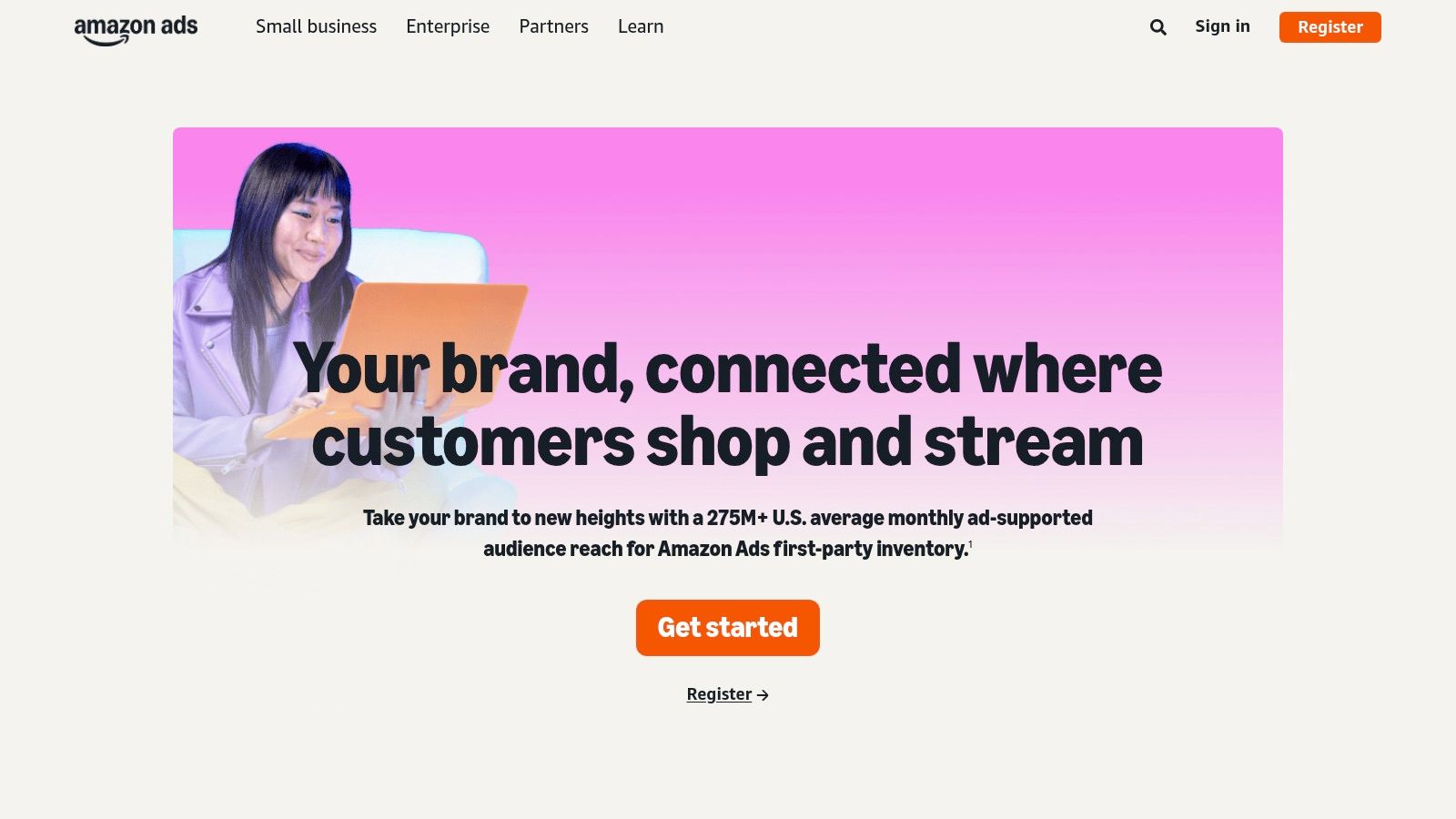
What truly sets Amazon DSP apart is its foundation of retail data. While search ads on Amazon capture active shoppers, the DSP enables brands to build audiences and influence consideration both on and off the platform. This makes it a crucial tool for everything from brand awareness to driving repeat purchases. If you’re currently focused on search, understanding how to master Amazon pay-per-click advertising can provide a solid foundation before expanding into the broader programmatic capabilities of the DSP.
Key Features and Specialisation
Amazon DSP’s core strength is its unique data, allowing advertisers to connect with consumers based on actual shopping, browsing, and streaming behaviours.
- Exclusive Amazon Audiences: Advertisers can access audiences based on lifestyle segments, in-market signals (e.g., users who recently viewed a product category), and lookalike audiences derived from existing customers. This targeting is based on real, authenticated user data.
- Omni-Channel Reach: Campaigns can run across display, video, and audio formats on Amazon-owned inventory (like Fire TV ads) and an extensive network of third-party publishers, providing a holistic reach.
- Flexible Access Models: Unlike some enterprise-level DSPs, Amazon offers multiple ways to get started. Brands can opt for a self-service model, a managed service with Amazon’s own team, or work with certified activation partners and agencies.
- Advanced Measurement: The platform offers unique reporting metrics like new-to-brand conversions, helping advertisers understand how many of their sales are coming from first-time customers on Amazon.
Expert Tip: Start by using Amazon’s pixel on your own website. This allows you to build retargeting audiences and, more powerfully, create lookalike audiences of your best off-Amazon customers to target across the Amazon DSP network.
Ideal Client and Access
Amazon DSP is a versatile platform suitable for a wide range of advertisers, but it is particularly potent for brands that sell products on Amazon, consumer packaged goods (CPG) companies, and entertainment brands. While accessible, the self-service option has certification requirements and is best suited for experienced programmatic teams. For many UK SMEs and mid-market companies, the managed-service or partner-led routes are more practical. Minimum spend requirements can vary depending on the access model chosen, so it is essential to discuss this with an Amazon representative or a certified partner.
| Feature Comparison | Amazon DSP | General DSPs |
|---|---|---|
| Primary User | Brands (especially CPG/Retail), Agencies, Experienced Media Buyers | Agencies, Large Advertisers |
| Primary Data Source | Amazon 1st-party shopping & streaming signals | 3rd-party data, Advertiser 1st-party data |
| Unique Inventory | Prime Video, Twitch, Fire TV, Amazon.co.uk | Primarily open exchange, PMPs, direct deals |
| Key Metrics | New-to-brand, Detail Page View Rate (DPVR) | CTR, CPA, Viewability |
| Access Models | Self-service, Managed-service, Certified Partner | Primarily Self-service or Managed-service |
| Pricing Model | Varies by model (CPM, platform fees) | Platform fees + Media Cost |
Pros:
- Unmatched first-party retail and streaming data for precise audience targeting.
- Flexible access options make it more approachable than some competing DSPs.
- Strong measurement capabilities tied directly to sales and product engagement on Amazon.
Cons:
- Minimum spend and certification requirements can be a barrier for smaller businesses.
- The most advanced features require specialised expertise, often necessitating partner support.
Website: advertising.amazon.com/en-gb/
4. Adform FLOW (Adform)
As a Europe-born, independent ad-tech platform, Adform FLOW offers a compelling alternative to the industry’s walled gardens. It provides an integrated full-stack solution that combines a DSP, DMP, ad server, and Dynamic Creative Optimisation (DCO) into a single, cohesive workflow. For UK advertisers prioritising transparency, omnichannel capabilities, and future-proofing against cookie deprecation, Adform presents a robust and privacy-conscious option among programmatic advertising companies.
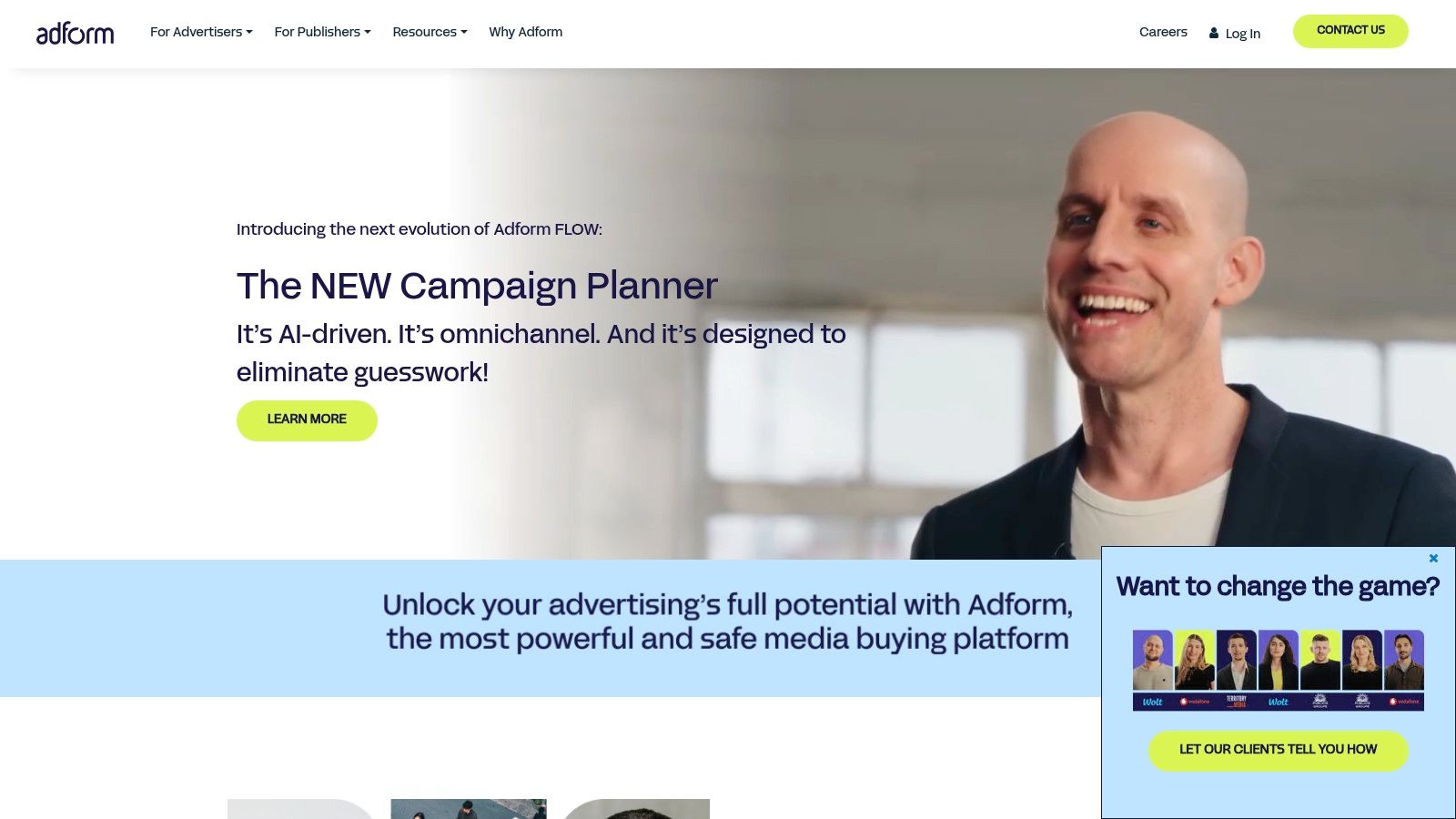
Adform’s strength lies in its unified architecture, designed to simplify complex media buying across all digital touchpoints. This integrated approach helps advertisers avoid the data silos and inefficiencies that can arise from stitching together multiple point solutions. It’s a holistic platform engineered for modern advertising, covering everything from standard display advertising to emerging channels.
Key Features and Specialisation (Top Programmatic Advertising Companies in the UK)
Adform FLOW is built on the principles of control, transparency, and seamless omnichannel activation, setting it apart as a strategic partner for sophisticated advertisers.
- Integrated Full-Stack Platform: By combining its DSP, DMP, and ad server, Adform allows for streamlined planning, buying, measuring, and optimising within one interface. This reduces data loss and improves campaign efficiency.
- Omnichannel Support: The platform provides extensive support for CTV, audio, and Digital Out-of-Home (DOOH), complete with visual planning tools for DOOH campaigns. This enables brands to execute truly unified cross-channel strategies.
- Cookieless Identity Solutions: Adform’s ID Fusion technology is designed to activate first-party data and navigate the post-cookie landscape. This privacy-first approach is particularly relevant for UK businesses operating under strict GDPR regulations.
- Strong European & UK Footprint: With its European origins, Adform has a deep understanding of the region’s privacy landscape and provides dedicated local support, which is a significant advantage for UK-based advertisers.
Expert Tip: Leverage Adform’s ID Fusion solution early to test and transition your targeting strategies away from third-party cookies. Start by onboarding your first-party data to build durable audience segments that will perform effectively in a privacy-first digital world.
Ideal Client and Access
Adform FLOW is best suited for medium to large enterprises and agencies that require a powerful, all-in-one platform for managing complex, multi-channel campaigns. Its full-stack nature and sophisticated features are designed for teams with programmatic expertise who seek greater control and transparency than what walled gardens offer.
Access typically involves enterprise-level licensing or bespoke contracts tailored to the advertiser’s needs. It is not a self-service platform for small businesses. UK companies usually engage directly with Adform’s sales and support teams to arrange a demo and discuss a customised package.
| Feature Comparison | Adform FLOW (Adform) | Typical Standalone DSP |
|---|---|---|
| Platform Model | Integrated Full Stack (DSP, DMP, Ad Server) | Primarily DSP (Demand-Side Platform) |
| Primary User | Large Advertisers, Agencies | Agencies, Programmatic Traders |
| Cookieless Solution | Native ID Fusion for 1st-party data | Varies; often reliant on 3rd-party IDs |
| Omnichannel Focus | Strong CTV, Audio, and DOOH capabilities | Varies; may require separate tools for some channels |
| European Alignment | Built with GDPR and EU privacy at its core | Varies by provider; may be US-centric |
| Pricing Model | Enterprise Licensing, Bespoke Contracts | Percentage of Media Spend, Platform Fees |
Pros:
- Independent and transparent platform, providing an alternative to big tech walled gardens.
- Strong omnichannel capabilities, especially for emerging formats like CTV and DOOH.
- Deeply aligned with European and UK privacy regulations, including GDPR.
Cons:
- Pricing is not publicly listed; requires direct engagement and negotiation.
- The learning curve can be steep for teams accustomed to simpler, single-channel platforms.
Website: site.adform.com/
5. Top Programmatic Advertising Companies in the UK: StackAdapt
StackAdapt has carved out a strong reputation as a self-serve, multi-channel demand-side platform (DSP) particularly popular with agencies and mid-market brands. It is designed to simplify the complexities of programmatic advertising, offering a user-friendly interface without sacrificing powerful, cross-channel capabilities. For UK businesses seeking an accessible yet comprehensive platform, StackAdapt provides a compelling entry point into the world of programmatic, covering native, display, video, Connected TV (CTV), audio, in-game, and Digital Out-of-Home (DOOH) advertising.
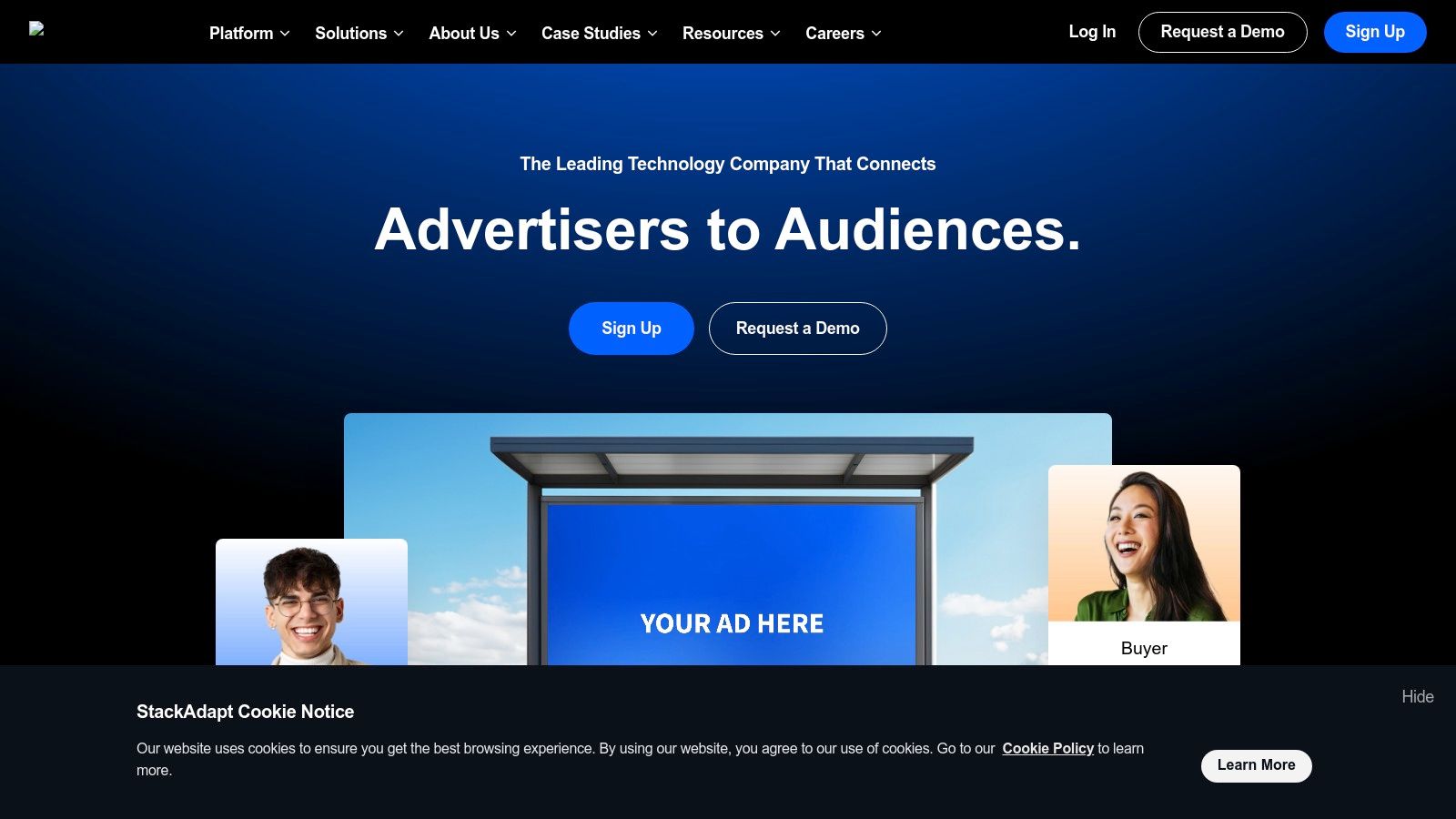
A key differentiator for the UK market is its strategic partnerships. StackAdapt has secured access to premium local inventory, such as Channel 4’s Broadcaster Video on Demand (BVOD) supply, allowing advertisers to reach highly engaged audiences on a major UK streaming service. This focus on local, high-quality supply makes it one of the more relevant programmatic advertising companies for businesses targeting a UK audience.
Key Features and Specialisation
StackAdapt excels by combining an intuitive platform experience with a broad range of channel options and robust data integrations. It empowers marketers to plan, execute, and measure sophisticated campaigns from a single hub.
- Multi-Channel Campaign Execution: The platform supports a wide array of formats, allowing advertisers to build truly integrated campaigns that reach users across native, display, video, CTV, audio, and emerging channels like in-game ads.
- Premium UK Inventory: Direct integrations with partners like Channel 4 for BVOD and Place Exchange and VIOOH/JCDecaux for DOOH provide access to high-impact, premium UK-based advertising opportunities.
- Advanced CTV & Measurement: It offers robust CTV targeting and measurement solutions, bolstered by integrations with data partners like Samba TV, helping advertisers understand reach and frequency in the increasingly fragmented TV landscape.
- User-Friendly Self-Serve Interface: The platform is widely praised for its ease of use, making it more approachable for teams that may not have deep technical expertise in programmatic buying, while still offering advanced features.
Expert Tip: When launching a CTV campaign on StackAdapt, leverage its partnership with Samba TV to build retargeting pools based on TV viewership data. This allows you to serve follow-up ads to households that were exposed to your (or a competitor’s) linear TV advert, creating a powerful, cross-screen narrative.
Ideal Client and Access
StackAdapt is best suited for mid-market brands and advertising agencies that want the control of a self-serve DSP but require a platform that is less complex and resource-intensive than enterprise-level solutions. Its model provides a good balance of power and usability, making it ideal for teams looking to bring programmatic buying in-house or scale their existing efforts across multiple channels.
Access to the platform is granted after consultation with their sales team, as there is no public price list. Commercial terms are customised based on client needs and anticipated spend. While it is a self-serve platform, some advanced integrations or features may require additional fees or have minimum spend requirements.
| Feature Comparison | StackAdapt | Enterprise DSPs (e.g., DV360) |
|---|---|---|
| Primary User | Mid-Market Brands, Agencies | Large Enterprises, Holding Companies |
| Platform Model | Self-Serve with Strong Support | Self-Serve or Managed (Requires high expertise) |
| Key UK Inventory | Channel 4 BVOD, VIOOH/JCDecaux DOOH | Google/YouTube Ecosystem, other major exchanges |
| Ease of Use | High (Designed for usability) | Low (Steep learning curve) |
| Data Integration | Strong partner ecosystem (e.g., Samba TV) | Deep native integration (e.g., Google Cloud) |
| Pricing Model | Custom terms via sales consultation | Platform fees + Media Cost (often with high minimums) |
Pros:
- Accessible and intuitive self-serve user experience.
- Strong UK relevance with premium broadcaster (BVOD) and DOOH supply.
- Excellent partner ecosystem for enhanced data and measurement.
Cons:
- Pricing is not public; requires engaging with a sales team.
- Some advanced features or premium data segments may carry additional costs.
Website: https://www.stackadapt.com/
6. Quantcast Platform (UK)
The Quantcast Platform is an AI-driven demand-side platform (DSP) that focuses on simplifying the programmatic process and delivering campaign outcomes. It stands out by leveraging its proprietary live data and machine learning engine, the Audience Graph, to find and influence relevant audiences without a heavy reliance on third-party cookies. For UK businesses looking for an end-to-end solution that automates much of the complexity of audience discovery and campaign optimisation, Quantcast offers a compelling, future-proofed platform.
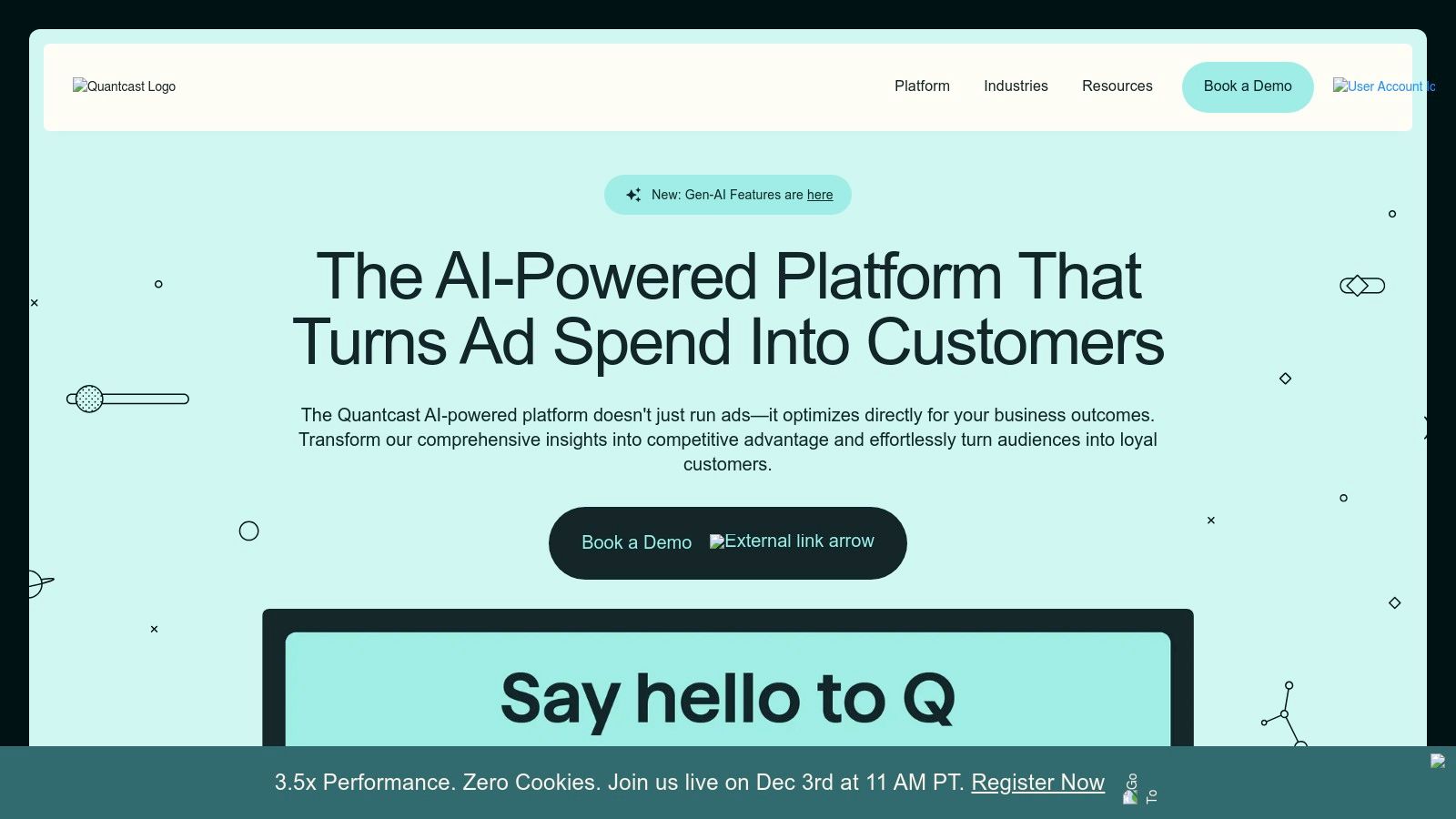
Unlike many platforms that require advertisers to manually build and test complex audience segments, Quantcast’s AI engine, Ara, automates much of this process. By focusing on campaign goals like conversions or ROAS, the platform autonomously identifies and targets users most likely to convert across display, video, native, and CTV inventory. This makes it one of the more accessible yet powerful programmatic advertising companies for teams without deep ad ops resources.
Key Features and Specialisation (Top Programmatic Advertising Companies in the UK)
Quantcast’s strength is its fusion of a powerful AI engine with a simplified workflow, designed to make outcome-based advertising more efficient.
- AI-Driven Audience Discovery: At its core is the Audience Graph, which analyses real-time data signals to build predictive models of consumer behaviour. This allows the platform to find new, high-value audiences beyond an advertiser’s initial targeting parameters.
- Cookieless Capabilities: The platform is engineered to operate effectively in environments without third-party cookies by using its vast first-party data set and contextual signals, providing a robust solution for the privacy-centric future.
- Unified Workflow: Quantcast integrates planning, activation, measurement, and insights into a single interface. This removes the need for multiple tools and helps streamline campaign management from start to finish.
- Omnichannel Activation: Advertisers can run coordinated campaigns across various channels, including Connected TV (CTV), display, video, and native, all managed and measured within the same platform for a holistic view of performance.
Expert Tip: When launching a campaign on Quantcast, trust the AI. Start with broader goals and minimal targeting constraints. The platform is designed to learn and optimise autonomously, and overly restrictive targeting can hinder its ability to discover new, high-performing audience pockets.
Ideal Client and Access
The Quantcast Platform is well-suited for mid-market to enterprise-level advertisers and agencies that want to achieve specific business outcomes without the manual overhead of traditional DSPs. Its user-friendly interface also makes it a viable option for brands with smaller, in-house marketing teams looking to scale their programmatic efforts. Access to the platform is not self-serve; prospective UK clients need to contact the Quantcast sales team for a demo and to discuss managed or self-service options. Pricing is not publicly listed and is typically based on a percentage of media spend.
| Feature Comparison | Quantcast Platform | Traditional DSPs |
|---|---|---|
| Primary User | Mid-Market to Enterprise Brands, Agencies | Specialised Ad Ops Teams, Large Agencies |
| Audience Targeting | AI-driven, predictive audience discovery | Manual segment building (1st, 2nd, 3rd-party data) |
| Optimisation | Autonomous, goal-based (e.g., CPA, ROAS) | Manual and algorithm-based bidding strategies |
| Cookieless Solution | Integrated, based on proprietary data graph | Varies; often reliant on third-party identity partners |
| Workflow | Unified platform for planning, buying, and measurement | Often requires separate tools for planning and analytics |
| Pricing Model | Platform fees + Media Cost (quote-based) | Varies (CPM, % of media spend, fixed fees) |
Pros:
- Powerful AI and automation simplify campaign management and optimisation.
- Strong, built-in cookieless targeting capabilities prepare advertisers for the future.
- Intuitive, end-to-end workflow reduces complexity and the need for multiple tools.
Cons:
- Pricing is not public, and access requires engaging with a sales team.
- As a “walled garden” of sorts, its data and insights are primarily contained within the platform.
Website: https://www.quantcast.co.uk/
7. Top Programmatic Advertising Companies in the UK: MiQ (wearemiq.com)
As a London-headquartered programmatic media partner, MiQ operates differently from self-serve DSPs by offering a fully managed service that blends data science, analytics, and trading expertise. It is designed for advertisers who want the power of programmatic without the complexity of building an in-house team. MiQ positions itself as a strategic partner, planning and executing campaigns across a range of leading DSPs and media channels, including display, video, audio, CTV, and Digital Out-of-Home (DOOH).
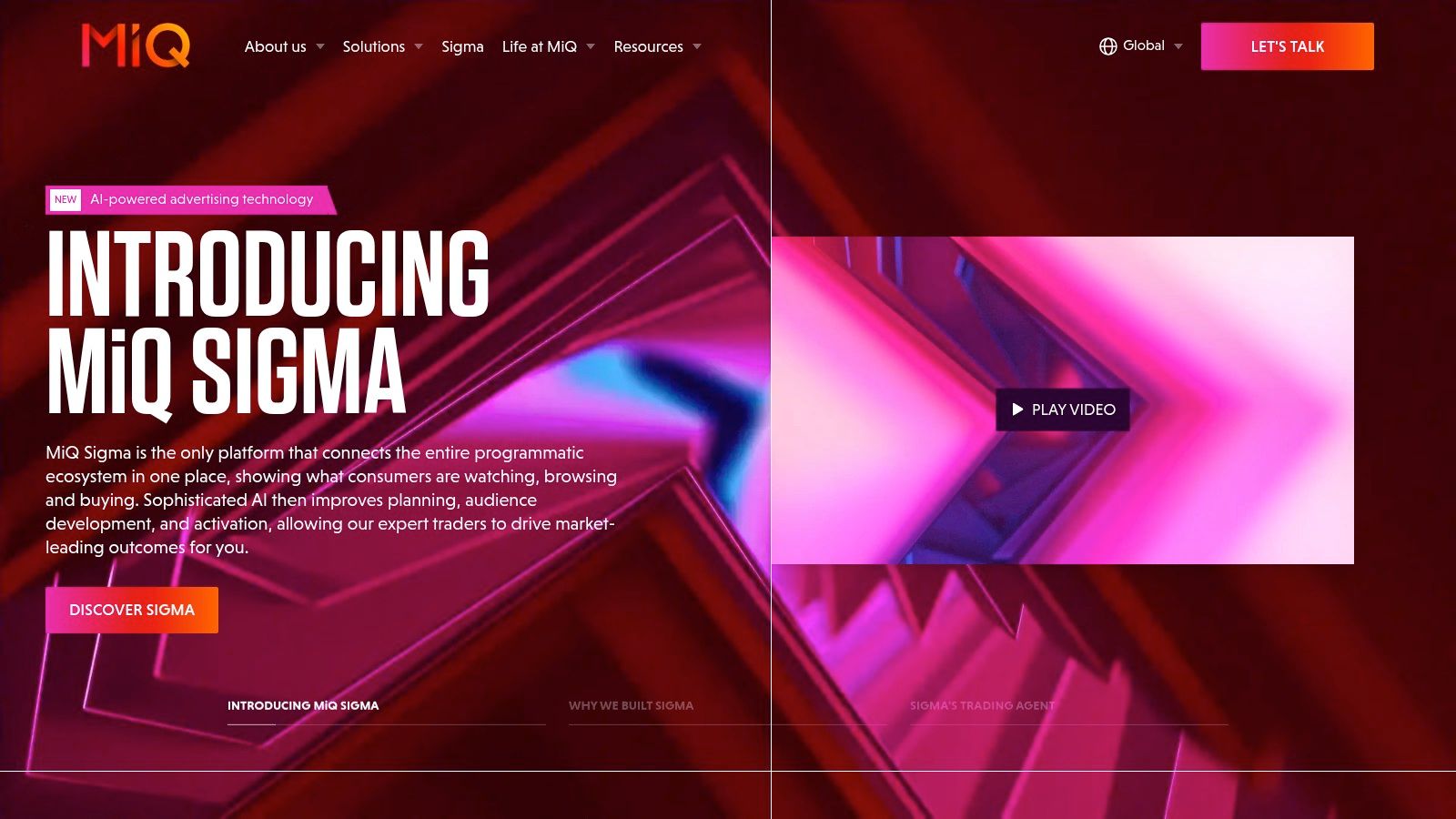
MiQ’s core value lies in its ability to connect disparate data points and apply intelligence to media buying, effectively acting as an extension of a client’s marketing department. This managed approach is particularly beneficial for UK businesses navigating the fragmented media landscape, especially in areas like Connected TV, where MiQ has developed specialised tools to deliver unified audience reach and frequency.
Key Features and Specialisation
MiQ combines proprietary technology with human expertise to deliver custom programmatic strategies. Its service is built around a deep understanding of data and analytics.
- Managed Programmatic Execution: MiQ’s UK-based trading and analytics teams handle every aspect of campaign management, from strategic planning and audience building to activation across multiple DSPs and real-time optimisation.
- AI-Enabled Planning (MiQ Sigma): This proprietary platform ingests and analyses vast datasets to uncover consumer insights, identify high-value audiences, and inform media planning decisions before a campaign even begins.
- Advanced TV Intelligence: Specialised tools help advertisers navigate the complex UK CTV ecosystem. It provides insights into audience duplication across platforms like ITVX, Sky, and Channel 4, enabling more efficient video ad spend.
- Channel Agnostic Approach: Being DSP-agnostic allows MiQ to select the best technology and inventory sources to meet specific campaign goals, rather than being tied to a single platform’s capabilities.
Expert Tip: Engage MiQ early in your planning process. By providing them with your business objectives and first-party data, their analytics teams can use their MiQ Sigma platform to build a predictive model for your campaign, identifying the most valuable audience segments and optimal channel mix before you spend your first pound.
Ideal Client and Access
MiQ is best suited for medium to large enterprises and agencies that want to leverage advanced programmatic capabilities but prefer a managed service model over building and training an in-house team. It’s an ideal partner for businesses with complex data challenges or those looking to scale their efforts in sophisticated channels like CTV.
Access is through a direct partnership, operating similarly to an agency retainer or a campaign-specific scope of work. Pricing is bespoke and not publicly available, as it depends on the level of service, media spend, and complexity of the campaign objectives. This makes it a less suitable option for very small businesses or those just starting with programmatic advertising.
| Feature Comparison | MiQ (Managed Service) | Self-Serve DSP (e.g., The Trade Desk) |
|---|---|---|
| Primary User | Marketing Teams, Agencies (as a partner) | In-house Programmatic Traders, Specialist Agencies |
| Operational Model | Fully managed service: planning, activation, analytics | Self-service: user manages all campaign aspects |
| Tech Stack | DSP-agnostic, uses proprietary analytics tools (MiQ Sigma) | Access to a single, proprietary DSP platform |
| Support | Dedicated UK-based account, strategy, and trading teams | Platform support, helpdesks, self-service resources |
| Pricing Model | Bespoke campaign/retainer fees + Media Cost | Platform fees as a % of media spend |
| Key Advantage | Strategic insights and execution without in-house overhead | Full control and transparency over campaign management |
Pros:
- Eliminates the need for costly in-house programmatic specialists and platform fees.
- Strong TV/CTV analytics and tooling tailored to the fragmented UK video market.
- UK-based teams provide localised strategic and analytical support.
Cons:
- Not a self-serve platform; advertisers cede direct control over campaign execution.
- Pricing is opaque and based on bespoke agreements, which may not suit all budgets.
Website: https://www.wearemiq.com/
Top 7 Top Programmatic Advertising Companies in the UK: Comparison
| Platform | 🔄 Implementation complexity | ⚡ Resource requirements | 📊 Expected outcomes | 💡 Ideal use cases | ⭐ Key advantages |
|---|---|---|---|---|---|
| Google Display & Video 360 (DV360) | 🔄 High — enterprise onboarding & workflows | ⚡ High — dedicated teams, Analytics 360 / BigQuery integrations | 📊 Unified cross‑channel measurement and scalable automation | 💡 Large agencies and complex multi‑channel UK campaigns | ⭐ Deep YouTube/TV access; mature ML optimisation |
| The Trade Desk (UK) | 🔄 Medium‑High — advanced feature set | ⚡ Medium — experienced buyers; commercial agreement | 📊 Broad open‑web scale with transparent controls | 💡 Brands/agencies seeking independent alternative to walled gardens | ⭐ Premium open inventory; strong identity & measurement ecosystem |
| Amazon Ads (Amazon DSP) — UK | 🔄 Medium — multiple access modes (self/managed) | ⚡ Medium‑High — minimum spends/certification may apply | 📊 Precise retail & streaming-driven targeting and conversions | 💡 Retail/e‑commerce brands and advertisers leveraging Amazon signals | ⭐ Unique first‑party shopping & streaming data; flexible access options |
| Adform FLOW (Adform) | 🔄 Medium‑High — full‑stack platform learning curve | ⚡ Medium — enterprise licensing; privacy tooling | 📊 Privacy‑forward omnichannel activation, cookieless readiness | 💡 EU/UK advertisers prioritising GDPR alignment and control | ⭐ Independent full‑stack solution; strong EU privacy focus |
| StackAdapt | 🔄 Low‑Medium — self‑serve, accessible UI | ⚡ Low‑Medium — suited to mid‑market & agencies | 📊 Efficient multi‑channel campaigns with broadcaster/DOOH reach | 💡 Agencies and mid‑market brands needing self‑serve DSP | ⭐ Easy self‑serve UX; Channel 4 BVOD & DOOH partnerships |
| Quantcast Platform (UK) | 🔄 Low‑Medium — simplified end‑to‑end workflows | ⚡ Medium — benefits from first/zero‑party data | 📊 AI‑driven outcome optimisation and cookieless reach | 💡 Outcome‑focused campaigns and cookieless strategies | ⭐ Autonomous AI optimisation; Audience Graph for discovery |
| MiQ (wearemiq.com) | 🔄 Low for clients (managed service); medium operationally | ⚡ Medium — managed fees; UK strategy & trading teams | 📊 Outsourced programmatic performance with TV intelligence | 💡 Advertisers preferring managed partners over self‑serve | ⭐ UK‑based managed expertise; strong TV/CTV tooling |
Making Your Choice: A Practical Checklist for UK Businesses
Navigating the landscape of programmatic advertising companies can feel overwhelming. We’ve explored a range of powerful platforms, from the enterprise-level integration of Google’s DV360 and the independent prowess of The Trade Desk, to the specialised e-commerce focus of Amazon DSP and the user-friendly, multi-channel capabilities of platforms like Adform FLOW and StackAdapt. Each offers a unique pathway to reaching your target audience with precision and scale.
The key takeaway is that the “best” platform is not universal; it’s the one that aligns perfectly with your business’s unique circumstances. A global retailer will have vastly different needs from a UK-based SME looking to drive local footfall. Your choice hinges on a careful evaluation of your internal resources, campaign objectives, budget, and desired level of control.
To distil this complex decision into a clear, actionable process, use the following checklist. Ask these critical questions internally and during your initial conversations with potential partners.
Your Programmatic Readiness Checklist
1. Define Your Core Objectives:
- What is our primary goal? Are we aiming for brand awareness, direct response and lead generation, e-commerce sales, or in-store visits? Different platforms excel in different areas. For example, Amazon DSP is unparalleled for driving sales on its marketplace, while The Trade Desk offers robust solutions for connected TV (CTV) awareness campaigns.
- Who is our target audience? How granular do we need our targeting to be? Consider whether your strategy relies on first-party data, contextual signals, or third-party audience segments. Platforms like Quantcast offer powerful AI-driven audience discovery that can be invaluable if you’re looking to find new customer segments.
2. Assess Your In-House Capabilities:
- What is our level of expertise? Do we have a dedicated team member with programmatic trading experience? If not, a platform with strong managed service options, like MiQ or a specialised agency, might be a more practical starting point than a self-serve DSP.
- How much time can we commit? Managing programmatic campaigns effectively requires significant time for setup, monitoring, and optimisation. Be realistic about your team’s capacity. A self-serve platform offers ultimate control but demands the most hands-on effort.
3. Evaluate Technical and Financial Requirements:
- What is our budget? Be clear on minimum spend requirements. Enterprise-level platforms often have substantial minimums that may not be suitable for smaller advertisers. Platforms like StackAdapt are known for being more accessible to SMEs.
- Do we have the necessary data infrastructure? To get the most out of programmatic advertising, you need a solid foundation for collecting and activating first-party data (e.g., from your CRM or website analytics).
- What level of transparency is essential? Understand the pricing model. Are you paying a percentage of media spend, a flat platform fee, or a hybrid? Demand clarity on where every pound is going, including data costs, media costs, and service fees.
4. Consider the Broader Partnership:
- What kind of support will we need? Evaluate the onboarding process, training resources, and ongoing technical support offered. A responsive and knowledgeable support team can make a significant difference, especially when you are new to a platform.
- Does the platform align with UK-specific regulations? Ensure any partner you choose has a strong understanding of GDPR and other local data privacy regulations to keep your advertising compliant and protect your brand’s reputation.
By thoughtfully working through this checklist, you transform a daunting decision into a strategic evaluation. This process ensures you select one of the programmatic advertising companies that not only provides powerful technology but also functions as a true partner in your growth, equipped to help you achieve your specific marketing goals in the competitive UK market.
Feeling confident about the ‘what’ but need an expert to handle the ‘how’? The world of programmatic advertising is complex, but the team at PPC Geeks specialises in simplifying it for UK businesses. We leverage our expertise to manage campaigns on powerful platforms, translating intricate data into tangible results and helping you scale your growth without the steep learning curve.
PPC Geeks