




How to Scale a Business for Sustainable Growth: Thinking about scaling your business often conjures up images of explosive growth. But the real secret? It’s about building a strong, flexible foundation before you hit the accelerator. Strategic scaling isn’t just about getting bigger; it’s about getting smarter at handling more demand without your quality dipping or your internal processes imploding.
It’s a crucial shift from simply growing—where you add resources as revenue increases—to truly scaling, where revenue climbs without a massive spike in resources.
How to Scale a Business for Sustainable Growth: Growth vs Scaling Key Differences
Let’s break down the fundamental differences between just growing and strategically scaling. While they might seem similar on the surface, their approach and outcomes are worlds apart.
| Aspect | Growth | Scaling |
|---|---|---|
| Resource Addition | Linear: Add resources for every new customer. | Non-linear: Add customers with minimal resource increase. |
| Revenue vs. Costs | Both revenue and costs increase together. | Revenue increases much faster than costs. |
| Focus | Adding inputs (people, budget) to get more outputs. | Improving systems to handle more output with same inputs. |
| Sustainability | Can be difficult to sustain long-term. | Designed for long-term, sustainable expansion. |
| Predictability | Often unpredictable and reactive. | Based on predictable, repeatable processes. |
Understanding this distinction is the first step. Growth is about muscle; scaling is about building an efficient, powerful engine.
How to Scale a Business for Sustainable Growth: Building a Scalable Foundation
Scaling a business is a deliberate act, not a happy accident. It demands a massive mindset shift, especially for founders. You have to move from being the hands-on person involved in every tiny detail to becoming the architect of a systems-driven company. It’s a tough transition, but absolutely essential.
Your goal is to build an organisation that runs smoothly and continues to thrive, even when you’re not in the weeds of the day-to-day.
This means shoring up your financial models, streamlining your operations, and empowering your team to take ownership. In the UK, where SMEs are the lifeblood of the economy, this strategic approach is what separates lasting success from a flash in the pan. UK SMEs make up 99.9% of all businesses and contribute over half of the total turnover. Yet, the average turnover only grew by a modest 1.3% in 2025, which tells you that while many businesses exist, very few manage to achieve true scale.
Confirming Your Readiness
Before you start building, you need to check the ground you’re standing on. There are two non-negotiable prerequisites that tell you if you’re genuinely ready to scale:
- Strong Product-Market Fit: You need undeniable proof that your product or service solves a real problem for a specific audience. This is more than just a few happy customers. We’re talking about consistent demand, low churn, and people who actively recommend you without being asked.
- A Replicable Sales Process: You must have a sales and marketing engine that is predictable and repeatable. If all your sales come from your personal network or one-off “heroic” efforts from a single team member, you can’t scale it. You need a defined process that a new hire could follow and get similar results.
This diagram neatly lays out the core process for checking if you’re ready, starting with nailing your product-market fit, moving to a repeatable sales process, and finally, building the systems to support it all.
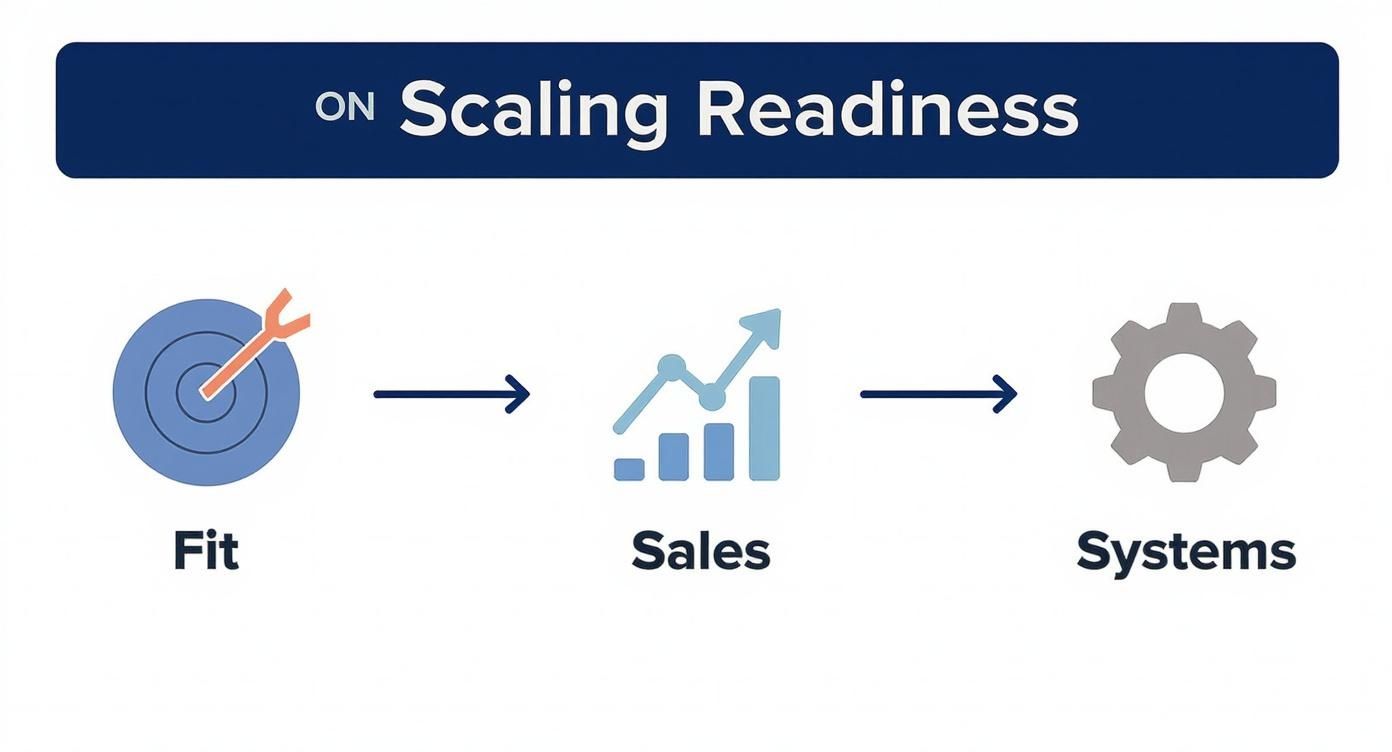
The flow here is critical. Without a validated product and a predictable way to sell it, any attempt to systematise and scale is just putting the cart before the horse.
Scaling is not about doing more; it’s about building the capacity to handle more with greater efficiency. Your systems, not your personal effort, should be the engine of your growth.
To keep everyone on the same page during this journey, setting crystal-clear goals is vital. You might find our guide on OKRs (Objectives and Key Results) helpful—it’s a brilliant framework for managing and hitting ambitious growth targets.
How to Scale a Business for Sustainable Growth: Mastering Your Financials to Fuel Expansion

Let’s be honest, scaling a business is powered by capital. But it’s financial discipline that keeps the engine from blowing up. Without an iron grip on your numbers, even the most brilliant growth plans can go sideways, fast. This isn’t just about having cash in the bank; it’s about knowing exactly how every pound is working for you.
This means you need to get way beyond basic profit and loss statements. You need a living, breathing financial model that forecasts your revenue, costs, and cash flow with painful accuracy. This model becomes your strategic map, showing you where you’re headed and what you’ll need to survive the journey.
Building Your Financial Roadmap
This financial model isn’t just a fancy document for pitching investors—it’s for you. It needs to be your single source of truth for making those tough, mission-critical decisions. Kick things off by building a detailed forecast for the next 18-24 months.
And please, be brutally honest with your projections. Base them on real historical data and realistic growth assumptions, not just pie-in-the-sky hopes. At its heart, a solid model must clearly outline your unit economics.
The core of any scalable financial plan is simple: you must understand the relationship between what it costs to get a customer and the value that customer brings in. If that ratio is unhealthy, scaling will just pour petrol on the fire.
Investors and lenders will tear these numbers apart. They need to see that you have a deep, almost obsessive, understanding of your business’s financial engine. Two metrics, in particular, will be under the microscope.
- Customer Acquisition Cost (CAC): How much do you really spend on marketing and sales to win a single new customer?
- Lifetime Value (LTV): How much total revenue will that customer generate for you over their entire relationship with your business?
A healthy, scalable business needs an LTV that is miles higher than its CAC—we’re typically talking a ratio of at least 3:1. Proving you’ve got this balance right is fundamental to showing your model is built to last. For a deeper dive into the maths, check out our guide on how to calculate customer lifetime value, which breaks down all the formulas you’ll need.
Securing the Right Funding in the UK (How to Scale a Business for Sustainable Growth)
Once your financial house is in order, you can start looking for fuel. The UK has a fantastic ecosystem for ambitious businesses, but choosing the right path depends entirely on your business model, where you are now, and where you want to go.
It’s crucial to remember that not all money is created equal. Where you get your funding from brings different expectations, pressures, and levels of control.
Common UK Funding Avenues
- Venture Capital (VC): VCs write big cheques in exchange for equity. They’re betting on high-growth businesses with the potential for massive returns and are looking for a fast-paced journey to a big exit, like an IPO or a major acquisition.
- Angel Investors: These are high-net-worth individuals investing their own cash. They often get involved at an earlier stage than VCs and can bring valuable mentorship to the table along with their investment.
- Government Grants: Organisations like Innovate UK offer non-dilutive funding, which is a brilliant way to get cash without giving up any equity. This is usually for businesses working on innovative projects that boost the UK economy.
- Revenue-Based Financing (RBF): This is a flexible option where you get capital now in exchange for a small percentage of your future monthly revenue. It’s becoming hugely popular with SaaS and e-commerce businesses that have predictable income.
Think about a real-world scenario. A UK subscription box company needed cash to ramp up its inventory and marketing spend. Instead of giving a chunk of their company away to a VC, they went for revenue-based financing. They got the cash they needed quickly, paid it back as a percentage of their sales, and kept 100% ownership—a perfect fit for their model.
When you go to craft your pitch, lead with the data. Don’t just tell a story; show investors the cold, hard numbers that prove your model works. Shout about your strong LTV to CAC ratio, your month-on-month growth, and your crystal-clear plan for how their capital will hit specific, measurable milestones. This data-first approach is how you turn a good idea into an investable rocket ship.
How to Scale a Business for Sustainable Growth: Building a Team That Can Drive Growth

You can have the slickest systems and a healthy bank balance, but the real ceiling on your growth is your people. A brilliant strategy in the hands of a mediocre team will always fall flat. For any founder, the toughest transition is shifting from being the main ‘doer’ to becoming a leader who empowers others to do amazing work.
This evolution isn’t optional. If every decision, new idea, and crisis still needs your sign-off, you’ve become the bottleneck. To truly scale, you need a team that can not only handle today’s workload but also has the drive and capacity to take on more, innovate, and own their functions.
This means intentionally designing a team structure that’s built for the future, defining roles with crystal clarity, and building a culture that attracts and keeps top performers—especially during the organised chaos of rapid growth.
Designing a Scalable Organisational Structure
Forget your current org chart for a minute. Instead, picture the team you’ll need in 18 months. Who are the key hires that will unlock that next level of growth? A classic mistake is hiring reactively, only bringing someone on board when a fire is already raging. You need to be proactive.
Start by mapping out the core functions of your business. This might look something like:
- Marketing & Sales: The engine for customer acquisition and revenue.
- Operations & Fulfilment: The machine that delivers your product or service flawlessly.
- Customer Success & Support: The team ensuring customers stick around and stay happy.
- Finance & Admin: The brains keeping the financial engine humming.
For each function, define the essential roles and—this is crucial—the single point of ownership for every critical outcome. When everyone knows exactly what they’re responsible for, accountability shoots up, and things get done a lot faster.
Hiring A-Players Who Thrive on Growth (How to Scale a Business for Sustainable Growth)
Scaling demands a specific kind of person. You’re looking for ‘A-players’—people who are not just competent but also adaptable, proactive, and genuinely excited by the prospect of building something. They see ambiguity as an opportunity, not a threat.
The most expensive hire you can make is the wrong one. In a scaling business, the damage is amplified. A single underperformer can kill momentum, drain resources, and tank the morale of your best people.
When you’re interviewing, dig deeper than technical skills. Ask behavioural questions that reveal how a candidate handles pressure, solves unexpected problems, and takes initiative. For example, instead of asking, “Are you a good problem-solver?” try, “Tell me about a time you spotted a major process bottleneck before anyone else and what you did about it.”
For specialised roles, particularly in digital marketing, you’ll hit the classic dilemma: build in-house or partner with an agency? It’s a huge decision. To help you weigh the pros and cons, our guide on in-house vs agency marketing offers some valuable clarity.
Nurturing a Culture That Retains Talent
As you grow, your company culture will change—that’s inevitable. The trick is to guide that change intentionally. Your values, how you communicate, and how you celebrate wins all shape a culture that either helps or hinders your ability to scale.
A strong culture is your best retention tool. This can’t be overstated, especially in the UK’s competitive job market. SMEs are the backbone of the economy, employing around 16.7 million people at the start of 2024, which is about 60.1% of all private sector jobs. With fierce competition for top talent, you need to be a place where great people want to stay.
To build a winning culture, focus on these pillars:
- Transparent Communication: Keep your team in the loop on company goals, challenges, and wins. This builds trust and makes everyone feel like they’re part of the journey.
- Radical Ownership: Empower your people to make decisions in their areas of responsibility. Micromanagement is the absolute enemy of scale.
- Structured Feedback: Implement regular, constructive performance reviews. This helps your team grow their skills and stay aligned with where the business is headed.
Ultimately, your job as a leader is to build the machine, hire the best people to run it, and then get out of their way so they can drive the growth.
How to Scale a Business for Sustainable Growth: Optimising Operations With Tech and Automation
Those manual processes that felt just fine when you were a small, nimble team? They’re the very things that will chain you down as you try to grow. Answering every customer email yourself, manually wrestling with spreadsheets, or chasing invoices by hand are classic examples of tasks that simply don’t scale.
Once the volume starts to creep up, these processes will fracture. This leads to costly mistakes, unhappy customers, and a team that’s completely burnt out.
The answer is to build a solid operational engine, one powered by smart technology and automation. This isn’t about replacing your people; it’s about freeing up their time and brainpower to focus on high-value work that actually pushes the business forward. The goal is to create systems that can handle growth, not get crushed by it.
Mapping Your Processes to Find Bottlenecks
Before you can fix anything, you need to get a really clear picture of how work gets done in your business right now. It’s time to map out your core processes from start to finish. You don’t need to overcomplicate it – a simple flowchart on a whiteboard is a perfect place to start.
Begin by identifying the major workflows that keep the lights on:
- Lead to Sale: How does a potential customer find you, get nurtured, and eventually make a purchase? What are all the touchpoints?
- Customer Onboarding: What happens the second a new client signs on the dotted line? What are the key steps to get them set up for success?
- Project or Service Delivery: How is the actual work completed, from the initial brief to the final delivery and sign-off?
- Support and Resolution: When a customer has a problem, what’s the exact process for getting it sorted quickly and efficiently?
As you map these out, the weak points will start to jump out at you. Look for repetitive data entry, clumsy hand-offs between team members, and any tedious tasks that eat up hours every week. These are your prime targets for automation.
Choosing the Right Tech Stack for Scale (How to Scale a Business for Sustainable Growth)
Once you’ve pinpointed the bottlenecks, you can start picking the right tools to smooth them out. The secret here is to build a connected ‘tech stack’ where different software solutions can talk to each other, creating a seamless flow of data. For anyone figuring out how to scale a business, this is a non-negotiable step.
Technology is the scaffolding that allows your business to build upwards without collapsing. Investing in the right tools isn’t a cost; it’s a direct investment in your capacity to grow.
A solid tech stack for a scaling business usually has a few core components. The specific tools might change depending on your industry, but the jobs they do are universal.
Getting your tech stack right is fundamental to scaling without chaos. Here’s a look at the essential software categories you should be considering.
Essential Tech Stack for a Scaling Business
| Category | Function/Purpose | Example Tools |
|---|---|---|
| CRM | Manages all customer relationships, sales pipelines, and interactions in one central place. | HubSpot, Salesforce, Zoho |
| Project Management | Organises tasks, deadlines, and team collaboration to ensure projects are delivered on time. | Asana, Trello, Monday.com |
| Marketing Automation | Automates marketing activities like email campaigns, social media posting, and lead nurturing. | Mailchimp, ActiveCampaign |
| ERP | Integrates core business processes like finance, inventory, and supply chain management. | NetSuite, SAP, Odoo |
| Communications | Facilitates seamless internal communication and collaboration, reducing email overload. | Slack, Microsoft Teams |
The real magic happens when these tools are integrated. For example, when a new lead comes through your website (captured by your marketing tool), it can automatically create a new contact and deal in your CRM. This then triggers a task in your project management software for the sales team to follow up.
This kind of hands-off efficiency is the heart of scaling. If you’d like to learn more, you might be interested in our guide on what marketing automation is and how it can completely change your lead generation process.
A Real-World UK Example (How to Scale a Business for Sustainable Growth)
Let’s look at a UK-based creative agency that was drowning in admin. The team was wasting hours every single week manually creating project briefs, tracking their time in clunky spreadsheets, and chasing up invoices with follow-up emails. Their growth had completely flatlined because they were spending more time on admin than on actual client work.
They decided to completely overhaul their operations with a new, integrated tech stack:
- First, they implemented a CRM (HubSpot) to manage their entire sales pipeline, from the first enquiry right through to a closed deal.
- Next, they brought in a project management tool (Asana) that plugged directly into their CRM. Now, when a deal was marked as ‘won’, a new project was automatically created with a pre-built template of tasks.
- Finally, they connected their accounting software (Xero) to automate invoicing and payment reminders. No more manual chasing.
The result? They slashed their non-billable administrative time by over 40%. This immediately freed up their creative team to take on more client projects, which directly boosted revenue without needing to hire more staff. What’s more, the smoother client onboarding process led to much higher customer satisfaction scores. This is a perfect example of how building proper systems is the key to unlocking your next stage of growth.
How to Scale a Business for Sustainable Growth: Engineering a Scalable Sales and Marketing Engine
To really grow your business, you need a steady, predictable stream of high-quality customers. One-off marketing wins and heroic sales efforts feel great in the moment, but they won’t get you to the next level. They’re actually the enemies of scale. The real trick is to stop treating customer acquisition like an art and start treating it like a science—a repeatable, measurable machine you can fine-tune over time.
This isn’t just about doing marketing; it’s about engineering a system for it. It’s about building a proper framework where every pound you spend on ads has a clear purpose, every blog post builds your authority, and your sales process runs smoothly, no matter who’s at the helm.
Building Your Digital Marketing Flywheel
First things first, you need to build a digital marketing flywheel that gains momentum as it spins. This isn’t about jumping on every new shiny trend. It’s about getting the fundamentals right to create a self-powering cycle of attracting, engaging, and converting customers.
Here are the core bits that make it work:
- Paid Advertising Optimisation: When you’re trying to scale, you can’t just “spray and pray” with your ad budget. Your spend on platforms like Google Ads and Meta has to be ruthlessly efficient. That means going beyond just launching campaigns and getting into a continuous cycle of A/B testing ad copy, landing pages, and audience targeting. The endgame is a predictable Cost Per Acquisition (CPA) that’s comfortably lower than your customer’s lifetime value.
- Content Strategy as an Asset: Think of your content—blogs, case studies, videos—as a library of valuable resources, not just a series of disconnected campaigns. Every piece should establish you as the go-to expert in your field. It should be designed from the ground up to pull in organic traffic and capture leads, effectively turning your website into a lead generation asset that works for you 24/7.
- Data-Driven Refinement: Analytics is what holds this whole system together. By keeping a close eye on key metrics like conversion rates, click-through rates, and how users move through your site, you get the insights you need to make smarter decisions. For instance, if you spot a high drop-off rate on a particular landing page, that’s your cue to test a new headline or call-to-action.
This approach ensures all your marketing efforts build on each other. Paid ads drive that initial burst of traffic to your best content, which in turn boosts your organic search presence and captures email leads for nurturing. Over time, this actually reduces how much you need to rely on paid channels.
Systematising Your Sales Process (How to Scale a Business for Sustainable Growth)
Once marketing starts delivering a steady flow of qualified leads, your sales process is the next bottleneck you need to fix. A sales team that runs purely on individual talent and charisma is impossible to scale. You need a playbook.
A solid sales playbook is basically the ultimate guide that documents everything a salesperson needs to hit their targets. It standardises your approach, which makes getting new hires up to speed much quicker and ensures every potential customer gets a consistent, high-quality experience.
Your playbook should cover:
- Clear Sales Stages: Define the exact steps in your pipeline, from the moment a “New Lead” comes in to when a “Deal Won” is closed. This gives you a crystal-clear view of your pipeline and helps you forecast revenue with more accuracy.
- Scripts and Email Templates: Give your team proven scripts for discovery calls and demos, plus email templates for follow-ups. The point isn’t to turn them into robots, but to give them a battle-tested foundation they can adapt and build on.
- Objection Handling: Write down the most common objections you hear from prospects and provide effective, tested responses. This arms your team for those tougher conversations and massively boosts their confidence.
Your CRM is the central nervous system of your sales engine. If it’s not being used consistently and accurately by everyone on the team, you’re flying blind. It should be the single source of truth for all customer interactions.
This structured system turns sales from a mysterious “black box” into something predictable. It lets you pinpoint exactly where deals are getting stuck and gives you the data you need to coach your team effectively—a crucial part of figuring out how to scale a business.
Tracking the Metrics That Truly Matter
You can’t scale what you don’t measure. Simple as that. As you build out your sales and marketing engine, you need to become obsessed with a handful of Key Performance Indicators (KPIs) that directly reflect how healthy and efficient your customer acquisition process is.
You should be laser-focused on metrics like:
- Customer Acquisition Cost (CAC): The total sales and marketing spend it takes to win one new customer.
- Lead-to-Customer Conversion Rate: The percentage of leads that actually turn into paying customers.
- Sales Cycle Length: The average time it takes to close a deal, from first contact to signed contract.
These numbers tell the real story. They show you if your marketing is profitable, if your sales process is efficient, and where you need to concentrate your efforts to improve. In the UK, businesses that manage this kind of growth, known as ‘scaleups’, are incredibly important. There are around 34,180 of them, and while they make up less than 0.6% of all small and medium-sized enterprises (SMEs), they generate half of all SME turnover. This just shows how vital it is for ambitious companies to master these systems. You can find more insights on the huge role these firms play by exploring the latest ScaleUp Institute report.
By engineering a systematic, data-led approach to both sales and marketing, you create a growth engine that’s predictable. This is the foundation that gives you the confidence to invest in expansion, knowing that every pound you put in will deliver a measurable and profitable return.
Got Questions About Scaling Up? Let’s Get Them Answered
Taking the leap to scale your business is a massive step, and it’s natural to have a tonne of questions rattling around. It’s a high-stakes game, so getting clear on the fundamentals before you hit the accelerator is just smart business. Let’s tackle some of the most common things founders ask when they’re figuring out how to scale properly.
How Do I Know if My Business Is Ready to Scale?
Honestly, real readiness comes down to two things: stability and predictability. You’re probably in a good spot to scale if you can confidently tick these boxes.
First, you need consistent profitability and a strong, predictable demand for whatever you sell. Crucially, this has to be backed by a sales model that works like clockwork—it can’t be dependent on one superstar salesperson’s heroic efforts.
Another massive green light is having solid operational systems that won’t crumble the second you double your volume. If you’re still the one signing off on every tiny decision, that’s a red flag. It means you need to systematise more before you even think about pushing for aggressive growth.
A sure sign you’re ready is when you have a leadership team that can run the day-to-day. This frees you up to stop firefighting and start focusing on the bigger picture—the strategic growth stuff.
What Is the Biggest Mistake Founders Make When Trying to Scale? (How to Scale a Business for Sustainable Growth)
Without a shadow of a doubt, the most common—and most damaging—mistake is scaling too soon. This usually happens when a business gets a nice injection of cash from a funding round and immediately starts splashing it on expansion, without first making sure their core processes and company culture are rock solid.
This “growth at all costs” mindset can be absolutely lethal. It almost always leads to a scary cash burn rate, operational chaos, a nosedive in customer service quality, and a completely burnt-out team. The golden rule is simple: make sure your foundations are bomb-proof before you start building sky-high.
How Much Funding Do I Need to Scale My Business in the UK?
There’s no magic number for this. The amount you’ll need is completely tied to your industry, your specific business model, and what your growth targets actually are. The first thing you need to do is build a detailed financial forecast for the next 18-24 months.
Your model needs to project everything—not just revenues, but all the associated costs that come with growth. Think about things like:
- New hires and the expanding payroll
- A bigger marketing and advertising budget
- Investment in new tech or software
- More inventory or higher operational overheads
Going through this process will show you your ‘funding gap’—the exact amount of capital you need to hit your targets. When you go to investors, you can walk in with a data-backed forecast, showing them precisely how their money will be used to hit specific, measurable milestones. It’s not about pulling a number out of thin air; it’s about asking for what you can prove you need.
Should I Hire Senior Leaders or Junior Staff When Scaling? (How to Scale a Business for Sustainable Growth)
This is a classic chicken-and-egg scenario, but from experience, the smart move is almost always to start with senior talent. Early on in your scaling journey, bringing in a few key senior hires will give you a massive return on your investment.
A seasoned Head of Sales or an experienced Operations Manager brings more than just skills; they bring a playbook. They know how to build the systems you need, they can manage growing teams, and most importantly, they stop you from being the bottleneck for every single decision.
Once you have that leadership layer in place and your processes are running smoothly, you can then bring in junior staff much more effectively. They’ll have the framework and training to slot right in and execute. Hiring juniors too early without that leadership often just leads to chaos and wasted effort.
Ready to build a sales and marketing engine that actually scales? The expert team at PPC Geeks creates data-driven PPC campaigns that deliver predictable, profitable growth. Stop guessing and start scaling with a strategy built for success. Get your free PPC audit today!