







Key takeaways
- Microsoft Advertising bidding has had what Microsoft calls its biggest model upgrade in a decade, announced on 18 November 2026.
- The rebuilt models predict more accurately whether a click will convert and what that conversion is worth, using new user signals.
- The upgrade rolls out automatically, so spend pacing and results may shift before you change anything.
- Microsoft reports 10% more conversion value per click at a similar ROAS for value-based strategies, based on its own data.
- Get conversion tracking right, change targets in 15% steps, avoid Max CPC caps and judge results on at least 30 conversions in 30 days.
Microsoft Advertising bidding is changing under the bonnet. On 18 November 2026, Microsoft announced what it describes as the biggest upgrade to its bidding models in a decade. The update rebuilds the prediction model behind automated strategies such as Target CPA, Target ROAS, Maximize Conversions and Maximize Conversion Value.
The announcement came in a Microsoft Advertising blog post by Carlo Buchmann, Principal Product Manager. Search Engine Journal also covered it, noting that because the upgrade applies automatically, campaigns may start spending differently before advertisers make any changes of their own.
What has changed in Microsoft Advertising bidding
Every automated bid depends on a prediction. Specifically, the system estimates whether a click will turn into a conversion and how much that conversion is worth. Microsoft says it has rebuilt that prediction model with new user signals and a better way of valuing each conversion.
Microsoft has not named the new signals or explained the new valuation method in detail. However, it has been clear about scope. This is the first stage of its updates, improvements will roll out automatically to more accounts over time, and further bidding changes are planned for 2027.
Microsoft also restated how it treats targets. On its platform, CPA and ROAS targets act as directional levers rather than rigid limits. In other words, campaigns can still beat their efficiency targets even when they are limited by budget.
How the Microsoft Advertising bidding upgrade could affect your campaigns
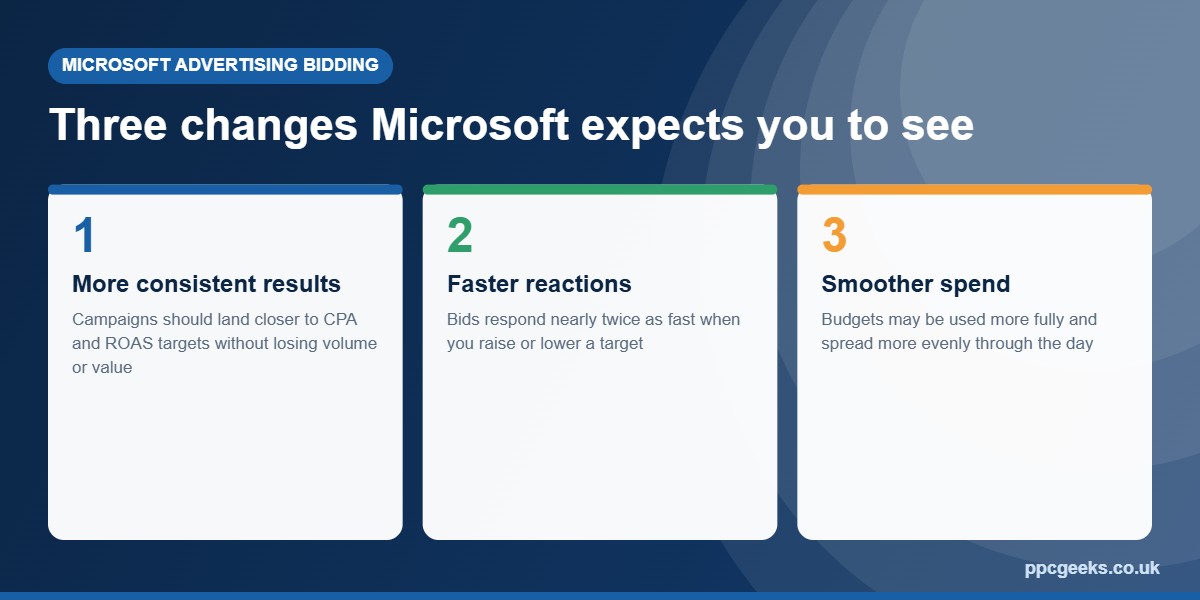
In practice, Microsoft lists three changes advertisers should expect:
- More consistent performance. Bids should meet CPA and ROAS targets more reliably, without giving up conversion volume or value.
- Faster optimisation. Bids adjust nearly twice as quickly when you raise or lower a CPA or ROAS target.
- More predictable delivery. Budgets pace more evenly through the day, and campaigns reach full budget faster.
One caution is worth repeating. Faster bidding does not shorten your customers’ buying cycle. If people usually take a week to convert, results from a target change will still lag by about a week, even if bids move quickly.
What Microsoft’s numbers do and do not tell you
Microsoft shared three headline figures, all from its own internal data:
- 10% more conversion value per click at a similar ROAS, for advertisers using Maximize Conversion Value or Target ROAS (global, Search and Audience Network, August 2026). This is the figure tied directly to the new models.
- 8% more conversion value at a similar ROAS for Search campaigns that switched from Target CPA to Target ROAS (August to September 2026).
- 18% more conversions at a similar cost per action for advertisers that moved from Enhanced CPC to Maximize Conversions with a CPA target (June to July 2026).
That said, these are averages, and Microsoft has not published sample sizes or ranges. Moreover, the 8% and 18% figures describe strategy switches rather than the new models alone. Treat them as a reason to test, not a forecast. Microsoft adds that the biggest gains come when advertisers send actual transaction values, such as purchase revenue.
Best practices for the new Microsoft Advertising bidding models
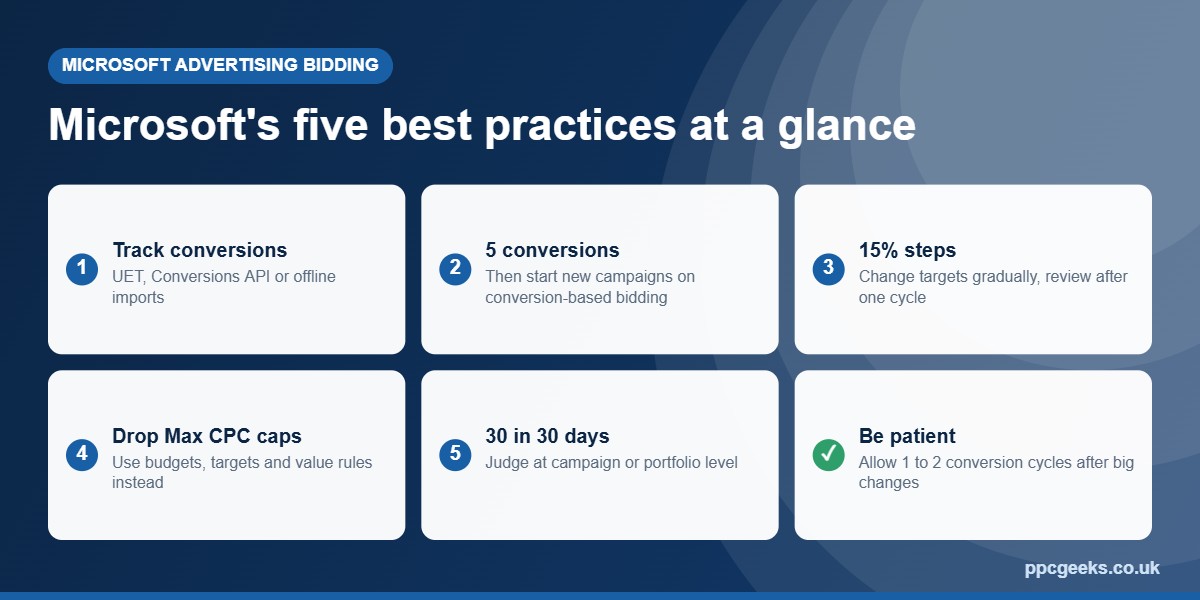
Alongside the upgrade, Microsoft set out five practices to help advertisers get the most from it:
- Set up healthy conversion tracking. Microsoft recommends Universal Event Tracking (UET), with the Conversions API and offline imports adding signals from CRMs, apps and stores.
- Choose the right bid strategy. If your account has at least five conversions, start new campaigns on a conversion-based strategy rather than Enhanced CPC, because account-level history feeds every campaign.
- Adjust targets gradually. New campaigns, strategy switches and changes to conversion goals cause the most volatility. To limit it, change targets in 15% steps and review after one conversion cycle.
- Use outcome-based controls. Microsoft does not recommend keeping a Maximum CPC on campaigns, because it conflicts with your CPA or ROAS target. Use budgets, bid targets and conversion value rules instead.
- Evaluate with enough data. Ideally, wait for 30 conversions in 30 days, allow one to two conversion cycles after major changes, and judge at campaign or portfolio level rather than keyword level.
PPC Geeks’ View
This is a meaningful update for anyone running Microsoft Ads alongside Google. Microsoft has often been the channel that gets copied over from Google and then left alone. So a rebuilt bidding model is a good reason to give it proper attention again, particularly if your audience is B2B or skews older, as many Microsoft searchers do.
However, the upgrade only helps if the data going in is sound. Many accounts we review still track a single form fill or purchase with a fixed value, so the system cannot tell a £50 order from a £5,000 one.
Better bidding is only as good as the conversions you feed it. Before you touch a target, check your tracking and make sure every conversion carries a realistic value.
— Chris S, Client Director, PPC Geeks
For lead generation, that means agreeing what a qualified lead is worth and sending updates from your CRM. Our guide to offline conversion imports explains how, and our Bing conversion tracking guide covers the UET basics.
What advertisers should do next
1. Check tracking before the Microsoft Advertising bidding changes reach you
First, confirm UET is firing on every key action and that conversion goals match what you actually care about. Remove duplicate or low-value goals that could mislead the new models.
2. Note the rollout date and watch pacing
Next, add an annotation in your reporting for mid-November. Then, if spend starts earlier in the day or budgets fill faster, you will know why.
3. Move targets in 15% steps
In short, avoid big jumps. Change a CPA or ROAS target by no more than about 15% at a time and wait one conversion cycle before the next change.
4. Review Max CPC caps
If campaigns on automated strategies still have a Maximum CPC set, test removing it on one campaign first and compare results over a full conversion cycle.
5. Move eligible campaigns off Enhanced CPC
If the account has at least five conversions, consider testing Maximize Conversions with a CPA target, or Maximize Conversion Value with a ROAS target if you send real values.
What the Microsoft Advertising bidding upgrade means for you
The Microsoft Advertising bidding upgrade should make automated strategies faster and more consistent, and it arrives without you needing to switch anything on. Even so, the advertisers who benefit most will be the ones with clean conversion data, realistic values and the patience to judge results over a full cycle.
If you are not sure whether your Microsoft Ads account is set up to take advantage, book a free PPC audit and we will check your tracking, bid strategies and targets. You can also find out more about our PPC management service.
For Microsoft’s own details, read Building the next generation of automated bidding at Microsoft Advertising.
Frequently asked questions
What is the Microsoft Advertising bidding upgrade?
It is a rebuild of the model that predicts whether a click will convert and what that conversion is worth. Microsoft announced it on 18 November 2026 and calls it its biggest bidding model upgrade in a decade.
Which bid strategies are affected?
The update applies to automated bidding, including Target CPA, Target ROAS, Maximize Conversions and Maximize Conversion Value. Enhanced CPC remains an option for new accounts with fewer than five conversions.
Do I need to do anything to get the upgrade?
No. It rolls out automatically to more accounts over time. However, checking your conversion tracking and targets will help you get more from it.
Should I remove Max CPC bid caps?
Microsoft does not recommend keeping a Maximum CPC on automated campaigns, because it conflicts with CPA or ROAS targets. Test removing caps on one campaign before rolling the change out widely.
How long should I wait to judge Microsoft Advertising bidding results?
Microsoft suggests waiting for around 30 conversions in 30 days, and one to two conversion cycles after any major change. Judge results at campaign or portfolio level, not by keyword.