







The budget pack is due on Friday. You've been asked for a 2027 PPC number, the finance director wants something they can defend to the rest of the board, and the account had a mixed year. One platform's conversions don't reconcile with the CRM, the last quarter was flattered by a sale event, and nobody in the room wants another slide of impressions.
The shift that gets budgets approved isn't a better media plan. It's presenting the spend as an investment decision: what goes in, what comes back, how quickly, and what happens if it doesn't. Answer those four questions on one page and the conversation moves on to the next item. Leave any of them vague and you'll spend the meeting defending click-through rate.
What Directors Check Before Approving Ad Spend
When a PPC budget reaches a board agenda, directors read it through five numbers. Everything else on the page is supporting material.
| Metric | Question the board asks | How to present it |
|---|---|---|
| Qualified leads | How many good enquiries did the spend produce? | Count leads that pass a qualification check, not raw form fills |
| Sales or revenue | What did the money bring in? | Tracked revenue from the CRM or till, matched to the spend period |
| Cost per sale | What does each sale cost us? | Media spend divided by sales, shown by month and by campaign |
| Payback period | How many months until the spend is recovered? | Cost per sale set against contribution margin, shown in months |
| Clicks and CTR | Are we buying attention? | Diagnostic only, kept in an appendix |
The two numbers that cause arguments
Raw form fills flatter a channel. A lead that never reaches a sales conversation has no value in the room, so tie lead counts to a qualification step: a booked call, a quote issued, a demo attended. If your sales team scores enquiries, use their definition, not the ad platform's.
Revenue is the second trap. Directors spot the difference between platform-attributed revenue and money that arrived, and once they distrust one number they distrust the page. Pull sales from the CRM or the till, match them to the same date range as the spend, and state the reconciliation method in a footnote. Where leads close weeks later, import offline conversions so the two sources tell the same story.
Rule of thumb: show cost per sale by month and by campaign, never as one blended average. A blended figure hides the campaign quietly losing money.
Payback is the number that usually decides the vote, because it's the one that speaks to cash. Set cost per sale against contribution margin and express the answer in months. A business with thin margins needs a faster payback than one selling high-value equipment, and the board knows which one they run.
Search is a mature line item now, not a gamble. The IAB UK Digital Adspend 2025 research reported that UK digital advertising reached £40.5 billion in 2025, a 10% year-on-year increase that significantly exceeded UK GDP growth of 1.4%, with search remaining the largest category at 44% of digital spend. PPC deserves the same governance as any other established cost line.
One test applies to every proposal: if a figure wouldn't change a decision, it doesn't belong on the first page of the business case.
Building a One-Page Business Case Finance Will Read
A single page gets read. A thirty-slide deck gets skimmed on the train and argued with in the meeting. The page below has seven blocks, arranged in the order a finance reader scans them.
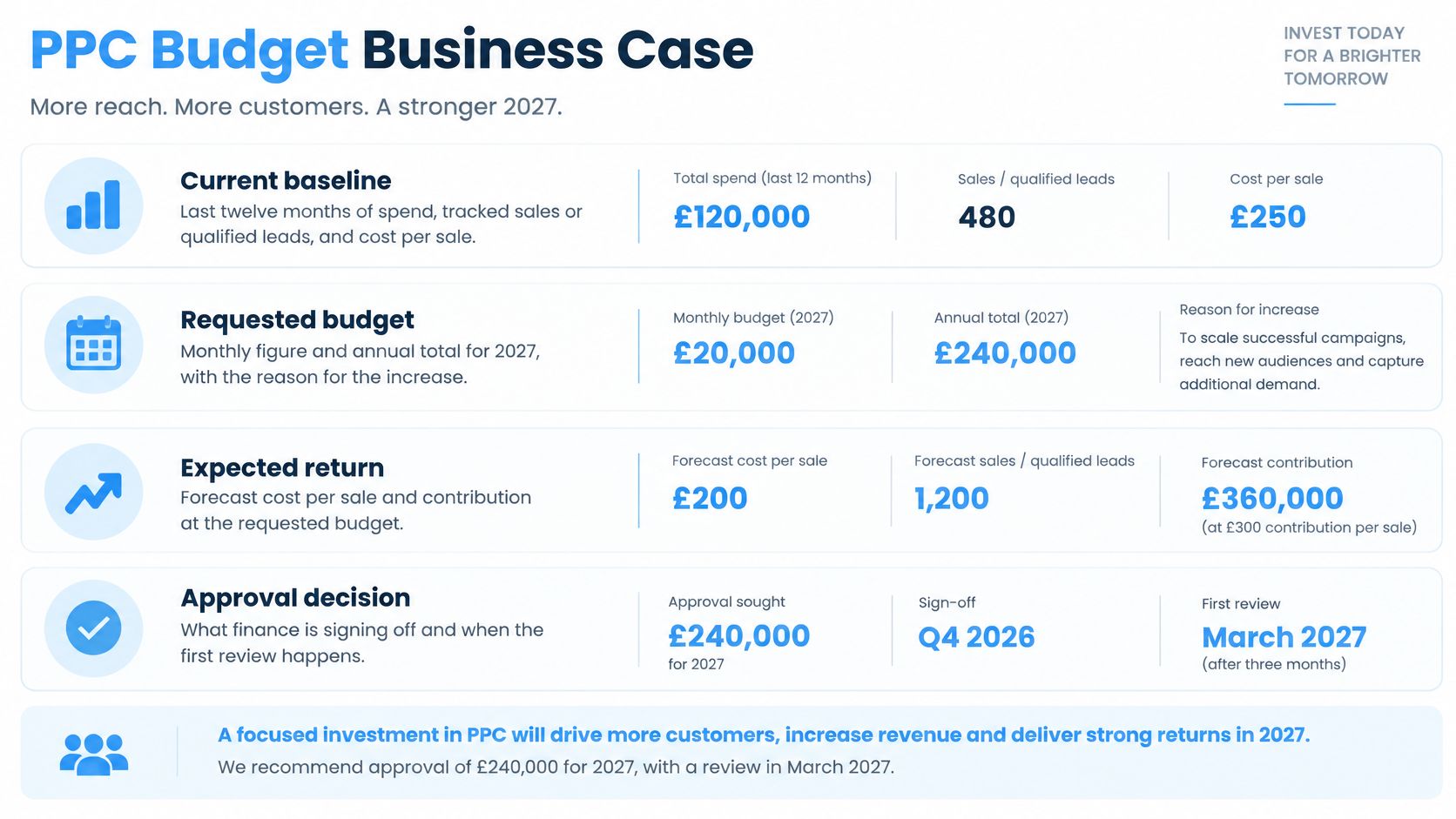
Seven blocks in the order finance reads them
- Current baseline. The last twelve months of spend, tracked sales or qualified leads, and cost per sale. Without this, the board can't tell whether you're asking for growth or repair, and those get different answers.
- Requested budget. The monthly figure and the annual total for 2027, with the reason for each part. If a component is a fixed commitment, say so; if it's scalable, say that too.
- Expected outcome against the baseline, given as a range. A single precise return figure invites one question you can't answer: what if it's 20% worse than that?
- Contribution margin and months to recover the spend. A PPC proposal becomes a finance document when it uses the language the rest of the business already understands: margin and payback.
- Spend being moved. Name the campaigns that will be paused or reduced and say where the released money goes. A budget request with no reallocation inside it reads as "more money for the same thing".
- Measurement risk. Show the gap between platform-reported conversions and verified CRM revenue, and state how you'll close it. Putting the gap on the page yourself is far better than having it found.
- Decision rule. The threshold that releases further budget and the level at which spend stops. Both in numbers, both agreed in advance.
Google's UK measurement guidance recommends agreeing the investment against an expected result before spending, committing additional budget only if an experiment reaches a pre-agreed return on ad spend. That's the structure finance wants: a defined outcome, measured against actual media spend, releasing more money only when the threshold is met.
The payback block is the one I'd spend the most time on. If your marketing ROI calculation uses platform revenue alone, the number will be challenged within minutes. Build it from contribution margin, not gross revenue, and you're arguing on ground the finance team already trusts.
What the page has to survive: three questions in sequence. What does the business get, when does it get it, and what happens if it doesn't arrive?
If you can't answer the third one, the proposal isn't finished. "We'll review it" isn't an answer. "We stop at £X cost per sale and move the money to the campaigns already hitting target" is.
Sizing the Minimum Test Budget and Timeframe
Every PPC proposal eventually meets one question: how much do you need to prove this works? Answered from a gut feeling, it stalls. Answered from the account's own numbers, it's a calculation anyone can check.

Start with how many conversions your bidding strategy needs before it can learn reliably. Your own account history will tell you, and so will the platform's guidance for the strategy you're running. Divide that requirement by a realistic conversion rate to get the clicks needed, then multiply by the expected cost per click. That gives the minimum monthly budget for the test to be readable at all.
The one-line version: minimum monthly budget = (conversions the strategy needs ÷ realistic conversion rate) × expected cost per click.
A worked example with placeholder inputs. Say the strategy needs 30 conversions to learn, the account converts 3% of clicks, and the expected cost per click is £2.00. Thirty divided by 0.03 gives 1,000 clicks. One thousand multiplied by £2.00 gives a minimum monthly budget of £2,000. Replace all three inputs with your own account history before that number goes anywhere near the proposal.
Then check it against margin. If £2,000 a month can't produce enough sales for the result to be distinguishable from noise, the test needs to be narrower, not shorter. Cut the number of campaigns under test rather than the length of the test.
Why short tests mislead
Ask for at least three months with a review date set in advance. A four-week window on a modest conversion volume swings wildly from one week to the next, and smart bidding spends the early part of that window learning rather than performing. Add a seasonal event into a single month and you've built a result that can't be repeated.
If the minimum budget is more than the business will commit, put that on the page: the figure needed, the figure offered, and what the smaller number will and won't prove. Finance teams respond well to a stated constraint. They distrust a plan that assumes more later.
Before you lock the cost-per-click assumption, sanity-check it against our guide to how much Google Ads costs in the UK, then write one line into the proposal: the monthly minimum, the review date, and the reason the window is three months.
The video below covers the same budgeting ground from a practitioner's angle.
Test-and-Scale Rules Agreed Before Spend Starts
Attributed results are what the platform credits to its own campaigns. Incremental results are what the advertising caused. The space between those two is where most budget approvals go wrong, because a campaign can report strong conversions while adding nothing the business wouldn't have won anyway.
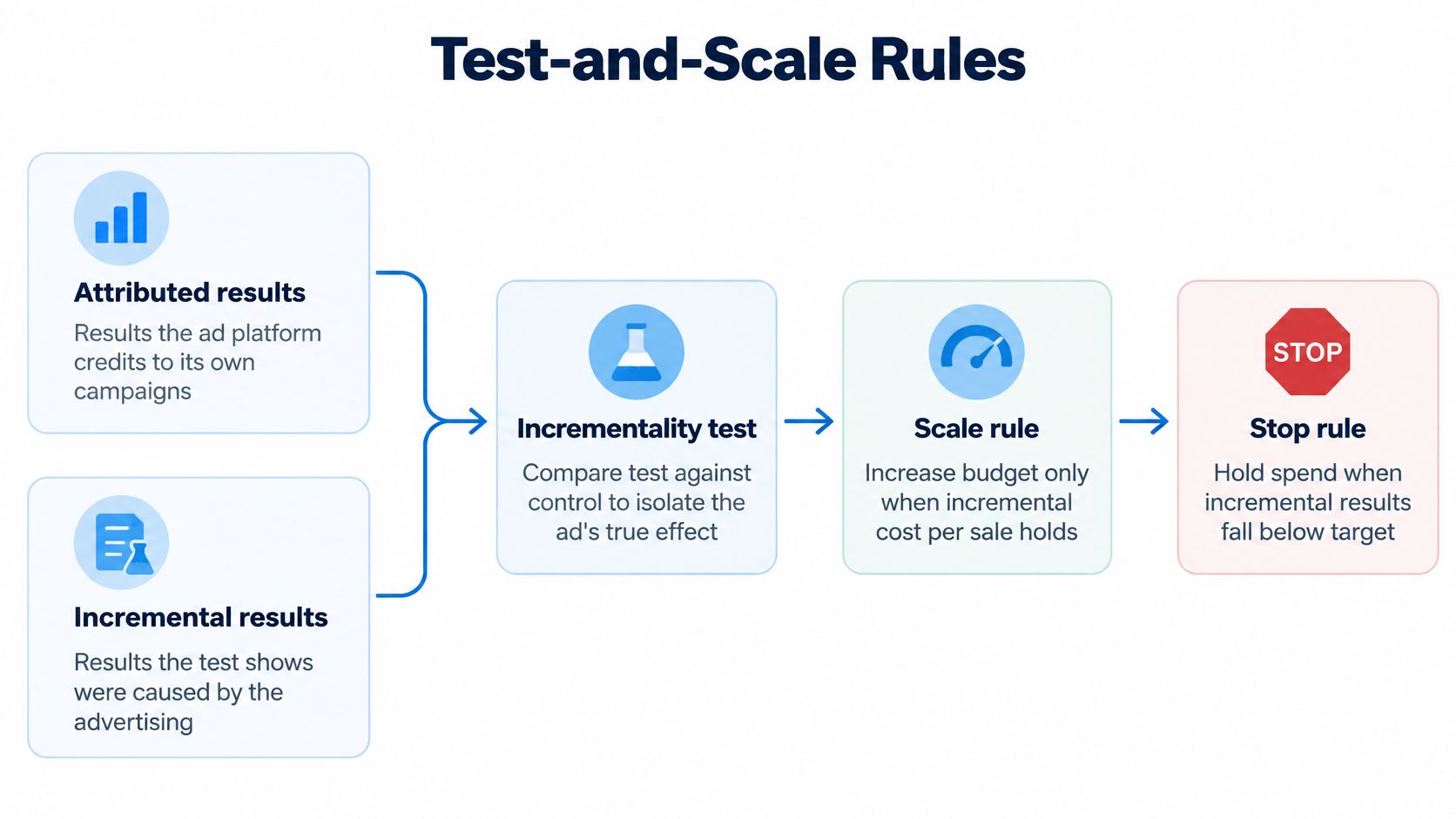
An incrementality test compares a treatment group exposed to advertising with a control group that isn't, using a matched comparison whose conditions stay consistent with the historical baseline. Incremental return on ad spend is the additional revenue the experiment identifies, divided by the media spend. For a UK advertiser that produces a defensible scaling mechanism, as Google's incrementality testing guidance sets out: document the test period, the audience or geographic split, the primary commercial KPI and the pass or fail threshold in advance, then increase budget only when measured lift and payback satisfy the agreed case.
In practice that means a holdout region, a held-back audience segment, or a paused campaign in a matched area, decided before launch. Not a retrofitted comparison pulled together when the result needs defending.
Decision gates for the test
| Condition at review | Action | Why it matters |
|---|---|---|
| Incremental return on ad spend above the agreed threshold | Scale the tested campaigns in agreed steps | Revenue was caused by ads, not just credited to them |
| Lead quality or margin below the agreed floor | Pause or reduce the affected campaigns | Volume alone can hide falling profit |
| Tracking discrepancy above the agreed tolerance | Hold budget and fix tracking before judging results | Decisions on broken data are unreliable |
| Results inside the expected noise range | Extend the test by one review cycle | There is not yet enough evidence either way |
| Marginal cost per acquisition clearly better in one campaign | Move budget from the weaker campaign to the stronger one | Reallocation follows cost per sale, not click volume |
Build the sample threshold before you start, using a proper sample size determination rather than a judgement call. Check statistical significance before treating any result as conclusive. A test that "looks good" on two weeks of data has usually just been lucky.
What the board is actually agreeing to: protect proven activity, ring-fence a defined test budget, and scale only when measured lift and payback meet the case they signed.
That's a far easier vote than "approve £X and see how it goes". The board keeps control, and you get a documented route to more money.
Past Results That Make the Case
A finance review needs evidence tied to the decision: how much was spent, what sales or leads resulted, and whether the return justified the cost. Use past results to show how you would judge the proposed budget, not to imply that another account's outcome will transfer directly.
| Metric to record | What to show |
|---|---|
| Spend | Total ad spend for the period |
| Wasted spend moved | Spend identified as unproductive and where it was reassigned |
| Revenue | Revenue attributed to the activity, with the measurement basis stated |
| Cost per sale | Ad spend divided by sales attributed to the activity |
| Leads | Enquiries generated, with commercially valuable leads separated where tracking allows |
| CTR, diagnostic only | Click-through rate as context, not as evidence of profitability |
Treat this as a hypothetical reporting template, not a client case study. Fill it with verified figures from your own account, and compare periods that make sense for your business. Keep the cost per sale and payback in the foreground. A higher click-through rate can help explain delivery, but it cannot show whether the budget paid back.
For each comparison, state what changed in the account and what happened to spend, sales and cost per sale. If spend fell while revenue held or rose, show both figures together. If revenue increased but cost per sale worsened, include that too. The trade-off matters more than a polished headline.
Do not present a result as proof that the same outcome will recur. Seasonality, category, margins and conversion tracking can all affect what the figures mean. Explain the limits of the comparison, especially if attribution is uncertain, and use a range where a single figure would imply more certainty than the measurement supports.
A credible case also records what did not work and what changed in response. That gives finance a clearer basis for judging the proposed spend: not clicks alone, but the cost of acquiring a sale, the likely payback, and the conditions under which further budget would make sense.
Answering the We Tried PPC Before Objection
The objection that stalls more PPC budget approvals than any other, usually from someone who lived through it:
"We tried PPC before and couldn't see what it returned."
That sentence isn't a rejection of paid search. It's a report on the measurement, and answering it with a more confident pitch misses the point.

Four fixes do the work.
- Cover every goal that matters. Conversion tracking that counts form submissions but ignores phone calls and quote requests will understate the channel by whatever share those produce.
- Import offline sales from the CRM where leads close days or weeks later, so the board sees the revenue PPC produced rather than the leads it generated.
- Separate three numbers. Platform-reported conversions, consent-adjusted conversions, and verified CRM revenue. They will differ, and showing all three builds credibility instead of inviting suspicion.
- Add a measurement-risk line to the business case, with a range rather than one precise return figure.
The consent point explains an uncomfortable reality. Google's guidance on user consent for ads states that UK advertisers using conversion tags for measurement must obtain valid user consent, which means campaigns can have less observable conversion data when users decline. Reported conversions fall even when the ads perform exactly as they did before. A lower reported rate can reflect lost measurement, not weaker advertising.
A modest conversion volume makes that swing more visible week to week, so don't let a single quiet week reset the plan. Point the board back to the review date instead.
At the next monthly report they should see spend, revenue, cost per sale and qualified leads, plus a short note on what changed in tracking since the last attempt. Not CTR.
Agree the Budget and Reporting Rhythm Before Q1 Spend
Everything above is worth nothing without a written decision. Five actions, one meeting.
- Get the decision gates approved in writing before any spend starts. The threshold that releases budget and the level that stops it, both signed off.
- Put the review date in the diary and name the person presenting. A date with no owner moves.
- Start a monthly report in the board's terms. Spend, revenue, cost per sale, qualified leads, money moved and progress against each gate. Our guide to analysing a PPC report covers what belongs in front of a director and what stays in the account.
- Hold a quarterly review where the result is compared against the agreed threshold, and the budget scales, holds or stops according to the gate that applies.
- Get an outside check on the baseline if your team is stretched. A PPC Geeks Google Ads audit and strategy review is a free, human review that covers account structure, conversion tracking, target audiences, the highest spending areas, a main KPIs overview, where you're wasting budget and the opportunities you're missing. It gives the proposal an independent foundation.
The audit matters most in the week before submission. Most accounts we audit are leaking 20-40% of budget through poor targeting, weak conversion tracking and misused automation, and a leak the board already knows about is cheaper to fix than one they discover in April.
Agree three things and the year runs itself: the monthly budget, the review date, and the threshold that releases more money.
If you've reached the point where the numbers need to be right before they reach a board paper, PPC Geeks can help. We manage over £1.5 million in ad spend every month across Google, Bing, Amazon and social, and we build reporting around cost per sale, revenue and payback rather than click charts. Book a free PPC audit with one of our specialists and you'll get a straight read on where your budget is going, plus a clear view of what a 2027 plan could realistically deliver. Visit PPC Geeks to start.