







You've got the sale calendar open, a margin spreadsheet beside it, and someone in finance asking for one number for Black Friday. The inbox has three supplier offers, the merchant wants to know whether to buy more stock, and the agency or the freelancer or you is expected to have the plan ready before the November rush.
Every year the same thing happens in UK ecommerce accounts. Someone takes the October daily budget, doubles it for the last week of November, sets it live on the morning of Black Friday and hopes the ROAS holds. By early afternoon the Shopping campaigns have hit their caps, Performance Max is bidding against the same search terms as the brand campaign, and a cheap accessory line has eaten the budget the high-margin products needed.
Black Friday falls on 27 November 2026 and Cyber Monday on 30 November 2026. That's a four-day window with a demand curve that is anything but flat, and treating it as one daily figure repeated four times is where most of the money goes wrong. The demand is real: the ONS retail sales bulletin puts UK online sales values up 8.3% year on year in November 2025, and 6.7% across the three months to November. Whether you can buy that demand profitably is the question worth answering in October, and it's the one this plan answers.
Raise Budgets Before Peak Without Losing Margin
Start with the ceiling. A percentage increase chosen because it feels suitably aggressive is a guess, and the sale weekend is an expensive place to test a guess. The maximum you can spend is already sitting in your own figures, and four steps pull it out.
- Pull last year's peak-week revenue from your own records. Total revenue, order count and average order value for the sale days, taken from your store and your Google Ads account rather than from a forecast or a sector report. Add the week before as a control you'll compare against later.
- Work out contribution per order. Take average order value and subtract cost of goods, payment fees, delivery, expected returns, and the discount depth you ran. What's left is contribution.
- Convert contribution into a break-even ROAS. If £30 of a £100 order survives those costs, break-even sits at 3.33, so the target goes a little above it. Run the same sum per product tier if your range is wide, because a single blended figure hides the lines that lose money.
- Divide peak-week revenue by the target ROAS. A sale week that turned over £40,000 at a target ROAS of 4 supports a spend ceiling of £10,000. That's the whole budget for the window, run-up included, not a daily figure.
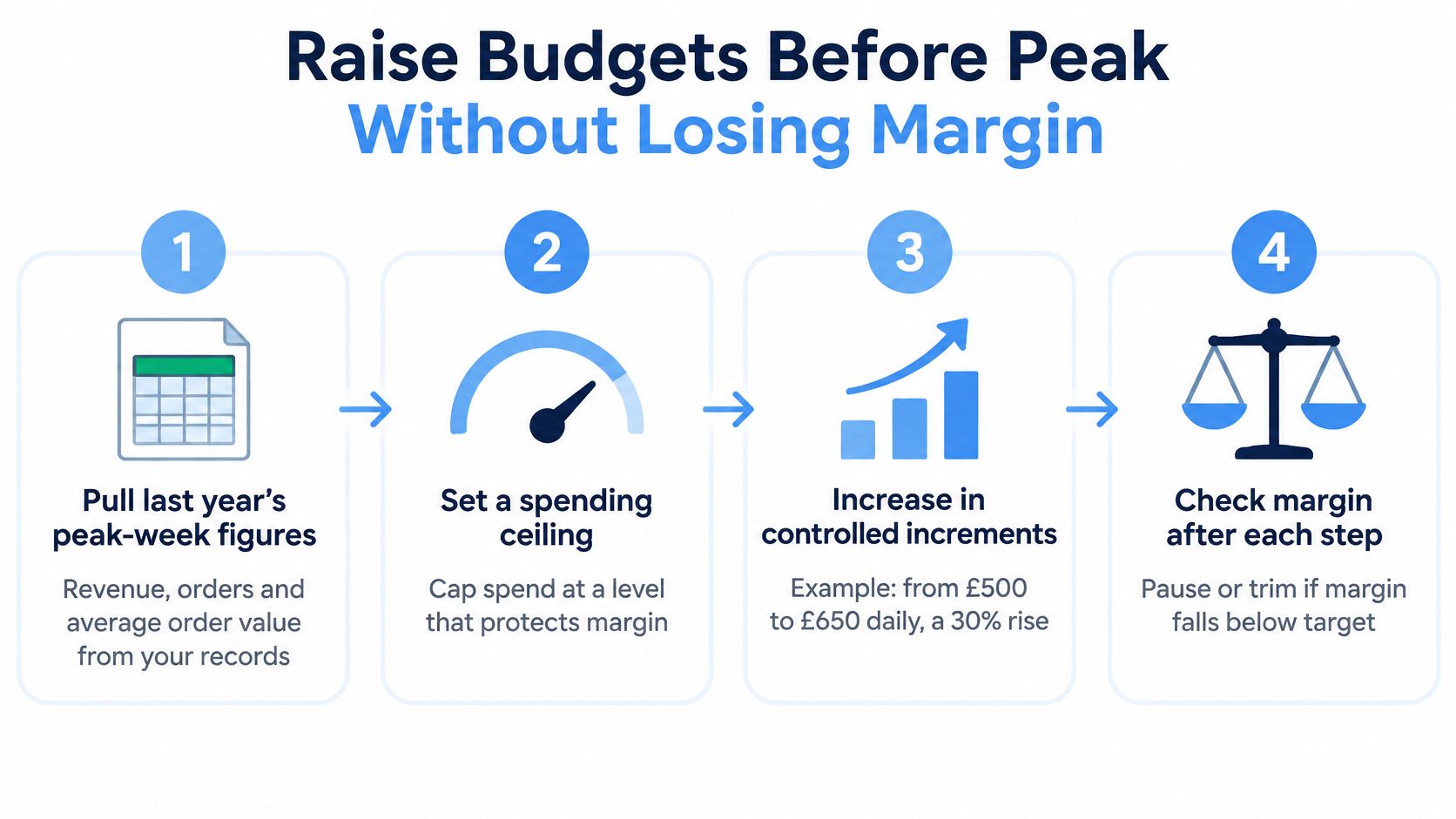
The ceiling then gets spent in stages. Budgets rise through the run-up so that Shopping and Performance Max have collected conversion data before the named days, with the last and largest step landing a few days before 27 November. Going into the sale on a budget you only lifted on the Friday means bidding without history in the week history matters most.
Two settings decide whether the ceiling holds. The first is conversion value. If your tracking sends basket totals to value-based bidding, a discount-heavy weekend tells Smart Bidding that every cheap order is a good order. Send contribution instead, net of returns and financing, so bidding optimises for orders worth having rather than orders that merely exist.
Payment method changes the net value of an order. Adobe's UK holiday forecast puts Black Friday buy-now-pay-later spending at £132.1 million, up 12.7% year on year (Adobe holiday shopping forecast). BNPL orders carry fees, later cash collection and often a different return rate, so a £200 financed basket can be worth less than a £170 card one. Segment reporting by payment method where your tracking allows it, and reflect it in the values you bid to.
How you express that in the account is a Google Ads smart bidding decision. A target ROAS built on contribution, held in a portfolio strategy where campaigns share a margin rule, beats one account-level target that treats a sofa and a cushion as equals.
The three numbers that matter: one target ROAS, one total spend ceiling and one daily budget for each run-up week. If you can't state those in a sentence, you don't have a budget yet.
Split the Budget Across the Sale Window
The flat-budget mistake is easy to make and hard to see until the invoices arrive. One daily figure applied from 26 November to 1 December spreads money evenly across days that carry very unequal demand, and it usually over-funds the quiet days while starving the last one.
UK figures show the shape. Online consumer spending across the Black Friday to Cyber Monday period reached £3.63 billion between 29 November and 2 December 2024, up 5.2% year on year, with Black Friday at £1.12 billion and Cyber Monday at £926 million. Together the two named days carried about £2.05 billion, or 56.5% of the four-day total (Reuters, reporting Adobe Analytics figures).
Use those shares to sanity-check your split, then replace them with your own daily revenue from last year's peak weeks. A gifting range with a hard delivery cut-off pulls demand forward into the Friday. Big-ticket products on finance often land more heavily on the Monday, once people have had a weekend to think.
| Phase | Dates in 2026 | Budget weighting | Bidding action |
|---|---|---|---|
| Run-up | 2 to 26 November | Build daily budgets gradually from the normal peak baseline | Hold targets and add headroom |
| Black Friday | 27 November | Largest single daily tranche, about 31% of 2024 four-day online sales | Protect bids and watch for midday caps |
| Weekend | 28 to 29 November | Set from your own weekend share in last year's data, below Friday | Review hourly and cut only on profit signals |
| Cyber Monday | 30 November | Ring-fenced tranche, about 26% of 2024 four-day online sales | Keep the tranche for the day and don't spend it on Friday |
| Wind-down | 1 December onwards | Taper back to baseline over two or three days | Keep remarketing and brand campaigns active |
Every weighting above is a share of the ceiling from the previous section, not a share of last year's daily budget. The tranche that earns its ring-fence is Cyber Monday. Treat it as unavailable on Friday and on Saturday, because dipping into it to rescue a soft afternoon is exactly how the final day of the window ends up underfunded while competitors are still bidding.
Rebuild those weightings from your own account data and write one daily budget per phase in a sheet before 2 November. A plan that lives in a dashboard gets edited in a hurry on the day.
Cut Low-Margin Lines Before They Take Budget
Say a furniture retailer builds its plan around a mid-margin sofa range, then watches a low-margin accessory line absorb the budget across the weekend. The accessories convert easily, they're cheap, and automated bidding follows conversion volume. Monday arrives with a healthy ROAS, plenty of orders and a contribution figure that doesn't cover the spend.
Bidding has no view on margin unless you give it one. A line that converts four times as often as a high-margin one keeps winning budget, and a discount-heavy weekend makes the skew worse. Higher sales value does not mean stronger commercial performance: UK online spending across Black Friday to Cyber Monday reached £3.8 billion in 2025, up 4.6% year on year, with an average discount of 16.7%, and platform data reported conversions up 16.2% while average order value rose just 0.6% (Reuters on the 2025 UK Black Friday weekend). More orders at broadly the same basket value, bought at a deeper discount, can leave you with less.
The fix is structural and it happens in October.
- Tier by contribution. High, medium and low, calculated after discount, fees and expected returns rather than before them.
- Label the tiers in the feed. Custom labels for premium, finance-eligible, high-margin and clearance stock make the tiers visible in Shopping and Performance Max without rebuilding campaigns.
- Split where the rules differ. Separate campaigns or asset groups per tier, so one target ROAS isn't averaging a 45% margin line with an 8% one.
- Cap or exclude the low tier during peak. A tighter budget, a reduced target or exclusion from the sale days, decided before the weekend rather than in the middle of it.
Finding those tiers is a reporting job before it's a bidding job, which is where a proper look at your best and worst performing products pays for itself.
Run each product group through four questions before it keeps peak budget: what margin survives the discount, how deep the stock runs, how likely a return is, and whether it deserves any of the weekend at all. An accessory with 6% contribution and a 20% return rate fails all four.
Seasonality Adjustments and Midday Budget Caps
A daily budget cap is a hard stop. When it's reached at 11am while purchase intent is still climbing, campaigns stop serving for the rest of the day, and in Shopping and Performance Max that means losing coverage in the evening peak when conversion value is densest. The cost isn't the spend you saved. It's the spend you didn't get to make at the best hour.
The forecast size matters less than the shape. Adobe projects £3.8 billion of UK online spending across Black Friday to Cyber Monday, 14.2% of total November to December online revenue, with Black Friday at £1.19 billion and Cyber Monday at £963.6 million (Adobe Digital Insights UK holiday forecast). Those are projections, not benchmarks for your account. What they establish is concentration: the money sits in a short window, so a cap hit at midday costs more than the same cap hit in a normal week.
What a seasonality adjustment does and doesn't fix
A seasonality adjustment tells Smart Bidding that conversion rates will be higher for a defined period. Set the start and end times when you create it, scope it to the sale window, and confirm on 1 December that nothing is still applying. An adjustment stretched across the whole month tells bidding to expect sale-day conversion rates on days that won't deliver them, and one left running into December keeps bidding as though the sale were still live.
It changes bids in auctions you're already eligible for. It won't rescue a target ROAS so tight that the campaign is missing the auction altogether, which needs the target lowered instead.
| Symptom | Likely cause | Fix |
|---|---|---|
| Budget limited before midday | Daily cap spent on early traffic | Raise the cap in the tranche for that day, set from the phase weighting |
| Impression share lost in the evening | Bids too low for higher evening intent | Apply a seasonality adjustment for the sale window |
| Smart bidding slow to react on 27 November | Model trained on normal weeks | Schedule the seasonality adjustment with the sale start and end times |
| Cost per click rising faster than sales | Competitor bids and broad match spreading spend | Tighten match types and protect branded and best-selling campaigns |
| Spend running on a sold-out product | Feed not updated | Exclude the product and check stock and feed status hourly |
Check the cap before the bid. A campaign that has run out of budget responds to nothing, and raising a target into a spent budget only changes what you paid for the morning.
For the wider mechanics of seasonal demand, seasonal PPC strategies covers how to phase offers and messaging around a short event. The practical action here is smaller: schedule the adjustment for both the Black Friday and Cyber Monday windows, then set a cap alert for mid-morning on each sale day so the first warning arrives before the budget is gone.
Monitor the Weekend Hour by Hour
Write the check-in times before the weekend starts, because ad hoc checking on a sale day turns into reacting to the last number you happened to see. Four fixed checks work: late morning, early afternoon, late afternoon and early evening. The evening check carries the most weight, since that's where the peak sits and where a bad morning decision gets paid for.
Each check compares three things. Spend against the hour-by-hour plan for that day, conversion volume and value so far, and cost per click against the same weekday the week before. That week-before comparison is what separates a genuine uplift from a busy-looking dashboard, and it's the only fair read on whether the sale is going well.
| Signal | Action | When to check |
|---|---|---|
| Budget-limited before midday and ROAS above target | Raise the daily budget in small, logged steps | Late morning, after the midday cap check |
| ROAS below the profit floor | Reduce or pause low-margin campaigns | Once each day's conversions have had time to arrive |
| Same-day ROAS low, conversions still arriving | Hold budget and judge against a multi-day view | End of each day |
Two rules keep the changes honest. Move in small steps, because a doubling is a new strategy rather than an adjustment. And read a full hour before the next change, since anything faster is reacting to noise from an auction that hasn't finished settling.
Stock gets the same attention as bids. A sold-out line still being advertised spends money you can't fulfil and sends shoppers to a page that disappoints them, so price and availability in the feed are part of the hourly check, not a job for Monday.
The habit that makes Monday's review possible is a shared log. Every budget change gets a line: the time, the reason, the ROAS at the moment of the change. Without it, the post-weekend conversation becomes a memory test, and deliberate decisions get confused with panic.
Wind Down After Cyber Monday Without Losing Remarketing
The taper starts on 1 December and it's a slope, not a switch. Killing everything the morning after Cyber Monday ends campaigns that still catch late buyers, returning shoppers and the people who bookmarked a product on Friday and came back with a card on Tuesday.
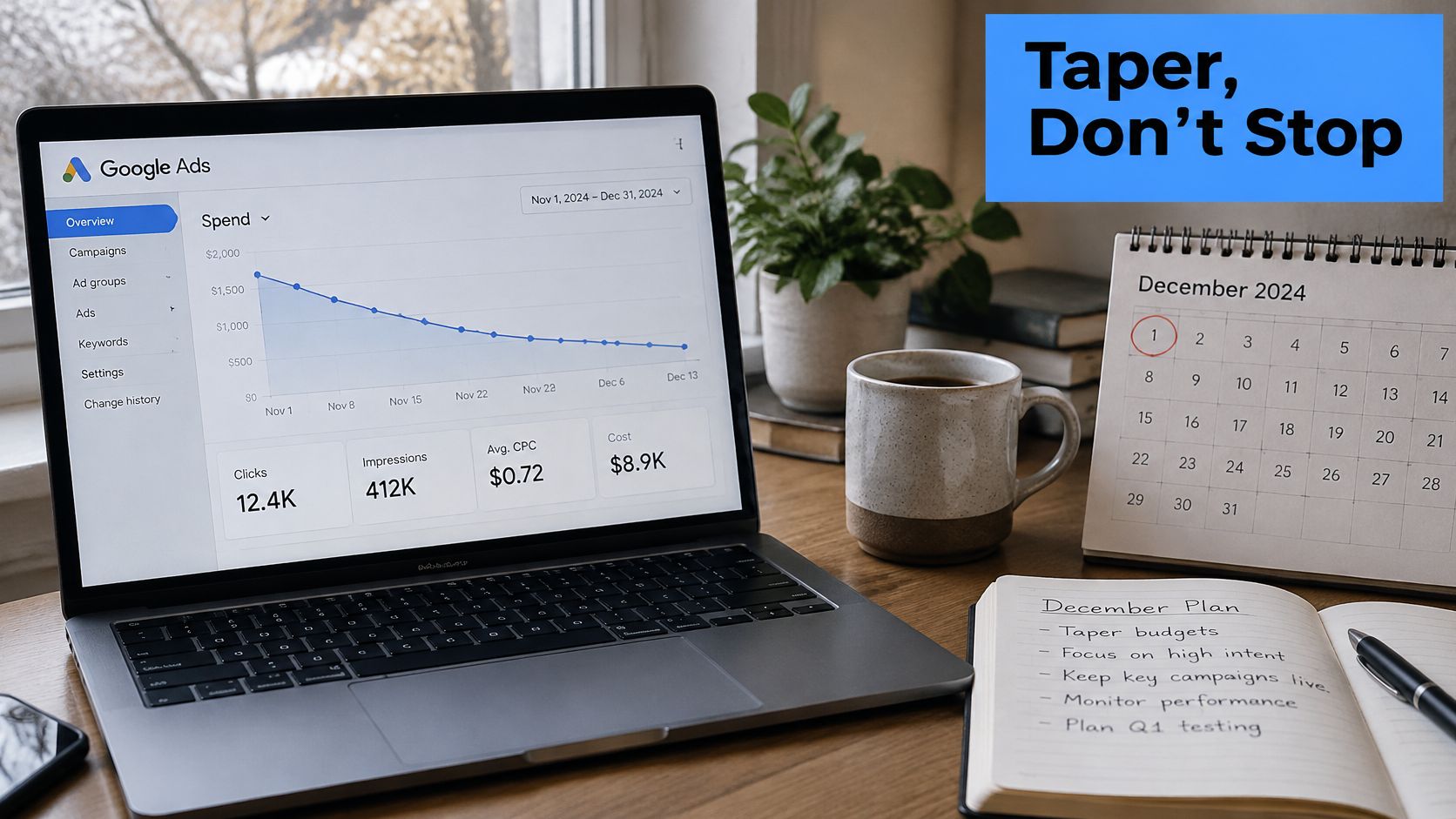
Work through it in order.
- Bring daily budgets down over two or three days. Step them back towards the normal baseline rather than cutting in a single move, and watch cost per click on the way down.
- Keep brand and best-seller campaigns running. Cyber Monday showed a strong pull of late buyers, and those campaigns are cheap to hold.
- Keep remarketing live for the lag period. Sale visitors who didn't convert are the warmest audience you'll have until next November. Set a date to remove sale-only assets, countdowns and discount messaging, so the ads stop promising an offer that has ended.
- Report spend by phase with ROAS against target. A phase-by-phase table shows which tranche earned its money far more clearly than an account total.
- Note which products carried the weekend and which ceilings were wrong. Too tight shows up as lost impression share. Too loose shows up as spend on a day that didn't deserve it.
The remarketing list is the asset most often thrown away in the rush to switch off. Fresh ideas for remarketing ads that still convert after a sale are worth having ready before December, when the audience is large and the offers have changed.
The taper is a slope, not a switch. Two or three days of declining budgets costs far less than a week of automated bidding chasing demand that has already gone.
Everything above feeds the next peak. Write a one-page post-event sheet: spend by phase, ROAS against the target you set, and three changes for next year. That sheet is what turns 2027's ceiling into a calculated figure rather than a repeat of this year's guess.
Confirm the Plan Before 27 November
Dates do the work now. Three sign-offs turn the plan from a document into something that runs without you watching it every hour.
By 2 November, the ceiling, target ROAS and phase tranches, built from last year's peak-week revenue and margin, are agreed with whoever owns the numbers. The daily budget sheet is locked, and everyone who might be tempted to change it knows where it lives.
By 20 November, low-margin exclusions and feed labels are live, and seasonality adjustments are scheduled with the Black Friday and Cyber Monday start and end times already in them. Leave feed changes any later and you'll be correcting them during the sale.
By 26 November, mid-morning cap alerts, the shared monitoring log and the taper dates are in the calendar. Then test the alerts so you know they fire, rather than finding out at 2pm on the Friday that nobody received one.
There's one optional check worth taking before the rush. A free Google Ads audit looks for the issues where automation, attribution or campaign structure make performance look cleaner than it is, and it surfaces wasted spend, tracking and attribution gaps and quick wins while there's still time to act on them. That's what the Google Ads audit and strategy service is for, and October is the month to use it.
The decision to make now is narrower than the whole plan. Confirm the ceiling, confirm the tranche split across the run-up, Black Friday, the weekend and Cyber Monday, then lock the budgets before the run-up begins.
If your account needs to be ready before the run-up starts, PPC Geeks runs a free Google Ads audit that finds wasted spend, fixes tracking and attribution gaps, and flags the quick wins worth taking into the sale window. Our team manages over £1.5 million in Google Ads spend every month for UK businesses, so margin-led targets, seasonality adjustments and phase-by-phase budget caps are everyday work rather than a once-a-year experiment. Visit PPC Geeks to book that audit and have the ceiling and tranche split checked before 27 November.