




You're checking Google Ads on the last morning of the month and conversions look unusually strong. Revenue is up, impression share is dropping because budgets are capping, and the obvious move seems to be adding money before the day escapes you. For UK ecommerce and consumer businesses spending £5,000 or more a month, that instinct is sometimes right and sometimes expensive.
Payday can change buying capacity. It doesn't automatically make every click more profitable, fix weak product margins or justify higher bids on broad prospecting. I'd treat your Google Ads budget around payday as an allocation test. Find whether payday-relative days produce better conversion rate, value per click and profit, reserve money for those days only where the pattern repeats, and remove waste before you give any campaign more to spend.
Payday Windows and the Budget Action for Each
| Window | What the UK evidence suggests | Budget action | Measure before changing spend |
|---|---|---|---|
| Days -3 to +1 around month-end payday | Offer-driven purchases and spend rise around payday dates | Reserve flexible budget for high-intent campaigns | Conversion rate and value per click against the same days last month |
| Days +2 to +3 after payday | Spend concentrates in the first 72 hours | Test a capped uplift on profitable campaigns only | Impression share lost to budget and marginal CPA |
| Mid-month weeks | Ordinary demand | Hold the flat allocation | Baseline for matched-window comparison |
| Final week before payday | Financial stress is common and some users delay or switch to cheaper options | Protect prospecting and remarketing, avoid bidding up low-margin products | Checkout drop-off and assisted conversions |
| Early to late November, before 27 November 2026 | Sales build through the month | Pace budget up gradually | Daily conversion trend against the previous November |
| 27 November 2026 (Black Friday) and 30 November 2026 (Cyber Monday) | Promotional peak in the same week as payday | Spend reserved budget on the strongest observed days | Profit per day, not revenue |
| Early December | Some employers pay December salaries early | Verify the shift in your own data before moving budget | Conversion rate by day of month |
| January | Longer gap before the next payday for many households | Daily caps and weekly reviews | Impression share, conversion value and margin |
The clearest UK benchmark is modest, not dramatic. Reporting by City A.M. on Valuedynamx purchase data found that around proxy payday dates, completed purchases made through offers were 5% above the same-weekday baseline and total spending from those purchases was 7% higher. The pattern appeared monthly, rather than being limited to major retail events such as Black Friday or Christmas.
That doesn't mean you should raise every budget by the same amount. Discretionary products such as clothing, meals, leisure and household purchases may respond differently from planned replacements or business purchases. Auction competition can also rise exactly when buyers become more willing to convert, so extra revenue doesn't guarantee extra profit.
How to Use the Windows
Start with 12 months of conversion rate and order value by day of month. Mark your customers' likely payday window, then compare it with mid-month days that fall on the same weekdays. If value per click rises and campaigns lose impression share to budget, you've got a reason to test reallocation.
Before payday, I wouldn't assume lower immediate revenue means activity has failed. Shoppers can research, build baskets and return once they've been paid, so assisted conversions and checkout behaviour matter. During the first few days after payday, protect high-intent Shopping, brand search and remarketing first. Low-margin products and loose prospecting should earn extra budget separately, not inherit it because the calendar changed.
Use a PPC budget calculator to sense-check the reserved amount against your normal daily allocation before you change the account. The table is a set of hypotheses, not a permanent schedule. Keep the windows that improve profit in your own account and drop the ones that only produce busier reporting.
Telling a Genuine Payday Spike from Noise
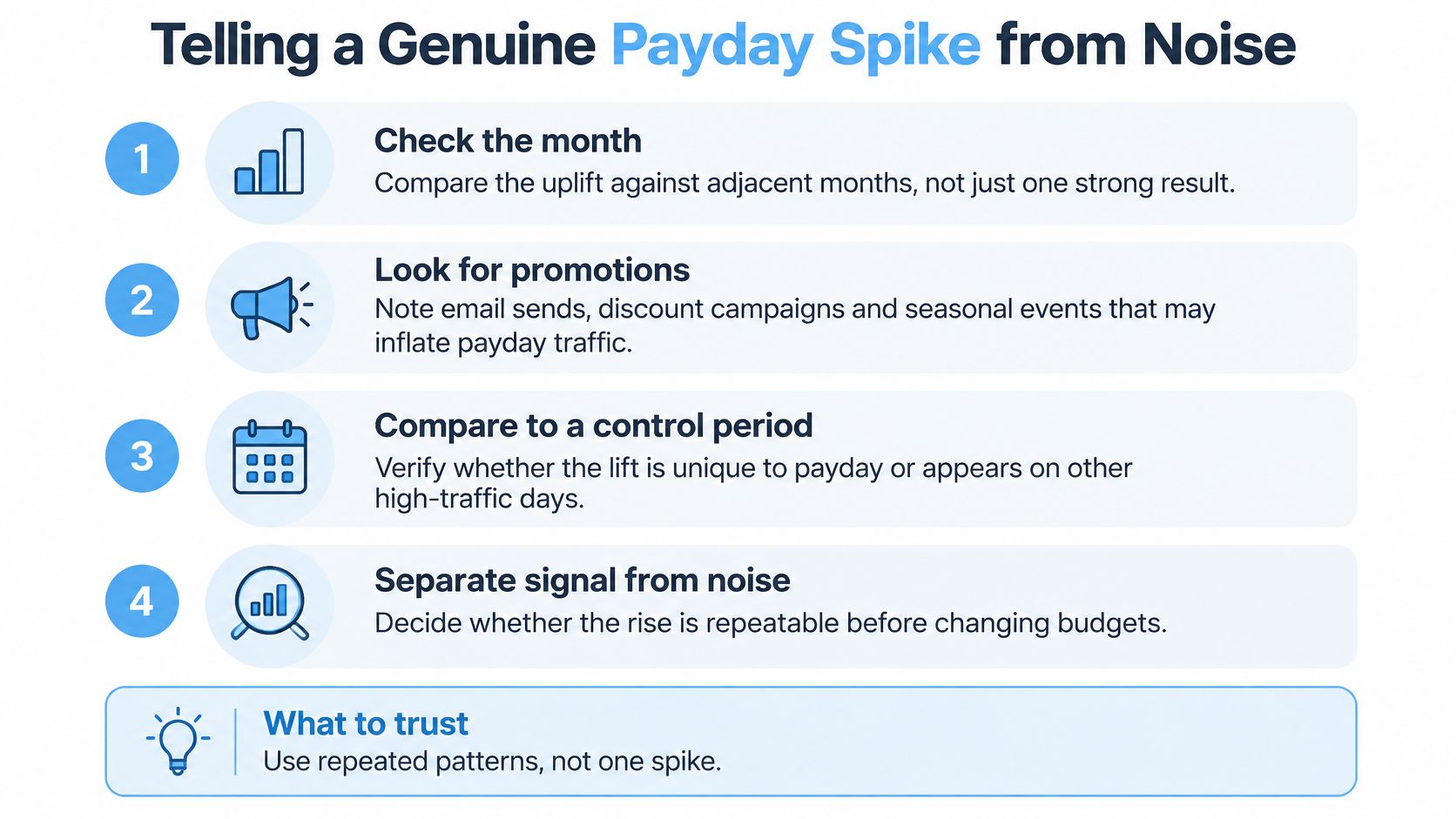
One strong month is the easiest trap. A discount, a large email send, payday falling on a favourable weekday, poor weather or a seasonal event can all create a lift that looks like a payday effect. If you scale from that month alone, you may fund the next ordinary week at peak prices.
UK activity data reported by A1 Retail Magazine found that on previous paydays, mobile traffic to food-delivery apps rose 9%, banking and payment-app activity rose nearly 6%, and shopping activity rose 2% versus average weekdays. Those differences show why category matters. A food business and a considered home purchase shouldn't expect identical behaviour, timing or conversion lag.
The Genuine Spike Checklist
- It repeats across months: The lift appears after payday in at least three months within a rolling dataset, not only during a promotion.
- It uses matched weekdays: Compare payday windows with ordinary weeks containing the same weekdays, because Saturday behaviour shouldn't be judged against Tuesday behaviour.
- It survives margin: Revenue, refunds, product costs and delivery costs still leave incremental profit.
- It allows for lag: Consideration-led purchases get enough attribution time before you declare the window ineffective.
- It shows constrained demand: Value per click rises while impression share is lost to budget, and marginal CPA stays acceptable.
Say conversion rate rises while CPC rises too. Don't stop at ROAS. Calculate the value created by each additional click, apply gross margin, then ask whether the extra conversions are worth their marginal cost. A campaign can look more efficient on blended CPA while the last portion of spend, the portion your increase buys, loses money.
Use repeated patterns, not one spike.
Where the data is borderline, a statistical significance calculation helps you avoid treating normal variation as a decision-grade result. If the payday test fails, keep the budget where it is and inspect account waste first. More money in a wasteful account usually buys more of the same poor clicks, only faster.
Ad Schedules and Pacing Rules That Protect Monthly Spend
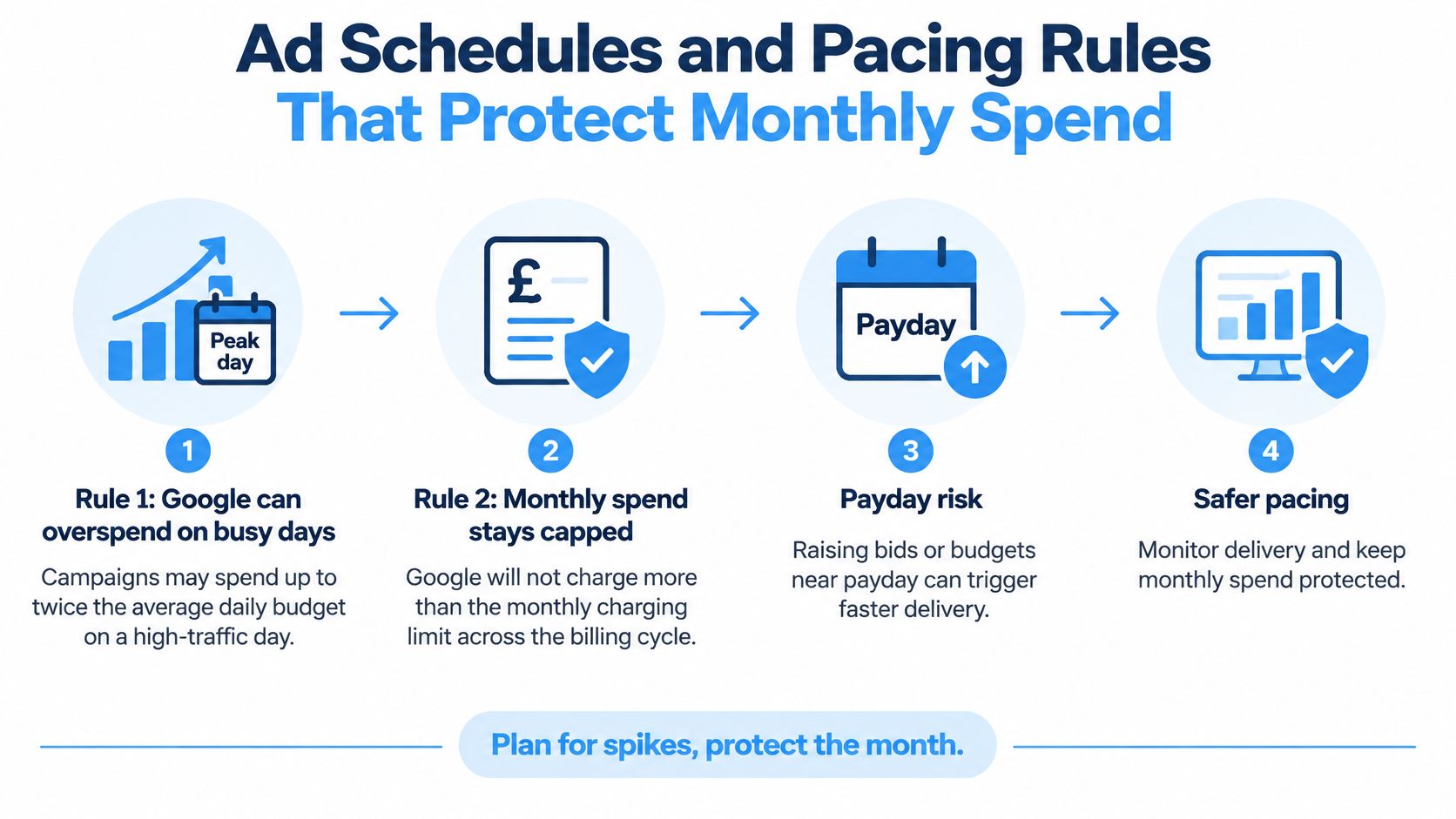
Google delivery mechanics make casual payday increases risky. Guidance from Google Business on Google Ads costs states that campaigns may spend up to twice the average daily budget on a high-traffic day, while monthly billed spend is constrained by a monthly spending limit calculated from the average daily budget multiplied by approximately 30.4 days. Raising a budget just before month-end can therefore buy useful auction access, but it can also pull planned monthly spend forward.
| Average daily budget | Possible spend on a high-traffic day |
|---|---|
| £200 | up to £400 |
| £500 | up to £1,000 |
| £1,000 | up to £2,000 |
The monthly ceiling matters when a strong opening day tempts you to keep increasing budgets. You haven't created new monthly money. You've changed how quickly Google can use it.
Six Pacing Steps
- Build the day-of-month view. Pull 12 months of conversion rate, average order value, value per click and impression share. This shows whether payday strength sits in one campaign or across the account.
- Mark payday and control windows. Use payday-relative days and ordinary weeks with equivalent weekdays. Without a control, you can't separate payday from normal weekly demand.
- Reserve money deliberately. Set aside a defined share of monthly budget for the window instead of raising every daily budget. I'd keep that reserve unavailable to weaker campaigns.
- Apply an eligibility check. Raise budgets or use a seasonality adjustment only where campaigns pass your margin or target CPA threshold. Broad, low-margin campaigns are the common slip because they can spend almost any increase.
- Check pacing daily. Track spend against the amount intended for the full month, not just the payday window. The failure mode is reaching the practical ceiling by day 20 and missing later demand.
- Judge against the prior month. Compare ROAS and profit with the same relative days last month and with the rest of the current month. Keep the change only if the payday window beats both.
Ad schedules need the same discipline. Set day-of-week or hour-of-day adjustments only where the 12-month data shows a repeatable lift at those times. Cap the adjustment within the measured effect, because a small conversion-rate advantage doesn't support an aggressive bid increase. For a wider view of bid controls, see this guide to Google Ads bid management.
During the first three days after payday, pacing should look controlled rather than frantic. High-intent campaigns receive the reserve, daily spend stays within the pre-set window allocation, and you review marginal CPA before releasing more. Don't cut budgets the moment the window ends if conversions normally arrive late. Wait for attribution lag, then reduce spend based on completed profit data.
Practical rule: Reserve budget for proven payday demand. Don't borrow it blindly from the rest of the month.
Late November Payday and the Black Friday Overlap
The 2026 calendar creates the year's most difficult pacing problem. According to LBC's Black Friday 2026 date guide, Black Friday falls on Friday 27 November 2026, with Cyber Monday following on Monday 30 November. The late-November payday lands in the same period, so newly paid customers meet the main promotional weekend together.
Keep the key November dates visible while you check budgets, stock and promotions.

UK Black Friday activity isn't confined to one Friday. A Radio Times guide to when Black Friday sales start describes the UK sales window as extending throughout November, with major retailers commonly launching offers before the day itself. That makes early prospecting and list building commercially useful even when immediate conversion rates look softer.
Preparation Before the Final Week
- Check the operational basics. Confirm daily budget limits, promotion eligibility, stock availability, Merchant Center status and conversion tracking before the final week of November.
- Change settings early. Make material bid and budget changes soon enough for delivery to adapt. A last-minute rebuild during peak competition is rarely a clean test.
- Protect early coverage. Keep prospecting and brand search visible before 27 November so you don't lose early-sale demand while waiting for the headline day.
- Reserve by evidence. Split last November into early sale, Black Friday weekend and Cyber Monday. Compare impression share, conversion rate, average order value and profit by day, then reserve flexible budget for the strongest observed days.
- Don't pause on conversion rate alone. Early November may create remarketing pools and assisted sales that convert when payday and deeper promotions arrive.
Use the Black Friday Google Ads checklist as your pre-peak control list rather than relying on memory during the busiest week.
The pacing example is simple. Money reserved for Friday shouldn't be spent because Monday's early traffic looks lively. Check spend each evening against the remaining reserve, stock position and profit by campaign. If a product sells out or its margin disappears under discounting, move budget away even if its ROAS still looks respectable.
This short video is useful for sense-checking peak-period budget decisions before the November rush begins.
Early December Pay and the January Wait
December breaks the normal month-end pattern because many employers pay salaries early. That can move payday demand into an earlier December window, but you shouldn't invent a universal UK payday date. Verify the shift in your own day-of-month data, then compare this December with previous years and ordinary matched weeks.
The underlying concentration is still relevant. Clear Channel's UK payday research reports that 75% of monthly-paid people receive their salary during the final week of the month. Nationwide survey data cited in that research found that 22% of UK workers spend more than half of their discretionary spending money within two days of payday.
January then asks households to bridge a longer gap before normal pay resumes. The mistake is assuming January demand will follow December because searches remain busy. Use daily caps, weekly budget reviews and a stronger focus on profitable remarketing, branded demand and products that meet post-Christmas needs.
Match the Message to Cash Position
Before payday, financially stretched customers may delay, choose a cheaper option or abandon checkout. Lower-cost products, clear payment terms, sensible delivery choices and remarketing can fit that moment better than aggressive upselling. After payday, the same audience may be more receptive to bundles, upgrades and higher-margin products.
Don't make that split by instinct alone. Compare January with December and with ordinary matched weeks using impression share, conversion value and margin. If value per click rises while profitable campaigns lose impression share to budget, move money. If clicks rise but baskets shrink and checkout abandonment increases, January searches aren't a reason to spend more.
Eligibility, Waste and Your Next Payday Test
Payday language needs care, especially anywhere near credit. Payday lending and short-term high-cost credit are restricted or subject to verification under Google's financial services policies in many markets, so check the current policy and UK certification requirements before building campaigns or assigning budget. Eligibility comes before keyword research, creative and launch dates.
- Confirm the category is permitted. Check the exact product against current Google financial services policy, not a general description of your business.
- Confirm authorisation and verification. Verify FCA authorisation where it applies and complete any Google certification or advertiser verification the account requires.
- Review the full journey. Check ads, extensions, landing pages and promotions, including pre-payday wording that could imply urgency, guaranteed approval or unsuitable affordability claims.
For ordinary ecommerce and consumer advertisers, the bigger gate is waste. UK research from Zable's UK Payday Report found that 38% of people run out of disposable income before their next pay packet, 40% feel financially stressed in the final week before payday, and 49% are more likely to treat themselves on payday than at other points in the month. A market where two in five customers are stretched in the days before payday will punish a blanket bid-up. Treat the payday lift as a hypothesis the account has to earn.
Remove Waste Before Adding Budget
Cut weak search terms, poorly performing broad campaigns, low-margin products and automation that's optimising toward unreliable conversion data. Most accounts PPC Geeks audits are leaking 20-40% of budget through poor targeting, weak conversion tracking and misused automation, which is why a leaner account often outperforms a better-funded one. If the structure is leaking, payday money leaks through the same holes.
- Check conversion tracking. Make sure purchase values, duplicates, consent handling and attribution record what the business thinks they record.
- Build the 12-month dataset. Include day of month, conversion rate, order value, impression share, refunds and margin where you can connect them.
- Run one controlled window test. Raise budgets or apply a seasonality adjustment for the selected payday days, compare profit with matched days, and retain only changes that beat the rest of the month.
That last step is the discipline most payday plans skip. A test that only measures revenue will credit payday for demand that was coming anyway. Comparing profit per day against matched days shows whether the extra budget bought extra orders or paid more for the same ones.
Where paid ads aren't viable for a restricted offer, measured alternatives include opted-in email and SMS, organic content reviewed against financial promotion rules, partnerships with information or comparison sites that follow their own compliance process, and account or app messaging. Judge each on the same payday windows, separating new and returning customers, assisted conversions, payment method, cancellations, refunds and delayed conversions.
For a structured review before your next test, use our Google Ads audit and strategy service. The free audit identifies wasted spend, fixes tracking and attribution gaps, and uncovers quick-win growth opportunities. The form asks for the website your ads point at, the platform to audit and your current monthly ad spend or planned budget, and the team will be in touch the same day it's submitted. Set the next payday-window test up before payday arrives, and get compliance or legal sign-off on any payday-related messaging before it goes live.
If your account caps out on strong days while wasting money elsewhere, PPC Geeks can audit the structure, tracking and budget pacing before you commit more spend to payday. You'll get a clear view of which campaigns deserve a reserved payday budget, which need fixing first and where extra money is unlikely to return a profit.