




For a small business, social media advertising is the single most direct line you have to your customers, right where they’re already spending their time. It’s not about just posting content and hoping for the best; it’s about strategically paying to put your products or services in front of a very specific group of people. This turns platforms like Facebook and Instagram from simple social tools into powerful engines for growth and sales.
Why Social Media Advertising Is a Must for UK Businesses
Imagine your local shop suddenly got a prime spot on the UK’s busiest high street. It’s open 24/7, and millions of potential customers are walking past every single day. That’s exactly what social media advertising does for you. It can take your business from a local gem to a nationwide name almost overnight, and all without the eye-watering cost of traditional marketing.
Think about it like this: handing out flyers in your town centre is old-school marketing. You hope the right people see your flyer, but let’s be honest, most of them end up in the next bin. Social media advertising is like having a personal guide who only gives your flyer to people they know are looking for exactly what you sell. That precision is what makes it so incredibly effective.
Find Your Perfect Customers with Pinpoint Accuracy
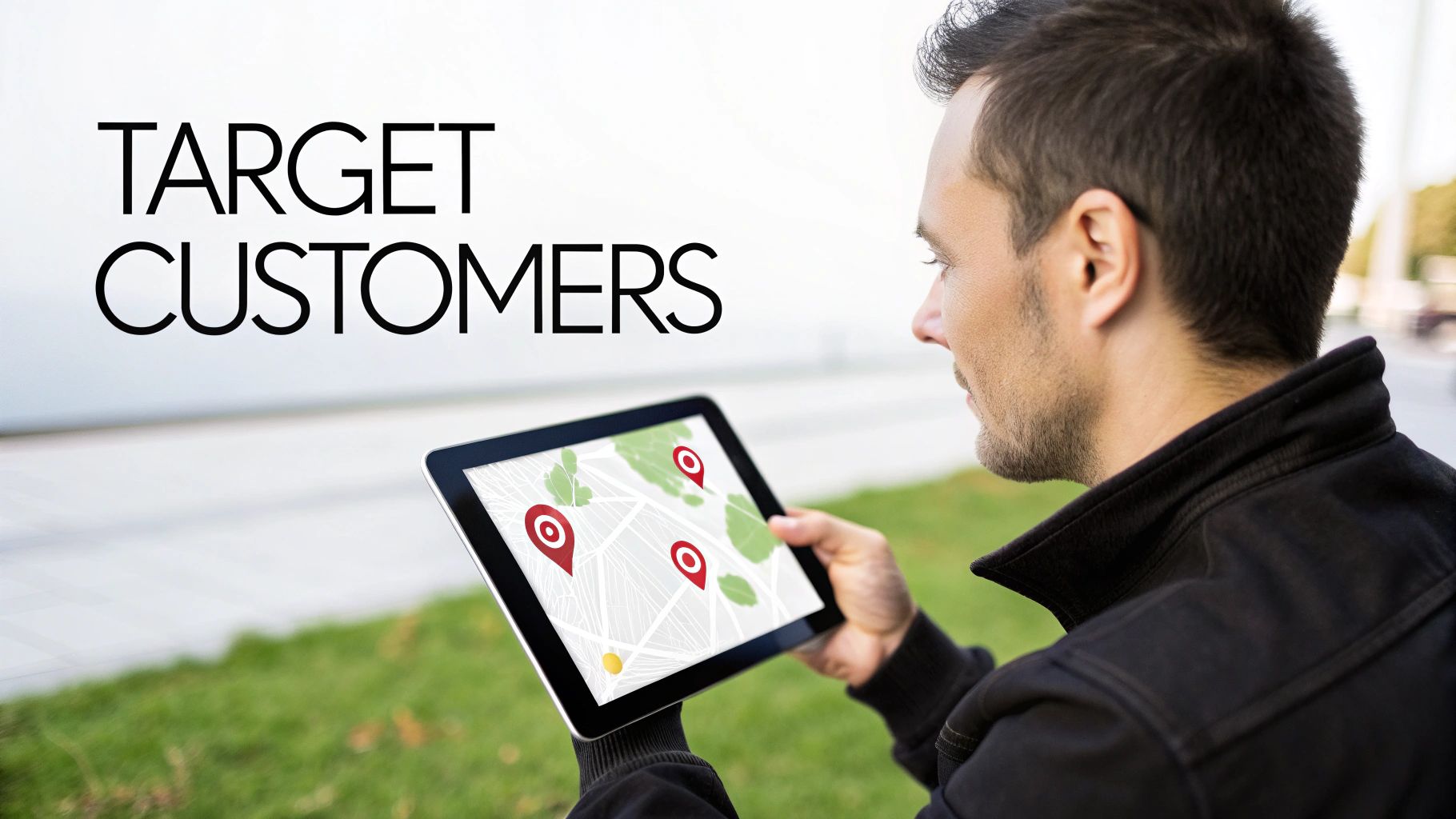
The real magic of social media advertising, especially for small businesses, is how ridiculously specific you can get with targeting. You can go way beyond basic details and connect with people based on their unique interests, what they do online, and even big life events they’ve recently shared.
Selling handmade dog collars in Manchester? No problem. You can target your ads specifically to dog lovers within a 20-mile radius who have recently liked or commented on pet-related posts. This level of detail ensures your message doesn’t just get seen, it gets seen by an audience that’s not just receptive but genuinely interested. Digging into the many advantages of social media advertising shows just how this precision leads to better results.
Social Media Advertising for Small Businesses: Get More Value for Every Pound Spent
When you’re a small business, every single penny in your marketing budget has to pull its weight. Unlike a pricey newspaper ad or a radio slot with vague, uncertain returns, social media advertising gives you crystal-clear, measurable results for a fraction of the cost. You can get started with a budget as small as £5 a day and see exactly how many people your ad reached, how many clicked through, and crucially, how many went on to buy something.
The ability to track your Return on Ad Spend (ROAS) in real-time is an absolute game-changer. It means you can quickly pull the plug on what isn’t working and put more fuel on the fire for what is, making your budget work incredibly hard for you.
The numbers don’t lie. In the UK, ad spending on social media is expected to hit a massive £9.95 billion by 2025. This is driven by its sheer effectiveness in reaching the 54.8 million Brits who are active on these platforms. You can read the full research on UK social media statistics to grasp the sheer scale of the opportunity here. This isn’t just a fleeting trend; it’s a fundamental shift in how businesses connect with their customers.
Choosing the Right Platform for Your Business
Investing in social media advertising without picking the right platform is like setting up a market stall at a high-end craft fair when you’re selling everyday fruit and veg. You might have the best products in the world, but you’re simply in the wrong place to find your customers.
Honestly, selecting the correct platform is the single most important strategic decision you’ll make. It’s what ensures your budget is spent talking to people who actually want to listen, rather than just shouting into the void.
Every social network attracts a different crowd with its own unique vibe and expectations. Your job is to match your business’s voice, products, and goals with the platform where your ideal customers are already spending their time. This isn’t about being everywhere at once; it’s about being effective where it truly counts.
This visual decision tree can help clarify if social media advertising is the right next step for your UK business.
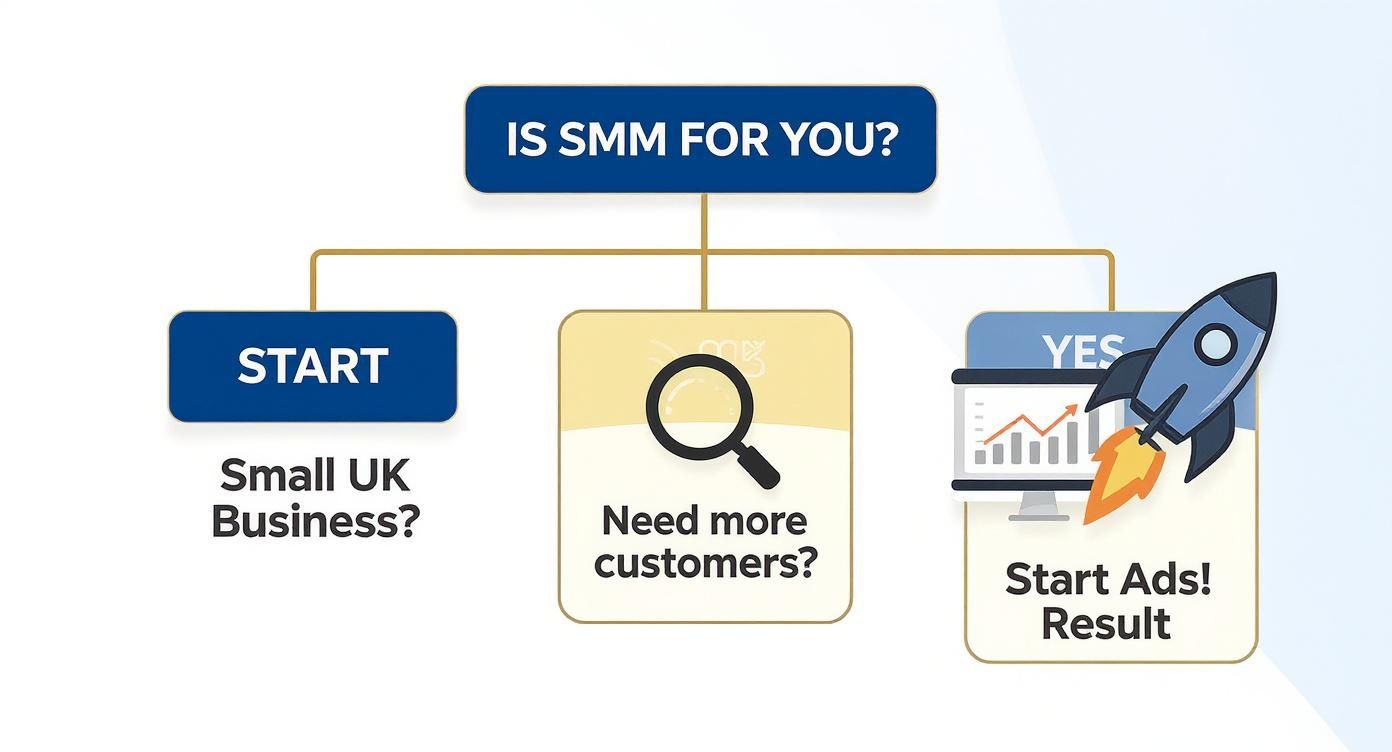
As you can see, for a small business hungry for growth, advertising on social media is a logical and powerful step forward. Now, let’s figure out where to take that step.
Facebook: The Community Hub
Think of Facebook as the bustling local market of the social media world. It’s absolutely massive, home to a hugely diverse UK audience that spans a wide range of ages and interests. Its real strength for small businesses lies in its powerful community-building features and hyper-local targeting.
Facebook is exceptional for businesses that depend on a local customer base—like cafés, plumbers, or boutique shops. You can target users within a specific postcode or just a few miles from your location with incredible precision. While it’s often compared to other advertising giants, understanding the differences is key. Our complete guide on Google Ads vs Facebook Ads provides a detailed breakdown of what makes each one tick.
- Best for: Local services, retail, community-focused brands, and businesses with a broad demographic appeal.
- Top Ad Formats: Image ads, video ads, carousel ads (perfect for showcasing multiple products), and lead ads to collect contact details directly.
Instagram: The Visual Showcase
If Facebook is the local market, then Instagram is the stylish art gallery or a trendy pop-up shop. It’s a purely visual platform where high-quality images and slick, engaging videos are the currency. The audience here is generally younger than on Facebook, with a strong presence of users under 45.
Success on Instagram is all about aesthetics and inspiration. It’s the perfect playground for businesses whose products or services look fantastic on camera. Think fashion, beauty, food, travel, and home décor. It allows you to tell your brand’s story through stunning visuals, turning casual scrollers into loyal customers.
LinkedIn: The Professional Network
Stepping into LinkedIn is like walking into a corporate conference or a professional networking event. The atmosphere is more formal, the conversations are business-focused, and the users are there for career development, industry news, and B2B connections. This is definitely not the place for casual consumer products.
LinkedIn is the undisputed champion for B2B (business-to-business) advertising. If your clients are other companies, this is where you’ll find them. It’s ideal for consultants, software companies, marketing agencies, and anyone selling high-value professional services. You can target users based on their job title, industry, company size, and even seniority.
TikTok: The Entertainment Stage
TikTok is the vibrant, fast-paced street festival of the social media world. It’s energetic, creative, and completely driven by trends, with a user base dominated by Gen Z and younger millennials. Authenticity and entertainment reign supreme here; polished, corporate-style ads almost always fall flat.
This platform is a goldmine for brands that can embrace creativity and have a bit of fun. Businesses in fashion, beauty, food, and entertainment can thrive by creating short, catchy videos that tap into current trends and challenges. The secret is to make ads that don’t feel like ads.
Choosing the right platform comes down to one simple question: Where do my ideal customers hang out online? By understanding the unique environment of each network, you can invest your advertising pounds where they will deliver the highest return and connect your business with the right audience, every single time.
To give UK businesses a head start, here’s a quick-reference table to help you compare the top platforms at a glance.
Platform Selection Guide for UK Small Businesses
| Platform | Best For (Business Type) | Primary UK Audience | Top Ad Formats |
|---|---|---|---|
| Local services, retail, community brands | Broad; strong in 25-55+ age range | Image, Video, Carousel, Lead Ads | |
| Fashion, food, beauty, travel, e-commerce | Younger; primarily 18-45 | Stories, Reels, Image, Carousel Ads | |
| B2B services, software, recruitment, consultants | Professionals, graduates, decision-makers | Sponsored Content, Message Ads, Lead Gen Forms | |
| TikTok | Consumer brands (fashion, food), entertainment | Youth-focused; strong in 16-30 age range | In-Feed Video Ads, Branded Hashtag Challenges |
Ultimately, choosing the right social media platform isn’t just about demographics; it’s about matching the platform’s culture with your brand’s personality. Get this right, and you’re already halfway to a successful campaign.
Social Media Advertising for Small Businesses: Setting Your Advertising Budget and Goals
Before you throw a single pound at social media ads, you have to know what you’re actually trying to do. Think of it like a road trip. You wouldn’t just jump in the car and start driving aimlessly, would you? You need a destination in mind before you can work out how much fuel you’ll need. Your business goal is that destination, and your ad budget is the fuel.
Framing it this way turns your ad spend from a fuzzy expense into a proper investment. When you define clear goals first, every pound you spend has a specific job. This makes it a whole lot easier to measure what’s working and see if you’re getting your money back.
Define Your Destination First
For most small businesses, ad goals boil down to one of three things. Each one needs a slightly different approach and, you guessed it, a different way of thinking about your budget. Be honest about which one is your absolute priority right now.
- Brand Awareness: This is all about getting your name out there. You’re introducing your business to a crowd that has probably never heard of you. Success here is measured by things like reach (how many people see your ad) and impressions (how many times it’s shown).
- Lead Generation: The main focus here is capturing the contact details of potential customers. It’s perfect for service businesses—think consultants, tradespeople, or anyone who needs to have a conversation before making a sale. You’re measuring success by the number of new leads, like email sign-ups or completed contact forms.
- Direct Sales: This one’s the most straightforward and is the bread and butter of e-commerce businesses. You want people to click your ad and buy something from your website, simple as that. Success is measured directly by the revenue your ads bring in.
Picking one main objective for each campaign is a cornerstone of effective social media advertising for small businesses. It keeps your message sharp and your results dead simple to track.
Translating Goals into Your Budget
Once you know where you’re going, you can start talking numbers. And don’t worry, you don’t need a massive war chest to get going. Plenty of small businesses get fantastic results by starting with as little as £5 to £10 per day. The trick is to start small, see what works, and then reinvest what you make.
To get your head around how your budget is spent, you just need to know two basic terms:
- Cost Per Click (CPC): This is what you pay every time someone clicks on your ad. If your goal is to get people to your website to buy something, this is a metric you’ll be watching like a hawk.
- Cost Per Mille (CPM): “Mille” is just a fancy Latin word for a thousand. This is what you pay for one thousand people to see your ad (impressions). If brand awareness is your game, you’ll be paying close attention to your CPM.
A small, tightly managed budget is infinitely more powerful than a huge, unfocused one. Your first job is to prove that your ads can be profitable. Once you know that spending £5 consistently brings in £25 worth of sales, you can scale up your budget with confidence.
Let’s make this real. Imagine you run a local bakery and you want to promote a new line of celebration cakes. Your goal is lead generation – getting people to fill out an enquiry form. You set a daily budget of £10. If your ads bring in two qualified enquiries a day, you’ve spent £5 per lead. If just one of those leads turns into a £50 cake order, your advertising has delivered a brilliant return. That simple bit of maths gives you all the data you need to decide whether to keep going, spend more, or tweak your approach.
Crafting Ads That Capture and Convert
Alright, you’ve got your goals locked in and your budget sorted. Now for the fun part: making an ad that actually gets people to stop scrolling and pay attention. This is where art meets science. A great social media ad isn’t about shouting the loudest; it’s about being the most relevant, compelling thing in someone’s feed at that exact moment.
Think of your ad like a three-legged stool. You need a strong visual, captivating copy, and a crystal-clear call-to-action (CTA). If any one of those legs is wobbly, the whole thing comes crashing down. But when they all work together? That’s when you create an ad that doesn’t just get seen—it gets results.
The Power of the Visual
Let’s be honest, social media is a visual battlefield. Your ad’s image or video is the very first thing people will see, and you have less than a second to make an impression before they flick their thumb and scroll on by. The good news? You don’t need a Hollywood-level production budget to create something that works.
In fact, sometimes those overly polished, corporate-looking images can stick out like a sore thumb and perform worse than something that feels real and authentic. Your smartphone is more than capable of capturing fantastic, high-quality visuals that connect with people on a human level.
Here are a few tips for creating scroll-stopping visuals without breaking the bank:
- Use Natural Light: Good lighting is the secret ingredient that makes photos and videos look professional. Get near a window whenever you can—it makes a world of difference.
- Show Your Product in Action: A boring product shot on a white background is easy to ignore. Show someone actually using and enjoying your product. This helps people picture it in their own lives.
- Feature Real People: Whether it’s you, your team, or a happy customer, human faces build trust and connection way more effectively than generic stock photos ever could.
Your visual’s job isn’t just to be noticed; it’s to make someone feel something. A genuine, relatable image can spark an emotional connection before they’ve even read a single word.
Writing Copy That Connects
Once your visual has done its job and hooked their attention, your ad copy needs to reel them in. This is your moment to speak directly to your customer’s pain points, needs, and aspirations. Ditch the bland, corporate jargon. Your copy should feel like the start of a good conversation.
The most effective ad copy always focuses on benefits, not just features. A feature is what your product is (e.g., “made from waterproof material”). A benefit is what your product does for the customer (e.g., “keeps you dry and smiling on those miserable, rainy dog walks”). People don’t buy features; they buy better versions of themselves.
Structure your copy with a clear purpose. Kick things off with a strong headline that grabs attention or asks a probing question. Follow up with a couple of short sentences that hammer home the core benefit and build a bit of intrigue. Finally, lead them smoothly to the action you want them to take. If you’re ever stuck for ideas, checking out a range of fantastic Facebook Ads examples is a great way to see how top brands nail their messaging.
The Unmistakable Call-to-Action
The final, and arguably most critical, piece of the puzzle is your Call-to-Action (CTA). This is the bit where you tell your audience exactly what you want them to do next. It’s amazing how often this is an afterthought. A weak or missing CTA is one of the biggest mistakes in social media advertising for small businesses, leaving interested people confused and your ad budget wasted.
Your CTA needs to be direct, punchy, and compelling. Use strong, action-focused words that create a sense of urgency or excitement.
Just look at the difference:
- Instead of: “Find out more about our services.”
- Try: “Get Your Free Quote Now”
- Instead of: “Our new collection is available.”
- Try: “Shop the Spring Collection”
The platform’s CTA button (like “Learn More” or “Shop Now”) is important, but don’t rely on it alone. Reinforce that same message in your ad text and even overlay it on your visual if it makes sense. Make it completely obvious what the next step is. When you master these three elements—visual, copy, and CTA—you’ll be crafting ads that don’t just grab attention, but turn casual scrollers into loyal customers.
Social Media Advertising for Small Businesses: Mastering Targeting to Reach Your Ideal Customers
The real magic of social media advertising isn’t just about getting your message out there; it’s about its incredible precision. It’s the difference between shouting from a rooftop hoping someone hears you, and whispering directly into the ear of someone who’s actually waiting to listen. This is how you stop wasting money on people who don’t care and start spending it where it counts.
Think of yourself as a postman who only delivers to people eagerly awaiting your letters. That’s what great targeting feels like. Instead of a scattergun approach, you get to build a detailed picture of your perfect customer and show your ads only to them. Every pound of your budget suddenly starts working much harder.
Getting Started with Core Audiences
The first layer you’ll work with is what the platforms call a Core Audience. This is the foundation of your targeting, where you define your customer based on who they are, where they are, and what they’re into. It’s the essential starting point for any campaign.
You can build this audience using a few key ingredients:
- Demographics: This is the basic stuff – age, gender, education level, even their job title. A local wedding photographer, for instance, could target users who’ve recently changed their relationship status to “Engaged.” Simple, but powerful.
- Location: You can go as broad as a whole country or as specific as a single postcode. If you run a café in Bristol, targeting people within a 5-mile radius makes a lot more sense than advertising across the entire UK.
- Interests: This is where it gets really clever. It’s all based on the pages people like, the groups they join, and the content they engage with. Selling handmade hiking gear? You can directly target users who follow hiking magazines, are members of rambling groups, and have shown an interest in well-known outdoor brands.
This screenshot from Facebook’s ad platform shows you exactly how you can mix and match these options to get super specific.
The interface lets you layer different criteria, whittling down an audience of millions to a focused group of people who are much more likely to be interested in what you have to offer.
Stepping Up Your Game with Custom and Lookalike Audiences
Once you’ve got the hang of Core Audiences, you can unlock even more powerful options that tap into your own customer data. This is where social media advertising for small businesses really starts to pay off.
A Custom Audience is built from your own sources, like an email subscriber list or people who have visited your website. It’s an absolute goldmine for re-engaging with a warm audience that already knows who you are.
Think of a Custom Audience as your VIP list. These are people who’ve already raised their hand and shown some interest, making them far more likely to take the next step, whether that’s buying a product or booking a service.
From there, you can create a Lookalike Audience. This is where the platform works its magic. It analyses the common traits of your Custom Audience (your best customers) and then goes out and finds new people who share similar characteristics and online behaviours. It’s an incredibly effective way to find new customers who are just like your existing ones, massively boosting your campaign’s chances of success.
By getting comfortable with these targeting tools, you’re not just running ads; you’re making direct connections with your future customers.
Measuring Your Success and Improving Campaigns
Getting your social media ad campaign live isn’t the finish line; it’s the starting block. The real magic, and the real growth, happens when you start listening to what the data is telling you, figuring out what your results mean, and making smart tweaks to get better over time.
This is how you turn advertising from a hopeful guess into a predictable system for making money. You don’t need a PhD in data science, just a solid grasp of a few key ideas that show you whether your ad spend is actually working for you.
Key Metrics Every Business Owner Should Know
The first time you open your ads manager, you’ll be hit with a wall of numbers and confusing acronyms. Don’t panic. For most small businesses, only a handful of these metrics really matter for judging success and making decisions.
Focusing on these core numbers helps you cut through the noise and see what’s actually going on.
- Click-Through Rate (CTR): This is simply the percentage of people who saw your ad and were curious enough to click it. A high CTR is a great sign that your visuals and headline are doing their job and grabbing attention.
- Cost Per Click (CPC): This tells you exactly how much each one of those clicks is costing you. The game here is to get this number as low as you can while still reaching the right people.
- Return on Ad Spend (ROAS): This is the big one—the most important metric of all. It measures how much revenue you’ve earned for every single pound you’ve spent on ads. A ROAS of 4:1 means you’re making £4 for every £1 you put in.
To get a really clear picture of how things are going, you can dive into our detailed guide on how to effectively measure advertising effectiveness. Getting comfortable with these numbers is the first step towards making profitable choices.
Using A/B Testing to Improve Your Ads
How do you really know if a different picture or a punchier headline would work better? You test it. That’s where A/B testing (or split testing) comes in. It’s the straightforward process of running two slightly different versions of an ad to see which one delivers the goods.
Think of it like an eye exam when the optician asks, “Which is better, one or two?” You’re just comparing two options side-by-side to find the clear winner. You could test the same ad copy with two different images, for example, or use the same image but try out two different calls-to-action.
A/B testing takes the guesswork out of your strategy. It lets you make small, data-backed improvements that can add up to huge increases in performance and profit over time.
This cycle of continuous improvement is what separates the campaigns that thrive from the ones that fizzle out. For businesses in the UK, the payoff is clear. Recent figures show that 71% of marketers see a measurable return on their social media investment, and businesses that dedicate over 25% of their marketing budget to social see their revenue grow 32% faster. Fine-tuning your approach has a direct impact on your bottom line.
Still Got Questions?
Diving into social media advertising can feel a bit overwhelming, and it’s completely normal to have a few questions rattling around. Let’s tackle some of the most common ones we hear from small business owners just like you, so you can move forward feeling confident.
How Much Should a Small Business Actually Spend on Social Media Ads in the UK?
There’s no magic number here, but a brilliant place to start is somewhere between £5 and £15 per day for each campaign you’re running. This is the sweet spot—it’s enough to get some real, meaningful data on what’s working without you having to empty your pockets from day one.
The most important thing to keep an eye on is your Return on Ad Spend (ROAS). Think about it: if you spend £10 and bring in £50 of new business, that’s a massive win. Start small, prove the ads are working, check your numbers, and then you can confidently start pumping your profits back in to scale things up.
Which Social Media Platform is Best for My Local Service Business?
For most local service businesses here in the UK, Facebook is the undisputed king. Why? Its location targeting is incredibly powerful. You can tell it to show your adverts only to people within a specific radius of your business—say, within 10 miles of your town, or even down to specific postcodes.
This is a game-changer for businesses like plumbers, hairdressers, and local cafes that serve a tight-knit community. When you layer that precise location targeting with people’s interests and demographics, you’ve got a seriously effective tool for pulling in customers right on your doorstep.
For any local business, being able to focus your ad spend on the exact area you serve is huge. It means every single pound is working hard to reach potential customers who can actually walk through your door or book your services.
Social Media Advertising for Small Businesses: Do I Need to Hire a Pro for Photos and Videos for My Ads?
Honestly? Not at all. In fact, sometimes those super-polished, corporate-looking ads can actually perform worse on social media. They stick out like a sore thumb and don’t feel real to people scrolling through pictures of their friends and family. A high-quality photo or video from your smartphone often feels more genuine and connects better.
Just focus on making sure your visuals are:
- Clear and well-lit: Good lighting makes all the difference. You want your product or service to look its best.
- Showing it in the real world: Let people see your product in action. Help them picture how it would fit into their own lives.
- Featuring happy customers: Got a great photo from a client (with their permission, of course)? Use it! This kind of content is pure gold because it builds instant trust and provides that all-important social proof.
Ready to stop the guesswork and start getting real results from your advertising? The team of experts at PPC Geeks builds campaigns driven by data to increase your traffic, generate leads, and boost sales. Find out how we can help your business grow by visiting us at https://ppcgeeks.co.uk/.