




Here we aim to bring you up to speed on what Marketing Attribution is and how it can accelerate your brand?
Think of marketing attribution like this: when your favourite football team scores a goal, who gets the credit?
Is it just the striker who kicked the ball into the net?
Or do you also give a nod to the midfielder who made the perfect pass, and the defender who started the whole play?
Attribution is simply the process of figuring out which marketing efforts—which players on your team—deserve credit for a conversion.
It helps you see the whole game, not just the final shot.
What Is Marketing Attribution and Why Does It Matter?

Imagine a customer’s path to buying from you. It’s rarely a straight line. They might see one of your social media posts, click a Google Ad a week later, read a blog post you wrote, and finally make a purchase after you send them a promotional email.
Without proper attribution, you might give 100% of the credit to that final email. This is a huge mistake. You’d be completely ignoring all the other touchpoints that built awareness, trust, and interest along the way. Marketing attribution is how you connect those dots and give credit where it’s due.
Beyond the Last Click: Answering What Is Marketing Attribution?
For years, many businesses fell into the trap of “last-click attribution.” It’s simple: the very last thing a customer clicked before buying gets all the glory. But this is a deeply flawed way of looking at things. It’s like only clapping for the final act of a play while ignoring the brilliant setup and character development in the acts that came before.
The modern customer journey is a tangled web of interactions. Real, effective marketing attribution is about understanding every single one of them. This holistic view comes from tracking the entire customer journey and appreciating the combined power of all your efforts.
Key Takeaway: Effective marketing attribution stops you from overvaluing bottom-of-the-funnel activities and undervaluing the top-of-funnel channels that introduce customers to your brand in the first place.
This is especially critical now, as customer paths become more complex than ever. For UK businesses, adopting attribution provides a clearer picture of ROI, smarter budget allocation, and vastly improved campaign strategies.
Core Benefits of Implementing Marketing Attribution
Diving into marketing attribution isn’t just a data exercise; it’s about making smarter, more profitable decisions that give you a real edge. The table below outlines the core benefits you can expect.
| Benefit | Business Impact |
|---|---|
| Optimise Marketing Spend | Stop guessing. Shift your budget from underperforming channels to those that deliver the highest return. Every pound spent works harder. |
| Prove Marketing ROI | Get the hard data you need to show marketing’s direct impact on revenue. Justify budgets and prove your team’s immense value. |
| Improve Customer Experience | Understand the paths customers take to refine your messaging. Create a smoother, more logical journey from first glance to final purchase. |
Ultimately, understanding and applying marketing attribution correctly means you can stop wasting resources and start investing in what truly grows your business. It’s about moving from guesswork to confident, data-driven action.
Understanding Common Marketing Attribution Models
Once you realise you need to track every touchpoint, the next big question pops up: how do you actually assign credit where it’s due? This is where marketing attribution models come into the picture. Think of them as different rulebooks for sharing the glory amongst all the players on your marketing team. Each one gives you a unique lens through which to view your customer’s journey.
There’s no single “perfect” model, by the way. The right choice hinges entirely on your business, the length of your sales cycle, and what you’re ultimately trying to accomplish.
Let’s follow a customer, Sarah, who buys a new coat. Her journey involved seeing a Facebook ad (the first touch), reading a blog post a week later, and finally clicking a retargeting Google Ad (the last touch) to make her purchase. How do we decide which of these deserves the credit?
Single-Touch Attribution Models: What Is Marketing Attribution?
The simplest methods are single-touch models. These give 100% of the credit for a sale to just one interaction. They’re dead easy to set up and understand, but they often paint a far too simple picture of what’s really happening.
- First-Touch Attribution: This model hands all the credit to the very first interaction Sarah had with your brand—that Facebook ad. It’s brilliant for businesses focused on filling the top of the funnel and figuring out which channels kickstart brand awareness.
- Last-Touch Attribution: In this scenario, the final Google Ad Sarah clicked gets all the praise. This model is great for pinpointing what sealed the deal, helping you identify your most powerful conversion channels. The big downside? It completely ignores everything that built her interest in the first place.
These models are a starting point, but their laser focus can be deceptive. They tell a piece of the story, but they miss the crucial middle parts that nurture a lead from curious to converted.
This image neatly lays out the basic ideas behind first-touch, last-touch, and the linear model.
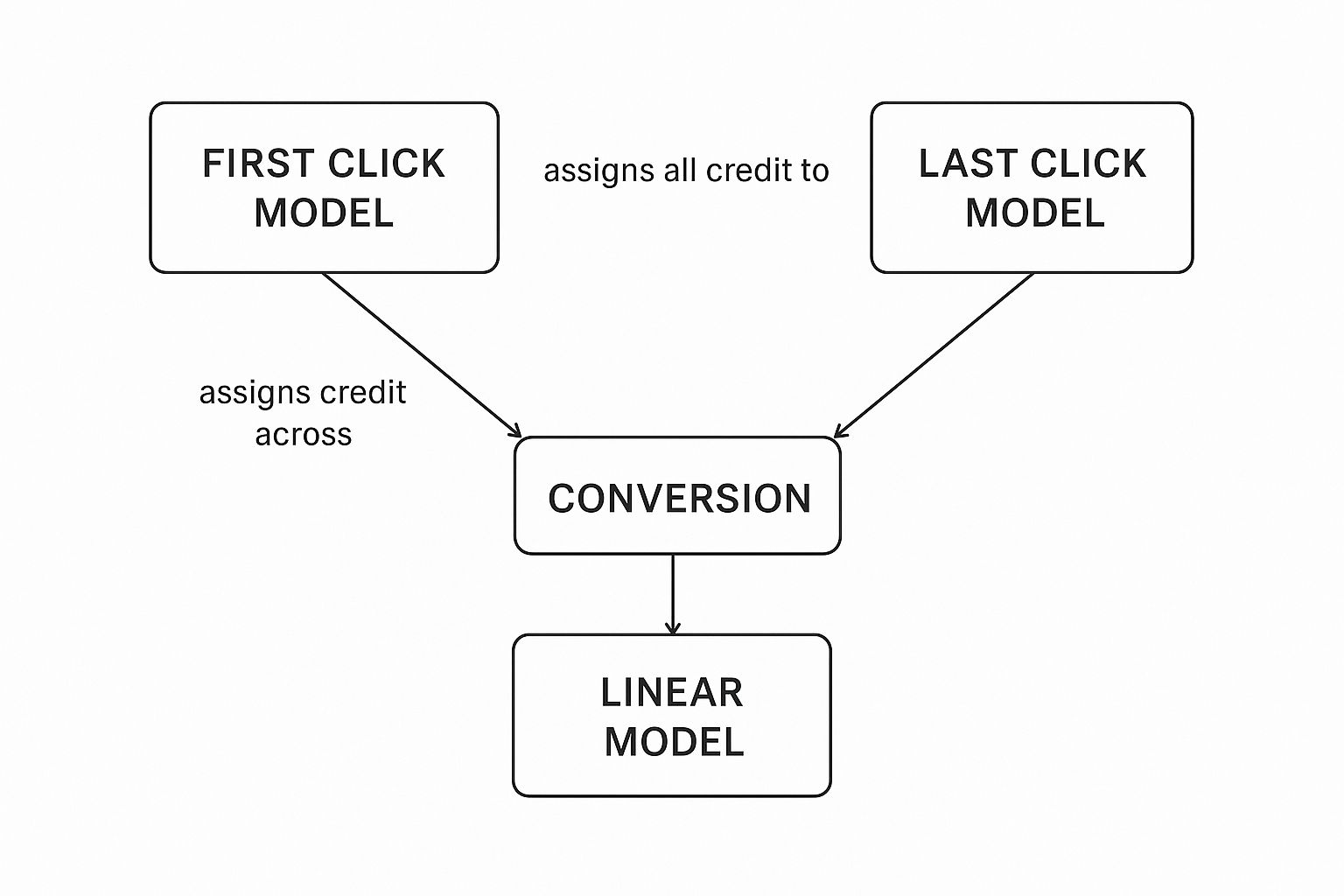
As you can see, the single-touch models put all their eggs in one basket, while the linear model starts to spread the credit more evenly across the journey.
Multi-Touch Attribution Models
This is where things get more interesting. Multi-touch models offer a more balanced and realistic view by spreading credit across multiple touchpoints. They recognise that it usually takes a village of interactions to raise a conversion.
Linear Model
The Linear model is the most straightforward of the multi-touch family. It splits credit equally among all interactions. In Sarah’s journey, the Facebook ad, the blog post, and the Google Ad would each get 33.3% of the credit. It’s a democratic approach that values every step, from awareness to closing the deal.
This model is a huge step up from single-touch because it makes sure no channel is left in the dark. It helps you appreciate that middle-of-the-funnel content that patiently nurtures leads over time.
Time-Decay Model
The Time-Decay model is a bit more sophisticated. It gives more credit to touchpoints that happened closer to the conversion, assuming the most recent interactions were the most influential. So, Sarah’s final Google Ad would get the biggest slice of the pie, the blog post would get a smaller piece, and the initial Facebook ad would get the crumbs. This is really useful for businesses with longer sales cycles, as it rewards the channels that pushed the customer over the finish line.
Position-Based Models (U-Shaped and W-Shaped)
These advanced models assign different weights to specific key moments in the customer journey.
- U-Shaped Model: Also known as the “bathtub” model, this gives 40% of the credit to the first touch (the Facebook ad) and another 40% to the final conversion touch (the Google Ad). The remaining 20% is shared among any interactions in the middle (like our blog post). It’s a great fit for businesses that place a high value on both generating the initial lead and closing it.
- W-Shaped Model: This model, often used in more detailed reports, gives 30% credit each to three key milestones: the first touch, the lead creation touch, and the opportunity creation touch (like creating a deal in your CRM). The last 10% is then divided among the other interactions.
Choosing the right approach is a vital part of managing your campaigns effectively. For a deeper look at how these models work inside platforms like Google Ads, you might find our guide on what attribution modelling is and how it impacts your campaigns helpful.
What Is Marketing Attribution? Choosing Between Single-Touch and Multi-Touch Attribution

Deciding between a single-touch and a multi-touch model isn’t just a technical choice in your analytics software. It’s a strategic one. It’s about what your business truly values. Are you only interested in celebrating the final click that sealed the deal, or do you want to recognise the entire team effort that led to the sale?
Think of it like this: a last-touch model is like giving a medal only to the runner who crossed the finish line. It completely ignores the months of training, coaching, and support that got them there. Multi-touch, on the other hand, acknowledges the whole journey, giving credit to everyone who played a part.
When Single-Touch Models Make Sense
While they offer a pretty narrow view, single-touch models like First-Touch or Last-Touch aren’t totally useless. Their main advantage is simplicity. For some businesses, this straightforward approach is all that’s needed to get a clear, actionable signal from their data.
A single-touch model might be all you need if your business has:
- A Very Short Sales Cycle: If customers typically buy within minutes or hours of their first interaction, like with a low-cost impulse purchase, the journey is simple. A last-click model often tells you most of what you need to know.
- Limited Marketing Channels: If you’re pouring all your energy into just one or two channels, like Google Ads and email, a simpler model can work because the customer path has very few touchpoints to analyse.
- A Singular Goal: When your main objective is pure brand awareness, a first-touch model is incredibly useful. It shows you exactly which channels are best at introducing new people to your brand.
For a new online shop selling quirky socks, a last-touch model could be perfectly fine. The journey from seeing a social media ad to making a purchase is often immediate. Here, the primary goal is driving quick sales, and last-touch reflects that perfectly.
Important Consideration: The big drawback of single-touch is that it creates blind spots. By focusing on only one interaction, you risk undervaluing the channels that build trust and familiarity over time. This could lead you to cut budgets for essential “middle-of-the-funnel” activities that are actually crucial to your success.
Why Multi-Touch Is Usually the Superior Choice
For most businesses, especially those with longer sales cycles or multiple marketing channels, a multi-touch approach is essential. It’s the only way to get a realistic and complete picture of what your marketing is actually doing.
Multi-touch models really shine in these scenarios:
- B2B Sales: The B2B customer journey is notoriously long and complex. It often involves research papers, webinars, sales calls, and multiple decision-makers. A multi-touch model is the only way to understand how these varied interactions contribute to a final deal.
- High-Value Products: When a customer is mulling over a big purchase—like a car, a bespoke suit, or enterprise software—they’ll interact with your brand many times before committing. Multi-touch helps you value each of these crucial touchpoints properly.
- Complex Marketing Strategies: If you’re running campaigns across social media, PPC, content marketing, SEO, and email, a single-touch model will inevitably fail. It just can’t show you how these channels work together.
The modern consumer rarely follows a straight line from A to B. This is especially true in the UK e-commerce sector, where research shows 73% of shoppers use multiple channels during their buying journey. Adopting a multi-touch model is therefore critical for accuracy. To learn more about how UK businesses are using this to their advantage, check out this article on attribution from Embryo.com. This data-driven approach allows you to see which combinations of touchpoints are most effective at generating revenue.
Ultimately, shifting from a single-touch to a multi-touch model is about moving from a simple, but flawed, snapshot to a detailed, panoramic view of your marketing performance. It empowers you to make smarter investments, nurture leads more effectively, and build a strategy that values every single step of the customer’s journey.
What Is Marketing Attribution? How to Implement a Marketing Attribution Strategy
Theory is one thing, but turning it into action is where you’ll see the real value. Putting a marketing attribution strategy in place isn’t a one-and-done job; it’s a constant process of tweaking and refining. You’re essentially building a system that gives you clear, actionable insights into what genuinely moves the needle for your business.
Let’s walk through the essential stages to get this powerful system up and running. This roadmap will guide you from the initial planning right through to ongoing analysis, making sure you end up with a strategy that’s both effective and sustainable.
1. Define Your Core Business Goals
Before you even glance at a tool or a model, you need to answer a fundamental question: what does a “conversion” actually mean to your business? Your answer will shape everything that follows. A conversion isn’t always just a final sale, after all.
You need to be crystal clear about your primary objectives. Your goals might be:
- Generating Qualified Leads: The key action here might be someone submitting a form for a demo or downloading a whitepaper.
- Driving Ecommerce Sales: The goal is a completed checkout, with revenue being the most important metric.
- Increasing Event Registrations: A successful sign-up for a webinar or an in-person event is your conversion.
Getting this right from the start is absolutely crucial. Without a well-defined goal, your attribution data will be unfocused and meaningless. You’ll be measuring for the sake of it, not measuring what truly matters.
2. Map the Customer Journey
Next up, you need to put on your detective hat and identify every single touchpoint a customer could possibly have with your brand, both online and offline. Think about it from their perspective. Where do they come from? What content do they engage with?
Your map should cover all potential interactions, including:
- Digital Channels: Social media posts, blog articles, paid search ads, organic search results, and email campaigns.
- Offline Channels: Phone calls, trade shows, print ads, or even in-store visits.
By mapping this journey, you create a complete inventory of the interactions you need to track. This ensures you don’t miss crucial steps that influence a customer’s decision, giving you a holistic view of their path to conversion.
3. Choose the Right Attribution Model
With your goals set and the journey mapped out, you can finally pick an attribution model. As we’ve covered, there’s no single “best” answer here. The right choice depends entirely on your business reality and how long your sales cycle is.
If your main goal is bringing in new leads, a First-Touch or U-Shaped model could be perfect, as they give credit to the channels that first brought prospects into your world. For businesses with longer, more complex sales cycles, a Time-Decay model often works well, giving more weight to the final interactions that sealed the deal. Start simple and let your strategy evolve as you collect more data.
4. Select the Best Tools and Maintain Data Hygiene
Now it’s time to pick the tech that will power your entire strategy. This could be anything from the built-in features of Google Analytics to more specialised, dedicated attribution platforms. The trick is to choose a tool that fits your chosen model, your team’s technical skills, and your budget.
Just as important is keeping your data clean. Consistent use of UTM parameters is completely non-negotiable for accurate campaign tracking. These little tags, added to your URLs, tell your analytics tool precisely where your traffic is coming from, making sure every click is properly logged and categorised. For instance, managing UTMs effectively is a core part of any successful campaign, and you can learn more about mastering Google Ads PPC in our detailed guide.
5. Analyse, Refine, and Repeat
Marketing attribution is not a “set it and forget it” task. Think of it as a continuous cycle of improvement. Once your system is up and collecting data, you have to regularly dive into the insights and use them to fine-tune your strategy.
Start asking the tough questions:
- Which channels are punching above their weight, and which are falling flat?
- What does the typical path of a high-value customer look like?
- Where are the major drop-off points in the customer journey?
Use the answers to shift your budget, tweak your messaging, and improve the overall customer experience. This ongoing loop of analysis and refinement is what turns attribution from a simple reporting tool into a powerful engine for real, sustainable business growth.
Finding the Right Marketing Attribution Tools
Choosing the right marketing attribution tool can feel like you’re staring at a map with no compass. There are countless options out there, but the good news is they generally fall into three distinct camps. Each one is built for different business needs, budgets, and technical comfort levels.
Figuring out which category fits your business is the first real step. And you don’t need to splash a huge amount of cash to get started. Many businesses can begin pulling valuable insights from tools they already use, getting a feel for attribution without adding another line to the marketing budget.
Built-in Analytics Platforms
These are your bread-and-butter, the most accessible entry points into the world of marketing attribution. Think of tools like Google Analytics. They’re often free and already hooked into platforms you use every single day, making them a brilliant starting point for small businesses or anyone just dipping their toes in.
- Best For: Small to medium-sized businesses (SMEs) with a pretty straightforward sales cycle, mostly focused on digital channels.
- Pros: They are usually free and give you a solid look at basic models like first-touch and last-touch. This is perfect for getting a handle on your website traffic and seeing which channels are bringing people in and which ones are sealing the deal.
- Cons: The big drawback is that they often struggle to pull in offline data. This means they can oversimplify what might be a really complex customer journey, as they’re missing key pieces of the puzzle.
All-in-One Marketing Suites
Moving up a level, we have comprehensive platforms like HubSpot or Marketo. These suites are designed to be the central nervous system of your marketing, bundling automation, CRM, and analytics into one ecosystem. Their power lies in connecting marketing efforts directly to sales outcomes, all under one roof.
These platforms are built to follow a customer from their very first click right through to becoming a loyal, repeat buyer.
Key Insight: All-in-one suites are fantastic at giving you a complete, 360-degree view of the customer lifecycle. By keeping all the data in one place, they make it much easier to use more sophisticated models like U-shaped or Time-Decay, which offer a richer understanding of what actually drives revenue.
Specialised Attribution Platforms
What Is Marketing Attribution? For businesses that need the absolute deepest level of insight, specialised platforms like Ruler Analytics or Mediahawk are the top-tier solution. These tools are built with a single, obsessive purpose: to master marketing attribution. They can connect a massive range of data points, including offline conversions like phone calls, and offer advanced, customisable models.
- Best For: Larger enterprises or seriously data-driven businesses that have complex, multi-channel customer journeys and an urgent need to prove ROI with pinpoint accuracy.
- Pros: You get unmatched accuracy, the ability to track both online and offline touchpoints, and custom modelling. This is absolutely crucial for businesses where a phone call or an in-store visit is a key step in the sales process.
- Cons: Be prepared for a significant investment. These tools come with a higher price tag and require real technical expertise to manage them effectively.
Knowing which tool is the right fit can dramatically improve Google Ads performance because it ensures you’re putting your budget where it will have the most impact, based on a complete and accurate picture of your customer’s journey.
Comparison of Marketing Attribution Tool Types
To help you see the differences at a glance, we’ve put together this table comparing the main categories of attribution tools. It’s designed to help UK businesses pick the right solution for their current needs.
| Tool Type | Best For | Typical Cost | Complexity |
|---|---|---|---|
| Built-in Analytics | SMEs, beginners | Free to low-cost | Low |
| All-in-One Suites | Growing businesses | Medium to high | Medium |
| Specialised Platforms | Large enterprises | High | High |
Ultimately, the best tool is the one that fits you today but has the room to grow with you tomorrow. Start where you are, get confident with the basics, and then scale up your technology as your attribution strategy gets more sophisticated.
Key Best Practices for Effective Attribution

Getting marketing attribution right is more than just a technical setup; it’s a fundamental shift in how you think. To really see the benefits, you need to move beyond just hunting for answers and start using your data to ask much smarter questions.
Think of these best practices as the framework for turning your attribution strategy into a powerful engine for continuous, sustainable growth.
The most successful attribution journeys don’t begin with throwing complex models at the wall to see what sticks. Far from it. The trick is to start simple and evolve.
Kick things off with a straightforward model, like Last-Touch, to get a feel for the data. Once you’re comfortable and have gathered more insights, you can gradually test more advanced multi-touch models as your needs (and confidence) grow. This approach stops you from getting bogged down and helps you build trust in your findings.
Align Teams and Break Down Silos
For attribution to actually work, it can’t live on an island. A classic mistake we see all the time is marketing and sales teams operating with completely separate sets of data. When these data silos exist, you’re only getting a fractured, incomplete picture of the customer journey.
This leads to misinformed decisions and, frankly, a lot of friction between departments. Your sales and marketing teams need to be perfectly in sync, sharing data and insights from a single, unified source of truth.
This collaborative spirit ensures everyone is pulling in the same direction, using the same information to understand what truly drives revenue. This alignment is absolutely vital for maximising your ROI with Google Pay Per Click advertising strategies, as it finally connects your ad spend directly to sales outcomes.
True attribution success comes when you use data not as a final verdict, but as a starting point for curiosity. It should prompt questions like, “Why is this channel outperforming others?” or “What can we learn from the paths of our most valuable customers?”
Combine Data with Human Insight
What Is Marketing Attribution? Quantitative data is brilliant at telling you what happened, but it rarely explains why. This is where real human feedback becomes your secret weapon. Don’t fall into the trap of relying solely on charts and reports.
You need to combine your attribution data with real customer feedback, surveys, and the on-the-ground insights from your sales team. This blend of hard numbers and human stories gives you a much richer, more accurate understanding of your marketing’s true impact.
Recent findings show that for UK businesses, priorities are shifting. A significant 54% prioritise increasing sales revenue through digital marketing, while 42% focus on boosting brand awareness. Interestingly, while 22% of UK marketers rate sales as their top performance metric, a mere 7% identify ROI as their main measure. This highlights a clear gap that a robust attribution strategy is perfectly positioned to fill.
Finally, do your best to avoid these all-too-common traps:
- Inconsistent Tracking: Make sure your UTM parameters and tracking codes are uniform across every single campaign. Messy data produces useless insights. Simple as that.
- Ignoring Offline Touchpoints: If phone calls or in-person events are part of how you sell, you have to find a way to track them. Ignoring these creates massive blind spots in your data.
- Analysis Paralysis: Don’t get so lost in the numbers that you forget to act. The whole point is to use the insights to make timely, confident decisions that push your business forward.
Frequently Asked Questions About Marketing Attribution
Even when you’ve got a good handle on the theory, a few practical questions always pop up once you start digging into marketing attribution. Let’s tackle some of the most common ones we hear, giving you straight answers to help you with the real-world stuff.
How Can I Track Offline Conversions Like Phone Calls?
This is a big one. For so many businesses, a phone call is just as valuable as an online form fill, if not more so. Ignoring them means you’re missing a huge piece of the puzzle.
The good news is, you absolutely can track them. Specialist tools like Mediahawk or Ruler Analytics are built for this. They work by assigning unique, trackable phone numbers to your different marketing efforts. So, when a potential customer sees your Google Ad and calls the number on it, the system knows exactly which campaign prompted that call. This neatly stitches those offline actions back into your digital customer journey, ensuring your PPC campaigns get the credit they rightly deserve.
What Is the Real Difference Between Attribution and Marketing Mix Modelling?
It’s easy to get these two mixed up, but they answer very different questions. Think of it like using a microscope versus a telescope.
- Marketing Attribution is your microscope. It zooms right in on individual customer journeys, looking at the specific touchpoints—like an ad click, an email open, or a social media post—that led to a conversion. It answers the question, “Which specific marketing touches made this particular sale happen?”
- Marketing Mix Modelling (MMM) is your telescope. It pulls way back to look at the big picture over a longer period. It uses heavy-duty statistical analysis to figure out how entire channels (TV, radio, PPC, print) and even external factors (like the economy or seasonality) affect your overall sales. It answers, “How is my total marketing budget influencing my revenue?”
So, in short, attribution is tactical and all about the individual’s path. MMM is strategic and about the overall channel impact.
How Soon Can I Expect to See Results?
You’ll see some data almost immediately. As soon as you set up basic tracking with a simple model like last-touch, you’ll start to see which channels are closing the deal. This can happen within a day or two.
But—and this is a big but—for the really juicy insights that come from multi-touch models, you need a bit of patience. To spot reliable patterns, you really need to let the data build up for at least one full sales cycle. If your typical customer takes 90 days from first contact to final purchase, you should expect to wait around three to four months before you can confidently make big strategic decisions based on that attribution data.
Ready to stop guessing and start getting real, data-driven results from your ad spend? PPC Geeks is a multi-award-winning PPC agency dedicated to making your budget work harder. We build campaigns that deliver growth you can actually measure.