




So, what exactly is marketing automation?
Let’s cut through the jargon. In simple terms, it’s about using specialised software to handle repetitive marketing jobs automatically. Think of it as your best marketing assistant, working 24/7 to send the right message to the right person at precisely the right time—all without you having to manually trigger every single action.
What Is Marketing Automation, Really?
Marketing automation isn’t about replacing marketers with robots; it’s about giving them superpowers. Instead of getting bogged down sending every welcome email by hand, scheduling each social media post one by one, or manually sorting contact lists, you set up smart systems called workflows. These workflows spring into action based on what your customers do, creating a personalised experience that feels responsive and human.
Let’s paint a picture. A potential customer lands on your website and downloads a free guide. That one click can kick off an entire automated sequence behind the scenes:
- They’re instantly added to an email list for people interested in that specific topic.
- A “thank you” email, complete with the guide, arrives in their inbox immediately.
- A follow-up email is automatically scheduled for three days later, offering more useful content.
- Their profile in your system gets updated, flagging their interest for any future messages.
This is where the magic happens. It shifts marketing from a list of separate, manual tasks into a smart, connected system that guides leads from their very first visit all the way to becoming a customer and beyond.
It’s More Than Just Sending Emails
A common mistake is thinking marketing automation is just a fancy way to blast out emails. While email is definitely a huge part of it, true automation platforms are much more powerful. They act as a central command centre for all your marketing, pulling together different channels and data points to give you a complete, 360-degree view of your customer.
This unified approach allows you to run sophisticated campaigns that would be a nightmare to manage manually. For instance, you could link an email sequence with targeted social media ads. A user who clicks on a product in your email might start seeing an ad for that exact product pop up in their Facebook feed. It’s a world away from just sending out generic messages and crossing your fingers. If you want to understand how paid ads fit into this picture, our guide on what is PPC and how does it work is a great place to start.
At its heart, marketing automation is about creating smarter, more human conversations at scale. It’s about using technology to be more helpful and relevant to every single person, building genuine relationships that turn curious visitors into loyal advocates.
The Core Pillars of Automation
To see how this all connects, take a look at the concept map below. It shows how marketing automation acts as the central engine, driving all your key marketing activities.
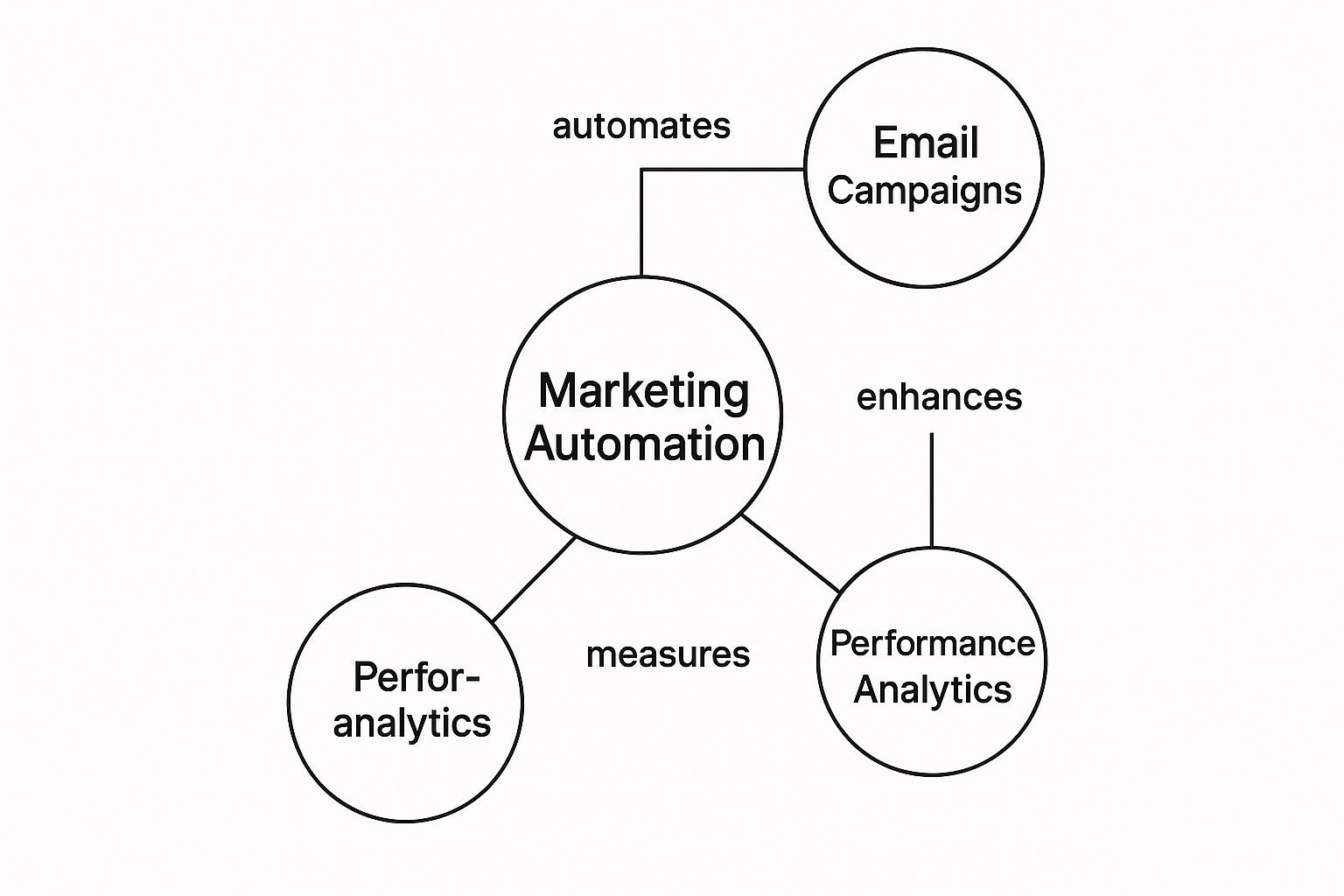
As you can see, things like powerful email campaigns, smart lead scoring, and clear performance analytics aren’t siloed activities. They’re all woven together by automation. This synergy frees up your team from the grind of repetitive tasks, allowing them to focus on what really matters: strategy, creativity, and building real customer relationships.
How Marketing Automation Drives Business Growth

So, we’ve covered what marketing automation is. But the real question on everyone’s mind is how it actually helps your business grow. It’s not just about doing things faster; it’s about fundamentally changing how you attract, engage, and keep your customers. For any UK business, getting this right can be a massive competitive advantage.
At its heart, automation gives you back your most precious resource: your team’s time. Just think about all the repetitive, manual jobs that clog up a marketer’s day—endlessly segmenting lists, scheduling social media posts, or chasing up leads with follow-up emails. Automation takes care of all that, working tirelessly in the background with pinpoint accuracy.
This frees up your team to focus on what really matters: big-picture strategy, creative thinking, and analysing what’s actually working. It’s a seismic shift in productivity that can make a small team punch well above its weight.
Improving Lead Quality and Sales Alignment
One of the most powerful things marketing automation does is dramatically improve the quality of leads you hand over to your sales team. This magic happens through smart processes like lead nurturing and lead scoring.
Instead of chucking every new contact straight over the fence to sales, automation warms them up with relevant, helpful content. A workflow can track a lead’s behaviour—what pages they’ve visited, emails they’ve opened, or content they’ve downloaded—and assign points for each action. This scoring system is brilliant for separating the tyre-kickers from the genuinely interested prospects.
By the time a lead makes it to your sales team, they’re not just better informed; they’re significantly more likely to convert. This harmony between marketing and sales is absolutely vital for boosting revenue and making everyone’s job easier.
By systematically qualifying leads, you stop wasting sales resources on cold prospects and instead focus their efforts on warm, engaged opportunities that have a much higher chance of closing.
Scaling Personalisation for a Better Customer Journey
Today’s customers expect more. They’re tired of generic marketing blasts and want messages that feel like they were written just for them, addressing their specific needs and interests. But trying to deliver that level of personalisation manually for every single customer? It’s simply impossible.
This is where automation truly shines. It allows you to create highly personalised customer journeys at scale. An e-commerce store, for instance, can automatically send abandoned cart reminders featuring the exact products someone left behind. You could also set up different email sequences depending on which service page a visitor spent time on.
And it goes beyond email. You can personalise website content, display targeted pop-ups, and even run laser-focused ad campaigns based on a user’s behaviour. When you pair this with a solid advertising strategy, the results can be phenomenal. To see how these elements can work together, you can explore our https://ppcgeeks.co.uk/marketing/the-google-adwords-ppc-playbook-every-uk-digital-marketer-needs-to-read.
Making Smarter Decisions with Centralised Data
Great marketing runs on good data. The problem is, that data is often scattered everywhere—your website analytics, email platform, CRM, and social media accounts are all telling different parts of the story. Marketing automation acts as the central hub, pulling all that performance data into one place.
This unified view gives you a crystal-clear picture of what’s working and what isn’t. You can trace a customer’s entire journey, from their first click on a paid ad all the way to their final purchase, and see precisely which touchpoints made the biggest difference.
This kind of insight empowers you to make smarter, data-driven decisions instead of just guessing. To really get to grips with the financial impact and learn how to maximize your marketing automation ROI, it’s worth digging into the numbers.
The demand for these data-powered approaches is causing huge market growth. The UK marketing automation market hit about £342 million in 2024 and is on track to more than double, reaching an estimated £720 million by 2030. This explosive growth underscores just how critical automation has become in the UK’s modern digital economy.
Diving Into Core Marketing Automation Features
Now that we’ve covered the business case, let’s pop the bonnet and have a look at the engine. What tools are actually inside a marketing automation platform that make everything tick? Getting to grips with these core features will help you understand not just what is marketing automation, but also what to look for when choosing the right software for your business.
At its heart, a marketing automation platform is a toolkit designed to help you talk to your audience more effectively. Think of it like a Swiss Army knife for marketers—each tool has its own job, but it’s how they work together that makes the whole thing so incredibly useful.
Let’s break down the must-have components you’ll find in almost every system, using some real-world examples to show you how they actually work.
Automated Email Marketing and Workflows
This is the bread and butter of most automation platforms. But it goes way beyond just sending out a monthly newsletter. Automated email marketing is all about creating dynamic, behaviour-triggered campaigns, often called drip campaigns or workflows.
These aren’t just static lists; they’re intelligent sequences that react to what a user does. For instance, if a customer buys something from your online shop, you can automatically add them to a post-purchase workflow that sends:
- An immediate order confirmation email.
- A follow-up email a week later asking for a review.
- A third email a month later suggesting complementary products.
This kind of responsive communication builds trust and encourages repeat business, all without a single manual click from your team. You set the rules once, and the system takes it from there, making sure every customer gets a timely, relevant follow-up.
Lead Management and Scoring
Let’s be honest: not all leads are created equal. Someone who just downloaded a free guide is in a very different place from someone who’s actively requested a pricing demo. Lead management features help you capture, track, and organise your contacts, while lead scoring helps you figure out who to talk to first.
Lead scoring is basically like giving each prospect points based on who they are and what they do. You might award points for things like:
- Demographics: +10 points if their job title is “Marketing Manager.”
- Engagement: +5 points for opening an email, +15 for clicking a link.
- High-Intent Actions: +50 points for visiting your pricing page or booking a demo.
This system automatically flags your most sales-ready leads. When a contact hits a certain score (say, 100 points), the platform can instantly ping your sales team, letting them know it’s time to reach out. This ensures they focus their precious time where it will have the biggest impact.
To help you visualise this, here’s a quick breakdown of common platform features and what they are designed to achieve.
Key Marketing Automation Features and Their Purpose
| Platform Feature | Its Primary Job | The Business Problem It Solves |
|---|---|---|
| Email Workflows | Send automated, timed email sequences. | Nurturing leads over time without manual effort. |
| Lead Scoring | Assign points to leads based on actions. | Identifying which leads are hot and ready for sales. |
| Landing Pages & Forms | Create and host conversion-focused pages. | Capturing new leads without needing a web developer. |
| CRM Integration | Sync data between marketing and sales tools. | Creating a single customer view and aligning teams. |
| Segmentation | Group contacts based on data or behaviour. | Sending highly relevant messages to specific audiences. |
| Analytics & Reporting | Track campaign performance and ROI. | Proving marketing’s value and making data-led decisions. |
Each of these features tackles a specific marketing headache, allowing you to build a more efficient and effective process from start to finish.
Landing Pages and Forms
To capture all those valuable leads, you need a place for them to hand over their information. Most marketing automation platforms come with built-in builders for creating professional landing pages and forms, no coding required.
These tools are built purely for conversion. You can quickly spin up a page for a new webinar, an e-book download, or a free trial offer. The magic happens when a visitor fills out the form: their details are automatically added to your contact database, and they can be instantly dropped into a relevant nurturing workflow. This completely removes the friction and technical headaches of getting new campaigns live.
CRM Integration and Data Syncing
For marketing automation to really deliver, it can’t be stuck on an island. It needs to be talking to your Customer Relationship Management (CRM) system—the database where your sales team lives and breathes. A smooth CRM integration is, without a doubt, one of the most critical features.
This connection creates a single, unified view of every single customer. Your marketing team can see sales activity, and your sales team can see exactly which marketing campaigns a lead has engaged with. This two-way street for information closes data gaps and ensures both teams are singing from the same hymn sheet, which makes for a much smoother handover from marketing to sales. It’s the key to achieving real alignment and, ultimately, driving more revenue.
Leading Marketing Automation Platforms for UK Businesses
Now that we’ve got a handle on the key features, let’s talk about the platforms that actually make it all happen. The market is packed with options, but a few names consistently come out on top for UK businesses, especially for small to mid-sized enterprises (SMEs).
Choosing the right tool can feel a bit overwhelming, but it gets a whole lot easier when you know what makes each one tick. We’ll walk through the most popular choices to help you figure out which one fits your business goals, budget, and technical skills.
HubSpot: The All-In-One CRM Powerhouse
You can’t really talk about what is marketing automation without mentioning HubSpot. It’s often the first name on people’s lips, and for good reason. Its killer feature is the all-in-one approach, which is built around a seriously powerful (and free) CRM. This means your sales, marketing, and customer service data all live together from day one.
For any UK SME, that’s a massive win. It saves you the nightmare of duct-taping different tools together and gives you a single, reliable view of every customer interaction.
- Best for: Businesses wanting one integrated platform to manage the entire customer journey.
- Key Strength: Its world-class CRM core makes aligning sales and marketing an absolute breeze.
- Starting Point: HubSpot breaks its services into “Hubs” (Marketing, Sales, etc.), so you can just start with what you need and add more later.
ActiveCampaign: The Email and B2C Specialist
If your main game is crafting slick email campaigns and personalised customer journeys, then you need to look at ActiveCampaign. It’s brilliant for building complex workflows with its visual, drag-and-drop builder, which is surprisingly simple to use.
Where HubSpot puts the CRM first, ActiveCampaign is all about the automation. It’s a huge hit with B2C and e-commerce companies that need to manage big contact lists with dynamic messages triggered by customer behaviour. It packs a lot of power for its price point, making it a solid choice for businesses on the up.
Mailchimp: The Accessible Starting Point
Mailchimp began life as a straightforward email newsletter tool, but it’s since blossomed into a much broader marketing platform. Its biggest appeal is still its friendly interface and approachable feel, which makes it a fantastic starting block for businesses just dipping their toes into automation.
It might lack the heavy-duty, enterprise-level features of a giant like Salesforce, but it gives an SME everything it needs to get going. For a lot of UK businesses, Mailchimp hits that sweet spot between useful features and ease of use for their first foray into automation.
Choosing a platform isn’t just about a feature checklist; it’s about finding a partner for your stage of growth. The perfect tool for a startup probably won’t cut it for a large enterprise, and vice versa. Always start with your most urgent business problem.
Adopting these tools is now a standard play for UK businesses looking to work smarter. In fact, recent data shows that nearly 44% of UK SMEs are now investing in marketing automation to slash manual work and improve their ROI. Platforms like HubSpot, ActiveCampaign, and the others mentioned here are leading the charge with features ranging from AI analytics to multi-channel campaign management. This isn’t just a trend; it’s a strategic move to keep up with the competition and meet customer demands for better communication. You can dive deeper into the stats on UK marketing automation adoption to see where the market is heading.
Salesforce and Zoho: The Ecosystem Giants
For businesses with more complicated needs, or those already using other tools from a big software family, Salesforce and Zoho have incredibly powerful offerings.
- Salesforce Pardot: This is the B2B marketing automation beast designed to work perfectly with Salesforce, the world’s number one CRM. It’s built for businesses with long sales cycles and a sharp focus on account-based marketing.
- Zoho Marketing Plus: Zoho offers a whole universe of business apps, and its marketing platform is just as comprehensive. It’s a fantastic choice for companies that want one provider for everything from finance and HR to marketing and sales, delivering incredible value for money.
The Future of Automation with AI and Personalisation
Marketing automation is already a powerful tool, but what’s coming next is set to make today’s systems look like those chunky, first-generation mobile phones. Artificial intelligence (AI) is transforming automation from a system that just follows pre-set rules into a predictive powerhouse that can think, anticipate, and even create. This isn’t some far-off sci-fi concept; it’s the new competitive edge for UK businesses, happening right now.
The old “if this, then that” logic that has powered automation for years is making way for AI-driven predictive analytics. Imagine a system that doesn’t just react when a customer abandons their shopping cart. Instead, it predicts which customers are most likely to leave in the next 30 days, based on thousands of tiny behavioural hints. This allows you to step in with proactive offers before they even consider walking away.
What is Marketing Automation? From Segmentation to True Hyper-Personalisation
Standard automation is great for grouping customers into segments, but AI pushes this into a whole new league with hyper-personalisation. Instead of designing a dozen different customer journeys, AI can craft a unique journey for every single person, all in real-time.
It chews through millions of data points—browsing history, purchase patterns, even the time of day a user is most active—to deliver a true one-to-one experience. This could mean:
- Dynamically changing the main image on your website to match a visitor’s specific interests.
- Sending an email offer at the exact moment AI predicts they are most likely to open it.
- Recommending products with an accuracy that feels almost psychic.
The goal here is to make every interaction feel so relevant and timely that it stops feeling like marketing. It becomes a genuinely helpful, personalised service that builds deep, lasting brand loyalty.
Generative AI: Your Creative Assistant
Perhaps the most talked-about change is the arrival of generative AI. These tools are now being built directly into marketing automation platforms, acting as a super-intelligent creative assistant. Instead of staring at a blank page, marketers can now simply ask AI to:
- Draft five different versions of an email subject line.
- Brainstorm campaign ideas for a new product launch.
- Whip up unique visuals for social media ads in an instant.
This massively speeds up content creation, freeing up marketers to focus on the big-picture strategy and refinement, rather than the initial grunt work.
This shift towards AI-powered automation is becoming a key focus for the UK’s B2B sector. AI-driven marketing automation is helping British firms use data-led insights, hyper-personalise customer experiences, and fine-tune their strategies on the fly. You can find out more about the rise of AI in UK B2B marketing on iotworldmagazine.com.
The integration of AI doesn’t just make today’s automation better; it opens up entirely new possibilities. To get a practical look at how this all comes together, you can explore some great insights on how to use AI in ecommerce for personalization, automation, and growth. The future isn’t just about automated marketing—it’s about creating marketing that is intelligent, predictive, and deeply personal.
How to Build Your First Automation Strategy (What is Marketing Automation?)

Jumping into marketing automation can feel like a massive undertaking, but it really doesn’t have to be. The secret? Forget the pressure to do everything all at once. Instead, let’s focus on building a simple, solid framework and starting small.
This guide will walk you through the process in a few manageable steps. Remember, the goal here is progress, not perfection. Nailing this approach will give you the confidence to get your first campaign out the door and build some real momentum.
Step 1: Define Your Goals
Before you even think about software, you need to know what you’re actually trying to achieve. Vague goals like “get more leads” just won’t cut it. You need clear, measurable objectives that will steer your entire strategy.
Good goals are specific and easy to track. For instance, you could aim to:
- Increase marketing qualified leads (MQLs) by 20% in the next quarter.
- Slash shopping cart abandonment by 15% within two months.
- Improve new subscriber engagement by pushing email open rates to 35%.
Having specific targets like these gives you a clear benchmark for what success looks like. It also makes it much easier to prove your return on investment down the line.
Step 2: Identify Your Audience
You can’t write a message that resonates if you don’t know who you’re talking to. The next step is to get a really clear picture of your ideal customer. This means putting together some basic customer personas.
A persona is just a fictional profile of your target customer, covering their goals, pain points, and what makes them tick. You don’t need a ten-page document for this—a simple outline is plenty to get started. This focus ensures your automated messages land with the right people, in the right tone of voice.
Step 3: Map the Customer Journey
With your goals and audience sorted, it’s time to visualise how customers actually interact with your business. A customer journey map charts the path someone takes, from their very first touchpoint (like seeing a social media ad) all the way to becoming a loyal fan.
Mapping this out is like finding a treasure map for your marketing. It helps you pinpoint the perfect moments for automation, showing you exactly where a timely email, a useful blog post, or a special offer will make the biggest difference in nudging someone along.
For example, you might see that your social media is driving plenty of traffic, but very few of those visitors are signing up for your newsletter. A great way to dig into why is by doing a social media audit. We explain exactly how to do a social media marketing audit in our complete guide.
Step 4: Start with a Pilot Campaign
Okay, now resist the urge to automate everything. Pick one simple, high-impact campaign to pilot first. This lets you get comfortable with your new platform and see results quickly, which is a massive confidence booster for bigger projects later on.
A fantastic starting point is a welcome email series for new subscribers. It’s fairly straightforward to set up and can make a huge difference in how new contacts feel about your brand right from the start.
Step 5: Measure and Optimise
Your first automation is live—brilliant! But the job isn’t done. The final, ongoing step is to dive into your platform’s analytics and track how you’re doing against the goals you set back in Step 1.
Keep an eye on key metrics like open rates, click-through rates, and, of course, conversions. Are you hitting your targets? If not, don’t be afraid to experiment. Tweak your subject lines, adjust the timing, or test a different offer. This continuous cycle of measuring, learning, and optimising is what turns a decent automation strategy into a truly great one.
What is Marketing Automation? Still Got Questions About Marketing Automation?
As you start to explore what marketing automation can do, a few common questions always pop up. It’s only natural. Let’s tackle some of the practical concerns and strategic queries that might be on your mind, so you can feel confident about what comes next.
Is Marketing Automation Just for Big Companies?
Not at all. While large corporations certainly rely on it, marketing automation is a powerhouse for small and medium-sized enterprises (SMEs) too. Many platforms offer flexible pricing and features built specifically for smaller teams. This helps them punch above their weight, improving efficiency and personalising communication without needing a huge staff.
In fact, for many startups and growing businesses, automation is the secret weapon. For a lot of UK SMEs, pairing automation with a clever advertising strategy is the key to real growth. You can learn more about how PPC ad agencies empower UK startups and SMEs to see how these pieces fit together.
Will Marketing Automation Seem Robotic to My Customers?
This is a big one, and a totally valid concern. But honestly, the goal of good marketing automation is the complete opposite. When you get it right, it allows you to create meaningful, personalised experiences at a scale you could never manage manually.
By tracking user behaviour and preferences, you can deliver content that’s more relevant, timely, and genuinely helpful.
The result? Your interactions actually feel more personal and considerate, not less. It’s all about sending the right message to the right person at the right time, which is the very foundation of building a strong customer relationship.
What is Marketing Automation? What’s This Going to Cost Me?
The price tag on marketing automation software varies massively. It all depends on the platform, how many contacts you have, and the specific features you need. Some tools offer free or very low-cost plans, making them accessible for almost any budget. On the other end, more advanced platforms can run from a few hundred to several thousand pounds a month.
The best way to approach it is to figure out your core needs and budget before you start browsing. That way, you can cut through the noise and find a solution that’s a perfect fit for your business.
Isn’t This Just the Same as Email Marketing?
This is a crucial distinction to make. Think of email marketing tools as being designed for one-off campaigns (like a weekly newsletter) or very simple, pre-scheduled email sequences.
Marketing automation, on the other hand, is a much bigger and smarter system. It uses email as just one tool in its toolbox. It connects with your CRM, your website, and your social media to manage the entire customer journey. It uses intelligent, behaviour-triggered workflows, lead scoring, and deep analytics. It’s a complete system for nurturing relationships, not just firing off messages.
Ready to drive more leads and sales with a data-driven strategy? The team at PPC Geeks are experts in building high-performance paid ad campaigns that deliver measurable results. Get your FREE PPC audit today and discover how we can help your business grow.